


Numbers 31:49
Bible text: King James Version (1769 Blayney text) · Public domain
Bible text: Berean Standard Bible · Public domain
Bible text: American Standard Version (1901) · Public domain
Bible text: World English Bible, Messianic edition · Public domain
Bible text: Geneva Bible (1599) · Public domain
Bible text: Young's Literal Translation · Public domain
- וַיֹּאמְרוּvai·yo·me·Ruand they saidH559Conj-w ¦ V-Qal-ConsecImperf-3mpVerb Qal Consecutive Imperfect 3rd Plural Masculineוַandיֹּאמְרוּthey said
- אֶל'eltoH413PrepPreposition
- מֹשֶׁהmo·ShehMosesH4872N-proper-mNoun Proper Masculine
- עֲבָדֶיךָ'a·va·Dei·khayour servantsH5650N-mpc ¦ 2msNoun Plural Masculine Constructעֲבָדֶיservantsךָyour
- נָשְׂאוּna·se·'Uthey have lifted upH5375V-Qal-Perf-3cpVerb Qal Perfect 3rd Plural common gender
- אֶת'et<obj.>H853DirObjMParticle Object Indicator
- רֹאשׁrosh[the] head ofH7218N-mscNoun Singular Masculine Construct
- אַנְשֵׁי'an·Shei[the] men ofH582N-mpcNoun Plural Masculine Construct
- הַמִּלְחָמָהha·mil·cha·Mah<the> warH4421Art ¦ N-fsNoun Singular Feminine Absoluteהַ<the>מִּלְחָמָהwar
- אֲשֶׁר'a·SherwhoH834RelParticle Relative
- בְּיָדֵנוּbe·ya·De·nu[were] in our handH3027Prep-b ¦ N-csc ¦ 1cpNoun Singular common gender Constructבְּ[were] inיָדֵhandנוּour
- וְלֹאve·lo'and notH3808Conj-w ¦ NegParticle Negativeוְandלֹאnot
- נִפְקַדnif·Kadhe is missingH6485V-Niphal-Perf-3msVerb Niphal Perfect 3rd Singular Masculine
- מִמֶּנּוּmi·Me·nufrom usH4480Prep ¦ 3msPreposition Definiteמִמֶּfromנּוּus
- אִישׁ'IshanyoneH376N-msNoun Singular Masculine Absolute
English is a literal word-by-word gloss of the Hebrew, not the KJV's wording. Why?
This is the original text the KJV's translators worked from — each Hebrew word with its own literal English meaning in this verse, prepared by scholars at Tyndale House, Cambridge. The KJV translates whole sentences, not word by word, so its wording differs: one Hebrew word can become several English words, and the KJV may choose “the LORD” where the gloss reads “Yahweh”. Both are faithful — they answer different questions. For the KJV's own rendering, switch to the KJV text.
Details
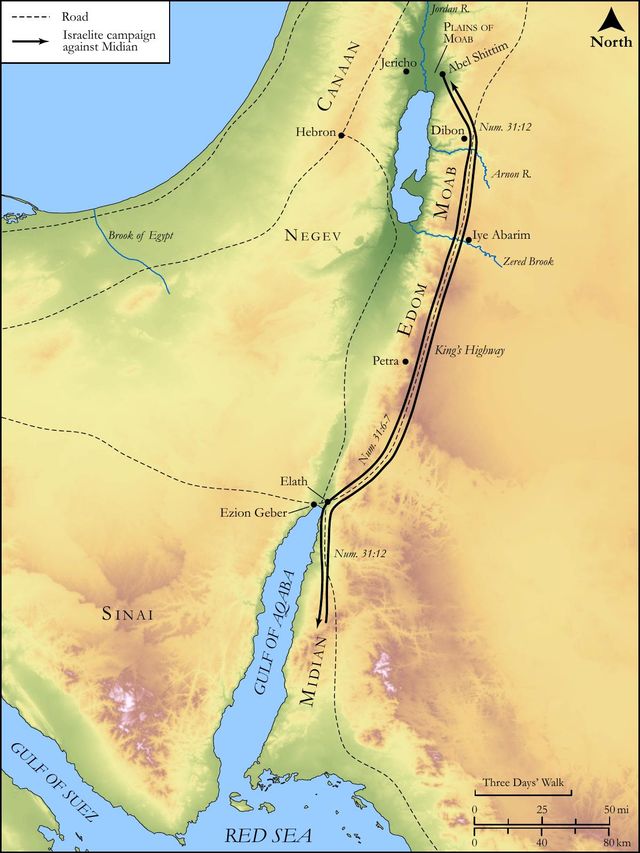
See on the biblical-era map
Study this verse
Continue studying Numbers 31:49 across the web’s major study libraries — every link below opens this exact verse, chapter, or book on the destination site.
Read & Compare
 BibleGatewayThis verse in more than 200 translations and 70 languages.
 Bible.comThe YouVersion reader — hundreds of translations, reading plans, and highlights.
 ESV.orgCrossway's official English Standard Version reader.
 NET BibleThe NET translation with 60,000+ translators' notes on every rendering decision.
 STEP BibleTyndale House's free study tool — original text, vocabulary, and scholarly resources.
 BibliaLogos Bible Software's free web reader.
 USCCBThe New American Bible (Revised Edition) with the U.S. bishops' study notes.
Commentaries
 BibleHub CommentariesDozens of classic commentaries on this verse, gathered on one page.
 StudyLightMore than 100 commentary sets — the largest collection on the web.
 BibleRefPlain-English commentary on what this verse means, verse by verse.
 Enduring WordDavid Guzik's free commentary on this chapter, widely used by Bible teachers.
 Bible Study ToolsVerse commentary alongside Greek and Hebrew study aids.
Original Language & Research
- BibleHub InterlinearThe verse word by word — original language, transliteration, and English.
- BibleHub LexiconEvery word's original-language definition and Strong's entry.
 Blue Letter BibleDeep-study tools — Strong's numbers, concordance, and word studies.
 SefariaThe Hebrew text with Rashi and centuries of Jewish commentary.
Sermons, Hymns & Audio


TrulyRandomVerse is not affiliated with these sites and doesn’t control their content. They’re linked because they’re genuinely useful.
Summary
Numbers 31:49 records an astounding declaration from the Israelite military commanders to Moses following their punitive campaign against the Midianites: "And they said unto Moses, Thy servants have taken the sum of the men of war which [are] under our charge, and there lacketh not one man of us." This remarkable report signifies a profound and miraculous preservation of life, indicating that despite engaging in a significant military conflict, not a single Israelite soldier was lost. This outcome unequivocally underscores God's direct, supernatural protection and unwavering faithfulness to His people, even in the midst of fierce battle.
Context
ShowHideLiterary Context
This verse is strategically placed at the culmination of the divinely commanded war against Midian, as detailed in Numbers 31:1-2. This conflict was not a typical territorial expansion but an act of righteous judgment, specifically ordained by God to avenge Midian's role in enticing Israel into idolatry and sexual immorality at Peor, an event vividly recounted in Numbers 25:1-18. Following the decisive victory, the military officers—captains of thousands and captains of hundreds—undertook a meticulous census of their forces. Their astonishing report in Numbers 31:49 serves as a powerful testament to God's direct intervention and protective hand, immediately preceding their voluntary offering of gratitude and atonement in Numbers 31:50. This sequence highlights the immediate recognition of divine favor.
Historical & Cultural Context
Ancient warfare was characterized by extreme brutality and high casualty rates; for an entire army, or even a significant division, to emerge from a major battle with zero fatalities was virtually unprecedented and considered a profound miracle. The act of taking a census, or "summing up the men," was a common military practice to assess troop strength and losses. However, in Israel, a census often carried significant theological weight, sometimes requiring atonement due to its potential to imply reliance on human strength over divine power (as seen in 2 Samuel 24). In this instance, the census in Numbers 31:49 serves not to highlight human military prowess, but rather to confirm and magnify God's unique favor and protective hand. The Midianites were a formidable and influential enemy, often allied with the Moabites, and their defeat marked a crucial demonstration of God's justice against those who sought to corrupt His covenant people on their journey to the Promised Land.
Key Themes
ShowHideThe central theme underscored by Numbers 31:49 is Divine Protection and Providence. The complete absence of casualties is attributed solely to God's supernatural preservation of His people, reinforcing the biblical principle that "the Lord your God is he who goes with you to fight for you against your enemies, to give you the victory" (Deuteronomy 20:4). This remarkable outcome also highlights God's Unwavering Faithfulness to His covenant promises, even in the wake of Israel's recent disobedience at Peor. Despite their failings, God honored His commitment to protect them as they acted in obedience to His command for vengeance. Finally, the officers' immediate and profound Gratitude and Acknowledgment of God's hand, expressed through their precise report and subsequent freewill offering (as detailed in Numbers 31:50), serves as a powerful model for recognizing and responding to divine blessings.
Exposition and Analysis
ShowHideKey Word Analysis
ShowHideThis word, typically meaning "head," is used here in the sense of "total," "sum," or "chief part." It denotes a precise accounting or enumeration of the men. The officers' report is not an estimate but a definitive "sum," emphasizing the careful and accurate nature of their count, which makes the subsequent declaration of "not one man" all the more astounding and verifiable. It implies a thorough, head-by-head tally.
Literally meaning "hand," this word is used idiomatically here to signify "custody," "authority," or "responsibility." The phrase "under our charge" indicates that the soldiers were directly under the command and oversight of these officers. This highlights their direct accountability for the men and the reliability of their meticulous census, confirming that the count of zero losses was based on their firsthand, responsible assessment.
This verb means "to visit," "to muster," "to count," but also "to miss," or "to be wanting." Here, it is used in its negative sense, "there lacketh not," meaning "not one is missing" or "not one is wanting." This creates a powerful linguistic connection with the idea of "counting" or "mustering" (which is also a meaning of pâqad). The officers counted, and in that count, not one was found missing. This repetition underscores the absolute totality of the preservation—not merely a low casualty rate, but a perfect, zero-loss outcome, highlighting the miraculous intervention of God.
Verse Breakdown
ShowHide"And they said unto Moses"
This refers to the military officers—the captains of thousands and captains of hundreds—who had led the Israelite forces into battle. Their collective voice signifies a unanimous, authoritative, and verifiable report based on their direct responsibility and thorough assessment of their troops.
"Thy servants have taken the sum of the men of war which [are] under our charge"
This phrase emphasizes the officers' diligence, accountability, and the meticulous nature of their post-battle census. They had carefully counted and accounted for every soldier under their command, fulfilling their military duty to ascertain the strength and status of their forces. The phrase "under our charge" highlights their direct oversight and the reliability of their report, giving weight to their astonishing finding.
"and there lacketh not one man of us"
This is the astonishing and miraculous declaration. It means that out of all the Israelite soldiers who went into the fierce battle against the Midianites, not a single one was killed, mortally wounded, or missing. This outcome is statistically improbable, if not humanly impossible, for a sustained military engagement in ancient times. It points directly and unequivocally to a supernatural act of divine protection and preservation, a clear sign of God fighting on behalf of His people.
Literary Devices
ShowHideThe profound statement in Numbers 31:49 employs several literary devices to convey its powerful message of divine intervention. The most prominent is Divine Intervention, as God's active hand is the only plausible explanation for the miraculous outcome of zero casualties in a significant military engagement. The complete absence of losses functions as a powerful Testimony, a factual report that simultaneously serves as a declaration of God's faithfulness and protective power. The stark contrast between the expected high casualties of ancient warfare and the actual zero-loss scenario creates a powerful Juxtaposition, highlighting the unique nature of God's warfare on behalf of His people and magnifying His power. Furthermore, the officers' precise accounting and the definitive "not one man" statement create a sense of Verisimilitude, lending credibility to the extraordinary claim by grounding it in a meticulous, verifiable military census.
Theological and Thematic Connections
ShowHideThe miraculous preservation of every Israelite soldier in Numbers 31:49 is a profound theological statement about God's sovereignty, power, and unwavering faithfulness. It demonstrates that when God commands a mission, He is fully capable of ensuring its success and protecting those who obey Him, even in the face of extreme danger and human impossibility. This event is not merely a historical anomaly but a vivid illustration of God actively fighting for His people, ensuring their safety as they execute His righteous judgment. It underscores the truth that divine protection is not always about avoiding conflict, but about being miraculously preserved within it by God's mighty hand. This passage serves as a powerful reminder that God's power transcends human limitations and expectations.
Reflection and Application
ShowHideNumbers 31:49 provides a powerful anchor for believers navigating the "battles" of life, whether they are spiritual, emotional, relational, or physical. It reminds us that God is not limited by human expectations, statistical probabilities, or the overwhelming odds that may appear stacked against us. Just as He miraculously preserved His people in ancient warfare, He is capable of delivering us in ways that defy human comprehension and logic. This verse calls us to cultivate a deep, unwavering trust in God's sovereign protection and provision, to remember His past faithfulness when we face daunting challenges, and to acknowledge His hand in every deliverance, success, and preservation we experience. It challenges us to respond with genuine gratitude and profound worship, recognizing that true victory and ultimate preservation come from Him alone, prompting us to live lives of humble dependence and overflowing thanks for His unfailing, supernatural care.
Questions for Reflection
ShowHideFAQ
ShowHideHow was it possible for no Israelite soldier to die in such a significant battle?
ShowHideThe biblical account presents this outcome as a direct and miraculous act of divine intervention. In ancient warfare, zero casualties for an entire army was humanly impossible, especially given the scale and ferocity implied by the complete destruction of the Midianite men, women, and children (as described in Numbers 31:7-18). The text unequivocally attributes this preservation not to superior military tactics or human strength, but to God's explicit and supernatural protection over His obedient people. It serves as a powerful demonstration of God fighting on behalf of Israel, ensuring their safety as they executed His righteous judgment against a corrupt nation.
What was the significance of the officers' report to Moses that "not one man" was lost?
ShowHideThe officers' report was profoundly significant for several reasons. First, it was an act of military accountability, confirming that the census was meticulously taken and the results were verifiable, lending objective weight to the extraordinary claim. Second, it served as an immediate, public, and undeniable testimony to God's miraculous power and unwavering faithfulness. The officers, as direct participants in the battle, were uniquely positioned to attest to this unprecedented preservation, which they clearly understood as divine rather than merely human success. Their subsequent offering of gold and jewels (as detailed in Numbers 31:50) further solidified their profound gratitude and acknowledgment of God's hand in both the victory and the preservation.
Does this verse imply that God always protects His people from physical harm in battle or danger?
ShowHideWhile Numbers 31:49 is a powerful and inspiring example of God's protection, it does not establish a universal theological principle that God will always prevent physical harm or death for His people in every conflict or dangerous situation. The Bible records numerous instances where God's people faced suffering, injury, and death, even in obedience to Him (e.g., the prophets, apostles, and martyrs). This specific event was a unique demonstration of divine power, tied to a particular act of judgment against Midian and God's covenant faithfulness to Israel at that precise moment in their history. It highlights God's ability to preserve miraculously, not a blanket promise of physical immunity in all circumstances. Believers are called to trust God's sovereignty and protection, recognizing that His ultimate purposes may sometimes include suffering or martyrdom, which ultimately leads to eternal preservation and glorification in Christ.
Christ-Centered Fulfillment
ShowHideNumbers 31:49, with its astounding declaration of "not one man" lost, powerfully foreshadows the ultimate and perfect preservation found in Jesus Christ. While the Israelite soldiers were miraculously preserved from physical death in battle, Christ's redemptive work ensures a spiritual and eternal preservation for all who believe in Him. He is the ultimate Lamb of God who takes away the sin of the world, enduring the full wrath of God on the cross so that those who are "in Him" might never be lost. Just as God fought for Israel and ensured their physical safety in that specific battle, Christ has fought and triumphed over the ultimate enemies: sin, death, and the devil (Colossians 2:15). Through His decisive victory, believers are not merely preserved from physical harm, but are eternally "kept by God's power through faith for a salvation ready to be revealed in the last time" (1 Peter 1:5). Jesus Himself declared, "I give them eternal life, and they will never perish, and no one will snatch them out of my hand" (John 10:28). Thus, the miraculous "no loss" in Numbers 31:49 points to the far greater, eternal, and comprehensive "no loss" that is guaranteed to every believer through Christ's perfect and complete work of redemption, ensuring their secure future with God.