


Numbers 31:48
Bible text: King James Version (1769 Blayney text) · Public domain
Bible text: Berean Standard Bible · Public domain
Bible text: American Standard Version (1901) · Public domain
Bible text: World English Bible, Messianic edition · Public domain
Bible text: Geneva Bible (1599) · Public domain
Bible text: Young's Literal Translation · Public domain
- וַיִּקְרְבוּvai·yik·re·Vuand they drew nearH7126Conj-w ¦ V-Qal-ConsecImperf-3mpVerb Qal Consecutive Imperfect 3rd Plural Masculineוַandיִּקְרְבוּthey drew near
- אֶל'eltoH413PrepPreposition
- מֹשֶׁהmo·ShehMosesH4872N-proper-mNoun Proper Masculine
- הַפְּקֻדִיםha·pe·ku·Dimthe officersH6485Art ¦ V-Qal-PassPrtcpl-mpVerb Qal Participle Passive Plural Masculine Absoluteהַtheפְּקֻדִיםofficers
- אֲשֶׁר'a·SherwhoH834RelParticle Relative
- לְאַלְפֵיle·'al·Fei[were] of [the] thousands ofH505Prep-l ¦ N-cpcNoun Plural common gender Constructלְ[were] ofאַלְפֵי[the] thousands of
- הַצָּבָאha·tza·Va'the armyH6635Art ¦ N-msNoun Singular Masculine Absoluteהַtheצָּבָאarmy
- שָׂרֵיsa·Rei[the] commanders ofH8269N-mpcNoun Plural Masculine Construct
- הָאֲלָפִיםha·'a·la·Fimthe thousandsH505Art ¦ Adj-cpAdjective Numerical Plural common gender Absoluteהָtheאֲלָפִיםthousands
- וְשָׂרֵיve·sa·Reiand [the] commanders ofH8269Conj-w ¦ N-mpcNoun Plural Masculine Constructוְandשָׂרֵי[the] commanders of
- הַמֵּאוֹתha·me·'otthe hundredsH3967Art ¦ Adj-fpAdjective Numerical Plural Feminine Absoluteהַtheמֵּאוֹתhundreds
English is a literal word-by-word gloss of the Hebrew, not the KJV's wording. Why?
This is the original text the KJV's translators worked from — each Hebrew word with its own literal English meaning in this verse, prepared by scholars at Tyndale House, Cambridge. The KJV translates whole sentences, not word by word, so its wording differs: one Hebrew word can become several English words, and the KJV may choose “the LORD” where the gloss reads “Yahweh”. Both are faithful — they answer different questions. For the KJV's own rendering, switch to the KJV text.
Details
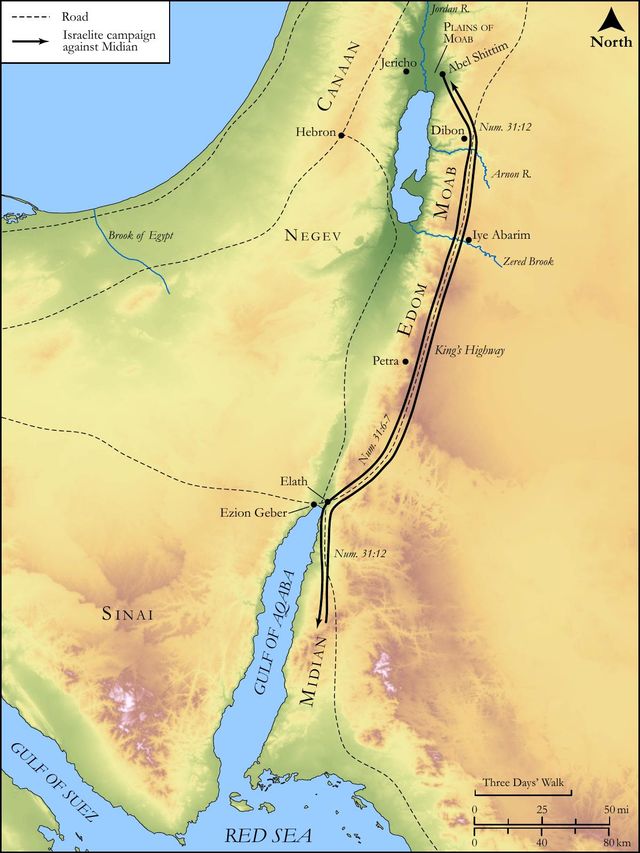
See on the biblical-era map
Study this verse
Continue studying Numbers 31:48 across the web’s major study libraries — every link below opens this exact verse, chapter, or book on the destination site.
Read & Compare
 BibleGatewayThis verse in more than 200 translations and 70 languages.
 Bible.comThe YouVersion reader — hundreds of translations, reading plans, and highlights.
 ESV.orgCrossway's official English Standard Version reader.
 NET BibleThe NET translation with 60,000+ translators' notes on every rendering decision.
 STEP BibleTyndale House's free study tool — original text, vocabulary, and scholarly resources.
 BibliaLogos Bible Software's free web reader.
 USCCBThe New American Bible (Revised Edition) with the U.S. bishops' study notes.
Commentaries
 BibleHub CommentariesDozens of classic commentaries on this verse, gathered on one page.
 StudyLightMore than 100 commentary sets — the largest collection on the web.
 BibleRefPlain-English commentary on what this verse means, verse by verse.
 Enduring WordDavid Guzik's free commentary on this chapter, widely used by Bible teachers.
 Bible Study ToolsVerse commentary alongside Greek and Hebrew study aids.
Original Language & Research
- BibleHub InterlinearThe verse word by word — original language, transliteration, and English.
- BibleHub LexiconEvery word's original-language definition and Strong's entry.
 Blue Letter BibleDeep-study tools — Strong's numbers, concordance, and word studies.
 SefariaThe Hebrew text with Rashi and centuries of Jewish commentary.
Sermons, Hymns & Audio


TrulyRandomVerse is not affiliated with these sites and doesn’t control their content. They’re linked because they’re genuinely useful.
Summary
Numbers 31:48 marks a significant moment following Israel's decisive victory over the Midianites, introducing the high-ranking military officers who formally approach Moses. This verse functions as a solemn and expectant preamble to their astounding report of divine protection and their subsequent act of voluntary thanksgiving, highlighting the profound recognition of God's miraculous preservation of every single Israelite soldier during the intense and divinely commanded campaign.
Context
ShowHideLiterary Context
This verse is strategically placed at the culmination of the Midianite campaign, a war initiated by divine command as retribution for Midian's role in the Baal-peor apostasy, detailed in Numbers 25:1-18. The preceding chapters meticulously describe the execution of the war, the taking of immense spoils, and the subsequent purification rituals necessary for the returning soldiers and their captives, as outlined in Numbers 31:1-24. Numbers 31:48 specifically sets the stage for the remarkable revelation in Numbers 31:49, where the officers declare that not a single man was lost. This astonishing and unprecedented fact forms the immediate backdrop and primary motivation for their approach to Moses, leading directly into their spontaneous and corporate offering of gratitude and atonement in the verses that follow, found in Numbers 31:50-54.
Historical & Cultural Context
The Israelite military structure, as presented in this verse, was highly organized, reflecting the practical necessities of managing a large nomadic population and preparing for the conquest of Canaan. The specific mention of "captains of thousands" and "captains of hundreds" points to a decimal system of military organization, a hierarchical structure likely influenced by Jethro's earlier counsel to Moses regarding judicial and administrative leadership, as recorded in Exodus 18:21-26. This system was crucial for maintaining order, discipline, and effective command and control during military campaigns. Furthermore, while the nations round about often attributed military success to the favor of their gods, Israel's understanding was unique. It emphasized Yahweh's direct and decisive involvement, and the people's absolute reliance on His power, rather than merely their own strength or military prowess, distinguishing their warfare from that of surrounding nations.
Key Themes
ShowHideNumbers 31:48 powerfully contributes to several overarching themes within the book of Numbers and the broader Pentateuch. It profoundly underscores the theme of Divine Protection and Providence, as the officers' approach is directly motivated by God's miraculous preservation of their lives, a compelling testament to His faithfulness to His covenant people even amidst acts of judgment against their enemies. It also highlights Accountability and Respect for Authority, as the military leaders, representing the entire fighting force, present themselves to Moses, God's appointed leader, demonstrating their submission to the established divine order and their responsibility to report on the campaign's outcome. Finally, this verse sets the immediate stage for the theme of Gratitude and Atonement, as their subsequent actions reveal a profound sense of indebtedness and a desire to make a freewill offering to the Lord in recognition of His unparalleled mercy and deliverance, an act that points to the broader concept of Israel's relationship with a holy God who requires purity, thanksgiving, and acknowledgment of His sovereign hand, as seen in passages like Leviticus 1:1-17.
Exposition and Analysis
ShowHideKey Word Analysis
ShowHideFrom the primitive root H6485, meaning "to visit," "to oversee," "to muster," "to charge," or "to appoint." In this context, "officers" refers to those who have been "appointed" or "mustered" into positions of oversight and leadership within the host. It emphasizes their official capacity and responsibility within the military hierarchy, indicating that their approach to Moses was not a casual visit but a formal report from those entrusted with the care and accounting of the troops.
Meaning "a head person (of any rank or class)," including "captain," "chief," or "prince." This designation highlights the structured and organized nature of the Israelite army. These were not ad-hoc leaders but established military officers, each responsible for a specific contingent of soldiers. Their collective presence signifies a unified representation of the entire fighting force, from the highest ranks down to those overseeing smaller units, underscoring the comprehensive nature of their report and subsequent offering.
From the primitive root H7126, meaning "to approach (causatively, bring near) for whatever purpose," or "to draw near." This verb often carries connotations of solemnity, reverence, or formality, especially when approaching a person of authority or God Himself. In this instance, it suggests a deliberate and respectful approach to Moses, acknowledging his unique position as God's mediator. Their drawing near is not merely physical proximity but an act imbued with significance, preparing to deliver a weighty and miraculous report.
Verse Breakdown
ShowHide"¶ And the officers which [were] over thousands of the host"
This clause introduces the primary subjects of the verse – the appointed leaders responsible for the larger divisions of the Israelite army. The term "host" (H6635, tsâbâʼ) specifically refers to the military force, emphasizing that these are the commanders who led the recent campaign against Midian. Their collective presence underscores the official and comprehensive nature of the upcoming report.
"the captains of thousands, and captains of hundreds"
This phrase further specifies and clarifies the ranks of the officers mentioned. It details the hierarchical structure of the Israelite military, indicating that leaders from both the largest units (thousands, H505, ʼeleph) and smaller units (hundreds, H3967, mêʼâh) were present. This comprehensive representation ensures that the report and subsequent actions reflect the experience and gratitude of the entire fighting force, not just a select few.
"came near unto Moses:"
This final clause describes the action taken by these officers. Their approach to Moses (H4872, Môsheh) signifies respect for his authority and his unique role as the leader appointed by God. It implies a formal and intentional meeting, setting the stage for the astonishing news they are about to deliver and the profound act of worship and thanksgiving that will follow.
Literary Devices
ShowHideNumbers 31:48 employs several literary devices to enhance its meaning and impact. The use of Repetition and Parallelism in "captains of thousands, and captains of hundreds" emphasizes the organized and comprehensive nature of the Israelite military leadership, underscoring that the report and subsequent offering came from the entire command structure. This creates a powerful sense of unity and collective responsibility. The verse also functions as a compelling piece of Foreshadowing, building anticipation for the miraculous revelation that immediately follows in Numbers 31:49, where the officers declare that not a single man was lost. This sets up the context for their extraordinary act of thanksgiving. Furthermore, the mention of "officers" and "captains" can be seen as a form of Synecdoche, where a part (the leaders) stands in for the whole (the entire army), signifying that the miraculous preservation and subsequent gratitude extended to every soldier under their command.
Theological and Thematic Connections
ShowHideNumbers 31:48, though seemingly a simple introductory verse, is deeply significant for its theological implications. It highlights the principle of divine sovereignty and meticulous providence, as the officers' approach is prompted by an unprecedented miracle of preservation. This event serves as a powerful reminder that God is actively involved in the affairs of His people, not only in judgment against their enemies but also in protection and deliverance for His own. The leaders' immediate response of drawing near to Moses, and their subsequent act of offering, exemplifies a proper posture of humility and gratitude before God, acknowledging that true victory and safety come from Him alone. This narrative underscores the covenantal relationship between God and Israel, where faithfulness is met with divine care, and human response should be one of profound thanksgiving and recognition of His holy hand.
Reflection and Application
ShowHideNumbers 31:48 invites us to consider our own responses to God's providential care and miraculous interventions in our lives. Just as the Israelite officers, having witnessed an extraordinary and unprecedented preservation, felt compelled to approach Moses and offer thanks, so too should we cultivate a spirit of profound gratitude for God's blessings, especially His unseen protection and daily mercies that often go unnoticed. This verse reminds us that true leadership, whether in a family, community, or workplace, involves not only directing others but also leading in worship and acknowledging God's hand in every success and deliverance. It challenges us to pause, reflect, and attribute our triumphs, big or small, not to our own strength, wisdom, or cleverness, but to the sovereign grace of God. Our lives should be marked by a readiness to give thanks and to recognize that every good and perfect gift comes from above, prompting a posture of humility and worship.
Questions for Reflection
ShowHideFAQ
ShowHideWhy did the officers come to Moses specifically, and what was the significance of their approach?
ShowHideThe officers came to Moses because he was God's appointed mediator and supreme leader for Israel. His unique relationship with Yahweh meant he was the one through whom divine commands were given and to whom reports of national and spiritual significance were made. Their approach was highly significant because it was a formal and unified act, representing the entire military force. It demonstrated their profound respect for his authority and, by extension, God's authority. This solemn approach set the stage for their astonishing report of no casualties (Numbers 31:49) and their subsequent freewill offering, signifying their profound recognition of God's miraculous intervention and their desire to express collective gratitude and atonement. It underscores the principle that all blessings and victories ultimately derive from the Lord and should be acknowledged through His appointed channels and in the manner He ordains.
Christ-Centered Fulfillment
ShowHideNumbers 31:48, with its emphasis on miraculous preservation and the subsequent offering of gratitude, finds its ultimate and perfect fulfillment in Jesus Christ. The Israelite officers' astonishment at the complete absence of casualties in battle, a physical preservation, foreshadows the infinitely greater spiritual victory achieved by the Lamb of God on the cross. Through His perfect sacrifice, Christ triumphed decisively over sin, death, and the powers of darkness, without Himself being overcome by them (Colossians 2:15). Just as the officers brought an offering for the preservation of their physical lives, Christ offered Himself as the perfect and final sacrifice, securing not merely physical safety but eternal salvation, spiritual life, and complete redemption for all who believe. He is the ultimate "Captain of our salvation" (Hebrews 2:10), who leads His people to victory over their spiritual enemies, ensuring that none of His own are lost from His hand (John 10:28). The gratitude and offerings of the Old Testament point to the worship due to Christ, whose singular act of self-giving love is the source of all our blessings, the foundation of our eternal security, and the reason for our unending praise.