


1 Samuel 21:6
Bible text: King James Version (1769 Blayney text) · Public domain
Bible text: King James Version with Strong's numbers · Public domain
Bible text: Berean Standard Bible · Public domain
Bible text: American Standard Version (1901) · Public domain
Bible text: World English Bible, Messianic edition · Public domain
Bible text: Geneva Bible (1599) · Public domain
Bible text: Young's Literal Translation · Public domain
- וַיִּתֶּןvai·yi·tenand he gaveH5414Conj-w ¦ V-Qal-ConsecImperf-3msVerb Qal Consecutive Imperfect 3rd Singular Masculineוַandיִּתֶּןhe gave
- לוֹloto <the> himPrep-l ¦ 3msSuffix Personal 3rd Singular Masculineלto <the>וֹhim
- הַכֹּהֵןha·ko·Henthe priestH3548Art ¦ N-msNoun Singular Masculine Absoluteהַtheכֹּהֵןpriest
- קֹדֶשׁKo·desha holy thingH6944N-msNoun Singular Masculine Absolute
- כִּיkiforH3588PrtParticle Conditional
- לֹאlo'notH3808NegParticle Negative
- הָיָהHa·yahit wasH1961V-Qal-Perf-3msVerb Qal Perfect 3rd Singular Masculine
- שָׁםshamthereH8033AdvAdverb
- לֶחֶםLe·chembreadH3899N-msNoun Singular Masculine Absolute
- כִּיkithatH3588PrtParticle Conditional
- אִם'imexceptH518PrtParticle Conditional
- לֶחֶםLe·chem[the] bread ofH3899N-mscNoun Singular Masculine Construct
- הַפָּנִיםha·pa·Nimthe presenceH6440Art ¦ N-mpNoun Plural Masculine Absoluteהַtheפָּנִיםpresence
- הַמּוּסָרִיםha·mu·sa·Rimwhich had been removedH5493Art ¦ V-Hophal-PassPrtcpl-mpVerb Hophal Participle Passive Plural Masculine Absoluteהַwhichמּוּסָרִיםhad been removed
- מִלִּפְנֵיmi·lif·Neifrom to beforeH6440Prep-m ¦ Prep-l ¦ N-mpcNoun Plural Masculine Constructמִfromלִּtoפְנֵיbefore
- יְהוָהYah·wehYahwehH3068N-properNoun Proper Title
- לָשׂוּםla·Sumto putH7760Prep-l ¦ V-Qal-InfVerb Qal Infinitive Constructלָtoשׂוּםput
- לֶחֶםLe·chembread ofH3899N-mscNoun Singular Masculine Construct
- חֹםChomheatH2527N-msNoun Singular Masculine Absolute
- בְּיוֹםbe·Yomon [the] dayH3117Prep-b ¦ N-mscNoun Singular Masculine Constructבְּonיוֹם[the] day
- הִלָּקְחוֹhi·la·ke·Chowas taken away itH3947V-Niphal-Inf ¦ 3msVerb Niphal Infinitive Constructהִלָּקְחwas taken awayוֹit
English is a literal word-by-word gloss of the Hebrew, not the KJV's wording. Why?
This is the original text the KJV's translators worked from — each Hebrew word with its own literal English meaning in this verse, prepared by scholars at Tyndale House, Cambridge. The KJV translates whole sentences, not word by word, so its wording differs: one Hebrew word can become several English words, and the KJV may choose “the LORD” where the gloss reads “Yahweh”. Both are faithful — they answer different questions. For the KJV's own rendering, switch to the KJV text.
Details
See on the biblical-era map
Study this verse
Public-domain commentary
Matthew Henry
From his Commentary on the Whole Bible. Henry comments on passages, not single verses — this entry covers 1 Samuel 21:1–9. His four-level outline is real structure in the source text, so it is rendered as structure.
Here, I. David, in distress, flies in the tabernacle of God, now pitched at Nob, supposed to be a city in the tribe of Benjamin. Since Shiloh was forsaken, the tabernacle was often removed, though the ark still remained at Kirjath-jearim. Hither David came in his flight from Saul's fury (Sa1 21:1), and applied to Ahimelech the priest. Samuel the prophet could not protect him, Jonathan the prince could not. He therefore has recourse next to Ahimelech the priest. He foresees he must now be an exile, and therefore comes to the tabernacle, 1. To take an affecting leave of it, for he knows not when he shall see it again, and nothing will be more afflictive to him in his banishment than his distance from the house of God, and his restraint from public ordinances, as appears by many of his psalms. He had given an affectionate farewell to his friend Jonathan, and cannot go till he has given the like to the tabernacle. 2. To enquire of the Lord there, and to beg direction from him in the way both of duty and safety, his case being difficult and dangerous. That this was his business appears Sa1 22:10, where it is said that Ahimelech enquired of the Lord for him, as he had done formerly, Sa1 21:15. It is a great comfort to us in a day of trouble that we have a God to go to, to whom we may open our case, and from whom we may ask and expect direction.
II.Ahimelech the priest is surprised to see him in so poor an equipage; having heard that he had fallen into disgrace at court, he looked shy upon him, as most are apt to do upon their friends when the world frowns upon them. He was afraid of incurring Saul's displeasure by entertaining him, and took notice how mean a figure he now made to what he used to make: Why art thou alone? He had some with him (as appears Mar 2:26), but they were only his own servants; he had none of the courtiers, no persons of quality with him, as he used to have at other times, when he came to enquire of the Lord. He says (Psa 42:4) he was wont to go with a multitude to the house of God; and, having now but two or three with him, Ahimelech might well ask, Why art thou alone? He that was suddenly advanced from the solitude of a shepherd's life to the crowd and hurries of the camp is now as soon reduced to the desolate condition of an exile and is alone like a sparrow on the housetop, such charges are there in this world and so uncertain are its smiles! Those that are courted today may be deserted tomorrow.
III.David, under pretence of being sent by Saul upon public services, solicits Ahimelech to supply his present wants, Sa1 21:2, Sa1 21:3.
1.Here David did not behave like himself. He told Ahimelech a gross untruth, that Saul had ordered him business to despatch, that his attendants were dismissed to such a place, and that he was charged to observe secresy and therefore durst not communicate it, no, not to the priest himself. This was all false. What shall we say to this? The scripture does not conceal it, and we dare not justify it. It was ill done, and proved of bad consequence; for it occasioned the death of the priests of the Lord, as David reflected upon it afterwards with regret, Sa1 22:22. It was needless for him thus to dissemble with the priest, for we may suppose that, if he had told him the truth, he would have sheltered and relieved him as readily as Samuel did, and would have known the better how to advise him and enquire of God for him. People should be free with their faithful ministers. David was a man of great faith and courage, and yet now both failed him, and he fell thus foully through fear and cowardice, and both owing to the weakness of his faith. Had he trusted God aright, he would not have used such a sorry sinful shift as this for his own preservation. It is written, not for our imitation, no, not in the greatest straits, but for our admonition. Let him that thinks he stands take heed lest he fall; and let us all pray daily, Lord, lead us not into temptation. Let us all take occasion from this to lament,
(1.)The weakness and infirmity of good men; the best are not perfect on this side heaven. There may be true grace where yet there are many failings.
(2.)The wickedness of bad times, which forces good men into such straits as prove temptations too strong for them. Oppression makes a wise man do foolishly.
2.Two things David begged of Ahimelech, bread and a sword.
(1.)He wanted bread: five loaves, Sa1 21:3. Travelling was then troublesome, when men generally carried their provisions with them in kind, having little money and no public houses, else David would not now have had to seek for bread. It seems David had known the seed of the righteous begging bread occasionally, but not constantly, Psa 37:25. Now,
[1.]The priest objected that he had none but hallowed bread, show-bread, which had stood a week on the golden table in the sanctuary, and was taken thence for the use of the priests and their families, Sa1 21:4. It seems the priest kept no good house, but wanted either a heart to be hospitable or provisions wherewithal to be so. Ahimelech thinks that the young men that attended David might not eat of this bread unless they had for some time abstained from women, even from their own wives; this was required at the giving of the law (Exo 19:15), but otherwise we never find this made the matter of any ceremonial purity on the one side or pollution on the other, and therefore the priest here seems to be over-nice, not to say superstitious.
[2.]David pleads that he and those that were with him, in this case of necessity, might lawfully eat of the hallowed bread, for they were not only able to answer his terms of keeping from women for three days past, but the vessels (that is, the bodies) of the young men were holy, being possessed in sanctification and honour at all times (Th1 4:4, Th1 4:5), and therefore God would take particular care of them, that they wanted not necessary supports, and would have his priest to do so. Being thus holy, holy things were not forbidden them. Poor and pious Israelites were in effect priests to God, and, rather than be starved, might feed on the bread which was appropriated to the priests. Believers are spiritual priests, and the offerings of the Lord shall be their inheritance; they eat the bread of their God. He pleads that the bread is in a manner common, now that what was primarily the religious use of it is over; especially (as our margin reads it) where there is other bread (hot, Sa1 21:6) sanctified that day in the vessel, and put in the room of it upon the table. This was David's plea, and the Son of David approves it, and shows from it that mercy is to be preferred to sacrifice, that ritual observance must give way to moral duties, and that may be done in a case of an urgent providential necessity which may not otherwise be done. He brings it to justify his disciples in plucking the ears of corn on the sabbath day, for which the Pharisees censured them, Mat 12:3, Mat 12:4.
[3.]Ahimelech hereupon supplies him: He gave him hallowed bread (Sa1 21:6), and some think it was about this that he enquired of the Lord, Sa1 22:10. As a faithful servant he would not dispose of his master's provisions without his master's leave. This bread, we may suppose, was the more agreeable to David for its being hallowed, so precious were all sacred things to him. The show-bread was but twelve loaves in all, yet out of these he gave David five (Sa1 21:3), though they had no more in the house; but he trusted Providence.
(2.)He wanted a sword. Persons of quality, though officers of the army, did not then wear their swords so constantly as now they do, else surely David would not have been without one. It was a wonder that Jonathan did not furnish him with his, as he had before done, Sa1 18:4. However, it happened that he had now no weapons with him, the reason of which he pretends to be because he came away in haste, Sa1 21:8. Those that are furnished with the sword of the Spirit and the shield of faith cannot be disarmed of them, nor need they, at any time, to be at a loss. But the priests, it seems, had no swords: the weapons of their warfare were not carnal. There was not a sword to be found about the tabernacle but the sword of Goliath, which was laid up behind the ephod, as a monument of the glorious victory David obtained over him. Probably David had an eye to that when he asked the priest to help him with a sword; for, that being mentioned, O! says he, there is none like that, give it to me, Sa1 21:9. He could not use Saul's armour, for he had not proved it; but this sword of Goliath he had made trial of and done execution with. By this it appears that he was now well grown in strength and stature, that he could wear and wield such a sword as that. God had taught his hands to war, so that he could do wonders, Psa 18:34. Two things we may observe concerning this sword: - [1.] That God had graciously given it to him, as a pledge of his singular favour; so that whenever he drew it, nay, whenever he looked upon it, it would be a great support to his faith, by bringing to mind that great instance of the particular care and countenance of the divine providence respecting him. [2.] That he had gratefully given it back to God, dedicating it to him and to his honour as a token of his thankfulness; and now in his distress it stood him greatly in stead. Note, What we devote to God's praise, and serve him with, is most likely to redound, one way or other, to our own comfort and benefit. What we gave we have.
Thus was David well furnished with arms and victuals; but it fell out very unhappily that there was one of Saul's servants then attending before the Lord, Doeg by name, that proved a base traitor both to David and Ahimelech. He was by birth an Edomite (Sa1 21:7), and though proselyted to the Jewish religion, to get the preferment he now had under Saul, yet he retained the ancient and hereditary enmity of Edom to Israel. He was master of the herds, which perhaps was then a place of as much honour as master of the horse is now. Some occasion or other he had at this time to wait on the priest, either to be purified from some pollution or to pay some vow; but, whatever his business was, it is said, he was detained before the Lord. He must attend and could not help it, but he was sick of the service, snuffed at it, and said, What a weariness is it! Mal 1:13. He would rather have been any where else than before the Lord, and therefore, instead of minding the business he came about, was plotting to do David a mischief and to be revenged on Ahimelech for detaining him. God's sanctuary could never secure such wolves in sheep's clothing. See Gal 2:4.
Historical interpretation
Five Centuries of Reception
6 surviving comments on this verse. Each one is dated, so this reads as a timeline rather than a list.
Select a marker to jump to its quote. Markers stagger vertically where authors wrote within a few decades of each other.
When the disciples had been hungry on the sabbath and had plucked some ears [of grain] and rubbed them in their hands, they violated the holy day by so preparing their food. Yet Christ excuses them and even became their accomplice in breaking the sabbath. … For from the Creator’s Scripture and from the purpose of Christ there is derived a vivid precedent from David’s example when he went into the temple on the sabbath and provided food by boldly breaking up the show bread. Even he remembered that this privilege (the dispensation from fasting) was allowed on the sabbath from the very beginning, from when the sabbath itself was instituted. For although the Creator had forbidden that the manna should be gathered for two days, he permitted it on only one occasion—the day before the sabbath—so that the previous day’s provision of food might free them from fasting on the following sabbath. Therefore the Lord had good reason for pursuing the same principle in the “annulling” of the sabbath (since that is the word which people will use). He had good reason, too, for expressing the Creator’s will, when he bestowed the privilege of not fasting on the sabbath. In short, might he have—right then and there—put an end not only to the sabbath but to the Creator himself if he had commanded his disciples to fast on the sabbath, as this would have been contrary to the intention of the Scripture and of the Creator’s will. But is he alien from the Creator because he did not directly defend his disciples but excuses them? Or because he interposes human need, as if deprecating censure? Or because he maintains the honor of the sabbath as a day which is to be free from gloom rather than from work? Or because he puts David and his companions on a level with his own disciples in their fault and their validation? Or because he is pleased to endorse the Creator’s indulgence? Or because he is himself good according to his example—is he therefore alien from the Creator?
Our Lord put forward the clear example of David, who was not accused either over this, as he was over something else. It was not permissible, he said, for David to eat [the holy bread] since he was not a priest. However, he was a priest, because he was a temple of the Spirit. Because they did not understand this, he openly proved them wrong with regard to their own [position]: “The priests were defiling the sabbath in the temple, and they were not guilty of sin.” Another element is depicted for us there. Before David was persecuted, he partook of the bread with authority.
Even if they accuse, yet Christ excuses, and he makes the souls that he wishes, that follow him, similar to David, who ate the loaves of proposition outside of the law—for even then he foresaw in his mind the prophetic mysteries of a new grace.
In many other testimonies of the divine Scriptures, Christ appears both as king and as priest. With good reason, therefore, he is declared to be David’s son more frequently than he is said to be Abraham’s son. Matthew and Luke have both affirmed this: the one viewing him [David] as the person from whom, through Solomon, his [Jesus’] lineage can be traced down, and the other taking him [David] for the person to whom, through Nathan, his [Jesus’] genealogy can be carried up. So he [David] did represent the role of a priest, although he was patently a king, when he ate the show bread. For it was not lawful for any one to eat that, except the priests alone.
For there was no bread there but that, etc. The apostles gave to those who believed, and were baptized from among the Gentiles, the word of the law and the prophets, sanctified by the grace of the Gospel. For there was no literal knowledge among the apostles and the disciples of the apostles, except only the prophetic books, which had been openly proposed to the ancient people for reading, and had recently been fulfilled by the Incarnation of the Lord, so that they were no longer held to be said, in order that the books of the New Testament might be written, to refresh the souls of priests, that is, those united to the eternal priest's members, warmed by the fire of the Holy Spirit. And it should be noted that David asked for bread, not five or twelve (for that was the number of the showbread), but it is said that he received sanctified bread singularly; just as he is remembered to have put five stones into his pouch, but struck down Goliath with one. There are five books containing the elements of legal doctrine. But, as the apostle says, the whole law is fulfilled in one word: You shall love your neighbor as yourself (Matthew 22; Mark 12). It can also rightly be understood that the sanctified bread is singularly named, either because of the unity of faith and love, but should be understood plurally due to either the various works of virtues or the multiple abundance of divine Scriptures by which we are instructed in virtues; just as what is written singularly in the Psalms: He sent among them swarms of flies, which devoured them, and frogs, which destroyed them (Psalm 77), there is no doubt that it must be understood in the plural, especially since the Lord in the Gospels, preferring mercy over sacrifice, affirms that the bread given to him must be understood in the plural (Matthew 9). Have you not read, he says, what David did when he was hungry, and those who were with him, how he entered the house of God and ate the showbread, which was not lawful for him to eat, nor for those who were with him, but only for the priests (Luke 6)? Where, according to the interpretation in which we said that the Lord our Savior was figuratively shown in this reading as both priest and king, it must be understood as prefigured, that the priestly food, upon the coming of the Lord, was no longer to be given to Levi or the people of the children of Israel only, but to all the Gentiles who are to be called to faith. For it has been said to all who hunger for righteousness, who wish to belong to the company of the true David: But you are a chosen race, a royal priesthood, a holy nation, a people for his own possession (1 Peter 2). And because we have spoken about the mystery to the best of our ability, Josephus's statements (Antiquities 3, 13) also help to elucidate the plain sense of the letter more clearly regarding the showbread, which we thought should be briefly looked into and inserted into our treatise for the benefit of the readers. For, since the religion and status of Jerusalem and the temple were still standing in his times, he could very easily know and reveal to the readers what was carried out by the priests through hereditary succession, as he himself was a priest. He says, therefore, "they used to make them out of fine flour without leaven, twenty-four in number." And he adds: "They are baked two by two, split before the Sabbath, and on the Sabbath morning, they are placed on the sacred table, facing each other, with two golden dishes full of incense placed on top of them, which remain until the next Sabbath, when other loaves are brought in their place. Those loaves are then offered to the priests, and after the incense is burnt in the sacred fire, in which all holocausts are made, other incense is added to the other loaves."
The priest therefore gave him the sanctified bread. Because he heard that they were clean who were to receive it, he consented to give them the sanctified bread; which he would in no way dare to do if he had not recognized them as clean in all respects. But if such careful attention to purity was required of him who was to taste the typical bread sanctified by the hands of Moses, how much more necessary is it for those who, having accepted the bread sanctified into the sacrament of Christ's body in his holy and venerable hands, received in memory of his death, are to partake of it as a help to eternal life, to take care of their purity? Indeed, it is necessary for one always to remember the saying of the Apostle: "For whoever eats the bread or drinks the cup of the Lord unworthily, will be guilty of the body and blood of the Lord. Let a man examine himself, and so let him eat of that bread and drink of that cup" (1 Cor. 11). The priest therefore gave him the sanctified bread.
Continue studying 1 Samuel 21:6 across the web’s major study libraries — every link below opens this exact verse, chapter, or book on the destination site.
Read & Compare
 BibleGatewayThis verse in more than 200 translations and 70 languages.
 Bible.comThe YouVersion reader — hundreds of translations, reading plans, and highlights.
 ESV.orgCrossway's official English Standard Version reader.
 NET BibleThe NET translation with 60,000+ translators' notes on every rendering decision.
 STEP BibleTyndale House's free study tool — original text, vocabulary, and scholarly resources.
 BibliaLogos Bible Software's free web reader.
 USCCBThe New American Bible (Revised Edition) with the U.S. bishops' study notes.
Commentaries
 BibleHub CommentariesDozens of classic commentaries on this verse, gathered on one page.
 StudyLightMore than 100 commentary sets — the largest collection on the web.
 BibleRefPlain-English commentary on what this verse means, verse by verse.
 Enduring WordDavid Guzik's free commentary on this chapter, widely used by Bible teachers.
 Bible Study ToolsVerse commentary alongside Greek and Hebrew study aids.
Original Language & Research
- BibleHub InterlinearThe verse word by word — original language, transliteration, and English.
- BibleHub LexiconEvery word's original-language definition and Strong's entry.
 Blue Letter BibleDeep-study tools — Strong's numbers, concordance, and word studies.
 SefariaThe Hebrew text with Rashi and centuries of Jewish commentary.
Sermons, Hymns & Audio


TrulyRandomVerse is not affiliated with these sites and doesn’t control their content. They’re linked because they’re genuinely useful.
Summary
1 Samuel 21:6 records the pivotal moment when Ahimelech, the high priest at Nob, provided David, who was in desperate flight from King Saul, with the consecrated shewbread. This act, a technical departure from Mosaic ritual law that reserved the bread for priests, underscores a profound theological principle: that in cases of extreme human necessity, God's compassion and the spirit of the law can take precedence over strict adherence to ritualistic regulations. The verse highlights both David's dire circumstances and the sacred nature of the bread, which was continuously replaced before the Lord, setting the stage for later New Testament teachings on mercy and the true intent of God's commands.
Context
ShowHideLiterary Context
This verse is situated within the dramatic narrative of David's desperate flight from King Saul, who is relentlessly pursuing him to kill him. Having narrowly escaped Saul's repeated attempts on his life, including a spear attack and a siege on his house, David flees first to the prophet Samuel in Ramah, then briefly to Gath, before arriving at Nob, the city of priests. He is alone, hungry, and unarmed. The preceding verses, specifically 1 Samuel 21:1-2, establish David's dire need and his strategic deception of Ahimelech, the chief priest, by claiming to be on a secret royal mission for Saul. This fabrication is crucial, as it provides the context for Ahimelech's decision to offer the only available food: the sacred shewbread. The immediate narrative flow emphasizes David's vulnerability, his cunning resourcefulness in survival, and the priest's compassionate, albeit legally compromising, response to what he perceives as a legitimate royal emergency.
Historical & Cultural Context
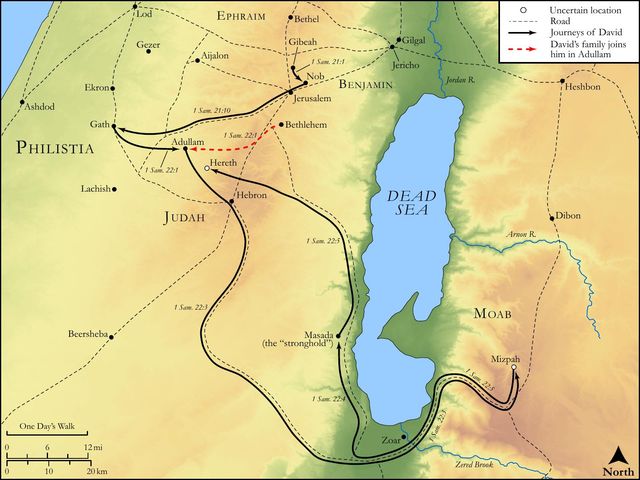
The incident occurs at Nob, a significant priestly city that, following the destruction of Shiloh, housed the Tabernacle or at least a central sanctuary with its sacred articles, including the Table of the Presence. The "shewbread" (or "Bread of the Presence") was a foundational element of Israelite worship, meticulously prescribed in Leviticus 24:5-9. Twelve loaves, symbolizing the twelve tribes of Israel, were perpetually placed "before the face" of the Lord, signifying God's covenant presence and His continuous provision for His people. These loaves were replaced weekly on the Sabbath, and only the priests were permitted to eat the old bread within the sacred precincts of the Tabernacle. David, as a non-priest, was strictly forbidden from consuming it. This context profoundly highlights the gravity of Ahimelech's decision, illustrating the extraordinary nature of David's need and the priest's willingness to bend ritual law in the face of perceived human necessity.
Key Themes
ShowHideThe primary theme illuminated by this verse is the profound tension between ritual law and human necessity, specifically the principle that mercy can, in certain circumstances, override strict legalistic observance. While the Mosaic Law unequivocally stipulated that only priests could eat the shewbread (as detailed in Leviticus 24:9), Ahimelech's decision, driven by David's extreme hunger and his (deceptive) claim of a pressing royal mission, prioritized human life and immediate need. This act serves as a significant precedent, foreshadowing Jesus' later teaching in the New Testament, where He references this very incident to assert His authority as Lord of the Sabbath and to emphasize that God desires mercy, not sacrifice (as powerfully stated in Matthew 12:7). Another crucial theme is divine provision, as God, through the compassionate act of the priest, provides for His anointed one even in his most desperate hour, albeit through unconventional means that ultimately serve a higher purpose.
Exposition and Analysis
ShowHideKey Word Analysis
ShowHideThis term (H6944) signifies something set apart, consecrated, or made holy for sacred use. In the context of the shewbread, it emphasizes its distinct status, separated from common use and dedicated exclusively to the worship of Yahweh. The bread was not merely food; it was a sacred offering, imbued with ritual purity and symbolic significance, making its consumption by a non-priest a significant breach of established law. Its "hallowed" nature underscores the gravity of Ahimelech's action and the extraordinary circumstances that necessitated it.
Literally meaning "bread of the face" or "bread of the presence," this term refers to the twelve loaves of bread (H3899, lechem) placed directly "before the face" (H6440, pânîym) of the Lord in the Tabernacle. This designation highlights its primary function: to symbolize God's constant presence among His people and His continuous provision for them. Its placement "before the LORD" (H3068, Yᵉhôvâh) underscores its profound sacredness and its integral role in maintaining the covenant relationship between God and Israel, making its consumption by anyone other than the priests a direct violation of divine ordinance.
Verse Breakdown
ShowHide"So the priest gave him hallowed [bread]:"
This clause describes Ahimelech's decisive and compassionate action (H5414, nâthan). Despite the strict regulations concerning the sacred bread, the priest, faced with David's apparent urgency and hunger, chooses to provide the only available food. The immediate mention of "hallowed bread" (H6944, qôdesh) instantly signals the extraordinary nature of this provision, drawing the reader's attention to its sacred status and the legal implications of its transfer to a non-priest. This act highlights the priest's discernment and willingness to prioritize perceived human need over rigid ritualistic adherence.
"for there was no bread there but the shewbread,"
This explanatory clause provides the crucial context for Ahimelech's decision. It emphasizes the absolute scarcity of food at Nob, indicating that the shewbread (H3899, lechem and H6440, pânîym) was not merely an option but the only available sustenance for David. This detail highlights the dire circumstances that prompted the priest's unconventional act, framing it as a response to extreme necessity rather than a casual or rebellious disregard for the law. It underscores the desperation of David's situation and the limited choices available.
"that was taken from before the LORD, to put hot bread in the day when it was taken away."
This final clause details the ritualistic cycle of the shewbread, clarifying its precise status at the moment it was given to David. The bread given was specifically the loaves that had just been removed (H5493, çûwr) from the Table of the Presence, having completed their week-long service "before the LORD" (H3068, Yᵉhôvâh). They were replaced by fresh, "hot" (H2527, chôm) bread (H3899, lechem) on the Sabbath (implied by "in the day when it was taken away" - H3117, yôwm and H3947, lâqach). This continuous cycle of presentation and renewal underscored the perpetual nature of God's presence and provision, even as it marked the precise moment when the old bread became ritually available for priestly consumption, making its diversion to David all the more remarkable.
Literary Devices
ShowHideThe passage employs several potent literary devices that enrich its meaning and foreshadow future theological developments. Irony is strikingly evident in the fact that David, God's anointed king-in-waiting, is reduced to deception and desperation, yet it is through this very circumstance that a sacred law is "broken" in an act later explicitly affirmed and used by Christ Himself. This highlights the paradox of divine purpose working through unconventional means. There is also significant foreshadowing at play, as this incident directly prefigures Jesus' teachings on the Sabbath and the spirit of the law over its letter, demonstrating a divine precedent for prioritizing human need and mercy above strict ritualistic observance. Furthermore, the symbolism of the shewbread itself—representing God's constant presence and provision for His people—is central. Its unconventional use in this moment points to a deeper truth about God's character: His ultimate desire for life, compassion, and the well-being of His people, even when it requires a re-evaluation of established norms.
Theological and Thematic Connections
ShowHideThis incident in 1 Samuel 21:6 serves as a powerful illustration of the theological tension between the letter of the law and the spirit of the law, particularly concerning the principle that mercy and human necessity can, in extraordinary circumstances, take precedence over rigid ritual observance. It reveals a God who is not bound by legalistic strictures when genuine human need is at stake, but rather desires compassion and life. Ahimelech's act, though technically a violation of the Mosaic Law regarding the shewbread, aligns with a higher divine principle of love for neighbor and the preservation of life. This event becomes a foundational example, later referenced by Jesus, to explain the true intent of God's commands and the supremacy of His compassionate character, demonstrating that divine principles are not arbitrary but are rooted in God's loving nature.
Reflection and Application
ShowHideThe narrative of David and the shewbread offers profound lessons for contemporary believers, challenging us to look beyond rigid interpretations of rules and to discern the heart of God in every situation. It calls us to cultivate a spirit of compassion and mercy, recognizing that genuine human need, especially in desperate circumstances, can sometimes take precedence over strict adherence to established norms or traditions. This does not diminish the importance of God's commands, but rather encourages us to understand their underlying purpose: to foster life, love, and flourishing. We are invited to trust in God's unconventional provision, even when it comes in unexpected ways, and to prioritize the well-being of others, especially those in distress, reflecting the very character of God who desires mercy over sacrifice. This passage compels us to ask if our adherence to rules sometimes blinds us to the greater call of love and compassion, urging us to seek God's heart in every ethical dilemma.
Questions for Reflection
ShowHideFAQ
ShowHideWas Ahimelech wrong to give David the shewbread?
ShowHideFrom a strict legalistic perspective, Ahimelech's act was indeed a violation of the Mosaic Law, which reserved the shewbread exclusively for the priests (as stated in Leviticus 24:9). However, the biblical narrative, especially as interpreted by Jesus Christ, presents a more nuanced understanding. Jesus Himself references this event in Matthew 12:3-4 to defend His disciples for plucking grain on the Sabbath, arguing that "the Sabbath was made for man, not man for the Sabbath" (Mark 2:27). Jesus implies that in cases of extreme necessity, human life and welfare take precedence over ritual law. Ahimelech, seeing David's desperate hunger and believing his fabricated story of a royal mission, acted out of compassion and a desire to preserve life, demonstrating a principle that God desires mercy over sacrifice (Hosea 6:6). Therefore, while technically a transgression of a ritual command, it was an act aligned with God's compassionate character and a higher moral principle of preserving life.
What was the significance of the shewbread in Israelite worship?
ShowHideThe shewbread, also known as the "Bread of the Presence" or "Bread of the Face," held profound significance in Israelite worship, as meticulously detailed in Leviticus 24:5-9. Twelve loaves, representing the twelve tribes of Israel, were baked weekly and placed on a pure gold table "before the LORD" in the Tabernacle's Holy Place. This perpetual offering symbolized God's constant covenant presence among His people and His faithful provision for them. It was a tangible reminder that Israel lived by God's grace and was sustained by His sustenance. The bread also represented Israel's ongoing dedication and communion with God, a continuous offering of thanksgiving and dependence. Its sacredness was paramount, as it was set apart exclusively for God and consumed only by the priests in a holy place, emphasizing its role in maintaining the ritual purity and sanctity of the Tabernacle service and the covenant relationship.
Christ-Centered Fulfillment
ShowHideThe incident of David and the shewbread finds its ultimate Christ-centered fulfillment in several profound ways, revealing the heart of God's redemptive plan. First, Jesus Himself appeals to this very event in Matthew 12:3-8 (and parallels in Mark and Luke) to assert His authority as "Lord of the Sabbath" and to declare that "something greater than the temple is here." This indicates that the principles of mercy and life, which allowed the shewbread to be given to David, are fully embodied and supremely actualized in Christ. He is the one who perfectly fulfills the law, not by abolishing it, but by revealing its true spirit and intent, prioritizing love and compassion over rigid legalism. Furthermore, Jesus identifies Himself as the true Bread of Life, stating, "I am the living bread that came down from heaven. Whoever eats this bread will live forever. This bread is my flesh, which I will give for the life of the world" (John 6:51). Just as the shewbread symbolized God's presence and provision for physical sustenance, Jesus is the ultimate spiritual provision, satisfying the deepest hunger of humanity and offering eternal life through His sacrificial body. The unconventional giving of the shewbread to David foreshadows the radical, grace-filled provision of Christ, who gives Himself freely to all who hunger and thirst for righteousness, regardless of their "priestly" status, fulfilling the law's deepest longing for mercy and life in a way that transcends all previous ritual.