


1 Chronicles 21:25
Bible text: King James Version (1769 Blayney text) · Public domain
Bible text: Berean Standard Bible · Public domain
Bible text: American Standard Version (1901) · Public domain
Bible text: World English Bible, Messianic edition · Public domain
Bible text: Geneva Bible (1599) · Public domain
Bible text: Young's Literal Translation · Public domain
- וַיִּתֵּןvai·yi·Tenand he gaveH5414Conj-w ¦ V-Qal-ConsecImperf-3msVerb Qal Consecutive Imperfect 3rd Singular Masculineוַandיִּתֵּןhe gave
- דָּוִידda·VidDavidH1732N-proper-mNoun Proper Masculine
- לְאָרְנָןle·'a·re·Nanto OrnanH771Prep-l ¦ N-proper-mNoun Proper MasculineלְtoאָרְנָןOrnan
- בַּמָּקוֹםba·ma·Komfor the placeH4725Prep-b ¦ N-msNoun Singular Masculine Absoluteבַּfor theמָּקוֹםplace
- שִׁקְלֵיshik·Leishekels ofH8255N-mpcNoun Plural Masculine Construct
- זָהָבza·HavgoldH2091N-msNoun Singular Masculine Absolute
- מִשְׁקָלmish·KalweightH4948N-msNoun Singular Masculine Absolute
- שֵׁשׁsheshsixH8337N-csNoun Singular common gender Absolute
- מֵאוֹתme·'othundred<s>H3967N-fpNoun Plural Feminine Absolute
English is a literal word-by-word gloss of the Hebrew, not the KJV's wording. Why?
This is the original text the KJV's translators worked from — each Hebrew word with its own literal English meaning in this verse, prepared by scholars at Tyndale House, Cambridge. The KJV translates whole sentences, not word by word, so its wording differs: one Hebrew word can become several English words, and the KJV may choose “the LORD” where the gloss reads “Yahweh”. Both are faithful — they answer different questions. For the KJV's own rendering, switch to the KJV text.
Details
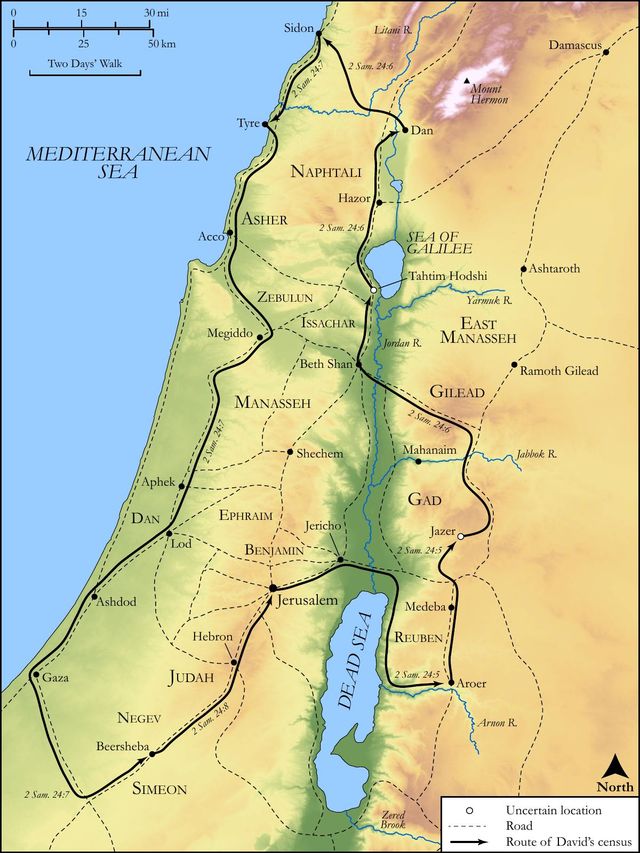
See on the biblical-era map
Study this verse
Public-domain commentary
Matthew Henry
From his Commentary on the Whole Bible. Henry comments on passages, not single verses — this entry covers 1 Chronicles 21:18–30.
We have here the controversy concluded, and, upon David's repentance, his peace made with God. Though thou wast angry with me, thy anger is turned away. 1. A stop was put to the progress of the execution, Ch1 21:15. When David repented of the sin God repented of the judgment, and ordered the destroying angel to stay his hand and sheath his sword, Ch1 21:27. 2. Direction was given to David to rear an altar in the threshing-floor of Ornan, Ch1 21:18. The angel commanded the prophet Gad to bring David this direction. The same angel that had, in God's name, carried on the war, is here forward to set on foot the treaty of peace; for angels do not desire the woeful day. The angel could have given this order to David himself; but he chose to do it by his seer, that he might put an honour upon the prophetic office. Thus the revelation of Jesus Christ was notified by the angel to John, and by him to the churches. The commanding of David to build an altar was a blessed token of reconciliation; for, if God had been pleased to kill him, he would not have appointed, because he would not have accepted, a sacrifice at his hands. 3. David immediately made a bargain with Ornan for the threshing-floor; for he would not serve God at other people's charge. Ornan generously offered it to him gratis, not only in complaisance to the king, but because he had himself seen the angel (Ch1 21:20), which so terrified him that he and his four sons hid themselves, as unable to bear the brightness of his glory and afraid of his drawn sword. Under these apprehensions he was willing to do anything towards making the atonement. Those that are duly sensible of the terrors of the Lord will do all they can, in their places, to promote religion, and encourage all the methods of reconciliation for the turning away of God's wrath. 4. God testified his acceptance of David's offerings on this altar; He answered him from heaven by fire, Ch1 21:26. To signify that God's anger was turned away from him, the fire that might justly have fastened upon the sinner fastened upon the sacrifice and consumed that; and, upon this, the destroying sword was returned into its sheath. Thus Christ was made sin and a curse for us, and it pleased the Lord to bruise him, that through him God might be to us, not a consuming fire, but a reconciled Father. 5. He continued to offer his sacrifices upon this altar. The brazen altar which Moses made was at Gibeon (Ch1 21:29), and there all the sacrifices of Israel were offered; but David was so terrified at the sight of the sword of the angel that he could not go thither, Ch1 21:30. The business required haste, when the plague was begun. Aaron must go quickly, nay, he must run, to make atonement, Num 16:46, Num 16:47. And the case here was no less urgent; so that David had not time to go to Gibeon: nor durst he leave the angel with his sword drawn over Jerusalem, lest the fatal stroke should be given before he came back. And therefore God, in tenderness to him, bade him build an altar in that place, dispensing with his own law concerning one altar because of the present distress, and accepting the sacrifices offered on this new altar, which was not set up in opposition to that, but in concurrence with it. The symbols of unity were not so much insisted on as unity itself. Nay, when the present distress was over (as it should seem), David, as long as he lived, sacrificed there, though the altar at Gibeon was still kept up; for God had owned the sacrifices that were here offered and had testified his acceptance of them, Ch1 21:28. On those administrations in which we have experienced the tokens of God's presence, and have found that he is with us of a truth, it is good to continue our attendance. "Here God had graciously met me, and therefore I will still expect to meet with him."
Historical interpretation
Ten Centuries of Reception
2 surviving comments on this verse. Each one is dated, so this reads as a timeline rather than a list.
Select a marker to jump to its quote. Markers stagger vertically where authors wrote within a few decades of each other.
David had prepared by singing psalms, and the other prophets too by prophesying prepared for the Lord who was indeed the true Solomon a place that he might build a house, because they taught the hearts of their hearers by true faith, earnestly urging them to receive with faith and devotion the Son of God who was coming in the flesh.… It is appropriate that this place should be on the threshing floor of Ornan the Jebusite because the church is customarily designated by the term “threshing floor,” as John says of the Lord: “His winnowing fork is in his hand, and he will clear his threshing floor.” Ornan, whose name means “enlightened” and who was a Jebusite by origin, signifies the Gentiles by his origin, and by his name he indicates these same [Gentiles] who were to be enlightened by the Lord and transformed into children of the church to whom the apostle rightly says, “Once you were darkness, but now you are light in the Lord.” Jebus is the same city as Jerusalem. Now Jebus means “trampled on” but Jerusalem “the vision of peace.” As long as the Gentile Ornan reigned there it was called Jebus; but when David bought a place of burnt offering there, when Solomon built a temple to the Lord there, it was no longer called Jebus but Jerusalem, because, that is, as long as the Gentiles continued in ignorance of divine worship they were trampled on and made a mockery of by the unclean spirits, following mute idols according as they were led to do; but when they called to mind the grace of their Creator, they immediately found in themselves both the place and the name of peace, as the Lord says of them, “Blessed are the peacemakers, for they shall be called the children of God.” Therefore, while Ornan still held sway in this city it was called Jebus, but when he sold the site of his threshing floor together with his oxen and threshing sledges to king David, it took the name Jerusalem because the Gentiles who still persisted in their obstinacy were trampled on as worthless and contemptible by the wicked spirits; but when they learned to sell all they had and offer it to the true king, they could no longer be trampled on by the demons and vices but were given a greater share of inner peace, which they possessed with their Creator.
Six hundred sicles: This was the price of the whole place, on which the temple was afterwards built; but the price of the oxen was fifty sicles of silver. 2 Kings 24:24.
Continue studying 1 Chronicles 21:25 across the web’s major study libraries — every link below opens this exact verse, chapter, or book on the destination site.
Read & Compare
 BibleGatewayThis verse in more than 200 translations and 70 languages.
 Bible.comThe YouVersion reader — hundreds of translations, reading plans, and highlights.
 ESV.orgCrossway's official English Standard Version reader.
 NET BibleThe NET translation with 60,000+ translators' notes on every rendering decision.
 STEP BibleTyndale House's free study tool — original text, vocabulary, and scholarly resources.
 BibliaLogos Bible Software's free web reader.
 USCCBThe New American Bible (Revised Edition) with the U.S. bishops' study notes.
Commentaries
 BibleHub CommentariesDozens of classic commentaries on this verse, gathered on one page.
 StudyLightMore than 100 commentary sets — the largest collection on the web.
 BibleRefPlain-English commentary on what this verse means, verse by verse.
 Enduring WordDavid Guzik's free commentary on this chapter, widely used by Bible teachers.
 Bible Study ToolsVerse commentary alongside Greek and Hebrew study aids.
Original Language & Research
- BibleHub InterlinearThe verse word by word — original language, transliteration, and English.
- BibleHub LexiconEvery word's original-language definition and Strong's entry.
 Blue Letter BibleDeep-study tools — Strong's numbers, concordance, and word studies.
 SefariaThe Hebrew text with Rashi and centuries of Jewish commentary.
Sermons, Hymns & Audio


TrulyRandomVerse is not affiliated with these sites and doesn’t control their content. They’re linked because they’re genuinely useful.
Summary
This verse meticulously details King David's substantial payment of six hundred shekels of gold to Ornan the Jebusite for his threshing floor. This transaction was far more than a simple land acquisition; it was a foundational act of worship, repentance, and atonement, establishing the precise location where the devastating plague was divinely halted and, significantly, where the future Temple of God would be built. The immense cost underscores the profound integrity, reverence, and personal sacrifice required for genuine reconciliation with God and the sacred establishment of His dwelling place among His people.
Context
ShowHideLiterary Context
This verse serves as the culmination of a pivotal narrative in 1 Chronicles 21. King David, influenced by an adversary (identified as Satan in 1 Chronicles 21:1), succumbed to the temptation of conducting a sinful census of Israel. This act, rooted in pride and a reliance on human strength rather than divine provision, provoked God's judgment, resulting in a severe plague that swept through the nation. When the angel of the Lord prepared to devastate Jerusalem, God relented, instructing David through the prophet Gad to erect an altar on the threshing floor of Ornan the Jebusite. Ornan, witnessing the divine intervention and David's distress, generously offered the land, oxen, and wood for the sacrifice without cost. However, David famously declared in 1 Chronicles 21:24, "I will not take that which is thine for the LORD, nor offer burnt offerings without cost." This verse, therefore, specifies the considerable price David paid, emphasizing the gravity and sanctity of his offering and the chosen location, bringing the episode of divine judgment and atonement to its resolved conclusion.
Historical & Cultural Context
The setting for this critical transaction is a threshing floor, a common agricultural site in Israel, typically situated on elevated, windy ground to facilitate the winnowing process. These locations often held communal significance and, at times, sacred associations. Ornan, also known as Araunah in the parallel account of 2 Samuel 24, was a Jebusite, part of the indigenous population of Jerusalem before David's conquest of the city (2 Samuel 5:6-9). His continued presence and land ownership suggest a degree of integration or peaceful coexistence within David's kingdom. The "shekel" was a widely recognized unit of weight, functioning as a standard for currency, and the phrase "gold by weight" underscores the precision, substantial value, and formal nature of the transaction. Furthermore, this specific threshing floor is traditionally identified with Mount Moriah, the very site where Abraham was commanded to sacrifice Isaac (Genesis 22:2), imbuing it with profound historical and theological layers for the Israelite people and foreshadowing its future sacred role.
Key Themes
ShowHideThis verse powerfully contributes to several overarching themes within the book of 1 Chronicles. Firstly, it profoundly illustrates The Cost of True Worship. David's unwavering insistence on paying a high price for the altar and sacrifice underscores the biblical principle that genuine worship and atonement are never cheap or convenient; they fundamentally demand personal investment and sacrifice. This act teaches that reverence for God necessitates giving Him our very best, even when it entails significant personal cost, rather than offering something that costs nothing (Malachi 1:8). Secondly, it exemplifies Integrity in Sacrifice. David's resolute refusal of Ornan's free gift demonstrates his deep theological understanding of what constitutes an acceptable sacrifice to God. He understood that an offering truly pleasing to God must originate from genuine willingness and personal expense, reflecting a heart of sincere repentance and unwavering devotion (Psalm 51:17). Finally, this costly purchase meticulously establishes the Foundation of the Temple Site. This threshing floor became the hallowed location where Solomon would later erect the First Temple (2 Chronicles 3:1). David's substantial payment solidified the immense importance and sacredness of this future center of Israelite worship, emphasizing that the place of God's dwelling was established with great intention, immense expense, and divine sanction, thereby foreshadowing the glory of God's manifest presence.
Exposition and Analysis
ShowHideKey Word Analysis
ShowHideDerived from a root meaning "to weigh," the shekel was a fundamental unit of weight in Israel, typically ranging from 11-12 grams, though its precise value could vary regionally and over time. While often associated with silver, its pairing here with 'gold' indicates a specific, exceptionally high-value measurement. The explicit mention of "by weight" (מִשְׁקָל, mishqâl) further emphasizes the meticulous precision and substantial nature of the transaction, ensuring that the full, agreed-upon amount of precious metal was transferred, not merely a nominal count. This highlights the meticulousness of David's offering and the seriousness with which he approached this sacred transaction.
From an unused root meaning "to shimmer," gold is a precious metal highly prized for its rarity, malleability, and resistance to corrosion. In biblical contexts, gold frequently symbolizes purity, divine glory, immense value, and sacredness. The use of gold in this transaction, rather than silver (as mentioned in the parallel account in 2 Samuel 24:24), signifies the extraordinary cost and the profound sacredness David ascribed to this purchase. It elevates the transaction from a mere commercial land deal to an act of supreme devotion and sacrifice, fitting for the site of God's future dwelling. The Chronicler's emphasis on gold and the larger sum (600 shekels of gold versus 50 shekels of silver in 2 Samuel) likely reflects the purchase of the entire, expansive area for the future Temple complex, not solely the threshing floor itself.
Verse Breakdown
ShowHide"So David gave to Ornan"
This opening clause firmly establishes David's active agency and personal initiative in the transaction, underscoring his unwavering commitment to fulfilling God's command. It stands in stark contrast to Ornan's initial generous offer of a free gift, highlighting David's profound conviction that an offering truly acceptable to God must come at a personal and tangible cost. The verb "gave" (נָתַן, natan) signifies a deliberate, complete, and irreversible transfer of ownership and value, thereby underlining the integrity and earnestness of David's worship.
"for the place"
This phrase specifically designates the threshing floor of Ornan, which had been divinely identified by the angel of the Lord as the precise site for the altar to halt the devastating plague. This "place" would subsequently be consecrated and become the permanent, hallowed site for the construction of the Temple in Jerusalem (2 Chronicles 3:1). The phrase profoundly underscores the sacred purpose and immense future significance of the land, transforming it from a common agricultural site into holy ground, forever consecrated for divine worship and reconciliation.
"six hundred shekels of gold by weight"
This clause specifies the exact and profoundly substantial payment made by David. The sum of "six hundred shekels of gold" (equivalent to approximately 15 pounds or 7 kilograms of gold) represents an immense fortune in David's day, strongly indicating the purchase of a much larger area than merely the threshing floor itself. It likely encompassed the entire mountain, later known as Mount Moriah, which would accommodate the expansive future Temple complex, in contrast to the 50 shekels of silver mentioned in 2 Samuel 24:24 for just the threshing floor and oxen. The concluding phrase "by weight" (בְּמִשְׁקָל, bᵉmishqal) further ensures the precision, transparency, and integrity of the transaction, leaving no ambiguity about the full value transferred. This exorbitant cost powerfully underscores David's profound reverence, deep repentance, and unwavering dedication to God, signifying that the establishment of God's dwelling place demanded the utmost sacrifice and personal investment.
Literary Devices
ShowHideThe Chronicler masterfully employs several literary devices within this verse to profoundly emphasize its significance and theological weight. Symbolism is highly prominent, as the "gold" itself symbolizes immense value, purity, divine glory, and the sacredness of the transaction, elevating it far beyond a mere commercial exchange to an act of profound spiritual devotion. The "place" also carries deep symbolic weight, undergoing a transformative shift from a mundane agricultural threshing floor to the consecrated ground destined for the future Temple, a sacred nexus of divine presence. A powerful Contrast is meticulously drawn between Ornan's exceptionally generous offer of a free gift and David's resolute and principled insistence on paying a high price. This contrast vividly highlights David's profound theological conviction that true worship and genuine atonement must inherently involve personal cost and sacrifice, emphatically rejecting the notion of offering to God what costs nothing. Furthermore, the verse functions as potent Foreshadowing, pointing directly and unequivocally to the eventual construction of the First Temple by Solomon on this very site (2 Chronicles 3:1). David's substantial and costly investment lays the essential groundwork, both literally and symbolically, for the central place of worship in Israel, underscoring the divine importance, permanence, and sacred nature of the chosen location.
Theological and Thematic Connections
ShowHideDavid's costly purchase of Ornan's threshing floor serves as a profound theological statement on the intrinsic nature of worship, the necessity of sacrifice, and the dynamics of divine-human interaction. It unequivocally underscores the principle that genuine reconciliation with God and the sacred establishment of His dwelling place demand a costly, heartfelt investment, not convenience or a superficial "cheap grace." This act of atonement, initiated by David's sincere repentance and culminating in a substantial, tangible offering, powerfully demonstrates that while God's mercy and forgiveness are freely given, our response to such grace often involves tangible sacrifice and a profound recognition of His supreme worth. It sets a timeless precedent for the sanctity, intentionality, and reverence required in approaching the Holy God, a foundational principle echoed throughout scripture in various forms of covenant, worship, and personal devotion.
Reflection and Application
ShowHideFor believers today, David's purposeful act in 1 Chronicles 21:25 offers enduring and profound lessons on the authentic nature of our relationship with God. It powerfully challenges the pervasive notion of "cheap grace" and serves as a poignant reminder that true worship, genuine repentance, and sincere devotion often necessitate significant personal cost and sacrifice. Just as David resolutely refused to offer to God what cost him nothing, so too are we called to wholeheartedly give our very best – our precious time, unique talents, and valuable resources – not out of mere obligation or legalism, but out of a heart profoundly transformed by God's boundless grace and overflowing love. This means intentionally and consistently prioritizing God in every facet of our lives, willingly making sacrifices that authentically reflect His supreme worth and unparalleled glory, and approaching Him with unwavering reverence and integrity. Our spiritual "offerings" should always be a tangible, heartfelt expression of our deep love and unwavering commitment, mirroring the infinitely costly love God has so graciously lavished upon us.
Questions for Reflection
ShowHideFAQ
ShowHideWhy is there a difference in the price paid between 1 Chronicles 21:25 and 2 Samuel 24:24?
ShowHideThe discrepancy between 1 Chronicles 21:25 (600 shekels of gold) and 2 Samuel 24:24 (50 shekels of silver) is a well-known textual issue that scholars have addressed with various explanations. One prominent view suggests that 2 Samuel refers specifically to the purchase of the threshing floor itself and the oxen for the immediate sacrifice to halt the plague. In contrast, 1 Chronicles refers to the purchase of the entire surrounding area, likely the whole mountain (Mount Moriah), which was necessary for the future, expansive Temple complex. This larger tract of land would naturally command a significantly higher price. The Chronicler, writing to a post-exilic audience with a strong theological focus on the Temple and its origins, would have emphasized the more comprehensive and foundational transaction that secured the entire sacred precinct. Another plausible explanation is that the 50 shekels of silver was an initial payment for the immediate need, while the 600 shekels of gold represented the final, total payment for the entire property, including all necessary surrounding land for the Temple's eventual construction. Regardless of the precise reconciliation, both accounts unequivocally agree on David's insistence on paying a substantial sum, thereby underscoring the enduring principle of costly and genuine worship.
What is the significance of "gold" in this transaction?
ShowHideThe explicit specification of "gold" rather than silver (as in 2 Samuel 24:24) profoundly emphasizes the immense value, purity, and sacredness David ascribed to this purchase. Gold, being a far more precious and enduring metal than silver, universally symbolizes purity, divine glory, and the highest possible offering. Its inclusion elevates the transaction from a simple land acquisition to an act of supreme devotion, sacrifice, and consecration. For the Chronicler, who meticulously details the extensive preparations for the Temple, the use of gold highlights the extraordinary expense, dedication, and reverence involved in establishing the future dwelling place of God. It signifies that only the best, the most valuable, and the most enduring was fitting for such a holy and divinely appointed purpose.
Why was it so important for David to pay for the land, rather than accept it as a gift?
ShowHideDavid's resolute refusal to accept Ornan's exceptionally generous offer for free, as articulated in 1 Chronicles 21:24 ("I will not take that which is thine for the LORD, nor offer burnt offerings without cost"), reveals a core and profound theological principle: true worship and genuine atonement must inherently involve personal cost and tangible sacrifice. An offering that costs nothing is, by definition, not a true sacrifice; it lacks the personal investment and sincerity required for genuine repentance and devotion. David profoundly understood that the act of repentance, seeking reconciliation with God, and making atonement for sin required a tangible, costly demonstration of his sincerity, commitment, and reverence. His substantial payment transformed the offering from a mere transaction into a genuine, heartfelt act of devotion, profoundly reflecting a heart that truly valued God's forgiveness, His mercy, and the inviolable sanctity of the altar.
Christ-Centered Fulfillment
ShowHideDavid's costly purchase of the threshing floor, a site consecrated through sacrifice to avert divine judgment and divinely destined to become the Temple Mount, profoundly and powerfully foreshadows the ultimate, infinitely costly sacrifice of Jesus Christ. David's insistence on paying a full and exorbitant price for atonement points to the timeless truth that sin's devastating penalty cannot be cheaply dismissed or superficially appeased; it demands a perfect, unblemished, and ultimate offering. This foundational truth finds its perfect and complete fulfillment in Jesus, the true Lamb of God, who willingly laid down His sinless life on the cross, thereby paying the full, unpayable price for humanity's sin. His redemption was accomplished not with "perishable things like silver or gold, but with the precious blood of Christ, a lamb without blemish or spot" (1 Peter 1:18-19). Just as David's costly purchase secured the sacred place for God's dwelling among His people in the Old Covenant, Christ's once-for-all sacrifice established the new covenant, making believers themselves the temple of the Holy Spirit and granting direct, unhindered access to God's holy presence (Hebrews 10:19-20). David's costly act of worship, born out of deep repentance, finds its perfect spiritual parallel in Christ's immeasurable, once-for-all sacrifice, which provides complete and eternal atonement, inviting us, in turn, to offer our entire lives as a living, holy, and pleasing sacrifice in response to His immeasurable and transforming gift (Romans 12:1).