


1 Chronicles 21:20
Bible text: King James Version (1769 Blayney text) · Public domain
Bible text: Berean Standard Bible · Public domain
Bible text: American Standard Version (1901) · Public domain
Bible text: World English Bible, Messianic edition · Public domain
Bible text: Geneva Bible (1599) · Public domain
Bible text: Young's Literal Translation · Public domain
- וַיָּשָׁבvai·Ya·shovand he turnedH7725Conj-w ¦ V-Qal-ConsecImperf-3msVerb Qal Consecutive Imperfect 3rd Singular Masculineוַandיָּשָׁבhe turned
- אָרְנָן'a·re·NanOrnanH771N-proper-mNoun Proper Masculine
- וַיַּרְאvai·yaR'and he sawH7200Conj-w ¦ V-Qal-ConsecImperf-3msVerb Qal Consecutive Imperfect 3rd Singular Masculineוַandיַּרְאhe saw
- אֶת'et<obj.>H853DirObjMParticle Object Indicator
- הַמַּלְאָךְha·mal·'Akhthe angelH4397Art ¦ N-msNoun Singular Masculine Absoluteהַtheמַּלְאָךְangel
- וְאַרְבַּעַתve·'ar·Ba·'atand [the] fourH702Conj-w ¦ N-cscNoun Singular common gender Constructוְandאַרְבַּעַת[the] four
- בָּנָיוba·Navhis sonsH1121N-mpc ¦ 3msNoun Plural Masculine Constructבָּנָיsonsוhis
- עִמּוֹi·Mowith himH5973Prep ¦ 3msPrepositionעִמּwithוֹhim
- מִתְחַבְּאִיםmit·cha·be·'Im[were] hiding themselvesH2244V-Hithpael-Prtcpl-mpVerb Hithpael Participle Plural Masculine Absolute
- וְאָרְנָןve·'a·re·Nanand OrnanH771Conj-w ¦ N-proper-mNoun Proper MasculineוְandאָרְנָןOrnan
- דָּשׁdashhe threshedH1758V-Qal-Prtcpl-msVerb Qal Participle Singular Masculine Absolute
- חִטִּיםchi·Timwheat<s>H2406N-mpNoun Plural Masculine Absolute
English is a literal word-by-word gloss of the Hebrew, not the KJV's wording. Why?
This is the original text the KJV's translators worked from — each Hebrew word with its own literal English meaning in this verse, prepared by scholars at Tyndale House, Cambridge. The KJV translates whole sentences, not word by word, so its wording differs: one Hebrew word can become several English words, and the KJV may choose “the LORD” where the gloss reads “Yahweh”. Both are faithful — they answer different questions. For the KJV's own rendering, switch to the KJV text.
Details
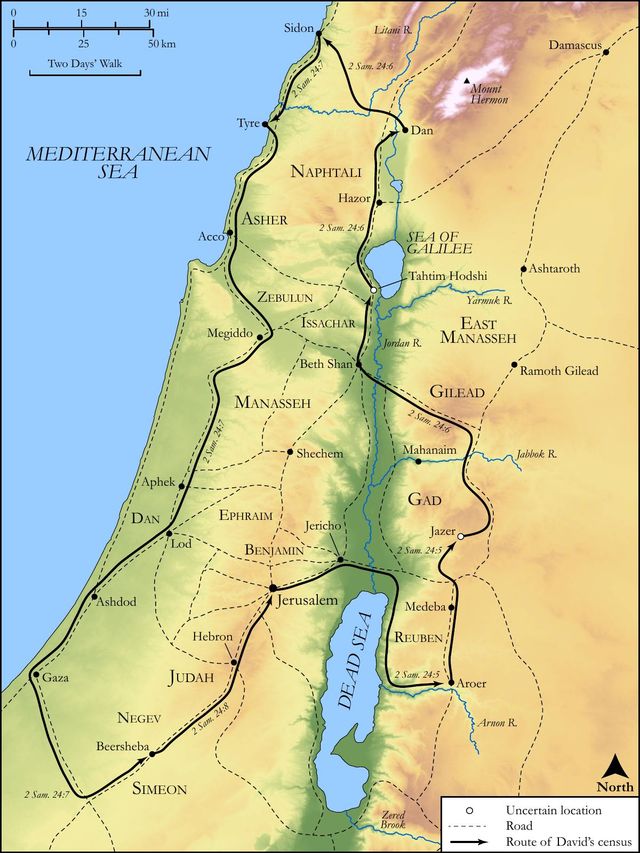
See on the biblical-era map
Study this verse
Public-domain commentary
Matthew Henry
From his Commentary on the Whole Bible. Henry comments on passages, not single verses — this entry covers 1 Chronicles 21:18–30.
We have here the controversy concluded, and, upon David's repentance, his peace made with God. Though thou wast angry with me, thy anger is turned away. 1. A stop was put to the progress of the execution, Ch1 21:15. When David repented of the sin God repented of the judgment, and ordered the destroying angel to stay his hand and sheath his sword, Ch1 21:27. 2. Direction was given to David to rear an altar in the threshing-floor of Ornan, Ch1 21:18. The angel commanded the prophet Gad to bring David this direction. The same angel that had, in God's name, carried on the war, is here forward to set on foot the treaty of peace; for angels do not desire the woeful day. The angel could have given this order to David himself; but he chose to do it by his seer, that he might put an honour upon the prophetic office. Thus the revelation of Jesus Christ was notified by the angel to John, and by him to the churches. The commanding of David to build an altar was a blessed token of reconciliation; for, if God had been pleased to kill him, he would not have appointed, because he would not have accepted, a sacrifice at his hands. 3. David immediately made a bargain with Ornan for the threshing-floor; for he would not serve God at other people's charge. Ornan generously offered it to him gratis, not only in complaisance to the king, but because he had himself seen the angel (Ch1 21:20), which so terrified him that he and his four sons hid themselves, as unable to bear the brightness of his glory and afraid of his drawn sword. Under these apprehensions he was willing to do anything towards making the atonement. Those that are duly sensible of the terrors of the Lord will do all they can, in their places, to promote religion, and encourage all the methods of reconciliation for the turning away of God's wrath. 4. God testified his acceptance of David's offerings on this altar; He answered him from heaven by fire, Ch1 21:26. To signify that God's anger was turned away from him, the fire that might justly have fastened upon the sinner fastened upon the sacrifice and consumed that; and, upon this, the destroying sword was returned into its sheath. Thus Christ was made sin and a curse for us, and it pleased the Lord to bruise him, that through him God might be to us, not a consuming fire, but a reconciled Father. 5. He continued to offer his sacrifices upon this altar. The brazen altar which Moses made was at Gibeon (Ch1 21:29), and there all the sacrifices of Israel were offered; but David was so terrified at the sight of the sword of the angel that he could not go thither, Ch1 21:30. The business required haste, when the plague was begun. Aaron must go quickly, nay, he must run, to make atonement, Num 16:46, Num 16:47. And the case here was no less urgent; so that David had not time to go to Gibeon: nor durst he leave the angel with his sword drawn over Jerusalem, lest the fatal stroke should be given before he came back. And therefore God, in tenderness to him, bade him build an altar in that place, dispensing with his own law concerning one altar because of the present distress, and accepting the sacrifices offered on this new altar, which was not set up in opposition to that, but in concurrence with it. The symbols of unity were not so much insisted on as unity itself. Nay, when the present distress was over (as it should seem), David, as long as he lived, sacrificed there, though the altar at Gibeon was still kept up; for God had owned the sacrifices that were here offered and had testified his acceptance of them, Ch1 21:28. On those administrations in which we have experienced the tokens of God's presence, and have found that he is with us of a truth, it is good to continue our attendance. "Here God had graciously met me, and therefore I will still expect to meet with him."
Continue studying 1 Chronicles 21:20 across the web’s major study libraries — every link below opens this exact verse, chapter, or book on the destination site.
Read & Compare
 BibleGatewayThis verse in more than 200 translations and 70 languages.
 Bible.comThe YouVersion reader — hundreds of translations, reading plans, and highlights.
 ESV.orgCrossway's official English Standard Version reader.
 NET BibleThe NET translation with 60,000+ translators' notes on every rendering decision.
 STEP BibleTyndale House's free study tool — original text, vocabulary, and scholarly resources.
 BibliaLogos Bible Software's free web reader.
 USCCBThe New American Bible (Revised Edition) with the U.S. bishops' study notes.
Commentaries
 BibleHub CommentariesDozens of classic commentaries on this verse, gathered on one page.
 StudyLightMore than 100 commentary sets — the largest collection on the web.
 BibleRefPlain-English commentary on what this verse means, verse by verse.
 Enduring WordDavid Guzik's free commentary on this chapter, widely used by Bible teachers.
 Bible Study ToolsVerse commentary alongside Greek and Hebrew study aids.
Original Language & Research
- BibleHub InterlinearThe verse word by word — original language, transliteration, and English.
- BibleHub LexiconEvery word's original-language definition and Strong's entry.
 Blue Letter BibleDeep-study tools — Strong's numbers, concordance, and word studies.
 SefariaThe Hebrew text with Rashi and centuries of Jewish commentary.
Sermons, Hymns & Audio


TrulyRandomVerse is not affiliated with these sites and doesn’t control their content. They’re linked because they’re genuinely useful.
Summary
1 Chronicles 21:20 vividly portrays a pivotal moment of divine intervention where Ornan the Jebusite, engaged in the ordinary act of threshing wheat, suddenly turns to behold the awe-inspiring and terrifying sight of the Lord's angel, poised for judgment. This direct encounter, which causes his four sons to hide in fear, marks the precise geographical and temporal point where God's wrath, unleashed due to King David's unauthorized census, was commanded to cease, transforming a mundane agricultural site into a place of profound sacred significance.
Context
ShowHideLiterary Context
This verse is situated at a critical juncture in the narrative of God's judgment upon Israel, following King David's sin of taking a census, an act of pride and reliance on human strength rather than divine provision (1 Chronicles 21:1-8). The preceding verses detail the Lord's decision to send a devastating plague upon Israel (1 Chronicles 21:14) and the angel of the Lord's progression towards Jerusalem, poised to destroy the city (1 Chronicles 21:15a). Verse 20 specifically pinpoints the moment the angel reached the threshing floor of Ornan the Jebusite, just as God, moved by David's repentance and the severity of the plague, commanded the angel to stop (1 Chronicles 21:15b). Ornan's direct witnessing of this divine agent of judgment and mercy sets the stage for David's subsequent purchase of the threshing floor and the building of an altar there (1 Chronicles 21:21-26), ultimately foreshadowing the site of Solomon's Temple, a central theme in the Chronicler's work.
Historical & Cultural Context
Threshing floors were common agricultural spaces in ancient Israel, typically elevated and open to the wind, used for separating grain from chaff. They were often communal and located outside city gates, making them visible and accessible. Ornan, identified as a Jebusite, represents the indigenous inhabitants of Jerusalem who continued to live alongside the Israelites after David's conquest of the city (compare 2 Samuel 5:6-9). The fact that this pivotal divine encounter occurs at a Jebusite's threshing floor underscores God's sovereignty over all peoples and places, even those not initially part of the covenant community. The visual manifestation of an angel, particularly one associated with judgment and wielding a drawn sword (as described in 1 Chronicles 21:16), would have been understood in Israel as a terrifying and awe-inspiring display of divine power, demanding immediate and absolute reverence. This specific threshing floor would later become the highly significant Temple Mount, the spiritual heart of Israel.
Key Themes
ShowHideThe encounter in 1 Chronicles 21:20 contributes to several overarching themes within the book of Chronicles. Firstly, it highlights Divine Sovereignty and Mercy, demonstrating God's absolute control over judgment and His compassionate intervention in response to repentance, as seen in the angel's cessation of destruction. Secondly, it underscores the theme of Sacred Space and Transformation, as an ordinary agricultural site is divinely chosen and consecrated, foreshadowing its future as the holy site for the Temple, a place of atonement and worship (as detailed in 2 Chronicles 3:1). Thirdly, the verse illustrates the Interruption of the Mundane by the Miraculous, showing that profound divine encounters can occur in the midst of daily life, calling individuals to a heightened awareness of God's active presence. Finally, Ornan's fearful reaction speaks to the Awe and Reverence due to God's holy presence, a foundational concept throughout the Old Testament, emphasizing that the fear of the Lord is the beginning of wisdom.
Exposition and Analysis
ShowHideKey Word Analysis
ShowHideThis proper name, paralleled by "Araunah" in 2 Samuel 24, identifies the Jebusite owner of the threshing floor. The slight variation in spelling is common in ancient texts and does not indicate a different individual. His ethnicity as a Jebusite is significant, emphasizing that God's redemptive plan can intersect with and sanctify those outside the immediate covenant community, transforming a non-Israelite's property into the future site of Israel's most sacred sanctuary.
The term mălʼâk literally means "messenger" or "agent," but in this context, it refers to a divine being acting as God's instrument of judgment. The angel is depicted with a drawn sword (1 Chronicles 21:16), indicating its destructive mission. Ornan's ability to "see" the angel signifies a unique, terrifying, and direct revelation of divine power, not merely an abstract concept but a visible, tangible manifestation of God's wrath and subsequent mercy.
This word describes the agricultural process of separating grain from its husks, a common and laborious daily activity. The detail that Ornan "was threshing wheat" highlights the stark contrast between the ordinary, earthly routine and the sudden, extraordinary intervention of the divine. It grounds the miraculous event in the reality of human labor, emphasizing that God's presence and purposes can break into and transform even the most mundane aspects of life.
Verse Breakdown
ShowHide"And Ornan turned back, and saw the angel"
This clause describes Ornan's sudden and unexpected encounter with the divine. "Turned back" implies a moment of realization, a physical turning to face something previously unseen or ignored, often suggesting a sudden awareness of a profound presence. The act of "seeing the angel" is a direct, terrifying visual confrontation with the divine agent of judgment, a sight granted to few in scripture and always accompanied by profound awe or fear, signaling a direct divine intervention into human affairs.
"and his four sons with him hid themselves"
This detail underscores the overwhelming nature of the angelic appearance. The sons' immediate reaction to "hide themselves" is a natural, instinctive response to the terrifying manifestation of divine power and holiness, reflecting a deep sense of vulnerability and fear in the face of the supernatural. It emphasizes the profound reverence and dread that such a revelation could inspire, highlighting the unapproachable holiness of God's presence.
"Now Ornan was threshing wheat"
This final clause provides the immediate, mundane context for the divine interruption. It sets the scene, grounding the extraordinary event in the ordinary activity of daily life. The stark contrast between the laborious, everyday task of separating grain and the sudden, awe-inspiring appearance of a divine messenger highlights God's ability to intersect with human existence at any moment, transforming the ordinary into the sacred and revealing His active involvement in the world.
Literary Devices
ShowHideThe verse effectively employs several literary devices to heighten its impact and convey its theological significance. Juxtaposition is prominently featured, contrasting the mundane, everyday act of "threshing wheat" with the sudden, terrifying appearance of "the angel." This stark contrast emphasizes the unexpected and overwhelming nature of divine intervention, highlighting how God's purposes can break into the ordinary. Symbolism is also at play, as the threshing floor, inherently a place of separation (grain from chaff), becomes symbolically significant as the precise location where God's judgment is separated from His mercy, and later, a consecrated place of atonement. Furthermore, the narrative employs Foreshadowing, as this specific threshing floor, initially a site of judgment's cessation, is implicitly marked as the future location for the Temple, Israel's central place of worship and sacrifice. The subtle Dramatic Irony is present: Ornan is initially unaware that his ordinary workplace is the very spot where a divine drama of judgment and mercy is unfolding, only realizing its profound significance when he "turned back" and saw the angel.
Theological and Thematic Connections
ShowHide1 Chronicles 21:20 profoundly illustrates the dual nature of God's character – His righteous judgment against sin and His compassionate mercy in response to repentance. Ornan's terrifying vision of the angel, an agent of divine wrath, underscores the fearful consequence of sin, yet the angel's presence also signals the imminent cessation of the plague, showcasing God's willingness to relent when His people humble themselves. This encounter transforms an ordinary place into a sacred site, emphasizing that God can consecrate any space for His redemptive purposes. It also highlights the "fear of the Lord" as a proper response to divine holiness and power, a reverence that leads to wisdom and understanding, acknowledging the vast chasm between human frailty and divine majesty.
Reflection and Application
ShowHideThe scene at Ornan's threshing floor offers a powerful reminder that God's presence is not confined to sacred buildings or designated holy times; He can and does intersect with our lives in the most ordinary of circumstances. Ornan was simply doing his daily work when he was confronted by the awesome reality of the divine. This challenges us to cultivate a posture of spiritual awareness, recognizing that every moment holds the potential for God's intervention, revelation, or guidance. His presence, whether in judgment or mercy, demands our reverence and awe, calling us to a deeper understanding of His holiness and power. Furthermore, the transformation of a common threshing floor into a holy site for worship teaches us that God can redeem and sanctify any aspect of our lives, any place, or any circumstance, turning areas of mundane labor or even past brokenness into spaces where His glory is revealed and His purposes are fulfilled, inviting us to see His hand at work in every detail.
Questions for Reflection
ShowHideFAQ
ShowHideWhy did Ornan and his sons hide when they saw the angel?
ShowHideOrnan and his sons hid because encountering a divine messenger, especially one with a drawn sword and associated with a devastating plague, was an overwhelming and terrifying experience. This reaction is a common biblical response to direct manifestations of God's holiness or His agents, reflecting a natural human fear in the face of immense power and purity. It underscores the profound awe and reverence that such an encounter inspires, acknowledging the vast chasm between human frailty and divine majesty, and the natural human instinct to recoil from such unapproachable holiness.
What is the significance of the threshing floor in this narrative?
ShowHideThe threshing floor holds immense significance beyond its agricultural function. It was the specific, divinely chosen location where the angel of the Lord stopped the plague, marking it as a point of divine mercy and cessation of judgment. This ordinary site was then consecrated by David's altar and sacrifice, becoming a place of atonement and reconciliation between God and His people. Most importantly, it was the very ground upon which Solomon would later build the First Temple (as recorded in 2 Chronicles 3:1), transforming a place of daily labor and divine judgment into the holiest site in Israel, symbolizing God's dwelling presence, the center of worship, and the ongoing covenant relationship with His people.
Christ-Centered Fulfillment
ShowHideThe scene at Ornan's threshing floor, where divine judgment is stayed and a place of atonement is established, powerfully foreshadows the redemptive work of Jesus Christ. The terrifying angel of the Lord, an agent of divine wrath poised to destroy, points to the ultimate judgment that humanity faced due to sin. However, just as God commanded the angel to sheath its sword at this specific location, so too in Christ, God's righteous wrath against sin was fully satisfied, and His judgment was turned away from all who believe. Jesus is the true Lamb of God who takes away the sin of the world, whose perfect sacrifice on the cross transformed the ultimate place of judgment (Calvary) into the ultimate place of salvation and reconciliation. The threshing floor, a place of separation (grain from chaff), also subtly prefigures Christ's role as the one who will ultimately gather His wheat into the barn, but burn up the chaff with unquenchable fire at the final judgment. Through Christ, the fear inspired by the angel's presence is replaced by a reverent awe and worship of a God who is both just and the justifier of those who have faith in Jesus (as articulated in Romans 3:26). His work transforms not just a physical space, but the human heart, making it a temple for the Holy Spirit (as taught in 1 Corinthians 6:19), where true worship, reconciliation with God, and eternal life are eternally possible.