


1 Chronicles 21:21
- וַיָּבֹאvai·ya·Vo'and he cameH935Conj-w ¦ V-Qal-ConsecImperf-3msVerb Qal Consecutive Imperfect 3rd Singular Masculineוַandיָּבֹאhe came
- דָוִידda·VidDavidH1732N-proper-mNoun Proper Masculine
- עַד'adtoH5704PrepPreposition
- אָרְנָן'a·re·NanOrnanH771N-proper-mNoun Proper Masculine
- וַיַּבֵּטvai·ya·Betand he lookedH5027Conj-w ¦ V-Hiphil-ConsecImperf-3msVerb Hiphil Consecutive Imperfect 3rd Singular Masculineוַandיַּבֵּטhe looked
- אָרְנָן'a·re·NanOrnanH771N-proper-mNoun Proper Masculine
- וַיַּרְאvai·Yar'and he sawH7200Conj-w ¦ V-Qal-ConsecImperf-3msVerb Qal Consecutive Imperfect 3rd Singular Masculineוַandיַּרְאhe saw
- אֶת'et<obj.>H853DirObjMParticle Object Indicator
- דָּוִידda·VidDavidH1732N-proper-mNoun Proper Masculine
- וַיֵּצֵאvai·ye·Tze'and he went outH3318Conj-w ¦ V-Qal-ConsecImperf-3msVerb Qal Consecutive Imperfect 3rd Singular Masculineוַandיֵּצֵאhe went out
- מִןminfromH4480PrepPreposition
- הַגֹּרֶןha·Go·renthe threshing floorH1637Art ¦ N-fsNoun Singular Feminine Absoluteהַtheגֹּרֶןthreshing floor
- וַיִּשְׁתַּחוּvai·yish·Ta·chuand he bowed downH7812Conj-w ¦ V-Hishtaphel-ConsecImperf-3msVerb Hishtaphel Consecutive Imperfect 3rd Singular Masculineוַandיִּשְׁתַּחוּhe bowed down
- לְדָוִידle·da·Vidto DavidH1732Prep-l ¦ N-proper-mNoun Proper MasculineלְtoדָוִידDavid
- אַפַּיִם'a·Pa·yimfaceH639N-mdNoun Dual Masculine Absolute
- אָרְצָה'A·re·tzah[the] ground towardsH776N-fs ¦ SfxNoun Singular Feminine Absoluteאָרְצָ[the] groundהtowards
English is a literal word-by-word gloss of the Hebrew, not the KJV's wording. Why?
This is the original text the KJV's translators worked from — each Hebrew word with its own literal English meaning in this verse, prepared by scholars at Tyndale House, Cambridge. The KJV translates whole sentences, not word by word, so its wording differs: one Hebrew word can become several English words, and the KJV may choose “the LORD” where the gloss reads “Yahweh”. Both are faithful — they answer different questions. For the KJV's own rendering, switch to the KJV text.
Details
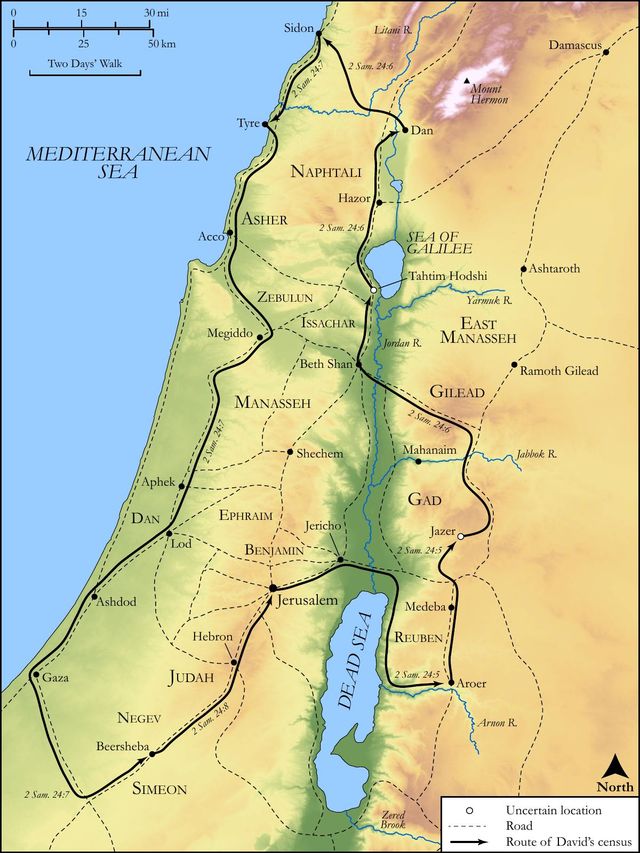
See on the biblical-era map
Study this verse
Public-domain commentary
Matthew Henry
From his Commentary on the Whole Bible. Henry comments on passages, not single verses — this entry covers 1 Chronicles 21:18–30.
We have here the controversy concluded, and, upon David's repentance, his peace made with God. Though thou wast angry with me, thy anger is turned away. 1. A stop was put to the progress of the execution, Ch1 21:15. When David repented of the sin God repented of the judgment, and ordered the destroying angel to stay his hand and sheath his sword, Ch1 21:27. 2. Direction was given to David to rear an altar in the threshing-floor of Ornan, Ch1 21:18. The angel commanded the prophet Gad to bring David this direction. The same angel that had, in God's name, carried on the war, is here forward to set on foot the treaty of peace; for angels do not desire the woeful day. The angel could have given this order to David himself; but he chose to do it by his seer, that he might put an honour upon the prophetic office. Thus the revelation of Jesus Christ was notified by the angel to John, and by him to the churches. The commanding of David to build an altar was a blessed token of reconciliation; for, if God had been pleased to kill him, he would not have appointed, because he would not have accepted, a sacrifice at his hands. 3. David immediately made a bargain with Ornan for the threshing-floor; for he would not serve God at other people's charge. Ornan generously offered it to him gratis, not only in complaisance to the king, but because he had himself seen the angel (Ch1 21:20), which so terrified him that he and his four sons hid themselves, as unable to bear the brightness of his glory and afraid of his drawn sword. Under these apprehensions he was willing to do anything towards making the atonement. Those that are duly sensible of the terrors of the Lord will do all they can, in their places, to promote religion, and encourage all the methods of reconciliation for the turning away of God's wrath. 4. God testified his acceptance of David's offerings on this altar; He answered him from heaven by fire, Ch1 21:26. To signify that God's anger was turned away from him, the fire that might justly have fastened upon the sinner fastened upon the sacrifice and consumed that; and, upon this, the destroying sword was returned into its sheath. Thus Christ was made sin and a curse for us, and it pleased the Lord to bruise him, that through him God might be to us, not a consuming fire, but a reconciled Father. 5. He continued to offer his sacrifices upon this altar. The brazen altar which Moses made was at Gibeon (Ch1 21:29), and there all the sacrifices of Israel were offered; but David was so terrified at the sight of the sword of the angel that he could not go thither, Ch1 21:30. The business required haste, when the plague was begun. Aaron must go quickly, nay, he must run, to make atonement, Num 16:46, Num 16:47. And the case here was no less urgent; so that David had not time to go to Gibeon: nor durst he leave the angel with his sword drawn over Jerusalem, lest the fatal stroke should be given before he came back. And therefore God, in tenderness to him, bade him build an altar in that place, dispensing with his own law concerning one altar because of the present distress, and accepting the sacrifices offered on this new altar, which was not set up in opposition to that, but in concurrence with it. The symbols of unity were not so much insisted on as unity itself. Nay, when the present distress was over (as it should seem), David, as long as he lived, sacrificed there, though the altar at Gibeon was still kept up; for God had owned the sacrifices that were here offered and had testified his acceptance of them, Ch1 21:28. On those administrations in which we have experienced the tokens of God's presence, and have found that he is with us of a truth, it is good to continue our attendance. "Here God had graciously met me, and therefore I will still expect to meet with him."
Continue studying 1 Chronicles 21:21 across the web’s major study libraries — every link below opens this exact verse, chapter, or book on the destination site.
Read & Compare
 BibleGatewayThis verse in more than 200 translations and 70 languages.
 Bible.comThe YouVersion reader — hundreds of translations, reading plans, and highlights.
 ESV.orgCrossway's official English Standard Version reader.
 NET BibleThe NET translation with 60,000+ translators' notes on every rendering decision.
 STEP BibleTyndale House's free study tool — original text, vocabulary, and scholarly resources.
 BibliaLogos Bible Software's free web reader.
 USCCBThe New American Bible (Revised Edition) with the U.S. bishops' study notes.
Commentaries
 BibleHub CommentariesDozens of classic commentaries on this verse, gathered on one page.
 StudyLightMore than 100 commentary sets — the largest collection on the web.
 BibleRefPlain-English commentary on what this verse means, verse by verse.
 Enduring WordDavid Guzik's free commentary on this chapter, widely used by Bible teachers.
 Bible Study ToolsVerse commentary alongside Greek and Hebrew study aids.
Original Language & Research
- BibleHub InterlinearThe verse word by word — original language, transliteration, and English.
- BibleHub LexiconEvery word's original-language definition and Strong's entry.
 Blue Letter BibleDeep-study tools — Strong's numbers, concordance, and word studies.
 SefariaThe Hebrew text with Rashi and centuries of Jewish commentary.
Sermons, Hymns & Audio


TrulyRandomVerse is not affiliated with these sites and doesn’t control their content. They’re linked because they’re genuinely useful.
Summary
1 Chronicles 21:21 captures a profound moment in the aftermath of King David's unauthorized census, which brought divine judgment upon Israel. As David approaches the threshingfloor of Ornan the Jebusite, Ornan immediately recognizes the king and responds with a deep gesture of respect and humility, prostrating himself with his face to the ground. This pivotal encounter sets the stage for David's act of obedience in building an altar and offering sacrifices, an act ordained by God to halt the devastating plague and consecrate a site destined to become the foundational location for the future Temple in Jerusalem.
Context
ShowHideLiterary Context
This verse is strategically placed within the Chronicler's narrative of David's census and its severe consequences. The preceding verses detail the devastating plague that afflicted Israel as a result of David's sin, instigated by Satan (or God's anger, as recounted in the parallel account of 2 Samuel 24:1). The turning point arrives when the angel of the Lord, who was executing the judgment, halts at Ornan's threshingfloor (1 Chronicles 21:15). The prophet Gad then delivers a divine instruction to David: he must go up to Ornan's threshingfloor and build an altar to the Lord there to make atonement and avert further wrath (1 Chronicles 21:18). Ornan's immediate and humble response to David's presence in this verse underscores the gravity of the national crisis and David's enduring authority, even in a moment of repentance, setting the solemn stage for the crucial act of sacrifice that follows.
Historical & Cultural Context
Threshingfloors in ancient Israel were typically elevated, open-air areas, often situated on hilltops to catch the wind, which aided in separating grain from chaff. These locations were not merely agricultural sites but often served as common public gathering places, even for legal transactions or significant events. Ornan, identified as a Jebusite, was a descendant of the original inhabitants of Jerusalem before David conquered the city. His continued presence and ownership of this significant plot of land are crucial to the narrative. The act of "bowing himself... with his face to the ground" (prostration) was a common and profound gesture of respect, submission, or even worship in the ancient Near East, reserved for kings, deities, or those of superior status. Ornan's immediate and unprompted prostration signifies his deep deference to King David and possibly his awareness of the unfolding divine judgment, demonstrating a remarkable sensitivity to the solemnity of the moment.
Key Themes
ShowHideSeveral profound themes converge in this verse, illuminating the Chronicler's theological agenda. Firstly, Divine Judgment and Mercy are prominently displayed, as God's wrath, though severe, is stayed at this specific location, signaling a shift from punishment to an opportunity for atonement and grace. Secondly, Obedience and Atonement are central; David's journey to the threshingfloor is a direct act of obedience to God's command through the prophet Gad, demonstrating that true repentance requires costly sacrifice to avert divine wrath. Thirdly, the concept of Sacred Space is powerfully illustrated; a common agricultural threshingfloor is transformed into a holy site, divinely chosen for an altar of atonement. This transformation is particularly significant as this very site would later become the location for Solomon's magnificent Temple in Jerusalem, underscoring its enduring sacredness and God's sovereign choice. Finally, Humility and Submission are embodied in Ornan's immediate and profound reverence for David, acknowledging the king's authority and the solemnity of the divine purpose, providing a stark contrast to David's earlier pride in the census.
Exposition and Analysis
ShowHideKey Word Analysis
ShowHideThis name refers to the Jebusite owner of the threshingfloor, whose full cooperation and willingness to offer his property for the sacrifice are crucial to the narrative. The Chronicler's emphasis on Ornan, a non-Israelite, highlights God's sovereign hand at work through all peoples and His ability to use anyone to accomplish His purposes, even in the context of Israel's national atonement and the establishment of its central place of worship.
This term denotes a flat, open area, typically on elevated ground, used for separating grain from chaff. Beyond its literal agricultural function, the "threshingfloor" often carried symbolic weight in the Old Testament, sometimes associated with judgment (separating the valuable from the worthless) or, as here, a place of significant encounter and transaction. Its elevation made it a suitable and visible place for an altar, signifying a public act of repentance and divine intervention.
This verb signifies a deep gesture of respect, submission, or even worship, often involving full prostration where one's face touches the ground. Ornan's immediate and unprompted action demonstrates profound deference to King David's authority and perhaps an intuitive understanding of the solemnity and divine purpose behind the king's unexpected visit. It conveys a readiness to submit to the king's will and, by extension, to God's will operating through David.
Verse Breakdown
ShowHide"And as David came to Ornan"
This clause emphasizes David's intentional and purposeful approach, acting in direct obedience to the divine command received through the prophet Gad to build an altar at this specific location. It marks the commencement of the process of national atonement and the king's personal act of repentance.
"Ornan looked and saw David"
This indicates Ornan's immediate recognition of the king. The unexpected arrival of the monarch, especially in a time of national crisis (the plague), would have been highly unusual and instantly signaled a matter of paramount importance. Ornan's quick perception and identification of David set the stage for his subsequent actions, demonstrating his attentiveness to the unfolding events.
"and went out of the threshingfloor"
Ornan's proactive movement to meet David demonstrates his profound respect and readiness to engage with the king. He does not wait for David to enter his working space but steps out to greet him, a gesture of honor, hospitality, and deference towards a superior, indicating his willingness to set aside his own tasks for the king's urgent matter.
"and bowed himself to David with [his] face to the ground"
This is the ultimate expression of humility, reverence, and submission in ancient Near Eastern culture. Ornan's full prostration signifies his acknowledgment of David's supreme royal authority and the gravity of the moment, perhaps even an intuitive understanding of the divine hand at work in David's visit. It establishes a tone of immediate cooperation and deep respect for the king's urgent, divinely mandated mission.
Literary Devices
ShowHideThe verse effectively employs several literary devices to convey its profound message. Foreshadowing is evident in the transformation of a common agricultural threshingfloor into a sacred site, which prophetically points to its future as the location of the Temple Mount, the central place of worship for Israel for centuries to come. Symbolism is also powerfully present: the threshingfloor itself, typically a place of separation (grain from chaff), becomes a symbol of judgment averted and atonement offered, where the "chaff" of sin is dealt with through sacrifice. Ornan's act of prostration is a powerful symbol of humility, submission, and reverence in the face of divine authority and human leadership, standing in stark contrast to David's prior act of pride in taking the census. The rapid sequence of Ornan's actions—looking, seeing, going out, and bowing—creates a vivid sense of immediacy and urgency, highlighting the profound impact of David's presence and the gravity of the national crisis.
Theological and Thematic Connections
ShowHideThis encounter between David and Ornan powerfully illustrates the principle of humble submission to divine authority, even when exercised through human instruments. Ornan's immediate prostration, a gesture of profound respect, demonstrates a readiness to yield personal property and plans for the greater purposes of God. This act of deference, coming from a Jebusite, underscores God's universal sovereignty and His ability to use anyone to accomplish His will, transcending ethnic and national boundaries. The transformation of a mundane threshingfloor into a holy site where atonement is made powerfully foreshadows God's redemptive work, turning places of ordinary life or even judgment into sanctuaries of mercy and reconciliation. This moment is a critical turning point, where human obedience and divine mercy converge to halt a devastating plague, emphasizing that true repentance and costly sacrifice are the pathways to reconciliation with God and the restoration of His favor.
Reflection and Application
ShowHideOrnan's immediate and humble response to King David's arrival, even before David states his purpose, offers a profound lesson in spiritual readiness and submission to authority. His willingness to prostrate himself and later offer his land and oxen for the sacrifice, without hesitation, reflects a heart attuned to the gravity of the moment and the authority of God's chosen leader. This challenges us to consider our own posture when confronted with God's directives, whether revealed through scripture, the guidance of spiritual leaders, or providential circumstances. Are we quick to recognize and honor divine authority, even when it comes in unexpected forms? Are we willing to yield our personal possessions, plans, or comfort for God's greater purposes, even when it involves personal cost, much like David's insistence on paying for the sacrifice rather than receiving it freely? Ornan's example encourages a spirit of humility, generosity, and prompt obedience, reminding us that true worship often involves a costly surrender that facilitates God's redemptive and healing work in our lives and in the world around us.
Questions for Reflection
ShowHideFAQ
ShowHideWhy was Ornan at the threshingfloor when David arrived?
ShowHideOrnan was at his threshingfloor because it was his place of work and livelihood. Threshingfloors were essential agricultural sites where grain was processed after harvest. They were often open, elevated areas, making them practical for separating grain from chaff. Ornan was likely engaged in or overseeing the daily operations of his farm when King David, accompanied by his servants, unexpectedly approached. The text notes that he "went out of the threshingfloor," suggesting he stepped away from his immediate work area to respectfully meet the king, indicating his awareness of David's status and the unusual nature of the visit.
What is the significance of Ornan being a Jebusite?
ShowHideThe fact that Ornan was a Jebusite, a non-Israelite and a remnant of the pre-Israelite inhabitants of Jerusalem, is highly significant. It demonstrates God's sovereignty extending beyond the chosen people of Israel, highlighting His universal dominion. God chose to use a Gentile to facilitate a crucial act of atonement for Israel, on the very land that would become the site of His holy Temple. This foreshadows God's expansive plan of salvation, which would eventually include all nations, as profoundly revealed in the New Testament. It also underscores that the sacred space of the Temple was established on land acquired through a legitimate and respectful transaction with its original, non-Israelite owner, emphasizing justice and divine provision in the foundation of Israel's central place of worship.
How does this account relate to 2 Samuel 24?
ShowHide1 Chronicles 21:21 is the Chronicler's parallel account to 2 Samuel 24:18. Both passages describe the same core events: David's sin of taking a census, the subsequent divine plague upon Israel, and the divine instruction to build an altar on the threshingfloor of Ornan (who is called Araunah in 2 Samuel). While there are minor differences in detail between the two accounts (e.g., the specific instigator of the census, the exact price paid for the land), the core narrative and theological message are consistent. Both emphasize God's judgment, David's repentance, the intercession through sacrifice, and the establishment of a sacred site that would become the Temple Mount. The Chronicler's account, written for a post-exilic audience, often emphasizes the Temple, the priesthood, and the importance of proper worship more explicitly, aligning with his overall theological agenda of restoring Israel's spiritual life.
Christ-Centered Fulfillment
ShowHideThe encounter at Ornan's threshingfloor, culminating in David's purchase and sacrifice, profoundly foreshadows the person and redemptive work of Jesus Christ. The threshingfloor, a place of judgment where grain is separated from chaff, becomes a site of atonement, pointing to Christ as the ultimate Lamb of God who takes away the sin of the world. David's costly sacrifice, insisted upon as something that "costs him something" (1 Chronicles 21:24), anticipates the infinitely greater and truly costly sacrifice of Christ on the cross, which alone provides perfect and eternal atonement for humanity's sin (Hebrews 9:12). Ornan's humble prostration before David, recognizing his authority, mirrors the universal submission that will ultimately be rendered to Christ, before whom "every knee should bow, in heaven and on earth and under the earth" (Philippians 2:10). Furthermore, the transformation of a common agricultural site into a holy place, the future Temple Mount, foreshadows how Christ's redemptive work sanctifies not just specific locations but makes believers themselves temples of the Holy Spirit (1 Corinthians 6:19), bringing God's presence into the ordinary and making all of life sacred through His indwelling. The plague's cessation at this site, through sacrifice, points to Christ's decisive victory over sin and death, ending the spiritual plague that afflicts humanity and offering eternal life to all who believe (Romans 6:23).