


1 Chronicles 21:22
- וַיֹּאמֶרvai·Yo·merand he saidH559Conj-w ¦ V-Qal-ConsecImperf-3msVerb Qal Consecutive Imperfect 3rd Singular Masculineוַandיֹּאמֶרhe said
- דָּוִידda·VidDavidH1732N-proper-mNoun Proper Masculine
- אֶל'eltoH413PrepPreposition
- אָרְנָן'a·re·NanOrnanH771N-proper-mNoun Proper Masculine
- תְּנָהte·nahgive !H5414V-Qal-Imp-2ms ¦ SfxVerb Qal Imperative 2nd Singular Masculineתְּנָgiveה!
- לִּיlito mePrep-l ¦ 1csSuffix Personal 1st Singular common genderלִּtoיme
- מְקוֹםme·Kom[the] place ofH4725N-mscNoun Singular Masculine Construct
- הַגֹּרֶןha·Go·renthe threshing floorH1637Art ¦ N-fsNoun Singular Feminine Absoluteהַtheגֹּרֶןthreshing floor
- וְאֶבְנֶהve·'ev·nehso I may buildH1129Conj-w ¦ V-Qal-ConjImperf-1csVerb Qal Conjunction+Imperfect 1st Singular common genderוְsoאֶבְנֶהI may build
- בּוֹboon itPrep-b ¦ 3msSuffix Personal 3rd Singular Masculineבּonוֹit
- מִזְבֵּחַmiz·Be·achan altarH4196N-msNoun Singular Masculine Absolute
- לַיהוָהla·Yah·wehto YahwehH3068Prep-l ¦ N-properNoun Proper TitleלַtoיהוָהYahweh
- בְּכֶסֶףbe·Khe·seffor moneyH3701Prep-b ¦ N-msNoun Singular Masculine Absoluteבְּforכֶסֶףmoney
- מָלֵאma·Le'fullH4392Adj-msAdjective Singular Masculine Absolute
- תְּנֵהוּte·Ne·hugive itH5414V-Qal-Imp-2ms ¦ 3msVerb Qal Imperative 2nd Singular Masculineתְּנֵgiveהוּit
- לִיLito mePrep-l ¦ 1csSuffix Personal 1st Singular common genderלִtoיme
- וְתֵעָצַרve·te·'a·Tzarso it may be restrainedH6113Conj-w ¦ V-Niphal-ConjImperf-3fsVerb Niphal Conjunction+Imperfect 3rd Singular Feminineוְsoתֵעָצַרit may be restrained
- הַמַּגֵּפָהha·ma·ge·Fahthe plagueH4046Art ¦ N-fsNoun Singular Feminine Absoluteהַtheמַּגֵּפָהplague
- מֵעַלme·'Alfrom onH5921Prep-m ¦ PrepPrepositionמֵfromעַלon
- הָעָםha·'Amthe peopleH5971Art ¦ N-msNoun Singular Masculine Absoluteהָtheעָםpeople
English is a literal word-by-word gloss of the Hebrew, not the KJV's wording. Why?
This is the original text the KJV's translators worked from — each Hebrew word with its own literal English meaning in this verse, prepared by scholars at Tyndale House, Cambridge. The KJV translates whole sentences, not word by word, so its wording differs: one Hebrew word can become several English words, and the KJV may choose “the LORD” where the gloss reads “Yahweh”. Both are faithful — they answer different questions. For the KJV's own rendering, switch to the KJV text.
Details
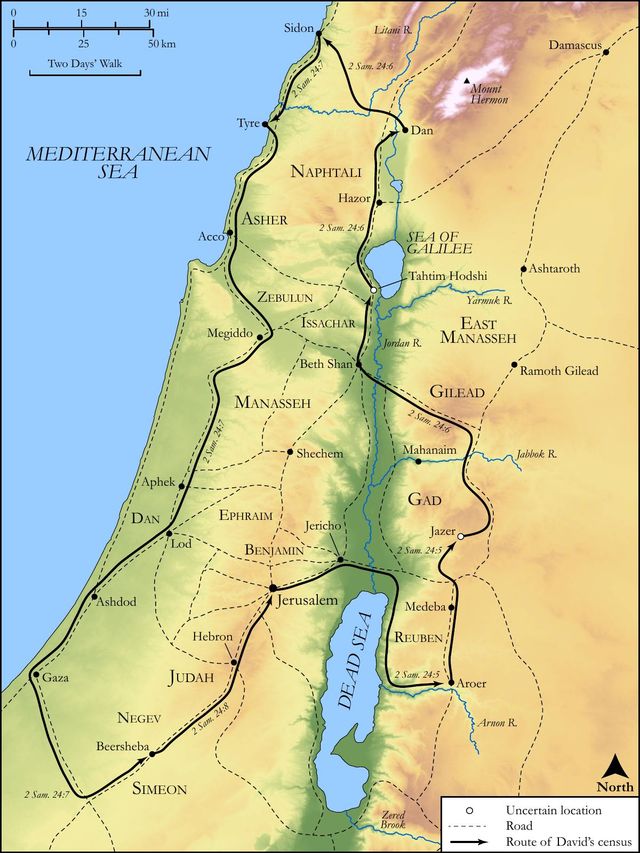
See on the biblical-era map
Study this verse
Public-domain commentary
Matthew Henry
From his Commentary on the Whole Bible. Henry comments on passages, not single verses — this entry covers 1 Chronicles 21:18–30.
We have here the controversy concluded, and, upon David's repentance, his peace made with God. Though thou wast angry with me, thy anger is turned away. 1. A stop was put to the progress of the execution, Ch1 21:15. When David repented of the sin God repented of the judgment, and ordered the destroying angel to stay his hand and sheath his sword, Ch1 21:27. 2. Direction was given to David to rear an altar in the threshing-floor of Ornan, Ch1 21:18. The angel commanded the prophet Gad to bring David this direction. The same angel that had, in God's name, carried on the war, is here forward to set on foot the treaty of peace; for angels do not desire the woeful day. The angel could have given this order to David himself; but he chose to do it by his seer, that he might put an honour upon the prophetic office. Thus the revelation of Jesus Christ was notified by the angel to John, and by him to the churches. The commanding of David to build an altar was a blessed token of reconciliation; for, if God had been pleased to kill him, he would not have appointed, because he would not have accepted, a sacrifice at his hands. 3. David immediately made a bargain with Ornan for the threshing-floor; for he would not serve God at other people's charge. Ornan generously offered it to him gratis, not only in complaisance to the king, but because he had himself seen the angel (Ch1 21:20), which so terrified him that he and his four sons hid themselves, as unable to bear the brightness of his glory and afraid of his drawn sword. Under these apprehensions he was willing to do anything towards making the atonement. Those that are duly sensible of the terrors of the Lord will do all they can, in their places, to promote religion, and encourage all the methods of reconciliation for the turning away of God's wrath. 4. God testified his acceptance of David's offerings on this altar; He answered him from heaven by fire, Ch1 21:26. To signify that God's anger was turned away from him, the fire that might justly have fastened upon the sinner fastened upon the sacrifice and consumed that; and, upon this, the destroying sword was returned into its sheath. Thus Christ was made sin and a curse for us, and it pleased the Lord to bruise him, that through him God might be to us, not a consuming fire, but a reconciled Father. 5. He continued to offer his sacrifices upon this altar. The brazen altar which Moses made was at Gibeon (Ch1 21:29), and there all the sacrifices of Israel were offered; but David was so terrified at the sight of the sword of the angel that he could not go thither, Ch1 21:30. The business required haste, when the plague was begun. Aaron must go quickly, nay, he must run, to make atonement, Num 16:46, Num 16:47. And the case here was no less urgent; so that David had not time to go to Gibeon: nor durst he leave the angel with his sword drawn over Jerusalem, lest the fatal stroke should be given before he came back. And therefore God, in tenderness to him, bade him build an altar in that place, dispensing with his own law concerning one altar because of the present distress, and accepting the sacrifices offered on this new altar, which was not set up in opposition to that, but in concurrence with it. The symbols of unity were not so much insisted on as unity itself. Nay, when the present distress was over (as it should seem), David, as long as he lived, sacrificed there, though the altar at Gibeon was still kept up; for God had owned the sacrifices that were here offered and had testified his acceptance of them, Ch1 21:28. On those administrations in which we have experienced the tokens of God's presence, and have found that he is with us of a truth, it is good to continue our attendance. "Here God had graciously met me, and therefore I will still expect to meet with him."
Continue studying 1 Chronicles 21:22 across the web’s major study libraries — every link below opens this exact verse, chapter, or book on the destination site.
Read & Compare
 BibleGatewayThis verse in more than 200 translations and 70 languages.
 Bible.comThe YouVersion reader — hundreds of translations, reading plans, and highlights.
 ESV.orgCrossway's official English Standard Version reader.
 NET BibleThe NET translation with 60,000+ translators' notes on every rendering decision.
 STEP BibleTyndale House's free study tool — original text, vocabulary, and scholarly resources.
 BibliaLogos Bible Software's free web reader.
 USCCBThe New American Bible (Revised Edition) with the U.S. bishops' study notes.
Commentaries
 BibleHub CommentariesDozens of classic commentaries on this verse, gathered on one page.
 StudyLightMore than 100 commentary sets — the largest collection on the web.
 BibleRefPlain-English commentary on what this verse means, verse by verse.
 Enduring WordDavid Guzik's free commentary on this chapter, widely used by Bible teachers.
 Bible Study ToolsVerse commentary alongside Greek and Hebrew study aids.
Original Language & Research
- BibleHub InterlinearThe verse word by word — original language, transliteration, and English.
- BibleHub LexiconEvery word's original-language definition and Strong's entry.
 Blue Letter BibleDeep-study tools — Strong's numbers, concordance, and word studies.
 SefariaThe Hebrew text with Rashi and centuries of Jewish commentary.
Sermons, Hymns & Audio


TrulyRandomVerse is not affiliated with these sites and doesn’t control their content. They’re linked because they’re genuinely useful.
Summary
1 Chronicles 21:22 captures King David's urgent and pivotal request to Ornan the Jebusite for the purchase of his threshingfloor. This plea, made in the immediate aftermath of David's unauthorized census and the ensuing divine plague, was driven by a direct divine command to build an altar to the LORD. David's insistence on acquiring the site for the "full price" underscores his profound commitment to genuine atonement and a costly act of worship, seeking to halt the devastating judgment that had afflicted the people of Israel as a consequence of his sin.
Context
ShowHideLiterary Context
This verse is situated at the dramatic climax of a national crisis and divine judgment. The preceding narrative details David's sin of taking a census, an act rooted in pride and a reliance on human strength rather than divine providence, which provoked the LORD's wrath. A devastating plague ensued, claiming 70,000 lives across Israel. At the critical moment when the angel of the LORD extended his hand to destroy Jerusalem, he stopped at Ornan's threshingfloor. It was then that the prophet Gad delivered God's explicit instruction to David: build an altar on that very spot. David's request in this verse is his immediate, obedient, and decisive response to this divine directive, setting the stage for the purchase of the land, the offering of sacrifices, and the subsequent cessation of the plague, as meticulously recounted in the concluding verses of 1 Chronicles 21.
Historical & Cultural Context
The narrative unfolds during David's reign, a period marked by the consolidation of the Israelite kingdom and the establishment of Jerusalem as its capital. Threshingfloors were typically open-air, elevated spaces, often located on hilltops, which facilitated the winnowing process by utilizing wind to separate grain from chaff. Such locations, while practical for agriculture, also held symbolic significance, sometimes associated with judgment or divine encounter. Ornan (identified as Araunah in the parallel account in 2 Samuel 24) was a Jebusite, one of the original inhabitants of Jerusalem, likely a prominent and respected figure. The act of building an altar and offering sacrifices was central to Israelite worship and the divinely ordained means by which atonement was sought for sin, as prescribed within the Mosaic Law. The concept of a widespread plague as a direct consequence of divine judgment for national sin was a well-understood and deeply feared reality within the ancient Near Eastern and Israelite worldview.
Key Themes
ShowHide1 Chronicles 21:22 powerfully contributes to several overarching themes within the Chronicler's theology. Firstly, it highlights Repentance and Obedience, as David, confronted with the devastating consequences of his sin, immediately obeys God's command to build an altar, demonstrating profound contrition and a turning back to the LORD. Secondly, it introduces the crucial theme of the Cost of True Sacrifice and Worship. David's unwavering insistence on paying the "full price" for the threshingfloor, despite Ornan's generous offer to give it freely, underscores the theological principle that genuine worship and atonement require personal cost and sincerity, not cheap or convenient offerings, a principle explicitly affirmed in 1 Chronicles 21:24. Thirdly, the verse points to Divine Mercy and Atonement, showcasing God's sovereign power to halt judgment and His gracious provision of a means for reconciliation through the prescribed act of sacrifice, even in the midst of severe wrath. Finally, the narrative powerfully foreshadows the Significance of the Location, as this very threshingfloor, consecrated by David's act of atonement, would later become the sacred site for the construction of Solomon's Temple, establishing it as the enduring central place of worship for Israel, as recorded in 2 Chronicles 3:1.
Exposition and Analysis
ShowHideKey Word Analysis
ShowHideA primitive word referring to a flat, open area, often elevated, used for threshing grain. As a place made even for separating grain from chaff, it often carried symbolic associations with judgment and separation. In this context, it undergoes a profound transformation from a mundane agricultural site to a consecrated space for divine encounter, atonement, and worship, illustrating God's capacity to redeem and sanctify ordinary places for extraordinary purposes.
This adjective signifies completeness, abundance, or an undiminished state. When applied to "price," it emphasizes that David was committed to paying the entire, fair, and unreduced value for the land and the sacrificial animals. This highlights his understanding that an offering to God, especially one for atonement, must be wholehearted and involve a genuine personal cost, reflecting the gravity of the sin and the sincerity of his repentance, rather than a token gesture.
A primitive root meaning to enclose, hold back, restrain, or stop. This verb denotes an active, deliberate cessation of the plague by divine intervention. It signifies that the devastating judgment was not merely running its course but was definitively halted by God's sovereign command in direct response to David's obedient act of atonement. It powerfully underscores God's authority over life and death, and His merciful willingness to withdraw His hand of judgment.
Verse Breakdown
ShowHide"Then David said to Ornan, Grant me the place of [this] threshingfloor"
This opening clause immediately establishes the direct, urgent, and authoritative nature of David's communication with Ornan. David's specific request for "the place" of the threshingfloor indicates his precise obedience to the divine command given through the prophet Gad, demonstrating his immediate alignment with God's will for the designated location of the altar.
"that I may build an altar therein unto the LORD"
This clause explicitly states the sacred purpose behind David's acquisition. Building an altar was the divinely prescribed means for making atonement, seeking reconciliation, and offering propitiation to God following the grievous sin of the census. It signifies David's intention to engage in a solemn act of worship and an appeal for divine mercy.
"thou shalt grant it me for the full price"
This crucial phrase reveals David's profound theological conviction regarding the nature of true sacrifice. Despite Ornan's generous offer to provide the land and animals freely, David resolutely insists on paying the complete, undiminished cost. This demonstrates his understanding that a genuine offering to God must involve personal sacrifice and cannot be something acquired without effort or expense, thereby reflecting the immense value he placed on seeking God's favor and the sincerity of his repentance.
"that the plague may be stayed from the people"
This final clause articulates the immediate desired outcome and the urgent motivation for David's actions. The cessation of the devastating plague, which had already claimed 70,000 lives, was the tangible and desperately sought sign of God's acceptance of the atonement and the restoration of His favor upon the afflicted people. It underscores both the severity of the divine judgment and the profound urgency of David's obedient response.
Literary Devices
ShowHideThe text in 1 Chronicles 21:22 masterfully employs several effective literary devices to convey its profound message. Dialogue is central, as David's direct and urgent speech to Ornan powerfully conveys his resolve, his immediate obedience to God, and his deep theological conviction regarding the necessity of a costly sacrifice. This direct address draws the reader into the dramatic and pivotal exchange. The threshingfloor itself functions as powerful Symbolism; initially a mundane agricultural site, it is dramatically transformed into a place of divine judgment (where the angel of the LORD halted) and then consecrated as a holy site for atonement and worship. This transformation symbolizes God's redemptive power to consecrate and repurpose even ordinary spaces for sacred ends. Furthermore, the narrative contains clear Foreshadowing, as this very threshingfloor is explicitly identified later in the Chronicler's account as the future, permanent site for the construction of Solomon's magnificent Temple in 2 Chronicles 3:1, imbuing David's purchase with profound long-term significance for the central worship life of Israel. Finally, there is a subtle yet significant Contrast between Ornan's generous offer to give the land and oxen freely, and David's resolute insistence on paying the "full price," which serves to highlight David's deep understanding of the true nature and integrity required for genuine sacrifice to God.
Theological and Thematic Connections
ShowHide1 Chronicles 21:22 encapsulates profound theological truths about the nature of sin, divine judgment, genuine repentance, and the essence of true worship. David's unwavering insistence on paying the "full price" for the threshingfloor and the sacrificial animals reveals a deep understanding that genuine atonement and acceptable offerings to God require personal cost and sincerity. This principle elevates sacrifice beyond a mere ritualistic act, emphasizing that true worship must emanate from a heart of devotion and a profound recognition of the immense value of divine favor and reconciliation. God's willingness to stay the devastating plague in direct response to David's obedient and costly sacrifice powerfully underscores His boundless mercy and His divine provision for reconciliation, even in the face of severe, deserved judgment. The narrative clearly highlights that while God is perfectly just in His judgment of sin, He is also abundant in mercy and grace when His people humble themselves, confess their transgressions, and seek Him according to His prescribed ways.
Reflection and Application
ShowHideThe profound account of David and Ornan's threshingfloor in 1 Chronicles 21:22 offers timeless and deeply relevant lessons for believers today. When confronted with the painful consequences of our own sin, like David, we are called to genuine repentance—a sincere turning away from our self-reliance, pride, and disobedience, and a humble turning toward God in obedient submission. David's insistence on paying the "full price" challenges us to critically examine the nature of our own offerings to God. Do we offer Him only what is convenient, what costs us little, or what is merely leftover from our lives? Or do we, like David, truly understand that genuine worship, committed service, and sacrificial generosity require a personal cost, reflecting the immense value we place on our relationship with Him and His redemptive work in our lives? This narrative serves as a powerful reminder that God's mercy is profound and readily available; even in the midst of deserved judgment, He faithfully provides a way for atonement and reconciliation when we respond in faith, humility, and obedience. Our "threshingfloors"—those challenging places of personal struggle, consequence, or even past failure—can be transformed into sacred altars of worship and sites of profound divine encounter when we surrender them fully to God and offer Him our costly, heartfelt devotion.
Questions for Reflection
ShowHideFAQ
ShowHideWhy was David's census considered a sin, and how does 1 Chronicles 21:22 relate to it?
ShowHideDavid's census was considered a sin primarily because it represented a profound lack of trust in God and an inappropriate reliance on human strength and military numbers. While censuses were not inherently forbidden, this particular one was undertaken without divine command, likely motivated by pride or a desire to assess his own military might rather than depend solely on God's protection and provision. The Chronicler attributes the instigation to "Satan" (1 Chronicles 21:1), while the parallel account in 2 Samuel 24:1 indicates God's anger was kindled against Israel, implying David's action served as a catalyst for divine judgment. 1 Chronicles 21:22 is David's immediate and obedient response to the devastating plague that ensued from this sin, as he seeks to build an altar to make atonement and "stay the plague," directly addressing the dire consequence of his transgression.
Who was Ornan, and why was his threshingfloor so significant?
ShowHideOrnan was a Jebusite, one of the original inhabitants of Jerusalem before David conquered the city and made it his capital. He is also known as Araunah in the parallel account in the book of Samuel (2 Samuel 24:16). His threshingfloor became supremely significant for several crucial reasons: it was the precise location where the angel of the LORD, sent to destroy Jerusalem, stopped his hand of judgment (1 Chronicles 21:15); it was the divinely appointed spot for David to build an altar and offer sacrifices to end the devastating plague; and most importantly, this very site, purchased and consecrated by David, later became the permanent location for the construction of Solomon's magnificent Temple, the central place of worship for Israel for centuries (2 Chronicles 3:1).
What is the deeper meaning behind David's insistence on paying "full price" when Ornan offered the threshingfloor for free?
ShowHideDavid's unwavering insistence on paying the "full price" for the threshingfloor and the oxen, as explicitly stated in 1 Chronicles 21:24, reveals a profound and enduring theological principle: true sacrifice must genuinely cost the offerer. David understood that an offering that cost him nothing would not be a genuine expression of repentance, nor would it be a worthy or acceptable sacrifice to the holy God. Such an offering would lack sincerity, personal investment, and a true recognition of the gravity of the sin and the immense value of God's grace. This act powerfully demonstrates that worship and atonement are not cheap or convenient; they demand personal sacrifice, effort, and a deep appreciation for the magnitude of God's forgiveness and restoration. It underscores the integrity of David's heart in seeking genuine reconciliation with the LORD.
Christ-Centered Fulfillment
ShowHide1 Chronicles 21:22, with its profound focus on a costly sacrifice offered at a specific location to avert devastating divine wrath, finds its ultimate and perfect fulfillment in the person and work of Jesus Christ. David's sin brought a plague of death upon Israel, and his costly sacrifice on Ornan's threshingfloor temporarily stayed that judgment, powerfully foreshadowing the far greater "plague" of sin that afflicts all humanity. Just as David paid the "full price" for the land and the animals for sacrifice, so too did Christ pay the ultimate, unquantifiable "full price" for our eternal redemption, not with perishable silver or gold, but with His own precious, sinless blood (1 Peter 1:18-19). The threshingfloor, a place initially associated with judgment and separation, was transformed into a sacred site of atonement and future worship. This transformation points directly to the cross of Christ, where the full judgment for our sins was perfectly and completely borne by Him, and through which we gain eternal access to true worship and profound reconciliation with God (Colossians 2:13-14). Furthermore, the threshingfloor becoming the very site of the Temple, the dwelling place of God's manifest presence among His people, points to Christ Himself as the true and ultimate Temple, the perfect meeting place between a holy God and sinful humanity (John 2:19-21). Through His perfect, once-for-all sacrifice, Christ has forever "stayed the plague" of eternal death and condemnation for all who believe, ushering in an era of boundless grace, forgiveness, and new, abundant life (Hebrews 9:26-28).