


1 Chronicles 21:23
- וַיֹּאמֶרvai·Yo·merand he saidH559Conj-w ¦ V-Qal-ConsecImperf-3msVerb Qal Consecutive Imperfect 3rd Singular Masculineוַandיֹּאמֶרhe said
- אָרְנָן'a·re·NanOrnanH771N-proper-mNoun Proper Masculine
- אֶל'eltoH413PrepPreposition
- דָּוִידda·VidDavidH1732N-proper-mNoun Proper Masculine
- קַחkachtake [it]H3947V-Qal-Imp-2msVerb Qal Imperative 2nd Singular Masculine
- לָךְLakhfor yourselfPrep-l ¦ 2msSuffix Personal 2nd Singular Masculineלָforךְyourself
- וְיַעַשׂve·Ya·'asso may he doH6213Conj-w ¦ V-Qal-Imperf-3msVerb Qal Imperfect 3rd Singular Masculineוְsoיַעַשׂmay he do
- אֲדֹנִי'a·do·Nimy lordH113N-msc ¦ 1csNoun Singular Masculine Constructאֲדֹנִlordיmy
- הַמֶּלֶךְha·Me·lekhthe kingH4428Art ¦ N-msNoun Singular Masculine Absoluteהַtheמֶּלֶךְking
- הַטּוֹבha·Tovthe goodH2896Art ¦ Adj-msAdjective Singular Masculine Absoluteהַtheטּוֹבgood
- בְּעֵינָיוbe·'ei·Navin his viewH5869Prep-b ¦ N-fdc ¦ 3msNoun Dual Feminine Constructבְּinעֵינָיviewוhis
- רְאֵהre·'EhseeH7200V-Qal-Imp-2msVerb Qal Imperative 2nd Singular Masculine
- נָתַתִּיna·Ta·tiI giveH5414V-Qal-Perf-1csVerb Qal Perfect 1st Singular common gender
- הַבָּקָרha·ba·Karthe ox[en]H1241Art ¦ N-csNoun Singular common gender Absoluteהַtheבָּקָרox[en]
- לָעֹלוֹתla·'o·Lotfor the burnt offeringsH5930Prep-l ¦ N-fpNoun Plural Feminine Absoluteלָfor theעֹלוֹתburnt offerings
- וְהַמּוֹרִגִּיםve·ham·mo·ri·Gimand the threshing-sledgesH4173Conj-w ¦ Art ¦ N-mpNoun Plural Masculine Absoluteוְandהַtheמּוֹרִגִּיםthreshing-sledges
- לָעֵצִיםla·'e·Tzimfor the wood<s>H6086Prep-l ¦ N-mpNoun Plural Masculine Absoluteלָfor theעֵצִיםwood<s>
- וְהַחִטִּיםve·ha·chi·Timand the wheat<s>H2406Conj-w ¦ Art ¦ N-mpNoun Plural Masculine Absoluteוְandהַtheחִטִּיםwheat<s>
- לַמִּנְחָהla·min·Chahfor the grain offeringH4503Prep-l ¦ N-fsNoun Singular Feminine Absoluteלַfor theמִּנְחָהgrain offering
- הַכֹּלha·Kol<the> everythingH3605Art ¦ N-msNoun Singular Masculine Absoluteהַ<the>כֹּלeverything
- נָתָתִּיna·Ta·tiI giveH5414V-Qal-Perf-1csVerb Qal Perfect 1st Singular common gender
English is a literal word-by-word gloss of the Hebrew, not the KJV's wording. Why?
This is the original text the KJV's translators worked from — each Hebrew word with its own literal English meaning in this verse, prepared by scholars at Tyndale House, Cambridge. The KJV translates whole sentences, not word by word, so its wording differs: one Hebrew word can become several English words, and the KJV may choose “the LORD” where the gloss reads “Yahweh”. Both are faithful — they answer different questions. For the KJV's own rendering, switch to the KJV text.
Details
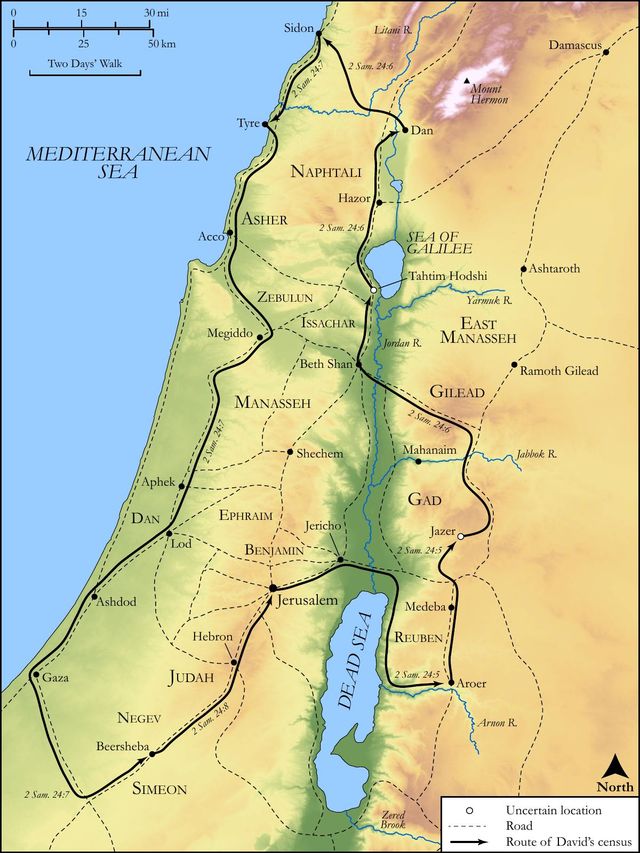
See on the biblical-era map
Study this verse
Public-domain commentary
Matthew Henry
From his Commentary on the Whole Bible. Henry comments on passages, not single verses — this entry covers 1 Chronicles 21:18–30.
We have here the controversy concluded, and, upon David's repentance, his peace made with God. Though thou wast angry with me, thy anger is turned away. 1. A stop was put to the progress of the execution, Ch1 21:15. When David repented of the sin God repented of the judgment, and ordered the destroying angel to stay his hand and sheath his sword, Ch1 21:27. 2. Direction was given to David to rear an altar in the threshing-floor of Ornan, Ch1 21:18. The angel commanded the prophet Gad to bring David this direction. The same angel that had, in God's name, carried on the war, is here forward to set on foot the treaty of peace; for angels do not desire the woeful day. The angel could have given this order to David himself; but he chose to do it by his seer, that he might put an honour upon the prophetic office. Thus the revelation of Jesus Christ was notified by the angel to John, and by him to the churches. The commanding of David to build an altar was a blessed token of reconciliation; for, if God had been pleased to kill him, he would not have appointed, because he would not have accepted, a sacrifice at his hands. 3. David immediately made a bargain with Ornan for the threshing-floor; for he would not serve God at other people's charge. Ornan generously offered it to him gratis, not only in complaisance to the king, but because he had himself seen the angel (Ch1 21:20), which so terrified him that he and his four sons hid themselves, as unable to bear the brightness of his glory and afraid of his drawn sword. Under these apprehensions he was willing to do anything towards making the atonement. Those that are duly sensible of the terrors of the Lord will do all they can, in their places, to promote religion, and encourage all the methods of reconciliation for the turning away of God's wrath. 4. God testified his acceptance of David's offerings on this altar; He answered him from heaven by fire, Ch1 21:26. To signify that God's anger was turned away from him, the fire that might justly have fastened upon the sinner fastened upon the sacrifice and consumed that; and, upon this, the destroying sword was returned into its sheath. Thus Christ was made sin and a curse for us, and it pleased the Lord to bruise him, that through him God might be to us, not a consuming fire, but a reconciled Father. 5. He continued to offer his sacrifices upon this altar. The brazen altar which Moses made was at Gibeon (Ch1 21:29), and there all the sacrifices of Israel were offered; but David was so terrified at the sight of the sword of the angel that he could not go thither, Ch1 21:30. The business required haste, when the plague was begun. Aaron must go quickly, nay, he must run, to make atonement, Num 16:46, Num 16:47. And the case here was no less urgent; so that David had not time to go to Gibeon: nor durst he leave the angel with his sword drawn over Jerusalem, lest the fatal stroke should be given before he came back. And therefore God, in tenderness to him, bade him build an altar in that place, dispensing with his own law concerning one altar because of the present distress, and accepting the sacrifices offered on this new altar, which was not set up in opposition to that, but in concurrence with it. The symbols of unity were not so much insisted on as unity itself. Nay, when the present distress was over (as it should seem), David, as long as he lived, sacrificed there, though the altar at Gibeon was still kept up; for God had owned the sacrifices that were here offered and had testified his acceptance of them, Ch1 21:28. On those administrations in which we have experienced the tokens of God's presence, and have found that he is with us of a truth, it is good to continue our attendance. "Here God had graciously met me, and therefore I will still expect to meet with him."
Continue studying 1 Chronicles 21:23 across the web’s major study libraries — every link below opens this exact verse, chapter, or book on the destination site.
Read & Compare
 BibleGatewayThis verse in more than 200 translations and 70 languages.
 Bible.comThe YouVersion reader — hundreds of translations, reading plans, and highlights.
 ESV.orgCrossway's official English Standard Version reader.
 NET BibleThe NET translation with 60,000+ translators' notes on every rendering decision.
 STEP BibleTyndale House's free study tool — original text, vocabulary, and scholarly resources.
 BibliaLogos Bible Software's free web reader.
 USCCBThe New American Bible (Revised Edition) with the U.S. bishops' study notes.
Commentaries
 BibleHub CommentariesDozens of classic commentaries on this verse, gathered on one page.
 StudyLightMore than 100 commentary sets — the largest collection on the web.
 BibleRefPlain-English commentary on what this verse means, verse by verse.
 Enduring WordDavid Guzik's free commentary on this chapter, widely used by Bible teachers.
 Bible Study ToolsVerse commentary alongside Greek and Hebrew study aids.
Original Language & Research
- BibleHub InterlinearThe verse word by word — original language, transliteration, and English.
- BibleHub LexiconEvery word's original-language definition and Strong's entry.
 Blue Letter BibleDeep-study tools — Strong's numbers, concordance, and word studies.
 SefariaThe Hebrew text with Rashi and centuries of Jewish commentary.
Sermons, Hymns & Audio


TrulyRandomVerse is not affiliated with these sites and doesn’t control their content. They’re linked because they’re genuinely useful.
Summary
This verse records the extraordinary generosity of Ornan the Jebusite, who, upon King David's arrival to purchase his threshing floor for an altar, spontaneously offers not only the land but also all necessary provisions—oxen for burnt offerings, threshing instruments for wood, and wheat for grain offerings—to facilitate the atonement for Israel's sin and the cessation of a devastating plague. His complete and immediate willingness to provide everything underscores a profound spirit of selfless devotion and obedience in a moment of national crisis, demonstrating a heart aligned with God's purposes.
Context
ShowHideLiterary Context
The narrative of 1 Chronicles 21 opens with Satan inciting King David to conduct an unauthorized census, an act of pride that demonstrated a reliance on human strength rather than divine provision. This disobedience brought severe divine judgment upon Israel in the form of a devastating plague, resulting in the deaths of seventy thousand people (1 Chronicles 21:14). The prophet Gad then instructed David to build an altar to the Lord on the threshing floor of Ornan the Jebusite to bring an end to the plague. As David approached, Ornan and his sons, who were actively engaged in threshing, saw the angel of the Lord, prompting Ornan to prostrate himself before the king (1 Chronicles 21:20-21). Verse 23 captures Ornan's remarkable and unsolicited offer, setting the stage for David's principled refusal in 1 Chronicles 21:24 and the subsequent purchase of the site for a full price.
Historical & Cultural Context
The setting is Jerusalem, specifically the threshing floor of Ornan (also known as Araunah in 2 Samuel 24). Threshing floors were typically elevated, open areas, often on hilltops, to catch the wind for winnowing, making them suitable for public gatherings and, in this case, for an altar. Ornan, as a Jebusite, was likely a remnant of the pre-Israelite inhabitants of Jerusalem, yet his actions demonstrate profound respect for David and, implicitly, for the God of Israel. The act of offering sacrifices for atonement, particularly burnt offerings (for complete dedication and expiation of sin) and grain offerings (as a tribute or acknowledgment of God's provision), was central to Israelite worship and a prescribed method for seeking divine favor and appeasing wrath, as detailed in Leviticus. The plague itself was a common form of divine judgment in the ancient Near East, often linked to breaches of covenant or royal disobedience.
Key Themes
ShowHideThis verse powerfully illustrates several key themes within 1 Chronicles. Firstly, it highlights Extraordinary Generosity and Selfless Sacrifice, as Ornan offers his entire livelihood—the oxen, instruments, and grain—without hesitation, for the sake of national atonement. This contrasts sharply with David's initial sin of self-reliance, emphasizing the importance of a humble and giving heart before God. Secondly, it underscores the theme of Divine Intervention and Atonement, as God's instruction through Gad leads to the specific site and the necessary sacrifices to halt the plague, demonstrating God's sovereignty over judgment and mercy. Finally, though not explicitly stated in this verse, Ornan's threshing floor holds immense Prophetic Significance as the Future Temple Site. 2 Chronicles 3:1 reveals that this very location would later become Mount Moriah, where King Solomon would build the First Temple, making Ornan's act a foundational moment for Israel's central place of worship and a place where God's presence would dwell.
Exposition and Analysis
ShowHideKey Word Analysis
ShowHideThis name, likely of Jebusite origin, identifies the owner of the threshing floor. His willingness to give everything he possessed for the sake of the nation's atonement, despite being a non-Israelite, highlights a remarkable piety and respect for God's purposes, setting him apart as an example of extraordinary generosity. He is a "sovereign" in his own domain, yet he defers to David, the "king" (H4428, melek'), demonstrating a humble and giving spirit.
This word signifies something that is "good" in the widest sense, encompassing what is pleasing, agreeable, or beneficial. When Ornan says, "let my lord the king do that which is good in his eyes," he is expressing complete deference to David's judgment and will, trusting that whatever David decides will be for the best, given the divine imperative for atonement. It implies a recognition of David's authority and God's overarching purpose.
This primitive root is used with the greatest latitude of application, meaning "to give," "to put," or "to make." Ornan uses this verb twice in the verse ("I give [thee] the oxen... I give it all"), emphasizing the active, intentional, and complete nature of his offering. It highlights his spontaneous and unreserved act of bestowing his possessions without expectation of return, an act of true generosity.
Verse Breakdown
ShowHide"And Ornan said unto David, Take [it] to thee, and let my lord the king do [that which is] good in his eyes"
This opening clause reveals Ornan's immediate and unreserved deference to King David. He does not hesitate or negotiate but freely offers whatever David desires, placing himself and his possessions at the king's disposal. This demonstrates profound respect for authority and an understanding of the gravity of the situation, prioritizing the king's judgment and the national crisis.
"lo, I give [thee] the oxen [also] for burnt offerings"
Ornan's generosity immediately becomes concrete and specific. He offers the oxen, which were valuable assets and the primary animals used for burnt offerings, symbolizing complete dedication and atonement for sin. This is a significant material sacrifice, indicating his willingness to part with his most valuable livestock for the sacred purpose.
"and the threshing instruments for wood"
Beyond the animals, Ornan offers his vital agricultural tools—the threshing instruments—to be used as fuel for the sacrificial fire. This is a striking detail, as these instruments represented his means of livelihood and the means of processing his harvest. Offering them as "wood" further emphasizes the depth of his willingness to sacrifice everything for the divine purpose, even dismantling his own productive capacity.
"and the wheat for the meat offering; I give it all"
Finally, Ornan completes his comprehensive offer by providing the wheat, which would serve as the grain (or "meat") offering, an essential component of Israelite sacrificial worship. His concluding declaration, "I give it all," encapsulates the boundless nature of his generosity, indicating a complete and unreserved surrender of his possessions for the sacred act, leaving nothing back.
Literary Devices
ShowHideThe verse employs several powerful literary devices that enhance its impact. Hyperbole is evident in Ornan's emphatic declaration, "I give it all," which underscores the completeness and magnitude of his offering, going beyond mere practical provision to convey a spirit of total surrender and boundless generosity. The dialogue between Ornan and David is crucial, highlighting Ornan's immediate and selfless response in stark contrast to David's subsequent principled refusal, creating a dramatic tension that illuminates the nature of true sacrifice. Symbolism is also profoundly present: the oxen, threshing instruments, and wheat are not just practical items for a sacrifice but symbolize Ornan's entire livelihood, his means of sustenance and wealth, all offered up for the nation's atonement. This act of giving everything for the sake of appeasing divine wrath becomes a powerful symbol of devotion, piety, and a deep understanding of the spiritual gravity of the moment, even from a non-Israelite.
Theological and Thematic Connections
ShowHideOrnan's spontaneous and complete generosity in 1 Chronicles 21:23 stands as a profound theological statement on the nature of true sacrifice and worship. It demonstrates that genuine devotion to God is not merely about fulfilling ritual requirements but involves a willingness to give generously, even sacrificially, from one's most valuable possessions. His act, coming from a non-Israelite, highlights that a heart of worship and understanding of divine judgment can transcend ethnic boundaries, demonstrating that God can stir such devotion in unexpected places. This selfless offering, made in the face of national crisis and divine judgment, prefigures the principle that atonement often requires a significant cost, setting the stage for David's insistence on purchasing the site, emphasizing that offerings to God should not be "without cost" (1 Chronicles 21:24). Ornan's example serves as a timeless illustration of true giving, where the value lies not just in the gift itself, but in the heart of the giver.
Reflection and Application
ShowHideOrnan's remarkable generosity in offering his entire livelihood for the national atonement provides a powerful model for contemporary believers. In a world often characterized by self-interest and calculating giving, Ornan's spontaneous and complete surrender challenges us to examine the depth of our own devotion and the sincerity of our offerings to God. His act reminds us that true worship is costly, not in the sense of being coerced, but in reflecting a heart that values God's purposes above personal gain or comfort. When faced with spiritual or communal needs, are we quick to offer what is convenient, or are we willing to give sacrificially, even our "threshing instruments"—our most valuable resources, time, or talents—for the sake of God's glory and the good of others? Ornan's example calls us to a radical generosity that trusts God's provision and prioritizes His will, understanding that genuine atonement and reconciliation often require a profound personal investment and a willingness to surrender what we hold dear.
Questions for Reflection
ShowHideFAQ
ShowHideWho was Ornan, and why was his threshing floor significant?
ShowHideOrnan was a Jebusite, likely a prominent landowner in Jerusalem, who owned a threshing floor on Mount Moriah. His threshing floor became significant because it was the specific location chosen by God, through the prophet Gad, for King David to build an altar to stop the devastating plague that had afflicted Israel due to David's unauthorized census. This site later became the highly sacred location where King Solomon would build the First Temple (2 Chronicles 3:1), establishing it as the central place of worship for the nation for centuries. Ornan's willingness to give this crucial site, along with all the necessary provisions for sacrifice, highlights his remarkable generosity and respect for David and the God of Israel, despite his non-Israelite background.
Why did Ornan offer everything, and why did David refuse his offer?
ShowHideOrnan offered everything—the oxen, threshing instruments, and wheat—out of a profound sense of generosity, deference to King David, and perhaps a deep understanding of the gravity of the national crisis and the urgent need for atonement. His offer was spontaneous and complete, demonstrating a selfless spirit. David, however, refused to accept the items for free, as recorded in 1 Chronicles 21:24, stating, "I will not take that which is thine for the LORD, nor offer burnt offerings without cost." David's refusal was based on the theological principle that a true sacrifice must involve personal cost and effort; an offering given to God should not be something that costs the worshiper nothing, as it would diminish the sincerity, value, and integrity of the act of worship. This principle underscores the importance of genuine, costly devotion in approaching God.
What is a "meat offering" in this context?
ShowHideIn the King James Version (KJV) of 1 Chronicles 21:23, "meat offering" is an archaic translation of the Hebrew word minḥâ (מִנְחָה). To a modern reader, "meat" implies animal flesh, but in this biblical context, it refers to a grain offering or a tribute, typically made of flour, oil, and frankincense. It was a common type of bloodless offering in Israelite worship, often accompanying burnt offerings, as described in Leviticus 2. Ornan's offer of "the wheat" is perfectly consistent with the requirements for such a grain offering, providing the necessary ingredient for this specific sacrificial component, signifying a gift of agricultural produce.
Christ-Centered Fulfillment
ShowHideOrnan's extraordinary generosity and willingness to provide a costly sacrifice for the atonement of Israel's sin finds its ultimate and perfect fulfillment in the person and work of Jesus Christ. Just as Ornan freely offered his most valuable possessions—his oxen, instruments, and wheat—for the sake of reconciliation, so too did God the Father, in His boundless love, freely offer His only Son, Jesus, as the supreme and perfect sacrifice for the sins of humanity (John 3:16). Jesus, the Lamb of God who takes away the sin of the world, did not merely offer a portion of His life or possessions, but He gave Himself completely, bearing the full cost of our transgression on the cross (Hebrews 9:26). His sacrifice was not merely a symbolic act but a real, costly, and once-for-all atonement that fully appeased God's righteous wrath and secured eternal salvation for all who believe (Romans 5:8-9). Thus, Ornan's selfless act, though commendable, points forward to the infinitely greater and perfect sacrifice of Christ, who truly "gave it all" so that we might receive forgiveness, reconciliation, and new life in Him (2 Corinthians 5:21).