


2 Samuel 24:23
- הַכֹּלha·Kol<the> everythingH3605Art ¦ N-msNoun Singular Masculine Absoluteהַ<the>כֹּלeverything
- נָתַןna·Tanhe givesH5414V-Qal-Perf-3msVerb Qal Perfect 3rd Singular Masculine
- אֲרַוְנָה'a·Rav·nahAraunahH728N-proper-mNoun Proper Masculine
- הַמֶּלֶךְha·Me·lekhO kingH4428Art ¦ N-msNoun Singular Masculine AbsoluteהַOמֶּלֶךְking
- לַמֶּלֶךְla·Me·lekhto the kingH4428Prep-l ¦ N-msNoun Singular Masculine Absoluteלַto theמֶּלֶךְking
- וַיֹּאמֶרvai·Yo·merand he saidH559Conj-w ¦ V-Qal-ConsecImperf-3msVerb Qal Consecutive Imperfect 3rd Singular Masculineוַandיֹּאמֶרhe said
- אֲרַוְנָה'a·Rav·nahAraunahH728N-proper-mNoun Proper Masculine
- אֶל'eltoH413PrepPreposition
- הַמֶּלֶךְha·Me·lekhthe kingH4428Art ¦ N-msNoun Singular Masculine Absoluteהַtheמֶּלֶךְking
- יְהוָהYah·wehYahwehH3068N-properNoun Proper Title
- אֱלֹהֶיךָ'e·lo·Hei·khayour GodH430N-mpc ¦ 2msNoun Plural Masculine ConstructאֱלֹהֶיGodךָyour
- יִרְצֶךָyir·Tze·khamay he accept favorably youH7521V-Qal-Imperf-3ms ¦ 2msVerb Qal Imperfect 3rd Singular Masculineיִרְצֶmay he accept favorablyךָyou
English is a literal word-by-word gloss of the Hebrew, not the KJV's wording. Why?
This is the original text the KJV's translators worked from — each Hebrew word with its own literal English meaning in this verse, prepared by scholars at Tyndale House, Cambridge. The KJV translates whole sentences, not word by word, so its wording differs: one Hebrew word can become several English words, and the KJV may choose “the LORD” where the gloss reads “Yahweh”. Both are faithful — they answer different questions. For the KJV's own rendering, switch to the KJV text.
Details
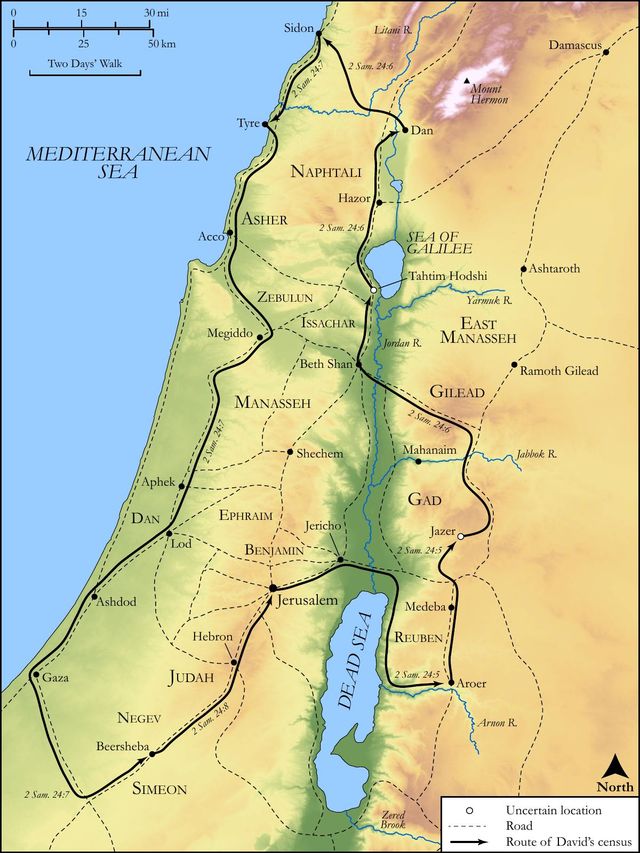
See on the biblical-era maps

Study this verse
Historical interpretation
Historical reception
1 surviving comment on this verse from the historical church.
Therefore, the king himself offered blessed David the threshing floor and oxen for a burnt offering, but King David refused to accept them without first paying a price. This, too, was fulfilled at the coming of our Lord and Savior, for he refused to take the hearts of the Gentiles for himself without first giving his precious blood for them. What, then, did he give? “Fifty shekels of silver,” it says. In the number fifty the grace of the Holy Spirit is understood and the remission of sins is designated. Indeed, on the fiftieth day the Holy Spirit was sent to the apostles, and in the Old Testament the fiftieth year was dedicated to forgiveness and pardon. That David, to be sure, gave silver; our David, whose type the other prefigured, shed his precious blood. Thus, in order to buy the pagan king’s threshing floor David offered fifty shekels; in order to build an altar to himself on the threshing floor of the Gentiles Christ, the true David, gave the grace of the Holy Spirit and forgiveness of sins on the fiftieth day. Therefore, brothers, since he has deigned to make a temple for himself in us and out of us, let him not suffer any insult in his home. If he does suffer injury because of our sins, he quickly withdraws, and woe to the unhappy soul from which he departs. Doubtless, if one is deserted by the light he will be seized by darkness. For this reason let us with his aid endeavor so to live that we may merit to have the good Lord not only as our guest but as a perpetual inhabitant: with the help of our same Lord Jesus Christ, to whom is honor and glory together with the Father and the Holy Spirit world without end. Amen.
Continue studying 2 Samuel 24:23 across the web’s major study libraries — every link below opens this exact verse, chapter, or book on the destination site.
Read & Compare
 BibleGatewayThis verse in more than 200 translations and 70 languages.
 Bible.comThe YouVersion reader — hundreds of translations, reading plans, and highlights.
 ESV.orgCrossway's official English Standard Version reader.
 NET BibleThe NET translation with 60,000+ translators' notes on every rendering decision.
 STEP BibleTyndale House's free study tool — original text, vocabulary, and scholarly resources.
 BibliaLogos Bible Software's free web reader.
 USCCBThe New American Bible (Revised Edition) with the U.S. bishops' study notes.
Commentaries
 BibleHub CommentariesDozens of classic commentaries on this verse, gathered on one page.
 StudyLightMore than 100 commentary sets — the largest collection on the web.
 BibleRefPlain-English commentary on what this verse means, verse by verse.
 Enduring WordDavid Guzik's free commentary on this chapter, widely used by Bible teachers.
 Bible Study ToolsVerse commentary alongside Greek and Hebrew study aids.
Original Language & Research
- BibleHub InterlinearThe verse word by word — original language, transliteration, and English.
- BibleHub LexiconEvery word's original-language definition and Strong's entry.
 Blue Letter BibleDeep-study tools — Strong's numbers, concordance, and word studies.
 SefariaThe Hebrew text with Rashi and centuries of Jewish commentary.
Sermons, Hymns & Audio


TrulyRandomVerse is not affiliated with these sites and doesn’t control their content. They’re linked because they’re genuinely useful.
Summary
2 Samuel 24:23 climaxes the narrative of Araunah's extraordinary generosity, wherein he, acting with kingly magnanimity, offers King David all the necessary provisions for a sacrifice to the LORD, concluding with a heartfelt prayer for divine acceptance. This pivotal verse not only underscores Araunah's remarkable selflessness and spiritual insight but also implicitly designates the sacred threshingfloor as the chosen site for a crucial act of atonement, marking the cessation of a devastating plague and foreshadowing its profound future significance as the location of God's Temple.
Context
ShowHideLiterary Context
This verse stands as the culmination of a critical episode in David's reign, immediately following his unauthorized and prideful census of Israel, an act that provoked God's severe wrath and resulted in a devastating plague that claimed seventy thousand lives across the nation, as recounted in 2 Samuel 24:15. In profound repentance and humility, David confessed his sin, prompting the prophet Gad to deliver a divine directive: David was to erect an altar to the LORD on the threshingfloor of Araunah the Jebusite (2 Samuel 24:18). Upon David's arrival, Araunah, a prominent Jebusite, immediately and spontaneously offered to provide all the necessary materials for the burnt offering—the oxen, the threshing sledges for wood, and the yokes—without cost (2 Samuel 24:22). Verse 23 confirms the immense scope of this gift and Araunah's accompanying spiritual blessing, setting the stage for David's principled refusal to offer to the LORD that which cost him nothing, a profound statement on the nature of true sacrifice (2 Samuel 24:24).
Historical & Cultural Context
The narrative is set in Jerusalem, the recently conquered Jebusite stronghold that David had established as his capital. Araunah (also known as Ornan in 1 Chronicles 21) was a Jebusite, indicating that not all indigenous inhabitants were displaced; some, like Araunah, retained significant landholdings and social standing, possibly even a chieftainship. Threshingfloors were typically elevated, open-air spaces, often on hilltops, designed to harness the wind for separating grain from chaff. Such locations, being somewhat isolated and exposed, were sometimes considered neutral or even sacred ground, making them suitable for altars and public ceremonies. The act of offering sacrifice was fundamental to Israelite worship, serving as a means of atonement, thanksgiving, and communion with God. Araunah's use of "the LORD thy God" suggests a remarkable familiarity with or respect for Yahweh, the God of Israel, or at least a clear recognition of David's God as supreme in this context of divine judgment. His magnanimity reflects a deep cultural understanding of hospitality and deference to a king, especially one seeking to appease divine wrath, yet his generosity transcends mere social custom.
Key Themes
ShowHideThis verse contributes profoundly to several overarching themes within 2 Samuel and the broader biblical narrative. Firstly, it powerfully illustrates the theme of Divine Sovereignty and Judgment, as God's wrath, incurred by David's sin, is met with a divinely appointed means of atonement and the eventual cessation of the plague. Secondly, the theme of Repentance and Atonement is central, highlighted by David's contrite heart leading to the specific divine instruction for sacrifice, which is then graciously facilitated by Araunah. Thirdly, Generosity and True Worship are strikingly presented through Araunah's unparalleled offer, which provides a stark contrast to David's conviction that genuine worship requires personal cost and cannot be offered cheaply (2 Samuel 24:24). Finally, and perhaps most significantly, the verse establishes the Profound Significance of the Temple Site. The threshingfloor of Araunah is divinely chosen as the exact location where David builds an altar, where the plague ceases, and where fire descends from heaven (1 Chronicles 21:26), thereby foreshadowing its future role as the permanent site of the First Temple built by Solomon (2 Chronicles 3:1). This ground, consecrated by divine intervention and acceptable sacrifice, becomes the sacred center of Israelite worship for centuries, a place where God's presence would dwell.
Exposition and Analysis
ShowHideKey Word Analysis
ShowHideFrom מָלַךְ; a king; king, royal. This word appears twice in the verse, referring first to Araunah ("as a king") and then to David ("unto the king"). Its application to Araunah is debated: it could signify his actual status as a Jebusite chieftain or former king, or it could describe the kingly, magnanimous manner of his giving. The latter interpretation emphasizes the extraordinary generosity, dignity, and authority with which he presented his offer, giving with the abundance and unreserved spirit characteristic of royalty.
A primitive root; to give, used with greatest latitude of application (put, make, etc.); add, apply, appoint, ascribe, assign, [idiom] avenge, [idiom] be (healed), bestow, bring (forth, hither), cast, cause, charge, come, commit, consider, count, [phrase] cry, deliver (up), direct, distribute, do, [idiom] doubtless, [idiom] without fail, fasten, frame, [idiom] get, give (forth, over, up), grant, hang (up), [idiom] have, [idiom] indeed, lay (unto charge, up), (give) leave, lend, let (out), [phrase] lie, lift up, make, [phrase] O that, occupy, offer, ordain, pay, perform, place, pour, print, [idiom] pull, put (forth), recompense, render, requite, restore, send (out), set (forth), shew, shoot forth (up), [phrase] sing, [phrase] slander, strike, (sub-) mit, suffer, [idiom] surely, [idiom] take, thrust, trade, turn, utter, [phrase] weep, [phrase] willingly, [phrase] withdraw, [phrase] would (to) God, yield. This versatile verb "give" highlights the active and generous nature of Araunah's offer. It implies a voluntary, unreserved transfer of ownership and resources. The breadth of its meaning underscores that Araunah was not merely providing, but bestowing a gift of immense value, crucial for the sacred act David was commanded to perform.
A primitive root; to be pleased with; specifically, to satisfy adebt; (be) accept(-able), accomplish, set affection, approve, consent with, delight (self), enjoy, (be, have, take) favour(-able), like, observe, pardon, (be, have, take) please(-ure), reconcile self. This verb, translated "accept," carries profound theological weight. It refers to God's favorable reception and approval of an offering, prayer, or person. For a sacrifice to be efficacious in achieving atonement or ending judgment, it must be "accepted" by God, signifying His pleasure and validation. Araunah's prayer for acceptance reflects a deep spiritual understanding that the mere act of offering is insufficient; it is God's gracious and sovereign reception that renders the offering valid and brings about its desired outcome.
Verse Breakdown
ShowHide"All these [things] did Araunah, [as] a king, give unto the king."
This clause emphatically conveys the completeness and extraordinary generosity of Araunah's offer. "All these [things]" refers to the oxen for the burnt offering, and the threshing sledges and yokes for the wood, all mentioned in the preceding verse as essential components for the sacrifice. The phrase "[as] a king" describes the manner of Araunah's giving—with a magnanimity, dignity, and abundance befitting royalty, whether he was a literal king or simply acted with a kingly spirit. The repetition of "king" (referring to Araunah, then to David) underscores the regal nature of this significant transaction. Araunah's unreserved gift to King David demonstrates profound respect for David's authority and his urgent mission to appease God, standing in stark contrast to the expectation of purchasing such valuable assets.
"And Araunah said unto the king, The LORD thy God accept thee."
This second clause reveals Araunah's remarkable spiritual insight and benevolent heart. His words constitute a sincere prayer or blessing, expressing a fervent desire for David's offering to be pleasing and effective in the sight of God. The phrase "The LORD thy God" indicates Araunah's clear recognition of Yahweh as David's deity, and by extension, the God who has brought the plague and possesses the power to remove it. Araunah's ultimate concern is not merely for David's well-being but for the divine acceptance of the sacrifice, which he understands to be the ultimate goal and validation of any offering made to God. This demonstrates a shared understanding of the critical need for divine favor and the efficacy of proper, divinely accepted worship.
Literary Devices
ShowHideThe verse employs several potent literary devices that enrich its meaning and impact. Characterization is strikingly evident, portraying Araunah as an individual of exceptional generosity, humility, and spiritual discernment, despite his Jebusite background. His actions and words reveal a noble spirit, willing to give freely and earnestly desiring divine favor for David's offering. The phrase "[as] a king" functions as a powerful Simile (or potentially a statement of his actual status), emphasizing the unparalleled quality and scale of his giving, likening it to the munificence expected of royalty. The subtle Repetition of "king" (referring first to Araunah's manner and then to David) subtly elevates the significance of the exchange, portraying it as a transaction between two figures of authority, one earthly and one divinely appointed. Furthermore, the entire narrative context leading to this verse, and this verse specifically, serves as profound Foreshadowing. The threshingfloor, consecrated by this altar and sacrifice, becomes the divinely chosen future site of the Temple, the permanent dwelling place for God's presence among His people. This divine choice of location, initiated by an act of atonement, imbues the place with deep Symbolism as a locus of reconciliation, divine presence, and acceptable worship.
Theological and Thematic Connections
ShowHide2 Samuel 24:23 is replete with profound theological implications, primarily centering on the nature of acceptable sacrifice, the significance of God's chosen dwelling place, and the demonstration of divine mercy. Araunah's profound generosity, coupled with his earnest prayer for divine acceptance, underscores a crucial biblical principle: true worship is not merely about the ritualistic act or the material offering, but about the sincere heart and pure intention behind it, seeking God's favor and approval above all else. This divine acceptance is absolutely crucial for the efficacy of any sacrifice, particularly in averting divine judgment. The narrative also powerfully demonstrates God's boundless mercy; even in the midst of severe judgment for sin, He graciously provides a clear path to reconciliation through repentance and atonement. The miraculous cessation of the plague at this specific site, marked by an altar and an accepted offering, divinely designates it as a sacred space, powerfully foreshadowing its future role as the Temple Mount—the very place where heaven and earth would meet, and where God's glorious presence would dwell among His people for centuries.
Reflection and Application
ShowHideAraunah's remarkable response to King David's urgent need for a place of sacrifice offers a profound and enduring lesson in radical generosity and the essential posture of true worship. In a moment of national crisis and divine judgment, Araunah did not cling to his valuable possessions but offered "all these things" freely and unreservedly, even going so far as to pray for divine acceptance of David's offering. This challenges us to deeply consider our own willingness to give to God and His work, not out of mere obligation or grudgingly, but with a cheerful, open, and genuinely sacrificial heart, prioritizing His glory and purposes above our own material gain or comfort. It serves as a powerful reminder that our acts of service, worship, and giving are ultimately directed towards God, and their true value is measured not by their material cost, but by the sincerity and devotion of our hearts, and ultimately, by God's gracious acceptance. Furthermore, the narrative powerfully highlights God's compassionate responsiveness to genuine repentance and His faithful provision of a means for reconciliation. When we, like David, turn to God in humility, confess our sins with a broken spirit, and earnestly seek His mercy, He unfailingly provides a way for atonement, forgiveness, and restoration, often in unexpected places and through the selfless actions of unexpected people.
Questions for Reflection
ShowHideFAQ
ShowHideWho was Araunah, and why was his threshingfloor so significant?
ShowHideAraunah was a Jebusite, one of the original inhabitants of Jerusalem before King David conquered the city and made it his capital. He was a prominent landowner, possibly a chieftain or even a former king of the Jebusites, given the phrase "[as] a king" used to describe his manner of giving in this verse. His threshingfloor held immense significance because it was the divinely appointed location where David was commanded to build an altar to the LORD to stop the devastating plague that afflicted Israel due to David's unauthorized census (2 Samuel 24:18). This specific site, where God's judgment ceased and an acceptable sacrifice was offered, later became the sacred ground upon which Solomon built the First Temple (2 Chronicles 3:1). It was a place where God's mercy was profoundly displayed and where His presence would dwell among His people for centuries.
Why did Araunah offer to give everything for free, and why did David refuse?
ShowHideAraunah's offer to give the oxen, threshing instruments, and wood for the sacrifice freely (2 Samuel 24:22) demonstrates extraordinary generosity and perhaps a recognition of David's divine mandate and the urgency of the national crisis. He acted with a "kingly" magnanimity, willing to provide all that was needed for an urgent national atonement without expectation of payment. However, David famously refused to accept the materials for free, stating, "Neither will I offer burnt offerings unto the LORD my God of that which doth cost me nothing" (2 Samuel 24:24). David understood that a true and meaningful sacrifice, particularly one for atonement, must involve personal cost, effort, and genuine sacrifice. It was not merely about performing a ritual, but about the sincere heart of the worshiper, demonstrating true repentance and a willingness to give something of tangible value to God. Offering something that cost him nothing would diminish the sincerity, spiritual weight, and integrity of the sacrifice in God's eyes.
Christ-Centered Fulfillment
ShowHideThe narrative of 2 Samuel 24:23, culminating in an acceptable sacrifice on Araunah's threshingfloor, powerfully foreshadows the ultimate, perfect, and once-for-all sacrifice of Jesus Christ. David's sin brought divine judgment, necessitating an altar and atonement to appease God's wrath—a temporary, symbolic solution that inherently pointed to a greater, permanent reality. Just as the plague miraculously ceased at the threshingfloor, so too does the judgment for sin cease for all who place their faith and trust in Christ. The "kingly" generosity of Araunah, giving "all these things" for the sacrifice, finds its supreme and eternal fulfillment in the King of Kings, Jesus, who did not merely give material possessions but gave Himself as the ultimate, infinitely costly sacrifice for the sins of the world (John 3:16). His sacrifice on the cross, the true altar, was not merely "accepted" by God, but was divinely ordained, perfectly efficacious, and eternally sufficient to atone for all sin, once for all (Hebrews 10:10-14). The threshingfloor, a place of separation and purification where grain is separated from chaff, symbolically points to Christ's work of separating believers from the condemnation of sin and purifying them for God's purposes. Furthermore, the site becoming the Temple Mount, the permanent dwelling place for God's presence, prefigures Christ as the true Temple, in whom the fullness of God dwells bodily and through whom believers are built into a spiritual dwelling for God by the Spirit (John 2:19-21; Ephesians 2:19-22). Thus, 2 Samuel 24:23, with its profound themes of costly sacrifice, divine acceptance, and a chosen place of atonement, ultimately directs our gaze to the person and redemptive work of Jesus Christ, the Lamb of God who truly takes away the sin of the world (John 1:29).