


1 Chronicles 21:19
Bible text: King James Version (1769 Blayney text) · Public domain
Bible text: Berean Standard Bible · Public domain
Bible text: American Standard Version (1901) · Public domain
Bible text: World English Bible, Messianic edition · Public domain
Bible text: Geneva Bible (1599) · Public domain
Bible text: Young's Literal Translation · Public domain
- וַיַּעַלvai·Ya·'aland he went upH5927Conj-w ¦ V-Qal-ConsecImperf-3msVerb Qal Consecutive Imperfect 3rd Singular Masculineוַandיַּעַלhe went up
- דָּוִידda·VidDavidH1732N-proper-mNoun Proper Masculine
- בִּדְבַרbid·varby [the] word ofH1697Prep-b ¦ N-mscNoun Singular Masculine Constructבִּbyדְבַר[the] word of
- גָּדGadGadH1410N-proper-mNoun Proper Masculine
- אֲשֶׁר'a·SherwhichH834RelParticle Relative
- דִּבֶּרdi·Berhe had spokenH1696V-Piel-Perf-3msVerb Piel Perfect 3rd Singular Masculine
- בְּשֵׁםbe·Shemin [the] name ofH8034Prep-b ¦ N-mscNoun Singular Masculine Constructבְּinשֵׁם[the] name of
- יְהוָהYah·wehYahwehH3068N-properNoun Proper Title
English is a literal word-by-word gloss of the Hebrew, not the KJV's wording. Why?
This is the original text the KJV's translators worked from — each Hebrew word with its own literal English meaning in this verse, prepared by scholars at Tyndale House, Cambridge. The KJV translates whole sentences, not word by word, so its wording differs: one Hebrew word can become several English words, and the KJV may choose “the LORD” where the gloss reads “Yahweh”. Both are faithful — they answer different questions. For the KJV's own rendering, switch to the KJV text.
Details
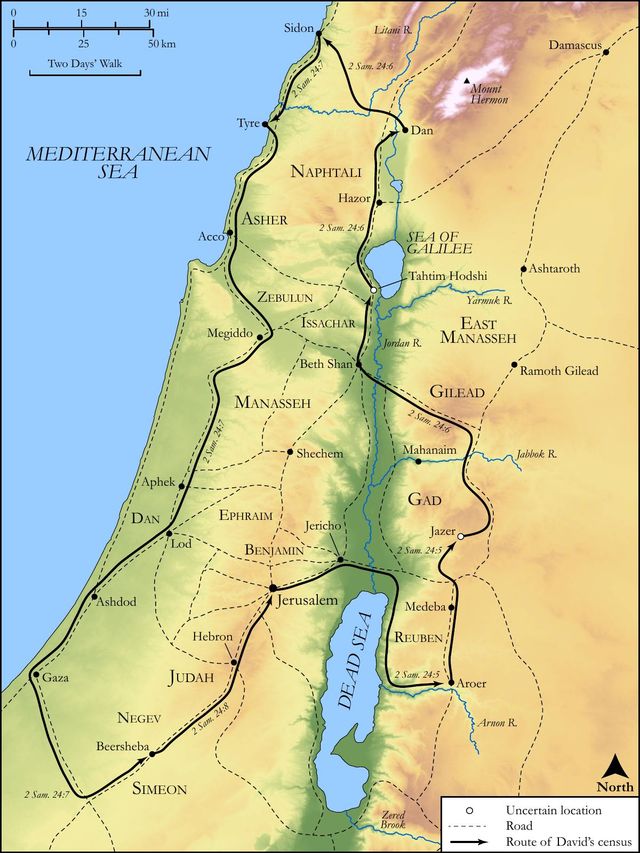
See on the biblical-era map
Study this verse
Public-domain commentary
Matthew Henry
From his Commentary on the Whole Bible. Henry comments on passages, not single verses — this entry covers 1 Chronicles 21:18–30.
We have here the controversy concluded, and, upon David's repentance, his peace made with God. Though thou wast angry with me, thy anger is turned away. 1. A stop was put to the progress of the execution, Ch1 21:15. When David repented of the sin God repented of the judgment, and ordered the destroying angel to stay his hand and sheath his sword, Ch1 21:27. 2. Direction was given to David to rear an altar in the threshing-floor of Ornan, Ch1 21:18. The angel commanded the prophet Gad to bring David this direction. The same angel that had, in God's name, carried on the war, is here forward to set on foot the treaty of peace; for angels do not desire the woeful day. The angel could have given this order to David himself; but he chose to do it by his seer, that he might put an honour upon the prophetic office. Thus the revelation of Jesus Christ was notified by the angel to John, and by him to the churches. The commanding of David to build an altar was a blessed token of reconciliation; for, if God had been pleased to kill him, he would not have appointed, because he would not have accepted, a sacrifice at his hands. 3. David immediately made a bargain with Ornan for the threshing-floor; for he would not serve God at other people's charge. Ornan generously offered it to him gratis, not only in complaisance to the king, but because he had himself seen the angel (Ch1 21:20), which so terrified him that he and his four sons hid themselves, as unable to bear the brightness of his glory and afraid of his drawn sword. Under these apprehensions he was willing to do anything towards making the atonement. Those that are duly sensible of the terrors of the Lord will do all they can, in their places, to promote religion, and encourage all the methods of reconciliation for the turning away of God's wrath. 4. God testified his acceptance of David's offerings on this altar; He answered him from heaven by fire, Ch1 21:26. To signify that God's anger was turned away from him, the fire that might justly have fastened upon the sinner fastened upon the sacrifice and consumed that; and, upon this, the destroying sword was returned into its sheath. Thus Christ was made sin and a curse for us, and it pleased the Lord to bruise him, that through him God might be to us, not a consuming fire, but a reconciled Father. 5. He continued to offer his sacrifices upon this altar. The brazen altar which Moses made was at Gibeon (Ch1 21:29), and there all the sacrifices of Israel were offered; but David was so terrified at the sight of the sword of the angel that he could not go thither, Ch1 21:30. The business required haste, when the plague was begun. Aaron must go quickly, nay, he must run, to make atonement, Num 16:46, Num 16:47. And the case here was no less urgent; so that David had not time to go to Gibeon: nor durst he leave the angel with his sword drawn over Jerusalem, lest the fatal stroke should be given before he came back. And therefore God, in tenderness to him, bade him build an altar in that place, dispensing with his own law concerning one altar because of the present distress, and accepting the sacrifices offered on this new altar, which was not set up in opposition to that, but in concurrence with it. The symbols of unity were not so much insisted on as unity itself. Nay, when the present distress was over (as it should seem), David, as long as he lived, sacrificed there, though the altar at Gibeon was still kept up; for God had owned the sacrifices that were here offered and had testified his acceptance of them, Ch1 21:28. On those administrations in which we have experienced the tokens of God's presence, and have found that he is with us of a truth, it is good to continue our attendance. "Here God had graciously met me, and therefore I will still expect to meet with him."
Continue studying 1 Chronicles 21:19 across the web’s major study libraries — every link below opens this exact verse, chapter, or book on the destination site.
Read & Compare
 BibleGatewayThis verse in more than 200 translations and 70 languages.
 Bible.comThe YouVersion reader — hundreds of translations, reading plans, and highlights.
 ESV.orgCrossway's official English Standard Version reader.
 NET BibleThe NET translation with 60,000+ translators' notes on every rendering decision.
 STEP BibleTyndale House's free study tool — original text, vocabulary, and scholarly resources.
 BibliaLogos Bible Software's free web reader.
 USCCBThe New American Bible (Revised Edition) with the U.S. bishops' study notes.
Commentaries
 BibleHub CommentariesDozens of classic commentaries on this verse, gathered on one page.
 StudyLightMore than 100 commentary sets — the largest collection on the web.
 BibleRefPlain-English commentary on what this verse means, verse by verse.
 Enduring WordDavid Guzik's free commentary on this chapter, widely used by Bible teachers.
 Bible Study ToolsVerse commentary alongside Greek and Hebrew study aids.
Original Language & Research
- BibleHub InterlinearThe verse word by word — original language, transliteration, and English.
- BibleHub LexiconEvery word's original-language definition and Strong's entry.
 Blue Letter BibleDeep-study tools — Strong's numbers, concordance, and word studies.
 SefariaThe Hebrew text with Rashi and centuries of Jewish commentary.
Sermons, Hymns & Audio


TrulyRandomVerse is not affiliated with these sites and doesn’t control their content. They’re linked because they’re genuinely useful.
Summary
1 Chronicles 21:19 records King David's immediate and unwavering response to the divine instruction delivered by the prophet Gad, a pivotal moment that underscores the profound importance of prompt obedience to God's specific word. This act of submission was not merely a personal decision but a divinely ordained step in the process of national repentance and atonement, directly leading to the cessation of the devastating plague that had afflicted Israel.
Context
ShowHideLiterary Context
This verse is situated at a critical juncture within the narrative of David's sin of numbering Israel, as recounted in 1 Chronicles 21. The chapter opens with Satan inciting David to take a census, an act rooted in pride and a reliance on human strength rather than divine provision (1 Chronicles 21:1). This transgression results in a devastating plague that sweeps across Israel, claiming 70,000 lives (1 Chronicles 21:14). Overwhelmed with remorse and seeing the angel of the Lord poised to destroy Jerusalem, David confesses his sin and pleads for the Lord's mercy (1 Chronicles 21:8). In response to David's genuine repentance, the prophet Gad, David's seer, is dispatched by the Lord with a specific command: David is to go and erect an altar to the Lord on the threshing floor of Ornan the Jebusite (1 Chronicles 21:18). Verse 19 then highlights David's immediate and unwavering action in response to this divine directive, setting the stage for the atonement and the cessation of the plague.
Historical & Cultural Context
In ancient Israel, prophets like Gad served as direct conduits for divine communication, delivering God's authoritative word to kings and the people. Their messages were not mere human counsel but were understood as binding commands from Yahweh Himself, carrying the weight of divine authority. The act of building an altar and offering sacrifices was the prescribed method for seeking atonement, expressing repentance, and appeasing divine wrath in the face of sin. Threshing floors, like Ornan's, were typically open, elevated spaces, making them suitable for public acts of worship and sacrifice. Furthermore, the narrative in Chronicles emphasizes the establishment of this specific site as the future location for the Temple (1 Chronicles 22:1), imbuing David's act of obedience with profound long-term significance for Israel's worship life and the centralization of their religious practices. The concept of a plague as divine judgment for sin was a common understanding in Israel, making the need for immediate, divinely-prescribed action paramount to restore order and divine favor.
Key Themes
ShowHideThis verse powerfully contributes to several key themes within 1 Chronicles. Obedience to Divine Command is paramount, as David's swift action demonstrates the necessity of immediate and complete compliance with God's word, especially when seeking deliverance or restoration from judgment. The phrase "which he spake in the name of the LORD" underscores the Divine Authority of Prophecy, emphasizing that Gad's message was not human advice but a direct, authoritative word from God Himself, authenticating the prophet's role as a divine messenger. It also highlights the theme of Repentance and Atonement, showing that genuine sorrow for sin must be accompanied by decisive action in accordance with God's prescribed path for dealing with sin and receiving mercy, as seen in David's subsequent sacrifices (1 Chronicles 21:26). Finally, the narrative beautifully illustrates God's Communication with Humanity, revealing His willingness to provide a path for reconciliation through His chosen servants, even in the midst of severe judgment, thereby demonstrating His faithfulness and mercy.
Exposition and Analysis
ShowHideKey Word Analysis
ShowHideThis verb signifies an ascent, often implying a movement towards a higher place, but also carries the connotation of offering or sacrifice (as in a "burnt offering," ‘olah'). Here, it denotes David's physical movement to the threshing floor, which would become the site of the altar, but also implicitly speaks to the spiritual ascent of an act of worship and obedience. David's "going up" is not merely a physical journey but a spiritual act of submission and worship, indicating a proactive and purposeful response.
Derived from the root "to speak," dâbâr here conveys a sense of a specific, authoritative utterance or command. It is not a suggestion, a piece of advice, or a general word, but a direct instruction from God, delivered through His prophet. This emphasizes the binding and imperative nature of Gad's message, demanding an immediate and decisive response from David.
While the full phrase is "in the name of the LORD," the word shêm itself signifies an appellation, a mark, or a memorial of individuality, by implication encompassing honor, authority, and character. When used in the phrase "in the name of the LORD," it signifies that Gad was speaking with the full authority, power, and character of God Himself. It means Gad was not speaking his own thoughts or opinions, but was acting as God's authorized representative, conveying a divine mandate that carried the very essence and authority of Yahweh.
Verse Breakdown
ShowHide"And David went up"
This clause emphasizes David's immediate and personal initiative, highlighting his prompt and direct action. Despite his royal status and the gravity of the situation, David does not delegate or delay. His physical movement is a tangible expression of a heart ready to obey God's command without hesitation, a stark contrast to his earlier sin of pride that led to the plague. This swift ascent signifies his humble submission and readiness to fulfill the divine directive.
"at the saying of Gad"
This specifies the direct impetus and the authoritative source for David's action. David is responding not to his own impulse, human wisdom, or a general sense of remorse, but to the specific, verbal instruction delivered by the prophet Gad. This highlights the crucial role of God's appointed messenger in conveying divine will and the importance of heeding such messages as direct communications from the Almighty. It underlines the principle of divine revelation guiding human action.
"which he spake in the name of the LORD"
This final, weighty phrase clarifies the ultimate source and supreme authority of Gad's "saying." It unequivocally states that the message was not Gad's personal advice or opinion, but a direct, authoritative word from Yahweh Himself. This underscores the divine origin of the command, making David's obedience an act of submission directly to God, rather than merely to a human prophet. This divine backing authenticates the message, validates Gad's prophetic office, and justifies David's immediate and absolute response, revealing the profound theological weight of the instruction.
Literary Devices
ShowHideThe verse employs several literary devices to convey its profound message with efficiency and impact. Narrative Economy is evident in the concise description of David's immediate action, highlighting his swift obedience without any reported hesitation or questioning. This brevity emphasizes the decisiveness and completeness of his response, contrasting with the detailed account of his earlier sin. The phrase "in the name of the LORD" serves as a powerful Divine Mandate, underscoring the absolute authority and divine origin of Gad's message, elevating it beyond human counsel and demanding unquestioning compliance. This also functions as Validation, confirming the legitimacy of Gad's prophetic role and the divine nature of the instruction, thereby reinforcing the imperative for David's obedience. Furthermore, the verse implicitly sets up a clear Cause and Effect relationship: the divine instruction (cause) leads to David's obedient action (effect), which in turn will lead to the cessation of the plague (subsequent effect, though not explicitly stated in this verse, it is the immediate outcome of the narrative). This structure reinforces the principle that God's commands are not arbitrary but are purposeful and efficacious, bringing about His desired outcomes.
Theological and Thematic Connections
ShowHide1 Chronicles 21:19 is a profound testament to the necessity and efficacy of immediate obedience to God's revealed will, especially in the context of repentance and atonement. David's swift response to Gad's divine instruction demonstrates a humble heart that prioritizes God's command above all else, even when it requires personal action and public acknowledgment of sin. This act of obedience was the divinely prescribed path to halt the plague and restore God's favor, illustrating that God's mercy is often contingent upon human response—specifically, a turning from sin and an active submission to His directives. The emphasis on Gad speaking "in the name of the LORD" underscores the unchanging principle that God communicates His will with authority, and our blessing often flows from our faithful and prompt adherence to it. This passage reinforces the sovereignty of God and His gracious provision of a path to reconciliation.
Reflection and Application
ShowHideDavid's immediate and unquestioning obedience in 1 Chronicles 21:19 serves as a powerful paradigm for believers today, offering profound lessons in spiritual discipline and trust. In a world that often encourages hesitation, questioning, or procrastination, David's swift action reminds us that true faith is often demonstrated through prompt and decisive compliance with God's revealed will. Whether through the clear directives of His written Word, the guiding whispers of the Holy Spirit, or the wise counsel of faithful spiritual leaders, God continues to speak and provide direction. Our response to His "saying" determines not only our personal spiritual trajectory but can also impact the well-being of our communities, just as David's obedience brought an end to a national crisis. This passage challenges us to cultivate a heart that is attuned to God's voice and ready to act without delay, trusting in His wisdom and authority, even when the path ahead is difficult, counter-intuitive, or demands personal sacrifice. True repentance involves not just sorrow for sin, but an active turning towards God's prescribed solutions and a willingness to obey His specific instructions for restoration.
Questions for Reflection
ShowHideFAQ
ShowHideWhy was David's obedience so crucial at this moment?
ShowHideDavid's obedience was crucial because it was the divinely prescribed action required to halt the devastating plague that had afflicted Israel due to his sin of numbering the people. God had specifically commanded him through the prophet Gad to build an altar and offer sacrifices on Ornan's threshing floor (1 Chronicles 21:18). David's immediate compliance demonstrated genuine repentance and submission to God's will, allowing God's mercy to be extended and the plague to cease (1 Chronicles 21:26-27). It was not merely an act of piety, but a necessary step in the process of national atonement and reconciliation with God, demonstrating that God's judgment can be averted through humble and obedient response to His commands.
What is the significance of Gad speaking "in the name of the LORD"?
ShowHideThe phrase "in the name of the LORD" signifies that Gad's message was not his own human counsel or opinion, but a direct, authoritative utterance from God Himself. This imbued the command with absolute divine authority, making it non-negotiable and demanding immediate, unquestioning obedience from David. It authenticated Gad as a true prophet of Yahweh and ensured that David's action was a direct response to God's will, rather than merely to a human messenger. This divine backing is what gave the command its power to bring about the cessation of the plague and underscored the sacred nature of the prophetic office as a conduit for God's infallible word.
Christ-Centered Fulfillment
ShowHideWhile 1 Chronicles 21:19 highlights David's crucial act of obedience in response to divine command, it ultimately points forward to the perfect and ultimate obedience of Jesus Christ. David's obedience, though vital for his time, brought only temporary relief and required repeated sacrifices under the Old Covenant. Christ, however, perfectly fulfilled the will of God, not just in a moment of crisis, but throughout His entire life and ministry, culminating in His sacrificial death on the cross. The altar David was commanded to build foreshadows the ultimate altar of the cross, where the one true and eternal sacrifice for sin was offered. Jesus, the true Lamb of God who takes away the sin of the world, perfectly obeyed the Father's "saying," even to the point of death (Philippians 2:8). Unlike David, who learned obedience through suffering and consequence (Hebrews 5:8-9), Christ's obedience was inherent, complete, and unblemished, offering Himself as the perfect and final atonement for humanity's sin. His "going up" to Jerusalem and ultimately to Calvary was the ultimate act of submission to God's redemptive will, bringing not just the cessation of a plague, but eternal salvation and reconciliation for all who believe (Hebrews 10:5-7).