


Mark 14:71
Bible text: King James Version (1769 Blayney text) · Public domain
Bible text: Berean Standard Bible · Public domain
Bible text: American Standard Version (1901) · Public domain
Bible text: World English Bible, Messianic edition · Public domain
Bible text: Geneva Bible (1599) · Public domain
Bible text: Young's Literal Translation · Public domain
- ὁho<the>G3588T-NSMDefinite article Nominative Singular Masculine
- δὲdeButG1161CONJConjunction
- ἤρξατοērxatohe beganG757V-ADI-3SVerb Aorist Middle Deponent Indicative 3rd Singular
- ἀναθεματίζεινanathematizeinto curseG332V-PANVerb Present Active Infinitive
- καὶkaiandG2532CONJConjunction
- ὀμνύναιomnunaito swearG3660V-PANVerb Present Active Infinitive
- ὅτιhotithatG3754CONJConjunction
- οὐκoukNotG3756PRT-NNegative Particle Negative
- οἶδαoidaI knowG1492V-RAI-1SVerb Perfect Active Indicative 1st Singular
- τὸνton<the>G3588T-ASMDefinite article Accusative Singular Masculine
- ἄνθρωπονanthrōponmanG444N-ASMNoun Accusative Singular Masculine
- τοῦτονtoutonthisG3778D-ASMDemonstrative pronoun Accusative Singular Masculine
- ὃνhonwhomG3739R-ASMRelative pronoun Accusative Singular Masculine
- λέγετεlegeteyou speak of!G3004V-PAI-2PVerb Present Active Indicative 2nd Plural
English is a literal word-by-word gloss of the Greek, not the KJV's wording. Why?
This is the original text the KJV's translators worked from — each Greek word with its own literal English meaning in this verse, prepared by scholars at Tyndale House, Cambridge. The KJV translates whole sentences, not word by word, so its wording differs: one Greek word can become several English words, and the KJV may choose “charity” where the gloss reads “love”. Both are faithful — they answer different questions. For the KJV's own rendering, switch to the KJV text.
Details
See on the biblical-era maps
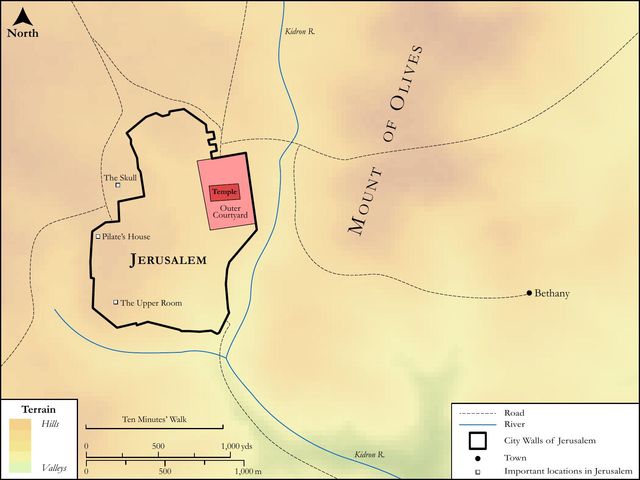
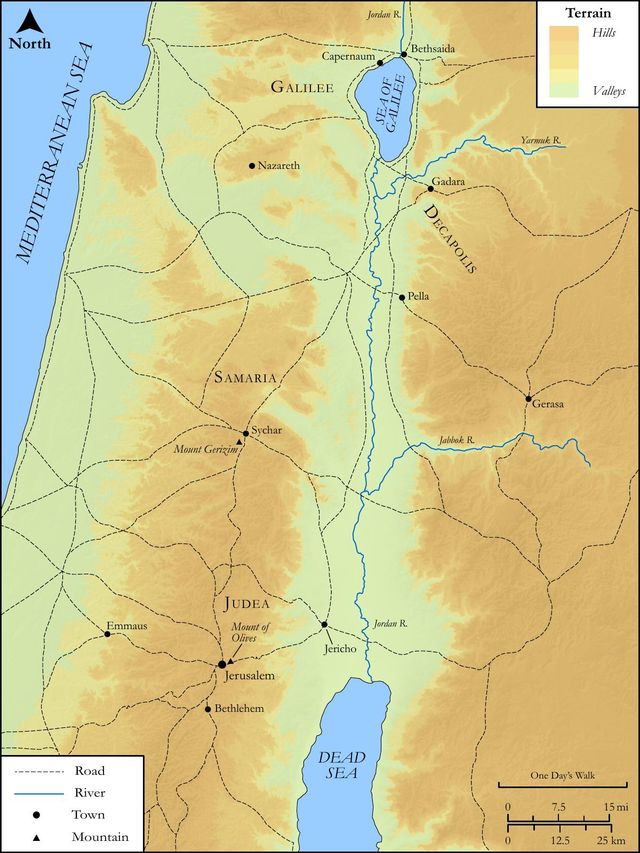
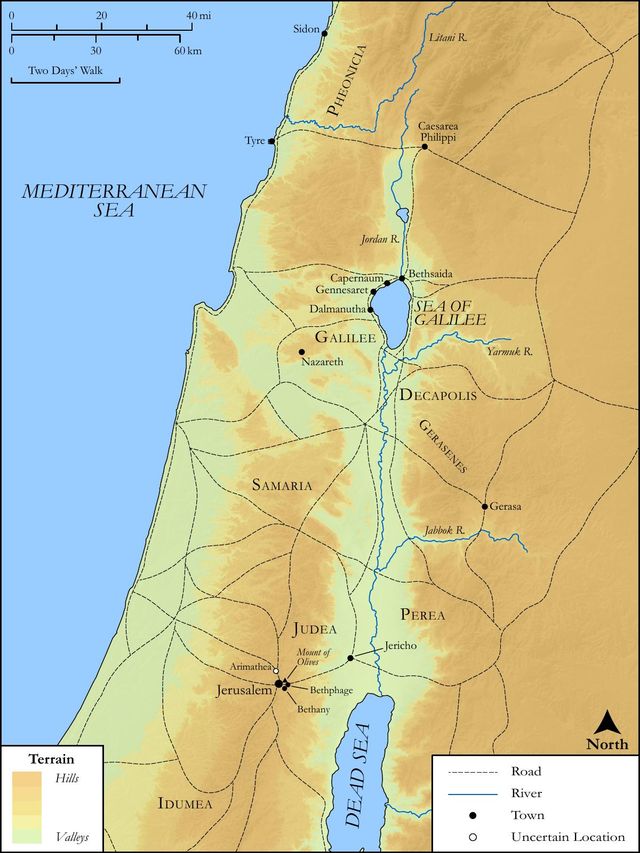
Study this verse
Public-domain commentary
Matthew Henry
From his Commentary on the Whole Bible. Henry comments on passages, not single verses — this entry covers Mark 14:66–72. His two-level outline is real structure in the source text, so it is rendered as structure.
We have here the story of Peter's denying Christ.
1.It began in keeping at a distance from him. Peter had followed afar off (Mar 14:54), and now was beneath in the palace, at the lower end of the hall. Those that are shy of Christ, are in a fair way to deny him, that are shy of attending on holy ordinances, shy of the communion of the faithful, and loth to be seen on the side of despised godliness.
2.It was occasioned by his associating with the high priest's servants, and sitting among them. They that think it dangerous to be in company with Christ's disciples, because thence they may be drawn in to suffer for him, will find it much more dangerous to be in company with his enemies, because there they may be drawn in to sin against him.
3.The temptation was, his being charged as a disciple of Christ; Thou also wert with Jesus of Nazareth, Mar 14:67. This is one of them (Mar 14:69), for thou art a Galilean, one may know that by thy speaking broad, Mar 14:70. It doth not appear that he was challenged upon it, or in danger of being prosecuted as a criminal for it, but only bantered upon it, and in danger of being ridiculed as a fool for it. While the chief priests were abusing the Master, the servants were abusing the disciples. Sometimes the cause of Christ seems to fall so much on the losing side, that every body has a stone to throw at it, and even the abjects gather themselves together against it. When Job was on the dunghill, he was had in derision of those that were the children of base men, Job 30:8. Yet, all things considered, the temptation could not be called formidable; it was only a maid that casually cast her eye upon him, and, for aught that appears, without design of giving him any trouble, said, Thou art one of them, to which he needed not to have made any reply, or might have said, "And if I be, I hope that is no treason."
4.The sin was very great; he denied Christ before men, at a time when he ought to have confessed and owned him, and to have appeared in court a witness for him. Christ had often given notice to his disciples of his own sufferings; yet, when they came, they were to Peter as great a surprise and terror as if he had never heard of them before. He had often told them that they must suffer for him, must take up their cross, and follow him; and yet Peter is so terribly afraid of suffering, upon the very first alarm of it, that he will lie and swear, and do any thing, to avoid it. When Christ was admired and flocked after, he could readily own him; but now that he is deserted, and despised, and run down, he is ashamed of him, and will own no relation to him.
5.His repentance was very speedy. He repeated his denial thrice, and the third was worst of all, for then he cursed and swore, to confirm his denial; and that the third blow, which, one would think, should have stunned him, and knocked him down, startled him, and roused him up. Then the cock crew the second time, which put him in mind of his Master's words, the warning he had given him, with that particular circumstance of the cock crowing twice; by recollecting that, he was made sensible of his sin and the aggravations of it; and when he thought thereon, he wept. Some observe that this evangelist, who wrote, as some have thought, by St. Peter's direction, speaks as fully of Peter's sin as any of them, but more briefly of his sorrow, which Peter, in modesty, would not have to be magnified, and because he thought he could never sorrow enough for great a sin. His repentance here is thus expressed, epibalōn eklaie, where something must be supplied. He added to weep, so some; making it a Hebraism; he wept, and the more he thought of it, the more he wept; he continued weeping; he flung out, and wept; burst out into tears; threw himself down, and wept; he covered his face, and wept, so some; cast his garment about his head, that he might not be seen to weep; he cast his eyes upon his Master, who turned, and looked upon him; so Dr. Hammond supplies it, and it is a probable conjecture. Or, as we understand it, fixing his mind upon it, he wept. It is not a transient thought of that which is humbling, that will suffice, but we must dwell upon it. Or, what if this word should mean his laying a load upon himself, throwing a confusion into his own face? he did as the publican that smote his breast, in sorrow for sin; and this amounts to his weeping bitterly.
Historical interpretation
Nine Centuries of Reception
5 surviving comments on this verse. Each one is dated, so this reads as a timeline rather than a list.
Select a marker to jump to its quote. Markers stagger vertically where authors wrote within a few decades of each other.
Peter when he had not the Spirit yielded and lost courage at the voice of a girl, though with the Spirit he was not afraid before princes and kings.
But in a mystical sense, the first maid means the wavering, the second, the assent, the third man is the act. This is the threefold denial which the remebrance of the word of the Lord washes away through tears. The cock then crows for us when some preacher up our hearts by repentance to compunction. We then begin to weep, when we are set on fire within by the spark of knowledge, and we go forth, when we cast out what we were within.
The second time he denied not simply but with an oath, the third time also with cursing. By this we are instructed never to promise without consideration anything above our human ability.
(upi. sup.) But what can be meant by his being first recognised by a woman, when men were more able to know him, if it be not that that sex might be seen to sin in the death of our Lord, and that sex be redeemed by His Passion? It goes on: But he denied, saying, I know not, neither understand I what thou sayest.
(ubi sup.) The other Evangelists do not mention this crowing of the cock; they do not however deny the fact, as also some pass over many other things in silence, which others relate. There follows: And a maid saw him again, and began to say to them that stood by, This is one of them
(ubi sup.) By this denial of Peter we learn, that not only he denies Christ, who says that He is not the Christ, but he also, who although he is a Christian, denies himself to be such. For the Lord did not say to Peter, Thou shalt deny thyself to be my disciple, but, Thou shalt deny me; he therefore denied Christ, when he said that he was not His disciple. There follows: And a little after, they that stood by said again to Peter, Surely thou art one of them, for thou art a Galilæan, and thy speech agreeth thereto. Not that the Galilæans spoke a different tongue from the inhabitants of Jerusalem, for they were both Hebrews, but that each province and region has its own peculiarities, and cannot avoid a vernacular pronunciation.
(ubi sup.) How hurtful is it to speak with the wicked. He denies before infidels that he knows the man, whom amongst the disciples, he had confessed to be God. But the Scripture is wont to point out a Sacrament of the causes of things, by the state of the time; thus Peter, who denied at midnight, repented at cock crow; wherefore it is added: And the second time the cock crew. And Peter called to mind the word which Jesus said unto him, Before the cock crow twice, thou shalt deny me thrice. And he began to weep.
But he began to curse and to swear: "I do not know this man you are talking about." And immediately the rooster crowed again. Scripture is wont to designate the mystery of events by the state of times. Hence Peter, who denied in the middle of the night, repented at the crowing of the rooster. He who even after the resurrection of the Lord professed by daylight equally thrice to love Him whom he had thrice denied. For surely, what he erred in the darkness of oblivion, he corrected by the remembrance of the hoped-for light, and by the acquisition of the presence of the true light, fully raised all that had faltered. I think this rooster is to be understood as some teacher, who, awakening us supine and rebuking the sleepy, says: "Awake to righteousness, and do not sin."
The Lord allowed this to happen to him by His providence, that is, lest he should be too much elated, and at the same time, that he might prove himself merciful to sinners, as knowing from himself the result of human weakness. There follows: And he went out into the porch; and the cock crew.
Therefore Peter was seized with fear, and for-getting the word of the Lord, which said, Whosoever shall confess me before men, him will I confess before my Father, (Matt. 30, 32) he denied our Lord; wherefore there follows: But he began to curse and to swear, saying, I know not this man of whom ye speak.
For tears brought Peter by penitence to Christ. Confounded then be the Novatians, who say that he who sins after receiving baptism, is not received to the remission of his sin. For behold Peter, who had also received the Body and Blood of the Lord, is received by penitence; for the failings of saints are written, that if we fall by want of caution, we also may be able to run back through their example, and hope to be relieved by penitence.
Continue studying Mark 14:71 across the web’s major study libraries — every link below opens this exact verse, chapter, or book on the destination site.
Read & Compare
 BibleGatewayThis verse in more than 200 translations and 70 languages.
 Bible.comThe YouVersion reader — hundreds of translations, reading plans, and highlights.
 ESV.orgCrossway's official English Standard Version reader.
 NET BibleThe NET translation with 60,000+ translators' notes on every rendering decision.
 STEP BibleTyndale House's free study tool — original text, vocabulary, and scholarly resources.
 BibliaLogos Bible Software's free web reader.
 USCCBThe New American Bible (Revised Edition) with the U.S. bishops' study notes.
Commentaries
 BibleHub CommentariesDozens of classic commentaries on this verse, gathered on one page.
 StudyLightMore than 100 commentary sets — the largest collection on the web.
 BibleRefPlain-English commentary on what this verse means, verse by verse.
 Enduring WordDavid Guzik's free commentary on this chapter, widely used by Bible teachers.
 Bible Study ToolsVerse commentary alongside Greek and Hebrew study aids.
Original Language & Research
- BibleHub InterlinearThe verse word by word — original language, transliteration, and English.
- BibleHub LexiconEvery word's original-language definition and Strong's entry.
 Blue Letter BibleDeep-study tools — Strong's numbers, concordance, and word studies.
 CNTR CollationThe earliest Greek manuscripts of this verse, collated letter by letter.
Sermons, Hymns & Audio


TrulyRandomVerse is not affiliated with these sites and doesn’t control their content. They’re linked because they’re genuinely useful.
Summary
Mark 14:71 records the climactic and most vehement of Peter's three denials of Jesus, occurring in the high priest's courtyard while Jesus endured an unjust trial. In a desperate attempt to disassociate himself from Jesus and avoid potential arrest or persecution, Peter not only denied knowing Jesus but fortified his denial with solemn curses and oaths, directly fulfilling Jesus' earlier prophecy concerning his betrayal. This moment starkly highlights the fragility of human resolve under pressure and the profound depth of Peter's fear.
Context
ShowHideLiterary Context
This verse is the culmination of a rapidly unfolding narrative of betrayal and abandonment. Immediately preceding it, Peter has already denied Jesus twice, first to a servant girl and then to others who identified him by his Galilean accent. The scene is set in the courtyard of the high priest, a dangerous place for any associate of Jesus, especially as Jesus himself is undergoing a sham trial inside. Peter's presence there, initially an act of loyalty, quickly devolves into self-preservation. This final denial, marked by its intensity, directly fulfills Jesus' specific prophecy in Mark 14:30 that Peter would deny Him three times before the cock crowed twice. The narrative structure emphasizes the rapid succession of denials, building to this desperate climax.
Historical & Cultural Context
In first-century Jewish society, an oath was a profoundly serious matter, often invoking God's name or a sacred object to attest to the truth of a statement. To "curse" (ἀναθεματίζω, anathematízō) oneself meant to call down divine judgment or execration upon oneself if one's statement was false. This was not casual swearing but a solemn, binding declaration, intended to convince listeners of one's absolute sincerity. Peter's use of such language underscored the gravity of his denial and his desperate attempt to create an undeniable separation from Jesus. The setting in the high priest's courtyard, a center of religious and legal authority, would have made such an oath even more potent and binding in the eyes of those present.
Key Themes
ShowHideMark 14:71 powerfully underscores several key themes within the Gospel of Mark and the broader biblical narrative. Firstly, it highlights human weakness and fallibility, even among the most devoted disciples. Peter, who boldly declared his unwavering loyalty in Mark 14:29, succumbs to fear, demonstrating the profound limitations of human strength apart from divine empowerment. Secondly, it serves as a striking example of the fulfillment of prophecy, showcasing Jesus' divine foreknowledge and the sovereign hand of God orchestrating events, even through human failure. Jesus' words in Mark 14:30 are precisely and dramatically realized. Finally, the verse emphasizes the gravity of denial, particularly when it involves disavowing one's allegiance to Christ under pressure. Peter's actions foreshadow the immense cost of discipleship and the temptation to compromise faith in the face of persecution, a theme relevant throughout the New Testament, as seen in passages like Matthew 10:33.
Exposition and Analysis
ShowHideKey Word Analysis
ShowHideFrom ἀνάθεμα (anáthema), this verb means "to declare or vow under penalty of execration." In this context, Peter was not merely uttering profanity but solemnly calling down a curse upon himself, invoking divine judgment if his statement (that he did not know Jesus) was untrue. It was a desperate and forceful way to emphasize the 'truth' of his denial, aiming to convince his accusers of his complete dissociation from Jesus.
This word signifies "to swear, i.e., take (or declare on) oath." Peter was taking a solemn oath, likely by God or something sacred, to affirm the veracity of his denial. This action elevated his denial from a simple statement to a binding declaration, demonstrating his extreme resolve to convince those around him that he had no connection to Jesus.
While primarily meaning "to see" (literally or figuratively), in its perfect tense, as used here, it carries the sense of "to know" or "to be aware." Peter's emphatic declaration, "I know not this man," signifies a complete disavowal of any acquaintance, relationship, or even recognition of Jesus. This is a denial of intimate knowledge and association, not merely a lack of casual familiarity.
Verse Breakdown
ShowHide"But he began to curse and to swear"
This phrase marks a significant escalation in Peter's denials. The use of "began" (G756, árchomai) suggests a sudden, intense outburst. Peter moves beyond simple verbal denial to invoking a solemn oath and a self-curse. This act was intended to lend absolute credibility to his claim of ignorance, demonstrating his desperation to convince his accusers and protect himself from any association with Jesus, who was at that moment being condemned. It reveals the depth of his fear and the extent to which he was willing to go to save his own life.
"saying, I know not this man of whom ye speak"
This is the substance of Peter's final and most forceful denial. The phrase "this man" (G5126, toûton, G444, ánthrōpos) is dismissive, further distancing himself from Jesus by refusing to even use His name. Peter's assertion of not knowing Jesus is a direct contradiction of his entire discipleship and relationship with Christ. It is a complete and public repudiation of his master, uttered under the most severe circumstances and reinforced by the solemnity of his curses and oaths. This statement, coupled with the immediate crowing of the cock, brings the weight of Jesus' prophecy crashing down upon Peter.
Literary Devices
ShowHideMark 14:71 is rich with literary devices that amplify its dramatic impact. Irony is profoundly present, as Peter, who vowed unwavering loyalty, vehemently denies his Master. The "rock" (Peter's name) crumbles under pressure. Foreshadowing is evident in Jesus' earlier prophecy in Mark 14:30, which is precisely fulfilled here, underscoring Jesus' divine foreknowledge and control even amidst human failure. The verse also employs Contrast between Peter's earlier bold declarations of loyalty and his current desperate, fear-driven denials. Furthermore, the act of "cursing and swearing" can be seen as a form of Hyperbole, as Peter uses extreme language to emphasize his denial, going beyond a simple "no" to a solemn, self-incriminating oath, thus highlighting the intensity of his fear and the gravity of the situation.
Theological and Thematic Connections
ShowHidePeter's dramatic failure in Mark 14:71 serves as a profound theological lesson on human frailty and the nature of divine grace. It underscores the truth that even the most devoted followers of Christ are susceptible to fear, temptation, and profound moral failure when relying on their own strength. Peter's fall is not merely a personal anecdote but a universal illustration of the human condition, prone to compromise and self-preservation in the face of intense pressure. Yet, this moment of profound weakness also sets the stage for God's redemptive grace, demonstrating that repentance and restoration are possible even after severe betrayal. It highlights God's unwavering faithfulness, even when His chosen instruments falter, and the ultimate triumph of His plan over human shortcomings.
Reflection and Application
ShowHidePeter's denial is a sobering reminder that spiritual strength is not inherent but derived from constant dependence on God. His story encourages humility, warning against overconfidence in our own resolve, especially when facing trials or social pressure to compromise our faith. We are called to learn from Peter's failure, recognizing our own capacity for weakness and the ever-present need for vigilance and prayer, as Jesus Himself exhorted His disciples in Mark 14:38. However, Peter's subsequent repentance and restoration by Jesus offer immense hope. His journey from denial to renewed discipleship, as powerfully depicted in John 21:15-19, assures us that God's grace is greater than our gravest failures. It teaches us that genuine repentance leads to forgiveness, healing, and renewed purpose, transforming even the deepest shame into a testimony of God's redemptive power. We are invited to embrace both the humility of our fallibility and the boundless hope of God's restorative love.
Questions for Reflection
ShowHideFAQ
ShowHideWhy did Peter curse and swear, and what was the significance of this act?
ShowHidePeter cursed and swore to vehemently deny any association with Jesus. In that cultural context, to "curse" (ἀναθεματίζω, anathematízō) meant to call down a divine curse upon oneself if one's statement was false, while to "swear" (ὀμνύω, omnýō) meant to take a solemn oath, often invoking God. Peter's use of such language was a desperate and extreme measure to convince his accusers of his absolute sincerity and to distance himself from Jesus, thereby protecting himself from potential arrest or persecution. This was not casual profanity but a binding, self-incriminating declaration meant to leave no doubt about his disavowal. It highlights the profound fear and pressure Peter was under in the high priest's courtyard during Jesus' trial.
How does Peter's denial fulfill Jesus' prophecy?
ShowHidePeter's denial directly and precisely fulfills Jesus' prophecy given earlier in Mark 14:30, where Jesus stated, "Truly, I tell you, this very night, before the rooster crows twice, you will deny me three times." The sequence of events in Mark 14:66-72 meticulously details Peter's three denials, culminating in this final, most emphatic one, immediately followed by the second crow of the rooster. This fulfillment underscores Jesus' divine foreknowledge and the sovereign hand of God at work, even through the failures of His disciples. It serves as a powerful testament to the reliability of Jesus' words.
What happened to Peter after this denial, and how was he restored?
ShowHideImmediately after his third denial and the cock crowing, Peter "broke down and wept" (Mark 14:72). This deep remorse was a crucial first step towards his restoration. After Jesus' resurrection, He specifically appeared to Peter (Luke 24:34; 1 Corinthians 15:5), a sign of His forgiveness and continued love. The most detailed account of Peter's restoration is found in John 21:15-19, where Jesus, by the Sea of Galilee, asks Peter three times if he loves Him, corresponding to Peter's three denials. Each affirmation of love is met with a commission to "feed my lambs" or "tend my sheep," symbolically restoring Peter to his pastoral role and leadership among the disciples. This powerful act of grace demonstrates God's willingness to forgive and restore those who genuinely repent, transforming failure into a foundation for future service.
Christ-Centered Fulfillment
ShowHidePeter's vehement denial in Mark 14:71 stands in stark contrast to the unwavering faithfulness of Jesus Christ. While Peter, in his human weakness and fear, disavowed his Master, Jesus, at that very moment, was enduring the unjust trial and condemnation that would lead to His atoning sacrifice. Peter's failure highlights the universal human condition of sin and our inability to perfectly uphold God's law or remain faithful in our own strength. However, it is precisely for such failures that Christ came. He is the perfectly obedient Son, who never denied His Father or His mission, even unto death on the cross. Jesus' intercession for Peter, as recorded in Luke 22:31-32, where He prayed that Peter's faith would not fail, demonstrates His compassionate High Priestly ministry even before the denial occurred. Ultimately, Peter's restoration after the resurrection, detailed in John 21:15-19, is a profound testament to the power of Christ's grace and forgiveness. The Lamb of God, who takes away the sin of the world (John 1:29), bore the shame and penalty for Peter's denial, and for all our denials, offering reconciliation and a path to renewed service through His perfect life, atoning death, and glorious resurrection.