


Joshua 9:23
- וְעַתָּהve·'a·Tahand thereforeH6258Conj-w ¦ AdvAdverbוְandעַתָּהtherefore
- אֲרוּרִים'a·ru·Rim[are] cursedH779V-Qal-PassPrtcpl-mpVerb Qal Participle Passive Plural Masculine Absolute
- אַתֶּם'a·TemyouH859Pro-2mpPronoun Personal 2nd Plural Masculine
- וְלֹאve·lo'and notH3808Conj-w ¦ NegParticle Negativeוְandלֹאnot
- יִכָּרֵתyi·ka·Rethe will be cut offH3772V-Niphal-Imperf-3msVerb Niphal Imperfect 3rd Singular Masculine
- מִכֶּםmi·Kemfrom <the> youPrep-m ¦ 2mpSuffix Personal 2nd Plural Masculineמִfrom <the>כֶּםyou
- עֶבֶד'E·veda slaveH5650N-msNoun Singular Masculine Absolute
- וְחֹטְבֵיve·cho·te·Veiand cutters ofH2404Conj-w ¦ V-Qal-Prtcpl-mpVerb Qal Participle Plural Masculine Constructוְandחֹטְבֵיcutters of
- עֵצִים'e·Tzimwood<s>H6086N-mpNoun Plural Masculine Absolute
- וְשֹׁאֲבֵיve·sho·'a·veiand drawers ofH7579Conj-w ¦ V-Qal-Prtcpl-mpVerb Qal Participle Plural Masculine Constructוְandשֹׁאֲבֵיdrawers of
- מַיִםMa·yimwaterH4325N-mpNoun Plural Masculine Absolute
- לְבֵיתle·Veitfor [the] house ofH1004Prep-l ¦ N-mscNoun Singular Masculine Constructלְforבֵית[the] house of
- אֱלֹהָי'e·lo·Haimy GodH430N-mpc ¦ 1csNoun Plural Masculine ConstructאֱלֹהָGodיmy
English is a literal word-by-word gloss of the Hebrew, not the KJV's wording. Why?
This is the original text the KJV's translators worked from — each Hebrew word with its own literal English meaning in this verse, prepared by scholars at Tyndale House, Cambridge. The KJV translates whole sentences, not word by word, so its wording differs: one Hebrew word can become several English words, and the KJV may choose “the LORD” where the gloss reads “Yahweh”. Both are faithful — they answer different questions. For the KJV's own rendering, switch to the KJV text.
Details
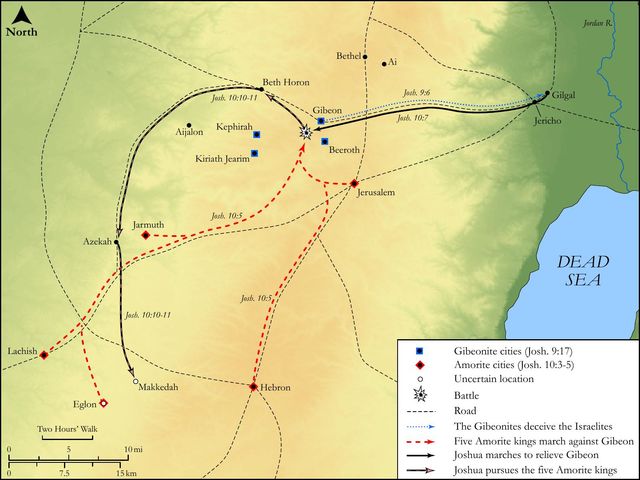
See on the biblical-era map
Study this verse
Public-domain commentary
Matthew Henry
From his Commentary on the Whole Bible. Henry comments on passages, not single verses — this entry covers Joshua 9:22–27. His four-level outline is real structure in the source text, so it is rendered as structure.
The matter is here settled between Joshua and the Gibeonites, and an explanation of the league agreed upon. We may suppose that now, not the messengers who were first sent, but the elders of Gibeon, and of the cities that were dependent upon it, were themselves present and treated with, that the matter might be fully compromised.
I.Joshua reproves them for their fraud, Jos 9:22. And they excuse it as well as they can, Jos 9:24.
1.Joshua gives the reproof very mildly: Wherefore have you beguiled us? He does not load them with any ill names, does not give them any harsh provoking language, does not call them, as they deserved to be called, base liars, but only asks them, Why have you beguiled us? Under the greatest provocations, it is our wisdom and duty to keep our temper, and to bridle our passion; a just cause needs not anger to defend it, and a bad one is made never the better by it.
2.They make the best excuse for themselves, that the thing would bear, Jos 9:24. They found by the word of God that sentence of death was passed upon them (the command was to destroy all the inhabitants of the land, without exception), and they found by the works of God already wrought that there was no opposing the execution of this sentence; they considered that God's sovereignty is incontestable, his justice inflexible, his power irresistible, and therefore resolved to try what his mercy was, and found it was not in vain to cast themselves upon it. They do not go about to justify their lie, but in effect beg pardon for it, pleading it was purely to save their lives that they did it, which every man that finds in himself the force of the law of self-preservation will therefore make great allowances for, especially in such a case as this, where the fear was not merely of the power of man (if that were all, one might flee from that to the divine protection), but of the power of God himself, which they saw engaged against them.
II.Joshua condemns them to servitude, as a punishment of their fraud (Jos 9:23), and they submit to the sentence (Jos 9:25), and for aught that appears both sides are pleased.
1.Joshua pronounces them perpetual bondmen. They had purchased their lives with a lie, but, that being no good consideration, he obliges them to hold their lives under the rent and reservation of their continual labours, in hewing wood and drawing water, the meanest and most toilsome employments. Thus their lie was punished; had they dealt fairly and plainly with Israel, perhaps they would have had more honourable conditions granted them, but now, since they gain their lives with ragged clothes and clouted shoes, the badges of servitude, they are condemned for ever to wear such, so must their doom be. And thus the ransom of their lives is paid; dominion is acquired by the preservation of a life that lies at mercy (servus dicitur a servando - a servant is so called from the act of saving); they owe their service to those to whom they owe their lives. Observe how the judgment is given against them.
(1.)Their servitude is made a curse to them. "Now you are cursed with the ancient curse of Canaan," from whom these Hivites descended, a servant of servants shalt thou be, Gen 9:25. What shall be done to the false tongue but this? Cursed shall it be.
(2.)Yet this curse is turned into a blessing; they must be servants, but it shall be for the house of my God. The princes would have them slaves unto all the congregation (Jos 9:21), at least they chose to express themselves so, for the pacifying of the people that were discontented; but Joshua mitigates the sentence, both in honour to God and in favour to the Gibeonites: it would be too hard upon them to make them every man's drudge; if they must be hewers of wood and drawers of water, than which there cannot be a greater disparagement, especially to those who are citizens of a royal city, and all mighty men (Jos 10:2), yet they shall be so to the house of my God, than which there cannot be a greater preferment: David himself could have wished to be a door-keeper there. Even servile work becomes honourable when it is done for the house of our God and the offices thereof.
[1.]They were hereby excluded from the liberties and privileges of true-born Israelites, and a remaining mark of distinction was put upon their posterity throughout all their generations.
[2.]They were hereby employed in such services as required their personal attendance upon the altar of God in the place which he should choose (Jos 9:27), which would bring them to the knowledge of the law of God, keep them strictly to that holy religion to which they were proselyted, and prevent their revolt to the idolatries of their fathers.
[3.]This would be a great advantage to the priests and Levites to have so many, and those mighty men, constant attendants upon them, and engaged by office to do all the drudgery of the tabernacle. A great deal of wood must be hewed for fuel for God's house, not only to keep the fire burning continually upon the altar, but to boil the flesh of the peace-offerings, etc. And a great deal of water must be drawn for the divers washings which the law prescribed. These and other such servile works, such as washing the vessels, carrying out ashes, sweeping the courts, etc., which otherwise the Levites must have done themselves, these Gibeonites were appointed to do.
[4.]They were herein servants to the congregation too; for whatever promotes and helps forward the worship of God is real service to the commonwealth. It is the interest of every Israelite that the altar of God be well attended. Hereby also the congregation was excused from much of that servile work which perhaps would otherwise have been expected from some of them. God had made a law that the Israelites should never make any of their brethren bondmen; if they had slaves, they must be of the heathen that were round about them, Lev 25:44. Now in honour of this law, and of Israel that was honoured by it, God would not have the drudgery, no, not of the tabernacle itself, to be done by Israelites, but by Gibeonites, who were afterwards called Nethinim, men given to the Levites, as the Levites were to the priests (Num 3:9), to minister to them in the service of God.
[5.]This may be looked upon as typifying the admission of the Gentiles into the gospel church. Now they were taken in upon their submission to be under-officers, but afterwards God promises that he will take of them for priests and Levites, Isa 66:21.
2.They submit to this condition, Jos 9:25. Conscious of a fault in framing a lie whereby to deceive the Israelites, and sensible also how narrowly they escaped with their lives and what a kindness it was to have them spared, they acquiesce in the proposal: Do as it seemeth right unto thee. Better live in servitude, especially such servitude, than not live at all. Those of the very meanest and most despicable condition are described to be hewers of wood and drawers of water, Deu 29:11. But skin for skin, liberty, and labour, and all that a man has, will he give for his life, and no ill bargain. Accordingly the matter was determined.
(1.)Joshua delivered them out of the hands of the Israelites that they should not be slain, Jos 9:26. It seems there were those who would have fallen upon them with the sword if Joshua had not interposed with his authority; but wise generals know when to sheathe the sword, as well as when to draw it.
(2.)He then delivered them again into the hands of the Israelites to be enslaved, Jos 9:27. They were not to keep possession of their cities, for we find afterwards that three of them fell to the lot of Benjamin and one to that of Judah; nor were they themselves to be at their own disposal, but, as bishop Patrick thinks, were dispersed into the cities of the priests and Levites, and came up with them in their courses to serve at the altar, out of the profits of which, it is probable, they were maintained. And thus Israel's bondmen became the Lord's freemen, for his service in the meanest office is liberty, and his work is its own wages. And this they got by their early submission. Let us, in like manner, submit to our Lord Jesus, and refer our lives to him, saying, "We are in thy hand, do unto us as seemeth good and right unto thee; only save our souls, and we shall not repent it:" if he appoint us to bear his cross, and draw in his yoke, and serve at his altar, this shall be afterwards neither shame nor grief to us, while the meanest office in God's service will entitle us to a dwelling in the house of the Lord all the days of our life.
Historical interpretation
Historical reception
2 surviving comments on this verse. Each one is dated, so this reads as a timeline rather than a list.
Of course, it must be observed that the heretics reading this passage, those who do not accept the Old Testament, are accustomed to make a malicious charge and say, “See how Jesus [Joshua] the son of Nun showed no human kindness, so that, although permitting salvation, he inflicted a mark of infamy and a yoke of servitude upon those men who had come to him in supplication.” If the soul less instructed in the divine Scriptures hears these things, it can in consequence be enfeebled and endangered, so that it may shun the catholic faith; for they do not understand their deceptions. For Jesus [Joshua] passed a fitting judgment upon them according to the measure of their own faith.Formerly Rahab the harlot, who believed with a sound faith with all her house and received the Israelite spies with fullest devotion, was received fully into the community and society of the people; and it is written of her that “she was attached to the sons of Israel until today.” But those who did not so much love the community of the Israelite clan as they were terrified by fear of their destruction approached Jesus [Joshua] with cunning and fraud. How could they deserve the liberty of life and the community of the kingdom in their slavish deceits?
Finally, do you wish to know that the condition was dispensed toward them by Jesus [Joshua] because the inferiority of their disposition was fitting for them? They themselves say, “We have heard how many things the Lord did for you.” through the midst of the Red Sea and in the desert. And although they said these things and confessed that they had both heard and known of the divine miracles, yet they produced nothing worthy in faith, nothing in admiration of such great powers. And therefore Jesus, when he sees the narrowness and smallness displayed in their faith, preserves a very just moderation towards them, so that they might merit salvation. Although they had brought a little faith, nevertheless they did not receive the highest rank of the kingdom or of freedom because their faith was not ennobled by the increase of works, since the apostle James declares, “faith without works is dead.”
Thus, therefore, you also, if you have brought a word in praise of God, not new and fresh from the learning of the spirit, from the doctrine of God’s grace, your mouth indeed offers “a sacrifice of praise,” but your mind is accused on account of the sterility of yesterday’s flesh. For the Lord did not delay and order the bread which he gave to the disciples to be reserved for the next day when he said to them, “Take and eat.” Perhaps there is something of this mystery in the fact that “he commands them not to carry bread on the way,” that you always bring fresh loaves of the word of God which you carry within you. For this reason, the Gibeonites are condemned, and they become “cutters of wood and carriers of water” because they had brought old bread to the Israelites whom the spiritual law ordered always to use fresh and new.
Continue studying Joshua 9:23 across the web’s major study libraries — every link below opens this exact verse, chapter, or book on the destination site.
Read & Compare
 BibleGatewayThis verse in more than 200 translations and 70 languages.
 Bible.comThe YouVersion reader — hundreds of translations, reading plans, and highlights.
 ESV.orgCrossway's official English Standard Version reader.
 NET BibleThe NET translation with 60,000+ translators' notes on every rendering decision.
 STEP BibleTyndale House's free study tool — original text, vocabulary, and scholarly resources.
 BibliaLogos Bible Software's free web reader.
 USCCBThe New American Bible (Revised Edition) with the U.S. bishops' study notes.
Commentaries
 BibleHub CommentariesDozens of classic commentaries on this verse, gathered on one page.
 StudyLightMore than 100 commentary sets — the largest collection on the web.
 BibleRefPlain-English commentary on what this verse means, verse by verse.
 Enduring WordDavid Guzik's free commentary on this chapter, widely used by Bible teachers.
 Bible Study ToolsVerse commentary alongside Greek and Hebrew study aids.
Original Language & Research
- BibleHub InterlinearThe verse word by word — original language, transliteration, and English.
- BibleHub LexiconEvery word's original-language definition and Strong's entry.
 Blue Letter BibleDeep-study tools — Strong's numbers, concordance, and word studies.
 SefariaThe Hebrew text with Rashi and centuries of Jewish commentary.
Sermons, Hymns & Audio


TrulyRandomVerse is not affiliated with these sites and doesn’t control their content. They’re linked because they’re genuinely useful.
Summary
Joshua 9:23 records Joshua's definitive and solemn pronouncement of judgment upon the Gibeonites, who, through cunning deception, had secured a peace treaty with Israel. Despite their successful stratagem, which averted immediate annihilation, their dishonesty resulted in a perpetual curse of servitude. They were condemned to remain bondmen, specifically designated as "hewers of wood and drawers of water" for the Tabernacle, and later the Temple, serving the "house of my God." This verse profoundly illustrates the enduring consequences of deceit, the sacred and inviolable nature of covenants, and God's sovereign capacity to integrate even human error and sin into His broader redemptive purposes, transforming a curse into a unique, albeit menial, form of sacred service.
Context
ShowHideLiterary Context
Joshua 9:23 concludes the pivotal narrative of the Gibeonites' deception, which unfolds throughout Joshua 9. Following Israel's formidable victories at Jericho and Ai, the Canaanite nations were understandably terrified. The Gibeonites, a powerful Hivite city, recognized the futility of direct military confrontation and resorted to an elaborate ruse. They disguised themselves as weary travelers from a distant land, seeking a covenant of peace. Tragically, Joshua and the elders, despite the Lord's explicit command not to make treaties with the inhabitants of the land (e.g., Deuteronomy 7:2), failed to inquire of the Lord and, consequently, entered into a solemn oath with them (Joshua 9:15). Three days later, the deception was uncovered, presenting Israel with a profound moral and theological dilemma: break a sacred oath and risk divine wrath, or uphold it despite the fraud. Joshua 9:23 represents the divinely guided resolution to this crisis, a judicial decree that upholds the sanctity of the oath while imposing a fitting, perpetual consequence for the Gibeonites' cunning.
Historical & Cultural Context
In the ancient Near East, covenants and oaths were profoundly serious matters, often invoked in the name of deities and considered absolutely binding, even if obtained through trickery. To break such an oath could invite severe divine wrath upon the oath-takers and their descendants. The Gibeonites, identified as Hivites in Joshua 9:7, belonged to the very group of Canaanite peoples whom God had commanded Israel to utterly destroy (e.g., Deuteronomy 20:16-18). Their deception was a desperate, yet ingenious, attempt to circumvent this divine decree and preserve their lives. The phrase "hewers of wood and drawers of water" was a common idiom signifying the lowest, most laborious, and menial tasks, typically performed by slaves or those of the lowest social status. This designation, also found in Deuteronomy 29:10-11, highlights their perpetual subjugation and lack of social standing. Their assigned service "for the house of my God" meant they would perform these essential tasks for the Tabernacle (and later the Temple), integrating them into the Israelite religious system in a subservient but protected role, thereby avoiding complete annihilation.
Key Themes
ShowHideThis verse powerfully illustrates several overarching themes within the book of Joshua and the broader Old Testament. Firstly, it highlights the consequences of deception, demonstrating that while the Gibeonites' lives were spared, their dishonesty resulted in a permanent state of servitude, a loss of autonomy and dignity. Secondly, it underscores the sanctity and inviolability of oaths and covenants made in God's name, even when obtained through deceit. Israel's commitment to their sworn word, despite the Gibeonites' trickery, reflected God's own unyielding faithfulness to His covenant promises and the seriousness with which He regards human vows (compare Numbers 30:2). Thirdly, the passage reveals a profound aspect of divine mercy within judgment. While "cursed" and condemned to servitude, the Gibeonites were spared from the complete annihilation that befell other Canaanite nations. Their integration into service for the Tabernacle, though menial, offered them a unique position of proximity to God's presence and protection, transforming a curse of perpetual labor into a form of sacred, albeit humble, service. This demonstrates God's sovereign ability to work through human error and sin to accomplish His broader redemptive purposes, even incorporating those who were once enemies into a role that ultimately served His people and His sanctuary.
Exposition and Analysis
ShowHideKey Word Analysis
ShowHideThis verb, H779, denotes a strong, binding pronouncement of judgment or condemnation. It implies a separation from blessing, divine disapproval, or a state of being devoted to severe, lasting consequences. Unlike a simple misfortune, an ʼârar curse is a formal, often public, declaration with profound and enduring implications, signifying a divinely ordained state of adversity. In this context, it signifies a permanent, inescapable state of subjugation and loss of freedom, directly linked to their deceptive actions.
This verb, H3772, primarily means "to cut (off, down or asunder)." By implication, it can mean "to destroy or consume," and specifically "to covenant" (by cutting flesh). In the negative construction "none of you be freed," it signifies an absolute and permanent inability to be cut off from or released from their bondservant status. It emphasizes the unalterable nature of Joshua's decree, binding them perpetually to their condition without any hope of severance or liberation.
This noun, H5650, broadly means "servant" or "slave." While it can refer to a willing servant of God (as in "servant of the Lord"), in this context, it specifically denotes involuntary servitude, a state of being owned or completely subject to another. For the Gibeonites, it signifies their permanent status as unfree laborers, stripped of their autonomy, personal dignity, and integrated into Israelite society at its lowest rung, without the possibility of manumission.
Verse Breakdown
ShowHide"Now therefore ye [are] cursed,"
This clause immediately follows the discovery of the Gibeonites' deception and Joshua's decision to uphold the oath. "Now therefore" acts as a legal transition, introducing the judicial pronouncement that is the direct consequence of their actions. The Gibeonites are formally declared to be under a curse, a divinely sanctioned state of perpetual disadvantage and subjugation, directly resulting from their deceit.
"and there shall none of you be freed from being bondmen,"
This specifies the precise nature and permanence of the curse: an unalterable, perpetual state of servitude. The phrase "none of you be freed" emphasizes the absolute and inescapable nature of their condition. They are condemned to be ʻebed, bondservants, with no prospect of liberation or redemption from this status for any of their descendants.
"and hewers of wood and drawers of water"
This further defines the specific, laborious nature of their perpetual servitude. It is not merely general bondage but a designation to the most physically demanding, lowest-status, and often degrading tasks within the community. This idiomatic expression underscores their abject position and the back-breaking, unglamorous nature of their forced service.
"for the house of my God."
This crucial and redemptive phrase reveals the ultimate purpose and destination of their servitude. Their labor is not for individual Israelites or for personal gain, but specifically for the Tabernacle (and later the Temple), the central place of Israel's worship and God's dwelling. This transforms their curse into a unique, albeit humble, form of service to the divine, providing essential resources for the sacrificial system and daily operations of the sanctuary, thus integrating them into the sacred life of Israel.
Literary Devices
ShowHideJoshua 9:23 employs several potent literary devices to convey its message. The primary device is Legal Pronouncement, as Joshua's words function as a formal, binding judicial decree, establishing the Gibeonites' permanent status and role within Israelite society. This pronouncement carries the weight of divine authority, reflecting the inviolability of the oath sworn in the Lord's name. There is also a strong element of Irony present. The Gibeonites, by their cunning, sought to preserve their lives and autonomy, yet their deception led directly to the loss of their freedom and a perpetual state of subservience. Their attempt to avoid destruction resulted in a curse, albeit one that spared their lives. Finally, the phrase "hewers of wood and drawers of water" functions as a powerful Idiom or Metonymy, where a specific, concrete task stands in for the entire concept of menial, lowest-status, and arduous labor. It vividly paints a picture of their future existence, emphasizing the physical hardship and social degradation associated with their punishment, yet also subtly hinting at their essential, if humble, contribution to the sacred life of Israel.
Theological and Thematic Connections
ShowHideJoshua 9:23 encapsulates profound theological truths regarding divine justice, the sanctity of vows, and God's sovereign integration of human actions into His redemptive plan. While the Gibeonites faced a severe judgment for their deception, their lives were spared, demonstrating God's mercy even within the context of judgment and the fulfillment of His covenant with Israel. Their perpetual servitude, though a curse, paradoxically placed them in a unique position of service to "the house of my God," highlighting how God can transform even difficult circumstances and human sin into a means of fulfilling His broader purposes. This act also underscores the immense weight placed on oaths and covenants in biblical thought, reflecting God's own unwavering faithfulness to His word and His expectation that His people uphold theirs, even to their own detriment. The Gibeonites' fate serves as a stark reminder that while God is merciful, deception carries lasting consequences, and His divine plan often unfolds in unexpected ways, even incorporating unexpected participants into His service.
Reflection and Application
ShowHideJoshua 9:23 offers timeless lessons for believers today, particularly concerning integrity, the weight of our commitments, and God's sovereign hand in all circumstances. Firstly, it powerfully reminds us of the enduring consequences of dishonesty. While the Gibeonites achieved their immediate goal of survival through deceit, their actions led to a perpetual state of servitude, a loss of dignity and freedom. This should prompt us to cultivate unwavering integrity in all our dealings, understanding that shortcuts and deception, even if seemingly successful in the short term, often lead to long-term complications, a compromised conscience, and a loss of true spiritual freedom. Secondly, the passage underscores the solemnity of our commitments and vows. Whether promises made to God, to others, or even to ourselves, they carry significant weight and reflect our character and our reverence for God. We are called to be people whose "yes is yes" and "no is no" (Matthew 5:37), reflecting the faithfulness of God Himself, who is utterly trustworthy in all His covenants. Finally, the Gibeonites' eventual role in serving "the house of my God" provides a fascinating insight into God's redemptive capacity. Even through human error and sin, God can orchestrate circumstances to serve His greater purposes, transforming a curse into a unique form of service. This encourages us to trust in God's sovereignty, even when faced with difficult or unexpected outcomes, knowing that He can redeem and integrate all things into His divine plan, transforming even a perceived curse into a unique opportunity for humble, essential service in His kingdom.
Questions for Reflection
ShowHideFAQ
ShowHideWhy were the Israelites bound by an oath made through deception?
ShowHideThe Israelites were bound by the oath primarily because it was a solemn covenant made in the name of the Lord, even if the premise was false. In ancient Near Eastern cultures, and especially within Israelite theology, oaths invoked the divine name and were considered sacred and inviolable. To break such an oath, even one obtained through cunning, would have been seen as a direct affront to God, risking severe divine judgment upon the oath-takers and their descendants. Psalm 15:4 speaks to the character of one who "swears to his own hurt and does not change." Joshua and the elders, having sworn by the Lord, recognized the immense gravity of their commitment, prioritizing the sanctity of the oath and the honor of God's name over the Gibeonites' deceit. This decision underscored the absolute importance of God's character and the integrity of His people's word, even when it led to an undesirable outcome for them.
Christ-Centered Fulfillment
ShowHideWhile Joshua 9:23 details a judgment of perpetual servitude for the Gibeonites, its ultimate fulfillment points to the radical reversal and profound transformation found in Christ. The Gibeonites were condemned to be "hewers of wood and drawers of water," performing the lowest and most laborious tasks for the "house of my God." This foreshadows the ultimate Servant, Jesus Christ, who, though divine, "did not come to be served, but to serve, and to give his life as a ransom for many" (Matthew 20:28). Unlike the Gibeonites, whose service was a curse imposed due to deception, Christ's service was a voluntary act of profound humility and boundless love, culminating in His self-sacrifice on the cross. He took on the very "form of a servant" (Philippians 2:7), performing the ultimate "drawing of water" by offering the living water of eternal salvation to all who believe (John 4:10; John 7:37-38). He also performed the ultimate "hewing of wood" by bearing the cross, a wooden instrument of curse and shame, to redeem humanity from the curse of sin and the law (Galatians 3:13). Through Him, those who were once "far off" and under the curse of sin are brought near and invited not into forced servitude, but into willing, joyful service as co-heirs with Christ, serving in the true "house of God," which is His church, built on the apostles and prophets, with Christ Jesus himself as the cornerstone (Ephesians 2:19-22). The Gibeonites' forced labor for a physical sanctuary is ultimately transcended by the New Covenant, where believers are empowered by grace to serve the living God with hearts transformed by the freely given sacrifice of the Lamb of God, who takes away the sin of the world!.