


Joshua 9:25
Bible text: King James Version (1769 Blayney text) · Public domain
Bible text: Berean Standard Bible · Public domain
Bible text: American Standard Version (1901) · Public domain
Bible text: World English Bible, Messianic edition · Public domain
Bible text: Geneva Bible (1599) · Public domain
Bible text: Young's Literal Translation · Public domain
- וְעַתָּהve·'a·Tahand thereforeH6258Conj-w ¦ AdvAdverbוְandעַתָּהtherefore
- הִנְנוּhi·Nuhere weH2005Prt ¦ 1cpParticle Interjectionהִנְhereנוּwe
- בְיָדֶךָve·ya·De·kha[are] in your handH3027Prep-b ¦ N-csc ¦ 2msNoun Singular common gender Constructבְ[are] inיָדֶhandךָyour
- כַּטּוֹבka·Tovaccording to the goodH2896Prep-k ¦ Adj-msAdjective Singular Masculine Absoluteכַּaccording to theטּוֹבgood
- וְכַיָּשָׁרve·khai·ya·Sharand according to the rightH3477Conj-w ¦ Prep-k ¦ Adj-msAdjective Singular Masculine Absoluteוְandכַaccording to theיָּשָׁרright
- בְּעֵינֶיךָbe·'ei·Nei·khain your viewH5869Prep-b ¦ N-fdc ¦ 2msNoun Dual Feminine Constructבְּinעֵינֶיviewךָyour
- לַעֲשׂוֹתla·'a·Sotto doH6213Prep-l ¦ V-Qal-InfVerb Qal Infinitive Constructלַtoעֲשׂוֹתdo
- לָנוּLa·nuto <the> usPrep-l ¦ 1cpSuffix Personal 1st Plural common genderלָto <the>נוּus
- עֲשֵׂה'a·SehdoH6213V-Qal-Imp-2msVerb Qal Imperative 2nd Singular Masculine
English is a literal word-by-word gloss of the Hebrew, not the KJV's wording. Why?
This is the original text the KJV's translators worked from — each Hebrew word with its own literal English meaning in this verse, prepared by scholars at Tyndale House, Cambridge. The KJV translates whole sentences, not word by word, so its wording differs: one Hebrew word can become several English words, and the KJV may choose “the LORD” where the gloss reads “Yahweh”. Both are faithful — they answer different questions. For the KJV's own rendering, switch to the KJV text.
Details
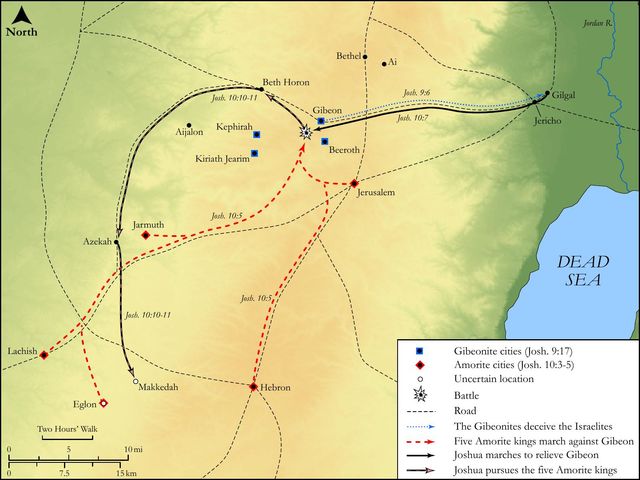
See on the biblical-era map
Study this verse
Public-domain commentary
Matthew Henry
From his Commentary on the Whole Bible. Henry comments on passages, not single verses — this entry covers Joshua 9:22–27. His four-level outline is real structure in the source text, so it is rendered as structure.
The matter is here settled between Joshua and the Gibeonites, and an explanation of the league agreed upon. We may suppose that now, not the messengers who were first sent, but the elders of Gibeon, and of the cities that were dependent upon it, were themselves present and treated with, that the matter might be fully compromised.
I.Joshua reproves them for their fraud, Jos 9:22. And they excuse it as well as they can, Jos 9:24.
1.Joshua gives the reproof very mildly: Wherefore have you beguiled us? He does not load them with any ill names, does not give them any harsh provoking language, does not call them, as they deserved to be called, base liars, but only asks them, Why have you beguiled us? Under the greatest provocations, it is our wisdom and duty to keep our temper, and to bridle our passion; a just cause needs not anger to defend it, and a bad one is made never the better by it.
2.They make the best excuse for themselves, that the thing would bear, Jos 9:24. They found by the word of God that sentence of death was passed upon them (the command was to destroy all the inhabitants of the land, without exception), and they found by the works of God already wrought that there was no opposing the execution of this sentence; they considered that God's sovereignty is incontestable, his justice inflexible, his power irresistible, and therefore resolved to try what his mercy was, and found it was not in vain to cast themselves upon it. They do not go about to justify their lie, but in effect beg pardon for it, pleading it was purely to save their lives that they did it, which every man that finds in himself the force of the law of self-preservation will therefore make great allowances for, especially in such a case as this, where the fear was not merely of the power of man (if that were all, one might flee from that to the divine protection), but of the power of God himself, which they saw engaged against them.
II.Joshua condemns them to servitude, as a punishment of their fraud (Jos 9:23), and they submit to the sentence (Jos 9:25), and for aught that appears both sides are pleased.
1.Joshua pronounces them perpetual bondmen. They had purchased their lives with a lie, but, that being no good consideration, he obliges them to hold their lives under the rent and reservation of their continual labours, in hewing wood and drawing water, the meanest and most toilsome employments. Thus their lie was punished; had they dealt fairly and plainly with Israel, perhaps they would have had more honourable conditions granted them, but now, since they gain their lives with ragged clothes and clouted shoes, the badges of servitude, they are condemned for ever to wear such, so must their doom be. And thus the ransom of their lives is paid; dominion is acquired by the preservation of a life that lies at mercy (servus dicitur a servando - a servant is so called from the act of saving); they owe their service to those to whom they owe their lives. Observe how the judgment is given against them.
(1.)Their servitude is made a curse to them. "Now you are cursed with the ancient curse of Canaan," from whom these Hivites descended, a servant of servants shalt thou be, Gen 9:25. What shall be done to the false tongue but this? Cursed shall it be.
(2.)Yet this curse is turned into a blessing; they must be servants, but it shall be for the house of my God. The princes would have them slaves unto all the congregation (Jos 9:21), at least they chose to express themselves so, for the pacifying of the people that were discontented; but Joshua mitigates the sentence, both in honour to God and in favour to the Gibeonites: it would be too hard upon them to make them every man's drudge; if they must be hewers of wood and drawers of water, than which there cannot be a greater disparagement, especially to those who are citizens of a royal city, and all mighty men (Jos 10:2), yet they shall be so to the house of my God, than which there cannot be a greater preferment: David himself could have wished to be a door-keeper there. Even servile work becomes honourable when it is done for the house of our God and the offices thereof.
[1.]They were hereby excluded from the liberties and privileges of true-born Israelites, and a remaining mark of distinction was put upon their posterity throughout all their generations.
[2.]They were hereby employed in such services as required their personal attendance upon the altar of God in the place which he should choose (Jos 9:27), which would bring them to the knowledge of the law of God, keep them strictly to that holy religion to which they were proselyted, and prevent their revolt to the idolatries of their fathers.
[3.]This would be a great advantage to the priests and Levites to have so many, and those mighty men, constant attendants upon them, and engaged by office to do all the drudgery of the tabernacle. A great deal of wood must be hewed for fuel for God's house, not only to keep the fire burning continually upon the altar, but to boil the flesh of the peace-offerings, etc. And a great deal of water must be drawn for the divers washings which the law prescribed. These and other such servile works, such as washing the vessels, carrying out ashes, sweeping the courts, etc., which otherwise the Levites must have done themselves, these Gibeonites were appointed to do.
[4.]They were herein servants to the congregation too; for whatever promotes and helps forward the worship of God is real service to the commonwealth. It is the interest of every Israelite that the altar of God be well attended. Hereby also the congregation was excused from much of that servile work which perhaps would otherwise have been expected from some of them. God had made a law that the Israelites should never make any of their brethren bondmen; if they had slaves, they must be of the heathen that were round about them, Lev 25:44. Now in honour of this law, and of Israel that was honoured by it, God would not have the drudgery, no, not of the tabernacle itself, to be done by Israelites, but by Gibeonites, who were afterwards called Nethinim, men given to the Levites, as the Levites were to the priests (Num 3:9), to minister to them in the service of God.
[5.]This may be looked upon as typifying the admission of the Gentiles into the gospel church. Now they were taken in upon their submission to be under-officers, but afterwards God promises that he will take of them for priests and Levites, Isa 66:21.
2.They submit to this condition, Jos 9:25. Conscious of a fault in framing a lie whereby to deceive the Israelites, and sensible also how narrowly they escaped with their lives and what a kindness it was to have them spared, they acquiesce in the proposal: Do as it seemeth right unto thee. Better live in servitude, especially such servitude, than not live at all. Those of the very meanest and most despicable condition are described to be hewers of wood and drawers of water, Deu 29:11. But skin for skin, liberty, and labour, and all that a man has, will he give for his life, and no ill bargain. Accordingly the matter was determined.
(1.)Joshua delivered them out of the hands of the Israelites that they should not be slain, Jos 9:26. It seems there were those who would have fallen upon them with the sword if Joshua had not interposed with his authority; but wise generals know when to sheathe the sword, as well as when to draw it.
(2.)He then delivered them again into the hands of the Israelites to be enslaved, Jos 9:27. They were not to keep possession of their cities, for we find afterwards that three of them fell to the lot of Benjamin and one to that of Judah; nor were they themselves to be at their own disposal, but, as bishop Patrick thinks, were dispersed into the cities of the priests and Levites, and came up with them in their courses to serve at the altar, out of the profits of which, it is probable, they were maintained. And thus Israel's bondmen became the Lord's freemen, for his service in the meanest office is liberty, and his work is its own wages. And this they got by their early submission. Let us, in like manner, submit to our Lord Jesus, and refer our lives to him, saying, "We are in thy hand, do unto us as seemeth good and right unto thee; only save our souls, and we shall not repent it:" if he appoint us to bear his cross, and draw in his yoke, and serve at his altar, this shall be afterwards neither shame nor grief to us, while the meanest office in God's service will entitle us to a dwelling in the house of the Lord all the days of our life.
Continue studying Joshua 9:25 across the web’s major study libraries — every link below opens this exact verse, chapter, or book on the destination site.
Read & Compare
 BibleGatewayThis verse in more than 200 translations and 70 languages.
 Bible.comThe YouVersion reader — hundreds of translations, reading plans, and highlights.
 ESV.orgCrossway's official English Standard Version reader.
 NET BibleThe NET translation with 60,000+ translators' notes on every rendering decision.
 STEP BibleTyndale House's free study tool — original text, vocabulary, and scholarly resources.
 BibliaLogos Bible Software's free web reader.
 USCCBThe New American Bible (Revised Edition) with the U.S. bishops' study notes.
Commentaries
 BibleHub CommentariesDozens of classic commentaries on this verse, gathered on one page.
 StudyLightMore than 100 commentary sets — the largest collection on the web.
 BibleRefPlain-English commentary on what this verse means, verse by verse.
 Enduring WordDavid Guzik's free commentary on this chapter, widely used by Bible teachers.
 Bible Study ToolsVerse commentary alongside Greek and Hebrew study aids.
Original Language & Research
- BibleHub InterlinearThe verse word by word — original language, transliteration, and English.
- BibleHub LexiconEvery word's original-language definition and Strong's entry.
 Blue Letter BibleDeep-study tools — Strong's numbers, concordance, and word studies.
 SefariaThe Hebrew text with Rashi and centuries of Jewish commentary.
Sermons, Hymns & Audio


TrulyRandomVerse is not affiliated with these sites and doesn’t control their content. They’re linked because they’re genuinely useful.
Summary
Joshua 9:25 encapsulates the Gibeonites' complete and desperate surrender to Joshua and the Israelite leaders, following the exposure of their elaborate deception. Having secured a covenant under false pretenses, and now facing the severe consequences of their deceit, they humbly place their lives and future entirely at Israel's disposal, appealing to their sense of justice and mercy, effectively submitting to whatever fate Israel deems "good and right."
Context
ShowHideLiterary Context
This verse serves as the climactic declaration of submission within the intricate Gibeonite narrative found in Joshua 9. Following Israel's stunning, divinely-assisted victories over Jericho and Ai, which saw the complete destruction of those cities (Joshua 8:26-28), the Gibeonites, a Hivite people, ingeniously concocted a scheme to avoid a similar fate. They disguised themselves as weary travelers from a distant land, prompting the Israelite leaders to enter into a peace treaty with them without first seeking divine counsel from the Lord (Joshua 9:14-15). Just three days later, the deception was revealed (Joshua 9:16), plunging Israel into a profound theological and ethical dilemma: they had sworn an oath by the Lord. Despite the people's grumbling and desire to annihilate the Gibeonites, the leaders, recognizing the sanctity of their oath, chose to uphold it (Joshua 9:18-20). Joshua subsequently confronted the Gibeonites, who confessed their fear and the extent of their deception (Joshua 9:22-24). Verse 25 is their final, unconditional response, a complete surrender to Joshua's judgment, which ultimately leads to their perpetual servitude as woodcutters and water carriers for the congregation and the altar of the Lord (Joshua 9:27).
Historical & Cultural Context
The command to utterly destroy the Canaanite inhabitants (known as herem, or "devotion to destruction") was a foundational and non-negotiable aspect of Israel's conquest, as explicitly detailed in passages like Deuteronomy 7:1-6 and Deuteronomy 20:16-18. This was not merely an act of ethnic cleansing but a profound theological imperative designed to prevent the spiritual corruption of Israel through exposure to Canaanite idolatry and abominable practices. In Scripture, treaties and sworn oaths were considered profoundly sacred, invoked in the presence of God as witness and carrying severe curses for their violation. Once an oath was sworn in the name of the LORD, it was considered divinely binding, even if obtained through deceit. The Gibeonites, acutely aware of Israel's commitment to their God and their oaths, skillfully exploited this deeply ingrained cultural and religious norm. Their palpable fear was entirely justified, given Israel's recent, divinely-empowered victories and the clear divine mandate for conquest. Their plea for mercy, expressed by placing themselves "in thine hand," was a common Hebrew idiom signifying absolute submission to a superior power, appealing to the victor's prerogative to show clemency rather than inflict total annihilation.
Key Themes
ShowHideThis verse powerfully contributes to several overarching themes within the book of Joshua and the broader Old Testament narrative. Firstly, it underscores the sanctity of oaths made before the Lord. Despite the Gibeonites' egregious deception, the Israelite leaders felt irrevocably bound by their covenant, emphasizing the critical importance of integrity and faithfulness to one's word, a principle consistently echoed throughout Scripture, as seen in Psalm 15:4. Secondly, the narrative vividly illustrates the consequences of deception: the Gibeonites, though spared from death, are condemned to perpetual servitude, demonstrating that actions, even those born of fear, carry lasting repercussions and shape one's future (Galatians 6:7). Thirdly, the episode implicitly highlights divine sovereignty and providence. While Israel undoubtedly erred in not consulting the Lord, the ultimate outcome served a divine purpose, preserving a group of people who would serve the tabernacle, thereby transforming their deceit into a form of service to God's people and His sanctuary (Joshua 9:27). Finally, the Gibeonites' plea showcases the power of humble submission and the appeal to mercy in the face of overwhelming power and deserved judgment.
Exposition and Analysis
ShowHideKey Word Analysis
ShowHideThe phrase "in thine hand" (בְּיָדְךָ, b'yadkha) is a potent idiom signifying complete control, power, and authority. It conveys absolute submission and dependence. When the Gibeonites declare themselves "in thine hand," they are not merely stating their physical presence but acknowledging Israel's total dominion over their lives, their fate, and their future. This reflects a state of utter vulnerability and a relinquishing of all agency, placing themselves entirely at the mercy of their conquerors.
The word "good" (טוֹב, ṭôwb) in the phrase "as it seemeth good and right unto thee" refers to that which is pleasing, agreeable, beneficial, or morally sound. It carries a broad semantic range, encompassing both what is subjectively pleasing and what is objectively righteous. Here, it appeals to Israel's sense of what is appropriate and advantageous, but also what aligns with their covenantal values.
The KJV translates "seemeth" from the Hebrew word for "eye" (בְּעֵינֶיךָ, bəʿêneykhā, literally "in your eyes"). This idiom signifies perception, judgment, and discretion. The Gibeonites are appealing to Joshua's personal discernment and moral judgment, trusting that he will act according to what he perceives as just and proper from his perspective, which they hope will be informed by God's own standards of righteousness.
Verse Breakdown
ShowHide"And now, behold, we [are] in thine hand"
This opening clause marks a dramatic and immediate shift from the Gibeonites' previous cunning and deception to a posture of absolute humility and surrender. The emphatic "now, behold" (וְעַתָּה הִנֵּה, wəʿattāh hinnēh) underscores the immediate and unavoidable reality of their exposed state and the gravity of their confession. By declaring themselves "in thine hand," they fully concede Israel's authority and power over them, acknowledging their total vulnerability and the forfeiture of any claim to self-determination. It is a desperate recognition that their lives are entirely at the disposal of Joshua and the Israelite leaders.
"as it seemeth good and right unto thee to do unto us, do."
This concluding phrase is a direct, unconditional, and open-ended appeal to Israel's judgment and mercy. It signifies their complete trust, or perhaps their only remaining hope, that Israel will act with a sense of justice and moral uprightness, even towards those who deceived them. They are not negotiating or pleading for specific terms, but rather submitting to whatever decision Israel's leaders deem appropriate and morally sound, aligning with principles of fairness and integrity. This profound level of desperation and resignation leaves their fate entirely in the hands of their captors.
Literary Devices
ShowHideThe verse employs several powerful literary devices that amplify its dramatic impact and theological significance. Supplication is profoundly evident in the Gibeonites' humble and desperate plea, a stark and deliberate contrast to their earlier cunning and self-reliance, highlighting their complete vulnerability and dependence on Israel's mercy. There is a strong undercurrent of Irony, as their elaborate deception, meticulously crafted to secure their freedom and survival, ultimately leads to a state of complete servitude and submission, a fate they initially sought to avoid. Furthermore, the Gibeonites skillfully employ a subtle yet potent Rhetorical Appeal to Israel's moral character and covenantal identity. By trusting that a people who serve a righteous God would act in a manner that is "good and right," they leverage Israel's own theological framework against them, hoping to elicit a merciful outcome rather than immediate destruction. This appeal to the moral integrity of their conquerors demonstrates their shrewd understanding of Israel's covenantal obligations, even in their desperate state.
Theological and Thematic Connections
ShowHideJoshua 9:25 offers profound theological insights into the nature of divine justice, human responsibility, and the sanctity of covenants. While the Gibeonites' deception was a grave sin, their ultimate submission and Israel's decision to uphold their oath, despite the circumstances, reveal God's overarching sovereignty. This narrative demonstrates God's remarkable ability to use even human error and deceit to further His purposes, bringing about good from imperfect situations. The episode underscores that while sin inevitably carries consequences (perpetual servitude for the Gibeonites), God's faithfulness to His people and His word (through the binding oath) remains paramount. This narrative also subtly foreshadows a broader biblical theme where those who were once enemies or outsiders are brought into a relationship, albeit a subordinate one, with God's people, ultimately serving His purposes within the divine plan.
Reflection and Application
ShowHideThe Gibeonites' desperate plea in Joshua 9:25 serves as a powerful reminder of the inevitable consequences of deception and the profound humility required when one's wrongdoing is exposed. For believers, this verse calls us to a posture of unwavering honesty and integrity in all our dealings, understanding that even well-intentioned deceit can lead to complicated and undesirable outcomes, entangling us and others in difficult situations. Yet, it also offers a glimmer of hope: when we find ourselves in situations where our past mistakes or sins have been uncovered, the path forward is often one of humble submission to rightful authority and a willingness to accept the consequences, trusting in God's ultimate justice and mercy. Just as the Gibeonites found a place of service, albeit a humble one, within Israel, we too can find purpose and redemption even in the aftermath of our failures, as God can transform our circumstances into opportunities for growth and service within His kingdom. This narrative challenges us to consider how we respond when others deceive us, prompting us to uphold our commitments and extend grace where appropriate, reflecting God's own character of both justice and compassion.
Questions for Reflection
ShowHideFAQ
ShowHideWhy did the Israelites not consult the Lord before making the covenant with the Gibeonites?
ShowHideThe text explicitly states in Joshua 9:14 that "the men took of their victuals, and asked not counsel at the mouth of the Lord." This was a critical failure on the part of the Israelite leaders. They relied on their own human wisdom and superficial assessment of the Gibeonites' appearance and story, rather than seeking divine guidance through established means like the Urim and Thummim or direct prophetic counsel. This significant oversight led them into a binding covenant with a people they were explicitly commanded to destroy, thereby creating a profound moral and theological dilemma for the entire nation. It serves as a stark warning against making important decisions without diligently seeking God's will and wisdom.
What was the ultimate fate and role of the Gibeonites after this event?
ShowHideAlthough they were spared from immediate death, the Gibeonites were condemned to perpetual servitude. As stated in Joshua 9:23 and confirmed in Joshua 9:27, Joshua declared them "cursed, and there shall none of you be freed from being bondmen, and hewers of wood and drawers of water for the house of my God." This meant they would serve the Israelite congregation and, specifically, the tabernacle (and later the Temple) by performing menial tasks such as cutting wood for the altar and drawing water for the priestly rituals. This outcome, though a direct consequence of their deception, paradoxically integrated them into the life of Israel and the worship of Yahweh, allowing them to serve God's people and His sanctuary, albeit in a humble and subordinate capacity.
Christ-Centered Fulfillment
ShowHideThe Gibeonites' desperate plea for mercy and their complete submission, placing themselves "in thine hand," finds a profound Christ-centered fulfillment in the broader narrative of redemption. Their voluntary servitude, born of fear and deception, yet leading to a form of service to God's sanctuary, echoes the greater narrative of humanity's fallen condition and Christ's redemptive work. We, like the Gibeonites, are by nature alienated from God, often resorting to our own devices and deceptions to navigate life, ultimately falling short of His glory (Romans 3:23). Yet, through Christ, we are called to a far greater and more glorious submission—not born of fear of destruction, but of love and faith in the One who willingly submitted to the Father's will, even to the point of death on a cross (Philippians 2:8). Jesus, the perfect Lamb of God, took on the very form of a servant (Philippians 2:7), fulfilling the ultimate act of submission to redeem those who were enslaved to sin (Romans 6:17-18). Our "servitude" in Christ is not a curse but a glorious freedom, transforming us from slaves of sin into willing servants of righteousness and adopted children of God (John 8:36; Galatians 4:7). The Gibeonites' integration into Israel's worship, even in a humble role, powerfully foreshadows the inclusion of Gentiles into God's covenant people through Christ, where all who believe, regardless of their past or origin, become part of God's spiritual temple, serving Him in Spirit and truth (Ephesians 2:19-22).