


Joshua 13:18
Bible text: King James Version (1769 Blayney text) · Public domain
Bible text: Berean Standard Bible · Public domain
Bible text: American Standard Version (1901) · Public domain
Bible text: World English Bible, Messianic edition · Public domain
Bible text: Geneva Bible (1599) · Public domain
Bible text: Young's Literal Translation · Public domain
- וְיַהְצָהve·Yah·tzahand Jahaz <towards>H3096Conj-w ¦ N-proper ¦ SfxNoun Proper LocationוְandיַהְצָJahazה<towards>
- וּקְדֵמֹתu·ke·de·Motand KedemothH6932Conj-w ¦ N-properNoun Proper LocationוּandקְדֵמֹתKedemoth
- וּמֵפָעַתu·me·Fa·'atand MephaathH4158Conj-w ¦ N-properNoun Proper LocationוּandמֵפָעַתMephaath
English is a literal word-by-word gloss of the Hebrew, not the KJV's wording. Why?
This is the original text the KJV's translators worked from — each Hebrew word with its own literal English meaning in this verse, prepared by scholars at Tyndale House, Cambridge. The KJV translates whole sentences, not word by word, so its wording differs: one Hebrew word can become several English words, and the KJV may choose “the LORD” where the gloss reads “Yahweh”. Both are faithful — they answer different questions. For the KJV's own rendering, switch to the KJV text.
Details
See on the biblical-era maps
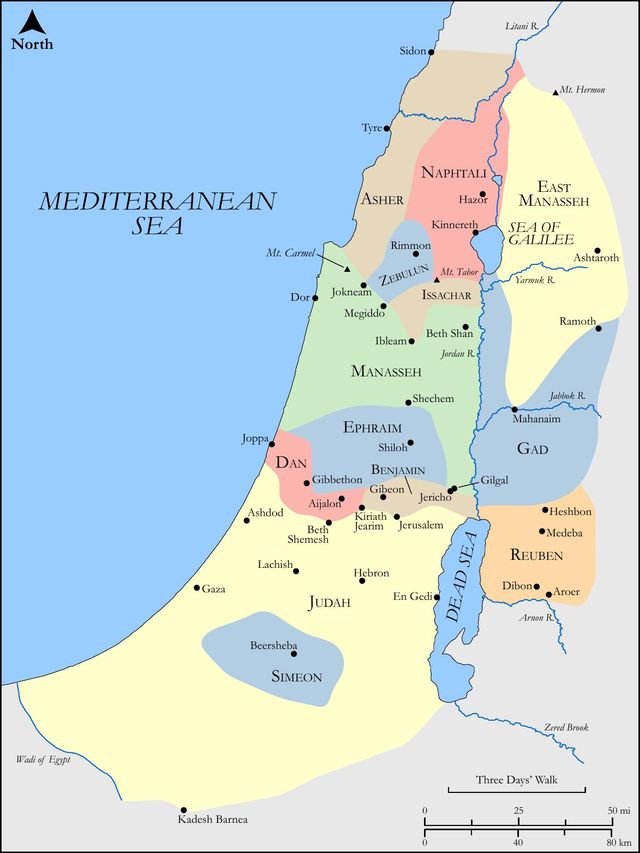
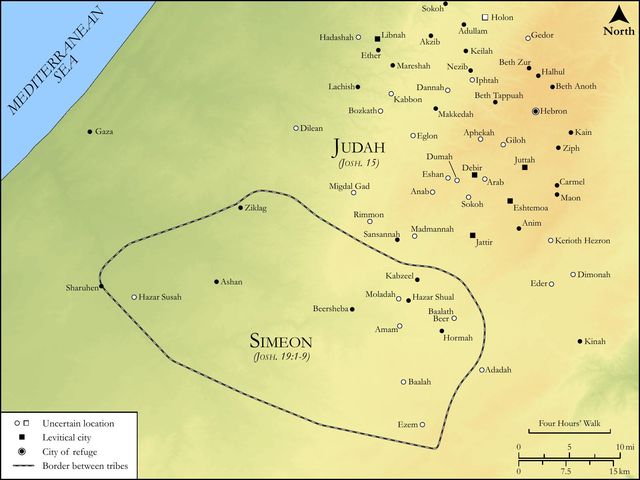
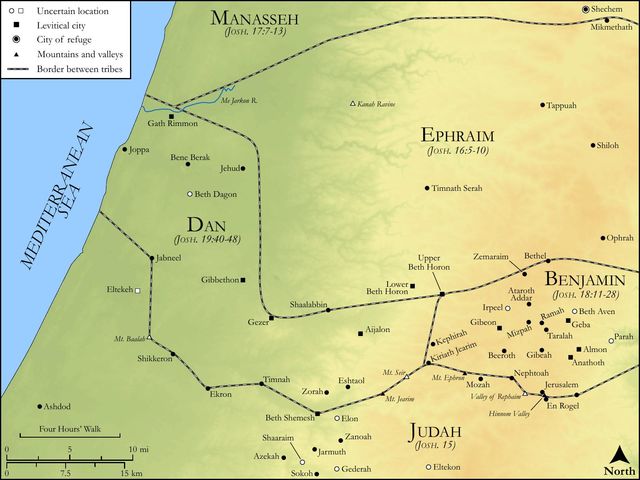
Study this verse
Public-domain commentary
Matthew Henry
From his Commentary on the Whole Bible. Henry comments on passages, not single verses — this entry covers Joshua 13:7–33. His four-level outline is real structure in the source text, so it is rendered as structure.
Here we have, I. Orders given to Joshua to assign to each tribe its portion of this land, including that which was yet unsubdued, which must be brought into the lot, in a believing confidence that it should be conquered when Israel was multiplied so as to have occasion for it (Jos 13:7): Now divide this land. Joshua thought all must be conquered before any must be divided. "No," said, God, "there is as much conquered as will serve your turn for the present; divide this, and make your best of it, and wait for the remainder hereafter." Note, We must take the comfort of what we have, though we cannot compass all we would have. Observe,
1.The land must be divided among the several tribes, and they must not always live in common, as now they did. Which way soever a just property is acquired, it is the will of that God who has given the earth to the children of men that there should be such a thing, and that every man should know his own, and not invade that which is another's. The world must be governed, not by force, but right, by the law of equity, not of arms.
2.That it must be divided for an inheritance, though they got it by conquest.
(1.)The promise of it came to them as an inheritance from their fathers; the land of promise pertained to the children of promise, who were thus beloved for their fathers' sakes, and in performance of the covenant with them.
(2.)The possession of it was to be transmitted by them, as an inheritance to their children. Frequently, what is got by force is soon lost again; but Israel, having an incontestable title to this land by the divine grant, might see it hereby secured as an inheritance to their seed after them, and that God kept this mercy for thousands.
3.That Joshua must not divide it by his own will. Though he was a very wise, just, and good man, it must not be left to him to give what he pleased to each tribe; but he must do it by lot, which referred the matter wholly to God, and to his determination, for he it is that appoints the bounds of our habitation, and every man's judgment must proceed from him. But Joshua must preside in this affair, must manage this solemn appeal to Providence, and see that the lot was drawn fairly and without fraud, and that every tribe did acquiesce in it. The lot indeed causeth contention to cease, Pro 18:18. But, if upon this lot any controversy should arise, Joshua by his wisdom and authority must determine it, and prevent any ill consequences of it. Joshua must have the honour of dividing the land,
(1.)Because he had undergone the fatigue of conquering it: and when, through his hand, each tribe received its allotment, they would thereby be made the more sensible of their obligations to him. And what a pleasure must it needs be to a man of such a public spirit as Joshua was to see the people that were so dear to him eating of the labour of his hands!
(2.)That he might be herein a type of Christ, who has not only conquered for us the gates of hell, but has opened to us the gates of heaven, and, having purchased the eternal inheritance for all believers, will in due time put them all in possession of it.
II.An account is here given of the distribution of the land on the other side Jordan among the Reubenites, and Gadites, and half the tribe of Manasseh. Observe,
1.How this account is introduced. It comes in,
(1.)As the reason why this land within Jordan must be divided only to the nine tribes and a half, because the other two and a half were already provided for.
(2.)As a pattern to Joshua in the work he had now to do. He had seen Moses distribute that land, which would give him some aid in distributing this, and thence he might take his measure; only this was to be done by lot, but it should seem Moses did that himself, according to the wisdom given unto him.
(3.)As an inducement to Joshua to hasten the dividing of this land, that the nine tribes and a half might not be kept any longer than was necessary out of their possession, since their brethren of the two tribes and a half were so well settled in theirs; and God their common Father would not have such a difference made between his children.
2.The particulars of this account.
(1.)Here is a general description of the country that was given to the two tribes and a half, which Moses gave them, even as Moses gave them, Jos 13:8. The repetition implies a ratification of the grant by Joshua. Moses settled this matter, and, as Moses settled it, so shall it rest; Joshua will not, under any pretence whatsoever, go about to alter it. And a reason is intimated why he would not, because Moses was the servant of the Lord, and acted in this matter by secret direction from him and was faithful as a servant. Here we have,
[1.]The fixing of the boundaries of this country, by which they were divided from the neighbouring nations, Jos 13:9, etc. Israel must know their own and keep to it, and may not, under pretence of their being God's peculiar people, encroach upon their neighbours, and invade their rights and properties, to which they had a good and firm title by providence, though not, as Israel, a title by promise.
[2.]An exception of one part of this country from Israel's possession, though it was in their grant, namely, the Geshurites and the Maachathites, Jos 13:13. They had not leisure to reduce all the remote and obscure corners of the country in Moses's time, and afterwards they had no mind to it, being easy with what they had. Thus those who are not straitened in God's promises are yet straitened in their own faith, and prayers, and endeavours.
(2.)A very particular account of the inheritances of these two tribes and a half, how they were separated from each other, and what cites, with the towns, villages, and fields, commonly known and reputed to be appurtenances to them, belonged to each tribe. This is very fully and exactly set down in order that posterity might, in reading this history, be the more affected with the goodness of God to their ancestors, when they found what a large and fruitful country, and what abundance of great and famous cities, he put them in possession of (God's grants look best when we descend to the particulars); and also that the limits of every tribe being punctually set down in this authentic record disputes might be prevented, and such contests between the tribes as commonly happen where boundaries have not been adjusted nor this matter brought to a certainty. And we have reason to think that the register here prescribed and published of the lot of each tribe was of great use to Israel in after-ages, was often appealed to, and always acquiesced in, for the determining of meum and tuum - mine and thine.
[1.]We have here the lot of the tribe of Reuben, Jacob's first-born, who, though he had lost the dignity and power which pertained to the birthright, yet, it seems, had the advantage of being first served. Perhaps those of that tribe had an eye to this in desiring to be seated on that side Jordan, that, since they could not expect the benefit of the best lot, they might have the credit of the first. Observe, First, In the account of the lot of this tribe mention is made of the slaughter, 1. Of Sihon, king of the Amorites, who reigned in this country, and might have kept it and his life if he would have been neighbourly, and have suffered Israel to pass through his territories, but, by attempting to oppose them, justly brought ruin upon himself, Num 21:21, etc. 2. Of the princes of Midian, who were slain afterwards in another war (Num 31:8), and yet are here called dukes of Sihon, and are said to be smitten with him, because they were either tributaries to him, or, in his opposition to Israel, confederates with him, and hearty in his interests, and his fall made way for theirs not long after. 3. Of Balaam particularly, that would, if he could, have cursed Israel, and was soon after recompensed according to the wickedness of his endeavour (Psa 28:4), for he fell with those that set him on. This was recorded before (Num 31:8), and is here repeated, because the defeating of Balaam's purpose to curse Israel was the turning of that curse into a blessing, and was such an instance of the power and goodness of God as was fit to be had in everlasting remembrance. See Mic 6:5. Secondly, Within the lot of this tribe was that Mount Pisgah from the top of which Moses took his view of the earthly Canaan and his flight to the heavenly. And not far off thence Elijah was when he was fetched up to heaven in a chariot of fire. The separation of this tribe from the rest, by the river Jordan, was that which Deborah lamented; and the preference they gave to their private interests above the public was what she censured, Jdg 5:15, Jdg 5:16. In this tribe lay Heshbon and Sibmah, famed for their fruitful fields and vineyards. See Isa 16:8, Isa 16:9; Jer 48:32. This tribe, with that of Gad, was sorely shaken by Hazael king of Syria (Kg2 10:33), and afterwards dislodged and carried into captivity, twenty years before the general captivity of the ten tribes by the king of Assyria, Ch1 5:26.
[2.]The lot of the tribe of Gad, Jos 13:24-28. This lay north of Reuben's lot; the country of Gilead lay in this tribe, so famous for its balm that it is thought strange indeed if there be no balm in Gilead, and the cities of Jabesh-Gilead and Ramoth-Gilead which we often read of in scripture. Succoth and Penuel, which we read of in the story of Gideon, were in this tribe; and that forest which is called the wood of Ephraim (from the slaughter Jephthah made there of the Ephraimites), in which Absalom's rebellious army was beaten, while his father David lay at Mahanaim, one of the frontier-cities of this tribe, Jos 13:26. Sharon, famous for roses, was in this tribe. And within the limits of this tribe lived those Gadarenes that loved their swine better than their Saviour, fitter to be called Girgashites than Israelites.
[3.]The lot of the half-tribe of Manasseh, Jos 13:29-31. Bashan, the kingdom of Og, was in this allotment, famous for the best timber, witness the oaks of Bashan - and the best breed of cattle, witness the bulls and rams of Bashan. This tribe lay north of Gad, reached to Mount Hermon, and had in it part of Gilead. Mispeh was in this half-tribe, and Jephthah was one of its ornaments; so was Elijah, for in this tribe was Thisbe, whence he is called the Tishbite; and Jair was another. In the edge of the tribe stood Chorazin, honoured with Christ's wondrous works, but ruined by his righteous woe for not improving them.
[4.]Twice in this chapter it is taken notice of that to the tribe of Levi Moses gave no inheritance (Jos 13:14, Jos 13:33), for so God had appointed, Num 18:20. If they had been appointed to a lot entire by themselves, Moses would have served them first, not because it was his own tribe, but because it was God's; but they must be provided for in another manner; their habitations must be scattered in all the tribes, and their maintenance brought out of all the tribes, and God himself was the portion both of their inheritance and of their cup, Deu 10:9; Deu 18:2.
Continue studying Joshua 13:18 across the web’s major study libraries — every link below opens this exact verse, chapter, or book on the destination site.
Read & Compare
 BibleGatewayThis verse in more than 200 translations and 70 languages.
 Bible.comThe YouVersion reader — hundreds of translations, reading plans, and highlights.
 ESV.orgCrossway's official English Standard Version reader.
 NET BibleThe NET translation with 60,000+ translators' notes on every rendering decision.
 STEP BibleTyndale House's free study tool — original text, vocabulary, and scholarly resources.
 BibliaLogos Bible Software's free web reader.
 USCCBThe New American Bible (Revised Edition) with the U.S. bishops' study notes.
Commentaries
 BibleHub CommentariesDozens of classic commentaries on this verse, gathered on one page.
 StudyLightMore than 100 commentary sets — the largest collection on the web.
 BibleRefPlain-English commentary on what this verse means, verse by verse.
 Enduring WordDavid Guzik's free commentary on this chapter, widely used by Bible teachers.
 Bible Study ToolsVerse commentary alongside Greek and Hebrew study aids.
Original Language & Research
- BibleHub InterlinearThe verse word by word — original language, transliteration, and English.
- BibleHub LexiconEvery word's original-language definition and Strong's entry.
 Blue Letter BibleDeep-study tools — Strong's numbers, concordance, and word studies.
 SefariaThe Hebrew text with Rashi and centuries of Jewish commentary.
Sermons, Hymns & Audio


TrulyRandomVerse is not affiliated with these sites and doesn’t control their content. They’re linked because they’re genuinely useful.
Summary
Joshua 13:18 meticulously lists three specific cities—Jahazah, Kedemoth, and Mephaath—as integral components of the land inheritance apportioned to the tribe of Reuben. This seemingly simple enumeration serves as a profound testament to God's unwavering faithfulness and meticulous precision in fulfilling His ancient covenant promises, demonstrating His sovereign care in providing a tangible, divinely ordered inheritance for His people as they established their nation in the Promised Land.
Context
ShowHideLiterary Context
Joshua 13 marks a pivotal shift in the book of Joshua, transitioning from the era of conquest to the methodical and detailed division of the Promised Land among the Israelite tribes. The chapter opens with a divine mandate to an aged Joshua, instructing him to commence the land distribution despite significant portions remaining unconquered, thereby underscoring God's ultimate sovereignty over the land's possession and His commitment to His covenant promises (Joshua 13:1). Following a concise overview of the territories yet to be subdued (verses 2-6), the narrative meticulously details the inheritance of the two and a half tribes who had opted to settle east of the Jordan River. Verses 15-23 specifically delineate the precise boundaries and cities allotted to the tribe of Reuben, thereby fulfilling the earlier agreement established with Moses (Numbers 32:33). Joshua 13:18 is embedded within this comprehensive enumeration, providing specific city names within Reuben's designated territory, which powerfully illustrates the biblical record's thoroughness and God's precise fulfillment of His word.
Historical & Cultural Context
The division of the land represented a foundational act for the nascent Israelite nation, solidifying their identity and actualizing centuries-old divine promises. The cities enumerated in Joshua 13:18—Jahazah, Kedemoth, and Mephaath—were situated in the Transjordan region, an area east of the Dead Sea, formerly part of the Amorite kingdom of Sihon and the Bashan kingdom of Og, which Israel had decisively conquered under Moses' leadership (Deuteronomy 2:26-37 and Deuteronomy 3:1-11). This particular region was predominantly pastoral, aligning perfectly with Reuben's stated preference for grazing lands to support their extensive livestock (Numbers 32:1-5). The meticulous listing of cities and precise boundaries within the text reflects the practice of recording land grants and property deeds, as Jeremiah "subscribed the evidence, and sealed it" when he bought the field at Anathoth. This detailed documentation underscores the legal, historical, and tangible reality of Israel's claim to the land as a direct, divine inheritance, distinguishing it from mere legend and establishing a verifiable record for future generations.
Key Themes
ShowHideJoshua 13:18, as an integral part of the broader land division narrative, powerfully reinforces several core theological themes that permeate the book of Joshua and the Pentateuch. Foremost among these is the Fulfillment of God's Promises, as the detailed allocation of land, including specific cities like Jahazah, Kedemoth, and Mephaath, directly actualized God's ancient covenant pledge to Abraham, promising his descendants the land of Canaan as an everlasting possession (Genesis 12:7). This precise listing also highlights Divine Order and Specificity, illustrating God's meticulous attention to detail in His redemptive plan, ensuring that every aspect of His word is brought to pass with absolute precision. The divine gift of the land, consistently referred to as an Inheritance and Possession, was not a vague concept but a tangible reality, meticulously recorded for each tribe, signifying Israel's establishment as a nation in their promised homeland and their rightful claim to the territory (Joshua 14:1). Furthermore, the inclusion of cities later designated for the Levites points to the theme of Divine Presence and Instruction within the land.
Exposition and Analysis
ShowHideKey Word Analysis
ShowHideFrom an unused root meaning "to stamp," perhaps suggesting "threshing-floor," Jahazah (also known as Jahaz or Jahzah) was a significant site located east of the Jordan. This city gained historical prominence as the location of a decisive battle where Israel, under Moses, achieved a critical victory over Sihon, king of the Amorites (Numbers 21:23-24). Its inclusion here confirms its strategic importance within Reuben's territory and its enduring place in Israel's history of conquest and divine deliverance.
Derived from a root meaning "beginnings," Kedemoth implies "ancient places" or "eastern places." This city was not only part of Reuben's tribal inheritance but was also later designated as a Levitical city, specifically assigned to the Merarite clan (Joshua 21:37 and 1 Chronicles 6:79). Its name likely reflects its antiquity or its location on the eastern frontier of Israel's territory, marking one of the earliest established points in the Transjordan.
From a root meaning "to illuminate," Mephaath signifies "illuminative." Like Kedemoth, Mephaath was also designated as a Levitical city for the Merarites (Joshua 21:37). Its listing here underscores the dual purpose of the land division: not only for tribal inheritance but also for the strategic establishment of cities for the Levites, ensuring the widespread presence of spiritual instruction, divine law, and priestly service throughout the land, thereby bringing "illumination" to the people.
Verse Breakdown
ShowHide"And Jahazah"
This phrase introduces the first of three specific cities allotted to the tribe of Reuben within their inheritance east of the Jordan River. Its mention immediately highlights the precise and granular detail with which the land division was recorded, underscoring the tangible and verifiable nature of God's fulfilled promise.
"and Kedemoth"
The second city named, Kedemoth, further elaborates on the specific geographical boundaries and key locations within Reuben's territory. Its subsequent designation as a Levitical city indicates its ongoing administrative and religious significance within the burgeoning Israelite nation, serving as a center for spiritual life and instruction.
"and Mephaath"
The final city listed in this verse, Mephaath, completes this trio of significant locations, contributing to the comprehensive inventory of Reuben's inheritance. Its inclusion, alongside Kedemoth, as a Levitical city, points to the profound integration of spiritual and practical aspects in the land's distribution, ensuring that the divine presence and instruction were interwoven into the very fabric of the tribal allotments.
Literary Devices
ShowHideThe primary literary device prominently featured in Joshua 13:18 is Enumeration, the systematic listing of distinct items—in this instance, three specific cities. This technique serves to convey an overwhelming sense of Precision and Thoroughness, reinforcing the meticulous nature of God's overarching plan and the exactitude with which the land division was executed. The very act of naming these ancient, identifiable locations functions as a powerful form of Historical Record, lending profound authenticity and verifiability to the biblical narrative. It firmly suggests that the events described were not vague or mythical, but rather deeply grounded in specific geographical and historical realities, thereby bolstering the text's claim to historical reliability. Furthermore, this detailed listing contributes significantly to the overarching biblical theme of Fulfillment, as each named city represents a tangible, physical piece of the promised inheritance, demonstrating God's faithfulness in bringing His word to pass.
Theological and Thematic Connections
ShowHideJoshua 13:18, though a seemingly mundane list of cities, profoundly illustrates God's unwavering faithfulness in fulfilling His promises with meticulous detail. Just as God precisely delineated the physical inheritance for the tribes of Israel, down to individual cities, He orchestrates the intricate details of His grand redemptive plan for humanity. This physical inheritance serves as a powerful type, foreshadowing the infinitely richer and eternal spiritual inheritance that believers receive through Christ. The extraordinary care taken in recording these ancient cities underscores that God's covenant is not an abstract concept but a concrete, tangible, and meticulously executed reality. It serves as a timeless reminder that our God is a God of perfect order, who brings His purposes to pass with absolute certainty, precision, and an unwavering commitment to His word.
Reflection and Application
ShowHideThe detailed listing of cities like Jahazah, Kedemoth, and Mephaath in Joshua 13:18 might initially appear to be a mere historical footnote, yet it offers profound and enduring insights into the character of God and our own spiritual journey. It serves as a powerful reminder that God is not only faithful in His grand, overarching promises, but also deeply invested in the intricate, often overlooked, details of His divine plan. Just as He meticulously allotted land to each tribe, ensuring their specific needs, boundaries, and destinies were met, He cares for the unique circumstances, challenges, and aspirations in our individual lives. This verse profoundly encourages us to cultivate a deep trust in God's sovereign provision and His precise timing, knowing with certainty that He has a unique and detailed purpose for each of us, just as He did for the tribes of Israel. It calls us to recognize that our spiritual inheritance in Christ is equally, if not more, meticulously secured, divinely appointed, and guaranteed by His unfailing character. Therefore, we can rest in the knowledge that God's detailed care extends to every facet of our existence.
Questions for Reflection
ShowHideFAQ
ShowHideWhy are these specific cities listed in Joshua 13:18, and what is their significance?
ShowHideThe listing of specific cities like Jahazah, Kedemoth, and Mephaath in Joshua 13:18 serves several crucial and interrelated purposes within the biblical narrative. Firstly, it demonstrates the meticulous record-keeping inherent in the biblical account itself, underscoring the historical and geographical accuracy of the land division. This level of detail provides tangible, verifiable evidence that the events described were real and grounded in specific locations. Secondly, and most importantly, it highlights God's unwavering faithfulness in fulfilling His covenant promises to Abraham and his descendants. The land was not vaguely given; it was precisely demarcated, city by city, tribe by tribe, ensuring that every aspect of the divine promise was actualized with absolute precision. Thirdly, it establishes the legal and administrative basis for Israel's possession of the land, providing clear boundaries and designated locations for each tribe's inheritance, which was vital for their national identity, future governance, and the establishment of a settled society. These specific names, therefore, are not arbitrary but are integral to the narrative of God's precise provision and covenant fidelity to His people, ensuring their secure and divinely appointed place in the Promised Land.
Christ-Centered Fulfillment
ShowHideWhile Joshua 13:18 meticulously details a physical land inheritance for the tribe of Reuben, its deeper theological resonance profoundly points to the ultimate spiritual inheritance found in Jesus Christ. The precise and careful division of Canaan among the tribes, ensuring each received their allotted portion, powerfully foreshadows the spiritual inheritance secured for all believers in the new covenant. Just as the land was a divine gift, our salvation, eternal life, and every spiritual blessing are a gift of immeasurable grace, not earned but freely given through Christ's atoning work (Ephesians 2:8-9). Jesus himself is the true and everlasting "Promised Land" for His people, the one in whom all of God's magnificent promises find their definitive "Yes" and "Amen" (2 Corinthians 1:20). Through His redemptive sacrifice, we are granted an "inheritance that is imperishable, undefiled, and unfading, kept in heaven for you" (1 Peter 1:4), an inheritance far surpassing any earthly possession. The physical boundaries of Reuben's territory ultimately give way to the boundless spiritual kingdom and the glorious heavenly Jerusalem, where believers, as co-heirs with Christ, will dwell in eternal, perfect fellowship with God (Romans 8:17 and Hebrews 12:22). Thus, Joshua 13:18, in its specificity and detail, points beyond itself to the comprehensive, eternal, and divinely secured inheritance that Christ has procured for all who place their faith in Him.