


Job 38:34
Bible text: King James Version (1769 Blayney text) · Public domain
Bible text: Berean Standard Bible · Public domain
Bible text: American Standard Version (1901) · Public domain
Bible text: World English Bible, Messianic edition · Public domain
Bible text: Geneva Bible (1599) · Public domain
Bible text: Young's Literal Translation · Public domain
- הֲתָרִיםha·ta·Rim¿ will you lift upH7311Interrog ¦ V-Hiphil-Imperf-2msVerb Hiphil Imperfect 2nd Singular Masculineהֲ¿תָרִיםwill you lift up
- לָעָבla·'Avto the cloud[s]H5645Prep-l ¦ N-msNoun Singular Masculine Absoluteלָto theעָבcloud[s]
- קוֹלֶךָko·Le·chayour voiceH6963N-msc ¦ 2msNoun Singular Masculine Constructקוֹלֶvoiceךָyour
- וְשִׁפְעַתve·shif·'atand an abundance ofH8229Conj-w ¦ N-fscNoun Singular Feminine Constructוְandשִׁפְעַתan abundance of
- מַיִםMa·yimwaterH4325N-mpNoun Plural Masculine Absolute
- תְּכַסֶּךָּte·kha·Se·kawill you cover? yourselfH3680V-Piel-Imperf-3fs ¦ 2msVerb Piel Imperfect 3rd Singular Feminineתְּכַסֶּwill you cover?ךָּyourself
English is a literal word-by-word gloss of the Hebrew, not the KJV's wording. Why?
This is the original text the KJV's translators worked from — each Hebrew word with its own literal English meaning in this verse, prepared by scholars at Tyndale House, Cambridge. The KJV translates whole sentences, not word by word, so its wording differs: one Hebrew word can become several English words, and the KJV may choose “the LORD” where the gloss reads “Yahweh”. Both are faithful — they answer different questions. For the KJV's own rendering, switch to the KJV text.
Details
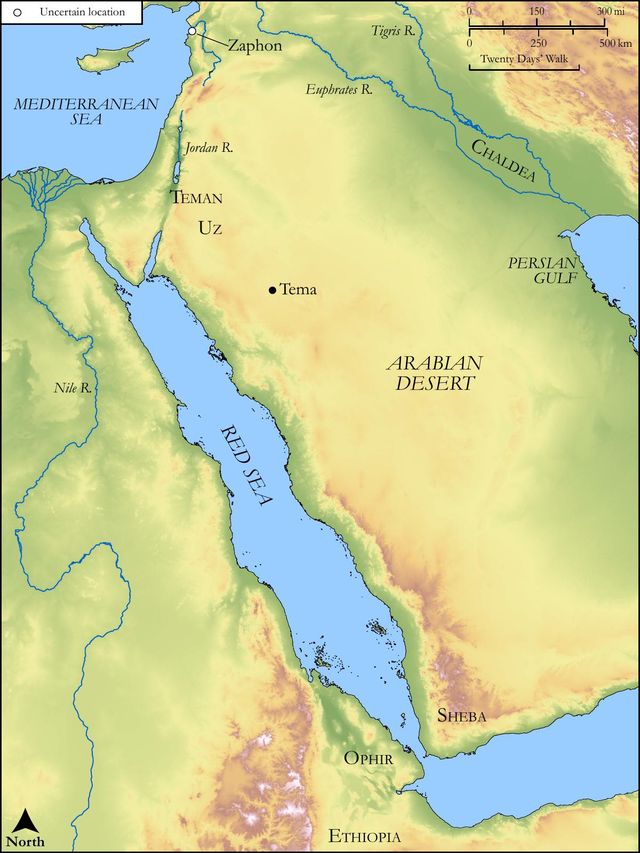
See on the biblical-era map
Study this verse
Public-domain commentary
Matthew Henry
From his Commentary on the Whole Bible. Henry comments on passages, not single verses — this entry covers Job 38:25–41. His four-level outline is real structure in the source text, so it is rendered as structure.
Hitherto God had put such questions to Job as were proper to convince him of his ignorance and short-sightedness. Now he comes, in the same manner, to show his impotency and weakness. As it is but little that he knows, and therefore he ought not to arraign the divine counsels, so it is but little that he can do, and therefore he ought not to oppose the proceedings of Providence. Let him consider what great things God does, and try whether he can do the like, or whether he thinks himself an equal match for him.
I.God has thunder, and lightning, and rain, and frost, at command, but Job has not, and therefore let him not dare to compare himself with God, or to contend with him. Nothing is more uncertain than what weather it shall be, nor more out of our reach to appoint; it shall be what weather pleases God, not what pleases us, unless, as becomes us, whatever pleases God pleases us. Concerning this observe here,
1.How great God is.
(1.)He has a sovereign dominion over the waters, has appointed them their course, even then when they seem to overflow and to be from under his check, Job 38:25. He has divided a water-course, directs the rain where to fall, even when the shower is most violent, with as much certainty as if it were conveyed by canals or conduit-pipes. Thus the hearts of kings are said to be in God's hand; and as the rains, those rivers of God, he turns them whithersoever he will. Every drop goes as it is directed. God has sworn that the waters of Noah shall no more return to cover the earth; and we see that he is able to make good what he has promised, for he has the rain in a water-course.
(2.)He has dominion over the lightning and the thunder, which go not at random, but in the way that he directs them. They are mentioned here because he prepares the lightnings for the rain, Psa 135:7. Let not those that fear God be afraid of the lightning or the thunder, for they are not blind bullets, but go the way that God himself, who means no hurt to them, directs.
(3.)In directing the course of the rain he does not neglect the wilderness, the desert land (Job 38:26, Job 38:27), where no man is.
[1.]Where there is no man to be employed in taking care of the productions. God's providence reaches further than man's industry. If he had not more kindness for many of the inferior creatures than man has, it would go ill with them. God can make the earth fruitful without any art or pains of ours, Gen 2:5, Gen 2:6. When there was not a man to till the ground, yet there went up a mist and watered it. But we cannot make it fruitful without God; it is he that gives the increase.
[2.]Where there is no man to be provided for nor to take the benefit of the fruits that are produced. Though God does with very peculiar favour visit and regard man, yet he does not overlook the inferior creatures, but causes the bud of the tender herb to spring forth for food for all flesh, as well as for the service of man. Even the wild asses shall have their thirst quenched, Psa 104:11. God has enough for all, and wonderfully provides even for those creatures that man neither has service from nor makes provision for.
(4.)He is, in a sense, the Father of the rain, Job 38:28. It has no other father. He produces it by his power; he governs and directs it, and makes what use he pleases of it. Even the small drops of the dew he distils upon the earth, as the God of nature; and, as the God of grace, he rains righteousness upon us and is himself as the dew unto Israel. See Hos 14:5, Hos 14:6; Mic 5:7.
(5.)The ice and the frost, by which the waters are congealed and the earth incrustrated, are produced by his providence, Job 38:29, Job 38:30. These are very common things, which lessens the strangeness of them. But, considering what a vast change is made by them in a very little time, how the waters are hid as with a stone, as with a grave-stone, laid upon them (so thick, so strong, is the ice that covers them), and the face even of the deep is sometimes frozen, we may well ask, "Out of whose womb came the ice? What created power could produce such a wonderful work?" No power but that of the Creator himself. Frost and snow come from him, and therefore should lead our thoughts and meditations to him who does such great things, past finding out. And we shall the more easily bear the inconveniences of winter-weather if we learn to make this good use of it.
2.How weak man is. Can he do such things as these? Could Job? No, v. 34, 35.
(1.)He cannot command one shower of rain for the relief of himself or his friends: "Canst thou lift up thy voice to the clouds, those bottles of heaven, that abundance of waters may cover thee, to water thy fields when they are dry and parched?" If we lift up our voice to God, to pray for rain, we may have it (Zac 10:1); but if we lift up our voice to the clouds, to demand it, they will soon tell us they are not at our beck, and we shall go without it, Jer 14:22. The heavens will not her the earth unless God hear them, Hos 2:21. See what poor, indigent, depending creatures we are; we cannot do without rain, nor can we have it when we will.
(2.)He cannot commission one flash of lightning, if he had a mind to make use of it for the terror of his enemies (Job 38:35): "Canst thou send lightnings, that they may go on thy errand, and do the execution thou desirest? Will they come at thy call, and say unto thee, Here we are?" No, the ministers of God's wrath will not be ministers of ours. Why should they, since the wrath of man works not the righteousness of God? See Luk 9:55.
II.God has the stars of heaven under his command and cognizance, but we have them not under ours.
Our meditations are now to rise higher, far above the clouds, to the glorious lights above. God mentions particularly, not the planets, which move in lower orbs, but the fixed stars, which are much higher. It is supposed that they have an influence upon this earth, notwithstanding their vast distance, not upon the minds of men or the events of providence (men's fate is not determined by their stars), but upon the ordinary course of nature; they are set for signs and seasons, for days and years, Gen 1:14. And if the stars have such a dominion over this earth (Job 38:33), though they have their place in the heavens and are but mere matter, much more has he who is their Maker and ours, and who is an Eternal Mind. Now see how weak we are.
1.We cannot alter the influences of the stars (Job 38:31), not theirs that are instrumental to produce the pleasures of the spring: Canst thou loose the bands of Orion? - that magnificent constellation which makes so great a figure (none greater), and dispenses rough and unpleasing influences, which we cannot control nor repel. Both summer and winter will have their course. God can change them when he pleases, can make the spring cold, and so bind the sweet influences of Pleiades, and the winter warm, and so loose the bands of Orion; but we cannot.
2.It is not in our power to order the motions of the stars, nor are we entrusted with the guidance of them. God, who calls the stars by their names (Psa 147:4), calls them forth in their respective seasons, appointing them the time of their rising and setting. But this is not our province; we cannot bring forth Mazzaroth - the stars in the southern signs, nor guide Arcturus - those in the northern, Job 38:32. God can bring forth the stars to battle (as he did when in their courses they fought against Sisera) and guide them in the attacks they are ordered to make; but man cannot do so.
3.We are not only unconcerned in the government of the stars (the government they are under, and the government they are entrusted with, for they both rule and are ruled), but utterly unacquainted with it; we know not the ordinances of heaven, Job 38:33. So far are we from being able to change them that we can give no account of them; they are a secret to us. Shall we then pretend to know God's counsels, and the reasons of them? If it were left to us to set the dominion of the stars upon the earth, we should soon be at a loss. Shall we then teach God how to govern the world?
III.God is the author and giver, the father and fountain, of all wisdom and understanding, Job 38:36.
The souls of men are nobler and more excellent beings than the stars of heaven themselves, and shine more brightly. The powers and faculties of reason with which man is endued, and the wonderful performances of thought, bring him into some alliance to the blessed angels; and whence comes this light, but from the Father of lights? Who else has put wisdom into the inner parts of man, and given understanding to the heart?
1.The rational soul itself, and its capacities, come from him as the God of nature; for he forms the spirit of man within him. We did not make our own souls, nor can we describe how they act, nor how they are united to our bodies. He only that made them knows them, and knows how to manage them. He fashioneth men's hearts alike in some things, and yet unlike in others.
2.True wisdom, with its furniture and improvement, comes from him as the God of grace and the Father of every good and perfect gift. Shall we pretend to be wiser than God, when we have all our wisdom from him? Nay, shall we pretend to be wise above our sphere, and beyond the limits which he that gave us our understanding sets to it? He designed we should with it serve God and do our duty, but never intended we should with it set up for directors of the stars or the lightning.
IV.God has the clouds under his cognizance and government, but so have not we, Job 38:37.
Can any man, with all his wisdom, undertake to number the clouds, or (as it may be read) to declare and describe the nature of them? Though they are near us, in our own atmosphere, yet we know little more of them than of the stars which are at so great a distance. And when the clouds have poured down rain in abundance, so that the dust grows into solid mire and the clods cleave fast together (Job 38:38), who can stay the bottles of heaven? Who can stop them, that it may not always rain? The power and goodness of God are herein to be acknowledged, that he gives the earth rain enough, but does not surfeit it, softens it, but does not drown it, makes it fit for the plough, but not unfit for the seed. As we cannot command a shower of rain, so we cannot command a fair day, without God; so necessary, so constant, is our dependence upon him.
V.God provides food for the inferior creatures, and it is by his providence, not by any care or pains of ours, that they are fed.
The following chapter is wholly taken up with the instances of God's power and goodness about animals, and therefore some transfer to it the last three verses of this chapter, which speak of the provision made,
1.For the lions, Job 38:39, Job 38:40. "Thou dost not pretend that the clouds and stars have any dependence upon thee, for they are above thee; but on the earth thou thinkest thyself paramount; let us try that then: Wilt thou hunt the prey for the lion? Thou valuest thyself upon thy possessions of cattle which thou wast once owner of, the oxen, and asses, and camels, that were fed at thy crib; but wilt thou undertake the maintenance of the lions, and the young lions, when they couch in their dens, waiting for a prey? No, needest not do it, they can shift for themselves without thee: thou canst not do it, for thou hast not wherewithal to satisfy them: thou darest not do it; shouldst thou come to feed them, they would seize upon thee. But I do it." See the all-sufficiency of the divine providence: it has wherewithal to satisfy the desire of every living thing, even the most ravenous. See the bounty of the divine Providence, that, wherever it has given life, it will give livelihood, even to those creatures that are not only not serviceable, but dangerous, to man. And see its sovereignty, that it suffers some creatures to be killed for the support of other creatures. The harmless sheep are torn to pieces, to fill the appetite of the young lions, who yet sometimes are made to lack and suffer hunger, to punish them for their cruelty, while those that fear God want no good thing.
2.For the young ravens, Job 38:41. As ravenous beasts, so ravenous birds, are fed by the divine Providence. Who but God provides for the raven his food? Man does not; he takes care only of those creatures that are, or may be, useful to him. But God has a regard to all the works of his hands, even the meanest and least valuable. The ravens' young ones are in a special manner necessitous, and God supplies them, Psa 147:9. God's feeding the fowls, especially these fowls (Mat 6:26), is an encouragement to us to trust him for our daily bread. See here,
(1.)What distress the young ravens are often in: They wander for lack of meat. The old ones, they say, neglect them, and do not provide for them as other birds do for their young: and indeed those that are ravenous to others are commonly barbarous to their own, and unnatural.
(2.)What they are supposed to do in that distress: They cry, for they are noisy clamorous creatures, and this is interpreted as crying to God. It being the cry of nature, it is looked upon as directed to the God of nature. The putting of so favourable a construction as this upon the cries of the young ravens may encourage us in our prayers, though we can but cry, Abba, Father.
(3.)What God does for them. Some way or other he provides for them, so that they grow up, and come to maturity. And he that takes this care of the young ravens certainly will not be wanting to his people or theirs. This, being but one instance of many of the divine compassion, may give us occasion to think how much good our God does, every day, beyond what we are aware of.
Historical interpretation
Two Centuries of Reception
2 surviving comments on this verse. Each one is dated, so this reads as a timeline rather than a list.
Select a marker to jump to its quote. Markers stagger vertically where authors wrote within a few decades of each other.
Up to this point God divides the heavenly realities in terms of those through which he punishes us, as distinguished from those through which he benefits us. Notice how the lightnings answer. They do not really mean, “What do you want?” The text wants to signify that all creatures, as though they were living creatures, bend their ear to God. Every time he wants to show the difference in their formation, God talks about “begetting” and “maternal womb.” Every time, on the other hand, he wants to show their docility and perfection, he depicts them as if they bent their ear to his call. Why did he present himself not only as a craftsman but as a father as well? This is because the art that presides over nature is quite superior to any manual art, for it is, so to speak, divine.
2. For God in truth lifts up His voice in the cloud, when He frames His exhortation to the darkened hearts of unbelievers, by the tongues of His preachers. And the force of the waters covers Him, when the crowd of opposing people oppresses His members who are acting rightly. For hence is that which is written, The word of the Lord came to Jeremiah, saying, Stand in the court of the Lord’s house, speaking to all the cities of Judah, from which men come to worship in the Lords house, all the words that I have commanded thee. [Jer. 26, 1. 2.] And a little after, And the priests, and the prophets, and all the people heard Jeremiah speaking these words in the house of the Lord. And when Jeremiah had made an end of speaking, the priests, and the prophets, and all the people, took him, saying, Let him surely die, why hath he prophesied in the name of the Lord? [ib. 7-9] Behold, the Lord lifted up His voice in a cloud, because He reproved the darkened minds of the haughty by sending the Prophet against them. Behold, the face of the waters covered Him immediately; because He Himself, Who commanded the words of reproof, suffered all things in the person of Jeremiah from the people who rose against him, and were provoked by reason of their reproof. The Lord also raised up His voice in a cloud by Himself, when on exhibiting Himself before us in His assumed body, He preached many things to His persecutors, but veiled in enigmatical figures. He raised up His voice in a cloud, because He uttered His truth, as if in darkness, to unbelievers who would not follow Him. Whence also it is well written in the Books of Kings, The cloud filled the house of the Lord, and the priests were not able to minister because of the cloud. [1 Kings 8, 10. 11.] For while the proud high priests of the Jews hear the divine mysteries in parables, as their merits demand, the priests were unable, as it were, to minister in the house of the Lord on account of the cloud. For when they scorn to examine, amid the obscure darkness of allegories, the mystical meanings which are covered with the veil of the letter in the Old Testament, they lost on account of the cloud the ministry which they deserved by their faith. To whom the Lord even now uttered His voice in a cloud, when He spoke even plainly concerning Himself. For what is plainer than, I and My Father are One? [John 10, 30] What plainer to utter, than, Before Abraham was, 1 am? [John 8, 58] But because the darkness of unbelief had filled the minds of His hearers, an intervening cloud was concealing, as it were, the ray of the sun which had been shot forth.
3. For the face of the waters immediately covered Him, at this elevation of voice, because the raging crowd of the people at once rose up against Him. For it is written, Therefore the Jews sought to kill Him, because He not only brake the Sabbath, but said also that God was His Father, making Himself equal with God. [John 5, 18] Of this force of waters He exclaims by the Prophet, They came round about Me all the day like water, they compassed Me about together. [Ps. 88, 17] And again, Saw Me, O God, for the waters have come in even unto My soul. [Ps. 69, 1] Which waters He surely endured in Himself before His death, but in His own people, even after His Ascension. For hence is that which He exclaims from above, Said, Saul, why persecutest thou Me? [Acts 9, 4] Behold, He had already ascended into heaven, and yet Saul, still pursuing Him with the force of unbelieving waters, was touching Him, even as a wave swelling above the rest. For it is He in truth Who speaks right things by the good, He Who is wounded in the sufferings of the godly. In order then to show, by the wondrous unity of charity, that it is He Who preaches by the mouths of His Saints to unworthy hearers, the Lord says, Wilt thou lift up thy voice in the cloud? But to show that it was He Who was enduring all kinds of adversity in His Saints, He subjoined, And shall the face of the waters cover thee? Thou understandest, As Myself, Whom all the wicked neither understand to be speaking by holy men when preaching, nor see to be suffering by them when dying. The Lord relates therefore what He suffers from men, that the pain of the afflicted man may be mitigated, as if He openly said to him, Weigh carefully My sufferings, and temper thine own with patience. For it is much less for thee to bear wounds, than for Me to bear the sufferings of men. [‘humans’]
4. But we can consider these words still more minutely, if we anxiously examine our hearts, in the midst of heavenly gifts. We are at this time indeed faithful, we now believe the heavenly truths which we hear, we now love the things which we believe. But when we are oppressed by some unnecessary cares, we are darkened by a confusion spread over us; and when God suggests to us, even when such, some wonderful notions respecting Himself, He lifts up, as it were, His voice in a cloud. While He speaks of Himself to our benighted minds, He, Who is not seen, is heard, as it were, in a cloud. For most exalted are the truths which we know of Him, but we do not yet behold Him by that secret inspiration, with which we are instructed. He therefore Who speaks indeed to our hearts, but conceals His shape, forms His voice, as it were, in a cloud. But, lo! we now hear the words of God speaking of Himself within, and we now know with what perseverance and with what zeal we ought to cling to His love; and yet we fall back from the height of inward consideration to our usual ways, from the very changeableness of this mortal condition, and are assaulted by the perverse importunity of impending sins. When, therefore, He insinuates subtle thoughts of Himself in our darkened minds, He raises up His voice in a cloud.
5. But when our very notion of God is overpowered by the temptation of sins, God is covered, as it were, in His voice, by the force of waters. For we cast as many waters over Him, as many forbidden thoughts as we dwell on in our heart, after the inspiration of His grace. But yet He 1 ‘op- forsakes us not even when overwhelmed [‘oppressos,’ al. ‘oppressus.’]; for He returns immediately to our mind, He disperses the mists of temptations, He pours on us the shower of compunction, and brings back the sun of subtle understanding. And He thus shows how much He loves us, Who forsakes us not, even when He is rejected; in order that the human mind may, at least when thus instructed, blush to admit temptation within, since its Redeemer ceases not to love it even when wandering. This He endures in us by Himself, this does He daily hear from unbelievers through His preachers. For His gift is cast out by the rising of temptation within us, and yet He is not kept back by our infirmity from pouring into us His gifts. His words are publicly rejected, and yet He is not restrained, by any wickedness of unbelievers, from bestowing the abundance of His grace. For when wicked men despise preaching, He adds miracles also, for them to reverence. Whence after the voice has been uttered, and the force of the overwhelming waters.
Continue studying Job 38:34 across the web’s major study libraries — every link below opens this exact verse, chapter, or book on the destination site.
Read & Compare
 BibleGatewayThis verse in more than 200 translations and 70 languages.
 Bible.comThe YouVersion reader — hundreds of translations, reading plans, and highlights.
 ESV.orgCrossway's official English Standard Version reader.
 NET BibleThe NET translation with 60,000+ translators' notes on every rendering decision.
 STEP BibleTyndale House's free study tool — original text, vocabulary, and scholarly resources.
 BibliaLogos Bible Software's free web reader.
 USCCBThe New American Bible (Revised Edition) with the U.S. bishops' study notes.
Commentaries
 BibleHub CommentariesDozens of classic commentaries on this verse, gathered on one page.
 StudyLightMore than 100 commentary sets — the largest collection on the web.
 BibleRefPlain-English commentary on what this verse means, verse by verse.
 Enduring WordDavid Guzik's free commentary on this chapter, widely used by Bible teachers.
 Bible Study ToolsVerse commentary alongside Greek and Hebrew study aids.
Original Language & Research
- BibleHub InterlinearThe verse word by word — original language, transliteration, and English.
- BibleHub LexiconEvery word's original-language definition and Strong's entry.
 Blue Letter BibleDeep-study tools — Strong's numbers, concordance, and word studies.
 SefariaThe Hebrew text with Rashi and centuries of Jewish commentary.
Sermons, Hymns & Audio


TrulyRandomVerse is not affiliated with these sites and doesn’t control their content. They’re linked because they’re genuinely useful.
Summary
Job 38:34 presents a profound rhetorical question from God to Job, emerging from the whirlwind, which dramatically challenges Job's capacity to command the natural world. This verse, integral to God's divine interrogation, powerfully underscores the immense chasm between human limitation and divine omnipotence, specifically highlighting humanity's utter inability to control meteorological phenomena like rainfall. It serves as a stark reminder designed to humble Job, contrasting his finite understanding and power with God's absolute and unchallengeable sovereignty over all creation, particularly the vital elements of nature that sustain or threaten life.
Context
ShowHideLiterary Context
Job 38 marks a pivotal and dramatic turning point in the Book of Job, as the Lord finally breaks His silence, speaking directly to Job out of a whirlwind. This divine discourse, which extends through chapters 38-41, is not an explanation for Job's suffering, nor is it a vindication of his friends' simplistic theological propositions. Instead, it comprises a relentless series of overwhelming rhetorical questions. God confronts Job's presumed wisdom and limited human perspective by showcasing His own unsearchable wisdom and absolute sovereignty over all creation. Within this grand interrogation, Job 38:34 specifically focuses on meteorological control, challenging Job to perform a feat—commanding the clouds to bring a deluge—that is utterly beyond human capability. This serves to illustrate the profound and unbridgeable difference between the Creator and His creation. The verse is part of a larger section where God systematically dismantles any human-centric view by parading the wonders of the natural world, from the very foundations of the earth to the intricate behaviors of its diverse animal life.
Historical & Cultural Context
In the land of Uz, the setting for the Book of Job, life was inextricably linked to the often-unpredictable forces of nature, with rainfall being paramount. Arid climates meant that water was an extraordinarily precious commodity, and its presence or absence directly determined the survival and prosperity of agricultural and pastoral societies. Many of the nations round about attributed control over rain, storms, and fertility to various polytheistic deities, often through elaborate rituals, sacrifices, and even cultic prostitution. Against this pervasive backdrop of pagan beliefs, the God of Israel, Yahweh, consistently asserted His sole and absolute dominion over all natural phenomena. Job 38:34 would have resonated deeply with an audience acutely aware of their vulnerability to weather patterns, emphasizing that no human king, priest, or false god could command the skies. This context highlights the radical monotheistic claim of the biblical text: only the one true God holds such power, a power that both sustains life and can bring judgment.
Key Themes
ShowHideJob 38:34 powerfully contributes to several overarching themes central to the Book of Job and broader biblical theology. Firstly, it starkly contrasts Divine Omnipotence with Human Impotence. God's effortless ability to command the clouds and unleash an "abundance of waters" stands in direct opposition to Job's, and indeed all humanity's, utter inability to influence such forces. This powerfully reinforces the theme of God's Sovereignty Over Nature, demonstrating that elements like clouds and rain are entirely under His control, not subject to human manipulation or even full comprehension, a truth profoundly established in the creation account. Secondly, the rhetorical question serves as a profound call to Humility Before God. It reminds Job, and by extension all readers, of our limited perspective and power when compared to the infinite wisdom and might of the Almighty. This divine challenge is designed to strip away any vestige of human pride or self-sufficiency, ultimately leading Job to a place of deeper reverence and repentance, as seen in Job's humble response. Finally, it underscores the theme of Divine Wisdom vs. Human Wisdom, asserting that true wisdom belongs solely to God, who alone comprehends and controls the intricate workings of the universe, a wisdom far beyond human comprehension as articulated in Isaiah 40:28.
Exposition and Analysis
ShowHideKey Word Analysis
ShowHideA primitive noun meaning "a voice or sound." In this context, "lift up thy voice" implies issuing a command, a powerful decree, or an authoritative appeal. God challenges Job to consider if his "voice"—his command or plea—carries any authority in the heavens, unlike the divine voice that spoke creation into being and continues to uphold it. The implication is that Job's voice, however earnest, is utterly powerless to influence the heavens.
From a root meaning "to envelope," referring to "a (scud) cloud" or dense mass. These are the visible masses of water vapor in the atmosphere, the direct source of rain. By challenging Job to command the clouds, God points to a fundamental element of the natural world that is entirely beyond human control, yet essential for life. It highlights the direct, unmediated control God exercises over the very sources of sustenance and, conversely, of potential destruction.
Shiphʻâh means "copiousness; abundance, company, multitude," and mayim refers to "water." This phrase together denotes a deluge, a torrent, or an overflowing quantity of water. It signifies not merely a gentle sprinkle, but a powerful, overwhelming downpour or even a flood. The challenge is not just to initiate rain, but to command its intensity and scope at will, further underscoring the vastness of divine power compared to human impotence.
Verse Breakdown
ShowHide"Canst thou lift up thy voice to the clouds,"
This opening clause presents a direct, rhetorical challenge to Job's authority and capability. The phrase "lift up thy voice" implies issuing a command, a decree, or a powerful appeal. God is asking Job if he possesses the inherent authority or persuasive power to command the very elements of nature, specifically the clouds, which are the visible manifestation of atmospheric power and the source of rain. The implied answer is a resounding "No," highlighting the vast chasm between finite human and infinite divine authority.
"that abundance of waters may cover thee?"
This second clause specifies the desired outcome of Job's hypothetical command: a torrential downpour, a deluge that would "cover" or overwhelm. This is not merely about producing a little rain, but about unleashing a powerful, life-altering flood at will. The question emphasizes not only the initiation of a natural phenomenon but also its scale and intensity, further magnifying the divine power required to control such forces and underscoring Job's absolute inability to do so. The "thee" could refer to Job personally, or more broadly, to the land or people, emphasizing the overwhelming and uncontrollable nature of such a commanded event from a human perspective.
Literary Devices
ShowHideThe primary literary device employed in Job 38:34, and indeed throughout God's discourse in Job 38-41, is the Rhetorical Question. God asks questions not because He lacks information or seeks an answer from Job, but to make a profound theological point and expose the limits of Job's understanding and power. These questions are meticulously designed to lead Job to a humbling realization of his own ignorance and the incomprehensible greatness of God. This verse also utilizes powerful Contrast and Juxtaposition, placing human impotence directly against divine omnipotence. The utter inability of a human to command the clouds stands in stark opposition to God's effortless and sovereign control over the elements. Furthermore, there is vivid Imagery evoked by "abundance of waters may cover thee," painting a powerful picture of an overwhelming deluge, which serves to emphasize the magnitude of the power being discussed. While less direct in this specific verse, the broader context of God "speaking" from a whirlwind employs Anthropomorphism, attributing human-like communication to God, making His presence and challenge more immediate and awe-inspiring.
Theological and Thematic Connections
ShowHideJob 38:34 serves as a powerful theological anchor, grounding humanity in a profound sense of humility and dependence before an infinitely sovereign God. It underscores that the intricate, life-sustaining, and sometimes destructive forces of nature are not random, nor are they subject to human will or manipulation. Instead, they are meticulously governed by the Creator, who alone possesses the unsearchable wisdom to orchestrate their movements and the absolute power to command their effects. This divine control over the elements is a testament to God's ongoing providence, His active and intimate involvement in sustaining the world He created. It challenges any humanistic notion of self-sufficiency and invites a posture of profound awe and worship, recognizing that our very existence is contingent upon the One who holds the "abundance of waters" in His hand.
Reflection and Application
ShowHideJob 38:34 calls us to cultivate a profound sense of humility and awe before God. In a world that often strives for control, mastery over nature, and human self-sufficiency, this verse serves as a stark reminder of our inherent limitations and the vastness of God's power. It encourages us to release our grip on perceived control and instead embrace a posture of dependence and trust. When we acknowledge that we cannot even command a cloud, let alone the complexities of our lives or the world's grand movements, we are freed from the burdensome illusion of trying to be God. This perspective fosters a deeper trust in His perfect timing and sovereign plan, knowing that the One who controls the heavens also meticulously cares for our every need. It invites us to cultivate a spirit of worship, marveling at the Creator who holds all creation in His hands, and to find profound peace in His ultimate authority, even amidst life's most uncertain and challenging circumstances.
Questions for Reflection
ShowHideFAQ
ShowHideWhy does God ask rhetorical questions of Job instead of directly explaining His reasons for Job's suffering?
ShowHideGod's primary purpose in His discourse with Job is not to provide a direct explanation for suffering, but rather to reveal Himself and expose the vast, unbridgeable chasm between finite human understanding and infinite divine wisdom. The rhetorical questions, such as "Canst thou lift up thy voice to the clouds," serve as a pedagogical and revelatory tool. They are designed to humble Job by highlighting his profound ignorance and impotence in comparison to God's omnipotence and omniscience. God is not seeking information from Job; rather, He is guiding Job to a transformative realization of his own limited perspective and the incomprehensible greatness of the Creator. This divine approach ultimately leads Job to a place of deeper reverence, repentance, and trust in God's sovereignty, as powerfully evidenced by his response in Job 42:1-6. The questions force Job, and by extension the reader, to confront the limits of human reason and to submit to divine mystery and majesty.
Christ-Centered Fulfillment
ShowHideWhile Job 38:34 powerfully asserts God's exclusive sovereignty over the natural world, its ultimate fulfillment and most profound meaning are gloriously revealed in the person of Jesus Christ. The very God who challenged Job from the whirlwind, demonstrating His unchallengeable authority over creation, is incarnated in Jesus, who demonstrates this identical divine authority over all creation. Unlike Job, who could not command the clouds or the waters, Jesus effortlessly commanded the wind and the sea, bringing about a great calm with a mere word, leaving His disciples to wonder, "Who then is this, that even the wind and the sea obey him?" as recorded in Mark 4:39-41. He walked on water, defying natural laws, as seen in Matthew 14:25, proving His dominion over the very elements that Job was powerless to influence. Jesus is not merely a prophet or a wise man; He is the embodiment of God's unsearchable wisdom and power, the very "wisdom of God" and "power of God" mentioned in 1 Corinthians 1:24. The One who controls the physical "abundance of waters" is also the one who offers spiritual "living water" to all who believe, promising that "whoever drinks of the water that I will give him will never be thirsty again," as declared in John 4:10 and John 7:38. Thus, Job 38:34 ultimately points to Christ as the sovereign Lord over all creation, whose power extends not only over the physical world but also over sin and death, offering a spiritual covering far greater and more eternal than any earthly deluge.