


Jeremiah 6:12
Bible text: King James Version (1769 Blayney text) · Public domain
Bible text: King James Version with Strong's numbers · Public domain
Bible text: Berean Standard Bible · Public domain
Bible text: American Standard Version (1901) · Public domain
Bible text: World English Bible, Messianic edition · Public domain
Bible text: Geneva Bible (1599) · Public domain
Bible text: Young's Literal Translation · Public domain
- וְנָסַבּוּve·na·Sa·buand they will be turned overH5437Conj-w ¦ V-Niphal-ConsecPerf-3cpVerb Niphal Consecutive Perfect 3rd Plural common genderוְandנָסַבּוּthey will be turned over
- בָתֵּיהֶםva·tei·Hemtheir housesH1004N-mpc ¦ 3mpNoun Plural Masculine Constructבָתֵּיhousesהֶםtheir
- לַאֲחֵרִיםla·'a·che·Rimto othersH312Prep-l ¦ Adj-mpAdjective Plural Masculine Absoluteלַtoאֲחֵרִיםothers
- שָׂדוֹתsa·DotfieldsH7704N-fpNoun Plural Feminine Absolute
- וְנָשִׁיםve·na·Shimand wivesH802Conj-w ¦ N-mpNoun Plural Masculine Absoluteוְandנָשִׁיםwives
- יַחְדָּוyach·DavalikeH3162AdvAdverb
- כִּיkiforH3588PrtParticle Conditional
- אַטֶּה'a·TehI will stretch outH5186V-Hiphil-Imperf-1csVerb Hiphil Imperfect 1st Singular common gender
- אֶת'et<obj.>H853DirObjMParticle Object Indicator
- יָדִיya·Dimy handH3027N-csc ¦ 1csNoun Singular common gender Constructיָדִhandיmy
- עַל'alonH5921PrepPreposition
- יֹשְׁבֵיyo·she·Vei[the] inhabitants ofH3427V-Qal-Prtcpl-mpVerb Qal Participle Plural Masculine Construct
- הָאָרֶץha·'A·retzthe landH776Art ¦ N-fsNoun Singular Feminine Absoluteהָtheאָרֶץland
- נְאֻםne·'um[the] utterance ofH5002N-mscNoun Singular Masculine Construct
- יְהוָהYah·wehYahwehH3068N-properNoun Proper Title
English is a literal word-by-word gloss of the Hebrew, not the KJV's wording. Why?
This is the original text the KJV's translators worked from — each Hebrew word with its own literal English meaning in this verse, prepared by scholars at Tyndale House, Cambridge. The KJV translates whole sentences, not word by word, so its wording differs: one Hebrew word can become several English words, and the KJV may choose “the LORD” where the gloss reads “Yahweh”. Both are faithful — they answer different questions. For the KJV's own rendering, switch to the KJV text.
Details
See on the biblical-era map
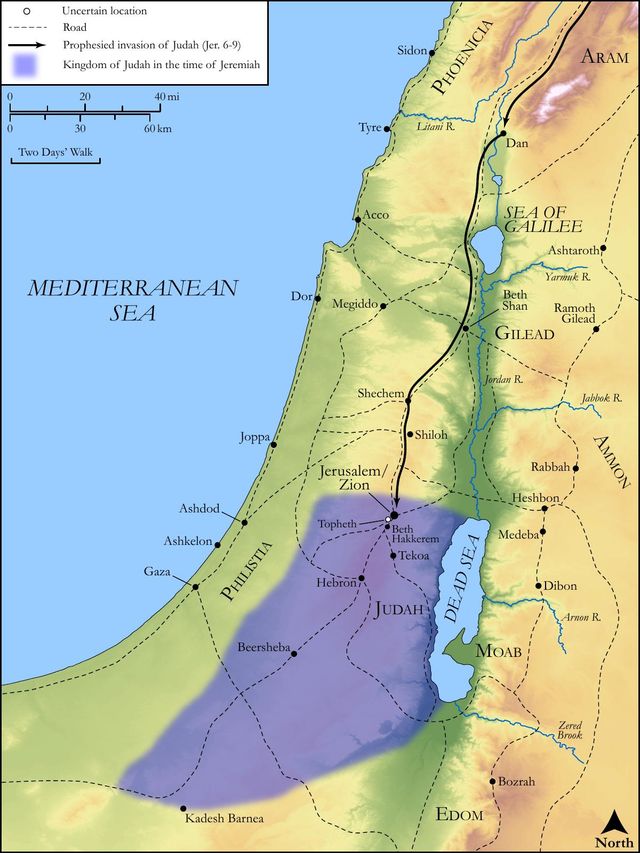
Study this verse
Public-domain commentary
Matthew Henry
From his Commentary on the Whole Bible. Henry comments on passages, not single verses — this entry covers Jeremiah 6:9–17. His three-level outline is real structure in the source text, so it is rendered as structure.
The heads of this paragraph are the very same with those of the last; for precept must be upon precept and line upon line.
I.The ruin of Judah and Jerusalem is here threatened.
We had before the haste which the Chaldea army made to the war (Jer 6:4, Jer 6:5); now here we have the havoc made by the war. How lamentable are the desolations here described! The enemy shall so long quarter among them, and be so insatiable in their thirst after blood and treasure, that they shall seize all they can meet with, and what escapes them at one time shall fall into their hands another (Jer 6:9): They shall thoroughly glean the remnant of Israel as a vine; as the grape-gatherer, who is resolved to leave none behind, still turns back his hand into the baskets, to put more in, till he has gathered all, so that they be picked up by the enemy, though dispersed, though hid, and none of them shall escape their eye and hand. Perhaps the people, being given to covetousness (Jer 6:13), had not observed that law of God which forbade them to glean all their grapes (Lev 19:10), and now they themselves shall be in like manner thoroughly gleaned and shall either fall by the sword or go into captivity. This is explained Jer 6:11, Jer 6:12, where God's fury and his hand are said to be poured out and stretched out, in the fury and by the hand of the Chaldeans; for even wicked men are often made use of as God's hand (Psa 17:14), and in their anger we may see God angry. Now see on whom the fury is poured out in full vials - upon the children abroad, or in the streets, where they are playing (Zac 8:5) or whither they run out innocently to look about them: the sword of the merciless Chaldeans shall not spare them, Jer 9:21. The children perish in the calamity which the fathers' sins have procured. The execution shall likewise reach the assembly of young men, their merry meetings, their clubs which they keep up to strengthen one another's hands in wickedness; they shall be cut off together. Nor shall those only fall into the enemies' hands who meet for lewdness (Jer 5:7), but even the husband with the wife shall be taken, these two in bed together, and neither left, but both taken prisoners. And, as they have no compassion for the weak but fair sex, so they have none for the decrepit but venerable age: The old with the full of days, whose deaths can contribute no more to their safety than their lives to their service, who are not in a capacity to do them either good or harm, shall be either cut off or carried off. Their houses shall then be turned to others (Jer 6:12); the conquerors shall dwell in their habitations, use their goods, and live upon their stores; their fields and vines shall fall together into their hands, as was threatened, Deu 28:30, etc. For God stretches out his hand upon the inhabitants of the land, and none can go out of the reach of it. Now as to this denunciation of God's wrath,
1.The prophet justifies himself in preaching thus terribly, for herein he dealt faithfully (Jer 6:11): "I am full of the fury of the Lord, full of the thoughts and apprehensions of it, and am carried out with a powerful impulse, by the spirit of prophecy, to speak of it thus vehemently." He took no delight in threatening, nor was it any pleasure to him with such sermons as these to make those about him uneasy; but he could not contain himself; he was weary with holding in; he suppressed it as long as he could, as long as he durst, but he was so full of power by the Spirit of the Lord of hosts that he must speak, whether they will hear or whether they will forbear. Note, When ministers preach the terrors of the Lord according to the scripture we have no reason to be displeased at them; for they are but messengers, and must deliver their message, pleasing or unpleasing.
2.He condemns the false prophets who preached plausibly, for therein they flattered people and dealt unfaithfully (Jer 6:13, Jer 6:14): The priest and the prophet, who should be their watchmen and monitors, have dealt falsely, have not been true to their trust not told the people their faults and the danger they were in; they should have been their physicians, but they murdered their patients by letting them have their will, by giving them every thing that had a mind to, and flattering them into an opinion that they were in no danger (Jer 6:14): They have healed the hurt of the daughter of my people slightly, or according to the cure of some slight hurt, skinning over the wound and never searching it to the bottom, applying lenitives only, when there was need of corrosives, soothing people in their sins, and giving them opiates to make them easy for the present, while the disease was preying upon the vitals. They said, "Peace peace - all shall be well." (if there were some thinking people among them, who were awake, and apprehensive of danger, they soon stopped their mouths with their priestly and prophetical authority, boldly averring that neither church nor state was in any danger), when there is no peace, because they went on in their idolatries and daring impieties. Note, Those are to be reckoned our false friends (that is, our worst and most dangerous enemies) who flatter us in a sinful way.
II.The sin of Judah and Jerusalem, which provoked God to bring this ruin upon them and justified him in it, is here declared.
1.They would by no means bear to be told of their faults, nor of the danger they were in. God bids the prophet give them warning of the judgment coming (Jer 6:9), "but," says he, "to whom shall I speak and give warning? I cannot find out any that will so much as give me a patient hearing. I may give warning long enough, but these is nobody that will take warning. I cannot speak that they may hear, cannot speak to any purpose, or with any hope of success; for their ear is uncircumcised, it is carnal and fleshly, indisposed to receive the voice of God, so that they cannot hearken. They have, as it were, a thick skin grown over the organs of hearing, so that divine things might to as much purpose be spoken to a stone as to them. Nay, they are not only deaf to it, but prejudiced against it; therefore they cannot hear, because they are resolved that they will not: The word of the Lord is unto them a reproach; both the reproofs and the threatenings of the word are so;" they reckoned themselves wronged and affronted by both, and resented the prophet's plain-dealing with them as they would the most causeless slander and calumny. This was kicking against the pricks (Act 9:5), as the lawyers against the word of Christ, Luk 11:45, Thus saying, thou repoachest us also. Note, Those reproofs that are counted reproaches, and hated as such, will certainly be turned into the heaviest woes. When it is here said, They have no delight in the word, more is implied than is expressed; "they have an antipathy to it; their hearts rise at it; it exasperates them, and enrages their corruptions, and they are ready to fly in the face and pull out the eyes of their reprovers." And how can those expect that the word of the Lord should speak any comfort to them who have no delight in it, but would rather be any where than within hearing of it?
2.They were inordinately set upon the world, and wholly carried away by the love of it (Jer 6:13): "From the least of them even to the greatest, old and young, rich and poor, high and low, those of all ranks, professions, and employments, every one is given to covetousness, greedy of filthy lucre, all for what they can get, per fas per nefas - right or wrong;" and this made them oppressive and violent (Jer 6:6, Jer 6:7), for of those evils, as well as others, the love of money is the bitter root. Nay, and this hardened their hearts against the word of God and his prophets. It was the covetous Pharisees that derided Christ, Luk 16:14.
3.They had become impudent in sin and were past shame. After such a high charge of flagrant crimes proved upon them, it was very proper to ask (Jer 6:15), Were they ashamed when they had committed all these abominations, which are such a reproach to their reason and religion? Did they blush at the conviction, and acknowledge that confusion of face belonged to them? If so, there is some hope of them yet. But, alas! there did not appear so much as this colour of virtue among them; their hearts were so hardened that they were not at all ashamed, neither could they blush, they had so brazened their faces. They even gloried in their wickedness, and openly confronted the convictions which should have humbled them and brought them to repentance. They resolved to face it out against God himself and not to own their guilt. Some refer this to the priests and prophets, who had healed the people slightly and told them that they should have peace, and yet were not ashamed of their treachery and falsehood, no, not when the event disproved them and gave them the lie. Those that are shameless are graceless and their case is hopeless. But those that will not submit to a penitential shame, nor take that to themselves as their due, shall not escape an utter ruin; for so it follows: Therefore they shall fall among those that fall; they shall have their portion with those that are quite undone; and, when God visits the nation in wrath, they shall be sure to be cast down and be made to tremble, because they would not blush. Note, Those that sin and cannot blush for it are in an evil case now, and it will be worse with them shortly. At first they hardened themselves and would not blush, afterwards they were so hardened that they could not. Quod unum habebant in malis bonum perdunt, peccandi verecundiam - they have lost the only good property which once blended itself with many bad ones, that is, shame for having done amiss. - Senec. De Vit. Beat.
III.They are put in mind of the good counsel which had been often given them, but in vain. They had a great deal said to them to little purpose,
1.By way of advice concerning their duty, Jer 6:16. God had been used to say to them, Stand in the ways and see. That is,
(1.)He would have them to consider, not to proceed rashly, but to do as travellers in the road, who are in care to find the right way which will bring them to their journey's end, and therefore pause and enquire for it. If they have any reason to think that they have missed their way, they are not easy till they have obtained satisfaction. O that men would be thus wise for their souls, and would ponder the path of their feet, as those that believe lawful and unlawful are of no less consequence to us than the right way and the wrong are to a traveller!
(2.)He would have them to consult antiquity, the observations and experiences of those that went before them: "Ask for the old paths, enquire of the former age (Job 8:8), ask thy father, thy elders (Deu 32:7), and thou wilt find that the way of godliness and righteousness has always been the way which God has owned and blessed and in which men have prospered. Ask for the old paths, the paths prescribed by the law of God, the written word, that true standard of antiquity. Ask for the paths that the patriarchs travelled in before you, Abraham, and Isaac, and Jacob; and, as you hope to inherit the promises made to them, tread in their steps. Ask for the old paths, Where is the good way?" We must not be guided merely by antiquity, as if the plea of prescription and long usage were alone sufficient to justify our path. No; there is an old way which wicked men have trodden, Job 22:15. But, when we ask for the old paths, it is only in order to find out the good way, the highway of the upright. Note, The way of religion and godliness is a good old way, the way that all the saints in all ages have walked in.
(3.)He would have them to resolve to act according to the result of these enquiries: "When you have found out which is the good way, walk therein, practise accordingly, keep closely to that way, proceed, and persevere in it." Some make this counsel to be given them with reference to the struggles that were between the true and false prophets, between those that said they should have peace and those that told them trouble was at the door; they pretended they knew not which to believe: "Stand in the way," says God, "and see, and enquire, which of these two agrees with the written word and the usual methods of God's providence, which of these directs you to the good way, and do accordingly." (4.) He assures them that, if they do thus, it will secure the welfare and satisfaction of their own souls: "Walk in the good old way and you will find your walking in that way will be easy and pleasant; you will enjoy both your God and yourselves, and the way will lead you to true rest. Though it cost you some pains to walk in that way, you will find an abundant recompence at your journey's end." (5.) He laments that this good counsel, which was so rational in itself and so proper for them, could not find acceptance: "But they said, We will not walk therein, not only we will not be at the pains to enquire which is the good way, the good old way; but when it is told us, and we have nothing to say to the contrary but that it is the right way, yet we will not deny ourselves and our humours so far as to walk in it." Thus multitudes are ruined for ever by downright wilfulness.
2.By way of admonition concerning their danger. Because they would not be ruled by fair reasoning, God takes another method with them; by less judgments he threatens greater, and sends his prophets to give them this explication of them, and to frighten them with an apprehension of the danger they were in (Jer 6:17); Also I set watchmen over you. God's ministers are watchmen, and it is a great mercy to have them set over us in the Lord. Now observe here,
(1.)The fair warning given by these watchmen. This was the burden of their song; they cried again and again, Hearken to the sound of the trumpet. God, in his providence, sounds the trumpet (Zac 9:14); the watchmen hear it themselves and are affected with it (Jer 4:19), and they are to call upon others to hearken to it too, to hear the Lord's controversy, to observe the voice of Providence, to improve it, and answer the intentions of it.
(2.)This fair warning slighted: "But they said, We will not hearken; we will not hear, we will not heed, we will not believe; the prophets may as well save themselves and us the trouble." The reason why sinners perish is because they do not hearken to the sound of the trumpet; and the reason why they do not is because they will not; and they have no reason to give why they will not but because they will not, that is, they are herein most unreasonable. One may more easily deal with ten men's reasons than one man's will.
Historical interpretation
Historical reception
1 surviving comment on this verse from the historical church.
(Verse 12) Pour (or he pours) on the little one outside, and on the assembly of young men together: for a man will be captured with a woman, an elder with one full of days. And their houses will pass on to others, fields and wives alike. Perhaps the Prophet commands, by the Spirit coming to the Chaldeans, to pour out the fury of the Lord on the little ones, and not spare even the innocent age: or certainly, he narrates what happened to the assembly of young men together, who had taken up arms to resist. For when a man is captured with a wife, they together will feel the sweetest names of captivity: an old man with full days. Therefore, old age is not the final age, but of those who are full of days, whom we call in our language the deposited or the decrepit. It follows, And their houses will pass on to others, with the evil of captivity, along with fields and wives: so that the spouse passes over to the enemies and possession. Whatever we understand literally about Jerusalem, let us refer spiritually to the Church, if it has offended God.
Continue studying Jeremiah 6:12 across the web’s major study libraries — every link below opens this exact verse, chapter, or book on the destination site.
Read & Compare
 BibleGatewayThis verse in more than 200 translations and 70 languages.
 Bible.comThe YouVersion reader — hundreds of translations, reading plans, and highlights.
 ESV.orgCrossway's official English Standard Version reader.
 NET BibleThe NET translation with 60,000+ translators' notes on every rendering decision.
 STEP BibleTyndale House's free study tool — original text, vocabulary, and scholarly resources.
 BibliaLogos Bible Software's free web reader.
 USCCBThe New American Bible (Revised Edition) with the U.S. bishops' study notes.
Commentaries
 BibleHub CommentariesDozens of classic commentaries on this verse, gathered on one page.
 StudyLightMore than 100 commentary sets — the largest collection on the web.
 BibleRefPlain-English commentary on what this verse means, verse by verse.
 Enduring WordDavid Guzik's free commentary on this chapter, widely used by Bible teachers.
 Bible Study ToolsVerse commentary alongside Greek and Hebrew study aids.
Original Language & Research
- BibleHub InterlinearThe verse word by word — original language, transliteration, and English.
- BibleHub LexiconEvery word's original-language definition and Strong's entry.
 Blue Letter BibleDeep-study tools — Strong's numbers, concordance, and word studies.
 SefariaThe Hebrew text with Rashi and centuries of Jewish commentary.
Sermons, Hymns & Audio


TrulyRandomVerse is not affiliated with these sites and doesn’t control their content. They’re linked because they’re genuinely useful.
Summary
Jeremiah 6:12 delivers a stark and comprehensive prophetic declaration of God's impending judgment upon Judah, foretelling the complete and devastating loss of their most fundamental sources of security and identity: their homes, agricultural lands, and even their families. This profound desolation is presented not as a random misfortune but as the direct, decisive, and intentional act of the LORD, a righteous consequence of the people's persistent rebellion, spiritual unfaithfulness, and rejection of His warnings. The verse powerfully underscores the absolute sovereignty of God in executing His just judgment against sin, revealing the transient nature of all earthly securities when divine favor is withdrawn.
Context
ShowHideLiterary Context
Jeremiah 6:12 is situated within a series of intense prophetic oracles (Jeremiah 6-10) that vividly depict God's righteous judgment against Jerusalem and Judah. Immediately preceding this verse, the prophet Jeremiah has meticulously detailed the widespread moral decay and spiritual apostasy that has permeated every stratum of society, from the common populace to its religious and political leaders. The people have become stubbornly unresponsive to God's repeated warnings, their "ears uncircumcised," as poignantly stated in Jeremiah 6:10. Jeremiah has foretold an imminent and devastating invasion from the north, a formidable force that God will employ as His instrument of divine wrath. This specific verse intensifies the picture of desolation, moving from general pronouncements of doom to the concrete, personal, and utterly devastating losses that will befall every household, thereby emphasizing the totality and inevitability of the coming judgment as a direct consequence of their unrepentance and spiritual rebellion. The preceding verses in Jeremiah 6 describe the siege and the people's refusal to listen, setting the stage for the severe consequences outlined in verse 12.
Historical & Cultural Context
The prophecy of Jeremiah 6:12 was delivered in the tumultuous latter half of the 7th century BCE, a period marked by the decline of the Assyrian Empire and the ascendance of the Neo-Babylonian Empire, which would eventually lead to the Babylonian exile. Judah, caught in this geopolitical maelstrom, had consistently deviated from its covenant obligations with Yahweh, engaging in rampant idolatry, pervasive oppression, and syncretistic worship practices. In Israel, land, homes, and family (represented by wives and children) constituted the bedrock of security, identity, and generational continuity. Losing these foundational elements meant utter ruin, the obliteration of one's heritage, and the severing of one's future. The threat of having one's property "turned unto others" and wives taken was a terrifying and common reality of conquest in this era, frequently detailed in ancient covenant curses and historical accounts (e.g., Deuteronomy 28:30). Jeremiah's prophecy, therefore, taps into these deep-seated cultural fears, portraying the impending Babylonian invasion not merely as a geopolitical event but as God's direct, punitive, and sovereign intervention in history.
Key Themes
ShowHideThis verse powerfully encapsulates several core theological and narrative themes prevalent throughout the book of Jeremiah and the broader Old Testament. Firstly, Divine Judgment is unequivocally declared, with the LORD explicitly stating, "I will stretch out my hand," signifying His active, intentional, and sovereign involvement in the coming destruction. Secondly, it highlights the Consequences of Persistent Sin, demonstrating with chilling clarity that unrepentant rebellion against God's covenant and His revealed will inevitably leads to severe, comprehensive, and personal loss. The specific mention of "houses, fields, and wives" underscores the theme of the Transience of Earthly Security, revealing the precarious and fleeting nature of material possessions and even family stability when God's favor is withdrawn due to disobedience. This profound loss also speaks directly to the theme of Covenant Faithfulness and Infidelity, as the judgment is a direct and just consequence of Judah's egregious breach of their covenant obligations. Finally, the concluding phrase "saith the LORD" reinforces the themes of Prophetic Authority and God's Sovereignty, asserting that these pronouncements are not mere human predictions but infallible divine decrees, emphasizing that God remains in sovereign control of all historical events, even those that bring about widespread devastation, as seen throughout Jeremiah's prophecies.
Exposition and Analysis
ShowHideKey Word Analysis
ShowHideDerived from a root meaning "to build," this word primarily refers to a physical dwelling, but its semantic range extends significantly to encompass a household, family, lineage, or even a temple. In Jeremiah 6:12, the loss of "houses" signifies not merely the destruction of physical structures but the complete dismantling of family units, the obliteration of heritage, and the very foundation of societal existence. It implies the end of a secure, settled life and the disruption of generational continuity, representing total dispossession.
This primitive root means "to revolve, surround, or border." In this context, it conveys the idea of something being "turned over," "transferred," or "assigned" to another. It implies a forceful, complete, and irreversible change of ownership and possession, highlighting the involuntary and permanent nature of the confiscation. The houses are not merely abandoned; they are actively re-assigned to "others," emphasizing the total dispossession of the original inhabitants and the transfer of their entire way of life.
While literally meaning the open hand, yâd is a rich Hebrew idiom frequently used to denote power, authority, means, or direction. When God "stretches out" His hand (related to H5186 nâṭâh, "to stretch or spread out"), it signifies His direct, powerful, and decisive intervention. In this context, it is an action of judgment, demonstrating God's sovereign power to execute His will and bring about the promised consequences of disobedience, underscoring the active role of the Divine in the impending catastrophe.
Verse Breakdown
ShowHide"And their houses shall be turned unto others"
This initial clause declares the forceful and involuntary transfer of property. The homes, which symbolize security, identity, and generational inheritance, will be seized and given to foreign invaders or new occupants. This signifies a complete and devastating loss of stability, belonging, and the very foundation of life for the people of Judah.
"[with their] fields and wives together"
This expands the scope of the judgment to include all vital aspects of life, emphasizing the totality of the impending ruin. "Fields" represent livelihood, sustenance, and the economic basis of the family and nation. "Wives" symbolize the family unit, lineage, and the future of the people, indicating the severing of generational continuity. The word "together" (Hebrew, yachad) powerfully emphasizes the comprehensive, simultaneous, and inescapable nature of this desolation, indicating that no aspect of their established life, no source of security, will be spared.
"for I will stretch out my hand upon the inhabitants of the land"
This phrase provides the divine rationale and identifies the active agent behind the judgment. The idiom "I will stretch out my hand" is a potent declaration signifying God's direct, intentional, and forceful intervention. It unequivocally underscores that the impending catastrophe is not random misfortune or mere geopolitical consequence, but a deliberate act of divine judgment against the people who "inhabit the land" (referring specifically to Judah and Jerusalem).
"saith the LORD"
This concluding phrase serves as an authoritative divine stamp on the prophecy. It affirms with absolute certainty that these words are not Jeremiah's personal opinion or a human prediction, but the infallible, unalterable declaration of Yahweh (H3068, Yᵉhôvâh), the self-existent, eternal, and covenant-keeping God. It establishes the divine origin, certainty, and absolute authority of the judgment pronounced.
Literary Devices
ShowHideJeremiah 6:12 employs several potent literary devices to convey its message of impending and inescapable doom with striking clarity and force. The phrase "I will stretch out my hand" functions as a powerful idiom and anthropomorphism, attributing a human action (stretching out a hand) to God to convey His direct, active, and sovereign intervention in judgment. This highlights that the impending disaster is not a passive allowance but a deliberate, forceful act of divine will. The listing of "houses," "fields," and "wives" together is a classic example of merism or totalizing language, where distinct, representative parts are named to encompass and signify the whole. This device emphasizes the comprehensive and absolute nature of the impending loss, indicating that nothing—no aspect of their security, livelihood, or family—will be spared from the divine judgment. The verse itself is structured as a direct prophetic oracle, a direct declaration from God, which lends it an undeniable sense of authority, certainty, and inevitability. This direct divine speech, punctuated by the authoritative "saith the LORD," creates a profound sense of dramatic irony for the original hearers, who, despite repeated warnings, remain oblivious or defiant to the certain and comprehensive doom awaiting them.
Theological and Thematic Connections
ShowHideJeremiah 6:12 resonates deeply with the broader biblical narrative concerning God's unwavering justice, the severe consequences of persistent sin, and the nature of His covenant relationship with Israel. This verse serves as a stark and sobering reminder that God's patience, while immense, is not infinite, and that unrepentant rebellion against His revealed will inevitably leads to profound and comprehensive consequences. It powerfully echoes the covenant curses outlined in Deuteronomy 28, where the loss of land, property, and family is explicitly and directly tied to disobedience and infidelity to the covenant. The divine declaration "I will stretch out my hand" asserts God's absolute sovereignty over history, nations, and the very fabric of human existence, demonstrating that even devastating geopolitical events serve His ultimate purposes of justice, purification, and the fulfillment of His word. This judgment, while undeniably severe, is rooted in God's perfect holiness and His unwavering commitment to His covenant, even if it means disciplining His own chosen people to bring them back to Himself or to uphold His righteous standards.
Reflection and Application
ShowHideJeremiah 6:12 serves as a profoundly sobering reminder of the grave consequences that stem from spiritual apathy, unrepentant sin, and a hardened heart towards God's warnings. While the specific forms of divine judgment may differ under the New Covenant, the underlying principle remains eternally true: God is holy, and persistent, deliberate rebellion against Him carries severe repercussions, both temporal and spiritual. This verse challenges us to deeply examine what we are truly placing our ultimate security and identity in. Do we, perhaps subtly, trust in our material possessions, our social standing, our family structures, or our perceived stability more than we trust in the living God? The radical dispossession described here forces us to confront the transient and fragile nature of all earthly things and to critically consider where our true, lasting, and unshakable security genuinely lies. It calls us to cultivate a heart of profound humility, prompt repentance when we stray from His path, and an unwavering reliance on God alone. This passage urges us to take God's warnings seriously, to live in faithful and obedient devotion, and to recognize that true peace, security, and fulfillment are found only in Him, not in the fleeting comforts, possessions, or relationships of this fallen world.
Questions for Reflection
ShowHideFAQ
ShowHideDoes Jeremiah 6:12 mean God will take away my physical possessions or family if I sin today?
ShowHideWhile Jeremiah 6:12 describes a specific historical judgment upon ancient Judah under the Old Covenant, the core principle of God's justice and the consequences of sin remains timeless. Under the New Covenant, believers are not under the law's curse but are under grace through faith in Christ (see Romans 6:14). Therefore, the direct, nationalistic, and physical dispossession described in Jeremiah 6:12 is not the typical mode of God's interaction with individual believers today. However, this does not negate the reality that persistent, unrepentant sin still carries natural and spiritual consequences. Such sin can lead to broken relationships, financial distress, loss of inner peace, and spiritual barrenness, which can metaphorically feel like a loss of "houses, fields, and wives." God's discipline for His children, as described in Hebrews 12:5-11, is often corrective and redemptive, aiming to draw us back to Himself and conform us to the image of Christ, rather than purely punitive in the sense of national judgment. The verse primarily serves as a profound warning about the seriousness of rejecting God's word and highlights the ultimate sovereignty of God over all aspects of life, including our security and possessions.
Christ-Centered Fulfillment
ShowHideJeremiah 6:12, with its stark prophecy of comprehensive loss and divine judgment against sin, finds its profound Christ-centered fulfillment not in a repeated physical desolation for New Covenant believers, but in the spiritual realities accomplished through Jesus Christ. The terrifying judgment threatened here, the "stretching out of God's hand" against humanity's rebellion and unfaithfulness, was fully and definitively borne by Jesus Christ on the cross. He became the ultimate recipient of God's righteous wrath against sin, taking upon Himself the very curse that would otherwise fall upon us (see Galatians 3:13). Through His perfect sacrifice, believers are eternally redeemed from the condemnation and spiritual dispossession that Judah faced, receiving instead an imperishable, undefiled, and unfading eternal inheritance that can never be "turned unto others" or taken away (see 1 Peter 1:3-5). While earthly "houses, fields, and wives" are transient and subject to loss, Christ offers a security that transcends all material possessions and temporal relationships—a spiritual dwelling in Him and the Father's house (see John 14:2-3), an abundant life that is truly life (see John 10:10), and an eternal family in the body of Christ that is bound by an unbreakable covenant (see Ephesians 2:19). Thus, the terrifying judgment of Jeremiah 6:12 serves to highlight the immense grace and unparalleled security found in Christ, who delivers us from the ultimate consequences of sin and grants us an unshakable kingdom that cannot be moved (see Hebrews 12:28).