


Zechariah 9:14
Bible text: King James Version (1769 Blayney text) · Public domain
Bible text: King James Version with Strong's numbers · Public domain
Bible text: Berean Standard Bible · Public domain
Bible text: American Standard Version (1901) · Public domain
Bible text: World English Bible, Messianic edition · Public domain
Bible text: Geneva Bible (1599) · Public domain
Bible text: Young's Literal Translation · Public domain
- וַיהוָהva·Yah·wehand YahwehH3068Conj-w ¦ N-properNoun Proper TitleוַandיהוָהYahweh
- עֲלֵיהֶם'a·lei·Hemover themH5921Prep ¦ 3mpPrepositionעֲלֵיoverהֶםthem
- יֵרָאֶהye·ra·'Ehhe will appearH7200V-Niphal-Imperf-3msVerb Niphal Imperfect 3rd Singular Masculine
- וְיָצָאve·ya·Tza'and it will go forthH3318Conj-w ¦ V-Qal-ConsecPerf-3msVerb Qal Consecutive Perfect 3rd Singular Masculineוְandיָצָאit will go forth
- כַבָּרָקkha·ba·Raklike <the> lightningH1300Prep-k ¦ N-msNoun Singular Masculine Absoluteכַlike <the>בָּרָקlightning
- חִצּוֹchi·Tzohis arrowH2671N-msc ¦ 3msNoun Singular Masculine Constructחִצּarrowוֹhis
- וַאדֹנָיva·do·Naiand [the] LordH136Conj-w ¦ N-properNoun Proper Titleוַandאדֹנָי[the] Lord
- יְהֹוִהYah·wehYahwehH3069N-properNoun Proper Title
- בַּשּׁוֹפָרba·sho·Faron the ram's hornH7782Prep-b ¦ N-msNoun Singular Masculine Absoluteבַּon theשּׁוֹפָרram's horn
- יִתְקָעyit·Ka'he will give a blastH8628V-Qal-Imperf-3msVerb Qal Imperfect 3rd Singular Masculine
- וְהָלַךְve·ha·Lakhand he will goH1980Conj-w ¦ V-Qal-ConsecPerf-3msVerb Qal Consecutive Perfect 3rd Singular Masculineוְandהָלַךְhe will go
- בְּסַעֲרוֹתbe·sa·'a·Rotin [the] storm winds ofH5591Prep-b ¦ N-fpcNoun Plural Feminine Constructבְּinסַעֲרוֹת[the] storm winds of
- תֵּימָןtei·Man[the] southH8486N-fsNoun Singular Feminine Absolute
English is a literal word-by-word gloss of the Hebrew, not the KJV's wording. Why?
This is the original text the KJV's translators worked from — each Hebrew word with its own literal English meaning in this verse, prepared by scholars at Tyndale House, Cambridge. The KJV translates whole sentences, not word by word, so its wording differs: one Hebrew word can become several English words, and the KJV may choose “the LORD” where the gloss reads “Yahweh”. Both are faithful — they answer different questions. For the KJV's own rendering, switch to the KJV text.
Details
See on the biblical-era map
Study this verse
Public-domain commentary
Matthew Henry
From his Commentary on the Whole Bible. Henry comments on passages, not single verses — this entry covers Zechariah 9:12–17. His four-level outline is real structure in the source text, so it is rendered as structure.
The prophet, having taught those that had returned out of captivity to attribute their deliverance to the blood of the covenant and to the promise of the Messiah (for they were so wonderfully helped because that blessing was in them, was yet in the womb of their nation), now comes to encourage them with the prospect of a joyful and happy settlement, and of glorious times before them; and such a happiness they did enjoy, in a great measure, for some time; but these promises have their full accomplishment in the spiritual blessings of the gospel which we enjoy by Jesus Christ.
I.They are invited to look unto Christ, and flee unto him as their city of refuge (Zac 9:12):
Turn you to the strong-hold, you prisoners of hope. The Jews that had returned out of captivity into their own land were yet, in effect, but prisoners (We are servants this day, Neh 9:36), yet prisoners of hope, or expectation, for God had given them a little reviving in their bondage, Ezr 9:8, Ezr 9:9. Those that yet continued in Babylon, detained by their affairs there, yet lived in hope some time or other to see their own land again. Now both these are directed to turn their eyes upon the Messiah, set before them in the promise as their strong-hold, to shelter themselves in him, and stay themselves upon him, for the perfecting of the mercy which by his grace, and for his sake, was so gloriously begun. Look unto him, and be you saved, Isa 45:22. The promise of the Messiah was the strong-hold of the faithful long before his coming; they saw his day at a distance and were glad, and the believing expectation of the redemption in Jerusalem was long the support and consolation of Israel, Luk 2:25, Luk 2:38. They, in their dangers and distresses, were ready to turn towards this and the other creature for relief; but the prophets directed them still to turn to Christ, and to comfort themselves with the joy of their king coming to them with salvation. But, as their deliverance was typical of our redemption by Christ (Zac 9:11), so this invitation to the strong-hold speaks the language of the gospel-call. Sinners are prisoners, but they are prisoners of hope; their case is sad, but it is not desperate; yet now there is hope in Israel concerning them. Christ is a strong-hold for them, a strong tower, in whom they may be safe and quiet from the fear of the wrath of God, the curse of the law, and the assaults of their spiritual enemies. To him they must turn by a lively faith; to him they must flee, and trust in his name.
II.They are assured of God's favour to them:
"Even to day do I declare, when things are at the worst, and you think your case deplorable to the last degree, yet I solemnly promise that I will render double unto thee, to thee, O Jerusalem! to every one of you prisoners of hope. I will give you comforts double to the sorrows you have experienced, or blessings double to what I ever bestowed upon your fathers, when their condition was at the best; the glory of your latter state, as well as of your latter house, shall be greater, shall be twice as great as that of your former." And so it was no otherwise than by the coming of the Messiah, the preaching of his gospel, and the setting up of his kingdom; these spiritual blessings in heavenly things were double to what they had ever enjoyed in their most prosperous state. As a pledge of this, in the fulness of time God here promises to the Jews victory, plenty, and joy, in their own land, which yet should be but a type and shadow of more glorious victories, riches, and joys, in the kingdom of Christ.
1.They shall triumph over their enemies. The Jews, after their return, were surrounded with enemies on all sides. They were as a speckled bird; all the birds of the field were against them. Their land lay between the two potent kingdoms of Syria and Egypt, branches of the Grecian monarchy, and what frequent dangers they should be in between them was foretold, Dan. 11. But it is here promised that out of them all the Lord would deliver them; and this promise had its primary accomplishment in the times of the Maccabees, when the Jews made head against their enemies, kept their head above water, and, after many struggles and difficulties, came to be head over them. It is promised,
(1.)That they shall be instruments in God's hand for the defeating and baffling of their persecutors: "I have bent Judah for me, as my bow of steel; that bow I have filled with Ephraim as my arrows, have drawn it up to its full bent, till the arrow be at the head;" for some think that this is signified by the phrase of filling the bow. The expressions here are very fine, and the figures lively. Judah had been taught the use of the bow (Sa2 1:18), and Ephraim had been famous for it, Psa 78:9. But let them not think that they gain their successes by their own bow, for they themselves are no more than God's bow and his arrows, tools in his hands, which he makes use of and manages as he pleases, which he holds as his bow and directs to the mark as his arrows. The best and bravest of men are but what God makes them, and do no more service than he enables them to do. The preachers of the gospel were the bow in Christ's hand, with which he went forth, he went on, conquering and to conquer, Rev 6:2. The following words explain this: I have raised up and animated thy sons, O Zion! against thy sons, O Greece! This was fulfilled when against Antiochus, one of the kings of the Grecian monarchy, the people that knew their God were strong and did exploits, Dan 11:32. And they in the hand of an almighty God were made as the sword of a mighty man, which none can stand before. Wicked men are said to be God's sword (Psa 17:13), and sometimes good men are made so; for he employs both as he pleases.
(2.)That God will be captain, and commander-in-chief, over them, in every expedition and engagement (Zac 9:14): The Lord shall be seen over them; he shall make it appear that he presides in their affairs, and that in all their motions they are under his direction, as apparently, though not as sensibly, as he was seen over Israel in the pillar of cloud and fire when he led them through the wilderness.
[1.]Is their army to be raised, or mustered, and brought into the field? The Lord shall blow the trumpet, to gather the forces together, to proclaim the war, to sound the alarm, and to give directions which way to march, which way to move; for, if God blow the trumpet, it shall not give an uncertain sound, nor a feeble ineffectual one.
[2.]Is the army taking the field, and entering upon action? Whatever enterprise the campaign is opened with, God shall go forth at the head of their forces, with whirlwinds of the south, which were of incredible swiftness and fierceness; and before these whirlwinds thy sons, O Greece! shall be as chaff.
[3.]Is the army actually engaged? God's arrows shall go forth as lightning, so strongly, so suddenly, so irresistibly; his lightnings shall go forth as arrows and scattered them, that is, he shot out his lightnings and discomfited them. This alludes to that which God had done for Israel of old when he brought them out of Egypt, and into Canaan, and had its accomplishment partly in the wonderful successes which the Jews had against their neighbours that attacked them in the time of the Maccabees, by the special appearances of the divine Providence for them, and perfectly in the glorious victories gained by the cross of Christ and the preaching of the cross over Satan and all the powers of darkness, whereby we are made more than conquerors.
[4.]Are they in danger of being overpowered by the enemy? The Lord of hosts shall defend them (Zac 9:15); The Lord their God shall save them (Zac 9:16); so that their enemies shall not prevail over them, nor prey upon them. God shall be unto them for defence as well as offence, the shield of their help as well as the sword of their excellency, and this as the Lord of hosts, who has power to defend them, and as their God, who is engaged by promise to defend them, and by the property he has in them. He shall save them in that day, that critical dangerous day, as the flock of his people, with the same care and tenderness that the shepherd protects his sheep with. Those are safe whom God saves.
[5.]Did their enemies hope to swallow them up? It shall be turned upon them, and they shall devour their enemies, and shall subdue with sling-stones, for want of better weapons, those that come forth against them. The stones of the brook, when God pleases, shall do as great execution as the best train of artillery; for the stars in their courses shall fight on the same side. Goliath was subdued with a sling-stone. Having subdued, they shall devour, shall drink the blood of their enemies, as it were, and, as conquerors are wont to do, they shall make a noise as through wine. It is usual for conquerors with loud huzzas and acclamations to glory in their victories and proclaim them. We read of those that shout for mastery, and of the shout of a king among God's people. They shall be filled with blood and spoil, as the bowls and basins of the temple, or the corners of the altar, were wont to be filled with the blood of the sacrifices; for their enemies shall fall as victims to divine justice.
2.They shall triumph in their God. They shall take the comfort and give God the glory of their successes. So some read Zac 9:15. They shall eat (that is, they shall quietly enjoy) what they have got; God will give them power to eat it after they have subdued the sling-stones (that is, their enemies that slung stones at them), and they shall drink and make a noise, a joyful noise, before the Lord their maker and protector, as through wine, as men are merry at a banquet of wine. Being not drunk with wine, wherein is excess, but filled with the Spirit, they shall speak to themselves and one another in psalms, and hymns, and spiritual songs, as those that are drunk do with vain and foolish songs, Eph 5:18, Eph 5:19. And, in the fulness of their joy, they shall offer abundance of sacrifices to the honour of God, so that they shall fill both the bowls and the corners of the altar with the fat and blood of their sacrifices. And, when they thus triumph in their successes, their joy shall terminate in God as their God, the God of their salvation. They shall triumph,
(1.)In the love he has for them, and the relation wherein they stand to him, that they are the flock of his people and he is their Shepherd, and that they are to him as the stones of a crown, which are very precious and of great value, and which are kept under a strong guard. Never was any king so pleased with the jewels of his crown as God is, and will be, with his people, who are near and dear unto him, and in whom he glories. They are a crown of glory and a royal diadem in his hand, Isa 62:2, Isa 62:3. And they shall be mine, saith the Lord, in that day when I make up my jewels, Mal 3:17. And they shall be lifted up as an ensign upon his land, as the royal standard is displayed in token of triumph and joy. God's people are his glory; so he is pleased to make them, so he is pleased to reckon them. He sets them up as a banner upon his own land, waging war against those who hate him, to whom it is a flag of defiance, while it is a centre of unity to all that love him, to all the children of God, that are scattered abroad, who are invited to come and enlist themselves under this banner, Isa 11:10, Isa 11:12.
(2.)In the provision he makes for them, Zac 9:15. This is the matter of their triumph (Zac 9:17): For how great is his goodness and how great is his beauty! This is the substance, this the burden, of the songs wherewith they shall make a noise before the Lord. We are here taught,
[1.]To admire and praise the amiableness of God's being: How great is his beauty! All the perfections of God's nature conspire to make him infinitely lovely in the eyes of all that know him. They are to him as the stones of a crown; but what is he to them? Our business in the temple is to behold the beauty of the Lord (Psa 27:4), and how great is that beauty! How far does it transcend all other beauties, particularly the beauty of his holiness. This may refer to the Messiah, to Zion's King that cometh. See that king in his beauty (Isa 33:17), who is fairer than the children of men, the fairest of ten thousand, and altogether lovely. Though, in the eye of the world, he had no form or comeliness, in the eye of faith how great is his beauty!
[2.]To admire and give thanks for the gifts of God's favour and grace, his bounty as well as his beauty; for how great is his goodness! How rich in mercy is he! How deep, how full, are its springs! How various, how plenteous, how precious, are its streams! What a great deal of good does God do! How rich in mercy is he! Here is an instance of his goodness to his people: Corn shall make the young men cheerful and new wine the maids; that is, God will bless his people with an abundance of the fruits of the earth. Whereas they had been afflicted with scarcity to such a degree that the young men and the maidens were ready to swoon and faint away for hunger and thirst (Lam 2:12, Lam 2:21; Lam 4:7, Lam 4:8; Lam 5:10), now they shall have bread enough and to spare, not water only, but wine, new wine, which shall make the young people grow and be cheerful, and (which some have observed to be the effect of plenty and the cheapness of corn) the poor will be encouraged to marry, and re-people the land, when they shall have wherewithal to maintain their families. Note, What good gifts God bestows upon us we must serve him cheerfully with, and must race the streams up to the fountain, and, when we are refreshed with corn and wine, must say, How great is his goodness!
Historical interpretation
Historical reception
1 surviving comment on this verse from the historical church.
(Verse 14) And the Lord God will appear over them, and His arrow will go forth like lightning, and the Lord God will sound the trumpet, and He will go in the whirlwind of the south. The Lord of hosts will protect them. LXX: And the Lord God will appear over them; and He will go forth like a lightning arrow: and the Lord God Almighty will sound the trumpet, and He will go in the commotion of His terror. The Lord Almighty will protect them. And this passage refers to the times of the Maccabees when, as they fought against and defeated Antiochus, the Lord's battle and victory was with them. He went forth strong to battle, and His power appeared like that of lightning, and He protected the people of Judah by scattering their enemies in the whirlwind of death. But we refer all things to the understanding of the Savior, concerning whom it was said above: 'I have stretched out Judah as my bow.' With this bow stretched out, and the heretics and gentiles from the sons of Zion being killed, the glory of the Lord will appear, and He will come forth like a lightning arrow, of which we read in Habakkuk: 'With light of your arrows they shall walk, in the brightness of your flashing spear' (Habakkuk 3:11). This lightning and brightness is also called by another name, a trumpet and a shout, so that when the holy shout resounds, let the one who was previously deaf say: 'The discipline of the Lord has opened my ears, and He has given me an ear to hear.' And what follows: And he will go in the whirlwind of the south wind, or he will go in the motion of his threat. Therefore he threatens, and says, that he will bring punishments, so that he may have mercy on the penitent. Finally, he joins and says: The Almighty Lord will protect those whom he previously terrified with his threat. Let us read the story of the Ninevites.
Continue studying Zechariah 9:14 across the web’s major study libraries — every link below opens this exact verse, chapter, or book on the destination site.
Read & Compare
 BibleGatewayThis verse in more than 200 translations and 70 languages.
 Bible.comThe YouVersion reader — hundreds of translations, reading plans, and highlights.
 ESV.orgCrossway's official English Standard Version reader.
 NET BibleThe NET translation with 60,000+ translators' notes on every rendering decision.
 STEP BibleTyndale House's free study tool — original text, vocabulary, and scholarly resources.
 BibliaLogos Bible Software's free web reader.
 USCCBThe New American Bible (Revised Edition) with the U.S. bishops' study notes.
Commentaries
 BibleHub CommentariesDozens of classic commentaries on this verse, gathered on one page.
 StudyLightMore than 100 commentary sets — the largest collection on the web.
 BibleRefPlain-English commentary on what this verse means, verse by verse.
 Enduring WordDavid Guzik's free commentary on this chapter, widely used by Bible teachers.
 Bible Study ToolsVerse commentary alongside Greek and Hebrew study aids.
Original Language & Research
- BibleHub InterlinearThe verse word by word — original language, transliteration, and English.
- BibleHub LexiconEvery word's original-language definition and Strong's entry.
 Blue Letter BibleDeep-study tools — Strong's numbers, concordance, and word studies.
 SefariaThe Hebrew text with Rashi and centuries of Jewish commentary.
Sermons, Hymns & Audio


TrulyRandomVerse is not affiliated with these sites and doesn’t control their content. They’re linked because they’re genuinely useful.
Summary
Zechariah 9:14 presents a powerful prophetic vision of Yahweh's direct, visible, and overwhelming intervention on behalf of His people. It depicts the Lord as a divine warrior, manifesting His presence and unleashing irresistible power through celestial phenomena—lightning-swift arrows, the sound of a trumpet signaling divine action, and devastating whirlwinds from the south—to defend and vindicate Israel against their adversaries, culminating in a triumphant display of divine sovereignty and might.
Context
ShowHideLiterary Context
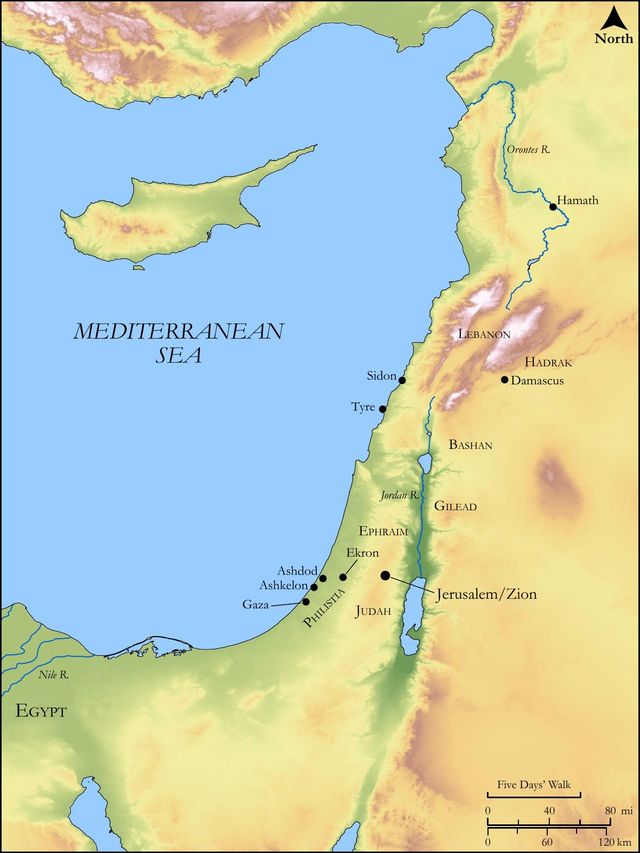
Zechariah 9:14 is situated within a pivotal section of Zechariah's prophecy, often referred to as the "Book of Comfort" or "Oracle concerning the Burden of the Word of the LORD" (chapters 9-14). Chapter 9 begins with a series of judgments against surrounding nations like Hadrach, Damascus, Tyre, Sidon, and the Philistine cities, establishing God's universal sovereignty. However, the focus quickly shifts to the glorious future of Judah and Jerusalem, particularly the coming of the Messiah, described as humble and riding on a donkey. Following this messianic anticipation, verses Zechariah 9:11-13 speak of God delivering His people from spiritual and physical captivity, likening Judah to His bow and Ephraim to His arrow, indicating their role as instruments in His hand. Verse 14 then dramatically elevates the imagery, showing the Lord Himself engaging directly in battle, thereby underscoring that the ultimate victory and defense come not from human strength, but from His supreme, irresistible power. This verse serves as a climactic declaration of divine intervention following the promise of restoration.
Historical & Cultural Context
Zechariah prophesied during the post-exilic period, roughly 520-518 BC, alongside Haggai. The Jewish people had returned from Babylonian captivity, were rebuilding the temple in Jerusalem, and faced significant challenges including opposition from surrounding peoples, internal discouragement, and the need to re-establish their identity and faith. In this context, prophecies like Zechariah 9:14 offered immense hope and assurance. The imagery of a god leading his armies was known among the nations round about. For Israel, Yahweh's role as a divine warrior was central to their history, from the crossing of the Red Sea to the conquest of Canaan. The "south" (têymân) in Israel often referred to the Negeb desert, from which strong, often destructive, winds and storms (whirlwinds) would typically come, making the imagery of "whirlwinds of the south" a potent symbol of overwhelming, irresistible force. The blowing of the trumpet (shofar) was a common practice in ancient Israel for signaling war, assembling the people, or announcing significant divine events, such as at Mount Sinai.
Key Themes
ShowHideZechariah 9:14 powerfully contributes to several key themes within the book and broader biblical theology. Firstly, it highlights Divine Presence and Visibility, emphasizing that the Lord's intervention is not hidden but "shall be seen over them," signifying an undeniable and active protective presence. Secondly, the verse underscores the theme of God as Warrior and Defender, depicting Yahweh personally fighting for His people, a motif found throughout the Old Testament, from the Song of Moses to the prophetic books. The "arrow" and "lightning" imagery convey His swift, precise, and devastating power in judgment and defense. Thirdly, it speaks to Divine Summons and Judgment, as the Lord "shall blow the trumpet," a sound often associated with a call to war, a divine assembly, or the announcement of a great and terrible day of the Lord, as seen in Joel 2:1. Finally, the imagery of "whirlwinds of the south" powerfully conveys Overwhelming Power and Sovereignty, illustrating God's unstoppable might over all natural forces and human opposition, reinforcing the truth that no one can stand against Him.
Exposition and Analysis
ShowHideKey Word Analysis
ShowHideThe text uses both H3068 (Yᵉhôvâh, "the self-Existent or Eternal; Jehovah, Jewish national name of God") and H136 (ʼĂdônây, "the Lord (used as a proper name of God only)"). H3069 (Yᵉhôvih) is a variation of Yᵉhôvâh, used after ʼĂdônây to prevent repetition of sound. The combination "Lord GOD" (ʼĂdônây Yᵉhôvih) emphasizes the absolute sovereignty and eternal nature of God. This divine name, YHWH, underscores His covenant faithfulness and His active presence as the one who "is seen over them" and intervenes decisively in human history.
Meaning "a piercer, i.e. an arrow; by implication, a wound; figuratively, (of God) thunderbolt." This word signifies a weapon of war, but when attributed to God, it carries the connotation of divine judgment or swift, unerring intervention. The imagery here is not of a human archer but of God Himself deploying a weapon that is both precise and devastating, akin to a "thunderbolt."
Meaning "lightning; by analogy, a gleam; concretely, a flashing sword." The comparison of God's arrow to lightning emphasizes its suddenness, its blinding speed, and its destructive power. Lightning is a natural phenomenon that is both awe-inspiring and terrifying, uncontrollable by human hands. Applied to God's action, it conveys an irresistible, instantaneous, and divinely charged force.
Meaning "a hurricane; storm(-y), tempest, whirlwind." This term denotes a violent, swirling storm, symbolizing immense, uncontrollable power and often associated with divine judgment or the manifestation of God's presence (as in Ezekiel 1:4). The "whirlwinds of the south" (H8486, têymân, the south) further specify a particularly strong and often destructive wind, reinforcing the idea of God's overwhelming and unyielding might against His adversaries.
Verse Breakdown
ShowHide"And the LORD shall be seen over them"
This clause emphasizes the visible and undeniable manifestation of God's presence and intervention. It signifies that His action will be clear and unmistakable to both His people and their enemies. It speaks to a theophany, a divine appearance or revelation, assuring His people of His active watchfulness and protection.
"and his arrow shall go forth as the lightning"
This powerful metaphor depicts God as a divine warrior. His "arrow" represents His swift, precise, and devastating judgment or defense. The comparison to "lightning" underscores the speed, suddenness, and irresistible force of His action, implying that His intervention is immediate and overwhelming, striking with unerring accuracy.
"and the Lord GOD shall blow the trumpet"
The blowing of the shofar (trumpet) in biblical contexts often serves as a signal for war, a call to assembly, or an announcement of a divine event or judgment. Here, it signifies God's authoritative command, His rallying of forces (perhaps heavenly hosts), and the initiation of His decisive action. It is a sound of divine summons and declaration of His will.
"and shall go with whirlwinds of the south"
This final clause reinforces the overwhelming nature of God's power. "Whirlwinds" symbolize an uncontrollable, destructive force, often associated with divine judgment or the awesome display of God's might. The specification "of the south" (têymân) points to the direction from which powerful, often desert-born, storms would come, further emphasizing the fierce, unyielding, and unstoppable nature of God's advance against His enemies.
Literary Devices
ShowHideZechariah 9:14 is rich with Imagery and Metaphor, painting a vivid picture of God's active involvement. God is presented through Anthropomorphic language as a warrior who has an "arrow" and "blows the trumpet," making His divine actions relatable to human experience. The Simile "his arrow shall go forth as the lightning" effectively conveys the swiftness, destructive power, and suddenness of God's intervention. The "whirlwinds of the south" serve as a powerful Symbolism for God's overwhelming and uncontrollable might, often associated with divine judgment and theophany in biblical literature. The cumulative effect of these devices is to create a sense of awe and dread, highlighting the absolute sovereignty and irresistible power of Yahweh in defending His people and executing His will.
Theological and Thematic Connections
ShowHideZechariah 9:14 profoundly articulates the biblical theme of God as the Divine Warrior, actively intervening in human history to defend His covenant people and execute His righteous judgment. This portrayal of Yahweh is not merely metaphorical; it reflects His active sovereignty over all creation and His unwavering commitment to His promises. The verse underscores that ultimate victory and security for God's people do not rest on human strength or military might, but solely on His irresistible power and visible presence. It speaks to an eschatological hope, where God Himself will decisively defeat all opposing forces, ensuring the triumph of His kingdom. This imagery foreshadows the final, decisive intervention of God in the end times, where His power will be fully displayed to establish His eternal reign.
Reflection and Application
ShowHideZechariah 9:14 offers profound assurance and a powerful call to trust for believers today. In a world fraught with uncertainty, conflict, and opposition, this verse reminds us that our God is not a distant, passive deity, but an active, present, and overwhelmingly powerful defender of His people. When we face spiritual battles, personal struggles, or societal injustices that seem insurmountable, this prophecy encourages us to lift our eyes to the Lord, knowing that His intervention is swift, decisive, and irresistible. It teaches us that our security is ultimately found in His sovereign might, not in our own strength or strategies. This vision of God as the divine warrior should instill courage, inspire unwavering faith, and prompt us to rely fully on His power, knowing that He will ultimately triumph over all forces that oppose His will and His kingdom, bringing about His perfect justice and peace.
Questions for Reflection
ShowHideFAQ
ShowHideDoes Zechariah 9:14 refer to a literal battle or a spiritual one?
ShowHideZechariah 9:14 uses highly figurative and symbolic language to describe God's intervention. While it can certainly be applied to literal historical instances where God defended Israel, its primary thrust is to convey the absolute, irresistible nature of God's power in defending His people and executing His judgment. It speaks to both physical and spiritual realities, encompassing any situation where God rises to vindicate His own. The "arrow," "lightning," "trumpet," and "whirlwinds" are powerful metaphors for divine action that transcends mere human warfare, pointing to a supernatural, overwhelming display of God's might. Ultimately, it refers to God's decisive intervention, whether in a specific historical event or in the broader eschatological conflict between good and evil.
How does this verse relate to God's love and mercy, given its warlike imagery?
ShowHideWhile Zechariah 9:14 employs warlike imagery, it is crucial to understand it within the broader context of God's covenant faithfulness. The divine warrior motif in the Bible is often an expression of God's commitment to protect His people from those who would oppress or destroy them. His "arrow" and "whirlwinds" are directed at adversaries who threaten His chosen ones, demonstrating His righteous judgment against evil. This act of defense is an extension of His love and mercy for His covenant community. Just as a loving parent protects their child, God, in His mercy, defends those He loves. This verse, therefore, highlights the protective aspect of God's love, where His power is deployed to secure the well-being and ultimate salvation of His people, ensuring that His redemptive plan will prevail.
Christ-Centered Fulfillment
ShowHideZechariah 9:14, with its vivid portrayal of God as a divine warrior, finds its ultimate and most profound fulfillment in the person and work of Jesus Christ. While the verse speaks of Yahweh's direct intervention, the New Testament reveals Jesus as the visible manifestation of God, the one through whom God's power and judgment are ultimately exercised. The Messiah, first prophesied in Zechariah 9:9, came humbly, but He is also the one who will return in power and glory. The "arrow" going forth as "lightning" foreshadows Christ's swift and decisive judgment at His second coming, when He will strike down the nations with a sharp sword and every eye will see Him. The "blowing of the trumpet" resonates with the biblical promise of Christ's return, heralded by a trumpet call, as described in 1 Thessalonians 4:16, signaling the resurrection of the dead and the final gathering of His people. Furthermore, the "whirlwinds of the south" symbolize the overwhelming, irresistible power that Christ wields, a power demonstrated in His victory over sin and death on the cross, and which will be fully displayed when He puts all enemies under His feet. Thus, Zechariah 9:14 ultimately points to Christ as the triumphant Lord who will visibly appear, execute righteous judgment, and establish His eternal kingdom with overwhelming power.