


Zechariah 9:15
Bible text: King James Version (1769 Blayney text) · Public domain
Bible text: King James Version with Strong's numbers · Public domain
Bible text: Berean Standard Bible · Public domain
Bible text: American Standard Version (1901) · Public domain
Bible text: World English Bible, Messianic edition · Public domain
Bible text: Geneva Bible (1599) · Public domain
Bible text: Young's Literal Translation · Public domain
- יְהוָהYah·wehYahwehH3068N-properNoun Proper Title
- צְבָאוֹתtze·va·'Otof hostsH6635N-fpNoun Plural Feminine Absolute
- יָגֵןya·Genhe will defendH1598V-Qal-Imperf-3msVerb Qal Imperfect 3rd Singular Masculine
- עֲלֵיהֶם'a·lei·Hem<on> themH5921Prep ¦ 3mpPrepositionעֲלֵי<on>הֶםthem
- וְאָכְלוּve·'a·khe·Luand they will eatH398Conj-w ¦ V-Qal-ConsecPerf-3cpVerb Qal Consecutive Perfect 3rd Plural common genderוְandאָכְלוּthey will eat
- וְכָבְשׁוּve·kha·ve·Shuand they will subdueH3533Conj-w ¦ V-Qal-ConsecPerf-3cpVerb Qal Consecutive Perfect 3rd Plural common genderוְandכָבְשׁוּthey will subdue
- אַבְנֵי'av·neistones ofH68N-fpcNoun Plural Feminine Construct
- קֶלַעKe·la'a slingH7050N-msNoun Singular Masculine Absolute
- וְשָׁתוּve·sha·Tuand they will drinkH8354Conj-w ¦ V-Qal-ConsecPerf-3cpVerb Qal Consecutive Perfect 3rd Plural common genderוְandשָׁתוּthey will drink
- הָמוּha·Muthey will be in an uproarH1993V-Qal-Perf-3cpVerb Qal Perfect 3rd Plural common gender
- כְּמוֹke·movlikeH3644PrepPreposition
- יָיִןYa·yinwineH3196N-msNoun Singular Masculine Absolute
- וּמָלְאוּu·mal·'Uand they will be fullH4390Conj-w ¦ V-Qal-ConsecPerf-3cpVerb Qal Consecutive Perfect 3rd Plural common genderוּandמָלְאוּthey will be full
- כַּמִּזְרָקka·miz·Raklike <the> bowlH4219Prep-k ¦ N-msNoun Singular Masculine Absoluteכַּlike <the>מִּזְרָקbowl
- כְּזָוִיּוֹתke·za·vi·Yotlike [the] corners ofH2106Prep-k ¦ N-fpcNoun Plural Feminine Constructכְּlikeזָוִיּוֹת[the] corners of
- מִזְבֵּחַmiz·Be·ach[the] altarH4196N-msNoun Singular Masculine Absolute
English is a literal word-by-word gloss of the Hebrew, not the KJV's wording. Why?
This is the original text the KJV's translators worked from — each Hebrew word with its own literal English meaning in this verse, prepared by scholars at Tyndale House, Cambridge. The KJV translates whole sentences, not word by word, so its wording differs: one Hebrew word can become several English words, and the KJV may choose “the LORD” where the gloss reads “Yahweh”. Both are faithful — they answer different questions. For the KJV's own rendering, switch to the KJV text.
Details
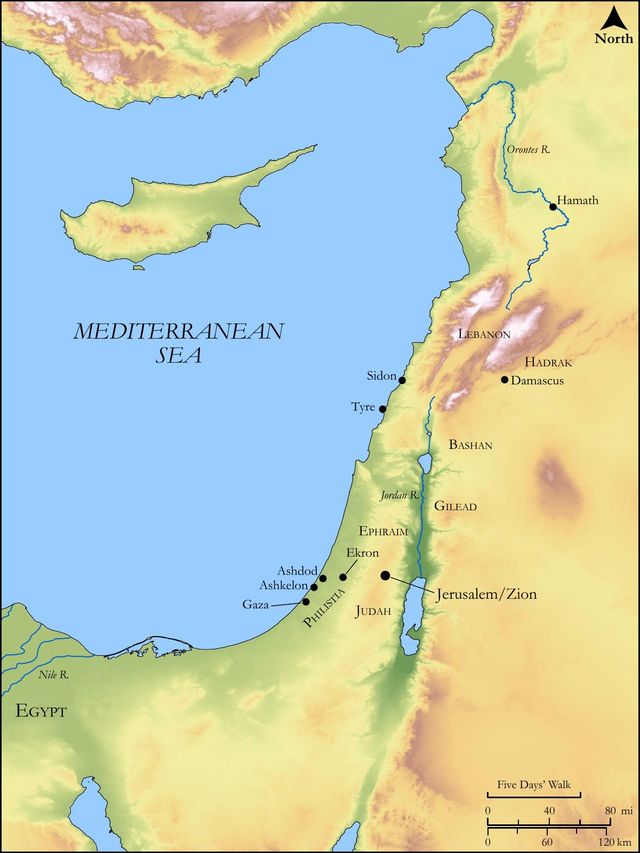
See on the biblical-era map
Study this verse
Public-domain commentary
Matthew Henry
From his Commentary on the Whole Bible. Henry comments on passages, not single verses — this entry covers Zechariah 9:12–17. His four-level outline is real structure in the source text, so it is rendered as structure.
The prophet, having taught those that had returned out of captivity to attribute their deliverance to the blood of the covenant and to the promise of the Messiah (for they were so wonderfully helped because that blessing was in them, was yet in the womb of their nation), now comes to encourage them with the prospect of a joyful and happy settlement, and of glorious times before them; and such a happiness they did enjoy, in a great measure, for some time; but these promises have their full accomplishment in the spiritual blessings of the gospel which we enjoy by Jesus Christ.
I.They are invited to look unto Christ, and flee unto him as their city of refuge (Zac 9:12):
Turn you to the strong-hold, you prisoners of hope. The Jews that had returned out of captivity into their own land were yet, in effect, but prisoners (We are servants this day, Neh 9:36), yet prisoners of hope, or expectation, for God had given them a little reviving in their bondage, Ezr 9:8, Ezr 9:9. Those that yet continued in Babylon, detained by their affairs there, yet lived in hope some time or other to see their own land again. Now both these are directed to turn their eyes upon the Messiah, set before them in the promise as their strong-hold, to shelter themselves in him, and stay themselves upon him, for the perfecting of the mercy which by his grace, and for his sake, was so gloriously begun. Look unto him, and be you saved, Isa 45:22. The promise of the Messiah was the strong-hold of the faithful long before his coming; they saw his day at a distance and were glad, and the believing expectation of the redemption in Jerusalem was long the support and consolation of Israel, Luk 2:25, Luk 2:38. They, in their dangers and distresses, were ready to turn towards this and the other creature for relief; but the prophets directed them still to turn to Christ, and to comfort themselves with the joy of their king coming to them with salvation. But, as their deliverance was typical of our redemption by Christ (Zac 9:11), so this invitation to the strong-hold speaks the language of the gospel-call. Sinners are prisoners, but they are prisoners of hope; their case is sad, but it is not desperate; yet now there is hope in Israel concerning them. Christ is a strong-hold for them, a strong tower, in whom they may be safe and quiet from the fear of the wrath of God, the curse of the law, and the assaults of their spiritual enemies. To him they must turn by a lively faith; to him they must flee, and trust in his name.
II.They are assured of God's favour to them:
"Even to day do I declare, when things are at the worst, and you think your case deplorable to the last degree, yet I solemnly promise that I will render double unto thee, to thee, O Jerusalem! to every one of you prisoners of hope. I will give you comforts double to the sorrows you have experienced, or blessings double to what I ever bestowed upon your fathers, when their condition was at the best; the glory of your latter state, as well as of your latter house, shall be greater, shall be twice as great as that of your former." And so it was no otherwise than by the coming of the Messiah, the preaching of his gospel, and the setting up of his kingdom; these spiritual blessings in heavenly things were double to what they had ever enjoyed in their most prosperous state. As a pledge of this, in the fulness of time God here promises to the Jews victory, plenty, and joy, in their own land, which yet should be but a type and shadow of more glorious victories, riches, and joys, in the kingdom of Christ.
1.They shall triumph over their enemies. The Jews, after their return, were surrounded with enemies on all sides. They were as a speckled bird; all the birds of the field were against them. Their land lay between the two potent kingdoms of Syria and Egypt, branches of the Grecian monarchy, and what frequent dangers they should be in between them was foretold, Dan. 11. But it is here promised that out of them all the Lord would deliver them; and this promise had its primary accomplishment in the times of the Maccabees, when the Jews made head against their enemies, kept their head above water, and, after many struggles and difficulties, came to be head over them. It is promised,
(1.)That they shall be instruments in God's hand for the defeating and baffling of their persecutors: "I have bent Judah for me, as my bow of steel; that bow I have filled with Ephraim as my arrows, have drawn it up to its full bent, till the arrow be at the head;" for some think that this is signified by the phrase of filling the bow. The expressions here are very fine, and the figures lively. Judah had been taught the use of the bow (Sa2 1:18), and Ephraim had been famous for it, Psa 78:9. But let them not think that they gain their successes by their own bow, for they themselves are no more than God's bow and his arrows, tools in his hands, which he makes use of and manages as he pleases, which he holds as his bow and directs to the mark as his arrows. The best and bravest of men are but what God makes them, and do no more service than he enables them to do. The preachers of the gospel were the bow in Christ's hand, with which he went forth, he went on, conquering and to conquer, Rev 6:2. The following words explain this: I have raised up and animated thy sons, O Zion! against thy sons, O Greece! This was fulfilled when against Antiochus, one of the kings of the Grecian monarchy, the people that knew their God were strong and did exploits, Dan 11:32. And they in the hand of an almighty God were made as the sword of a mighty man, which none can stand before. Wicked men are said to be God's sword (Psa 17:13), and sometimes good men are made so; for he employs both as he pleases.
(2.)That God will be captain, and commander-in-chief, over them, in every expedition and engagement (Zac 9:14): The Lord shall be seen over them; he shall make it appear that he presides in their affairs, and that in all their motions they are under his direction, as apparently, though not as sensibly, as he was seen over Israel in the pillar of cloud and fire when he led them through the wilderness.
[1.]Is their army to be raised, or mustered, and brought into the field? The Lord shall blow the trumpet, to gather the forces together, to proclaim the war, to sound the alarm, and to give directions which way to march, which way to move; for, if God blow the trumpet, it shall not give an uncertain sound, nor a feeble ineffectual one.
[2.]Is the army taking the field, and entering upon action? Whatever enterprise the campaign is opened with, God shall go forth at the head of their forces, with whirlwinds of the south, which were of incredible swiftness and fierceness; and before these whirlwinds thy sons, O Greece! shall be as chaff.
[3.]Is the army actually engaged? God's arrows shall go forth as lightning, so strongly, so suddenly, so irresistibly; his lightnings shall go forth as arrows and scattered them, that is, he shot out his lightnings and discomfited them. This alludes to that which God had done for Israel of old when he brought them out of Egypt, and into Canaan, and had its accomplishment partly in the wonderful successes which the Jews had against their neighbours that attacked them in the time of the Maccabees, by the special appearances of the divine Providence for them, and perfectly in the glorious victories gained by the cross of Christ and the preaching of the cross over Satan and all the powers of darkness, whereby we are made more than conquerors.
[4.]Are they in danger of being overpowered by the enemy? The Lord of hosts shall defend them (Zac 9:15); The Lord their God shall save them (Zac 9:16); so that their enemies shall not prevail over them, nor prey upon them. God shall be unto them for defence as well as offence, the shield of their help as well as the sword of their excellency, and this as the Lord of hosts, who has power to defend them, and as their God, who is engaged by promise to defend them, and by the property he has in them. He shall save them in that day, that critical dangerous day, as the flock of his people, with the same care and tenderness that the shepherd protects his sheep with. Those are safe whom God saves.
[5.]Did their enemies hope to swallow them up? It shall be turned upon them, and they shall devour their enemies, and shall subdue with sling-stones, for want of better weapons, those that come forth against them. The stones of the brook, when God pleases, shall do as great execution as the best train of artillery; for the stars in their courses shall fight on the same side. Goliath was subdued with a sling-stone. Having subdued, they shall devour, shall drink the blood of their enemies, as it were, and, as conquerors are wont to do, they shall make a noise as through wine. It is usual for conquerors with loud huzzas and acclamations to glory in their victories and proclaim them. We read of those that shout for mastery, and of the shout of a king among God's people. They shall be filled with blood and spoil, as the bowls and basins of the temple, or the corners of the altar, were wont to be filled with the blood of the sacrifices; for their enemies shall fall as victims to divine justice.
2.They shall triumph in their God. They shall take the comfort and give God the glory of their successes. So some read Zac 9:15. They shall eat (that is, they shall quietly enjoy) what they have got; God will give them power to eat it after they have subdued the sling-stones (that is, their enemies that slung stones at them), and they shall drink and make a noise, a joyful noise, before the Lord their maker and protector, as through wine, as men are merry at a banquet of wine. Being not drunk with wine, wherein is excess, but filled with the Spirit, they shall speak to themselves and one another in psalms, and hymns, and spiritual songs, as those that are drunk do with vain and foolish songs, Eph 5:18, Eph 5:19. And, in the fulness of their joy, they shall offer abundance of sacrifices to the honour of God, so that they shall fill both the bowls and the corners of the altar with the fat and blood of their sacrifices. And, when they thus triumph in their successes, their joy shall terminate in God as their God, the God of their salvation. They shall triumph,
(1.)In the love he has for them, and the relation wherein they stand to him, that they are the flock of his people and he is their Shepherd, and that they are to him as the stones of a crown, which are very precious and of great value, and which are kept under a strong guard. Never was any king so pleased with the jewels of his crown as God is, and will be, with his people, who are near and dear unto him, and in whom he glories. They are a crown of glory and a royal diadem in his hand, Isa 62:2, Isa 62:3. And they shall be mine, saith the Lord, in that day when I make up my jewels, Mal 3:17. And they shall be lifted up as an ensign upon his land, as the royal standard is displayed in token of triumph and joy. God's people are his glory; so he is pleased to make them, so he is pleased to reckon them. He sets them up as a banner upon his own land, waging war against those who hate him, to whom it is a flag of defiance, while it is a centre of unity to all that love him, to all the children of God, that are scattered abroad, who are invited to come and enlist themselves under this banner, Isa 11:10, Isa 11:12.
(2.)In the provision he makes for them, Zac 9:15. This is the matter of their triumph (Zac 9:17): For how great is his goodness and how great is his beauty! This is the substance, this the burden, of the songs wherewith they shall make a noise before the Lord. We are here taught,
[1.]To admire and praise the amiableness of God's being: How great is his beauty! All the perfections of God's nature conspire to make him infinitely lovely in the eyes of all that know him. They are to him as the stones of a crown; but what is he to them? Our business in the temple is to behold the beauty of the Lord (Psa 27:4), and how great is that beauty! How far does it transcend all other beauties, particularly the beauty of his holiness. This may refer to the Messiah, to Zion's King that cometh. See that king in his beauty (Isa 33:17), who is fairer than the children of men, the fairest of ten thousand, and altogether lovely. Though, in the eye of the world, he had no form or comeliness, in the eye of faith how great is his beauty!
[2.]To admire and give thanks for the gifts of God's favour and grace, his bounty as well as his beauty; for how great is his goodness! How rich in mercy is he! How deep, how full, are its springs! How various, how plenteous, how precious, are its streams! What a great deal of good does God do! How rich in mercy is he! Here is an instance of his goodness to his people: Corn shall make the young men cheerful and new wine the maids; that is, God will bless his people with an abundance of the fruits of the earth. Whereas they had been afflicted with scarcity to such a degree that the young men and the maidens were ready to swoon and faint away for hunger and thirst (Lam 2:12, Lam 2:21; Lam 4:7, Lam 4:8; Lam 5:10), now they shall have bread enough and to spare, not water only, but wine, new wine, which shall make the young people grow and be cheerful, and (which some have observed to be the effect of plenty and the cheapness of corn) the poor will be encouraged to marry, and re-people the land, when they shall have wherewithal to maintain their families. Note, What good gifts God bestows upon us we must serve him cheerfully with, and must race the streams up to the fountain, and, when we are refreshed with corn and wine, must say, How great is his goodness!
Historical interpretation
Historical reception
1 surviving comment on this verse from the historical church.
(Verse 15, 16.) And they shall devour and subject to stones of slings: and drinking, they shall be intoxicated as with wine (Vulgate: with wine), and shall be filled like bowls and like the horns of the altar, and the Lord their God shall save them in that day as the flock of his people, because holy stones shall be lifted up upon his land. LXX: And they shall consume them, and bury them in stones of slings, and they shall drink their blood like wine, and they shall be filled like the bowls of the altar, and the Lord shall save them on that day as his flock, because holy stones shall roll on his land. For what we have said, they will be exalted, and it is written in Hebrew, Methnosasoth (), can be interpreted as wandering or fleeing. With the children of Zion protected, and the Lord singing, and going in a whirlwind against their adversaries, the destruction of the Greeks will be so great that I will not say by swords, but they will be crushed by the throwing of stones and the rotations of catapults, so that they will be spoils and food for their enemies. Then they will be drunk as if with wine. Not those who have been killed, but they will be drunk with their own blood; but those who conquer will fight as if drunk with desperation, and they will please the Lord like the horns of the altar, and their libation. For this is understood in the bowls, in which the offerings are poured out on the altar. The Lord will also save them like sheep and the flock of his people: for he will not fight like an armed and trained army against the Macedonians; but he will come like a flock prepared for death, and with the help of the Lord, he will prevail. And the holy stones that were oppressed (for they are called stones, on account of the hardness of trials and the courage of the soul) shall be lifted up from their humility, and they shall be on the land of his glory. Otherwise: his holy stones of the priestly race fleeing in different directions, with him granting them victory, shall attain it, let us say, according to the anagoge, nay, let us explain the prophecy enveloped in many obscurities. The sons of Zion, protected by their Lord, shall devour their adversaries, whom we understand to be the sons of Greece. And they shall subject them to stones of slings, and menaces of Scriptures, making their adversaries subject and humble: for nothing strikes so much as an example from the holy Scriptures, and a testimony emitted by the rotation of the mouth. But what is said in the Septuagint: And they shall drink their blood like wine, we do not read thus in Hebrew; but they shall be drunken with wine, so that they may hear that from the Song of Songs: Drink, O friends, and be intoxicated (Song of Songs 5:1). And so their drunkenness will please them, like a sacrificial altar; and like the horns or angles of an altar. The Lord will also save them, like a flock of his people, for the holy stones will roll upon his land, which will be so light and shining that they will not wait for the hands of builders, but will themselves hasten to be placed upon the foundation of Christ, and to be held by the corner stone, of which even the Apostle Peter speaks: 'You yourselves, as living stones, are being built into a spiritual house, to be a holy priesthood, offering spiritual sacrifices acceptable to God.' (I Peter 2:5). These are the stones that will cry out if the people of Judah keep silent (Luke XIX), and they will roll as long as they are on earth, for earthly dwelling weighs down the senses that attend to many cares (Wisdom IX), and the Holy One, who is in the flesh, speaks: Who will give me wings like a dove? (Psalm LIV, 7) Whoever is able, strives and rolls; and is lifted up to the heights, but is held back by the frailty of the flesh. And that earth on which the stones roll is the one of which we read: Sing to the Lord, all the earth (Psalm XCV, 1). And let all the earth adore you and sing to you (Ps. 65:4).
Continue studying Zechariah 9:15 across the web’s major study libraries — every link below opens this exact verse, chapter, or book on the destination site.
Read & Compare
 BibleGatewayThis verse in more than 200 translations and 70 languages.
 Bible.comThe YouVersion reader — hundreds of translations, reading plans, and highlights.
 ESV.orgCrossway's official English Standard Version reader.
 NET BibleThe NET translation with 60,000+ translators' notes on every rendering decision.
 STEP BibleTyndale House's free study tool — original text, vocabulary, and scholarly resources.
 BibliaLogos Bible Software's free web reader.
 USCCBThe New American Bible (Revised Edition) with the U.S. bishops' study notes.
Commentaries
 BibleHub CommentariesDozens of classic commentaries on this verse, gathered on one page.
 StudyLightMore than 100 commentary sets — the largest collection on the web.
 BibleRefPlain-English commentary on what this verse means, verse by verse.
 Enduring WordDavid Guzik's free commentary on this chapter, widely used by Bible teachers.
 Bible Study ToolsVerse commentary alongside Greek and Hebrew study aids.
Original Language & Research
- BibleHub InterlinearThe verse word by word — original language, transliteration, and English.
- BibleHub LexiconEvery word's original-language definition and Strong's entry.
 Blue Letter BibleDeep-study tools — Strong's numbers, concordance, and word studies.
 SefariaThe Hebrew text with Rashi and centuries of Jewish commentary.
Sermons, Hymns & Audio


TrulyRandomVerse is not affiliated with these sites and doesn’t control their content. They’re linked because they’re genuinely useful.
Summary
Zechariah 9:15 presents a powerful prophetic vision of God's active defense and the subsequent overwhelming victory and joyous abundance experienced by His people. This verse paints a vivid picture of divine intervention, where the "LORD of hosts" empowers His chosen ones to conquer their adversaries decisively, leading to a profound celebration and a state of overflowing blessing that is both complete and consecrated.
Context
ShowHideLiterary Context
Zechariah 9:15 is situated within the latter half of the book of Zechariah (chapters 9-14), often referred to as "The Burden of the Word of the LORD." This section shifts from earlier prophecies concerning the rebuilding of the Temple to future eschatological and Messianic themes. Specifically, chapter 9 begins with prophecies of judgment against surrounding nations (Zech 9:1-8), establishing God's sovereignty over all peoples. It then transitions to a glorious promise of the coming Messiah, riding on a donkey (Zech 9:9-10), and the restoration of Israel from exile (Zech 9:11-12). Verse 15, therefore, serves as a vivid description of the Lord's direct involvement in the future triumph of His people, illustrating the nature of their victory and the resulting joy, bridging the gap between the Messiah's arrival and the ultimate restoration.
Historical & Cultural Context
Zechariah prophesied during the post-exilic period, roughly 520-518 BC, a time when the Jewish exiles had returned from Babylon to a desolate Jerusalem. They faced significant challenges, including opposition from neighboring peoples (as seen in the books of Ezra and Nehemiah) and internal discouragement. The prophecies of Zechariah were designed to offer hope, encouragement, and a renewed vision of God's faithfulness and ultimate plan for His people. The imagery of "sling stones" would have resonated deeply with the Jewish audience, recalling the iconic victory of David over Goliath, signifying that God could use seemingly humble or weak means to achieve mighty victories. The references to "bowls" and "corners of the altar" evoke the familiar rituals and sacred spaces of the Temple, emphasizing the consecrated nature of the promised abundance and victory.
Key Themes
ShowHideZechariah 9:15 contributes significantly to several overarching themes within the book and broader biblical narrative. Firstly, it powerfully underscores the theme of Divine Sovereignty and Protection, emphasizing that the "LORD of hosts" is the ultimate defender and warrior for His people. Secondly, it highlights Victorious Warfare and Deliverance, portraying a decisive and complete triumph over adversaries, achieved not by human might alone, but through God's empowerment. The imagery of devouring and subduing speaks to a comprehensive conquest. Thirdly, the verse introduces the theme of Joy and Abundance, depicting a scene of profound celebration and overflowing satisfaction. The comparison to "wine" and being "filled like bowls" suggests a state of joyous spiritual intoxication and complete fulfillment. Finally, the mention of "the corners of the altar" weaves in the theme of Consecration and Divine Presence, implying that the abundance and victory are not merely material but are sanctified and intimately connected to God's holy presence and purposes, perhaps even a foreshadowing of the ultimate cleansing and restoration that God would bring to His people, as seen in Zechariah 13:1.
Exposition and Analysis
ShowHideKey Word Analysis
ShowHideThis primitive root means "to hedge about," implying a strong, protective barrier. It conveys the idea of God actively shielding and guarding His people, providing an impenetrable defense against all adversaries. It is not merely passive protection but an engaged, surrounding safeguard.
While often translated simply as "make a noise," this word carries a richer connotation of "to be in great commotion or tumult," "to rage," "roar," or "clamor." In this context, it suggests a boisterous, triumphant shout or roar of victory and exultation, akin to the joyous clamor of those celebrating with wine, rather than a mere sound. It denotes a powerful, unrestrained expression of triumph.
Derived from a root suggesting "prominence," this word refers to an angle or a corner-column. In the context of the altar, the "corners" were significant, often where the blood of sacrifices was applied or poured out (e.g., Leviticus 4:7). Being "filled as the corners of the altar" implies not just abundance, but a sacred, overflowing fullness, consecrated to God and intimately connected with His presence and the sacrificial system.
Verse Breakdown
ShowHide"The LORD of hosts shall defend them"
This opening clause immediately establishes the divine source of power and protection. "The LORD of hosts" (Yahweh Sabaoth) is a majestic title emphasizing God's sovereignty over all heavenly and earthly armies, highlighting His immense power and His unwavering commitment to His covenant people. He is not a passive observer but an active, mighty warrior who personally intervenes to protect those who are His.
"and they shall devour, and subdue with sling stones"
This phrase vividly describes the complete and decisive victory granted to God's people. "Devour" signifies the utter destruction or consumption of their enemies, while "subdue" speaks of bringing them into complete subjection. The mention of "sling stones" is particularly striking. It suggests that the means of victory, though seemingly humble or insignificant from a human perspective, are supernaturally empowered by God, recalling David's triumph over Goliath and underscoring that the power for conquest comes entirely from the Lord, not from the might of human weaponry.
"and they shall drink, [and] make a noise as through wine"
This clause shifts from the battlefield to a scene of profound celebration and joy. "They shall drink" implies partaking in the spoils of victory or simply experiencing immense satisfaction. The phrase "make a noise as through wine" denotes a boisterous, unrestrained, and joyous clamor, akin to the loud revelry of those intoxicated with wine. It signifies a celebration so overwhelming and exuberant that it spills forth in shouts of triumph and delight, a spiritual "intoxication" with God's goodness and victory.
"and they shall be filled like bowls, [and] as the corners of the altar"
This final part of the verse uses rich imagery to convey the extent of the blessing and satisfaction. Being "filled like bowls" suggests an overflowing abundance, a complete saturation. Bowls (mizrâq) were often used in the Temple for collecting blood or offerings, signifying a vessel completely full. The addition "and as the corners of the altar" deepens this imagery. The altar's corners were sacred points where sacrificial blood was applied, symbolizing atonement and consecration. Thus, being "filled... as the corners of the altar" implies an abundance that is not only overflowing but also holy, consecrated to God, and intimately connected with His presence and the sacred. It speaks of a deep, spiritual satisfaction that is pure and complete.
Literary Devices
ShowHideZechariah 9:15 is rich with powerful Imagery, painting vivid pictures of battle, celebration, and sacred abundance. The phrase "devour, and subdue with sling stones" employs Metonymy, where "sling stones" represent the humble yet divinely empowered means of victory. The verse also uses striking Similes to convey the depth of joy and fullness: "make a noise as through wine" vividly compares the celebratory clamor to the unrestrained joy of wine-induced revelry, while "filled like bowls, and as the corners of the altar" uses two distinct comparisons to emphasize an overwhelming and consecrated abundance. The latter simile also incorporates Symbolism, as "bowls" and "altar corners" are potent symbols of Temple rituals, sacrifice, and divine presence, elevating the promised abundance beyond mere material gain to a state of spiritual saturation and holiness.
Theological and Thematic Connections
ShowHideZechariah 9:15 powerfully articulates the biblical truth that God is the ultimate source of His people's defense, victory, and joy. It underscores His covenant faithfulness and His active role as the "LORD of hosts," a divine warrior who fights for His people. The passage highlights that true triumph comes not from human strength or sophisticated weaponry, but from divine empowerment, often through unexpected or humble means. This victory leads to an overflowing abundance and profound celebration, which is not merely carnal but consecrated, deeply connected to God's holy presence and purposes, foreshadowing the spiritual blessings and joy found in a right relationship with Him.
Reflection and Application
ShowHideZechariah 9:15 offers profound encouragement and a robust framework for faith in the life of a believer today. It calls us to place our ultimate trust in the "LORD of hosts," acknowledging that our true defense and security come from Him alone, regardless of the challenges we face. In a world often characterized by fear and uncertainty, this verse reassures us that God is actively engaged in protecting His people and granting them victory, even when the odds seem insurmountable or the means appear insignificant. It reminds us that our spiritual battles are fought and won by God's power, not our own. Furthermore, the imagery of overflowing joy and consecrated abundance invites us to live lives characterized by deep satisfaction and exuberant celebration of God's goodness. It challenges us to recognize His blessings as holy and to offer our lives back to Him in gratitude, allowing His Spirit to fill us to overflowing, transforming our daily experiences into a continuous act of worship and joyful service.
Questions for Reflection
ShowHideFAQ
ShowHideWhat is the significance of "The LORD of hosts" in this verse?
ShowHide"The LORD of hosts" (Hebrew: Yahweh Sabaoth) is a powerful and majestic title for God, emphasizing His sovereignty and supreme authority over all creation, particularly over all armies, both heavenly and earthly. In Zechariah 9:15, it underscores that God is not merely a passive observer but an active, mighty warrior who personally defends and fights for His people. This title assures the reader of God's immense power and His unwavering commitment to His covenant promises, making Him the ultimate source of protection and victory.
How can "sling stones" represent victory, especially when compared to modern warfare?
ShowHideThe imagery of "sling stones" is a deliberate biblical allusion, most famously recalling David's victory over the giant Goliath (1 Samuel 17). In that narrative, David, a shepherd boy armed only with a sling and stones, defeated a heavily armored warrior. This serves as a powerful symbol that God often chooses to work through seemingly weak, humble, or unconventional means to accomplish His mighty purposes. It highlights that the power for victory comes not from the instrument itself, nor from human strength or military might, but entirely from God's divine empowerment. Thus, "sling stones" in Zechariah 9:15 signify that God's people will achieve decisive victory not through their own formidable power, but through God working supernaturally through them, regardless of their perceived weakness.
What does it mean to be "filled like bowls, and as the corners of the altar"?
ShowHideThis phrase conveys a profound sense of overflowing abundance, joy, and consecration. "Filled like bowls" (Hebrew: mizrâq) suggests a complete saturation, as bowls were vessels often used in Temple rituals for collecting blood or offerings, implying a fullness that is comprehensive and overflowing. The addition "and as the corners of the altar" deepens the spiritual significance. The "corners" (Hebrew: zâvîyth) of the altar were sacred points where sacrificial blood was applied, symbolizing atonement, purification, and dedication to God (e.g., Leviticus 4:7). Therefore, being "filled... as the corners of the altar" means that the abundance and joy experienced by God's people are not merely material or fleeting but are holy, consecrated to God, deeply connected to His presence, and purified through sacrifice. It speaks of a spiritual satisfaction and blessing that is complete, pure, and dedicated to divine purposes.
Christ-Centered Fulfillment
ShowHideZechariah 9:15 finds its ultimate and most profound fulfillment in Jesus Christ. He is the true "LORD of hosts," the divine warrior who came not to conquer earthly kingdoms with physical weapons, but to defeat the ultimate enemies of humanity: sin, death, and the devil. His defense of His people is perfectly demonstrated in His atoning sacrifice on the cross, where He triumphed over principalities and powers, making a public spectacle of them (Colossians 2:15). Through His death and resurrection, Christ "devoured" the power of death and "subdued" the one who held its power (Hebrews 2:14-15). The "sling stones" imagery, representing humble means, finds its parallel in Christ's seemingly weak and vulnerable crucifixion, which paradoxically became the means of God's greatest victory. Believers, united with Christ, share in this overwhelming triumph, becoming "more than conquerors through him who loved us" (Romans 8:37). The "drinking" and "making a noise as through wine" foreshadow the spiritual joy and exuberance of the Holy Spirit, with which believers are to be filled (Ephesians 5:18), a foretaste of the ultimate celebration at the marriage supper of the Lamb (Revelation 19:7-9). Finally, being "filled like bowls, and as the corners of the altar" points to the consecrated fullness that believers experience in Christ. Through His perfect sacrifice, we are made holy and are filled with His Spirit, becoming living sacrifices, consecrated vessels overflowing with God's grace and presence, dedicated entirely to His glory.