


Jeremiah 22:9
Bible text: King James Version (1769 Blayney text) · Public domain
Bible text: Berean Standard Bible · Public domain
Bible text: American Standard Version (1901) · Public domain
Bible text: World English Bible, Messianic edition · Public domain
Bible text: Geneva Bible (1599) · Public domain
Bible text: Young's Literal Translation · Public domain
- וְאָמְרוּve·'A·me·Ruand they will sayH559Conj-w ¦ V-Qal-ConsecPerf-3cpVerb Qal Consecutive Perfect 3rd Plural common genderוְandאָמְרוּthey will say
- עַל'alonH5921PrepPreposition
- אֲשֶׁר'a·SherthatH834RelParticle Relative
- עָזְבוּ'a·ze·Vuthey forsookH5800V-Qal-Perf-3cpVerb Qal Perfect 3rd Plural common gender
- אֶת'et<obj.>H853DirObjMParticle Object Indicator
- בְּרִיתbe·Rit[the] covenant ofH1285N-fscNoun Singular Feminine Construct
- יְהוָהYah·wehYahwehH3068N-properNoun Proper Title
- אֱלֹהֵיהֶם'e·lo·hei·Hemtheir GodH430N-mpc ¦ 3mpNoun Plural Masculine ConstructאֱלֹהֵיGodהֶםtheir
- וַיִּשְׁתַּחֲווּvai·yish·ta·cha·Vuand they bowed downH7812Conj-w ¦ V-Hishtaphel-ConsecImperf-3mpVerb Hishtaphel Consecutive Imperfect 3rd Plural Masculineוַandיִּשְׁתַּחֲווּthey bowed down
- לֵאלֹהִיםle·lo·Himto godsH430Prep-l ¦ N-mpNoun Plural Masculine Absoluteלֵtoאלֹהִיםgods
- אֲחֵרִים'a·che·RimotherH312Adj-mpAdjective Plural Masculine Absolute
- וַיַּעַבְדוּםvai·ya·'av·Dumand they served themH5647Conj-w ¦ V-Qal-ConsecImperf-3mp ¦ 3mpVerb Qal Consecutive Imperfect 3rd Plural Masculineוַandיַּעַבְדוּthey servedםthem
English is a literal word-by-word gloss of the Hebrew, not the KJV's wording. Why?
This is the original text the KJV's translators worked from — each Hebrew word with its own literal English meaning in this verse, prepared by scholars at Tyndale House, Cambridge. The KJV translates whole sentences, not word by word, so its wording differs: one Hebrew word can become several English words, and the KJV may choose “the LORD” where the gloss reads “Yahweh”. Both are faithful — they answer different questions. For the KJV's own rendering, switch to the KJV text.
Details
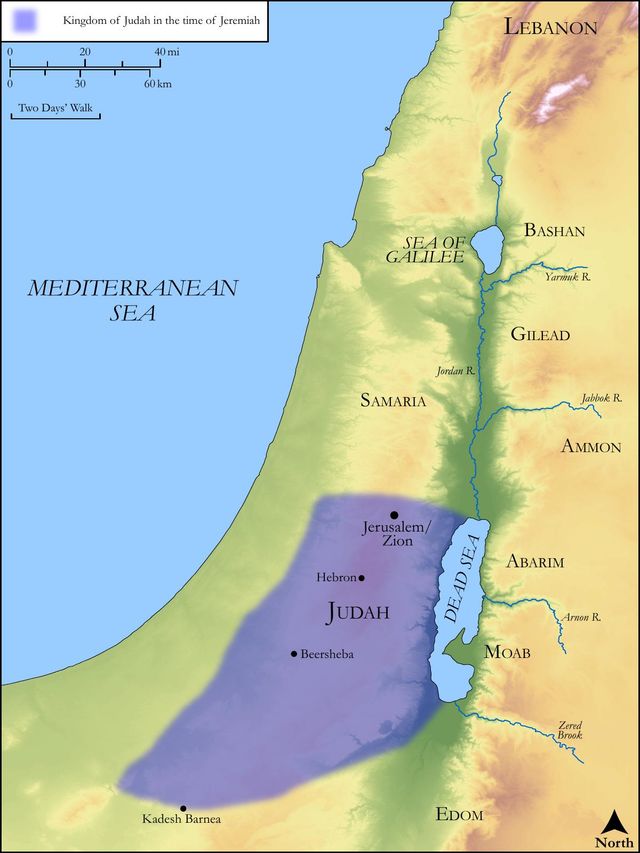
See on the biblical-era map
Study this verse
Public-domain commentary
Matthew Henry
From his Commentary on the Whole Bible. Henry comments on passages, not single verses — this entry covers Jeremiah 22:1–9. His four-level outline is real structure in the source text, so it is rendered as structure.
Here we have,
I.Orders given to Jeremiah to go and preach before the king.
In the foregoing chapter we are told that Zedekiah sent messengers to the prophet, but here the prophet is bidden to go, in his own proper person, to the house of the king, and demand his attention to the word of the King of kings (Jer 22:2): Hear the word of the Lord, O king of Judah! Subjects must own that where the word of the king is there is power over them, but kings must own that where the word of the Lord is there is power over them. The king of Judah is here spoken to as sitting upon the throne of David, who was a man after God's own heart, as holding his dignity and power by the covenant made with David; let him therefore conform to his example, that he may have the benefit of the promises made to him. With the king his servants are spoken to, because a good government depends upon a good ministry as well as a good king.
II.Instructions given him what to preach.
1.He must tell them what was their duty, what was the good which the Lord their God required of them, Jer 22:3. They must take care,
(1.)That they do all the good they can with the power they have. They must do justice in defence of those that were injured, and must deliver the spoiled out of the hand of their oppressors. This was the duty of their place, Psa 82:3. Herein they must be ministers of God for good.
(2.)That they do no hurt with it, no wrong, no violence. That is the greatest wrong and violence which is done under colour of law and justice, and by those whose business it is to punish and protect from wrong and violence. They must do no wrong to the stranger, fatherless, and widow; for these God does in a particular matter patronise and take under his tuition, Exo 22:21, Exo 22:22.
2.He must assure them that the faithful discharge of their duty would advance and secure their prosperity, Jer 22:4. There shall then be a succession of kings, an uninterrupted succession, upon the throne of David and of his line, these enjoying a perfect tranquillity, and living in great state and dignity, riding in chariots and on horses, as before, Jer 17:25. Note, the most effectual way to preserve the dignity of the government is to do the duty of it.
3.He must likewise assure them that the iniquity of their family, if they persisted in it, would be the ruin of their family, though it was a royal family (Jer 22:5): If you will not hear, will not obey, this house shall become a desolation, the palace of the kings of Judah shall fare no better than other habitations in Jerusalem. Sin has often been the ruin of royal palaces, though ever so stately, ever so strong. This sentence is ratified by an oath: I swear by myself (and God can swear by no greater, Heb 6:13) that this house shall be laid in ruins. Note, Sin will be the ruin of the houses of princes as well as of mean men.
4.He must show how fatal their wickedness would be to their kingdom as well as to themselves, to Jerusalem especially, the royal city, Jer 22:6-9.
(1.)It is confessed that Judah and Jerusalem had been valuable in God's eyes and considerable in their own: thou art Gilead unto me and the head of Lebanon. Their lot was cast in a place that was rich and pleasant as Gilead; Zion was a stronghold, as stately as Lebanon: this they trusted to as their security. But,
(2.)This shall not protect them; the country that is now fruitful as Gilead shall be made a wilderness. The cities that are now strong as Lebanon shall be cities not inhabited; and, when the country is laid waste, the cities must be dispeopled. See how easily God's judgments can ruin a nation, and how certainly sin will do it. When this desolating work is to be done,
[1.]There shall be those that shall do it effectually (Jer 22:7): "I will prepare destroyers against thee; I will sanctify them" (so the word is); "I will appoint them to this service and use them in it." Note, When destruction is designed destroyers are prepared, and perhaps are in the preparing, and things are working towards the designed destruction, and are getting ready for it, long before. And who can contend with destroyers of God's preparing? They shall destroy cities as easily as men fell trees in a forest: They shall cut down thy choice cedars; and yet, when they are down, shall value them no more than thorns and briers; they shall cast them into the fire, for their choicest cedars have become rotten ones and good for nothing else.
[2.]There shall be those who shall be ready to justify God in the doing of it (Jer 22:8, Jer 22:9); persons of many nations, when they pass by the ruins of this city in their travels, will ask, "Wherefore hath the Lord done thus unto this city? How came so strong a city to be overpowered? so rich a city to be impoverished? so populous a city to be depopulated? so holy a city to be profaned? and a city that had been so dear to God to be abandoned by him?" The reason is so obvious that it shall be ready in every man's mouth. Ask those that go by the way, Job 21:29. Ask the next man you meet, and he will tell you it was because they changed their gods, which other nations never used to do. They forsook the covenant of Jehovah their own God, revolted from their allegiance to him and from the duty which their covenant with him bound them to, and they worshipped other gods and served them, in contempt of him; and therefore he gave them up to this destruction. Note, God never casts any off until they first cast him off. "Go," says God to the prophet, "and preach this to the royal family."
Continue studying Jeremiah 22:9 across the web’s major study libraries — every link below opens this exact verse, chapter, or book on the destination site.
Read & Compare
 BibleGatewayThis verse in more than 200 translations and 70 languages.
 Bible.comThe YouVersion reader — hundreds of translations, reading plans, and highlights.
 ESV.orgCrossway's official English Standard Version reader.
 NET BibleThe NET translation with 60,000+ translators' notes on every rendering decision.
 STEP BibleTyndale House's free study tool — original text, vocabulary, and scholarly resources.
 BibliaLogos Bible Software's free web reader.
 USCCBThe New American Bible (Revised Edition) with the U.S. bishops' study notes.
Commentaries
 BibleHub CommentariesDozens of classic commentaries on this verse, gathered on one page.
 StudyLightMore than 100 commentary sets — the largest collection on the web.
 BibleRefPlain-English commentary on what this verse means, verse by verse.
 Enduring WordDavid Guzik's free commentary on this chapter, widely used by Bible teachers.
 Bible Study ToolsVerse commentary alongside Greek and Hebrew study aids.
Original Language & Research
- BibleHub InterlinearThe verse word by word — original language, transliteration, and English.
- BibleHub LexiconEvery word's original-language definition and Strong's entry.
 Blue Letter BibleDeep-study tools — Strong's numbers, concordance, and word studies.
 SefariaThe Hebrew text with Rashi and centuries of Jewish commentary.
Sermons, Hymns & Audio


TrulyRandomVerse is not affiliated with these sites and doesn’t control their content. They’re linked because they’re genuinely useful.
Summary
Jeremiah 22:9 serves as the definitive divine pronouncement explaining the catastrophic judgment descending upon Judah, unequivocally attributing the nation's impending desolation to their profound spiritual apostasy. It succinctly articulates that their doom is a direct consequence of their deliberate abandonment of the sacred covenant established with the LORD their God, coupled with their pervasive and persistent worship and service of foreign deities, thereby underscoring the immutable principles of divine justice and the severe repercussions of national unfaithfulness.
Context
ShowHideLiterary Context
Jeremiah 22:9 provides the direct and divinely authoritative answer to the rhetorical question posed in the preceding verse, Jeremiah 22:8, which anticipates the inquiry of "many nations": "Wherefore hath the LORD done thus unto this great city?" This immediate literary placement frames verse 9 as the theological rationale for Jerusalem's impending destruction and the exile of its people, revealing that the calamity is not arbitrary but a just recompense. The broader discourse in Jeremiah 22 is a series of prophetic pronouncements against the unrighteous kings of Judah—specifically Shallum (Jehoahaz), Jehoiakim, and Coniah (Jehoiachin)—condemning their injustice, oppression, and rampant idolatry. The chapter contrasts their wicked rule with the righteous reign of a future Davidic king, making verse 9 integral to Jeremiah's sustained theme of warning and judgment, underscoring that Judah's suffering is a direct result of their profound covenant infidelity.
Historical & Cultural Context
Jeremiah prophesied during the tumultuous final decades of the Kingdom of Judah (late 7th to early 6th century BCE), a period characterized by intense political instability, shifting allegiances between regional superpowers (Egypt and Babylon), and profound spiritual decline. Following the brief but significant reforms under King Josiah, Judah quickly reverted to widespread idolatry and oppression under his successors, particularly Jehoiakim, who is a primary target of condemnation in Jeremiah 22. Despite their unique covenant relationship with Yahweh, the people had adopted the religious practices of surrounding nations, engaging in the worship of pagan gods like Baal and Asherah, and even abhorrent practices such as child sacrifice. Culturally, this was a direct violation of the foundational principles of the Mosaic Law, which demanded exclusive allegiance to the LORD and strictly prohibited syncretism. The looming threat of the Babylonian Empire, which would eventually lead to the destruction of Jerusalem and the exile, provides the grim backdrop against which Jeremiah's words of judgment resonate with urgent prophetic authority.
Key Themes
ShowHideThe central theme in Jeremiah 22:9 is the breach of covenant, specifically the Mosaic Covenant. This sacred agreement, established at Mount Sinai, stipulated blessings for obedience and severe curses for disobedience, as vividly detailed in Deuteronomy 28. Judah's actions, particularly their "forsaking" of this covenant, represent a deliberate and profound betrayal of their unique relationship with God. Closely intertwined is the theme of idolatry and spiritual apostasy, as the verse explicitly states they "worshipped other gods, and served them." This highlights the pervasive turning away from the one true God, a direct violation of the First Commandment. Finally, the verse powerfully conveys the theme of divine justice and consequences. It demonstrates that God is faithful to His word, not only in blessing but also in bringing forth the promised consequences for sustained rebellion. The suffering and exile of Judah were thus not arbitrary acts but a just and righteous response to their persistent unfaithfulness.
Exposition and Analysis
ShowHideKey Word Analysis
ShowHideThis term refers to a solemn, binding agreement or treaty, often established by "cutting" (referencing the ancient practice of cutting animals in half and parties walking between them). In the context of Israel, it signifies the unique and sacred relationship God initiated with His people at Mount Sinai, based on His promises and their required obedience. To forsake this covenant was to abandon the very foundation of their national and spiritual identity, severing the bond with the LORD.
This primitive root means "to loosen, i.e. relinquish, permit, etc." It implies a deliberate and conscious abandonment, a turning away from, or a leaving behind. In Jeremiah 22:9, it denotes Judah's active and intentional rejection of their foundational commitment to the LORD, rather than a passive or accidental lapse. This was a willful act of disloyalty.
This root means "to depress, i.e. prostrate (especially reflexive, in homage to royalty or God)." It describes the act of bowing down or prostrating oneself in reverence, homage, or adoration. When applied to "other gods," it signifies the ultimate act of betrayal against the LORD, transferring the exclusive devotion due to Him to false deities, an act of spiritual adultery.
Verse Breakdown
ShowHide"Then they shall answer"
This phrase anticipates the response given by "many nations" (mentioned in Jeremiah 22:8) who will inquire why the great city of Jerusalem has been so devastated. It signifies that the reason for Judah's judgment will be universally known and understood, not a mystery. The answer is direct and unequivocal, coming from a divine perspective, revealing God's just cause.
"Because they have forsaken the covenant of the LORD their God"
This is the primary and foundational reason for Judah's downfall. The "covenant" refers specifically to the Mosaic Covenant, which established Israel's unique relationship with Yahweh and outlined the terms of their obedience and the consequences of their disobedience. To "forsake" this covenant means a deliberate and active abandonment of their loyalty and commitment to God, rejecting the very basis of their existence as His chosen people. This was not a minor transgression but a fundamental betrayal of their identity and purpose.
"and worshipped other gods, and served them"
This clause specifies the practical manifestation of their covenant breach. Their forsaking of the LORD was directly evidenced by their turning to idolatry. "Worshipped" (prostrating themselves before) and "served" (devoting their lives, resources, and allegiance to) other gods indicates a full and active allegiance to pagan deities, which were explicitly forbidden by the covenant. This highlights the pervasive nature of their spiritual adultery and the depth of their rebellion against the one true God, demonstrating a complete transfer of devotion.
Literary Devices
ShowHideJeremiah 22:9 employs several potent literary devices to convey its message of judgment with clarity and force. The verse functions as a direct answer to the rhetorical question posed in the preceding verse, creating a powerful cause-and-effect relationship: the desolation is the effect, and Judah's unfaithfulness is the cause. This structure emphasizes divine justice and the logical consequences of disobedience. The repetition of actions related to false worship – "worshipped other gods, and served them" – creates a form of parallelism or hendiadys, underscoring the comprehensive nature of their idolatry, encompassing both ritualistic homage (worship) and practical devotion (service). The phrase "the covenant of the LORD their God" uses apposition to clarify the specific nature of the forsaken agreement, highlighting the intimate and personal relationship that was betrayed. The entire verse serves as a concise summary statement of Judah's guilt, functioning as a theological explanation for the national catastrophe and reinforcing the prophetic message of impending doom.
Theological and Thematic Connections
ShowHideJeremiah 22:9 profoundly underscores the gravity of covenant faithfulness and the severe consequences of spiritual apostasy. It reveals God's unwavering commitment to His covenant, not only in its promises of blessing but also in its warnings of judgment. The nation's deliberate choice to abandon the LORD and embrace idolatry demonstrates a fundamental misunderstanding of God's exclusive claim on His people and His holiness. This verse serves as a timeless reminder that true worship demands undivided allegiance and that turning to "other gods"—whether literal idols or contemporary substitutes like materialism, power, self-reliance, or even comfort—inevitably leads to spiritual desolation and divine discipline. It reflects God's character as both loving and just, upholding the integrity of His word and demonstrating that His warnings are not idle threats but expressions of His righteous governance.
Reflection and Application
ShowHideJeremiah 22:9, though rooted in ancient Judah's historical context, resonates with profound relevance for believers today. It serves as a stark warning against spiritual complacency and the insidious nature of idolatry. While we may not bow before physical statues, modern "gods" often manifest as anything that displaces God from the supreme position in our hearts and lives—be it career, comfort, relationships, wealth, technology, or even self-image and personal ambition. This verse calls us to a radical self-examination, prompting us to identify and dismantle any idols that have subtly crept into our lives, demanding our time, energy, and devotion more than God Himself. It reminds us that our relationship with God is a covenant, a sacred commitment requiring exclusive allegiance and obedience, and that straying from this commitment carries spiritual consequences, hindering our flourishing and fellowship with Him. Ultimately, it calls us to an undivided devotion to the LORD, recognizing Him as the sole source of true life, lasting joy, and eternal blessing, and to actively choose His ways over the fleeting allure of the world.
Questions for Reflection
ShowHideFAQ
ShowHideWhat does "forsaken the covenant of the LORD their God" mean in practical terms for ancient Judah?
ShowHideFor ancient Judah, "forsaking the covenant" meant a comprehensive abandonment of the terms and spirit of the Mosaic Covenant established at Mount Sinai. Practically, this involved several key aspects: They turned away from exclusive worship of Yahweh and actively engaged in the worship of pagan deities like Baal, Asherah, and Molech, often incorporating their practices into daily life and even temple rituals (e.g., 2 Kings 21:3-7). The covenant also mandated justice, care for the poor, and righteous governance. Jeremiah's prophecies are replete with condemnations of the kings and people for oppression, corruption, and exploitation of the vulnerable (e.g., Jeremiah 22:3). God repeatedly sent prophets like Jeremiah to call them back to the covenant, but their persistent refusal to repent demonstrated their deliberate forsaking of His word and will (e.g., Jeremiah 7:25-26). In essence, it meant a national spiritual rebellion that permeated all aspects of their society, leading to the severe consequences outlined in the covenant itself (e.g., Deuteronomy 28:15-68).
Why is "worshipping other gods and serving them" highlighted as a key reason for judgment?
ShowHideThe worship and service of "other gods" were highlighted as a key reason for judgment because it represented the ultimate act of spiritual treason and a direct violation of the foundational principles of the Mosaic Covenant. The covenant was predicated on Israel's exclusive relationship with Yahweh, who had delivered them from slavery in Egypt (e.g., Exodus 20:2). To worship other gods was to deny His unique sovereignty, power, and faithfulness. It was a rejection of the very identity God had given them as His chosen people, a spiritual adultery that broke the most sacred bond. Furthermore, the pagan practices often involved immoral rituals, child sacrifice, and oppression that were anathema to God's holy character and His moral law (e.g., Leviticus 18:21). Thus, this act was not merely a religious transgression but a comprehensive moral and relational betrayal that necessitated divine judgment, demonstrating a complete abandonment of God's rightful claim.
Christ-Centered Fulfillment
ShowHideJeremiah 22:9, with its stark declaration of judgment for a broken covenant and pervasive idolatry, finds its ultimate Christ-centered fulfillment in the person and redemptive work of Jesus Christ. The Old Covenant, which Judah so grievously forsook, revealed humanity's inherent inability to perfectly keep God's law and maintain a righteous standing before a holy God. Jesus, however, perfectly fulfilled the Law and inaugurated a New Covenant, not based on human obedience to external commands, but on His atoning sacrifice and the indwelling of the Holy Spirit. Through His death on the cross, Jesus bore the full judgment for humanity's forsaking of God and their idolatry, becoming the Lamb of God who takes away the sin of the world. He addresses the problem of idolatry by revealing the true God in His person, drawing all people to Himself as the rightful object of worship and service (e.g., John 14:6). In Christ, believers are not merely forgiven for their past idolatry but are empowered by the Holy Spirit to live lives of true worship, serving the living God rather than the "other gods" of this world (e.g., Romans 6:11-14). The judgment pronounced in Jeremiah 22:9 for covenant breaking is fully satisfied in Christ, offering reconciliation and a renewed, eternal covenant relationship to all who believe (e.g., Hebrews 8:6-13).