


Joshua 24:20
- כִּיkiifH3588PrtParticle Conditional
- תַעַזְבוּta·'az·Vuyou will forsakeH5800V-Qal-Imperf-2mpVerb Qal Imperfect 2nd Plural Masculine
- אֶת'et<obj.>H853DirObjMParticle Object Indicator
- יְהוָהYah·wehYahwehH3068N-properNoun Proper Title
- וַעֲבַדְתֶּםva·'a·vad·Temand you will serveH5647Conj-w ¦ V-Qal-ConsecPerf-2mpVerb Qal Consecutive Perfect 2nd Plural Masculineוַandעֲבַדְתֶּםyou will serve
- אֱלֹהֵי'e·lo·Heigods ofH430N-mpcNoun Plural Masculine Construct
- נֵכָרne·KharforeignnessH5236N-msNoun Singular Masculine Absolute
- וְשָׁבve·Shavand he will turnH7725Conj-w ¦ V-Qal-ConsecPerf-3msVerb Qal Consecutive Perfect 3rd Singular Masculineוְandשָׁבhe will turn
- וְהֵרַעve·he·Ra'and he will do harmH7489Conj-w ¦ V-Hiphil-ConsecPerf-3msVerb Hiphil Consecutive Perfect 3rd Singular Masculineוְandהֵרַעhe will do harm
- לָכֶםla·Khemto <the> youPrep-l ¦ 2mpSuffix Personal 2nd Plural Masculineלָto <the>כֶםyou
- וְכִלָּהve·khi·Lahand he will make an end ofH3615Conj-w ¦ V-Piel-ConsecPerf-3msVerb Piel Consecutive Perfect 3rd Singular Masculineוְandכִלָּהhe will make an end of
- אֶתְכֶם'et·Khem<obj.> youH853DirObjM ¦ 2mpParticle Object Indicatorאֶתְ<obj.>כֶםyou
- אַחֲרֵי'a·cha·ReiafterH310Adj-mpcAdjective Numerical Plural Masculine Construct
- אֲשֶׁר'a·SherthatH834RelParticle Relative
- הֵיטִיבhei·Tivhe has done goodH3190V-Hiphil-Perf-3msVerb Hiphil Perfect 3rd Singular Masculine
- לָכֶםla·Khemto <the> youPrep-l ¦ 2mpSuffix Personal 2nd Plural Masculineלָto <the>כֶםyou
English is a literal word-by-word gloss of the Hebrew, not the KJV's wording. Why?
This is the original text the KJV's translators worked from — each Hebrew word with its own literal English meaning in this verse, prepared by scholars at Tyndale House, Cambridge. The KJV translates whole sentences, not word by word, so its wording differs: one Hebrew word can become several English words, and the KJV may choose “the LORD” where the gloss reads “Yahweh”. Both are faithful — they answer different questions. For the KJV's own rendering, switch to the KJV text.
Details
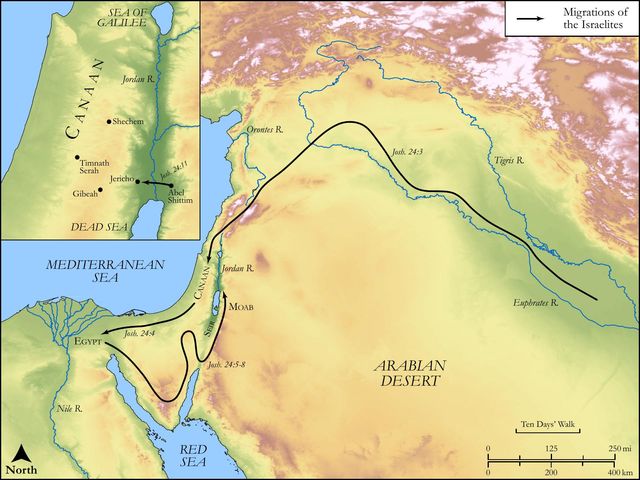
See on the biblical-era map
Study this verse
Public-domain commentary
Matthew Henry
From his Commentary on the Whole Bible. Henry comments on passages, not single verses — this entry covers Joshua 24:15–28. His four-level outline is real structure in the source text, so it is rendered as structure.
Never was any treaty carried on with better management, nor brought to a better issue, than this of Joshua with the people, to engage them to serve God. The manner of his dealing with them shows him to have been in earnest, and that his heart was much upon it, to leave them under all possible obligations to cleave to him, particularly the obligation of a choice and of a covenant.
I.Would it be any obligation upon them if they made the service of God their choice? - he here puts them to their choice, not as if it were antecedently indifferent whether they served God or nor, or as if they were at liberty to refuse his service, but because it would have a great influence upon their perseverance in religion if they embraced it with the reason of men and with the resolution of men. These two things he here brings them to.
1.He brings them to embrace their religion rationally and intelligently, for it is a reasonable service. The will of man is apt to glory in its native liberty, and, in a jealousy for the honour of this, adheres with most pleasure to that which is its own choice and is not imposed upon it; therefore it is God's will that this service should be, not our chance, or a force upon us, but our choice. Accordingly,
(1.)Joshua fairly puts the matter to their choice, Jos 24:15. Here,
[1.]He proposes the candidates that stand for the election. The Lord, Jehovah, on one side, and on the other side either the gods of their ancestors, which would pretend to recommend themselves to those that were fond of antiquity, and that which was received by tradition from their fathers, or the gods of their neighbours, the Amorites, in whose land they dwelt, which would insinuate themselves into the affections of those that were complaisant and fond of good fellowship.
[2.]He supposes there were those to whom, upon some account or other, it would seem evil to serve the Lord. There are prejudices and objections which some people raise against religion, which, with those that are inclined to the world and the flesh, have great force. It seems evil to them, hard and unreasonable, to be obliged to deny themselves, mortify the flesh, take up their cross, etc. But, being in a state of probation, it is fit there should be some difficulties in the way, else there were no trial.
[3.]He refers it to themselves: "Choose you whom you will serve, choose this day, now that the matter is laid thus plainly before you, speedily bring it to a head, and do not stand hesitating." Elijah, long after this, referred the decision of the controversy between Jehovah and Baal to the consciences of those with whom he was treating, Kg1 18:21. Joshua's putting the matter here to this issue plainly intimates two things: - First, That it is the will of God we should every one of us make religion our serious and deliberate choice. Let us state the matter impartially to ourselves, weigh things in an even balance, and then determine for that which we find to be really true and good. Let us resolve upon a life of serious godliness, not merely because we know no other way, but because really, upon search, we find no better. Secondly, That religion has so much self-evident reason and righteousness on its side that it may safely be referred to every man that allows himself a free thought either to choose or refuse it; for the merits of the cause are so plain that no considerate man can do otherwise but choose it. The case is so clear that it determines itself. Perhaps Joshua designed, by putting them to their choice, thus to try if there were any among them who, upon so fair an occasion given, would show a coolness and indifference towards the service of God, whether they would desire time to consider and consult their friends before they gave in an answer, and if any such should appear he might set a mark upon them, and warn the rest to avoid them.
[4.]He directs their choice in this matter by an open declaration of his own resolutions: "But as for me and my house, whatever you do, we will serve the Lord, and I hope you will all be of the same mind." Here he resolves, First, For himself: As for me, I will serve the Lord. Note, The service of God is nothing below the greatest of men; it is so far from being a diminution and disparagement to princes and those of the first rank to be religious that it is their greatest honour, and adds the brightest crown of glory to them. Observe how positive he is: "I will serve God." It is no abridgment of our liberty to bind ourselves with a bond to God. Secondly, For his house, that is, his family, his children and servants, such as were immediately under his eye and care, his inspection and influence. Joshua was a ruler, a judge in Israel, yet he did not make his necessary application to public affairs an excuse for the neglect of family religion. Those that have the charge of many families, as magistrates and ministers, must take special care of their own (Ti1 3:4, Ti1 3:5): I and my house will serve God. 1. "Not my house, without me." He would not engage them to that work which he would not set his own hand to. As some who would have their children and servants good, but will not be so themselves; that is, they would have them go to heaven, but intend to go to hell themselves. 2. "Not I, without my house." He supposes he might be forsaken by his people, but in his house, where his authority was greater and more immediate, there he would over-rule. Note, When we cannot bring as many as we would to the service of God we must bring as many as we can, and extend our endeavours to the utmost sphere of our activity; if we cannot reform the land, let us put away iniquity far from our own tabernacle. 3. "First I, and then my house." Note, Those that lead and rule in other things should be first in the service of God, and go before in the best things. Thirdly, He resolves to do this whatever others did. Though all the families of Israel should revolt from God, and serve idols, yet Joshua and his family will stedfastly adhere to the God of Israel. Note, Those that resolve to serve God must not mind being singular in it, nor be drawn by the crowd to forsake his service. Those that are bound for heaven must be willing to swim against the stream, and must not do as the most do, but as the best do.
(2.)The matter being thus put to their choice, they immediately determine it by a free, rational, and intelligent declaration, for the God of Israel, against all competitors whatsoever, Jos 24:16-18. Here,
[1.]They concur with Joshua in his resolution, being influenced by the example of so great a man, who had been so great a blessing to them (Jos 24:18): We also will serve the Lord. See how much good great men might do, if they were but zealous in religion, by their influence on their inferiors.
[2.]They startle at the thought of apostatizing from God (Jos 24:16): God forbid; the word intimates the greatest dread and detestation imaginable. "Far be it, far be it from us, that we or ours should ever forsake the Lord to serve other gods. We must be perfectly lost to all sense of justice, gratitude, and honour, ere we can harbour the least thought of such a thing." Thus must our hearts rise against all temptations to desert the service of God. Get thee behind me, Satan.
[3.]They give very substantial reasons for their choice, to show that they did not make it purely in compliance to Joshua, but from a full conviction of the reasonableness and equity of it. They make this choice for, and in consideration, First, Of the many great and very kind things God had done for them, bringing them out of Egypt through the wilderness into Canaan, Jos 24:17, Jos 24:18. Thus they repeat to themselves Joshua's sermon, and then express their sincere compliance with the intentions of it. Secondly, Of the relation they stood in to God, and his covenant with them: "We will serve the Lord (Jos 24:18), for he is our God, who has graciously engaged himself by promise to us, and to whom we have by solemn vow engaged ourselves."
2.He brings them to embrace their religion resolutely, and to express a full purpose of heart to cleave to the Lord. Now that he has them in a good mind he follows his blow, and drives the nail to the head, that it might, if possible, be a nail in a sure place. Fast bind, fast find.
(1.)In order to this he sets before them the difficulties of religion, and that in it which might be thought discouraging (Jos 24:19, Jos 24:20): You cannot serve the Lord, for he is a holy God, or, as it is in the Hebrew, he is the holy Gods, intimating the mystery of the Trinity, three in one; holy, holy, holy, holy Father, holy Son, holy Spirit. He will not forgive. And, if you forsake him, he will do you hurt. Certainly Joshua does not intend hereby to deter them from the service of God as impracticable and dangerous. But,
[1.]He perhaps intends to represent here the suggestions of seducers, who tempted Israel from their God, and from the service of him; with such insinuations as these, that he was a hard master, his work impossible to be done, and he not to be pleased, and, if displeased, implacable and revengeful, - that he would confine their respects to himself only, and would not suffer them to show the least kindness for any other, - and that herein he was very unlike the gods of the nations, which were easy, and neither holy nor jealous. It is probable that this was then commonly objected against the Jewish religion, as it has all along been the artifice of Satan every since he tempted our first parents thus to misrepresent God and his laws, as harsh and severe; and Joshua by his tone and manner of speaking might make them perceive he intended it as an objection, and would put it to them how they would keep their ground against the force of it. Or,
[2.]He thus expresses his godly jealousy over them, and his fear concerning them, that, notwithstanding the profession they now made of zeal for God and his service, they would afterwards draw back, and if they did they would find him just and jealous to avenge it. Or,
[3.]He resolves to let them know the worst of it, and what strict terms they must expect to stand upon with God, that they might sit down and count the cost. "You cannot serve the Lord, except you put away all other gods for he is holy and jealous, and will by no means admit a rival, and therefore you must be very watchful and careful, for it is at your peril if you desert his service; better you had never known it." Thus, though our Master has assured us that his yoke is easy, yet lest, upon the presumption of this, we should grow remiss and careless, he has also told us that the gate is strait, and the way narrow, that leads to life, that we may therefore strive to enter, and not seek only. "You cannot serve God and Mammon; therefore, if you resolve to serve God, you must renounce all competitors with him. You cannot serve God in your own strength, nor will he forgive your transgressions for any righteousness of your own; but all the seed of Israel must be justified and must glory in the Lord alone as their righteousness and strength," Isa 45:24, Isa 45:25. They must therefore come off from all confidence in their own sufficiency, else their purposes would be to no purpose. Or,
[4.]Joshua thus urges on them the seeming discouragements which lay in their way, that he might sharpen their resolutions, and draw from them a promise yet more express and solemn that they would continue faithful to God and their religion. He draws it form them that they might catch at it the more earnestly and hold it the faster.
(2.)Notwithstanding this statement of the difficulties of religion, they declare a firm and fixed resolution to continue and persevere therein (Jos 24:21): "Nay, but we will serve the Lord. We will think never the worse of him for his being a holy and jealous God, nor for his confining his servants to worship himself only. Justly will he consume those that forsake him, but we never will forsake him; not only we have a good mind to serve him, and we hope we shall, but we are at a point, we cannot bear to hear any entreaties to leave him or to turn from following after him (Rut 1:16); in the strength of divine grace we are resolved that we will serve the Lord." This resolution they repeat with an explication (Jos 24:24): "The Lord our God will we serve, not only be called his servants and wear his livery, but our religion shall rule us in every thing, and his voice will we obey." And in vain do we call him Master and Lord, if we do not the things which he saith, Luk 6:46. This last promise they make in answer to the charge Joshua gave them (Jos 24:23), that, in order to their perseverance, they should,
[1.]Put away the images and relics of the strange gods, and not keep any of the tokens of those other lovers in their custody, if they resolved their Maker should be their husband; they promise, in this, to obey his voice.
[2.]That they should incline their hearts to the God of Israel, use their authority over their own hearts to engage them for God, not only to set their affections upon him, but to settle them so. These terms they agree to, and thus, as Joshua explains the bargain, they strike it: The Lord our God will we serve.
II.The service of God being thus made their deliberate choice, Joshua binds them to it by a solemn covenant, Jos 24:25.
Moses had twice publicly ratified this covenant between God and Israel, at Mount Sinai (Ex. 24) and in the plains of Moab, Deu 29:1. Joshua had likewise done it once (Jos 8:31, etc.) and now the second time. It is here called a statute and an ordinance, because of the strength and perpetuity of its obligation, and because even this covenant bound them to no more than what they were antecedently bound to by the divine command. Now, to give it the formalities of a covenant, 1. He calls witnesses, no other than themselves (Jos 24:22): You are witnesses that you have chosen the Lord. He promises himself that they would never forget the solemnities of this day; but, if hereafter they should break this covenant, he assures them that the professions and promises they had now made would certainly rise up in judgment against them and condemn them; and they agreed to it: "We are witnesses; let us be judged out of our own mouths if ever we be false to our God." 2. He put it in writing, and inserted it, as we find it here, in the sacred canon: He wrote it in the book of the law (Jos 24:26), in that original which was laid up in the side of the ark, and thence, probably, it was transcribed into the several copies which the princes had for the use of each tribe. There it was written, that their obligation to religion by the divine precept, and that by their own promise, might remain on record together. 3. He erected a memorandum of it, for the benefit of those who perhaps were not conversant with writings, Jos 24:26, Jos 24:27. He set up a great stone under an oak, as a monument of this covenant, and perhaps wrote an inscription upon it (by which stones are made to speak) signifying the intention of it. When he says, It hath heard what was past, he tacitly upbraids the people with the hardness of their hearts, as if this stone had heard to as good purpose as some of them; and, if they should forget what was no done, this stone would so far preserve the remembrance of it as to reproach them for their stupidity and carelessness, and be a witness against them.
The matter being thus settled, Joshua dismissed this assembly of the grandees of Israel (Jos 24:28), and took his last leave of them, well satisfied in having done his part, by which he had delivered his soul; if they perished, their blood would be upon their own heads.
Continue studying Joshua 24:20 across the web’s major study libraries — every link below opens this exact verse, chapter, or book on the destination site.
Read & Compare
 BibleGatewayThis verse in more than 200 translations and 70 languages.
 Bible.comThe YouVersion reader — hundreds of translations, reading plans, and highlights.
 ESV.orgCrossway's official English Standard Version reader.
 NET BibleThe NET translation with 60,000+ translators' notes on every rendering decision.
 STEP BibleTyndale House's free study tool — original text, vocabulary, and scholarly resources.
 BibliaLogos Bible Software's free web reader.
 USCCBThe New American Bible (Revised Edition) with the U.S. bishops' study notes.
Commentaries
 BibleHub CommentariesDozens of classic commentaries on this verse, gathered on one page.
 StudyLightMore than 100 commentary sets — the largest collection on the web.
 BibleRefPlain-English commentary on what this verse means, verse by verse.
 Enduring WordDavid Guzik's free commentary on this chapter, widely used by Bible teachers.
 Bible Study ToolsVerse commentary alongside Greek and Hebrew study aids.
Original Language & Research
- BibleHub InterlinearThe verse word by word — original language, transliteration, and English.
- BibleHub LexiconEvery word's original-language definition and Strong's entry.
 Blue Letter BibleDeep-study tools — Strong's numbers, concordance, and word studies.
 SefariaThe Hebrew text with Rashi and centuries of Jewish commentary.
Sermons, Hymns & Audio


TrulyRandomVerse is not affiliated with these sites and doesn’t control their content. They’re linked because they’re genuinely useful.
Summary
Joshua 24:20 issues a profound and solemn warning within Joshua's farewell address to the Israelites at Shechem. It articulates the severe and inevitable consequences of abandoning their covenant relationship with the LORD for the worship of foreign deities. This verse underscores God's righteous judgment and active intervention against apostasy, particularly when it follows a period of immense divine favor and blessing, highlighting the conditional nature of the Mosaic Covenant and the gravity of spiritual ingratitude.
Context
ShowHideLiterary Context
This verse is situated within Joshua's climactic farewell address to the assembled tribes of Israel at Shechem, just before his death. Having meticulously recounted God's faithful acts from Abraham's call to their triumphant settlement in the Promised Land, Joshua challenges the people to make a definitive choice: to serve the LORD or the gods their ancestors served beyond the Euphrates, or the gods of the Amorites in whose land they now dwelt. Following the people's confident, even zealous, declaration, "We will serve the LORD, for he is our God!" (Joshua 24:18), Joshua issues a stark counter-warning, emphasizing the LORD's holiness and their own inability to perfectly serve Him without divine aid. This warning in Joshua 24:19-20 serves to temper their overconfidence and impress upon them the absolute seriousness of their covenant commitment.
Historical & Cultural Context
The setting is the transition period from conquest to settlement in Canaan, a land saturated with polytheistic worship, particularly the Baal and Asherah cults, which involved fertility rites, temple prostitution, and even child sacrifice. Israel had a history of succumbing to idolatry, notably with the golden calf at Sinai (Exodus 32) and the Baal of Peor incident (Numbers 25). The Mosaic Covenant, established at Sinai, explicitly outlined blessings for obedience and severe curses for disobedience, as detailed in Deuteronomy 28. Joshua's warning is thus rooted in a deep understanding of Israel's past failures and the pervasive spiritual dangers of their new environment, reminding them that their continued possession of the land and enjoyment of God's favor were contingent upon exclusive devotion to Yahweh.
Key Themes
ShowHideJoshua 24:20 encapsulates several pivotal themes. Firstly, it highlights Covenant Fidelity and its Consequences, emphasizing that the covenant between God and Israel was bilateral, demanding Israel's exclusive loyalty. A breach, particularly through idolatry, would inevitably trigger divine judgment, not arbitrary punishment. Secondly, it underscores Divine Holiness and Justice, revealing God not merely as a benevolent provider but as a holy judge who will not tolerate the worship of false gods from His chosen people. His "turning to do hurt" and "consume" them signifies His unwavering commitment to His own character and the terms of His covenant. Thirdly, the phrase "after that he hath done you good" brings to the forefront The Gravity of Ingratitude and Apostasy. It accentuates the profound betrayal inherent in forsaking God after experiencing His mighty acts of deliverance, provision, and blessing, making their potential defection all the more heinous. Finally, the warning against serving "strange gods" reinforces the Exclusivity of Worship, echoing the First Commandment that Israel was to worship the LORD alone (Exodus 20:3).
Exposition and Analysis
ShowHideKey Word Analysis
ShowHideThis verb (H5800) signifies a deliberate act of abandoning, deserting, or leaving behind. It implies a conscious and active turning away from a previously established relationship or commitment. In the context of the covenant, it denotes a profound breach of loyalty and a willful severance of ties with the LORD, moving beyond mere passive neglect to active rebellion.
This plural noun (H430) refers to deities. When qualified as "strange" (H5236, nêkâr, meaning foreign or alien), it refers to deities alien and foreign to the covenant God of Israel, Yahweh. These were the gods of the surrounding Canaanite nations, often associated with polytheism, idolatry, and practices anathema to Israel's monotheistic faith. The term emphasizes the stark contrast between the one true God who revealed Himself to Israel and the false, powerless idols of the Gentiles, highlighting the exclusivity of Yahweh's claim on His people's worship.
This word (H3615) carries the meaning of bringing to an end, completing, finishing, or utterly destroying. In the context of divine judgment, it suggests a comprehensive and decisive destruction, often implying removal from the land, loss of national identity, or severe reduction in numbers. It signifies a complete termination of the favorable conditions previously enjoyed under the covenant, leading to utter ruin or devastation.
Verse Breakdown
ShowHide"If ye forsake the LORD,"
This opening clause establishes the conditional premise for the ensuing judgment. It posits a deliberate and active choice by the people of Israel to abandon their covenant relationship with Yahweh. This is not a casual drifting away, but a willful act of disloyalty and rebellion against the God who had chosen, delivered, and sustained them.
"and serve strange gods,"
This clause specifies the particular act of covenant breach: idolatry. "Strange gods" refers to the foreign deities of the surrounding nations, whose worship was strictly forbidden by the Mosaic Law and constituted the ultimate betrayal of Israel's unique relationship with Yahweh, the one true God. This act of serving other gods is the direct consequence of forsaking the LORD.
"then he will turn and do you hurt,"
This marks the divine response to Israel's apostasy. The anthropomorphic phrase "he will turn" indicates a reversal of God's disposition from favor to active opposition. "Do you hurt" (literally "do evil to you," H7489, râʻaʻ) signifies that God Himself will become their adversary, bringing calamitous judgment upon them as a just consequence of their unfaithfulness. This is not arbitrary malice but a righteous judicial action.
"and consume you,"
This clause describes the severe outcome of God's judgment. To "consume" implies a thorough and devastating destruction, potentially leading to national ruin, exile, or a significant reduction in their numbers and power. It signifies the termination of their privileged status and the removal of the blessings previously enjoyed under the covenant.
"after that he hath done you good."
This final clause highlights the profound ingratitude and moral depravity inherent in Israel's potential apostasy. It underscores that God's judgment is not inflicted upon an undeserving people, but upon those who, having experienced immense divine favor, deliverance, provision, and blessing (H3190, yâṭab, to be or make well), willfully turn away from their Benefactor. This context of prior goodness makes their potential betrayal all the more grievous and justifies the severity of the impending judgment.
Literary Devices
ShowHideJoshua 24:20 is rich in literary devices that amplify its solemn warning. The primary structure is a Conditional Clause ("If... then..."), which clearly links Israel's actions to God's response, establishing a cause-and-effect relationship central to covenant theology. The phrase "he will turn" employs Anthropomorphism, attributing human-like action (turning) to God to convey a change in His posture from benevolent protector to righteous judge. This turning signifies a reversal of His favor. The verse also utilizes Juxtaposition by placing "do you hurt, and consume you" in stark contrast to "after that he hath done you good," powerfully highlighting the tragic irony and profound ingratitude of Israel's potential apostasy. The strong verbs "forsake," "serve," "hurt," and "consume" create a sense of urgency and gravity, emphasizing the seriousness of the covenant and its consequences. Furthermore, the declaration of "consume you" can be seen as a form of Hyperbole, conveying the absolute severity and thoroughness of God's judgment, implying national devastation and loss of privilege, rather than necessarily the literal annihilation of every individual. The entire verse functions as a powerful Warning and Exhortation, designed to impress upon the Israelites the absolute necessity of exclusive devotion to Yahweh.
Theological and Thematic Connections
ShowHideJoshua 24:20 stands as a stark reminder of the unchanging character of God, who is both merciful and just, and the enduring principles of covenant relationship. While the specific context is the Mosaic Covenant with ancient Israel, the theological underpinnings resonate throughout biblical history. God's holiness demands exclusive worship, and His justice ensures that deliberate rebellion and spiritual adultery will not go unpunished, especially when His immense goodness has been spurned. This truth underscores the seriousness of our choices and the profound implications of our allegiance, reminding us that God is not to be trifled with, and His love, while boundless, is not unconditional in its covenant blessings for those who willfully reject Him. The verse serves as a timeless warning against idolatry in all its forms, emphasizing that true spiritual well-being is inextricably linked to wholehearted devotion to the one true God.
Reflection and Application
ShowHideJoshua 24:20, though rooted in ancient Israel's covenant, speaks powerfully to believers today. The warning against forsaking the LORD and serving "strange gods" remains profoundly relevant, as spiritual idolatry is not confined to bowing before physical statues. In our modern context, "strange gods" can encompass anything that usurps God's rightful place as the supreme object of our affection, trust, and devotion—whether it be wealth, career, relationships, comfort, personal ambition, or even self-worship. This verse challenges us to rigorously examine our loyalties and ask ourselves what truly holds the preeminent position in our hearts. It reminds us that God's character is unchanging: He is holy and righteous, and while His mercy is vast, He also disciplines those He loves when they stray, not out of malice, but to restore them to a right relationship with Him. His discipline, though painful, is ultimately for our good, aiming to purify our hearts and draw us back to Him. The verse also serves as a poignant reminder to remember God's past goodness in our lives. Just as God had done good to Israel, He continually blesses us with salvation, provision, and grace. This profound goodness should inspire unwavering gratitude and devotion, compelling us to resist any temptation to turn away from Him and instead commit ourselves wholeheartedly to His service.
Questions for Reflection
ShowHideFAQ
ShowHideDoes God truly "do hurt" to His people? Is this compatible with His love?
ShowHideYes, the Bible teaches that God, in His justice and holiness, will "do hurt" or bring judgment upon His people when they willfully forsake Him and engage in idolatry. This is not arbitrary malice but a just and often corrective response to covenant unfaithfulness. For ancient Israel, this "hurt" often manifested as famine, pestilence, defeat by enemies, and eventually exile from the Promised Land. For believers in the New Covenant, while we are not under the Law's curses, God still disciplines those He loves (Hebrews 12:6). This discipline, though painful, is always for our spiritual good, intended to lead us to repentance, purify us, and conform us more to the image of Christ, ultimately aiming for our restoration and deeper fellowship with Him. It is an expression of His perfect love, which seeks our holiness above our comfort.
What does "consume you" mean for Israel in this context? Does it imply annihilation?
ShowHideIn the context of Joshua 24:20 and the broader Old Testament, "consume you" (Hebrew kâlâh) does not typically mean the literal annihilation of every individual Israelite. Instead, it refers to a comprehensive and devastating judgment that would lead to the loss of their national identity, the destruction of their societal structures, their removal from the Promised Land (exile), and a significant reduction in their numbers. This judgment would effectively "consume" their privileged status as God's covenant people in the land. History bears this out in the Assyrian and Babylonian exiles, where Israel was indeed "consumed" as a sovereign nation in their land, though a remnant always survived to preserve the covenant line and promise.
Christ-Centered Fulfillment
ShowHideJoshua 24:20, with its stark warning against forsaking the LORD, finds its ultimate Christ-centered fulfillment not in a renewed conditional covenant, but in the person and work of Jesus Christ. The Old Covenant, under which Israel repeatedly failed to uphold their end, demonstrated humanity's inherent inability to perfectly "forsake strange gods" and serve the LORD wholeheartedly. Israel's history, marked by cycles of apostasy and judgment, underscores the need for a new and better covenant. Jesus Christ, the true Israelite, perfectly fulfilled the demands of the Law, never forsaking the Father or serving "strange gods." He is the one who perfectly served the LORD. More profoundly, Christ bore the "hurt" and was "consumed" by God's righteous wrath on the cross, not for His own sin, but for the idolatry and unfaithfulness of His people (2 Corinthians 5:21). He became the curse for us (Galatians 3:13), enduring the ultimate consumption of divine judgment so that those who believe in Him might never face it. Under the New Covenant, established by Christ's blood, our standing with God is not based on our perfect obedience, which we cannot achieve, but on Christ's perfect obedience and His finished work (Hebrews 9:15). The "good" that God has done for us is supremely revealed in His gift of salvation through Christ. While believers are no longer under the condemnation of the Law (Romans 8:1), the principle of spiritual fidelity remains. Our call is now to abide in Christ, empowered by the Holy Spirit, to live lives of devotion, recognizing that any "strange gods" in our hearts are overcome by the supremacy and sufficiency of Jesus, who is our life and our all (Colossians 3:4).