


2 Kings 22:17
Bible text: King James Version (1769 Blayney text) · Public domain
Bible text: King James Version with Strong's numbers · Public domain
Bible text: Berean Standard Bible · Public domain
Bible text: American Standard Version (1901) · Public domain
Bible text: World English Bible, Messianic edition · Public domain
Bible text: Geneva Bible (1599) · Public domain
Bible text: Young's Literal Translation · Public domain
- תַּחַתTa·chatbecauseH8478N-mscNoun Singular Masculine Construct
- אֲשֶׁר'a·SherthatH834RelParticle Relative
- עֲזָבוּנִי'a·za·Vu·nithey have forsaken meH5800V-Qal-Perf-3cp ¦ 1csVerb Qal Perfect 3rd Plural common genderעֲזָבוּthey have forsakenנִיme
- וַיְקַטְּרוּvay·ka·te·Ruand they have made smokeH6999Conj-w ¦ V-Piel-ConsecImperf-3mpVerb Piel Consecutive Imperfect 3rd Plural Masculineוַandיְקַטְּרוּthey have made smoke
- לֵאלֹהִיםle·lo·Himto godsH430Prep-l ¦ N-mpNoun Plural Masculine Absoluteלֵtoאלֹהִיםgods
- אֲחֵרִים'a·che·RimotherH312Adj-mpAdjective Plural Masculine Absolute
- לְמַעַןle·Ma·'anso asH4616PrtParticle Conditional
- הַכְעִיסֵנִיhakh·'i·Se·nito provoke to anger meH3707V-Hiphil-Inf ¦ 1csVerb Hiphil Infinitive Constructהַכְעִיסֵto provoke to angerנִיme
- בְּכֹלbe·Kholby allH3605Prep-b ¦ N-mscNoun Singular Masculine Constructבְּbyכֹלall
- מַעֲשֵׂהma·'a·Seh[the] work ofH4639N-mscNoun Singular Masculine Construct
- יְדֵיהֶםye·dei·Hemtheir handsH3027N-cdc ¦ 3mpNoun Dual common gender Constructיְדֵיhandsהֶםtheir
- וְנִצְּתָהve·ni·tze·Tahand it will be kindledH3341Conj-w ¦ V-Niphal-ConsecPerf-3fsVerb Niphal Consecutive Perfect 3rd Singular Feminineוְandנִצְּתָהit will be kindled
- חֲמָתִיcha·ma·Timy angerH2534N-fsc ¦ 1csNoun Singular Feminine Constructחֲמָתִangerיmy
- בַּמָּקוֹםba·ma·Komin the placeH4725Prep-b ¦ N-msNoun Singular Masculine Absoluteבַּin theמָּקוֹםplace
- הַזֶּהha·Zeh<the> thisH2088Art ¦ PrtParticle Demonstrativeהַ<the>זֶּהthis
- וְלֹאve·Lo'and notH3808Conj-w ¦ NegParticle Negativeוְandלֹאnot
- תִכְבֶּהtikh·Behit will be quenchedH3518V-Qal-Imperf-3fsVerb Qal Imperfect 3rd Singular Feminine
English is a literal word-by-word gloss of the Hebrew, not the KJV's wording. Why?
This is the original text the KJV's translators worked from — each Hebrew word with its own literal English meaning in this verse, prepared by scholars at Tyndale House, Cambridge. The KJV translates whole sentences, not word by word, so its wording differs: one Hebrew word can become several English words, and the KJV may choose “the LORD” where the gloss reads “Yahweh”. Both are faithful — they answer different questions. For the KJV's own rendering, switch to the KJV text.
Details
See on the biblical-era map
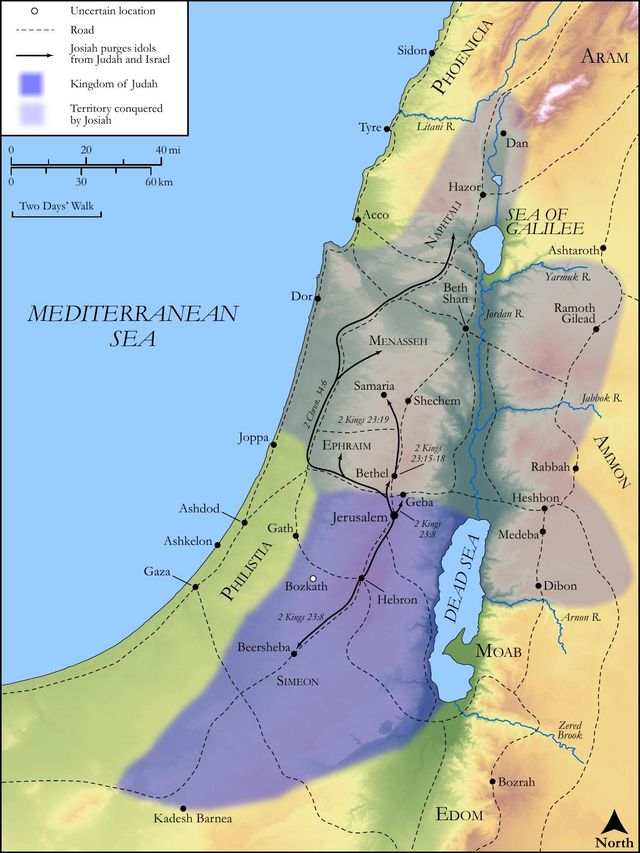
Study this verse
Public-domain commentary
Matthew Henry
From his Commentary on the Whole Bible. Henry comments on passages, not single verses — this entry covers 2 Kings 22:11–20. His three-level outline is real structure in the source text, so it is rendered as structure.
We hear no more of the repairing of the temple: no doubt that good work went on well; but the book of the law that was found in it occupies us now, and well it may. It is not laid up in the king's cabinet as a piece of antiquity, a rarity to be admired, but it is read before the king. Those put the truest honour upon their Bibles that study them and converse with them daily, feed on that bread and walk by that light. Men of honour and business must look upon an acquaintance with God's word to be their best business and honour. Now here we have,
I.The impressions which the reading of the law made upon Josiah.
He rent his clothes, as one ashamed of the sin of his people and afraid of the wrath of God; he had long thought the case of his kingdom bad, by reason of the idolatries and impieties that had been found among them, but he never thought it so bad as he perceived it to be by the book of the law now read to him. The rending of his clothes signified the rending of his heart for the dishonour done to God, and the ruin he saw coming upon his people.
II.The application he made to God hereupon: Go, enquire of the Lord for me, Kg2 22:13.
1.Two things we may suppose he desired to know: - "Enquire, (1.) What we shall do; what course we shall take to turn away God's wrath and prevent the judgments which our sins have deserved." Convictions of sin and wrath should put us upon this enquiry, What shall we do to be saved? Wherewithal shall we come before the Lord? If you will thus enquire, enquire quickly, before it be too late. (2.) "What we may expect and must provide for." He acknowledges, "Our fathers have not hearkened to the words of this book; if this be the rule of right, certainly our fathers have been much in the wrong." Now that the commandment came sin revived, and appeared sin; in the glass of the law, he saw the sins of his people more numerous and more heinous than he had before seen them, and more exceedingly sinful. He infers hence, "Certainly great is the wrath that is kindled against us; if this be the word of God, as no doubt it is, and he will be true to his word, as no doubt he will be, we are all undone. I never thought the threatenings of the law so severe, and the curses of the covenant so terrible, as now I find them to be; it is time to look about us if these be in force against us." Note, Those who are truly apprehensive of the weight of God's wrath cannot but be very solicitous to obtain his favour, and inquisitive how they may make their peace with him. Magistrates should enquire for their people, and study how to prevent the judgments of God that they see hanging over them.
2.This enquiry Josiah sent,
(1.)By some of his great men, who are named Kg2 22:12, and again Kg2 22:14. Thus he put an honour upon the oracle, by employing those of the first rank to attend it.
(2.)To Huldah the prophetess, Kg2 22:14. The spirit of prophecy, that inestimable treasure, was sometimes put not only into earthen vessels, but into the weaker vessels, that the excellency of the power might be of God. Miriam helped to lead Israel out of Egypt (Mic 6:4), Deborah judged them, and now Huldah instructed them in the mind of God, and her being a wife was no prejudice at all to her being a prophetess; marriage is honourable in all. It was a mercy to Jerusalem that when Bibles were scarce they had prophets, as afterwards, when prophecy ceased, that they had more Bibles; for God never leaves himself without witness, because he will leave sinners without excuse. Jeremiah and Zephaniah prophesied at this time, yet the king's messengers made Huldah their oracle, probably because her husband having a place at court (for he was keeper of the wardrobe) they had had more and longer acquaintance with her and greater assurances of her commission than of any other; they had, it is likely, consulted her upon other occasions, and had found that the word of God in her mouth was truth. She was near, for she dwelt at Jerusalem, in a place called Mishneh, the second rank of buildings from the royal palace. The Jews say that she prophesied among the women, the court ladies, being herself one of them, who it is probable had their apartments in that place. Happy the court that had a prophetess within the verge of it, and knew how to value her.
III.The answer he received from God to his enquiry.
Huldah returned it not in the language of a courtier - "Pray give my humble service to his Majesty, and let him know that this is the message I have for him from the God of Israel;" but in the dialect of a prophetess, speaking from him before whom all stand upon the same level - Tell the man that sent you to me, Kg2 22:15. Even kings, though gods to us, are men to God, and shall so be dealt with; for with him there is no respect of persons.
1.She let him know what judgments God had in store for Judah and Jerusalem (Kg2 22:16, Kg2 22:17): My wrath shall be kindled against this place; and what is hell itself but the fire of God's wrath kindled against sinners? Observe,
(1.)The degree and duration of it. It is so kindled that it shall not be quenched; the decree has gone forth; it is too late now to think of preventing it; the iniquity of Jerusalem shall not be purged with sacrifice or offering. Hell is unquenchable fire.
(2.)The reference it has, [1.] To their sins: "They have committed them, as it were, with design, and on purpose to provoke me to anger. It is a fire of their own kindling; they would provoke me, and at length I am provoked." [2.] To God's threatenings: "The evil I bring is according to the words of the book which the king of Judah has read; the scripture is fulfilled in it. Those that would not be bound by the precept shall be bound by the penalty." God will be found no less terrible to impenitent sinners than his word makes him to be.
2.She let him know what mercy God had in store for him.
(1.)Notice is taken of his great tenderness and concern for the glory of God and the welfare of his kingdom (Kg2 22:19): Thy heart was tender. Note, God will distinguish those that distinguish themselves. The generality of the people were hardened and their hearts unhumbled, so were the wicked kings his predecessors, but Josiah's heart was tender. He received the impressions of God's word, trembled at it and yielded to it; he was exceedingly grieved for the dishonour done to God by the sins of his fathers and of his people; he was afraid of the judgments of God, which he saw coming upon Jerusalem, and earnestly deprecated them. This is tenderness of heart, and thus he humbled himself before the Lord, and expressed these pious affections by rending his clothes and weeping before God, probably in his closet; but he that sees in secret says it was before him, and he heard it, and put every tear of tenderness into his bottle. Note, Those that most fear God's wrath are least likely to feel it. It should seem that those words (Lev 26:32) much affected Josiah, I will bring the land into desolation; for when he heard of the desolation and of the curse, that is, that God would forsake them and separate them to evil (for till it came to that they were neither desolate nor accursed), then he rent his clothes: the threatening went to his heart.
(2.)A reprieve is granted till after his death (Kg2 22:20): I will gather thee to thy fathers. The saints then, no doubt, had a comfortable prospect of happiness on the other side death, else being gathered to their fathers would not have been so often made the matter of a promise as we find it was. Josiah could not prevail to prevent the judgment itself, but God promised him he should not live to see it, which (especially considering that he died in the midst of his days, before he was forty years old) would have been but a small reward for his eminent piety if there had not been another world in which he should be abundantly recompensed, Heb 11:16. When the righteous is taken away from the evil to come he enters into peace, Isa 57:1, Isa 57:2. This is promised to Josiah here: Thou shalt go to thy grave in peace, which refers not to the manner of his death (for he was killed in a battle), but to the time of it; it was a little before the captivity in Babylon, that great trouble, in comparison with which the rest were as nothing, so that he might be truly said to die in peace that did not live to share in that. He died in the love and favour of God, which secure such a peace as no circumstances of dying, no, not dying in the field of war, could alter the nature of, or break in upon.
Continue studying 2 Kings 22:17 across the web’s major study libraries — every link below opens this exact verse, chapter, or book on the destination site.
Read & Compare
 BibleGatewayThis verse in more than 200 translations and 70 languages.
 Bible.comThe YouVersion reader — hundreds of translations, reading plans, and highlights.
 ESV.orgCrossway's official English Standard Version reader.
 NET BibleThe NET translation with 60,000+ translators' notes on every rendering decision.
 STEP BibleTyndale House's free study tool — original text, vocabulary, and scholarly resources.
 BibliaLogos Bible Software's free web reader.
 USCCBThe New American Bible (Revised Edition) with the U.S. bishops' study notes.
Commentaries
 BibleHub CommentariesDozens of classic commentaries on this verse, gathered on one page.
 StudyLightMore than 100 commentary sets — the largest collection on the web.
 BibleRefPlain-English commentary on what this verse means, verse by verse.
 Enduring WordDavid Guzik's free commentary on this chapter, widely used by Bible teachers.
 Bible Study ToolsVerse commentary alongside Greek and Hebrew study aids.
Original Language & Research
- BibleHub InterlinearThe verse word by word — original language, transliteration, and English.
- BibleHub LexiconEvery word's original-language definition and Strong's entry.
 Blue Letter BibleDeep-study tools — Strong's numbers, concordance, and word studies.
 SefariaThe Hebrew text with Rashi and centuries of Jewish commentary.
Sermons, Hymns & Audio


TrulyRandomVerse is not affiliated with these sites and doesn’t control their content. They’re linked because they’re genuinely useful.
Summary
The prophetess Huldah delivers a severe divine pronouncement to King Josiah, articulating God's righteous wrath against Judah and Jerusalem. This verse specifically cites the nation's consistent idolatry and their deliberate abandonment of the covenant relationship as the direct cause. It underscores the irreversible nature of the coming calamity, emphasizing that the accumulated sin of generations has reached a point where divine justice will be fully executed, leading to an unquenchable judgment upon the land.
Context
ShowHideLiterary Context
This verse is situated within the pivotal narrative of King Josiah's reign, immediately following the transformative discovery of the "Book of the Law" (widely believed to be a significant portion of Deuteronomy) during Temple repairs. Upon hearing its contents, Josiah, a king renowned for his righteousness, was profoundly distressed by the nation's widespread and long-standing disobedience to God's covenant commands, a distress so deep that he tore his clothes in lamentation, signifying repentance and grief (2 Kings 22:11). In response to Josiah's humble inquiry, he dispatched a delegation to consult the prophetess Huldah. Her prophetic word, recorded in 2 Kings 22:15-20, confirms the certainty of national judgment for Judah while simultaneously granting Josiah a personal reprieve due to his penitent heart. Verse 17 specifically details the profound and long-standing reasons for this impending national judgment, emphasizing the covenant infidelity of the people.
Historical & Cultural Context
Judah, particularly during the reigns preceding Josiah's reforms, had descended into deep syncretism and overt idolatry, frequently adopting the abominable religious practices of surrounding nations. Kings such as Manasseh, Josiah's grandfather, had actively promoted the worship of pagan deities like Baal, Asherah, and the "host of heaven," going so far as to erect altars to these foreign gods within the sacred precincts of the Temple itself (2 Kings 21:3-7). The act of burning incense to "other gods" was a ubiquitous form of pagan worship, representing a direct and egregious violation of the first two commandments of the Decalogue, which explicitly forbid the worship of other gods and the making of idols (Exodus 20:3-5). This persistent spiritual infidelity, despite numerous prophetic warnings from figures like Isaiah and Jeremiah, had severely eroded the foundational covenant relationship between Yahweh and His chosen people, inevitably leading to a divine and just response.
Key Themes
ShowHideThis verse powerfully articulates several key themes pervasive throughout the Deuteronomistic History (which encompasses the books of Joshua through 2 Kings). Foremost among these is the theme of covenant faithfulness and infidelity. God's pronouncement of judgment is a direct and righteous consequence of Judah's "forsaking" Him, a profound violation of the covenant established at Mount Sinai. This directly links to the theme of idolatry, which is consistently presented throughout the Old Testament as the ultimate act of spiritual treason and rebellion against God's sovereignty, inevitably provoking His righteous anger. The concept of divine wrath and justice is central, portraying God not as an indifferent deity, but as a holy and righteous judge who actively responds to persistent rebellion and sin. While Josiah's personal repentance brings a delay of judgment during his lifetime (2 Kings 22:20), the national judgment remains fixed, highlighting the cumulative effect of generations of sin and the principle of consequences for corporate disobedience within the covenant community.
Exposition and Analysis
ShowHideKey Word Analysis
ShowHideThis verb (H5800) signifies a deliberate abandonment, neglect, or desertion. In the context of a covenant relationship, it implies a breaking of loyalty and a turning away from one's commitments. Here, it highlights Judah's active choice to abandon their covenant God, Yahweh, not merely a passive drifting away, but a conscious and willful rejection of their Lord and His commands, leading to a profound breach of their foundational relationship.
This term (H3707) denotes causing vexation, grief, or indignation. It emphasizes that God's wrath is not arbitrary or capricious, but a righteous and just response to the specific, intentional actions of His people. Their idolatry and "works of their hands" were direct affronts to His holiness, sovereignty, and covenant stipulations, intentionally inciting His righteous indignation and displeasure.
This noun (H2534), derived from a root meaning "heat," figuratively denotes intense anger, fury, or indignation. It describes a passionate, fervent divine displeasure that is a just response to sin. When God's chêmâh is "kindled," it signifies a powerful, consuming anger, not an emotional outburst, but a settled, holy resolve to execute justice.
Verse Breakdown
ShowHide"Because they have forsaken me"
This initial clause presents the fundamental and overarching reason for God's impending judgment. It points to Judah's deliberate and long-standing abandonment of their exclusive covenant relationship with Yahweh, the one true God, choosing instead to pursue and serve other deities. This "forsaking" implies a conscious breach of the covenant vows made at Sinai.
"and have burned incense unto other gods"
This specifies the concrete and tangible manifestation of their act of forsaking God. Burning incense was a profound act of worship, and performing it for "other gods" (Hebrew: ʼachêr ʼĕlôhîym, H312 H430, denoting foreign, false deities) was a direct and egregious violation of the first two commandments, representing the pinnacle of their spiritual infidelity and idolatry.
"that they might provoke me to anger with all the works of their hands"
This clause clarifies the effect and intentionality behind their idolatrous practices. Their actions, born from their own choices, efforts, and creations ("works of their hands," Hebrew: maʻăseh yâd, H4639 H3027), were not merely misguided but were direct, intentional provocations against God's holy character and His explicit commands, justly inciting His righteous indignation and vexation.
"therefore my wrath shall be kindled against this place"
This introduces the inevitable divine consequence, marked by the strong causal connector "therefore." God's "wrath" (Hebrew: chêmâh, H2534) is described as "kindled" (Hebrew: yâtsath, H3341), a vivid metaphor for a fire ignited, indicating its intense, consuming, and destructive potential. "This place" (Hebrew: mâqôwm, H4725) refers specifically to Jerusalem and the land of Judah, the locus of their rebellion.
"and shall not be quenched"
This final, emphatic declaration underscores the absolute certainty, inevitability, and finality of the judgment. Like an unquenchable fire (Hebrew: kâbâh, H3518, meaning to extinguish), God's wrath, once kindled, will burn without cessation until its destructive purpose is fully accomplished. This signifies the complete and irreversible devastation that awaits the nation, leading to exile and the destruction of the city and Temple.
Literary Devices
ShowHideThe verse employs several potent literary devices to convey its message of impending and inescapable judgment. Metaphor is central, particularly in the striking phrase "my wrath shall be kindled," which vividly likens divine anger to a consuming fire. This imagery powerfully communicates the fierce intensity and destructive capacity of God's righteous indignation. This fiery metaphor is further emphasized by the powerful hyperbole of "shall not be quenched." While not implying an eternal literal burning, this phrase powerfully communicates the absolute certainty and comprehensive nature of the judgment; it will not be stopped, mitigated, or extinguished until its devastating purpose is fully accomplished. The structure of the verse also demonstrates clear cause-and-effect (often considered a form of logical parallelism), explicitly linking Judah's actions ("Because they have forsaken me... and have burned incense... that they might provoke me to anger") to God's inevitable response ("therefore my wrath shall be kindled... and shall not be quenched"). This highlights the principle of divine justice and accountability, where sin inevitably leads to consequences.
Theological and Thematic Connections
ShowHideThis verse profoundly illustrates God's unyielding holiness and justice, demonstrating that His patience, while vast and enduring, is not infinite. The accumulated sin of generations, particularly the pervasive idolatry and covenant breaking, reaches a tipping point where divine judgment becomes inevitable and necessary for God's character to remain true. It underscores the profound severity of spiritual infidelity and the direct, unavoidable consequences of turning away from the one true God. While God is merciful and slow to anger, He is also perfectly righteous and will not tolerate persistent, intentional rebellion against His character and His commands. This judgment, though severe and destructive, is not arbitrary but a just and holy response to a people who deliberately "provoke" Him with their actions, rejecting the very source of their life and blessing.
Reflection and Application
ShowHideThe message of 2 Kings 22:17, though rooted in ancient history and a specific covenant context, carries profound and timeless implications for individuals and communities today. It serves as a stark reminder that our actions, particularly those that betray our ultimate allegiance and devotion, have real and serious spiritual consequences. While we may not burn physical incense to stone idols in the modern world, contemporary idolatry often manifests as prioritizing wealth, power, comfort, reputation, self-fulfillment, or even human relationships above God. This verse calls us to a radical and honest self-examination: what are the "works of our hands" – our efforts, pursuits, and allegiances – that might be displacing God from His rightful place, subtly or overtly provoking His displeasure? It challenges us to consider the seriousness of spiritual apathy, the dangers of syncretism, and the subtle ways we might "forsake" God by neglecting His Word, His presence, or His commands in our daily lives. Ultimately, it compels us to cultivate a deep reverence for God's holiness and to live in faithful obedience, understanding that His justice is as real and immutable as His love and mercy.
Questions for Reflection
ShowHideFAQ
ShowHideWhat does it mean for God's wrath to be "kindled" and "not be quenched" in this context?
ShowHideThe imagery of God's wrath being "kindled" is a powerful metaphor, likening His anger to a fire that has been ignited. It signifies intense, righteous indignation that has reached a boiling point due to persistent sin and rebellion. This is not a capricious emotional outburst, but a settled, holy resolve to execute justice. The phrase "shall not be quenched" emphasizes the absolute certainty, inevitability, and comprehensive nature of the impending judgment. It means that once this divine judgment begins, it will not be stopped, mitigated, or extinguished until its destructive purpose is fully accomplished. It speaks to the finality and severity of the consequences for Judah's long history of forsaking God and engaging in idolatry, foreshadowing the complete devastation of Jerusalem and the Babylonian exile (2 Kings 25:8-10). This unquenchable nature highlights that the time for repentance for the nation as a whole had passed, and the consequences were now unavoidable.
Christ-Centered Fulfillment
ShowHideWhile 2 Kings 22:17 pronounces an unquenchable wrath upon a rebellious Judah, the New Testament reveals the ultimate answer to humanity's universal propensity for forsaking God and provoking His anger: the person and redemptive work of Jesus Christ. The "works of their hands" that provoked God's wrath in Judah find their ultimate and universal expression in humanity's pervasive sinfulness, for "all have sinned and fall short of the glory of God" (Romans 3:23). This universal sin justly deserves divine judgment, as "the wrath of God is revealed from heaven against all ungodliness and unrighteousness of men" (Romans 1:18). However, God, in His infinite love and perfect justice, provided a way for His wrath to be appeased and His justice satisfied, not by destroying the sinner, but by offering His Son as the perfect propitiation. On the cross, Jesus became the Lamb of God who takes away the sin of the world (John 1:29), bearing the full, unquenchable wrath of God against sin so that all who believe in Him might be spared from that wrath and reconciled to God (Romans 5:9). Through Christ, the covenant broken by Israel is renewed and fulfilled in a New Covenant, sealed by His precious blood, offering forgiveness of sins and a path to intimate fellowship with God, transforming those who once provoked His anger into His beloved children (Hebrews 8:6-13).