


2 Samuel 17:3
- וְאָשִׁיבָהve·'a·Shi·vahand I will bring backH7725Conj-w ¦ V-Hiphil-Imperf-1csVerb Hiphil Imperfect 1st Singular common genderוְandאָשִׁיבָהI will bring back
- כָלkholallH3605N-mscNoun Singular Masculine Construct
- הָעָםha·'Amthe peopleH5971Art ¦ N-msNoun Singular Masculine Absoluteהָtheעָםpeople
- אֵלֶיךָ'e·Lei·khato youH413Prep ¦ 2msPreposition Definiteאֵלֶיtoךָyou
- כְּשׁוּבke·Shuvas returnsH7725Prep-k ¦ V-Qal-InfVerb Qal Infinitive Constructכְּasשׁוּבreturns
- הַכֹּלha·Kol<the> everythingH3605Art ¦ N-msNoun Singular Masculine Absoluteהַ<the>כֹּלeverything
- הָאִישׁha·'Ishthe manH376Art ¦ N-msNoun Singular Masculine Absoluteהָtheאִישׁman
- אֲשֶׁר'a·SherwhomH834RelParticle Relative
- אַתָּה'a·TahyouH859Pro-2msPronoun Personal 2nd Singular Masculine
- מְבַקֵּשׁme·va·Kesh[are] seekingH1245V-Piel-Prtcpl-msVerb Piel Participle Singular Masculine Absolute
- כָּלkolallH3605N-mscNoun Singular Masculine Construct
- הָעָםha·'Amthe peopleH5971Art ¦ N-msNoun Singular Masculine Absoluteהָtheעָםpeople
- יִהְיֶהyih·Yehit will beH1961V-Qal-Imperf-3msVerb Qal Imperfect 3rd Singular Masculine
- שָׁלוֹםsha·LompeaceH7965N-msNoun Singular Masculine Absolute
English is a literal word-by-word gloss of the Hebrew, not the KJV's wording. Why?
This is the original text the KJV's translators worked from — each Hebrew word with its own literal English meaning in this verse, prepared by scholars at Tyndale House, Cambridge. The KJV translates whole sentences, not word by word, so its wording differs: one Hebrew word can become several English words, and the KJV may choose “the LORD” where the gloss reads “Yahweh”. Both are faithful — they answer different questions. For the KJV's own rendering, switch to the KJV text.
Details
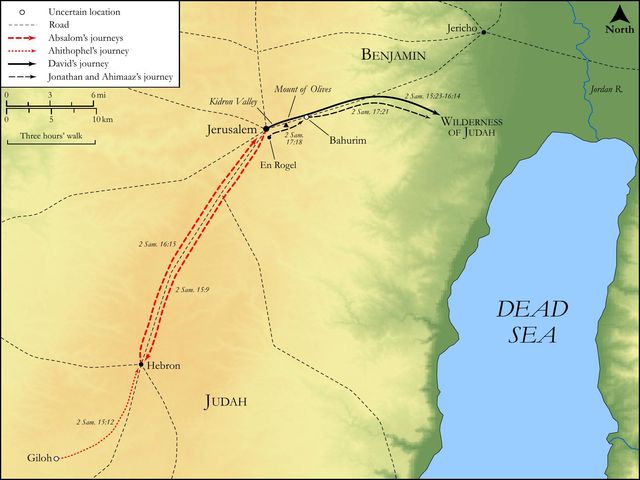
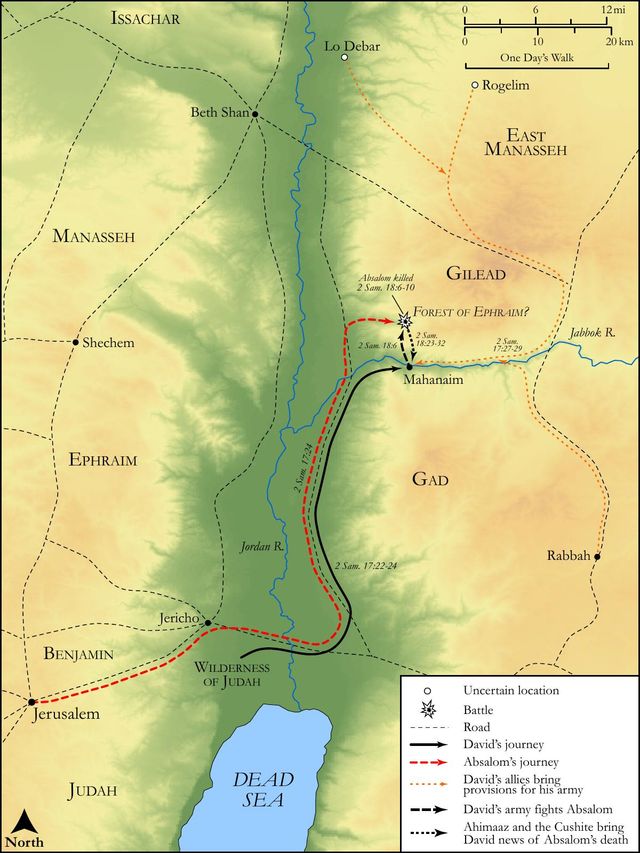
See on the biblical-era map

Study this verse
Public-domain commentary
Matthew Henry
From his Commentary on the Whole Bible. Henry comments on passages, not single verses — this entry covers 2 Samuel 17:1–14. His four-level outline is real structure in the source text, so it is rendered as structure.
Absalom is now in peaceable possession of Jerusalem; the palace-royal is his own, as are the thrones of judgment, even the thrones of the house of David. His good father reigned in Hebron, and only over the tribe of Judah, above seven years, and was not hasty to destroy his rival; his government was built upon a divine promise, the performance of which he was sure of in due time, and therefore he waited patiently in the mean time. But the young man, Absalom, not only hastens from Hebron to Jerusalem, but is impatient there till he has destroyed his father, cannot be content with his throne till he has his life; for his government is founded in iniquity, and therefore feels itself tottering and thinks itself obliged to do every thing with violence. That so profligate a wretch as Absalom should aim at the life of so good a father is not so strange (there are here and there monsters in nature); but that the body of the people of Israel, to whom David had been so great a blessing in all respects, should join with him in his attempt, is very amazing. But their fathers often mutinied against Moses. The best of parents, and the best of princes will not think it strange if they be made uneasy by those who should be their support and joy, when they consider what sons and what subjects David himself had.
David and all that adhered to him must be cut off. This was resolved, for aught that appears, nemine contradicente - unanimously. None durst mention his personal merits, and the great services done to his country, in opposition to this resolve, nor so much as ask, "Why, what evil has he done to forfeit his crown, much less his head?" None durst propose that his banishment should suffice, for the present, nor that agents should be sent to treat with him to resign the crown, which, having so tamely quitted the city, they might think he would easily be persuaded to do. It was not long since that Absalom himself fled for a crime, and David contented himself with his being an exile, though he deserved death, nay, he mourned and longed for him; but so perfectly void of all natural affection is this ungrateful Absalom that he eagerly thirsts after his own father's blood. It is past dispute that David must be destroyed; all the question is how he may be destroyed.
I.Ahithophel advises that he be pursued immediately, this very night, with a flying army (which he himself undertakes the command of), that the king only be smitten and his forces dispersed, and then the people that were now for him would fall in with Absalom of course, and there would not be such a long war as had been between the house of Saul and David: The man whom thou seekest is as if all returned, Sa2 17:1-3. By this it appears that Absalom had declared his design to be upon David's life, and Ahithophel concurs with him in it. Smite the shepherd, and the sheep will be scattered, and be an easy prey to the wolf. Thus he contrives to include the war in a little compass, by fighting neither with small nor great but the king of Israel only, and to conclude it in a little time, by falling upon him immediately. Nothing could be more fatal to David than the taking of these measures. It was too true that he was weary and weak-handed, that a little thing would make him afraid, else he would not have fled from his house upon the first alarm of Absalom's rebellion; it was probable enough that upon a fierce attack, especially in the night, the small force he had would be put into confusion and disorder, and it would bean easy thing to smite the king only, and then the business would be done, the whole nation would be reduced, of course, and all the people, says he, shall be in peace. See how a general ruin is called by usurpers a general peace; but thus the devil's palace is in peace, while he, as a strong man armed, keeps it. Compare with this the plot of Caiaphas (that second Ahithophel) against the Son of David, to crush his interest by destroying him. Let that one man die for the people, Joh 11:50. Kill the heir, and the inheritance shall be ours, Mat 21:38. But the counsel of them both was turned into foolishness. Yet the children of light may, in their generation, learn wisdom from the children of this world. What our hand finds to do let us do quickly, and with all our might. It is prudence to be vigorous and expeditious, and not to lose time, particularly in our spiritual warfare. If Satan flee from us, let us follow our blow. Those that have quarrelled with crowned heads have generally observed the decorum of declaring only against their evil counsellors, and calling them to an account (The king himself can do no wrong, it is they that do it); but Absalom's bare-faced villany strikes at the king directly, nay, at the king only; for (would you think it?) this saying, I will smite the king only, pleased Absalom well (Sa2 17:4), nor had he so much sense of humor and virtue left him to pretend to startle at it or even to be reluctant in this barbarous and monstrous resolution. What good can stand before the heat of a furious ambition?
II.Hushai advises that they be not too hasty in pursuing David, but take time to draw up all their force against him, and to overpower him with numbers, as Ahithophel had advised to take him by surprise. Now Hushai, in giving this counsel, really intended to serve David and his interest, that he might have time to send him notice of his proceedings, and that David might gain time to gather an army and to remove into those countries beyond Jordan, in which, lying more remote, Absalom had probably least interest. Nothing would be of greater advantage to David in this juncture than time to turn himself in; that he may have this, Hushai counsels Absalom to do nothing rashly, but to proceed with caution and secure his success by securing his strength. Now,
1.Absalom gave Hushai a fair invitation to advise him. All the elders of Israel approved of Ahithophel's counsel, yet God overruled the heart of Absalom not to proceed upon it, till he had consulted Hushai (Sa2 17:5): Let us hear what he saith. Herein he thought he did wisely (two heads are better than one), but God taketh the wise in their own craftiness. See Mr. Poole's note on this.
2.Hushai gave very plausible reasons for what he said.
(1.)He argued against Ahithophel's counsel, and undertook to show the danger of following his advice. It is with modesty, and all possible deference to Ahithophel's settled reputation, that he begs leave to differ from him, Sa2 17:7. He acknowledges that the counsel of Ahithophel is usually the best, and such as may be relied on; but, with submission to that noble peer, he is of opinion that his counsel is not good at this time, and that it is by no means safe to venture so great a cause as that in which they are now engaged upon so small a number, and such a hasty sally, as Ahithophel advises, remembering the defeat of Israel before Ai, Jos 7:4. It has often proved of bad consequence to despise an enemy. See how plausibly Hushai reasoned. [1.] He insisted much upon it that David was a great soldier, a man of great conduct, courage, and experience; all knew and owned this, even Absalom himself: "Thy father is a man of war (Sa2 17:8), a mighty man (Sa2 17:10), and not so weary and weak-handed as Ahithophel imagines. His retiring from Jerusalem must be imputed, not to his cowardice, but his prudence." [2.] His attendants, though few, were mighty men (Sa2 17:8), valiant men (Sa2 17:10), men of celebrated bravery and versed in all the arts of war. Ahithophel, who perhaps had worn the gown more than the sword, would find himself an unequal match for them. One of them would chase a thousand. [3.] They were all exasperated against Absalom, who was the author of all this mischief, were chafed in their minds, and would fight with the utmost fury; so that, what with their courage, and what with their rage, there would be no standing before them, especially for such raw soldiers as Absalom's generally were. Thus did he represent them as formidable as Ahithophel had made them despicable. [4.] He suggested that probably David and some of his men would lie in ambush, in some pit, or other close place, and fall upon Absalom's soldiers before they were aware the terror of which would put them to flight; and the defeat, though but of a small party, would dispirit all the rest, especially their own consciences at the same time accusing them of treason against one that, they were sure, was not only God's anointed, but a man after his own heart, Sa2 17:9. "It will soon be given out that there is a slaughter among Absalom's men, and then they will all make the best of their way, and the heart of Ahithophel himself, though now it seems like the heart of a lion, will utterly melt. In short, he will not find it so easy a matter to deal with David and his men as he thinks it is; and, if he be foiled, we shall all be routed."
(2.)He offered his own advice, and gave his reasons; and,
[1.]He counselled that which he knew would gratify Absalom's proud vain-gloriuos humour, though it would not be really serviceable to his interest. First, He advised that all Israel should be gathered together, that is, the militia of all the tribes. His taking it for granted that they are all for him, and giving him an opportunity to see them all together under his command, would gratify him as much as any thing. Secondly, He advises that Absalom go to battle in his own person, as if he looked upon him to be a better soldier than Ahithophel, more fit to give command and have the honour of the victory, insinuating that Ahithophel had put a slight upon him in offering to go without him. See how easy it is to betray proud men, by applauding them, and feeding their pride.
[2.]He counselled that which seemed to secure the success, at last, infallibly, without running any hazard. For, if they could raise such vast numbers as they promised themselves, wherever they found David they could not fail to crush him. First, If in the field, they should fall upon him, as the dew that covers the face of the ground, and cut off all his men with him, Sa2 17:12. Perhaps Absalom was better pleased with the design of cutting off all the men that were with him, having a particular antipathy to some of David's friends, than with Ahithophel's project of smiting the king only. Thus Hushai gained his point by humouring his revenge, as well as his pride. Secondly, If in a city, they need not fear conquering him, for they should have hands enough, if occasion were, to draw the city itself into its river with ropes, Sa2 17:13. This strange suggestion, how impracticable soever, being new, served for an amusement, and recommended itself by pleasing the fancy, for they would all smile at the humour of it.
(3.)By all these arts, Hushai gained not only Absalom's approbation of his advice, but the unanimous concurrence of this great counsel of war; they all agreed that the counsel of Hushai was better than the counsel of Ahithophel, Sa2 17:14. See here,
[1.]How much the policy of man can do; If Hushai had not been there, Ahithophel's counsel would certainly have prevailed; and, though all had given their opinion, nothing could be really more for Absalom's interest than that which he advised; yet Hushai, with his management, brings them all over to his side, and none of them are aware that he says all this in favour of David and his interest, but all say as he says. See how the unthinking are imposed upon by the designing part of mankind; what tools, what fools, great men make of one another by their intrigues; and what tricks there are often in courts and councils, which those are happiest that are least conversant with.
[2.]See how much more the providence of God can do. Hushai managed the plot with dexterity, yet the success is ascribed to God, and his agency on the minds of those concerned: The Lord had appointed to defeat the good counsel of Ahithophel. Be it observed, to the comfort of all that fear God, he turns all men's hearts as the rivers of water, though they know not the thoughts of the Lord. He stands in the congregation of the mighty, has an overruling hand in all counsels and a negative voice in all resolves, and laughs at men's projects against his anointed.
Historical interpretation
Historical reception
1 surviving comment on this verse from the historical church.
There is nothing so foreign to a Christian soul as haughtiness. Haughtiness, I say, not boldness nor courage, for these are agreeable. But these are one thing, and that is another; so too humility is one thing, and ignobility, flattery and adulation another. I will now, if you wish, give you examples of all these qualities. For these things which are contraries, seem in some way to be placed close together, as the tares are to the wheat and the thorns to the rose. But while babes might easily be deceived, those who are mature in truth and are skilled in spiritual husbandry know how to separate what is really good from the bad. Let me then lay before you examples of these qualities from the Scriptures. What is flattery and ignobility and adulation? Ziba flattered David out of season and falsely slandered his master. Much more did Ahitophel flatter Absalom. But David was not like this but was humble. For the deceitful are flatterers, as when they say, “O king, live forever.” Again, what flatterers the magicians are.
Continue studying 2 Samuel 17:3 across the web’s major study libraries — every link below opens this exact verse, chapter, or book on the destination site.
Read & Compare
 BibleGatewayThis verse in more than 200 translations and 70 languages.
 Bible.comThe YouVersion reader — hundreds of translations, reading plans, and highlights.
 ESV.orgCrossway's official English Standard Version reader.
 NET BibleThe NET translation with 60,000+ translators' notes on every rendering decision.
 STEP BibleTyndale House's free study tool — original text, vocabulary, and scholarly resources.
 BibliaLogos Bible Software's free web reader.
 USCCBThe New American Bible (Revised Edition) with the U.S. bishops' study notes.
Commentaries
 BibleHub CommentariesDozens of classic commentaries on this verse, gathered on one page.
 StudyLightMore than 100 commentary sets — the largest collection on the web.
 BibleRefPlain-English commentary on what this verse means, verse by verse.
 Enduring WordDavid Guzik's free commentary on this chapter, widely used by Bible teachers.
 Bible Study ToolsVerse commentary alongside Greek and Hebrew study aids.
Original Language & Research
- BibleHub InterlinearThe verse word by word — original language, transliteration, and English.
- BibleHub LexiconEvery word's original-language definition and Strong's entry.
 Blue Letter BibleDeep-study tools — Strong's numbers, concordance, and word studies.
 SefariaThe Hebrew text with Rashi and centuries of Jewish commentary.
Sermons, Hymns & Audio


TrulyRandomVerse is not affiliated with these sites and doesn’t control their content. They’re linked because they’re genuinely useful.
Summary
This verse encapsulates the strategic core of Ahithophel's counsel to Absalom, advocating for a swift, targeted strike against King David. Ahithophel argues that eliminating David, the central figure of the opposition, would immediately dissolve all resistance, causing the entire nation to rally behind Absalom and ushering in a state of political stability. This proposed "peace" is presented as the pragmatic outcome of a violent, decisive act of rebellion, rather than genuine reconciliation or divine blessing.
Context
ShowHideLiterary Context
This verse is an integral part of Ahithophel's pivotal counsel to Absalom, immediately following Absalom's successful coup and King David's hurried flight from Jerusalem. It builds directly upon Ahithophel's detailed tactical plan outlined in 2 Samuel 17:1-2, where he proposes pursuing David with 12,000 elite men to strike him while he is weary and vulnerable. Verse 3 articulates the compelling justification and desired outcome for this rapid, targeted strike: the belief that David's death would instantly end the rebellion by removing its symbolic head, thereby consolidating Absalom's power without prolonged civil war. This counsel crucially sets the stage for Hushai's divinely orchestrated counter-counsel, which God uses to frustrate Ahithophel's otherwise "good" advice, as explicitly stated in 2 Samuel 17:14.
Historical & Cultural Context
This event unfolds during a period of intense political turmoil and civil unrest within David's kingdom. Absalom, David's son, has orchestrated a successful rebellion, seizing Jerusalem and forcing his father to flee across the Jordan River. Ahithophel, formerly David's most trusted counselor, has defected to Absalom, bringing with him a formidable reputation for unparalleled wisdom, often regarded as divine counsel (2 Samuel 16:23). In ancient Near Eastern monarchies, the king was frequently seen as the embodiment of the nation, and his death or capture could indeed signify the immediate end of a conflict or the transfer of power. Ahithophel's counsel reflects this cultural understanding, aiming for a swift "decapitation strike" to avoid a prolonged and costly civil war, thereby consolidating Absalom's rule with minimal further bloodshed. The urgency of his advice is palpable, as David's loyalists could regroup and mount a stronger resistance if given time.
Key Themes
ShowHideThis verse powerfully contributes to several overarching themes within the broader narrative of 2 Samuel. Firstly, it highlights the theme of Strategic Counsel and its Consequences, contrasting Ahithophel's shrewd, humanly wise, but ultimately flawed counsel with God's divine intervention that thwarts it (Proverbs 19:21). Secondly, it underscores the Centrality of the King's Person in ancient Israelite thought; David's life is presented as synonymous with the resistance itself, making his elimination the key to ending the conflict. Thirdly, it touches upon the theme of False Peace vs. True Shalom, where Ahithophel promises a "peace" born of violence and rebellion, a stark contrast to the holistic peace God desires for His people, which is rooted in righteousness and covenant faithfulness. Finally, it exemplifies the Tragedy of Rebellion and its Ripple Effects, showing how Absalom's ambition leads to internal strife, betrayal, and the unraveling of the kingdom's fabric.
Exposition and Analysis
ShowHideKey Word Analysis
ShowHideThis primitive root signifies "to turn back (hence, away) transitively or intransitively, literally or figuratively." Here, Ahithophel uses it to suggest a return to normalcy and unity under Absalom's rule. However, it's a forced "return" achieved through violence and political maneuvering, not a genuine spiritual or relational restoration based on reconciliation. It represents a pragmatic political consolidation rather than a true turning of hearts.
This primitive root means "to search out (by any method, specifically in worship or prayer); by implication, to strive after." In this context, it emphasizes that David is the singular, focused target of Absalom's efforts. Ahithophel asserts that the entire rebellion, from his strategic perspective, hinges on the elimination of this one individual. The pursuit is precise and singular.
Derived from H7999 (shâlam), meaning "to be safe, i.e. (figuratively) well, happy, friendly; also (abstractly) welfare, i.e. health, prosperity, peace." While shâlôwm commonly denotes wholeness, well-being, and harmony, its usage here is politically expedient. Ahithophel promises a cessation of hostilities and political stability, but it's a peace achieved through the violent removal of the legitimate king. It lacks the deeper dimensions of justice, righteousness, and covenantal faithfulness inherent in the biblical concept of shâlôwm, representing merely the absence of conflict.
Verse Breakdown
ShowHide"And I will bring back all the people unto thee"
Ahithophel asserts his ability and intention to consolidate all the people under Absalom's authority. This statement implies that the current division and the people's scattered loyalties are solely due to David's continued resistance and presence. His plan aims to remove the obstacle (David) and thereby gather all the scattered allegiances back to Absalom, establishing his undisputed reign.
"the man whom thou seekest [is] as if all returned"
This clause forms the core of Ahithophel's strategic insight and persuasive argument. He posits that King David is the singular embodiment and rallying point of the opposition. If David is eliminated, the entire resistance movement collapses, and all the people, currently divided in their loyalties or supporting David, will automatically flock to Absalom. David's life is thus equated with the entire populace's loyalty or disloyalty, making his removal the decisive factor.
"[so] all the people shall be in peace."
The promised outcome is a state of "peace," signifying the end of the civil strife and the establishment of Absalom's undisputed reign. This "peace" is primarily a political cessation of conflict, a quietude achieved through the violent removal of the legitimate king, rather than through genuine reconciliation, justice, or divine blessing. It is a pragmatic peace, not a holistic shâlôwm.
Literary Devices
ShowHideThe verse effectively employs Metonymy and Hyperbole to underscore Ahithophel's persuasive argument. Metonymy is evident in the phrase "the man whom thou seekest [is] as if all returned," where "the man" (David) stands in for the entire opposing faction or the very spirit of resistance. Ahithophel asserts that the removal of this one individual is equivalent to the complete capitulation of all his followers and the entire nation. This assertion is further amplified by Hyperbole, as the idea that all people would immediately return and be in peace upon David's death is an overstatement designed to persuade Absalom of the plan's absolute effectiveness and minimal collateral damage. Furthermore, the "peace" promised is a form of Irony, as it is a peace born of rebellion and violence against the anointed king, standing in stark contrast to the true shâlôwm that God desires for His people, which is rooted in righteousness and covenant faithfulness.
Theological and Thematic Connections
ShowHideAhithophel's counsel, though shrewd from a human perspective, fundamentally misunderstands the nature of God's sovereignty and the divine anointing upon David. It operates on the premise that human power and strategic cunning can override God's purposes. The "peace" offered is a superficial one, achieved through violence and the usurpation of legitimate authority, rather than through righteousness or divine appointment. This contrasts sharply with the biblical understanding of true shâlôwm, which is rooted in covenant faithfulness, God's justice, and reconciliation, not merely the absence of conflict. The narrative ultimately reveals that God frustrates Ahithophel's "good" counsel, demonstrating that human plans, especially those built on rebellion and unrighteousness, are subject to God's ultimate will and will fail if they oppose His divine purposes.
Reflection and Application
ShowHideAhithophel's counsel serves as a powerful reminder that what appears strategically brilliant or pragmatically effective from a human standpoint may be entirely contrary to God's will and ultimately lead to ruin. His plan promised a quick, decisive "peace," but it was a peace built on rebellion, violence, and the rejection of God's anointed. This narrative challenges us to examine the foundations of our own "solutions" and "strategies." Do we seek peace and resolution through means that align with God's righteousness, or do we prioritize expediency, even if it means compromising ethical or spiritual principles? The story of Ahithophel's frustrated counsel underscores the profound truth that God is sovereign over human affairs, and His purposes will prevail, even when opposed by the most cunning human schemes. True peace, whether in our personal lives, families, or communities, is not merely the absence of conflict but the presence of God's justice, truth, and reconciliation, which can only be fully realized through obedience to His will and reliance on His divine wisdom.
Questions for Reflection
ShowHideFAQ
ShowHideWhy was Ahithophel's counsel considered so wise, yet it failed?
ShowHideAhithophel's counsel was renowned for its shrewdness and strategic brilliance, often described as if it were an oracle from God (2 Samuel 16:23). His plan to strike David immediately was militarily sound and aimed at a swift resolution to the rebellion, minimizing prolonged civil war. However, it failed not because of a flaw in its human logic or tactical execution, but because God actively intervened to frustrate it. 2 Samuel 17:14 explicitly states, "For the Lord had purposed to defeat the good counsel of Ahithophel, to the intent that the Lord might bring evil upon Absalom." This highlights a key biblical theme: even the most brilliant human plans are subject to God's ultimate sovereignty and will fail if they oppose His purposes or His anointed.
What does "the man whom thou seekest [is] as if all returned" mean?
ShowHideThis phrase encapsulates Ahithophel's core strategic insight and the basis of his "decapitation strike" plan. He believed that King David was the sole embodiment and rallying point of the opposition to Absalom's reign. By eliminating David, the entire rebellion would instantly collapse, and all the people who were currently divided in their loyalties or actively supporting David would immediately return their allegiance to Absalom. It was a strategy based on the ancient Near Eastern understanding that the king's person was synonymous with the nation's resistance. Ahithophel argued that removing David would be equivalent to the entire nation returning to Absalom's side, thus ending the conflict without widespread, protracted fighting.
Christ-Centered Fulfillment
ShowHideAhithophel's counsel to eliminate "the man whom thou seekest" to bring "peace" foreshadows, in a twisted and inverted way, the ultimate divine plan for true and lasting peace. While Ahithophel sought to achieve a false, temporary peace through the violent removal of an earthly king, God's divine counsel brought about true and eternal peace through the sacrificial death of the ultimate "Man whom God sought" – His Son, Jesus Christ. The world, enslaved by sin and in rebellion against God, could not achieve genuine reconciliation through any human strategy or military might. Instead, God sent His own Son, the Lamb of God, who willingly laid down His life. Unlike David, whose life was sought for destruction by his enemies, Jesus' death was a voluntary act of atonement, a cosmic "decapitation strike" against the power of sin and death (Colossians 2:15). Through His blood, Christ "made peace" (Ephesians 2:14-16), not by eliminating an opposing human leader, but by reconciling humanity to God and breaking down the wall of hostility between God and man, and between Jew and Gentile. The "peace" offered by Ahithophel was temporary, violent, and ultimately failed; the peace offered by Christ is eternal, rooted in righteousness, and freely given to all who believe, ushering in a new kingdom where He is our true King and the source of all shâlôwm.