


2 Samuel 17:9
Bible text: King James Version (1769 Blayney text) · Public domain
Bible text: King James Version with Strong's numbers · Public domain
Bible text: Berean Standard Bible · Public domain
Bible text: American Standard Version (1901) · Public domain
Bible text: World English Bible, Messianic edition · Public domain
Bible text: Geneva Bible (1599) · Public domain
Bible text: Young's Literal Translation · Public domain
- הִנֵּהhi·Nehthere!H2009PrtParticle Interjection
- עַתָּה'a·TahnowH6258AdvAdverb
- הוּאhu'heH1931Pro-3msPronoun Personal 3rd Singular Masculine
- נֶחְבָּאnech·Ba'[has] hidden himselfH2244V-Niphal-Prtcpl-msVerb Niphal Participle Singular Masculine Absolute
- בְּאַחַתbe·'a·Chatin one ofH259Prep-b ¦ N-fscNoun Singular Feminine Constructבְּinאַחַתone of
- הַפְּחָתִיםha·pe·cha·Timthe ravinesH6354Art ¦ N-mpNoun Plural Masculine Absoluteהַtheפְּחָתִיםravines
- אוֹ'oorH176ConjConjunction
- בְּאַחַדbe·'a·Chadin one ofH259Prep-b ¦ N-fscNoun Singular Feminine Constructבְּinאַחַדone of
- הַמְּקוֹמֹתha·me·ko·Motthe placesH4725Art ¦ N-fpNoun Plural Feminine Absoluteהַtheמְּקוֹמֹתplaces
- וְהָיָהve·ha·Yahand it will beH1961Conj-w ¦ V-Qal-ConsecPerf-3msVerb Qal Consecutive Perfect 3rd Singular Masculineוְandהָיָהit will be
- כִּנְפֹלkin·Folwhen fallsH5307Prep-k ¦ V-Qal-InfVerb Qal Infinitive Constructכִּwhenנְפֹלfalls
- בָּהֶםba·Hemamong <the> themPrep-b ¦ 3mpSuffix Personal 3rd Plural Masculineבָּamong <the>הֶםthem
- בַּתְּחִלָּהba·te·chi·Lahat the firstH8462Prep-b ¦ N-fsNoun Singular Feminine Absoluteבַּat theתְּחִלָּהfirst
- וְשָׁמַעve·sha·Ma'and he will hearH8085Conj-w ¦ V-Qal-ConsecPerf-3msVerb Qal Consecutive Perfect 3rd Singular Masculineוְandשָׁמַעhe will hear
- הַשֹּׁמֵעַha·sho·Me·a'the [one who] hearsH8085Art ¦ V-Qal-Prtcpl-msVerb Qal Participle Singular Masculine Absoluteהַtheשֹּׁמֵעַ[one who] hears
- וְאָמַרve·'a·Marand he will sayH559Conj-w ¦ V-Qal-ConsecPerf-3msVerb Qal Consecutive Perfect 3rd Singular Masculineוְandאָמַרhe will say
- הָיְתָהha·ye·Tahit has beenH1961V-Qal-Perf-3fsVerb Qal Perfect 3rd Singular Feminine
- מַגֵּפָהma·ge·Faha slaughterH4046N-fsNoun Singular Feminine Absolute
- בָּעָםba·'Amamong the peopleH5971Prep-b ¦ N-msNoun Singular Masculine Absoluteבָּamong theעָםpeople
- אֲשֶׁר'a·SherwhichH834RelParticle Relative
- אַחֲרֵי'a·cha·Rei[is] afterH310Adj-mpcAdjective Numerical Plural Masculine Construct
- אַבְשָׁלֹם'av·sha·LomAbsalomH53N-proper-mNoun Proper Masculine
English is a literal word-by-word gloss of the Hebrew, not the KJV's wording. Why?
This is the original text the KJV's translators worked from — each Hebrew word with its own literal English meaning in this verse, prepared by scholars at Tyndale House, Cambridge. The KJV translates whole sentences, not word by word, so its wording differs: one Hebrew word can become several English words, and the KJV may choose “the LORD” where the gloss reads “Yahweh”. Both are faithful — they answer different questions. For the KJV's own rendering, switch to the KJV text.
Details
See on the biblical-era maps
Study this verse
Public-domain commentary
Matthew Henry
From his Commentary on the Whole Bible. Henry comments on passages, not single verses — this entry covers 2 Samuel 17:1–14. His four-level outline is real structure in the source text, so it is rendered as structure.
Absalom is now in peaceable possession of Jerusalem; the palace-royal is his own, as are the thrones of judgment, even the thrones of the house of David. His good father reigned in Hebron, and only over the tribe of Judah, above seven years, and was not hasty to destroy his rival; his government was built upon a divine promise, the performance of which he was sure of in due time, and therefore he waited patiently in the mean time. But the young man, Absalom, not only hastens from Hebron to Jerusalem, but is impatient there till he has destroyed his father, cannot be content with his throne till he has his life; for his government is founded in iniquity, and therefore feels itself tottering and thinks itself obliged to do every thing with violence. That so profligate a wretch as Absalom should aim at the life of so good a father is not so strange (there are here and there monsters in nature); but that the body of the people of Israel, to whom David had been so great a blessing in all respects, should join with him in his attempt, is very amazing. But their fathers often mutinied against Moses. The best of parents, and the best of princes will not think it strange if they be made uneasy by those who should be their support and joy, when they consider what sons and what subjects David himself had.
David and all that adhered to him must be cut off. This was resolved, for aught that appears, nemine contradicente - unanimously. None durst mention his personal merits, and the great services done to his country, in opposition to this resolve, nor so much as ask, "Why, what evil has he done to forfeit his crown, much less his head?" None durst propose that his banishment should suffice, for the present, nor that agents should be sent to treat with him to resign the crown, which, having so tamely quitted the city, they might think he would easily be persuaded to do. It was not long since that Absalom himself fled for a crime, and David contented himself with his being an exile, though he deserved death, nay, he mourned and longed for him; but so perfectly void of all natural affection is this ungrateful Absalom that he eagerly thirsts after his own father's blood. It is past dispute that David must be destroyed; all the question is how he may be destroyed.
I.Ahithophel advises that he be pursued immediately, this very night, with a flying army (which he himself undertakes the command of), that the king only be smitten and his forces dispersed, and then the people that were now for him would fall in with Absalom of course, and there would not be such a long war as had been between the house of Saul and David: The man whom thou seekest is as if all returned, Sa2 17:1-3. By this it appears that Absalom had declared his design to be upon David's life, and Ahithophel concurs with him in it. Smite the shepherd, and the sheep will be scattered, and be an easy prey to the wolf. Thus he contrives to include the war in a little compass, by fighting neither with small nor great but the king of Israel only, and to conclude it in a little time, by falling upon him immediately. Nothing could be more fatal to David than the taking of these measures. It was too true that he was weary and weak-handed, that a little thing would make him afraid, else he would not have fled from his house upon the first alarm of Absalom's rebellion; it was probable enough that upon a fierce attack, especially in the night, the small force he had would be put into confusion and disorder, and it would bean easy thing to smite the king only, and then the business would be done, the whole nation would be reduced, of course, and all the people, says he, shall be in peace. See how a general ruin is called by usurpers a general peace; but thus the devil's palace is in peace, while he, as a strong man armed, keeps it. Compare with this the plot of Caiaphas (that second Ahithophel) against the Son of David, to crush his interest by destroying him. Let that one man die for the people, Joh 11:50. Kill the heir, and the inheritance shall be ours, Mat 21:38. But the counsel of them both was turned into foolishness. Yet the children of light may, in their generation, learn wisdom from the children of this world. What our hand finds to do let us do quickly, and with all our might. It is prudence to be vigorous and expeditious, and not to lose time, particularly in our spiritual warfare. If Satan flee from us, let us follow our blow. Those that have quarrelled with crowned heads have generally observed the decorum of declaring only against their evil counsellors, and calling them to an account (The king himself can do no wrong, it is they that do it); but Absalom's bare-faced villany strikes at the king directly, nay, at the king only; for (would you think it?) this saying, I will smite the king only, pleased Absalom well (Sa2 17:4), nor had he so much sense of humor and virtue left him to pretend to startle at it or even to be reluctant in this barbarous and monstrous resolution. What good can stand before the heat of a furious ambition?
II.Hushai advises that they be not too hasty in pursuing David, but take time to draw up all their force against him, and to overpower him with numbers, as Ahithophel had advised to take him by surprise. Now Hushai, in giving this counsel, really intended to serve David and his interest, that he might have time to send him notice of his proceedings, and that David might gain time to gather an army and to remove into those countries beyond Jordan, in which, lying more remote, Absalom had probably least interest. Nothing would be of greater advantage to David in this juncture than time to turn himself in; that he may have this, Hushai counsels Absalom to do nothing rashly, but to proceed with caution and secure his success by securing his strength. Now,
1.Absalom gave Hushai a fair invitation to advise him. All the elders of Israel approved of Ahithophel's counsel, yet God overruled the heart of Absalom not to proceed upon it, till he had consulted Hushai (Sa2 17:5): Let us hear what he saith. Herein he thought he did wisely (two heads are better than one), but God taketh the wise in their own craftiness. See Mr. Poole's note on this.
2.Hushai gave very plausible reasons for what he said.
(1.)He argued against Ahithophel's counsel, and undertook to show the danger of following his advice. It is with modesty, and all possible deference to Ahithophel's settled reputation, that he begs leave to differ from him, Sa2 17:7. He acknowledges that the counsel of Ahithophel is usually the best, and such as may be relied on; but, with submission to that noble peer, he is of opinion that his counsel is not good at this time, and that it is by no means safe to venture so great a cause as that in which they are now engaged upon so small a number, and such a hasty sally, as Ahithophel advises, remembering the defeat of Israel before Ai, Jos 7:4. It has often proved of bad consequence to despise an enemy. See how plausibly Hushai reasoned. [1.] He insisted much upon it that David was a great soldier, a man of great conduct, courage, and experience; all knew and owned this, even Absalom himself: "Thy father is a man of war (Sa2 17:8), a mighty man (Sa2 17:10), and not so weary and weak-handed as Ahithophel imagines. His retiring from Jerusalem must be imputed, not to his cowardice, but his prudence." [2.] His attendants, though few, were mighty men (Sa2 17:8), valiant men (Sa2 17:10), men of celebrated bravery and versed in all the arts of war. Ahithophel, who perhaps had worn the gown more than the sword, would find himself an unequal match for them. One of them would chase a thousand. [3.] They were all exasperated against Absalom, who was the author of all this mischief, were chafed in their minds, and would fight with the utmost fury; so that, what with their courage, and what with their rage, there would be no standing before them, especially for such raw soldiers as Absalom's generally were. Thus did he represent them as formidable as Ahithophel had made them despicable. [4.] He suggested that probably David and some of his men would lie in ambush, in some pit, or other close place, and fall upon Absalom's soldiers before they were aware the terror of which would put them to flight; and the defeat, though but of a small party, would dispirit all the rest, especially their own consciences at the same time accusing them of treason against one that, they were sure, was not only God's anointed, but a man after his own heart, Sa2 17:9. "It will soon be given out that there is a slaughter among Absalom's men, and then they will all make the best of their way, and the heart of Ahithophel himself, though now it seems like the heart of a lion, will utterly melt. In short, he will not find it so easy a matter to deal with David and his men as he thinks it is; and, if he be foiled, we shall all be routed."
(2.)He offered his own advice, and gave his reasons; and,
[1.]He counselled that which he knew would gratify Absalom's proud vain-gloriuos humour, though it would not be really serviceable to his interest. First, He advised that all Israel should be gathered together, that is, the militia of all the tribes. His taking it for granted that they are all for him, and giving him an opportunity to see them all together under his command, would gratify him as much as any thing. Secondly, He advises that Absalom go to battle in his own person, as if he looked upon him to be a better soldier than Ahithophel, more fit to give command and have the honour of the victory, insinuating that Ahithophel had put a slight upon him in offering to go without him. See how easy it is to betray proud men, by applauding them, and feeding their pride.
[2.]He counselled that which seemed to secure the success, at last, infallibly, without running any hazard. For, if they could raise such vast numbers as they promised themselves, wherever they found David they could not fail to crush him. First, If in the field, they should fall upon him, as the dew that covers the face of the ground, and cut off all his men with him, Sa2 17:12. Perhaps Absalom was better pleased with the design of cutting off all the men that were with him, having a particular antipathy to some of David's friends, than with Ahithophel's project of smiting the king only. Thus Hushai gained his point by humouring his revenge, as well as his pride. Secondly, If in a city, they need not fear conquering him, for they should have hands enough, if occasion were, to draw the city itself into its river with ropes, Sa2 17:13. This strange suggestion, how impracticable soever, being new, served for an amusement, and recommended itself by pleasing the fancy, for they would all smile at the humour of it.
(3.)By all these arts, Hushai gained not only Absalom's approbation of his advice, but the unanimous concurrence of this great counsel of war; they all agreed that the counsel of Hushai was better than the counsel of Ahithophel, Sa2 17:14. See here,
[1.]How much the policy of man can do; If Hushai had not been there, Ahithophel's counsel would certainly have prevailed; and, though all had given their opinion, nothing could be really more for Absalom's interest than that which he advised; yet Hushai, with his management, brings them all over to his side, and none of them are aware that he says all this in favour of David and his interest, but all say as he says. See how the unthinking are imposed upon by the designing part of mankind; what tools, what fools, great men make of one another by their intrigues; and what tricks there are often in courts and councils, which those are happiest that are least conversant with.
[2.]See how much more the providence of God can do. Hushai managed the plot with dexterity, yet the success is ascribed to God, and his agency on the minds of those concerned: The Lord had appointed to defeat the good counsel of Ahithophel. Be it observed, to the comfort of all that fear God, he turns all men's hearts as the rivers of water, though they know not the thoughts of the Lord. He stands in the congregation of the mighty, has an overruling hand in all counsels and a negative voice in all resolves, and laughs at men's projects against his anointed.
Continue studying 2 Samuel 17:9 across the web’s major study libraries — every link below opens this exact verse, chapter, or book on the destination site.
Read & Compare
 BibleGatewayThis verse in more than 200 translations and 70 languages.
 Bible.comThe YouVersion reader — hundreds of translations, reading plans, and highlights.
 ESV.orgCrossway's official English Standard Version reader.
 NET BibleThe NET translation with 60,000+ translators' notes on every rendering decision.
 STEP BibleTyndale House's free study tool — original text, vocabulary, and scholarly resources.
 BibliaLogos Bible Software's free web reader.
 USCCBThe New American Bible (Revised Edition) with the U.S. bishops' study notes.
Commentaries
 BibleHub CommentariesDozens of classic commentaries on this verse, gathered on one page.
 StudyLightMore than 100 commentary sets — the largest collection on the web.
 BibleRefPlain-English commentary on what this verse means, verse by verse.
 Enduring WordDavid Guzik's free commentary on this chapter, widely used by Bible teachers.
 Bible Study ToolsVerse commentary alongside Greek and Hebrew study aids.
Original Language & Research
- BibleHub InterlinearThe verse word by word — original language, transliteration, and English.
- BibleHub LexiconEvery word's original-language definition and Strong's entry.
 Blue Letter BibleDeep-study tools — Strong's numbers, concordance, and word studies.
 SefariaThe Hebrew text with Rashi and centuries of Jewish commentary.
Sermons, Hymns & Audio


TrulyRandomVerse is not affiliated with these sites and doesn’t control their content. They’re linked because they’re genuinely useful.
Summary
2 Samuel 17:9 captures a pivotal moment in Hushai the Archite's cunning counter-counsel to Absalom, a strategic deception designed to undermine Ahithophel's sound but dangerous advice and secure King David crucial time to escape and regroup. Hushai masterfully paints a picture of David as a formidable, hidden warrior, ready to ambush Absalom's forces, thereby instilling fear and advocating for a delayed, large-scale attack that would ultimately prove disastrous for Absalom's rebellion. This verse is a testament to the power of psychological warfare and divine intervention in human affairs, demonstrating how God can use human ingenuity to accomplish His sovereign will.
Context
ShowHideLiterary Context
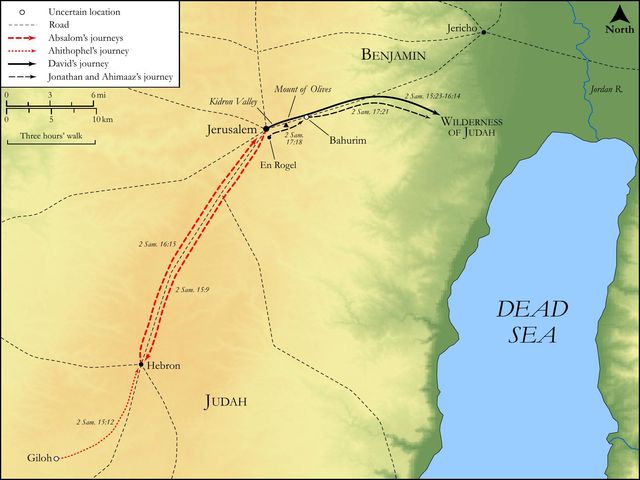
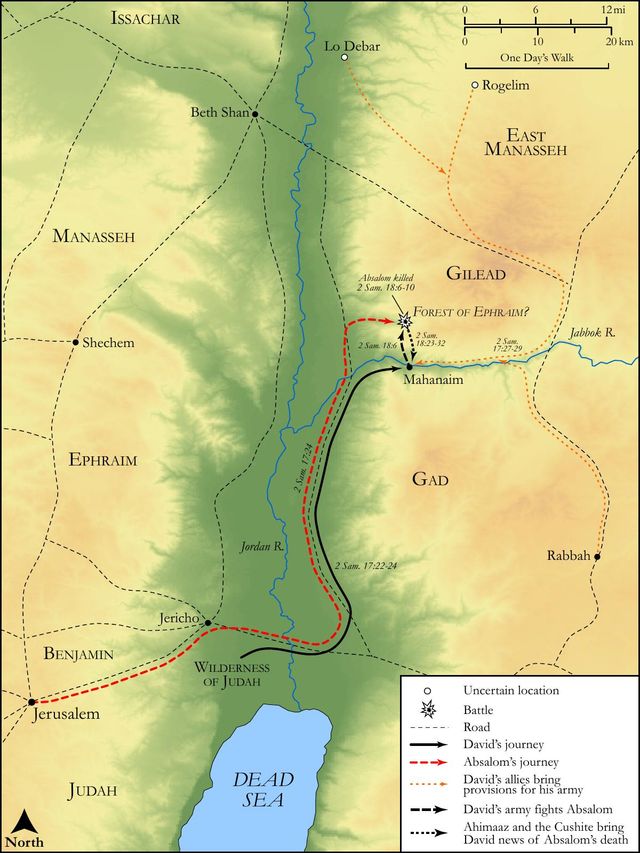
This verse is deeply embedded within the dramatic narrative of Absalom's rebellion against his father, King David, as chronicled in 2 Samuel 15-18. Following Absalom's usurpation of the throne and David's hasty flight from Jerusalem (2 Samuel 15:14), the immediate tension centers on the contrasting counsel offered to Absalom by his two key advisors: Ahithophel and Hushai. Ahithophel, renowned for his sagacity, advises an immediate and decisive pursuit of David (2 Samuel 17:1-3), which would likely have led to David's swift capture and death. However, David, through divine inspiration and strategic foresight, had sent Hushai back to Jerusalem as a double agent (2 Samuel 15:34-37). In 2 Samuel 17:7-13, Hushai presents his elaborate counter-proposal, and verse 9 specifically details the psychological tactic he employs: portraying David not as a weak, fleeing king, but as a dangerous, cornered lion, hiding in ambush, ready to inflict a devastating blow. This narrative twist is crucial for delaying Absalom's pursuit and ultimately allowing David to escape across the Jordan River.
Historical & Cultural Context
Israel placed a high value on military prowess and reputation, especially for a king, as the women sang, "Saul hath slain his thousands, and David his ten thousands." David's past as a renowned warrior, from his victory over Goliath (1 Samuel 17) to his many conquests, was legendary and deeply ingrained in the collective memory. Hushai shrewdly leverages this established reputation, knowing that fear of David's capabilities would be a powerful deterrent. The concept of "counsel" in royal courts was paramount; kings relied on trusted advisors for strategic decisions, and the quality of advice could determine the fate of a kingdom. Furthermore, ancient warfare often involved psychological tactics, using fear and rumor to demoralize opponents before or during battle. The geographical understanding of "pits" (cisterns, caves, or natural hollows) and "places" (hidden ravines, dense thickets) in the rugged Judean wilderness would have made Hushai's description of David's potential hiding spots and ambush tactics highly believable and terrifying to Absalom's council. The immediate impact of an initial defeat, as described by Hushai, could indeed trigger a rout among less disciplined, newly formed armies, a common phenomenon in ancient battles.
Key Themes
ShowHideThis verse powerfully illustrates several key themes woven throughout the broader narrative. Firstly, it highlights the theme of strategic deception and psychological warfare. Hushai masterfully constructs a narrative designed to exploit Absalom's fears and vanity, painting a vivid and terrifying picture of David's potential ambush, thereby misleading Absalom and his followers. Secondly, it underscores David's enduring reputation as a formidable warrior, even in vulnerability. Hushai shrewdly capitalizes on David's past military prowess, likening him to a "bear robbed of her whelps" in 2 Samuel 17:8, to instill a paralyzing fear. Thirdly, the verse emphasizes the psychological impact of initial defeat and rumor. Hushai argues that even a small initial setback for Absalom's troops would be magnified into a widespread "slaughter" due to panic and the pervasive fear of David's legendary fighting ability, leading to a complete demoralization of the army. Finally, and most profoundly, the acceptance of Hushai's seemingly inferior counsel over Ahithophel's superior advice is explicitly attributed to divine intervention. 2 Samuel 17:14 reveals that "the LORD had purposed to defeat the good counsel of Ahithophel, to the intent that the LORD might bring evil upon Absalom." This demonstrates God's sovereignty, guiding events even amidst human schemes and deceptions to fulfill His purposes.
Exposition and Analysis
ShowHideKey Word Analysis
ShowHideThis primitive root means "to secrete" or "to hide (self)." Hushai uses it to suggest David is not merely fleeing in fear but strategically concealing himself, poised for a surprise attack. This implies a deliberate, tactical maneuver rather than a desperate retreat, amplifying the perceived danger David poses and transforming his vulnerability into a perceived threat.
This noun refers to a hole or a pit, especially one for catching animals. The choice of this word enhances the image of David being in a confined, often dark and deep, hidden place from which he could launch a sudden, unexpected, and devastating assault. It reinforces the idea of an ambush from an unseen vantage point, making the threat feel immediate and inescapable.
This term denotes a pestilence or, by analogy, a defeat or stroke. It implies a widespread, devastating blow, often with divine overtones (as in a plague sent by God). Hushai's use of "slaughter" suggests not just a tactical loss but a catastrophic, panic-induced rout that would decimate Absalom's forces and demoralize his entire following, playing on the psychological vulnerability of a newly formed, less loyal army.
Verse Breakdown
ShowHide"Behold, he is hid now in some pit, or in some [other] place:"
Hushai begins by asserting David's current, concealed location. This immediately establishes David as a hidden threat, not a helpless fugitive. The mention of "pit" or "other place" suggests a strategic, concealed position, leveraging the rugged terrain of the Judean wilderness where David was known to hide (e.g., 1 Samuel 23:19). This creates an image of David as a dangerous, unseen predator, ready to spring from a concealed vantage point.
"and it will come to pass, when some of them be overthrown at the first,"
This clause sets up the scenario for panic. Hushai predicts that even a small initial defeat of Absalom's vanguard or first wave of attackers would have disproportionate consequences. The phrase "at the first" (literally "at the beginning") implies the initial engagement, suggesting that even a minor setback early in the battle would be enough to trigger a wider collapse. This plays on the psychology of an army, especially one formed by rebellion, which might lack the discipline and loyalty of a seasoned, unified force.
"that whosoever heareth it will say, There is a slaughter among the people that follow Absalom."
This is the climax of Hushai's psychological strategy. He predicts the widespread rumor and panic that would ensue from the initial defeat. The word "slaughter" (Hebrew: maggêphāh) implies a devastating, widespread calamity, far more severe than a mere tactical loss. Hushai suggests that the news, amplified by fear and David's fearsome reputation, would spread like wildfire, causing a complete rout and demoralization among Absalom's followers. This would lead to the entire army abandoning the pursuit, thus buying David critical time to regroup and prepare.
Literary Devices
ShowHideHushai's counsel in 2 Samuel 17:9 is a masterclass in Psychological Warfare and Rhetoric. He employs Hyperbole by exaggerating the impact of a small initial defeat into a full-blown "slaughter," knowing that fear and rumor can be more potent than actual casualties. His vivid description of David as hidden and ready to ambush, building on the earlier Metaphor of David as a "bear robbed of her whelps" (2 Samuel 17:8), serves to instill terror and hesitation. This is also a form of Foreshadowing, as the panic Hushai predicts ultimately contributes to Absalom's downfall. The entire speech is a dramatic Irony, as Hushai, ostensibly advising Absalom, is actually working to save David, using the very strengths of David's reputation against Absalom's ambition.
Theological and Thematic Connections
ShowHide2 Samuel 17:9, while a testament to human cunning, ultimately serves as a powerful illustration of divine sovereignty overriding human wisdom. Hushai's brilliant deception, though humanly conceived, is explicitly stated to be God's instrument to thwart Ahithophel's superior counsel and bring about Absalom's destruction (2 Samuel 17:14). This highlights a profound theological truth: God can use any means, even the strategic deceptions of men, to accomplish His purposes and protect His anointed. It demonstrates that true wisdom and ultimate victory do not rest in human ingenuity or military might, but in the unfolding of God's sovereign plan. The narrative reminds us that even when circumstances appear dire and human plans are at their most intricate, God remains in control, orchestrating events to fulfill His righteous will and preserve His covenant promises.
Reflection and Application
ShowHideHushai's counsel offers profound insights for contemporary believers. It reminds us that God often works through unexpected and seemingly convoluted means to achieve His purposes. While we are called to be wise and discerning, employing strategic thinking in our lives, we must ultimately rest in the sovereignty of God, knowing that His plans cannot be thwarted by human schemes or adversities. This passage encourages us to trust that even in moments of chaos, betrayal, and uncertainty, God is actively working behind the scenes, orchestrating events for our good and His glory. It challenges us to look beyond immediate circumstances and perceive the larger, divine narrative at play, fostering a deeper reliance on God's wisdom rather than solely on our own ingenuity or the counsel of others. Furthermore, it underscores the enduring power of reputation and the psychological impact of fear and rumor; as believers, our character and consistency in faith can either be a source of strength in adversity or a point of vulnerability, influencing how others perceive and react to us and, by extension, to the God we serve.
Questions for Reflection
ShowHideFAQ
ShowHideWhy was Hushai's counsel accepted over Ahithophel's, given that Ahithophel's advice seemed militarily superior?
ShowHideAhithophel's counsel to pursue David immediately was indeed militarily sound and likely would have led to David's swift defeat. However, 2 Samuel 17:14 explicitly states the divine reason: "For the LORD had purposed to defeat the good counsel of Ahithophel, to the intent that the LORD might bring evil upon Absalom." Absalom and his advisors were swayed by Hushai's more flattering and seemingly less risky plan because God sovereignly intervened to frustrate Ahithophel's "good" counsel. This demonstrates that God can manipulate human decisions and perceptions to accomplish His ultimate will, even when it involves seemingly illogical choices from a human perspective.
Was Hushai's deception morally justifiable, given that he was lying?
ShowHideThe Bible often narrates events without explicitly endorsing or condemning every action. Hushai's deception was a strategic act of loyalty to King David, God's anointed, and was instrumental in preserving his life and the Davidic line. From a theological perspective, it was part of God's larger plan to defeat Absalom's rebellion. While deception is generally condemned in scripture (Proverbs 12:22), biblical narratives sometimes present instances where individuals use deception in situations of warfare or to protect the innocent, and God works through these actions to achieve His purposes (e.g., the Hebrew midwives in Exodus 1:15-21 or Rahab in Joshua 2:1-21). This passage highlights God's sovereignty over human actions, even those that might be morally ambiguous, to bring about His righteous ends.
Christ-Centered Fulfillment
ShowHideThe narrative of Hushai's counsel and David's deliverance in 2 Samuel 17:9 finds profound Christ-centered fulfillment. Just as David, God's anointed king, was in a vulnerable position, seemingly "hid now in some pit, or in some [other] place" from his enemies, so too was Christ, the ultimate Anointed One, seemingly defeated and hidden in the tomb. Yet, this "hiding" was not a sign of weakness but a strategic position for the ultimate ambush of sin and death. Through His death and resurrection, Christ, like David, turned apparent defeat into ultimate victory, frustrating the schemes of the true enemy, Satan, and his followers. The "slaughter" Hushai predicted for Absalom's forces foreshadows the decisive and complete victory Christ achieved over the powers of darkness (Colossians 2:15). Furthermore, just as God sovereignly frustrated Ahithophel's "wise" counsel for David's sake, so too did God make foolish the wisdom of the world through the cross of Christ (1 Corinthians 1:20-25). Christ is our ultimate "hiding place" and refuge (Psalm 91:1), the one who, by His strategic "hiding" and subsequent resurrection, secured eternal deliverance for all who follow Him, ensuring that no counsel or power can ever prevail against His kingdom (Matthew 16:18).