


Judges 20:32
Bible text: King James Version (1769 Blayney text) · Public domain
Bible text: King James Version with Strong's numbers · Public domain
Bible text: Berean Standard Bible · Public domain
Bible text: American Standard Version (1901) · Public domain
Bible text: World English Bible, Messianic edition · Public domain
Bible text: Geneva Bible (1599) · Public domain
Bible text: Young's Literal Translation · Public domain
- וַיֹּאמְרוּvai·yo·me·Ruand they saidH559Conj-w ¦ V-Qal-ConsecImperf-3mpVerb Qal Consecutive Imperfect 3rd Plural Masculineוַandיֹּאמְרוּthey said
- בְּנֵיbe·Nei[the] descendants ofH1121N-mpcNoun Plural Masculine Construct
- בִנְיָמִןvin·ya·MinBenjaminH1144N-proper-mNoun Proper Masculine
- נִגָּפִיםni·ga·Fim[are] defeatedH5062V-Niphal-Prtcpl-mpVerb Niphal Participle Plural Masculine Absolute
- הֵםhemtheyH1992Pro-3mpPronoun Personal 3rd Plural Masculine
- לְפָנֵינוּle·fa·Nei·nu<to> before usH6440Prep-l ¦ N-mpc ¦ 1cpNoun Plural Masculine Constructלְ<to>פָנֵיbeforeנוּus
- כְּבָרִאשֹׁנָהke·va·ri·sho·Nahas at the former [time]H7223Prep-k ¦ Prep-b ¦ Adj-fsAdjective Numerical Position Singular Feminine Absoluteכְּasבָat theרִאשֹׁנָהformer [time]
- וּבְנֵיu·ve·Neiand [the] people ofH1121Conj-w ¦ N-mpcNoun Plural Masculine Constructוּandבְנֵי[the] people of
- יִשְׂרָאֵלYis·ra·'ElIsraelH3478N-properNoun Proper Location
- אָמְרוּ'a·me·Ruthey saidH559V-Qal-Perf-3cpVerb Qal Perfect 3rd Plural common gender
- נָנוּסָהna·Nu·sahlet us fleeH5127V-Qal-Imperf-1cpVerb Qal Imperfect 1st Plural common gender
- וּנְתַקְּנֻהוּu·ne·ta·ke·Nu·huand we will draw away himH5423Conj-w ¦ V-Qal-ConsecPerf-1cp ¦ 3msVerb Qal Consecutive Perfect 1st Plural common genderוּandנְתַקְּנֻwe will draw awayהוּhim
- מִןminfromH4480PrepPreposition
- הָעִירha·'Irthe cityH5892Art ¦ N-fsNoun Singular Feminine Absoluteהָtheעִירcity
- אֶל'eltoH413PrepPreposition
- הַמְסִלּוֹתHam·si·Lotthe highwaysH4546Art ¦ N-fpNoun Plural Feminine Absoluteהַtheמְסִלּוֹתhighways
English is a literal word-by-word gloss of the Hebrew, not the KJV's wording. Why?
This is the original text the KJV's translators worked from — each Hebrew word with its own literal English meaning in this verse, prepared by scholars at Tyndale House, Cambridge. The KJV translates whole sentences, not word by word, so its wording differs: one Hebrew word can become several English words, and the KJV may choose “the LORD” where the gloss reads “Yahweh”. Both are faithful — they answer different questions. For the KJV's own rendering, switch to the KJV text.
Details
See on the biblical-era maps

Study this verse
Public-domain commentary
Matthew Henry
From his Commentary on the Whole Bible. Henry comments on passages, not single verses — this entry covers Judges 20:26–48. His four-level outline is real structure in the source text, so it is rendered as structure.
We have here a full account of the complete victory which the Israelites obtained over the Benjamites in the third engagement: the righteous cause was victorious at last, when the managers of it amended what had been amiss; for, when a good cause suffers, it is for want of good management. Observe then how the victory was obtained, and how it was pursued.
I.How the victory was obtained.
Two things they had trusted too much to in the former engagements - the goodness of their cause and the superiority of their numbers. It was true that they had both right and strength on their side, which were great advantages; but they depended too much upon them, to the neglect of those duties to which now, this third time, when they see their error, they apply themselves.
1.They were previously so confident of the goodness of their cause that they thought it needless to address themselves to God for his presence and blessing. They took it for granted that God would bless them, nay, perhaps they concluded that he owed them his favour, and could not in justice withhold it, since it was in defence of virtue that they appeared and took up arms. But God having shown them that he was under no obligation to prosper their enterprise, that he neither needed them nor was tied to them, that they were more indebted to him for the honour of being ministers of his justice than he to them for the service, now they became humble petitioners for success. Before they only consulted God's oracle, Who shall go up first? And, Shall we go up? But now they implored his favour, fasted and prayed, and offered burnt-offerings and peace-offerings (Jdg 20:26), to make an atonement for sin and an acknowledgment of their dependence upon God, and as an expression of their desire towards him. We cannot expect the presence of God with us, unless we thus seek it in the way he has appointed. And when they were in this frame, and thus sought the Lord, then he not only ordered them to go up against the Benjamites the third time, but gave them a promise of victory: Tomorrow I will deliver them into thy hand, Jdg 20:28.
2.They were previously so confident of the greatness of their strength that they thought it needless to use any art, to lay any ambush, or form a stratagem, not doubting but to conquer purely by a strong hand; but now they saw it was requisite to use some policy, as if they had an enemy to deal with them that had been superior in number; accordingly, they set liers in wait (Jdg 20:29), and gained their point, as their fathers did before Ai (Jos. 8), stratagems of that kind being most likely to take effect after a previous defeat, which has flushed the enemy, and made the pretended flight the less suspected. The management of this artifice is here very largely described. The assurance God had given them of success in this day's action, instead of making them remiss and presumptuous, set all heads and hands on work for the effecting of what God had promised.
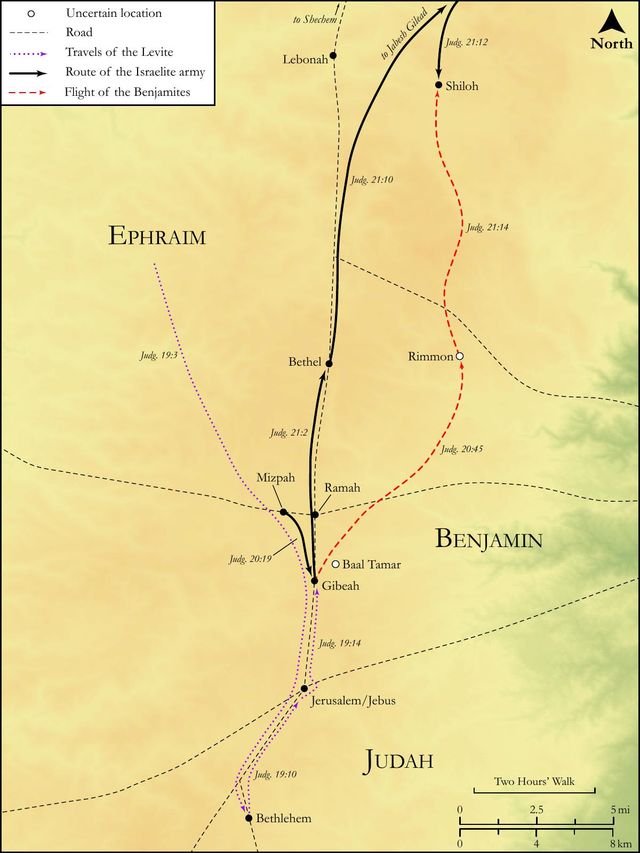
(1.)Observe the method they took. The body of the army faced the city of Gibeah, as they had done before, advancing towards the gates, Jdg 20:30. The Benjamites, the body of whose army was now quartered at Gibeah, sallied out upon them, and charged them with great bravery. The besiegers gave back. retired with precipitation, as if their hearts failed them upon the sight of the Benjamites, which they were willing to believe, proudly imagining that by their former success they had made themselves very formidable. Some loss the Israelites sustained in this counterfeit flight, about thirty men being cut off in their rear, Jdg 20:31, Jdg 20:39. But, when the Benjamites were all drawn out of the city, the ambush seized the city (Jdg 20:37), gave a signal to the body of the army (Jdg 20:38, Jdg 20:40), which immediately turned upon them (Jdg 20:41), and, it should seem, another considerable party that was posted at Baal-tamar came upon them at the same time (Jdg 20:33); so that the Benjamites were quite surrounded, which put them into the greatest consternation that could be. A sense of guilt now disheartened them, and the higher their hopes had been raised the more grievous was this confusion. At first the battle was sore (Jdg 20:34), the Benjamites fought with fury; but, when they saw what a snare they were drawn into, they thought one pair of heels (as we say) was worth two pair of hands, and they made the best of their way towards the wilderness (Jdg 20:42); but in vain: the battle overtook them, and, to complete their distress, those who came out of the cities of Israel, that waited to see the event of the battle, joined with their pursuers, and helped to cut them off. Every man's hand was against them.
(2.)Observe in this story,
[1.]That the Benjamites, in the beginning of the battle, were confident that the day was their own: They are smitten down before us, Jdg 20:32, Jdg 20:39. Sometimes God suffers wicked men to be lifted up in successes and hopes, that their fall may be the sorer. See how short their joy is, and their triumphing but for a moment. Let not him that girdeth on the harness boast, except he has reason to boast in God.
[2.]Evil was near them and they did not know it, Jdg 20:34. But (Jdg 20:41) they saw, when it was too late to prevent it, that evil had come upon them. What evils may at any time be near us we cannot tell, but the less they are feared the heavier they fall. Sinners will not be persuaded to see evil near them, but how dreadful will it be when it comes and there is no escaping! Th1 5:3.
[3.]Though the men of Israel played their parts so well in this engagement, yet the victory is ascribed to God (Jdg 20:35): The Lord smote Benjamin before Israel. The battle was his, and so was the success.
[4.]They trode down the men of Benjamin with ease when God fought against them, Jdg 20:43. It is an easy thing to trample upon those who have made God their enemy. See Mal 4:3.
II.How the victory was prosecuted and improved in a military execution done upon these sinners against their own souls.
1.Gibeah itself, that nest of lewdness, was destroyed in the first place. The ambush that entered the city by surprise drew themselves along, that is, dispersed themselves into the several parts of it, which they might easily do, now that all the men of war had sallied out and very presumptuously left it defenceless; and they smote all they found, even women and children, with the sword (Jdg 20:37), and set fire to the city, Jdg 20:40. Sin brings ruin upon cities.
2.The army in the field was quite routed and cut off: 18,000 men of valour lay dead upon the spot, Jdg 20:44.
3.Those that escaped from the field were pursued, and cut off in their flight, to the number of 7000, Jdg 20:45. It is to no purpose to think of out-running divine vengeance. Evil pursues sinners, and it will overtake them.
4.Even those that tarried at home were involved in the ruin. They let their sword devour for ever, not considering that it would be bitterness in the latter end, as Abner pleads long after, when he was at the head of an army of Benjamites, probably with an eye to this very story, Sa2 2:25, Sa2 2:26. They put to the sword all that breathed, and set fire to all the cities, Jdg 20:48. So that of all the tribe of Benjamin, for aught that appears, there remained none alive but 600 men that took shelter in the rock Rimmon, and lay close there four months, Jdg 20:47. Now,
(1.)It is difficult to justify this severity as it was Israel's act. The whole tribe of Benjamin was culpable; but must they therefore be treated as devoted Canaanites? That it was done in the heat of war, that this was the way of prosecuting victories which the sword of Israel had been accustomed to, that the Israelites were extremely exasperated against the Benjamites for the slaughter they had made among them in the two former engagements, will go but a little way to excuse the cruelty of this execution. It is true they had sworn that whosoever did not come up to Mizpeh should be put to death, Jdg 21:5. But that, if it was a justifiable oath, yet extended only to the men of war; the rest were not expected to come. Yet,
(2.)It is easy to justify the hand of God in it. Benjamin had sinner against him, and God had threatened that, if they forgot him, they should perish as the nations that were before them perished (Deu 8:20), who were all in this manner cut off.
(3.)It is easy likewise to improve it for warning against the beginnings of sin: they are like the letting forth of water, therefore leave it off before it be meddled with, for we know not what will be in the end thereof. The eternal ruin of souls will be worse, and more fearful, than all these desolations of a tribe. This affair of Gibeah is twice spoken of by the prophet Hosea as the beginning of the corruption of Israel and a pattern to all that followed (Hos 9:9): They have deeply corrupted themselves as in the days of Gibeah; and (Hos 10:9), Thou hast sinned from the days of Gibeah; and it is added that the battle in Gibeah against the children of iniquity did not (that is, did not at first) overtake them.
Continue studying Judges 20:32 across the web’s major study libraries — every link below opens this exact verse, chapter, or book on the destination site.
Read & Compare
 BibleGatewayThis verse in more than 200 translations and 70 languages.
 Bible.comThe YouVersion reader — hundreds of translations, reading plans, and highlights.
 ESV.orgCrossway's official English Standard Version reader.
 NET BibleThe NET translation with 60,000+ translators' notes on every rendering decision.
 STEP BibleTyndale House's free study tool — original text, vocabulary, and scholarly resources.
 BibliaLogos Bible Software's free web reader.
 USCCBThe New American Bible (Revised Edition) with the U.S. bishops' study notes.
Commentaries
 BibleHub CommentariesDozens of classic commentaries on this verse, gathered on one page.
 StudyLightMore than 100 commentary sets — the largest collection on the web.
 BibleRefPlain-English commentary on what this verse means, verse by verse.
 Enduring WordDavid Guzik's free commentary on this chapter, widely used by Bible teachers.
 Bible Study ToolsVerse commentary alongside Greek and Hebrew study aids.
Original Language & Research
- BibleHub InterlinearThe verse word by word — original language, transliteration, and English.
- BibleHub LexiconEvery word's original-language definition and Strong's entry.
 Blue Letter BibleDeep-study tools — Strong's numbers, concordance, and word studies.
 SefariaThe Hebrew text with Rashi and centuries of Jewish commentary.
Sermons, Hymns & Audio


TrulyRandomVerse is not affiliated with these sites and doesn’t control their content. They’re linked because they’re genuinely useful.
Summary
Judges 20:32 marks a pivotal moment in the devastating civil war between the tribes of Israel and Benjamin. Following two initial, humiliating defeats for Israel, this verse captures Benjamin's overconfident declaration of continued victory, based on their past successes. Simultaneously, it reveals Israel's strategic shift to a feigned retreat, a calculated maneuver designed to lure the Benjamites away from the fortified city of Gibeah and into a pre-planned ambush on the open highways, setting the stage for Benjamin's decisive downfall.
Context
ShowHideLiterary Context
This verse is deeply embedded within the grim narrative of Judges 19-21, which recounts one of the darkest periods in Israel's history—a civil war sparked by the horrific crime committed against a Levite's concubine in Gibeah of Benjamin. The preceding chapters detail Israel's initial, righteous indignation and their subsequent, divinely sanctioned (Judges 20:18, Judges 20:23) but militarily disastrous attempts to bring justice against Benjamin. Israel had suffered staggering losses on two consecutive days (Judges 20:21, Judges 20:25), leading to deep repentance and desperate prayer before the Lord. Judges 20:32 introduces the third and decisive phase of the battle, where Israel, having learned from their failures and sought God's guidance, employs a sophisticated tactical deception that ultimately leads to Benjamin's near-annihilation.
Historical & Cultural Context
The events of Judges 20 unfold during the turbulent period of the Judges, a time characterized by spiritual apostasy, moral decay, and political fragmentation, famously summarized by the refrain, "In those days there was no king in Israel; everyone did what was right in his own eyes" (Judges 21:25). Warfare in ancient Israel often involved siege tactics against fortified cities like Gibeah, as well as open-field engagements. Military strategies commonly included direct assault, but also cunning maneuvers such as ambushes and feigned retreats, as seen in Joshua's conquest of Ai (Joshua 8). The Benjamites were renowned for their skilled slingers and fierce fighting prowess (Judges 20:16), which contributed to their initial successes and subsequent overconfidence. The "highways" mentioned refer to the main roads or thoroughfares outside the city, providing the ideal terrain for Israel's planned ambush.
Key Themes
ShowHideThis verse powerfully illustrates several key themes prevalent in the book of Judges and broader biblical narrative. Firstly, it highlights the danger of overconfidence and hubris, as the Benjamites, emboldened by their previous victories, declare, "They [are] smitten down before us, as at the first." This arrogance blinds them to the possibility of a strategic shift from the Israelites, serving as a classic example of how pride often precedes a fall. Secondly, it showcases strategic deception in warfare, as the children of Israel consciously employ a feigned retreat to lure their enemy into a trap. This demonstrates the use of cunning and careful planning as legitimate, albeit morally complex, military tactics in ancient times. Thirdly, the broader narrative of the civil war underscores the theme of divine judgment and perseverance. Despite Israel's initial setbacks, their persistence and eventual victory, guided by God, ultimately served as a form of divine judgment against Benjamin for their unrepentant sin and the heinous crime committed within their territory (Judges 20:13).
Exposition and Analysis
ShowHideKey Word Analysis
ShowHideFrom a primitive root meaning "to push, gore, defeat, stub (the toe), inflict (a disease); beat, dash, hurt, plague, slay, smite (down), strike, stumble, put to the worse." In this context, it signifies a decisive military defeat. The Benjamites use this term to express their belief that they have completely routed the Israelites, just as they had done on the previous two days, implying a total and irreversible victory. Their use of this word reveals their profound confidence, bordering on arrogance, in their perceived military superiority.
From a root meaning "first, in place, time or rank; ancestor, before(-time), beginning, eldest, fore(-father) (-most), former (thing), of old time, past." This term directly refers to the two prior engagements where the Benjamites had inflicted heavy casualties upon the Israelites (Judges 20:21, Judges 20:25). It encapsulates Benjamin's overconfidence and their fatal failure to anticipate a change in Israel's tactics. They assume the pattern of battle will repeat itself, leading them directly into the Israelite trap.
From a root meaning "a thoroughfare (as turnpiked), literally or figuratively; specifically a viaduct, a staircase; causeway, course, highway, path, terrace." The significance here is that these "highways" are open, public roads located outside the fortified city of Gibeah. By luring the Benjamites onto these open roads, Israel draws them away from the protective walls and strategic advantages of their city, making them vulnerable to the ambush forces that Israel had positioned.
Verse Breakdown
ShowHide"And the children of Benjamin said, They [are] smitten down before us, as at the first."
This clause captures the Benjamites' arrogant response to Israel's feigned retreat. Having twice defeated the numerically superior Israelite army, they are filled with overconfidence and hubris. They interpret Israel's withdrawal as a sign of weakness and a simple repeat of their previous victories, failing to discern the strategic deception at play. This arrogance prevents them from exercising caution or re-evaluating the situation, leading them to pursue the retreating Israelites with reckless abandon, sealing their own doom.
"But the children of Israel said, Let us flee, and draw them from the city unto the highways."
This clause reveals the calculated and deceptive strategy of the Israelite forces. After two devastating defeats and a period of intense repentance and renewed commitment to God, Israel has devised a new plan. Their "fleeing" is not a genuine retreat but a tactical maneuver designed to lure the Benjamites into a pre-arranged ambush. The explicit goal is to draw the Benjamites out of the defensive stronghold of Gibeah and onto the open "highways," where hidden Israelite forces (mentioned in subsequent verses, e.g., Judges 20:34) are waiting to spring the trap, ensuring a decisive victory and the execution of divine judgment.
Literary Devices
ShowHideJudges 20:32 effectively employs several literary devices to heighten the drama and underscore the narrative's themes. Irony is profoundly prominent, as Benjamin's confident declaration, "as at the first," directly precedes their ultimate and devastating defeat, making their perceived victory a tragic prelude to their downfall. This creates a powerful sense of dramatic foreshadowing, indicating that the tide of battle is about to turn decisively against Benjamin. There is also a clear contrast between Benjamin's overconfident, almost boastful, pronouncement and Israel's quiet, calculated, and deceptive strategy. This highlights the stark difference in their states of mind and tactical approaches, emphasizing Benjamin's blindness and Israel's newfound cunning. The verse also masterfully builds significant dramatic tension, setting the stage for the climactic battle that will determine the fate of the tribe of Benjamin.
Theological and Thematic Connections
ShowHideJudges 20:32, though detailing a military tactic, resonates with profound theological and thematic truths. The Benjamites' overconfidence, rooted in past successes and a failure to seek divine counsel, serves as a stark warning against spiritual pride, a recurring theme in Scripture. Their inability to discern Israel's deception highlights how arrogance can blind individuals and communities to reality, making them vulnerable to downfall. Conversely, Israel's willingness to learn from failure, adapt their strategy, and seek divine guidance after two crushing defeats underscores the importance of perseverance, humility, and strategic wisdom in the face of adversity. The entire narrative of Judges 19-21, culminating in this strategic battle, is a grim testament to the devastating consequences of unchecked sin and moral decay within God's covenant people, illustrating how societal corruption can lead to internal strife and near-annihilation, even among those called by God's name.
Reflection and Application
ShowHideThe strategic turning point in Judges 20:32 offers timeless lessons for our spiritual and daily lives. Benjamin's overconfidence serves as a potent reminder for us to guard against spiritual pride, which can blind us to our weaknesses, prevent us from seeking wise counsel, and make us susceptible to the enemy's schemes. Success, whether in ministry, personal growth, or professional life, must always be met with humility and a continued reliance on God. Furthermore, Israel's willingness to adapt their strategy after repeated failures teaches us the vital importance of learning from our mistakes. Perseverance in faith does not always mean stubbornly repeating the same actions; sometimes, it requires a humble re-evaluation, a change in approach, and a renewed seeking of God's wisdom and direction. The broader context of the Benjamite civil war also underscores the devastating impact of unaddressed sin, both individually and communally. Just as Gibeah's wickedness brought judgment upon Benjamin, so too can unrepentant sin lead to chaos and destruction in our lives and communities, highlighting the constant need for repentance, justice, and adherence to God's righteous standards.
Questions for Reflection
ShowHideFAQ
ShowHideWhy did Israel suffer two defeats before finally winning?
ShowHideIsrael's initial defeats in Judges 20:21 and Judges 20:25 served multiple profound purposes within the divine narrative. Firstly, they highlighted the severity of Benjamin's unrepentant sin and the depth of Israel's own moral compromise, demonstrating that victory was not guaranteed simply by numerical superiority or even by initial divine permission to fight. It was a humbling experience for the united tribes, preventing them from attributing victory solely to their own might. Secondly, these defeats drove Israel to deeper repentance, renewed prayer, and more fervent inquiry before the Lord (Judges 20:23, Judges 20:26-28), ensuring that their ultimate victory would be recognized as God's doing, not merely their own strategic brilliance. The setbacks forced them to adapt their tactics, leading to the strategic deception seen in Judges 20:32, which ultimately brought about the decisive judgment against Benjamin.
Is it ethical for Israel to use deception in warfare, as seen in this verse?
ShowHideThe Bible records instances of deception being employed in warfare by God's people, such as Joshua's feigned retreat at Ai (Joshua 8) or Rahab's deception to protect the Israelite spies (Joshua 2). While modern ethical frameworks might question such tactics, in the context of ancient warfare, deception was a common and often accepted military strategy. The biblical narrative does not condemn Israel for using this tactic in Judges 20:32; rather, it highlights their strategic shift and Benjamin's folly in falling for it. The primary focus of the text is on the outcome of divine judgment against Benjamin's unrepentant wickedness and the restoration of a measure of order, not on a detailed moral analysis of every military maneuver. The narrative presents the events as they unfolded, demonstrating God's sovereign hand working through human actions, even complex ones, to achieve His purposes.
Christ-Centered Fulfillment
ShowHideThe events of Judges 20:32, particularly Benjamin's overconfidence and Israel's strategic "fleeing" leading to victory, find profound Christ-centered fulfillment. Benjamin's hubris, which leads to their downfall, serves as a stark Old Testament shadow of the spiritual pride that ultimately leads to destruction, a fate averted only by the humility of Christ. Jesus, the true Israel, did not "flee" from His mission but embraced it, appearing to be "smitten down" and defeated on the cross (Isaiah 53:5), yet through this apparent weakness and death, He achieved the ultimate victory over sin, death, and the powers of darkness (Colossians 2:15). While Israel's deception was a human military tactic, it subtly points to a greater divine strategy where God often works through what appears to be weakness or defeat to achieve His ultimate, glorious purposes. The judgment against Benjamin for their deep-seated sin foreshadows the ultimate judgment against all sin that Christ bore on the cross, becoming sin for us so that we might become the righteousness of God in Him (2 Corinthians 5:21). The chaos and moral decay of the Judges era, where "every man did what was right in his own eyes" (Judges 21:25), powerfully underscores humanity's desperate need for a true, righteous King—a need perfectly fulfilled in Jesus Christ, who reigns eternally to bring order, justice, and salvation to His people (Revelation 19:16).