


2 Kings 4:17
- וַתַּהַרva·Ta·harand she conceivedH2029Conj-w ¦ V-Qal-ConsecImperf-3fsVerb Qal Consecutive Imperfect 3rd Singular Feminineוַandתַּהַרshe conceived
- הָאִשָּׁהha·'i·Shahthe womanH802Art ¦ N-fsNoun Singular Feminine Absoluteהָtheאִשָּׁהwoman
- וַתֵּלֶדva·Te·ledand she gave birth toH3205Conj-w ¦ V-Qal-ConsecImperf-3fsVerb Qal Consecutive Imperfect 3rd Singular Feminineוַandתֵּלֶדshe gave birth to
- בֵּןBena sonH1121N-msNoun Singular Masculine Absolute
- לַמּוֹעֵדla·mo·'Edto the appointed timeH4150Prep-l ¦ N-msNoun Singular Masculine Absoluteלַto theמּוֹעֵדappointed time
- הַזֶּהha·Zeh<the> thisH2088Art ¦ PrtParticle Demonstrativeהַ<the>זֶּהthis
- כָּעֵתka·'Etabout the timeH6256Prep-k ¦ N-csNoun Singular common gender Absoluteכָּabout theעֵתtime
- חַיָּהchai·YahlivingH2416Adj-fsAdjective Singular Feminine Absolute
- אֲשֶׁר'a·SherwhichH834RelParticle Relative
- דִּבֶּרdi·Berhe had spokenH1696V-Piel-Perf-3msVerb Piel Perfect 3rd Singular Masculine
- אֵלֶיהָ'e·Lei·hato herH413Prep ¦ 3fsPrepositionאֵלֶיtoהָher
- אֱלִישָׁע'e·li·Sha'ElishaH477N-proper-mNoun Proper Masculine
English is a literal word-by-word gloss of the Hebrew, not the KJV's wording. Why?
This is the original text the KJV's translators worked from — each Hebrew word with its own literal English meaning in this verse, prepared by scholars at Tyndale House, Cambridge. The KJV translates whole sentences, not word by word, so its wording differs: one Hebrew word can become several English words, and the KJV may choose “the LORD” where the gloss reads “Yahweh”. Both are faithful — they answer different questions. For the KJV's own rendering, switch to the KJV text.
Details
See on the biblical-era map
Study this verse
Public-domain commentary
Matthew Henry
From his Commentary on the Whole Bible. Henry comments on passages, not single verses — this entry covers 2 Kings 4:8–17. His two-level outline is real structure in the source text, so it is rendered as structure.
The giving of a son to such as were old, and had been long childless, was an ancient instance of the divine power and favour, in the case of Abraham, and Isaac, and Manoah, and Elkanah; we find it here among the wonders wrought by Elisha. This was wrought in recompence for the kind entertainment which a good woman gave him, as the promise of a son was given to Abraham when he entertained angels. Observe here,
I.The kindness of the Shunammite woman to Elisha.
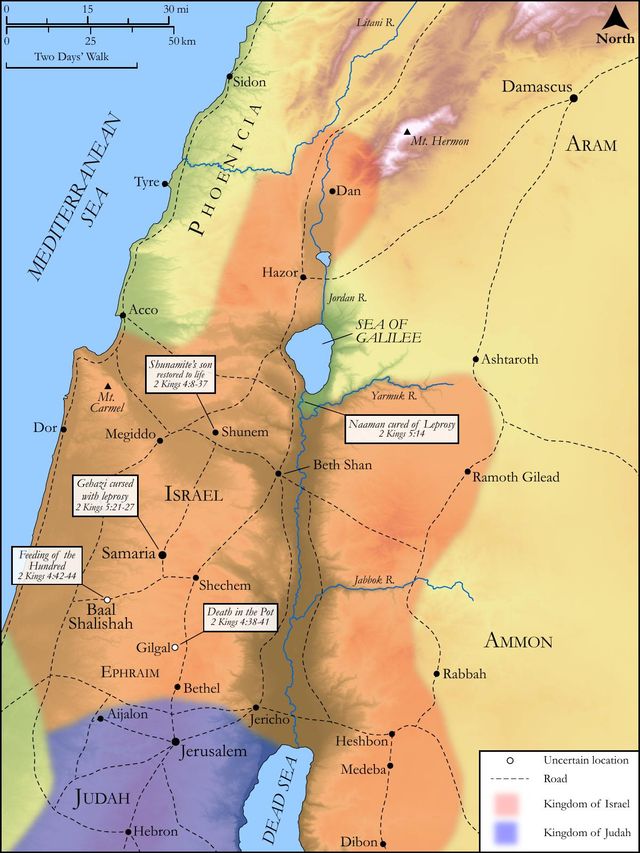
Things are bad enough in Israel, yet not so bad but that God's prophet finds friends, wherever he goes. Shunem was a city in the tribe of Issachar, that lay in the road between Samaria and Carmel, a road that Elisha often travelled, as we find Kg2 2:25. There lived a great woman, who kept a good house, and was very hospitable, her husband having a good estate, and his heart safely trusting in her, and in her discreet management, Pro 31:11. So famous a man as Elisha could not pass and repass unobserved. Probably he had been accustomed to take some private obscure lodgings in the town; but this pious matron, having notice once of his being there, pressed him with great importunity, and, with much difficulty, constrained him to dine with her, Kg2 4:8. He was modest and loth to be troublesome, humble and affected not to associate with those of the first rank; so that it was not without some difficulty that he was first drawn into an acquaintance there; but afterwards, whenever he went that way in his circuit, he constantly called there. So well pleased was she with her guest, and so desirous of his company, that she would not only bid him welcome to her table, but provide a lodging-room for him in her house, that he might make the longer stay, not doubting but her house would be blessed for his sake, and all under her roof edified by his pious instructions and example - a good design, yet she would not do it without acquainting her husband, would neither lay out his money nor invite strangers to his house without his consent asked and obtained, Kg2 4:9, Kg2 4:10. She suggests to him,
1.That the stranger she would invite was a holy man of God, who therefore would do good to their family, and God would recompense the kindness done to him; perhaps she had heard how well paid the widow of Sarepta was for entertaining Elijah.
2.That the kindness she intended him would be no great charge to them; she would build him only a little chamber. Perhaps she had no spare room in the house, or none private and retired enough for him, who spent much of his time in contemplation, and cared not for being disturbed with the noise of the family. The furniture shall be very plain; no costly hangings, no stands, no couches, no looking-glasses, but a bed, and a table, a stool, and a candlestick, all that was needful for his convenience, not only for his repose, but for his study, his reading and writing. Elisha seemed highly pleased with these accommodations, for he turned in and lay there (Kg2 4:11), and, as it should seem, his man in the same chamber, for he was far from taking state.
II.Elisha's gratitude for this kindness.
Being exceedingly pleased with the quietness of his apartment, and the friendliness of his entertainment, he began to consider with himself what recompence he should make her. Those that receive courtesies should study to return them; it ill becomes men of God to be ungrateful, or to sponge upon those that are generous.
1.He offered to use his interest for her in the king's court (Kg2 4:13): Thou hast been careful for us with all this care (thus did he magnify the kindness he received, as those that are humble are accustomed to do, though in the purse of one so rich, and in the breast of one so free, it was as nothing); now what shall be done for thee? As the liberal devise liberal things, so the grateful devise grateful things. "Wouldst thou be spoken for to the king, or the captain of the host, for an office for thy husband, civil or military? Hast thou any complaint to make, any petition to present, any suit at law depending, that needs the countenance of the high powers? Wherein can I serve thee?" It seems Elisha had got such an interest by his late services that, though he chose not to prefer himself by it, yet he was capable of preferring his friends. A good man can take as much pleasure in serving others as in raising himself. But she needs not any good offices of this kind to be done for her: I dwell (says she) among my own people, that is, "We are well off as we are, and do not aim at preferment." It is a happiness to dwell among our own people, that love and respect us, and to whom we are in a capacity of doing good; and a greater happiness to be content to do so, to be easy, and to know when we are well off. Why should those that live comfortably among their own people covet to live delicately in kings' palaces? It would be well with many if they did but know when they were well off. Some years after this we find this Shunammite had occasion to be spoken for to the king, though now she needed it not, Kg2 8:3, Kg2 8:4. Those that dwell among their own people must not think their mountain stands so strong as that it cannot be moved; they may be driven, as this good woman was, to sojourn among strangers. Our continuing city is above.
2.He did use his interest for her in the court of heaven, which was far better. Elisha consulted with his servant what kindness he should do for her, to such a freedom did this great prophet admit even his servant. Gehazi reminded him that she was childless, had a great estate, but no son to leave it to, and was past hopes of having any, her husband being old. If Elisha could obtain this favour from God for her, it would be the removal of that which at present was her only grievance. Those are the most welcome kindnesses which are most suited to our necessities. He sent for her immediately. She very humbly and respectfully stood in the door (Kg2 4:15), according to her accustomed modesty, and then he assured her that within a year she should bring forth a son, Kg2 4:16. She had received this prophet in the name of a prophet, and now she had not a courtier's reward, in being spoken for to the king, but a prophet's reward, a signal mercy given by prophets and in answer to prayer: the promise was a surprise to her, and she begged that she might not be flattered by it: "Nay, my lord, thou are a man of God, and therefore I hope speakest seriously, and doth not jest with me, nor lie unto thy handmaid." The event, within the time limited, confirmed the truth of the promise: She bore a son at the season that Elisha spoke of, Kg2 4:17. God built up her house, in reward to her kindness in building the prophet a chamber. We may well imagine what joy this brought to the family. Sing, O barren! thou that didst not bear.
Historical interpretation
Two Centuries of Reception
2 surviving comments on this verse. Each one is dated, so this reads as a timeline rather than a list.
Select a marker to jump to its quote. Markers stagger vertically where authors wrote within a few decades of each other.
“The woman conceived and bore a son at that season, in due time, as Elisha had declared to her,” but after a few years, the child died. His mother placed the corpse on the bed of the prophet in the high room of her house and then rushed to meet him, blessed him and knelt down at his feet, not in order to make a request but to rebuke him. She said, “Did I ask my lord for a son? Did I not say, ‘Do not mislead your servant?’ ” [“Why did you take me and throw me into the pangs of Eve, when I was free of them, and why did you make death, against which I had risen and for which I had no consideration, reign over me? Indeed, thanks to my unlucky sterility I had been away from those two evils. Because of my fear of death I had not asked you for children, and because of the mockeries of the pagans, among whom I live, I did not desire them. So I have said to you: Do not ask that children be given to me.”]5From her lips she gave reproaches, while with her hands she implored him and, catching hold of his feet, besieged him. She swore she would not leave him until he had given her his grace and had brought back to life her son, which death had grasped. So Elisha was profoundly touched by the words of the woman. [Because he did not suffer so much for the death of the child as for the mockeries he would have been obliged to bear on the part of the prophets of Baal.]
When he saw her suffering and anguish, he immediately sent his disciple, entrusting him with his staff, and told him to lay it on the dead child and to inform him about the results of his ministry. He wanted the resurrection of the dead to happen by means of the staff of the master and the hands of the disciple, if his servant was sufficient for the miracle. If that were not sufficient, he would blame himself, because he had outraged with his laziness the coat of arms of the house of Moses.
After the death of her son, that woman went out and prostrated herself at the feet of holy Elisha, but the blessed man gave his staff to his servant and said to him, “Go, and lay my staff on the face of the child. If anyone salutes you, do not return the greeting.” At this point, brothers, see to it that no wicked thought overtake anyone by saying that blessed Elisha wanted to practice fortune telling and that for this reason he commanded the boy not to return the greeting if anyone should salute him on the way. We read this frequently in Scripture, but it is said for the sake of speed and is not a command of something superfluous or a wicked practice. It means, in effect: Walk so quickly that you may not presume to busy yourself on the way or slow yourself with gossip. Therefore, the servant departed and laid the staff on the face of the child, but the boy did not rise at all. That servant typified blessed Moses, whom God sent into Egypt with a staff; without Christ, Moses could scourge the people with the staff, but he could not free or revive them from original or actual sin. As the apostle says, “For the law brought nothing to perfection.” It was necessary that he who had sent the staff should himself come down. The staff without Elisha availed nothing, because the cross without Christ had no power.
Continue studying 2 Kings 4:17 across the web’s major study libraries — every link below opens this exact verse, chapter, or book on the destination site.
Read & Compare
 BibleGatewayThis verse in more than 200 translations and 70 languages.
 Bible.comThe YouVersion reader — hundreds of translations, reading plans, and highlights.
 ESV.orgCrossway's official English Standard Version reader.
 NET BibleThe NET translation with 60,000+ translators' notes on every rendering decision.
 STEP BibleTyndale House's free study tool — original text, vocabulary, and scholarly resources.
 BibliaLogos Bible Software's free web reader.
 USCCBThe New American Bible (Revised Edition) with the U.S. bishops' study notes.
Commentaries
 BibleHub CommentariesDozens of classic commentaries on this verse, gathered on one page.
 StudyLightMore than 100 commentary sets — the largest collection on the web.
 BibleRefPlain-English commentary on what this verse means, verse by verse.
 Enduring WordDavid Guzik's free commentary on this chapter, widely used by Bible teachers.
 Bible Study ToolsVerse commentary alongside Greek and Hebrew study aids.
Original Language & Research
- BibleHub InterlinearThe verse word by word — original language, transliteration, and English.
- BibleHub LexiconEvery word's original-language definition and Strong's entry.
 Blue Letter BibleDeep-study tools — Strong's numbers, concordance, and word studies.
 SefariaThe Hebrew text with Rashi and centuries of Jewish commentary.
Sermons, Hymns & Audio


TrulyRandomVerse is not affiliated with these sites and doesn’t control their content. They’re linked because they’re genuinely useful.
Summary
Second Kings 4:17 meticulously records the precise and faithful fulfillment of a divine promise, serving as the triumphant culmination of the Shunammite woman's extraordinary hospitality and the prophet Elisha's miraculous intercession. This verse marks the miraculous conception and birth of the son Elisha had prophesied, confirming God's unwavering commitment to His spoken word and His sovereign power to transcend natural limitations, thereby bringing profound joy and life where there was once barrenness and despair.
Context
ShowHideLiterary Context
This verse provides the climactic resolution to the narrative arc introduced in 2 Kings 4:8-16. The preceding verses meticulously detail the Shunammite woman's exceptional generosity in providing a dedicated upper room for Elisha, demonstrating her reverence for God's prophet. Recognizing her selflessness, Elisha, through his servant Gehazi, seeks to bestow a blessing upon her. Upon learning of her childlessness and her husband's advanced age, Elisha boldly declares in 2 Kings 4:16 that "at this season, according to the time of life, thou shalt embrace a son." The woman's initial reaction, a mixture of disbelief and a plea not to be deceived, underscores the human impossibility of the promise. Verse 17 then immediately confirms the miraculous conception and subsequent birth, occurring with precise timing as Elisha had foretold, thereby unequivocally validating the prophet's word and, more importantly, God's omnipotence. This miraculous fulfillment also serves as a crucial precursor to the later, equally astonishing event of the son's resurrection in 2 Kings 4:18-37, further demonstrating the ongoing divine care and miraculous intervention in the life of this favored family.
Historical & Cultural Context
In ancient Israelite society, the ability to bear children, particularly sons, was profoundly valued, considered a direct and tangible blessing from God, signifying continuity, strength, and divine favor. Conversely, barrenness was often a source of deep sorrow, social stigma, and even perceived as a divine curse, as it threatened the very existence of the family line and the inheritance of property. The Shunammite woman's advanced age, coupled with her husband's old age, made natural conception an absolute impossibility, rendering the birth described in 2 Kings 4:17 a profound and undeniable miracle, a clear act of divine intervention. Furthermore, this narrative highlights the significant and authoritative role of prophets like Elisha in Israelite society. They served as God's direct spokespersons, conveying His will, delivering His promises, and performing signs and wonders to authenticate their divine commission and underscore God's active presence among His people. The cultural norm of hospitality, deeply ingrained in the Near East, is also prominently featured, demonstrating that acts of selfless kindness and reverence towards God's servants were often met with extraordinary divine favor and blessing.
Key Themes
ShowHideThe central and most prominent theme in 2 Kings 4:17 is Divine Faithfulness and Promise Fulfillment. God's word, spoken through His chosen prophet, is unequivocally demonstrated to be utterly reliable, true, and effective, even when confronted by seemingly insurmountable human circumstances. This miracle powerfully underscores God's Sovereignty Over Natural Limitations, showcasing His absolute ability to intervene in the natural order of creation and bring forth life where it is humanly impossible. The narrative also subtly, yet significantly, highlights the theme of Divine Blessing for Righteousness and Hospitality, suggesting that the Shunammite woman's selfless devotion, reverence for God's prophet, and generous hospitality were divinely honored with a profound and deeply personal miracle. This event stands in a rich biblical tradition of miraculous births to barren women, echoing the stories of Sarah's conception of Isaac in Genesis 18:10, Hannah's fervent prayer leading to the birth of Samuel in 1 Samuel 1:20, and Elizabeth's conception of John the Baptist in Luke 1:13, thereby reinforcing God's consistent character as the ultimate Giver of life and the fulfiller of His promises.
Exposition and Analysis
ShowHideKey Word Analysis
ShowHideThis primitive root signifies the act of becoming pregnant or being with child. In the context of 2 Kings 4:17, it emphasizes the miraculous nature of the conception, as the Shunammite woman was known to be barren and her husband old. This word points directly to a divine intervention, bypassing natural biological limitations and highlighting God's power to initiate life.
This primitive root means "to bear young" or "to bring forth." This word confirms the successful and full-term delivery of the child, signifying the complete and tangible fulfillment of Elisha's prophecy. It marks the transition from the miraculous conception to the undeniable reality of a new life, a son, entering the world.
This word properly denotes "an appointment," specifically a fixed time or season. In this verse, it precisely conveys the idea of a divinely appointed and specific timing for the birth, directly correlating with Elisha's prophetic declaration. It underscores God's meticulousness and the exactitude with which His promises are fulfilled, not haphazardly but at the precise, predetermined moment.
Verse Breakdown
ShowHide"And the woman conceived"
This opening clause immediately declares the miraculous inception of life. Despite the Shunammite woman's barrenness and advanced age, she became pregnant, an event directly attributable to God's sovereign power and Elisha's prophetic word. It signifies the overcoming of human impossibility by a divine, supernatural act.
"and bare a son"
This confirms the successful and complete outcome of the pregnancy. The birth of a son was the specific blessing promised by Elisha, fulfilling the deep cultural and personal desire for an heir and bringing immense joy, validation, and continuity to the woman and her household.
"at that season that Elisha had said unto her"
This phrase emphatically highlights the precise fulfillment of Elisha's prophecy. It underscores the prophet's divine authority and the absolute accuracy of God's word, demonstrating that God's promises are not vague or conditional, but are brought to pass with perfect, predetermined timing, validating His messenger.
"according to the time of life"
This reiterates and clarifies the exact timing of the fulfillment. It means "at the appointed time next year" or after a full, normal term of pregnancy. This detail underscores God's meticulousness and faithfulness, showing that while the conception was miraculous, the subsequent development and birth occurred within a divinely ordained, orderly biological process, showcasing His power both to initiate and sustain life.
Literary Devices
ShowHideThe verse powerfully employs Fulfillment, as it explicitly states the direct realization of Elisha's prophecy from 2 Kings 4:16. This immediate and undeniable fulfillment serves to validate Elisha's prophetic authority and, more profoundly, the absolute reliability and truthfulness of God's spoken word. There is also a subtle but significant element of Irony, contrasting the Shunammite woman's initial disbelief and plea ("Nay, my lord, thou man of God, do not lie unto thine handmaid") with the undeniable, tangible reality of the miraculous birth. This irony highlights the vast chasm between human skepticism and divine omnipotence. Furthermore, the precise and repeated phrasing "at that season... according to the time of life" emphasizes Divine Precision, showcasing God's meticulous timing and the orderly, unswerving execution of His plans, even in the context of supernatural events.
Theological and Thematic Connections
ShowHideThe miraculous birth of the Shunammite woman's son in 2 Kings 4:17 stands as a profound and enduring testament to God's unwavering faithfulness and His sovereign power over all natural limitations. It vividly illustrates that the Creator is not bound by human biology, advanced age, or any perceived impossibility. What God promises, He unfailingly performs, often in ways that defy human expectation and logic, thereby magnifying His glory and demonstrating His unique authority over life itself. This miracle profoundly underscores the intrinsic value God places on human life, His deep compassion for those who experience barrenness or profound need, and His readiness to bless those who demonstrate genuine hospitality, reverence for His servants, and faith in His word. It serves as a powerful and timeless reminder that God's word is living, active, and inherently capable of bringing forth life and fruitfulness even in the most barren, hopeless, or humanly impossible circumstances.
Reflection and Application
ShowHideThe poignant story of the Shunammite woman and the miraculous birth of her son in 2 Kings 4:17 offers profound encouragement and timeless lessons for believers today. It issues a powerful call for us to cultivate an unwavering trust in God's promises, even when our personal circumstances appear utterly impossible, our hopes have been deferred for a long time, or our faith is challenged by seemingly insurmountable obstacles. Just as God miraculously brought life to a physically barren womb, He possesses the infinite power to bring fruitfulness, breakthrough, and new beginnings into any "barren" area of our lives—be it spiritual stagnation, emotional desolation, relational brokenness, or seemingly intractable challenges. This narrative serves as a potent reminder that God's timing is always perfect, and His faithfulness is absolute, never failing. Our acts of faith, genuine hospitality, and profound reverence for God and His people are never overlooked; on the contrary, they often serve as catalysts, opening doors for divine intervention and blessings far beyond what we could ever ask, imagine, or conceive. We are invited to live with an expectant faith in God's miraculous power, believing wholeheartedly that He is able to do immeasurably more than all that we ask or think, according to His power that is at work within us.
Questions for Reflection
ShowHideFAQ
ShowHideWhat does "according to the time of life" mean in this verse?
ShowHideThe phrase "according to the time of life" (Hebrew: ka'et chayyah) is a precise temporal marker signifying "at this season next year" or "at this appointed time of life." It indicates that while the conception of the son was a profound miracle, the subsequent birth followed a normal, full-term gestation period. This detail emphasizes God's meticulous timing and His orderly working within natural processes, even when performing supernatural acts. It assures the reader that the promise was fulfilled with absolute exactitude and divine precision, not vaguely or haphazardly, underscoring the reliability of God's word.
Why was the birth of this son so significant?
ShowHideThe birth of the son was profoundly significant for multiple reasons. First, it served as an undeniable validation of Elisha's prophetic word, confirming his divine authority and demonstrating that God truly spoke through him. Second, it showcased God's omnipotent power over natural limitations, as the woman was barren and her husband old, rendering natural conception impossible. This miracle powerfully underscored God's ability to bring life where there was none. Third, it was a direct, personal, and deeply cherished blessing to the Shunammite woman, a divine reward for her exceptional hospitality and reverence for God's prophet, bringing immense joy and an heir to a family that had none. It stood as a tangible sign of God's faithfulness to those who honor Him.
Are there other biblical examples of miraculous births to barren women like the Shunammite woman?
ShowHideYes, the Bible contains several prominent and inspiring examples of God miraculously opening barren wombs to bring forth significant individuals, demonstrating His sovereignty over life. These include Sarah, who bore Isaac in her old age as promised in Genesis 18:10; Rebekah, who conceived Jacob and Esau after years of barrenness in Genesis 25:21; Rachel, who finally bore Joseph after a long struggle with barrenness in Genesis 30:22-24; Manoah's wife, who gave birth to Samson as foretold by an angel in Judges 13:3; Hannah, who bore Samuel after fervent prayer and a solemn vow in 1 Samuel 1:20; and Elizabeth, who conceived John the Baptist in her old age as prophesied by Gabriel in Luke 1:13. These narratives collectively highlight God's consistent character as the Giver of life and the faithful fulfiller of His promises, often working through seemingly impossible circumstances.
Christ-Centered Fulfillment
ShowHideThe miraculous birth of the Shunammite woman's son in 2 Kings 4:17 serves as a profound type and shadow of the ultimate and most significant miraculous birth in human history: that of Jesus Christ. Just as God intervened supernaturally to bring life from a physically barren womb, He intervened uniquely in the annals of time, causing a virgin to conceive the Son of God, thereby fulfilling the ancient prophecy of Isaiah 7:14 and powerfully affirmed in Matthew 1:23. Furthermore, the son's birth, a direct fulfillment of Elisha's spoken word, beautifully foreshadows the Incarnation, where the eternal Word of God became flesh and dwelt among us, full of grace and truth (John 1:14). Beyond mere physical birth, this narrative points to the spiritual "birth" that Christ alone makes possible. Just as God brought physical life to a barren situation, Jesus brings spiritual life to those who are spiritually dead and barren in sin, enabling them to be "born again"—not of natural descent, nor of human decision or a husband's will, but born of God (John 1:13; John 3:3-8). The later resurrection of the Shunammite's son by Elisha (2 Kings 4:32-35) is a potent prefigurement of Christ's own resurrection, the ultimate victory over death, which secures newness of life and eternal hope for all who believe and are united with Him (Romans 6:4). Thus, the miraculous birth in 2 Kings 4:17 is a beautiful testament to God's life-giving power, ultimately fulfilled, expanded, and eternally secured in the person and redemptive work of Jesus Christ, the true source of all life—both physical and spiritual.