


2 Kings 4:13
- וַיֹּאמֶרvai·Yo·merand he saidH559Conj-w ¦ V-Qal-ConsecImperf-3msVerb Qal Consecutive Imperfect 3rd Singular Masculineוַandיֹּאמֶרhe said
- לוֹloto himPrep-l ¦ 3msSuffix Personal 3rd Singular Masculineלtoוֹhim
- אֱמָר'e·morsayH559V-Qal-Imp-2msVerb Qal Imperative 2nd Singular Masculine
- נָאna'pleaseH4994PrtParticle Interjection
- אֵלֶיהָ'e·lei·Hato herH413Prep ¦ 3fsPrepositionאֵלֶיtoהָher
- הִנֵּהhi·Nehhere!H2009PrtParticle Interjection
- חָרַדְתְּcha·Radtyou have taken careH2729V-Qal-Perf-2fsVerb Qal Perfect 2nd Singular Feminine
- אֵלֵינוּ'e·lei·Nuto usH413Prep ¦ 1cpPrepositionאֵלֵיtoנוּus
- אֶת'et<obj.>H853DirObjMParticle Object Indicator
- כָּלkolallH3605N-mscNoun Singular Masculine Construct
- הַחֲרָדָהha·cha·ra·Dahthe careH2731Art ¦ N-fsNoun Singular Feminine Absoluteהַtheחֲרָדָהcare
- הַזֹּאתha·zoT<the> thisH2063Art ¦ PrtParticle Demonstrativeהַ<the>זֹּאתthis
- מֶהmehwhat?H4100InterrogPronoun Interrogative
- לַעֲשׂוֹתla·'a·Sot[is] to doH6213Prep-l ¦ V-Qal-InfVerb Qal Infinitive Constructלַ[is] toעֲשׂוֹתdo
- לָךְLakhfor youPrep-l ¦ 2fsSuffix Personal 2nd Singular Feminineלָforךְyou
- הֲיֵשׁha·Yesh¿ [is] thereH3426Interrog ¦ Adj-csAdjective Numerical Singular common gender Absoluteהֲ¿יֵשׁ[is] there
- לְדַבֶּרle·da·berto speakH1696Prep-l ¦ V-Piel-InfVerb Piel Infinitive Constructלְtoדַבֶּרspeak
- לָךְloKhfor youPrep-l ¦ 2fsSuffix Personal 2nd Singular Feminineלָforךְyou
- אֶל'eltoH413PrepPreposition
- הַמֶּלֶךְha·Me·lekhthe kingH4428Art ¦ N-msNoun Singular Masculine Absoluteהַtheמֶּלֶךְking
- אוֹ'oor?H176ConjConjunction
- אֶל'eltoH413PrepPreposition
- שַׂרsar[the] commander ofH8269N-mscNoun Singular Masculine Construct
- הַצָּבָאha·tza·Va'the armyH6635Art ¦ N-msNoun Singular Masculine Absoluteהַtheצָּבָאarmy
- וַתֹּאמֶרva·To·merand she saidH559Conj-w ¦ V-Qal-ConsecImperf-3fsVerb Qal Consecutive Imperfect 3rd Singular Feminineוַandתֹּאמֶרshe said
- בְּתוֹךְbe·Tokhin amongH8432Prep-b ¦ N-mscNoun Singular Masculine Constructבְּinתוֹךְamong
- עַמִּי'a·Mimy own peopleH5971N-msc ¦ 1csNoun Singular Masculine Constructעַמִּown peopleיmy
- אָנֹכִי'a·no·KhiIH595Pro-1csPronoun Personal 1st Singular common gender
- יֹשָׁבֶתyo·Sha·vet[am] dwellingH3427V-Qal-Prtcpl-fsVerb Qal Participle Singular Feminine Absolute
English is a literal word-by-word gloss of the Hebrew, not the KJV's wording. Why?
This is the original text the KJV's translators worked from — each Hebrew word with its own literal English meaning in this verse, prepared by scholars at Tyndale House, Cambridge. The KJV translates whole sentences, not word by word, so its wording differs: one Hebrew word can become several English words, and the KJV may choose “the LORD” where the gloss reads “Yahweh”. Both are faithful — they answer different questions. For the KJV's own rendering, switch to the KJV text.
Details
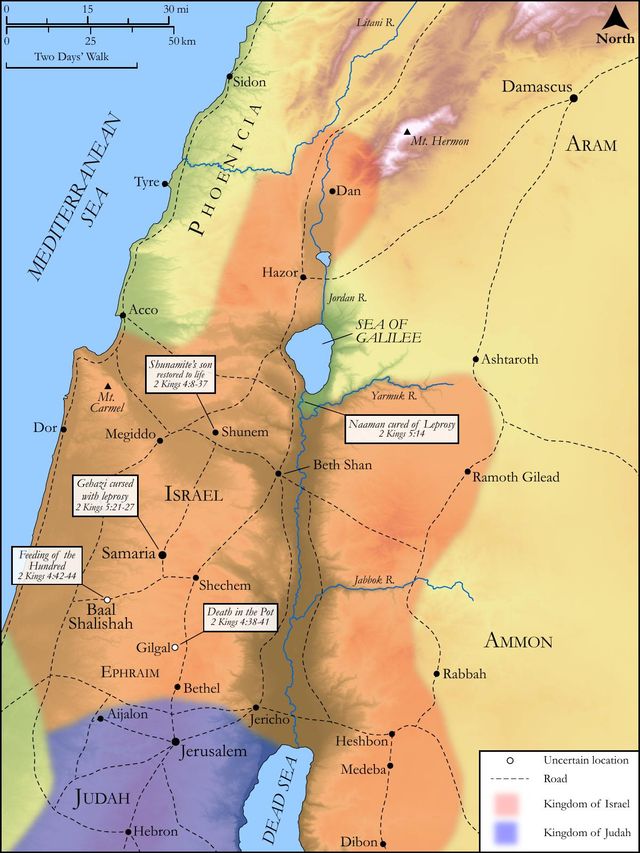
See on the biblical-era map
Study this verse
Public-domain commentary
Matthew Henry
From his Commentary on the Whole Bible. Henry comments on passages, not single verses — this entry covers 2 Kings 4:8–17. His two-level outline is real structure in the source text, so it is rendered as structure.
The giving of a son to such as were old, and had been long childless, was an ancient instance of the divine power and favour, in the case of Abraham, and Isaac, and Manoah, and Elkanah; we find it here among the wonders wrought by Elisha. This was wrought in recompence for the kind entertainment which a good woman gave him, as the promise of a son was given to Abraham when he entertained angels. Observe here,
I.The kindness of the Shunammite woman to Elisha.
Things are bad enough in Israel, yet not so bad but that God's prophet finds friends, wherever he goes. Shunem was a city in the tribe of Issachar, that lay in the road between Samaria and Carmel, a road that Elisha often travelled, as we find Kg2 2:25. There lived a great woman, who kept a good house, and was very hospitable, her husband having a good estate, and his heart safely trusting in her, and in her discreet management, Pro 31:11. So famous a man as Elisha could not pass and repass unobserved. Probably he had been accustomed to take some private obscure lodgings in the town; but this pious matron, having notice once of his being there, pressed him with great importunity, and, with much difficulty, constrained him to dine with her, Kg2 4:8. He was modest and loth to be troublesome, humble and affected not to associate with those of the first rank; so that it was not without some difficulty that he was first drawn into an acquaintance there; but afterwards, whenever he went that way in his circuit, he constantly called there. So well pleased was she with her guest, and so desirous of his company, that she would not only bid him welcome to her table, but provide a lodging-room for him in her house, that he might make the longer stay, not doubting but her house would be blessed for his sake, and all under her roof edified by his pious instructions and example - a good design, yet she would not do it without acquainting her husband, would neither lay out his money nor invite strangers to his house without his consent asked and obtained, Kg2 4:9, Kg2 4:10. She suggests to him,
1.That the stranger she would invite was a holy man of God, who therefore would do good to their family, and God would recompense the kindness done to him; perhaps she had heard how well paid the widow of Sarepta was for entertaining Elijah.
2.That the kindness she intended him would be no great charge to them; she would build him only a little chamber. Perhaps she had no spare room in the house, or none private and retired enough for him, who spent much of his time in contemplation, and cared not for being disturbed with the noise of the family. The furniture shall be very plain; no costly hangings, no stands, no couches, no looking-glasses, but a bed, and a table, a stool, and a candlestick, all that was needful for his convenience, not only for his repose, but for his study, his reading and writing. Elisha seemed highly pleased with these accommodations, for he turned in and lay there (Kg2 4:11), and, as it should seem, his man in the same chamber, for he was far from taking state.
II.Elisha's gratitude for this kindness.
Being exceedingly pleased with the quietness of his apartment, and the friendliness of his entertainment, he began to consider with himself what recompence he should make her. Those that receive courtesies should study to return them; it ill becomes men of God to be ungrateful, or to sponge upon those that are generous.
1.He offered to use his interest for her in the king's court (Kg2 4:13): Thou hast been careful for us with all this care (thus did he magnify the kindness he received, as those that are humble are accustomed to do, though in the purse of one so rich, and in the breast of one so free, it was as nothing); now what shall be done for thee? As the liberal devise liberal things, so the grateful devise grateful things. "Wouldst thou be spoken for to the king, or the captain of the host, for an office for thy husband, civil or military? Hast thou any complaint to make, any petition to present, any suit at law depending, that needs the countenance of the high powers? Wherein can I serve thee?" It seems Elisha had got such an interest by his late services that, though he chose not to prefer himself by it, yet he was capable of preferring his friends. A good man can take as much pleasure in serving others as in raising himself. But she needs not any good offices of this kind to be done for her: I dwell (says she) among my own people, that is, "We are well off as we are, and do not aim at preferment." It is a happiness to dwell among our own people, that love and respect us, and to whom we are in a capacity of doing good; and a greater happiness to be content to do so, to be easy, and to know when we are well off. Why should those that live comfortably among their own people covet to live delicately in kings' palaces? It would be well with many if they did but know when they were well off. Some years after this we find this Shunammite had occasion to be spoken for to the king, though now she needed it not, Kg2 8:3, Kg2 8:4. Those that dwell among their own people must not think their mountain stands so strong as that it cannot be moved; they may be driven, as this good woman was, to sojourn among strangers. Our continuing city is above.
2.He did use his interest for her in the court of heaven, which was far better. Elisha consulted with his servant what kindness he should do for her, to such a freedom did this great prophet admit even his servant. Gehazi reminded him that she was childless, had a great estate, but no son to leave it to, and was past hopes of having any, her husband being old. If Elisha could obtain this favour from God for her, it would be the removal of that which at present was her only grievance. Those are the most welcome kindnesses which are most suited to our necessities. He sent for her immediately. She very humbly and respectfully stood in the door (Kg2 4:15), according to her accustomed modesty, and then he assured her that within a year she should bring forth a son, Kg2 4:16. She had received this prophet in the name of a prophet, and now she had not a courtier's reward, in being spoken for to the king, but a prophet's reward, a signal mercy given by prophets and in answer to prayer: the promise was a surprise to her, and she begged that she might not be flattered by it: "Nay, my lord, thou are a man of God, and therefore I hope speakest seriously, and doth not jest with me, nor lie unto thy handmaid." The event, within the time limited, confirmed the truth of the promise: She bore a son at the season that Elisha spoke of, Kg2 4:17. God built up her house, in reward to her kindness in building the prophet a chamber. We may well imagine what joy this brought to the family. Sing, O barren! thou that didst not bear.
Continue studying 2 Kings 4:13 across the web’s major study libraries — every link below opens this exact verse, chapter, or book on the destination site.
Read & Compare
 BibleGatewayThis verse in more than 200 translations and 70 languages.
 Bible.comThe YouVersion reader — hundreds of translations, reading plans, and highlights.
 ESV.orgCrossway's official English Standard Version reader.
 NET BibleThe NET translation with 60,000+ translators' notes on every rendering decision.
 STEP BibleTyndale House's free study tool — original text, vocabulary, and scholarly resources.
 BibliaLogos Bible Software's free web reader.
 USCCBThe New American Bible (Revised Edition) with the U.S. bishops' study notes.
Commentaries
 BibleHub CommentariesDozens of classic commentaries on this verse, gathered on one page.
 StudyLightMore than 100 commentary sets — the largest collection on the web.
 BibleRefPlain-English commentary on what this verse means, verse by verse.
 Enduring WordDavid Guzik's free commentary on this chapter, widely used by Bible teachers.
 Bible Study ToolsVerse commentary alongside Greek and Hebrew study aids.
Original Language & Research
- BibleHub InterlinearThe verse word by word — original language, transliteration, and English.
- BibleHub LexiconEvery word's original-language definition and Strong's entry.
 Blue Letter BibleDeep-study tools — Strong's numbers, concordance, and word studies.
 SefariaThe Hebrew text with Rashi and centuries of Jewish commentary.
Sermons, Hymns & Audio


TrulyRandomVerse is not affiliated with these sites and doesn’t control their content. They’re linked because they’re genuinely useful.
Summary
Second Kings 4:13 captures a pivotal exchange between the prophet Elisha and the Shunammite woman, revealing profound spiritual insights into divine initiative and human contentment. Moved by her exceptional and consistent hospitality, Elisha seeks to reciprocate, offering to intercede on her behalf with the highest earthly authorities—the king or the captain of the host. Her remarkable and concise reply, "I dwell among mine own people," serves as a powerful declaration of her deep satisfaction, security, and lack of worldly ambition, setting the stage for a miraculous divine blessing that transcends human influence and was neither anticipated nor requested.
Context
ShowHideLiterary Context
This verse is strategically placed within a series of miraculous accounts that underscore Elisha's prophetic authority and God's active involvement in the lives of His faithful servants. The immediate narrative preceding 2 Kings 4:13 details the Shunammite woman's extraordinary generosity in providing a dedicated "prophet's chamber" for Elisha's use whenever he passed through Shunem, a gesture of profound respect and selfless service (2 Kings 4:8-10). Elisha, recognizing the depth of her kindness, feels compelled to respond. He first sends his servant Gehazi to inquire about her needs (2 Kings 4:12), and then directly offers his powerful intercession with the highest echelons of society. Her response in 2 Kings 4:13 is a crucial turning point, revealing her character and paving the way for the subsequent, unasked-for divine blessing: the promise and miraculous birth of a son, which unfolds in 2 Kings 4:14-17.
Historical & Cultural Context
In ancient Israelite society, direct access to the reigning monarch (the "king") or high-ranking military officials (the "captain of the host") was an extraordinary privilege, typically reserved for the elite, those with significant political influence, or individuals presenting urgent legal or social grievances. Such connections were invaluable for resolving disputes, securing justice, gaining political favors, or ensuring protection from oppression. For a woman, especially, direct audience with such figures would be exceedingly rare, usually requiring mediation through a male relative or a highly respected figure like a prophet. The Shunammite woman is explicitly identified as a "wealthy woman" or "great woman" (2 Kings 4:8), indicating her established social standing, likely including land ownership and a secure position within her community. Her reply, "I dwell among mine own people," was not merely a geographical statement but a profound declaration of her secure, integrated, and self-sufficient status within her family and communal network, implying that she had no outstanding needs or vulnerabilities requiring external, high-level intervention.
Key Themes
ShowHideThe narrative of the Shunammite woman, particularly the exchange in 2 Kings 4:13, powerfully illuminates several profound theological and narrative themes. Firstly, it highlights contentment and security rooted in God's provision. The woman's expression of satisfaction with her current circumstances, rather than seeking worldly advancement or influence, stands in stark contrast to typical human ambition. This emphasizes a deep trust in her established life and God's sufficiency. Secondly, the passage underscores the theme of divine initiative and unmerited grace. Because she sought nothing for herself from human sources, God, through Elisha, initiated a miraculous provision far beyond human connections—the promise of a son, addressing her barrenness, a significant sorrow in that culture (2 Kings 4:14-17). This demonstrates God's propensity to bless those who are faithful and content, often exceeding their expectations and desires. Finally, the story subtly explores the theme of reciprocity in divine service, illustrating that genuine acts of generosity and hospitality towards God's servants do not go unnoticed and are often met with blessings that far exceed the original kindness.
Exposition and Analysis
ShowHideKey Word Analysis
ShowHideThis feminine noun derives from the root chârad (H2729), meaning "to shudder with terror," "to fear," or "to hasten with anxiety." In this context, chărâdâh signifies a deep, anxious, and meticulous concern or care. Elisha uses this word to acknowledge the Shunammite woman's thorough, thoughtful, and sustained effort in providing for him, highlighting the depth and earnestness of her hospitality. It suggests a level of attentiveness that went beyond mere duty, implying a genuine and perhaps even anxious desire to ensure his comfort and well-being.
This primitive root means "to sit down," "to remain," or "to inhabit." In the Shunammite woman's response, yâshab conveys a sense of settled, stable, and established existence. It implies that she is not a transient, a sojourner, or one in an unstable social position. Her dwelling is secure, indicating a deep sense of belonging and permanence within her community. This is not merely a physical location but a state of being firmly rooted and content.
This noun refers to "a people" as a congregated unit, specifically a tribe or a collective body of individuals. When the Shunammite woman declares, "I dwell among mine own people," ʻam emphasizes her integration within her family, clan, and local community. It underscores her social and familial support network, implying that her needs are met through these existing relationships and that she possesses a respected and secure standing among those who know her best. This collective "people" provides her with all the security and resources she requires, negating the need for external, higher authority.
Verse Breakdown
ShowHide"And he said unto him, Say now unto her, Behold, thou hast been careful for us with all this care;"
Elisha, communicating through his servant Gehazi, expresses profound gratitude and acknowledgment of the Shunammite woman's exceptional and consistent hospitality. The phrase "careful for us with all this care" (using the Hebrew chărâdâh) underscores the meticulousness, thoughtfulness, and sustained nature of her generosity, particularly in preparing and maintaining a dedicated lodging for him. This opening sets a tone of deep appreciation and highlights the prophet's earnest desire to reciprocate her selfless service.
"what [is] to be done for thee?"
This is Elisha's direct and open-ended offer of assistance, inviting the Shunammite woman to articulate any need or desire she might have. It signifies his recognition of her kindness and his willingness to leverage his spiritual authority and social influence on her behalf. This broad question emphasizes the sincerity of his intent to bless her and the depth of his appreciation.
"wouldest thou be spoken for to the king, or to the captain of the host?"
Elisha specifies the highest levels of human authority he can access, demonstrating the significant extent of his influence and the magnitude of the favor he is offering. Being "spoken for" to the king or the military commander (sar tsâbâʼ) could address legal grievances, secure property rights, gain social standing, or provide protection from injustice. This offer highlights the practical power and influence a prophet of God could wield in ancient society, offering a pathway to resolve any conceivable problem.
"And she answered, I dwell among mine own people."
This is the pivotal and profound response that reveals the Shunammite woman's character. Her declaration, "I dwell among mine own people" (b'tokh ammi ani yoshavet), signifies her deep contentment, security, and lack of desire for external intervention or worldly advancement. She is not seeking political leverage, social climbing, or material gain. She is satisfied with her established place within her family and community, implying that all her present needs are met and she feels safe, provided for, and respected without the need for royal or military patronage. This profound contentment sets the stage for God's unasked-for, miraculous blessing, which transcends any human connection.
Literary Devices
ShowHideThe passage masterfully employs several effective Literary Devices. The most prominent is Dialogue, which directly reveals the motivations, character, and spiritual posture of both Elisha and the Shunammite woman. Elisha's direct question, "what [is] to be done for thee?", highlights his gratitude and desire to act, while the Shunammite woman's concise and profound reply, "I dwell among mine own people," powerfully conveys her contentment, humility, and disinterest in worldly power or influence. There is also a subtle but significant Contrast or Irony at play; Elisha offers the highest forms of human power and influence (the king, the captain of the host), yet the woman's response reveals that her true security and satisfaction come not from external political connections but from her established place within her community and, implicitly, God's providence. This striking contrast serves as a powerful Foreshadowing of divine intervention; precisely because she asks for nothing from human authorities, God Himself intervenes with a blessing far greater than any human favor—the miraculous gift of a son, addressing her deepest, unvoiced sorrow. This narrative also contributes significantly to her Characterization as a woman of profound faith, humility, and contentment, whose spiritual discernment values belonging and peace over worldly status.
Theological and Thematic Connections
ShowHideThe Shunammite woman's response in 2 Kings 4:13 serves as a profound theological statement on the nature of contentment, divine provision, and true security. In a world perpetually driven by the pursuit of more—more influence, more wealth, more status—her declaration, "I dwell among mine own people," stands as a powerful, counter-cultural affirmation of satisfaction with God's present blessings and one's established place within community. This contentment is not passive resignation but an active trust in God's sufficiency, demonstrating that true peace and security are found not in external human connections or worldly power, but in one's rootedness within God's providence and the community He has provided. Her disinterest in leveraging human power sets the stage for God's unmerited grace, as He provides a blessing (a son) that she did not even ask for, revealing His intimate knowledge of her heart's deepest desires and His boundless generosity. This narrative beautifully illustrates that God often blesses those who are content in Him, not necessarily those who strive for worldly gain.
Reflection and Application
ShowHideThe Shunammite woman's simple yet profound declaration, "I dwell among mine own people," offers a timeless and vital lesson for contemporary believers. In an age characterized by relentless striving, social climbing, the pursuit of external validation, and an insatiable desire for more, her contentment provides a refreshing and challenging counter-narrative. Her example compels us to examine our own hearts: are we truly satisfied with what God has graciously provided, or are we constantly seeking more, believing that external connections, increased status, or greater influence will bring us deeper security or lasting happiness? Her response encourages us to cultivate a spirit of gratitude for our current circumstances, to find our ultimate security not in human power or material accumulation, but in our rootedness within God's family and the community He has sovereignly placed us in. It powerfully reminds us that God often blesses us in ways we don't anticipate or even dare to ask for, precisely because our hearts are aligned with His will and we are content in His provision, thereby freeing Him to act beyond our limited expectations and human striving.
Questions for Reflection
ShowHideFAQ
ShowHideWhat does "I dwell among mine own people" truly signify about the Shunammite woman?
ShowHideHer statement signifies a profound sense of contentment, security, and deep integration within her community and family structure. It implies that she is not a stranger, a vulnerable widow, or someone facing a legal or social distress that would necessitate the intervention of the king or military commander. She is well-established, respected, and has her needs met through her existing relationships and resources within her immediate circle. This was a powerful declaration of her self-sufficiency and satisfaction with her current lot, indicating a lack of desire for worldly advancement or external political favors. It highlights her trust in God's provision through her immediate circumstances and her valuing of community over political influence.
Christ-Centered Fulfillment
ShowHideThe Shunammite woman's story, particularly her profound contentment expressed in 2 Kings 4:13, beautifully foreshadows the nature of God's grace and the unexpected blessings found in Christ. Just as she sought no earthly favor from human authorities, yet received the miraculous gift of a son, so too humanity, utterly unable to secure its own salvation through works or human influence, receives the ultimate, unmerited gift of God's Son, Jesus Christ. Her contentment in her existing community reflects the profound peace that surpasses all understanding offered through Christ Jesus, a peace that does not depend on worldly status, political connections, or material possessions. The unasked-for blessing of a son, who later dies and is miraculously resurrected by Elisha, deeply prefigures the greater miracle of spiritual life and resurrection found in Jesus, the Son of God, who gives eternal life to all who believe. Through Him, we are not merely "among our own people" in an earthly sense, but are adopted into God's eternal family, becoming co-heirs with Christ and receiving a spiritual inheritance far greater than any earthly favor or human connection. This narrative powerfully reminds us that our deepest needs are met not by human striving or influence, but by the sovereign, generous, and unexpected grace of God in Christ, who gives us life abundantly, even when we don't know to ask for it (Ephesians 3:20).