


2 Kings 4:14
- וַיֹּאמֶרvai·Yo·merand he saidH559Conj-w ¦ V-Qal-ConsecImperf-3msVerb Qal Consecutive Imperfect 3rd Singular Masculineוַandיֹּאמֶרhe said
- וּמֶהu·Mehand what?H4100Conj-w ¦ InterrogPronoun Interrogativeוּandמֶהwhat?
- לַעֲשׂוֹתla·'a·Sot[is] to doH6213Prep-l ¦ V-Qal-InfVerb Qal Infinitive Constructלַ[is] toעֲשׂוֹתdo
- לָהּLahfor herPrep-l ¦ 3fsSuffix Personal 3rd Singular Feminineלָforהּher
- וַיֹּאמֶרvai·Yo·merand he saidH559Conj-w ¦ V-Qal-ConsecImperf-3msVerb Qal Consecutive Imperfect 3rd Singular Masculineוַandיֹּאמֶרhe said
- גֵּיחֲזִיgei·cha·ZiGehaziH1522N-proper-mNoun Proper Masculine
- אֲבָל'a·ValindeedH61PrtParticle Interjection
- בֵּןbena sonH1121N-msNoun Singular Masculine Absolute
- אֵין'einnotH369N-mscNoun Singular Masculine Construct
- לָהּlah[belongs] to herPrep-l ¦ 3fsSuffix Personal 3rd Singular Feminineלָ[belongs] toהּher
- וְאִישָׁהּve·'i·Shahand her husbandH376Conj-w ¦ N-msc ¦ 3fsNoun Singular Masculine Constructוְandאִישָׁhusbandהּher
- זָקֵןza·Kenhe is oldH2204V-Qal-Perf-3msVerb Qal Perfect 3rd Singular Masculine
English is a literal word-by-word gloss of the Hebrew, not the KJV's wording. Why?
This is the original text the KJV's translators worked from — each Hebrew word with its own literal English meaning in this verse, prepared by scholars at Tyndale House, Cambridge. The KJV translates whole sentences, not word by word, so its wording differs: one Hebrew word can become several English words, and the KJV may choose “the LORD” where the gloss reads “Yahweh”. Both are faithful — they answer different questions. For the KJV's own rendering, switch to the KJV text.
Details
See on the biblical-era map
Study this verse
Public-domain commentary
Matthew Henry
From his Commentary on the Whole Bible. Henry comments on passages, not single verses — this entry covers 2 Kings 4:8–17. His two-level outline is real structure in the source text, so it is rendered as structure.
The giving of a son to such as were old, and had been long childless, was an ancient instance of the divine power and favour, in the case of Abraham, and Isaac, and Manoah, and Elkanah; we find it here among the wonders wrought by Elisha. This was wrought in recompence for the kind entertainment which a good woman gave him, as the promise of a son was given to Abraham when he entertained angels. Observe here,
I.The kindness of the Shunammite woman to Elisha.
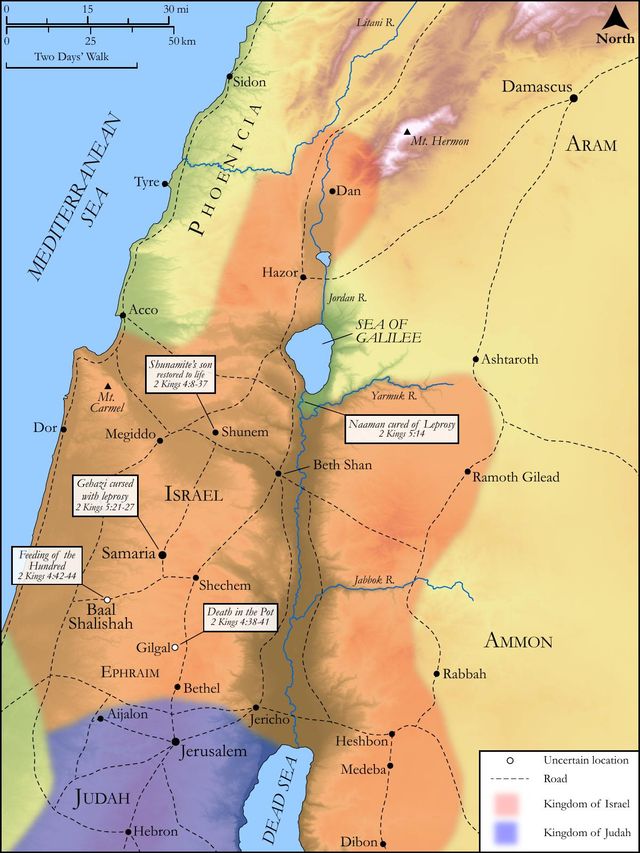
Things are bad enough in Israel, yet not so bad but that God's prophet finds friends, wherever he goes. Shunem was a city in the tribe of Issachar, that lay in the road between Samaria and Carmel, a road that Elisha often travelled, as we find Kg2 2:25. There lived a great woman, who kept a good house, and was very hospitable, her husband having a good estate, and his heart safely trusting in her, and in her discreet management, Pro 31:11. So famous a man as Elisha could not pass and repass unobserved. Probably he had been accustomed to take some private obscure lodgings in the town; but this pious matron, having notice once of his being there, pressed him with great importunity, and, with much difficulty, constrained him to dine with her, Kg2 4:8. He was modest and loth to be troublesome, humble and affected not to associate with those of the first rank; so that it was not without some difficulty that he was first drawn into an acquaintance there; but afterwards, whenever he went that way in his circuit, he constantly called there. So well pleased was she with her guest, and so desirous of his company, that she would not only bid him welcome to her table, but provide a lodging-room for him in her house, that he might make the longer stay, not doubting but her house would be blessed for his sake, and all under her roof edified by his pious instructions and example - a good design, yet she would not do it without acquainting her husband, would neither lay out his money nor invite strangers to his house without his consent asked and obtained, Kg2 4:9, Kg2 4:10. She suggests to him,
1.That the stranger she would invite was a holy man of God, who therefore would do good to their family, and God would recompense the kindness done to him; perhaps she had heard how well paid the widow of Sarepta was for entertaining Elijah.
2.That the kindness she intended him would be no great charge to them; she would build him only a little chamber. Perhaps she had no spare room in the house, or none private and retired enough for him, who spent much of his time in contemplation, and cared not for being disturbed with the noise of the family. The furniture shall be very plain; no costly hangings, no stands, no couches, no looking-glasses, but a bed, and a table, a stool, and a candlestick, all that was needful for his convenience, not only for his repose, but for his study, his reading and writing. Elisha seemed highly pleased with these accommodations, for he turned in and lay there (Kg2 4:11), and, as it should seem, his man in the same chamber, for he was far from taking state.
II.Elisha's gratitude for this kindness.
Being exceedingly pleased with the quietness of his apartment, and the friendliness of his entertainment, he began to consider with himself what recompence he should make her. Those that receive courtesies should study to return them; it ill becomes men of God to be ungrateful, or to sponge upon those that are generous.
1.He offered to use his interest for her in the king's court (Kg2 4:13): Thou hast been careful for us with all this care (thus did he magnify the kindness he received, as those that are humble are accustomed to do, though in the purse of one so rich, and in the breast of one so free, it was as nothing); now what shall be done for thee? As the liberal devise liberal things, so the grateful devise grateful things. "Wouldst thou be spoken for to the king, or the captain of the host, for an office for thy husband, civil or military? Hast thou any complaint to make, any petition to present, any suit at law depending, that needs the countenance of the high powers? Wherein can I serve thee?" It seems Elisha had got such an interest by his late services that, though he chose not to prefer himself by it, yet he was capable of preferring his friends. A good man can take as much pleasure in serving others as in raising himself. But she needs not any good offices of this kind to be done for her: I dwell (says she) among my own people, that is, "We are well off as we are, and do not aim at preferment." It is a happiness to dwell among our own people, that love and respect us, and to whom we are in a capacity of doing good; and a greater happiness to be content to do so, to be easy, and to know when we are well off. Why should those that live comfortably among their own people covet to live delicately in kings' palaces? It would be well with many if they did but know when they were well off. Some years after this we find this Shunammite had occasion to be spoken for to the king, though now she needed it not, Kg2 8:3, Kg2 8:4. Those that dwell among their own people must not think their mountain stands so strong as that it cannot be moved; they may be driven, as this good woman was, to sojourn among strangers. Our continuing city is above.
2.He did use his interest for her in the court of heaven, which was far better. Elisha consulted with his servant what kindness he should do for her, to such a freedom did this great prophet admit even his servant. Gehazi reminded him that she was childless, had a great estate, but no son to leave it to, and was past hopes of having any, her husband being old. If Elisha could obtain this favour from God for her, it would be the removal of that which at present was her only grievance. Those are the most welcome kindnesses which are most suited to our necessities. He sent for her immediately. She very humbly and respectfully stood in the door (Kg2 4:15), according to her accustomed modesty, and then he assured her that within a year she should bring forth a son, Kg2 4:16. She had received this prophet in the name of a prophet, and now she had not a courtier's reward, in being spoken for to the king, but a prophet's reward, a signal mercy given by prophets and in answer to prayer: the promise was a surprise to her, and she begged that she might not be flattered by it: "Nay, my lord, thou are a man of God, and therefore I hope speakest seriously, and doth not jest with me, nor lie unto thy handmaid." The event, within the time limited, confirmed the truth of the promise: She bore a son at the season that Elisha spoke of, Kg2 4:17. God built up her house, in reward to her kindness in building the prophet a chamber. We may well imagine what joy this brought to the family. Sing, O barren! thou that didst not bear.
Continue studying 2 Kings 4:14 across the web’s major study libraries — every link below opens this exact verse, chapter, or book on the destination site.
Read & Compare
 BibleGatewayThis verse in more than 200 translations and 70 languages.
 Bible.comThe YouVersion reader — hundreds of translations, reading plans, and highlights.
 ESV.orgCrossway's official English Standard Version reader.
 NET BibleThe NET translation with 60,000+ translators' notes on every rendering decision.
 STEP BibleTyndale House's free study tool — original text, vocabulary, and scholarly resources.
 BibliaLogos Bible Software's free web reader.
 USCCBThe New American Bible (Revised Edition) with the U.S. bishops' study notes.
Commentaries
 BibleHub CommentariesDozens of classic commentaries on this verse, gathered on one page.
 StudyLightMore than 100 commentary sets — the largest collection on the web.
 BibleRefPlain-English commentary on what this verse means, verse by verse.
 Enduring WordDavid Guzik's free commentary on this chapter, widely used by Bible teachers.
 Bible Study ToolsVerse commentary alongside Greek and Hebrew study aids.
Original Language & Research
- BibleHub InterlinearThe verse word by word — original language, transliteration, and English.
- BibleHub LexiconEvery word's original-language definition and Strong's entry.
 Blue Letter BibleDeep-study tools — Strong's numbers, concordance, and word studies.
 SefariaThe Hebrew text with Rashi and centuries of Jewish commentary.
Sermons, Hymns & Audio


TrulyRandomVerse is not affiliated with these sites and doesn’t control their content. They’re linked because they’re genuinely useful.
Summary
This verse marks a pivotal moment in the narrative of the Shunammite woman, where the prophet Elisha, prompted by his observant servant Gehazi, uncovers a profound and unspoken longing in her life: the desire for a child. Despite her material wealth and humble contentment, this revelation sets the stage for a miraculous divine intervention, demonstrating God's compassionate attention to the deepest needs of His faithful servants and His power to overcome natural limitations.
Context
ShowHideLiterary Context
This verse is nestled within a series of Elisha's miracles, following his compassionate interaction with the Shunammite woman. Chapters 2-8 of 2 Kings detail Elisha's prophetic ministry, marked by acts of healing, provision, and resurrection, demonstrating God's continued presence and power in Israel. Specifically, 2 Kings 4:8-13 describes the Shunammite woman's extraordinary hospitality towards Elisha, providing him with a dedicated room. Elisha, moved by her selfless generosity, desires to reciprocate. He first offers to intercede on her behalf with the king or army commander, but she humbly declines, stating her contentment living "among her own people" (2 Kings 4:13). This response, indicating no need for worldly advancement, prompts Elisha to seek a deeper, unexpressed need, leading directly to Gehazi's observation in verse 14. This exchange builds narrative tension, preparing the reader for a miraculous resolution.
Historical & Cultural Context
In ancient Israelite society, childlessness, particularly for women, was a profound sorrow and often perceived as a reproach or even a divine curse. Lineage and continuation of the family name were paramount, and children were seen as a blessing from God, ensuring inheritance and security in old age. The phrase "her husband is old" underscores the natural impossibility of conceiving a child, highlighting the couple's advanced age and setting the stage for a supernatural intervention. Shunem, located in the Jezreel Valley, was a fertile region, but its prosperity could not alleviate the pain of barrenness. Prophets like Elisha served as God's direct spokesmen, often intervening in the natural order to demonstrate divine power and compassion, addressing both national crises and personal needs.
Key Themes
ShowHideThis verse contributes significantly to several key themes within 2 Kings and the broader biblical narrative. It highlights Divine Discernment and Compassion, as Elisha, through God's leading, perceives a need beyond the superficial, demonstrating God's intimate knowledge of human hearts and His desire to meet unspoken longings. It powerfully portrays The Sorrow of Childlessness as a deep, cultural, and personal burden, echoing the narratives of Sarah (Genesis 16:1-2 and Genesis 18:10-14), Rachel (Genesis 30:1), and Hannah (1 Samuel 1:1-8). Crucially, it serves as Preparation for a Miracle, setting the scene for the miraculous birth of a son to the Shunammite couple (2 Kings 4:16), thereby showcasing God's sovereignty over life and His ability to transcend natural limitations. This act of divine generosity also underscores the theme of Divine Reward for Hospitality and Faithfulness, as Elisha seeks to bless the woman for her selfless service.
Exposition and Analysis
ShowHideKey Word Analysis
ShowHideThe servant of Elisha, whose name means "valley of a visionary." In this verse, Gehazi acts as Elisha's keen observer and informant, providing the crucial insight into the Shunammite woman's unspoken need. His role here is pivotal, demonstrating that God can use even a servant's natural observation to advance His divine purposes and reveal deeper truths.
Literally "son," derived from a root meaning "to build" (referring to building the family name). This term highlights the profound cultural and personal significance of male offspring in ancient Israel. The absence of a "child" or "son" was a source of deep sorrow, representing a lack of lineage, inheritance, and a future for the family. Gehazi's observation that she has "no child" pinpoints the core of her unfulfilled longing.
A primitive root meaning "to be old" or "aged." This word describes the husband's advanced age, which, when combined with the wife's childlessness, underscores the natural impossibility of them conceiving a child. It emphasizes that any forthcoming pregnancy would be a supernatural act, clearly attributable to God's intervention rather than human capability.
Verse Breakdown
ShowHide"And he said, What then [is] to be done for her?"
Elisha, having been told by the Shunammite woman that she needs nothing from the king or army commander, shifts his focus. His question to Gehazi demonstrates his commitment to repaying her hospitality. It also highlights his prophetic sensitivity; he senses a deeper, unarticulated need beyond material or social status, prompting him to seek counsel from his observant servant. This inquiry sets the stage for the revelation of the woman's true longing.
"And Gehazi answered, Verily she hath no child"
Gehazi, Elisha's servant, provides the crucial insight. His "Verily" (Hebrew 'ăbâl') indicates a firm, certain observation. He has likely noticed the absence of children in the household or heard it discussed, recognizing this as a significant void in a culture that highly valued progeny. This statement immediately identifies the profound sorrow of barrenness, which was a source of great distress for women in ancient Israel.
"and her husband is old"
This additional detail from Gehazi amplifies the problem. The husband's advanced age underscores the natural impossibility of the couple conceiving a child. It removes any human hope for procreation, thus magnifying the miraculous nature of the impending divine intervention. This detail establishes the utter human helplessness of the situation, making the subsequent divine act even more powerful and clearly attributable to God.
Literary Devices
ShowHideThe verse primarily employs Dialogue to advance the plot, with Elisha's question and Gehazi's insightful answer driving the narrative forward. This direct exchange reveals critical information about the Shunammite woman's circumstances and sets the stage for the ensuing miracle. There is also a strong element of Foreshadowing, as Gehazi's observation about childlessness immediately signals to the reader that the narrative is about to address this specific need, hinting at a miraculous birth to come. The Contrast between the woman's material abundance and her profound personal lack (childlessness) is subtly highlighted, emphasizing that true fulfillment often lies beyond worldly possessions. Finally, Irony is present in Gehazi, the servant, being the one to discern the deepest need, rather than Elisha directly, though Elisha's question initiated the discernment process.
Theological and Thematic Connections
ShowHideThis verse powerfully illustrates God's attentiveness to the deepest, often unspoken, longings of the human heart. It reveals a God who sees beyond outward appearances and material contentment, perceiving the hidden sorrows and unfulfilled desires that burden His people. Just as Elisha sought to bless the Shunammite woman for her extraordinary hospitality, God often responds to faithfulness and generosity with blessings that transcend human expectation, addressing needs that only He can meet. The theme of miraculous birth, overcoming natural barrenness, is a recurring motif in Scripture, demonstrating God's sovereignty over life itself and His ability to bring forth life where it seems naturally impossible, often for those who have faithfully served Him.
Reflection and Application
ShowHideThe exchange in 2 Kings 4:14 serves as a profound reminder that God is intimately acquainted with our deepest needs, even those we may not articulate or perhaps have resigned ourselves to. The Shunammite woman, content in her community, had seemingly accepted her childless state. Yet, God, through His prophet, sought to address this unspoken sorrow. This invites us to consider what hidden longings or perceived impossibilities we carry. It encourages us to cultivate a spirit of spiritual discernment, both in our own lives and as we seek to serve others. Are we truly listening to the unspoken cues, observing the deeper needs, and allowing God to work through us to bring His miraculous provision? This verse calls us to trust in God's power to transcend natural limitations and to believe that His compassion extends to every area of our lives, even where human solutions are exhausted.
Questions for Reflection
ShowHideFAQ
ShowHideWhy didn't Elisha know about her childlessness immediately, and why did Gehazi have to tell him?
ShowHideWhile Elisha was a prophet of God, his knowledge was not always exhaustive or automatic; it was often revealed by God as needed. In this instance, Elisha's initial offer to intercede with the king or army commander suggests he was looking for a more "public" or "worldly" need. The Shunammite woman's response that she was "content living among her own people" (2 Kings 4:13) indicated no such outward need. Elisha then turned to Gehazi, his observant servant, who was likely more intimately familiar with the household's daily life and common knowledge within the community. God often uses human observation and insight, even from servants, to bring about His divine purposes, demonstrating that His work is not solely through direct supernatural revelation but also through the natural channels of human interaction and discernment. This highlights Gehazi's role as a keen observer and Elisha's reliance on his insight, which God then used as the catalyst for the miracle.
Christ-Centered Fulfillment
ShowHideThe narrative of the Shunammite woman's barrenness and God's miraculous intervention through Elisha finds profound Christ-centered fulfillment. Just as the prophet discerned and addressed an unspoken, seemingly impossible need, Jesus Christ perfectly embodies divine discernment and compassion. He consistently saw beyond the surface, perceiving the deepest spiritual and physical needs of those He encountered, from the woman with the issue of blood (Mark 5:25-34) to the Samaritan woman at the well (John 4:7-26). The miraculous birth of the Shunammite's son foreshadows the ultimate miracle of the new birth that Christ offers, where spiritual barrenness is overcome by the life-giving power of the Holy Spirit (John 3:3-8). Furthermore, Christ's coming addresses humanity's deepest and most universal "barrenness"—our inability to produce spiritual fruit or attain righteousness on our own (Romans 3:23). He is the one who brings life from death, hope from despair, and fulfills every longing of the human heart, ultimately offering adoption into God's family and an eternal inheritance that far surpasses any earthly blessing (Ephesians 1:5 and Romans 8:15). In Christ, our greatest "old age" (our spiritual death) is overcome, and we are made new creations (2 Corinthians 5:17), receiving the ultimate Son, Jesus, who grants us abundant and eternal life (John 10:10).