


1 Samuel 1:8
Bible text: King James Version (1769 Blayney text) · Public domain
Bible text: King James Version with Strong's numbers · Public domain
Bible text: Berean Standard Bible · Public domain
Bible text: American Standard Version (1901) · Public domain
Bible text: World English Bible, Messianic edition · Public domain
Bible text: Geneva Bible (1599) · Public domain
Bible text: Young's Literal Translation · Public domain
- וַיֹּאמֶרvai·Yo·merand he saidH559Conj-w ¦ V-Qal-ConsecImperf-3msVerb Qal Consecutive Imperfect 3rd Singular Masculineוַandיֹּאמֶרhe said
- לָהּlahto <the> herPrep-l ¦ 3fsSuffix Personal 3rd Singular Feminineלָto <the>הּher
- אֶלְקָנָה'el·ka·NahElkanahH511N-proper-mNoun Proper Masculine
- אִישָׁהּ'i·Shahher husbandH376N-msc ¦ 3fsNoun Singular Masculine Constructאִישָׁhusbandהּher
- חַנָּהcha·NahO HannahH2584N-proper-fNoun Proper Feminine
- לָמֶהLa·meh<to> why?H4100Prep-l ¦ InterrogPronoun Interrogativeלָ<to>מֶהwhy?
- תִבְכִּיtiv·Kido you weepH1058V-Qal-Imperf-2fsVerb Qal Imperfect 2nd Singular Feminine
- וְלָמֶהve·La·mehand <to> why?H4100Conj-w ¦ Prep-l ¦ InterrogPronoun Interrogativeוְandלָ<to>מֶהwhy?
- לֹאlo'notH3808NegParticle Negative
- תֹאכְלִיtokh·Liare you eatingH398V-Qal-Imperf-2fsVerb Qal Imperfect 2nd Singular Feminine
- וְלָמֶהve·La·mehand <to> why?H4100Conj-w ¦ Prep-l ¦ InterrogPronoun Interrogativeוְandלָ<to>מֶהwhy?
- יֵרַעye·Ra'is sadH3415V-Qal-Imperf-3msVerb Qal Imperfect 3rd Singular Masculine
- לְבָבֵךְle·va·Vekhyour heartH3824N-msc ¦ 2fsNoun Singular Masculine Constructלְבָבֵheartךְyour
- הֲלוֹאha·Lo'¿ notH3808Interrog ¦ NegParticle Negativeהֲ¿לוֹאnot
- אָנֹכִי'a·no·Khi[am] IH595Pro-1csPronoun Personal 1st Singular common gender
- טוֹבTovgoodH2896Adj-msAdjective Singular Masculine Absolute
- לָךְLakhto <the> youPrep-l ¦ 2fsSuffix Personal 2nd Singular Feminineלָto <the>ךְyou
- מֵעֲשָׂרָהme·'a·sa·Rahmore than tenH6235Prep-m ¦ N-fsNoun Singular Feminine Absoluteמֵmore thanעֲשָׂרָהten
- בָּנִיםba·NimsonsH1121N-mpNoun Plural Masculine Absolute
English is a literal word-by-word gloss of the Hebrew, not the KJV's wording. Why?
This is the original text the KJV's translators worked from — each Hebrew word with its own literal English meaning in this verse, prepared by scholars at Tyndale House, Cambridge. The KJV translates whole sentences, not word by word, so its wording differs: one Hebrew word can become several English words, and the KJV may choose “the LORD” where the gloss reads “Yahweh”. Both are faithful — they answer different questions. For the KJV's own rendering, switch to the KJV text.
Details
See on the biblical-era map
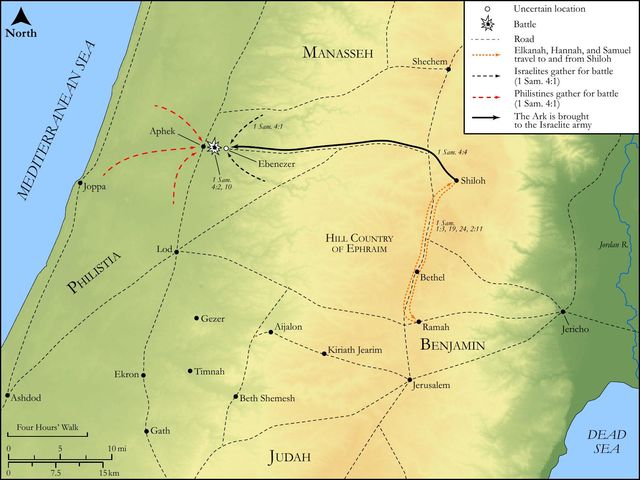
Study this verse
Public-domain commentary
Matthew Henry
From his Commentary on the Whole Bible. Henry comments on passages, not single verses — this entry covers 1 Samuel 1:1–8. His four-level outline is real structure in the source text, so it is rendered as structure.
We have here an account of the state of the family into which Samuel the prophet was born. His father's name was Elkanah, a Levite, and of the family of the Kohathites (the most honourable house of that tribe) as appears, Ch1 6:33, Ch1 6:34. His ancestor Zuph was an Ephrathite, that is, of Bethlehem-Judah, which was called Ephrathah, Ruth, Rut 1:2. There this family of the Levites was first seated, but one branch of it, in process of time, removed to Mount Ephraim, from which Elkanah descended. Micah's Levite came from Bethlehem to Mount Ephraim, Jdg 17:8. Perhaps notice is taken of their being originally Ephrathites to show their alliance to David. This Elkanah lived at Ramah, or Ramathaim, which signifies the double Ramah, the higher and lower town, the same with Arimathea of which Joseph was, here called Ramathaim-zophim. Zophim signifies watchmen; probably they had one of the schools of the prophets there, for prophets are called watchmen: the Chaldee paraphrase calls Elkanah a disciple of the prophets. But it seems to me that it was in Samuel that prophecy revived, before his time there being, for a great while, no open vision, Sa1 3:1. Nor is there any mention of a prophet of the Lord from Moses to Samuel, except Jdg 6:8. So that we have no reason to think that there was any nursery or college of prophets here till Samuel himself founded one, Jdg 19:19, Jdg 19:20. This is the account of Samuel's parentage, and the place of his nativity. Let us now take notice of the state of the family.
I.It was a devout family.
All the families of Israel should be so, but Levites' families in a particular manner. Ministers should be patterns of family religion. Elkanah went up at the solemn feasts to the tabernacle at Shiloh, to worship and to sacrifice to the Lord of hosts. I think this is the first time in scripture that God is called the Lord of hosts - Jehovah Sabaoth, a name by which he was afterwards very much called and known. Probably Samuel the prophet was the first that used this title of God, for the comfort of Israel, when in his time their hosts were few and feeble and those of their enemies many and mighty; then it would be a support to them to think that the God they served was Lord of hosts, of all the hosts both of heaven and earth; of them he has a sovereign command, and makes what use he pleases of them. Elkanah was a country Levite, and, for aught that appears, had not any place or office which required his attendance at the tabernacle, but he went up as a common Israelite, with his own sacrifices, to encourage his neighbours and set them a good example. When he sacrificed he worshipped, joining prayers and thanksgivings with his sacrifices. In this course of religion he was constant, for he went up yearly. And that which made it the more commendable in him was,
1.That there was a general decay and neglect of religion in the nations. Some among them worshipped other gods, and the generality were remiss in the service of the God of Israel, and yet Elkanah kept his integrity; whatever others did, his resolution was that he and his house should serve the Lord.
2.That Hophni and Phinehas, the sons of Eli, were the men that were now chiefly employed in the service of the house of God; and they were men that conducted themselves very ill in their place, as we shall find afterwards; yet Elkanah went up to sacrifice. God had then tied his people to one place and one altar, and forbidden them, under any pretence whatsoever, to worship elsewhere, and therefore, in pure obedience to that command, he attended at Shiloh. If the priests did not do their duty, he would do his. Thanks be to God, we, under the gospel, are not tied to any one place or family; but the pastors and teachers whom the exalted Redeemer has given to his church are those only whose ministration tends to the perfecting of the saints and the edifying of the body of Christ, Eph 4:11, Eph 4:12. None have dominion over our faith; but our obligation is to those that are the helpers of our holiness and joy, not to any that by their scandalous immoralities, like Hophni and Phinehas, make the sacrifices of the Lord to be abhorred, though still the validity and efficacy of the sacraments depend not on the purity of him that administers them.
II.Yet it was a divided family, and the divisions of it carried with them both guilt and grief.
Where there is piety, it is a pity but there should be unity. The joint-devotions of a family should put an end to divisions in it.
1.The original cause of this division was Elkanah's marrying two wives, which was a transgression of the original institution of marriage, to which our Saviour reduces it. Mat 19:5, Mat 19:8, From the beginning it was not so. It made mischief in Abraham's family, and Jacob's, and here in Elkanah's. How much better does the law of God provide for our comfort and ease in this world than we should, if we were left to ourselves! It is probable that Elkanah married Hannah first, and, because he had not children by her so soon as he hoped, he married Peninnah, who bore him children indeed, but was in other things a vexation to him. Thus are men often beaten with rods of their own making.
2.That which followed upon this error was that the two wives could not agree. They had different blessings: Peninnah, like Leah, was fruitful and had many children, which should have made her easy and thankful, though she was but a second wife, and was less beloved; Hannah, like Rachel, was childless indeed, but she was very dear to her husband, and he took all occasions to let both her and others know that she was so, and many a worthy portion he gave her (Sa1 1:5), and this should have made her easy and thankful. But they were of different tempers: Peninnah could not bear the blessing of fruitfulness, but she grew haughty and insolent; Hannah could not bear the affliction of barrenness, but she grew melancholy and discontented: and Elkanah had a difficult part to act between them.
(1.)Elkanah kept up his attendance at God's altar notwithstanding this unhappy difference in his family, and took his wives and children with him, that, if they could not agree in other things, they might agree to worship God together. If the devotions of a family prevail not to put an end to its divisions, yet let not the divisions put a stop to the devotions.
(2.)He did all he could to encourage Hannah, and to keep up her spirits under her affliction, Sa1 1:4, Sa1 1:5. At the feast he offered peace-offerings, to supplicate for peace in his family; and when he and his family were to eat their share of the sacrifice, in token of their communion with God and his altar, though he carved to Peninnah and her children competent portions, yet to Hannah he gave a worthy portion, the choicest piece that came to the table, the piece (whatever it was) that used to be given on such occasions to those that were most valued; this he did in token of his love to her, and to give all possible assurances of it. Observe,
[1.]Elkanah loved his wife never the less for her being barren. Christ loves his church, notwithstanding her infirmities, her barrenness; and so ought men to love their wives, Eph 5:25. To abate our just love to any relation for the sake of any infirmity which they cannot help, and which is not their sin but their affliction, is to make God's providence quarrel with his precept, and very unkindly to add affliction to the afflicted.
[2.]He studied to show his love so much the more because she was afflicted, insulted, and low-spirited. It is wisdom and duty to support the weakest, and to hold up those that are run down.
[3.]He showed his great love to her by the share he gave her of his peace-offerings. Thus we should testify our affection to our friends and relations, by abounding in prayer for them. The better we love them the more room let us give them in our prayers.
(3.)Peninnah was extremely peevish and provoking.
[1.]She upbraided Hannah with her affliction, despised her because she was barren, and gave her taunting language, as one whom Heaven did not favour.
[2.]She envied the interest she had in the love of Elkanah, and the more kind he was to her the more was she exasperated against her, which was all over base and barbarous.
[3.]She did this most when they went up to the house of the Lord, perhaps because then they were more together than at other times, or because then Elkanah showed his affection most to Hannah. But it was very sinful at such a time to show her malice, when pure hands were to be lifted up at God's altar without wrath and quarrelling. It was likewise very unkind at that time to vex Hannah, not only because then they were in company, and others would take notice of it, but then Hannah was to mind her devotions, and desired to be most calm and composed, and free from disturbance. The great adversary to our purity and peace is then most industrious to ruffle us when we should be most composed. When the sons of God come to present themselves before the Lord Satan will be sure to come among them, Job 1:6.
[4.]She continued to do this from year to year, not once or twice, but it was her constant practice; neither deference to her husband nor compassion to Hannah could break her of it.
[5.]That which she designed was to make her fret, perhaps in hopes to break her heart, that she might possess her husband's heart solely, or because she took a pleasure in her uneasiness, nor could Hannah gratify her more than by fretting. Note, It is an evidence of a base disposition to delight in grieving those that are melancholy and of a sorrowful spirit, and in putting those out of humour that are apt to fret and be uneasy. We ought to bear one another's burdens, not add to them.
(4.)Hannah (poor woman) could not hear the provocation: She wept, and did not eat, Sa1 1:7. It made her uneasy to herself and to all her relations. She did not eat of the feast; her trouble took away her appetite, made her unfit for any company, and a jar in the harmony of family-joy. It was of the feast upon the sacrifice that she did not eat, for they were not to eat of the holy things in their mourning, Deu 26:14; Lev 10:19. Yet it was her infirmity so far to give way to the sorrow of the world as to unfit herself for holy joy in God. Those that are of a fretful spirit, and are apt to lay provocations too much to heart, are enemies to themselves, and strip themselves very much of the comforts both of life and godliness. We find that God took notice of this ill effect of discontents and disagreements in the conjugal relation, that the parties aggrieved covered the altar of the Lord with tears, insomuch that he regarded not the offering, Mal 2:13.
(5.)Elkanah said what he could to her to comfort her. She did not upbraid him with his unkindness in marrying another wife as Sarah did, nor did she render to Peninnah railing for railing, but took the trouble wholly to herself, which made her an object of much compassion. Elkanah showed himself extremely grieved at her grief (Sa1 1:8): Hannah, why weepest thou?
[1.]He is much disquieted to see her thus overwhelmed with sorrow. Those that by marriage are made one flesh ought thus far to be of one spirit too, to share in each other's troubles, so that one cannot be easy while the other is uneasy.
[2.]He gives her a loving reproof for it: Why weepest thou? And why is thy heart grieved? As many as God loves he rebukes, and so should we. He puts her upon enquiring into the cause of her grief. Though she had just reason to be troubled, yet let her consider whether she had reason to be troubled to such a degree, especially so much as to be taken off by it from eating of the holy things. Note, Our sorrow upon any account is sinful and inordinate when it diverts us from our duty to God and embitters our comfort in him, when it makes us unthankful for the mercies we enjoy and distrustful of the goodness of God to us in further mercies, when it casts a damp upon our joy in Christ, and hinders us from doing the duty and taking the comfort of our particular relations.
[3.]He intimates that nothing should be wanting on his part to balance her grief: "Am not I better to thee than ten sons? Thou knowest thou hast my entire affection, and let that comfort thee." Note, We ought to take notice of our comforts, to keep us from grieving excessively for our crosses; for our crosses we deserve, but our comforts we have forfeited. If we would keep the balance even, we must look at that which is for us, as well as at that which is against us, else we are unjust to Providence and unkind to ourselves. God hath set the one over-against the other (Ecc 7:14) and so should we.
Historical interpretation
Five Centuries of Reception
3 surviving comments on this verse. Each one is dated, so this reads as a timeline rather than a list.
Select a marker to jump to its quote. Markers stagger vertically where authors wrote within a few decades of each other.
Thus a Godward fast is a work of reverential awe. By its means also Hannah the wife of Elkanah making suit, barren as she had been beforetime, easily obtained from God the filling of her belly, empty of food, with a son, indeed, and a prophet.
Would you like to understand what watchfulness in prayer is? Go to Hannah, listen to her very words, “Adonai Eloi Sabaoth.” No, rather, hear what preceded those words; “they all rose up,” says the history, “from the table,” and she did not give herself right away to sleep or to repose. She appears to me even when she was sitting at the table to have partaken lightly and not to have been made heavy with food. Otherwise she could never have shed so many tears. When we are fasting and foodless, we hardly pray in such a manner, or rather never pray in this way. Much more Hannah would not ever have prayed in this fashion after a meal, unless even at the meal she had been like those that do not eat. Let men be ashamed at the example of this woman. Let those be ashamed who are suing and grasping for a kingdom, at her, praying and weeping for a little child.
Then Elkanah, her husband, said to her: "Anna, why do you weep?" etc. Ten sons symbolize the receivers or observers of the law's decalogue. Therefore, the Lord consoles the Church, so that it does not bear grievously that the legislation, the promises, the covenant, and the entrusted utterances of God were given not to it but to the Synagogue; but let it be cheered and exult with the greatest joy, that it has now deserved to receive a greater gift and better grace than all these, the advent of the Mediator of God and men, the man Jesus Christ, whom it did not know to expect or hope for. This lesson not only figuratively expresses the different states of the two peoples, but also the differing merits of the dissenting persons in each of those peoples, and the different rewards of merits. For Christ has always loved, and will love, the humble tears of penitents more than the rigid justice of the proud; and, neglecting the Pharisee's arrogance, who exalts himself as if fertile with the progeny of ten sons due to his fulfillment of legal commands, he deigns rather to regard the lamentations of the penitent publican.
Continue studying 1 Samuel 1:8 across the web’s major study libraries — every link below opens this exact verse, chapter, or book on the destination site.
Read & Compare
 BibleGatewayThis verse in more than 200 translations and 70 languages.
 Bible.comThe YouVersion reader — hundreds of translations, reading plans, and highlights.
 ESV.orgCrossway's official English Standard Version reader.
 NET BibleThe NET translation with 60,000+ translators' notes on every rendering decision.
 STEP BibleTyndale House's free study tool — original text, vocabulary, and scholarly resources.
 BibliaLogos Bible Software's free web reader.
 USCCBThe New American Bible (Revised Edition) with the U.S. bishops' study notes.
Commentaries
 BibleHub CommentariesDozens of classic commentaries on this verse, gathered on one page.
 StudyLightMore than 100 commentary sets — the largest collection on the web.
 BibleRefPlain-English commentary on what this verse means, verse by verse.
 Enduring WordDavid Guzik's free commentary on this chapter, widely used by Bible teachers.
 Bible Study ToolsVerse commentary alongside Greek and Hebrew study aids.
Original Language & Research
- BibleHub InterlinearThe verse word by word — original language, transliteration, and English.
- BibleHub LexiconEvery word's original-language definition and Strong's entry.
 Blue Letter BibleDeep-study tools — Strong's numbers, concordance, and word studies.
 SefariaThe Hebrew text with Rashi and centuries of Jewish commentary.
Sermons, Hymns & Audio


TrulyRandomVerse is not affiliated with these sites and doesn’t control their content. They’re linked because they’re genuinely useful.
Summary
1 Samuel 1:8 presents a tender yet poignant scene where Elkanah, Hannah's devoted husband, attempts to comfort her profound grief and refusal to eat during their annual pilgrimage to Shiloh. Observing her deep distress, Elkanah poses a series of rhetorical questions concerning her sorrow, culminating in the assertion, "Am not I better to thee than ten sons?" This verse powerfully illustrates the tension between genuine human affection and a spiritual longing that transcends earthly comfort, highlighting the immense cultural value placed on sons in ancient Israel while foreshadowing the divine intervention Hannah desperately sought for her barrenness.
Context
ShowHideLiterary Context
This verse is strategically positioned within the opening narrative of 1 Samuel, immediately following the vivid portrayal of Hannah's deep sorrow due to her barrenness and the relentless provocation she endured from Peninnah, Elkanah's other wife. The preceding verses establish the annual pilgrimage to Shiloh as a significant event, during which Peninnah would taunt Hannah, exacerbating her pain (1 Samuel 1:6-7). Elkanah's words in this verse serve as a pivotal moment of human interaction before Hannah turns directly to the Lord in desperate prayer and makes her solemn vow (1 Samuel 1:9-11). It underscores the depth of Hannah's suffering, which even her loving husband's exceptional devotion, demonstrated by giving her a double portion of the sacrifice (1 Samuel 1:5), could not fully comprehend or alleviate. This scene sets the stage for God's miraculous intervention, highlighting that Hannah's ultimate comfort and fulfillment would come from divine rather than human provision.
Historical & Cultural Context
In ancient Israelite society, children, especially sons, were considered an indispensable blessing from God, crucial for continuing the family lineage, inheriting property, and ensuring social standing. Barrenness was often perceived as a curse or divine disfavor, leading to immense personal shame and societal reproach for women. The annual pilgrimage to Shiloh, where the tabernacle was located, was a significant religious festival involving communal worship and sacrificial meals, meant to be a time of joy and fellowship with God. Hannah's refusal to eat during this festive occasion (1 Samuel 1:7) was a clear and profound sign of her despair, indicating that her grief was so overwhelming it superseded even the joy of religious observance and family fellowship. Elkanah's perspective, though loving and well-intentioned, reflects the patriarchal societal norms where a husband's affection was expected to be a woman's primary source of comfort and fulfillment, even when faced with a culturally devastating condition like barrenness.
Key Themes
ShowHideThis verse contributes significantly to several overarching themes in 1 Samuel and the broader biblical narrative. Firstly, it highlights the theme of profound grief and barrenness, a recurring motif in biblical narratives (e.g., Sarah in Genesis 16:1 and Rachel in Genesis 30:1), which often serves as a prelude to divine intervention and miraculous birth, demonstrating God's sovereign power over life. Secondly, it explores the limitations of human comfort and understanding in the face of deep, spiritual longing. While Elkanah's love for Hannah is evident and exceptional, his words, though well-intentioned, fall short of addressing the spiritual and cultural depth of Hannah's pain, which ultimately only God could resolve. Lastly, the phrase "better to thee than ten sons" powerfully underscores the immense cultural value of sons in ancient Israel, where male offspring were seen as the ultimate blessing and security, a theme also echoed in Psalm 127:3. This cultural backdrop intensifies Hannah's suffering and magnifies the miracle of Samuel's birth.
Exposition and Analysis
ShowHideKey Word Analysis
ShowHideThis verb (H1058) is a primitive root signifying to weep, generally to bemoan, make lamentation, or mourn. It describes a deep, often uncontrollable, emotional crying, indicative of profound sorrow or distress. Hannah's weeping was not merely shedding tears but an intense, prolonged expression of grief, reflecting the anguish that had consumed her to the point of losing her appetite and being unable to participate in the festive meal.
The root (H3415) properly means "to be broken up" with any violent action, or figuratively, "to fear." In this context, applied to the heart, it denotes a state of deep anguish, sorrow, or being "broken in spirit." Hannah's grief was not superficial but a profound affliction that had permeated her inner being, causing her heart to be deeply distressed and in turmoil.
This common Hebrew adjective (H2896) means "good" in the widest sense, including pleasant, agreeable, or superior. Elkanah's rhetorical question, "Am not I ṭôwb to thee than ten sons?" asserts his perceived sufficiency and superiority as a source of comfort and value. He attempts to reassure Hannah that his love should outweigh her desire for children, particularly sons, who represented the pinnacle of blessing and security in their culture.
Verse Breakdown
ShowHide"Then said Elkanah her husband to her, Hannah,"
The verse opens with Elkanah initiating the conversation, directly addressing Hannah by name. This immediate address highlights his personal concern and affection, signaling that his words are born out of a desire to connect with and understand her distress. It establishes the intimate and loving nature of their relationship.
"why weepest thou?"
Elkanah's first question immediately points to her outward manifestation of sorrow—her persistent and visible weeping. He observes her physical signs of distress and seeks to understand the underlying cause, demonstrating his attentiveness to her emotional state and his desire to alleviate her suffering.
"and why eatest thou not?"
This second question points to a tangible symptom of Hannah's profound distress. Refusing to eat, especially during a celebratory sacrificial meal that was meant to be a joyous communal event, was a clear and culturally recognized sign of deep grief or protest. Elkanah recognizes that her sorrow has affected her physical well-being and her participation in communal life and religious observance.
"and why is thy heart grieved?"
Elkanah probes beyond the outward signs of weeping and not eating, seeking to understand the internal source of her anguish. He perceives that her sorrow is not superficial but originates from a deeply troubled or "broken" heart, indicating a spiritual or emotional wound that goes beyond mere sadness. This question reveals his attempt to reach the core of her pain.
"[am] not I better to thee than ten sons?"
This rhetorical question is Elkanah's attempt at consolation and reassurance. By comparing himself to "ten sons," he invokes the highest cultural standard of blessing and value in ancient Israel, where male offspring were paramount for family continuity and social standing. His intention is to convey the immense depth of his love and devotion, suggesting that his affection should be more than enough to fill any void in her life, even the profound longing for male offspring. It underscores his genuine love but also his limited understanding of the specific, God-directed nature of Hannah's yearning.
Literary Devices
ShowHideThe verse employs several significant Literary Devices. The most prominent is the Rhetorical Question, particularly in Elkanah's concluding statement, "Am not I better to thee than ten sons?" This is not a question seeking a factual answer, but rather a statement of affirmation intended to convey Elkanah's deep love and his belief in its sufficiency. It serves to comfort and reassure Hannah, though it ultimately falls short of addressing her profound spiritual and cultural pain. The phrase "ten sons" functions as Hyperbole, an exaggeration used for emphasis. It underscores the immense societal and personal value placed on male offspring in ancient Israel, representing the epitome of blessing, family continuity, and security. Elkanah uses this hyperbole as a Metaphor for the ultimate fulfillment and joy he believes his love should provide. Furthermore, there is an implicit Dramatic Irony in Elkanah's words. While his love is genuine and exceptional, the reader, aware of Hannah's deeper spiritual yearning and the subsequent divine intervention, understands that human affection, however great, cannot fulfill a need that only God can satisfy. This highlights the Contrast between human comfort and divine provision.
Theological and Thematic Connections
ShowHideThis verse profoundly illustrates the human condition of seeking fulfillment in earthly relationships and possessions, often failing to recognize the deeper, spiritual longings that only God can satisfy. Elkanah's genuine love, while commendable and exceptional, could not assuage Hannah's specific, God-given desire for a child, particularly a son, which was tied to her identity, societal standing, and a sense of divine favor. Theologically, Hannah's barrenness and intense grief serve as a powerful backdrop for demonstrating God's sovereignty over life and death, His attentiveness to the cries of the afflicted, and His ability to open the womb (or provide any blessing) in His perfect timing. It highlights that true blessing and ultimate comfort come not from human provision, however loving, but from divine intervention and a deep, trusting relationship with the Almighty. Her story becomes a testament to the truth that God hears the cries of the brokenhearted and responds according to His perfect will.
Reflection and Application
ShowHideElkanah's words in 1 Samuel 1:8 offer a powerful lesson in empathy, the limits of human comfort, and the nature of true fulfillment. While his love for Hannah was undeniable and his attempt to console her sincere, he could not fully grasp the spiritual depth of her pain or the immense societal pressures she faced. This reminds us that even with the best intentions, our human efforts to comfort others can fall short when faced with profound, God-directed longings or deep-seated grief that only a divine touch can address. It challenges us to move beyond superficial comfort and truly listen to the specific nature of another's pain, recognizing that some sorrows require a spiritual answer. For those experiencing deep unmet longings, whether for children, a spouse, healing, purpose, or a sense of belonging, Hannah's story encourages persistent prayer and unwavering trust in God's unique and perfect provision, understanding that only He can truly satisfy the deepest desires of the heart. It also prompts us to examine what "ten sons" might represent in our own lives—those earthly things we mistakenly believe will bring ultimate satisfaction and security, when true peace, joy, and lasting fulfillment are found only in God.
Questions for Reflection
ShowHideFAQ
ShowHideWhy did Elkanah think his love was "better than ten sons"?
ShowHideElkanah's statement reflects both his profound love for Hannah and the prevailing cultural values of his time. In ancient Israel, sons were considered the ultimate blessing from God, crucial for ensuring family lineage, inheriting property, and securing social standing, as powerfully articulated in Psalm 127:3. By asserting that his love was "better than ten sons," Elkanah was attempting to convey the immeasurable depth of his devotion and affection for Hannah. He genuinely loved her more than Peninnah, demonstrated by giving her a double portion of the sacrifice (1 Samuel 1:5), and from his perspective, he believed his love should be sufficient to alleviate her sorrow and fulfill her. It wasn't necessarily insensitivity but rather a loving husband's earnest attempt to provide ultimate comfort within the scope of his human understanding, not fully grasping the spiritual and societal weight of Hannah's barrenness or the depth of her God-given longing.
Christ-Centered Fulfillment
ShowHideHannah's profound grief over her barrenness and Elkanah's well-intentioned but ultimately insufficient comfort in 1 Samuel 1:8 powerfully foreshadow humanity's spiritual barrenness and its desperate need for a divine solution. Just as Elkanah's love, however great, could not produce the son Hannah longed for, no human effort, earthly possession, or relationship can truly satisfy the deepest longings of the human heart for redemption and spiritual fruitfulness. This narrative points us to Christ, the ultimate "Son" who is infinitely "better" than any earthly blessing or human provision. He is the one who takes away the sin of the world (John 1:29), opens the spiritually barren womb of humanity, and brings forth new life. Where Hannah sought a son to end her reproach and bring her joy, Jesus, through His perfect life, atoning sacrifice, and resurrection, removes the ultimate reproach of sin and offers spiritual adoption, making us children of God (John 1:12). He invites all who are weary and burdened by their spiritual barrenness and unmet longings to come to Him for true rest and fulfillment (Matthew 11:28-30), providing a comfort that transcends human understanding and yields eternal fruitfulness, making us branches connected to the true vine (John 15:5), bearing fruit that glorifies God and brings everlasting joy.