


2 Kings 2:23
Bible text: King James Version (1769 Blayney text) · Public domain
Bible text: King James Version with Strong's numbers · Public domain
Bible text: Berean Standard Bible · Public domain
Bible text: American Standard Version (1901) · Public domain
Bible text: World English Bible, Messianic edition · Public domain
Bible text: Geneva Bible (1599) · Public domain
Bible text: Young's Literal Translation · Public domain
- וַיַּעַלvai·Ya·'aland he went upH5927Conj-w ¦ V-Qal-ConsecImperf-3msVerb Qal Consecutive Imperfect 3rd Singular Masculineוַandיַּעַלhe went up
- מִשָּׁםmi·Shamfrom thereH8033Prep-m ¦ AdvAdverbמִfromשָּׁםthere
- בֵּיתbeitBeth-H1008N-properNoun Proper Location
- אֵל'El-elH1008N-properNoun Proper Location
- וְהוּאve·Hu'and heH1931Conj-w ¦ Pro-3msPronoun Personal 3rd Singular Masculineוְandהוּאhe
- עֹלֶה'o·Leh[was] going upH5927V-Qal-Prtcpl-msVerb Qal Participle Singular Masculine Absolute
- בַדֶּרֶךְva·De·rekhon the wayH1870Prep-b ¦ N-csNoun Singular common gender Absoluteבַon theדֶּרֶךְway
- וּנְעָרִיםu·ne·'a·Rimand ladsH5288Conj-w ¦ N-mpNoun Plural Masculine Absoluteוּandנְעָרִיםlads
- קְטַנִּיםke·ta·NimyoungH6996Adj-mpAdjective Plural Masculine Absolute
- יָצְאוּya·tze·'Uthey came outH3318V-Qal-Perf-3cpVerb Qal Perfect 3rd Plural common gender
- מִןminfromH4480PrepPreposition
- הָעִירha·'Irthe cityH5892Art ¦ N-fsNoun Singular Feminine Absoluteהָtheעִירcity
- וַיִּתְקַלְּסוּvai·yit·ka·le·suand they deridedH7046Conj-w ¦ V-Hithpael-ConsecImperf-3mpVerb Hithpael Consecutive Imperfect 3rd Plural Masculineוַandיִּתְקַלְּסוּthey derided
- בוֹvo<in> himPrep-b ¦ 3msSuffix Personal 3rd Singular Masculineב<in>וֹhim
- וַיֹּאמְרוּvai·Yo·me·ruand they saidH559Conj-w ¦ V-Qal-ConsecImperf-3mpVerb Qal Consecutive Imperfect 3rd Plural Masculineוַandיֹּאמְרוּthey said
- לוֹloto himPrep-l ¦ 3msSuffix Personal 3rd Singular Masculineלtoוֹhim
- עֲלֵה'a·Lehgo upH5927V-Qal-Imp-2msVerb Qal Imperative 2nd Singular Masculine
- קֵרֵחַke·Re·achO bald [man]H7142Adj-msAdjective Singular Masculine Absolute
- עֲלֵה'a·Lehgo upH5927V-Qal-Imp-2msVerb Qal Imperative 2nd Singular Masculine
- קֵרֵחַke·Re·achO bald [man]H7142Adj-msAdjective Singular Masculine Absolute
English is a literal word-by-word gloss of the Hebrew, not the KJV's wording. Why?
This is the original text the KJV's translators worked from — each Hebrew word with its own literal English meaning in this verse, prepared by scholars at Tyndale House, Cambridge. The KJV translates whole sentences, not word by word, so its wording differs: one Hebrew word can become several English words, and the KJV may choose “the LORD” where the gloss reads “Yahweh”. Both are faithful — they answer different questions. For the KJV's own rendering, switch to the KJV text.
Details
See on the biblical-era map
Study this verse
Public-domain commentary
Matthew Henry
From his Commentary on the Whole Bible. Henry comments on passages, not single verses — this entry covers 2 Kings 2:19–25. His three-level outline is real structure in the source text, so it is rendered as structure.
Elisha had, in this respect, a double portion of Elijah's spirit, that he wrought more miracles than Elijah. Some reckon them in number just double. Two are recorded in these verses - a miracle of mercy to Jericho and a miracle of judgment to Bethel, Psa 101:1.
I.Here is a blessing upon the waters of Jericho, which was effectual to heal them.
Jericho was built in disobedience to a command, in defiance to a threatening, and at the expense of the lives of all the builder's children; yet, when it was built, it was not ordered to be demolished again, nor were God's prophets or people forbidden to dwell in it, but even within those walls that were built by iniquity we find a nursery of piety. Fools, they say, build houses for wise men to dwell in. Here the wealth of the sinner provided a habitation for the just. We find Christ at Jericho, Luk 19:1. Hither Elisha came, to confirm the souls of the disciples with a more particular account of Elijah's translation than their spies, who saw at a distance, could give them. Here he staid while the fifty men were searching for him. And,
1.The men of Jericho represented to him their grievance, Kg2 2:19. God's faithful prophets love to be employed; it is wisdom to make use of them during the little while that their light is with us. They had not applied to Elijah concerning the matter, perhaps because he was not so easy of access as Elisha was; but now, we may hope, by the influence of the divinity-school in their city, they were reformed. The situation was pleasant and afforded a good prospect; but they had neither wholesome water to drink nor fruitful soil to yield them food, and what pleasure could they take in their prospect? Water is a common mercy, which we should estimate by the greatness of the calamity which the want or unwholesomeness of it would be. Some think that it was not all the ground about Jericho that was barren and had bad water, but some one part only, and that where the sons of the prophets had their lodgings, who are here called the men of the city.
2.He soon redressed their grievance. Prophets should endeavour to make every place they come to, some way or other, the better for them, endeavouring to sweeten bitter spirits, and to make barren souls fruitful, by the due application of the word of God. Elisha will heal their waters; but,
(1.)They must furnish him with salt in a new cruse, Kg2 2:20. If salt had been proper to season the water, yet what could so small a quantity do towards it and what the better for being in a new cruse? But thus those that would be helped must be employed and have their faith and obedience tried. God's works of grace are wrought, not by any operations of ours, but in observance of his institutions.
(2.)He cast the salt into the spring of the waters, and so healed the streams and the ground they watered. Thus the way to reform men's lives is to renew their hearts; let those be seasoned with the salt of grace; for out of them are the issues of life. Make the tree good and the fruit will be good. Purify the heart and that will cleanse the hands.
(3.)He did not pretend to do this by his own power, but in God's name: Thus saith the Lord, I have healed these waters. He is but the instrument, the channel through which God is pleased to convey this healing virtue. By doing them this kindness with a Thus saith the Lord, they would be made the more willing hereafter, to receive from him a reproof, admonition, or command, with the same preface. If, in God's name, he can help them, in God's name let him teach and rule them. Thus saith the Lord, out of Elisha's mouth, must, ever after, be of mighty force with them.
(4.)The cure was lasting, and not for the present only: The waters were healed unto this day, Kg2 2:22. What God does shall be for ever, Ecc 3:14. When he, by his Spirit, heals a soul, there shall be no more death nor barrenness; the property is altered: what was useless and offensive becomes grateful and serviceable.
II.Here is a curse upon the children of Bethel, which was effectual to destroy them; for it was not a curse causeless.
At Bethel there was another school of prophets. Thither Elisha went next, in this his primary visitation, and the scholars there no doubt welcomed him with all possible respect, but the townsmen were abusive to him. One of Jeroboam's calves was at Bethel; this they were proud of, and fond of, and hated those that reproved them. The law did not empower them to suppress this pious academy, but we may suppose it was their usual practice to jeer the prophets as they went along the streets, to call them by some nickname or other, that they might expose them to contempt, prejudice their youth against them, and, if possible, drive them out of their town. Had the abuse done to Elisha been the first offence of that kind, it is probable that it would not have been so severely punished. But mocking the messengers of the Lord, and misusing the prophets, was one of the crying sins of Israel, as we find, Ch2 36:16. Now here we have,
1.An instance of that sin. The little children of Bethel, the boys and girls that were playing in the streets (notice, it is likely, having come to the town of his approach), went out to meet him, not with their hosannas, as they ought to have done, but with their scoffs; they gathered about him and mocked him, as if he had been a fool, or one fit to make sport with. Among other things that they used to jeer the prophets with, they had this particular taunt for him, Go up, thou bald head, go up, thou bald head. It is a wicked thing to reproach persons for their natural infirmities or deformities; it is adding affliction to the afflicted; and, if they are as God made them, the reproach reflects upon him. But this was such a thing as scarcely deserved to be called a blemish, and would never have been turned to his reproach if they had had any thing else to reproach him with. It was his character as a prophet that they designed to abuse. The honour God had crowned him with should have been sufficient to cover his bald head and protect him from their scoffs. They bade him go up, perhaps reflecting on the assumption of Elijah: "Thy master," they say, "has gone up; why dost not thou go up after him? Where is the fiery chariot? When shall we be rid of thee too?" These children said as they were taught; they had learned of their idolatrous parents to call foul names and give bad language, especially to prophets. These young cocks, as we say, crowed after the old ones. Perhaps their parents did at this time send them out and set them on, that, if possible, they might keep the prophet out of their town.
2.A specimen of that ruin which came down upon Israel at last, for misusing God's prophets, and of which this was intended to give them fair warning. Elisha heard their taunts, a good while, with patience; but at length the fire of holy zeal for God was kindled in his breast by the continued provocation, and he turned and looked upon them, to try if a grave and severe look would put them out of countenance and oblige them to retire, to see if he could discern in their faces any marks of ingenuousness; but they were not ashamed, neither could they blush; and therefore he cursed them in the name of the Lord, both imprecated and denounced the following judgment, not in personal revenge for the indignity done to himself, but as the mouth of divine justice to punish the dishonour done to God. His summons was immediately obeyed. two she-bears (bears perhaps robbed of their whelps) came out of an adjacent wood, and presently killed forty-two children, Kg2 2:24. Now in this,
(1.)The prophet must be justified, for he did it by divine impulse. Had the curse come from any bad principle God would not have said Amen to it. We may think it would have been better to have called for two rods for the correction of these children than two bears for the destruction of them. But Elisha knew, by the Spirit, the bad character of these children. He knew what a generation of vipers those were, and what mischievous enemies they would be to God's prophets if they should live to be men, who began so early to be abusive to them. He intended hereby to punish the parents and to make them afraid of God's judgments.
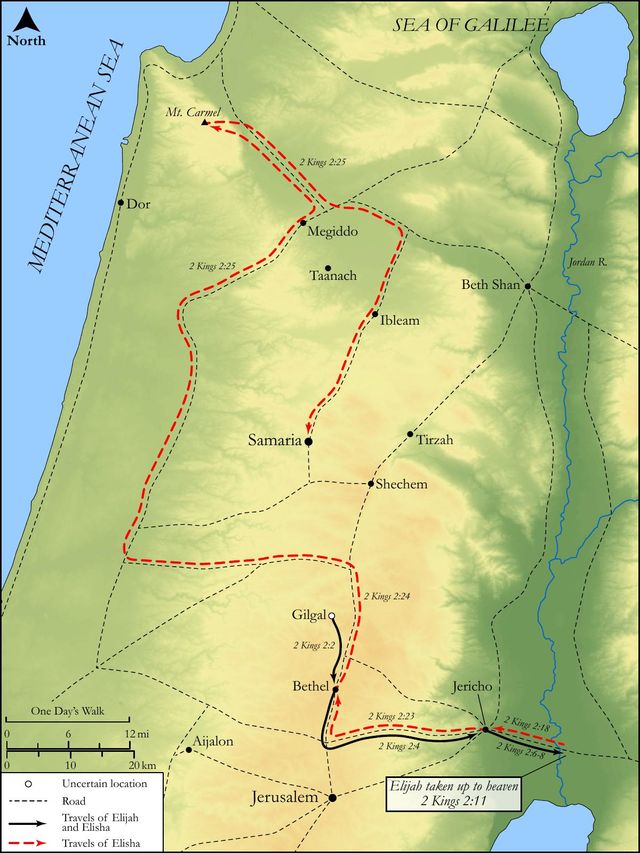
(2.)God must be glorified as a righteous God, that hates sin, and will reckon for it, even in little children. Let the wicked wretched brood make our flesh tremble for fear of God. Let little children be afraid of speaking wicked words, for God notices what they say,. Let them not mock any for their defects in mind or body, but pity them rather; especially let them know that it is at their peril if they jeer God's people or ministers, and scoff at any for well-doing. Let parents, that would have comfort in their children, train them up well, and do their utmost betimes to drive out the foolishness that is bound up in their hearts; for, as bishop Hall says, "In vain do we look for good from those children whose education we have neglected; and in vain do we grieve for those miscarriages which our care might have prevented." Elisha comes to Bethel and fears not the revenges of the bereaved parents; God, who bade him do what he did, he knew would bear him out. Thence he goes to Mount Carmel (Kg2 2:25), where it is probable there was a religious house fit for retirement and contemplation. Thence he returned to Samaria, where, being a public place, this father of the prophets might be most serviceable. Bishop Hall observes here, "That he can never be a profitable seer who is either always or never alone."
Historical interpretation
Two Centuries of Reception
2 surviving comments on this verse. Each one is dated, so this reads as a timeline rather than a list.
Select a marker to jump to its quote. Markers stagger vertically where authors wrote within a few decades of each other.
“He went up from there to Bethel; and while he was going up on the way, some small boys came out of the city and jeered at him, saying, “Go away, baldhead! Go away, baldhead!” After Elisha had settled the matters concerning his disciples in Jericho, he moved to his dwelling place in Bethel, and during his journey the facts, which the Scripture places here, happened to him. It seems that the impudence of the children resulted from the teaching of their parents, because they were iniquitous and hostile to Elijah and all his disciples. And we may also think that they had been sent by their masters to repeat what they had learned. The word proclaimed according to Elisha by the disciples of Elijah, their fellow citizens, with regard to the ascension of their master grieved the people of Bethel a great deal. That is why, I suppose, those children did not only mention his baldness but also found further insults, which they said before him to outrage his fame, so that nobody might believe his word, if he repeated in Bethel what he had told and about which he had convinced many people in Jericho. In fact, they had meditated on this evil thought and said, “This is the reason for his coming.” Now, Elisha, even though he was upset by the effrontery of the children, was much more enraged by the craftiness and the iniquities of their parents, and he corrected both by a harsh and terrible sentence: he punished the former, so that they might not add to their iniquity by growing up to adulthood; the latter, so that they might be corrected and cease from their wickedness. He, who had blessed the children of Jericho and benefited them to the highest degree for their faith, because, after seeing that he had divided the Jordan through his word, they had said that the spirit of Elijah rested on Elisha, decreed this bitter sentence against the people of Bethel. Indeed, the people of Bethel did not believe, when they heard from children of prophets who were in their city, the news of the ascension of Elijah.“Then two she-bears came out of the woods and mauled forty-two of the boys.” On the day the Lord sent Elijah to anoint Elisha, he said that he would have taken revenge through him on the children of Israel, who had revolted against him, that is, those who escaped from the sword of Hazael and Jehu, Elisha would have caused to perish. This is, therefore, the beginning of the punishment: the word pronounced against the iniquitous began to be fulfilled.
Now according to the letter, dearly beloved, we are to believe, as we mentioned above, that blessed Elisha was aroused with God’s zeal to correct the people, rather than moved by unwholesome anger, when he permitted the Jewish children to be torn to pieces. His purpose was not revenge but their amendment, and in this fact, too, the passion of our Lord and Savior was plainly prefigured. Just as those undisciplined children shouted to blessed Elisha, “Go up, you baldhead; go up, you baldhead,” so at the time of the passion the insane Jews with impious words shouted to Christ the true Elisha, “Crucify him! Crucify him!” What does “Go up, you baldhead” mean except: Ascend the cross on the site of Calvary? Notice further, brothers, that just as under Elisha forty-two boys were killed, so forty-two years after the passion of our Lord two bears came, Vespasian and Titus, and besieged Jerusalem. Also consider, brothers, that the siege of Jerusalem took place on the Paschal solemnity. Thus, by the just judgment of God the Jews who had assembled from all the provinces suffered the punishment they deserved, on the very days on which they had hung the true Elisha, our Lord and Savior, on the cross. Indeed, at that time, that is, in the forty-second year after the passion of our Lord, the Jews as if driven by the hand of God assembled in Jerusalem according to their custom to celebrate the Passover. We read in history that three million Jews were then gathered in Jerusalem; eleven hundred thousand of them are read to have been destroyed by the sword of hunger, and one hundred thousand young men were led to Rome in triumph. For two years that city was besieged, and so great was the number of the dead who were cast out of the city that their bodies equaled the height of the walls. This destruction was prefigured by those two bears that are said to have torn to pieces forty-two boys for deriding blessed Elisha. Then was fulfilled what the prophet had said, “The boar from the forest lays it waste, and the beasts of the field feed on it,” for as was indicated, after forty-two years that wicked nation received what it deserved from the two bears, Vespasian and Titus.
Continue studying 2 Kings 2:23 across the web’s major study libraries — every link below opens this exact verse, chapter, or book on the destination site.
Read & Compare
 BibleGatewayThis verse in more than 200 translations and 70 languages.
 Bible.comThe YouVersion reader — hundreds of translations, reading plans, and highlights.
 ESV.orgCrossway's official English Standard Version reader.
 NET BibleThe NET translation with 60,000+ translators' notes on every rendering decision.
 STEP BibleTyndale House's free study tool — original text, vocabulary, and scholarly resources.
 BibliaLogos Bible Software's free web reader.
 USCCBThe New American Bible (Revised Edition) with the U.S. bishops' study notes.
Commentaries
 BibleHub CommentariesDozens of classic commentaries on this verse, gathered on one page.
 StudyLightMore than 100 commentary sets — the largest collection on the web.
 BibleRefPlain-English commentary on what this verse means, verse by verse.
 Enduring WordDavid Guzik's free commentary on this chapter, widely used by Bible teachers.
 Bible Study ToolsVerse commentary alongside Greek and Hebrew study aids.
Original Language & Research
- BibleHub InterlinearThe verse word by word — original language, transliteration, and English.
- BibleHub LexiconEvery word's original-language definition and Strong's entry.
 Blue Letter BibleDeep-study tools — Strong's numbers, concordance, and word studies.
 SefariaThe Hebrew text with Rashi and centuries of Jewish commentary.
Sermons, Hymns & Audio


TrulyRandomVerse is not affiliated with these sites and doesn’t control their content. They’re linked because they’re genuinely useful.
Summary
Following the dramatic ascension of Elijah and the transfer of his prophetic mantle, Elisha, now established as God's leading prophet in Israel, journeyed from Jericho to Bethel. As he approached this city, notorious for its idolatry, a group of youths emerged and brazenly mocked him, repeatedly taunting him with the sarcastic challenge, "Go up, thou bald head; go up, thou bald head." This incident represents a direct challenge to Elisha's newly affirmed divine authority and reflects the profound spiritual decay prevalent in Bethel, setting the stage for a swift divine vindication.
Context
ShowHideLiterary Context
This verse immediately follows the pivotal moment of Elijah's miraculous ascension into heaven and Elisha's reception of a double portion of his spirit, symbolically represented by the falling mantle, as detailed in 2 Kings 2:9-14. Elisha has just demonstrated his prophetic power by healing the waters of Jericho, a testament to his divine anointing, recorded in 2 Kings 2:19-22. The encounter at Bethel serves as Elisha's first major public test of authority after Elijah's departure, demonstrating God's immediate and dramatic vindication of His new prophet. The narrative flow emphasizes the swift transition of power and the Lord's unwavering support for His anointed servant, establishing Elisha's prophetic legitimacy from the outset of his ministry.
Historical & Cultural Context
Bethel was a place of immense historical and religious significance, first hallowed by Jacob's vision of a ladder to heaven, as recounted in Genesis 28:10-19. However, by the time of Elisha, it had become a notorious center for idolatry. King Jeroboam I had established a golden calf cult there, turning it into a rival religious center to Jerusalem and a hub for apostasy in the Northern Kingdom of Israel, a development vividly described in 1 Kings 12:28-30. The "little children" (better understood as youths or young men, as discussed below) mocking Elisha reflects the deep spiritual decline and irreverence permeating the city. Their taunt, "Go up, thou bald head," likely carried multiple layers of insult, not just a physical jab, but a sarcastic reference to Elijah's recent ascension, challenging Elisha's prophetic legitimacy and implying he was not a true prophet or that his God was powerless to "take him up" as well. Such public defiance of a prophet of Yahweh indicated a profound rejection of divine authority within the community.
Key Themes
ShowHideThe incident in 2 Kings 2:23 powerfully underscores several key themes central to the book of Kings. Primarily, it highlights the disrespect for divine authority and God's chosen messengers. The youths' mockery was not merely a personal insult to Elisha but a direct challenge to the God who had just publicly affirmed him. Secondly, it functions as an immediate testing and vindication of a new prophet's anointing, demonstrating that God would swiftly and dramatically uphold Elisha's prophetic office. This divine vindication sets a crucial precedent for Elisha's entire ministry, establishing his authority. Thirdly, the behavior of the youths reveals the profound spiritual condition of the community in Bethel, a city steeped in idolatry and marked by profound irreverence towards the Lord and His servants. This incident serves as a stark reminder of the consequences of rejecting God's truth and His representatives, a theme echoed throughout the prophetic books concerning Israel's spiritual decline and the necessity of divine judgment.
Exposition and Analysis
ShowHideKey Word Analysis
ShowHideThis term, translated as "children" in the KJV, typically refers to youths, young men, or even servants, ranging in age from adolescence to early adulthood. For example, Joseph was called a naʻar at seventeen (Genesis 37:2), and Rehoboam consulted with ne'arim (young men) who had grown up with him (1 Kings 12:8). Coupled with qâṭân ("small" or "young"), it specifies younger individuals within this age bracket, but certainly old enough to be morally accountable for their actions and to grasp the gravity of their taunts against a prophet. They were not toddlers but a group of unruly, disrespectful adolescents or young adults.
This primitive root, from which "mocked him" (Hebrew, vayitqal'su bo') is derived, means "to disparage," "ridicule," "mock," "scoff," or "scorn." It conveys a strong sense of contempt, derision, and open insolence. This was not a playful tease but a malicious and disrespectful act, challenging Elisha's authority and person. The Hithpael stem (reflexive/reciprocal) suggests an active, deliberate, and perhaps even collective act of mockery, indicating their shared disdain.
This word, translated "bald head," refers to someone bald on the back of the head. While it could be a physical description of Elisha, in this context, it functions primarily as a derogatory insult, used to demean and ridicule him. The repetition of "Go up, thou bald head" emphasizes their insolence and persistent challenge, linking a physical characteristic to a sarcastic dare, thereby denying his prophetic legitimacy and divine calling.
Verse Breakdown
ShowHide"And he went up from thence unto Bethel:"
This clause establishes Elisha's journey from Jericho, where he had just performed a miracle, to Bethel. The phrase "went up" signifies a geographical ascent, as Bethel was situated on higher ground. Symbolically, it also represents Elisha's ascent into his full prophetic ministry and authority following Elijah, marking a new phase in his divine commission.
"and as he was going up by the way, there came forth little children out of the city,"
This sets the scene for the confrontation, highlighting Elisha's vulnerability as he travels alone. The sudden "coming forth" of the youths from Bethel suggests a deliberate act, perhaps lying in wait or a spontaneous eruption of disrespect from a community steeped in irreverence and hostility towards Yahweh's prophets.
"and mocked him, and said unto him, Go up, thou bald head; go up, thou bald head."
This is the core of the offense, revealing the youths' brazen insolence. They not only mocked Elisha with their actions but verbally assaulted him with a specific, repeated taunt. The repetition underscores their persistent contempt and the depth of their challenge. Their words were a direct challenge to Elisha's prophetic legitimacy, linking his appearance to a sarcastic dare for him to ascend like Elijah, thus denying his divine calling and the power of the God he served.
Literary Devices
ShowHideThe narrative of 2 Kings 2:23 employs several powerful literary devices that amplify its theological impact. Irony is profoundly present, as the youths mock Elisha with the command "Go up," unknowingly invoking a divine response that would indeed involve a "going up" – not of Elisha, but of the youths themselves in a tragic and swift judgment. The repetition of "Go up, thou bald head" serves to emphasize the youths' persistent contempt, their collective and brazen nature, and the sheer audacity of their challenge to a prophet of God, thereby building dramatic tension that anticipates the immediate divine intervention. This incident also functions as a form of foreshadowing, immediately establishing God's unwavering support for Elisha's ministry and indicating that challenges to his authority would be met with swift and decisive divine vindication. Finally, there is a stark contrast drawn between the newly established, divinely affirmed authority of Elisha and the profound irreverence and spiritual decay represented by the youths of Bethel, setting the stage for the dramatic display of divine justice that follows.
Theological and Thematic Connections
ShowHideThe incident in 2 Kings 2:23 serves as a profound theological statement about the seriousness of disrespecting God's anointed messengers and, by extension, God Himself. In a context where the Northern Kingdom had largely abandoned Yahweh for idolatry, particularly in Bethel, the mocking of Elisha was not merely a personal affront but an act of open defiance against the divine authority he embodied. God's swift and severe response in the subsequent verse underscores His zealous protection of His prophets and His intolerance for irreverence and rebellion against His revealed will. This passage reminds us that while God is merciful, He is also just, and there are grave consequences for those who openly scorn His truth and His representatives, especially within a covenant relationship. It highlights the principle that mocking God's servants is tantamount to mocking God's own authority, revealing a heart hardened against divine truth.
Reflection and Application
ShowHideWhile the specific divine judgment in 2 Kings 2:23-24 is unique to its historical and covenantal context, the underlying principles remain profoundly relevant for believers today. This passage calls us to a deep reverence for God and His Word, which is often mediated through His appointed servants. It reminds us that disrespect towards those who faithfully represent God can be a manifestation of a deeper disrespect for God Himself. We are challenged to examine our own attitudes towards spiritual authority, the Church, and the sacred. Furthermore, the incident implicitly highlights the crucial role of parents and communities in fostering an environment of respect and spiritual understanding in the younger generation. The spiritual health of a community is often reflected in the attitudes of its youth towards divine matters, underscoring the importance of discipleship and moral formation. This passage serves as a sobering reminder that irreverence and open defiance towards God's truth can have serious, albeit often spiritual rather than physical, consequences. It encourages us to cultivate hearts of humility, respect, and teachability, recognizing that true wisdom begins with the fear of the Lord.
Questions for Reflection
ShowHideFAQ
ShowHideWere these "little children" really just toddlers?
ShowHideNo, the Hebrew phrase ne'arim qetannim (נערים קטנים) refers to youths or young men, not infants or toddlers. The term ne'arim (plural of naʻar) can describe individuals old enough to be morally accountable for their actions, ranging from adolescents to young adults. For example, Joseph was called a naʻar at seventeen in Genesis 37:2, and King Rehoboam consulted with ne'arim who had grown up with him in 1 Kings 12:8. While qetannim means "small" or "young," it serves to specify that they were younger members of this age group, but certainly not so young as to be unaware of the gravity of their mocking Elisha, a recognized prophet of God. Their actions were deliberate and contemptuous, indicating a level of moral culpability.
Why such a severe punishment for mocking?
ShowHideThe severity of the punishment must be understood within its specific historical and theological context. This was not merely a personal insult to Elisha; it was a direct challenge to the newly established prophetic authority of God's chosen servant, immediately following Elijah's dramatic ascension. In the Northern Kingdom, which was steeped in idolatry (especially in Bethel, a center of calf worship, as seen in 1 Kings 12:29), such open defiance of a prophet of Yahweh was tantamount to rejecting God Himself. God's swift and dramatic judgment served multiple purposes: to publicly vindicate Elisha's prophetic office, establish his authority beyond doubt, and send a clear, undeniable message to a rebellious nation about the consequences of irreverence and rejection of divine truth. It was a unique act of divine justice in a specific covenantal context, demonstrating God's zealous protection of His honor and His chosen representatives, rather than a general pattern for human retaliation against disrespect.
Christ-Centered Fulfillment
ShowHideWhile the incident with Elisha demonstrates God's zealous defense of His anointed prophet, it ultimately points forward to the supreme prophet, Jesus Christ, who faced far greater mockery and rejection yet responded with ultimate grace and self-sacrifice. Jesus, the true Son of God, was relentlessly mocked and ridiculed by the very people He came to save. He was taunted by soldiers who clothed Him in purple and crowned Him with thorns (Matthew 27:29), by Herod's guards (Luke 23:11), and by the chief priests and scribes at His crucifixion (Matthew 27:41). Unlike Elisha, who called down judgment, Jesus, the Lamb of God who takes away the sin of the world, absorbed the mockery and bore the sins of humanity, offering forgiveness even to His tormentors from the cross (Luke 23:34). His ultimate "going up" was not a sarcastic taunt but a glorious ascension into heaven, where He was exalted to the right hand of God (Acts 1:9-11; Ephesians 4:8), affirming His supreme authority and establishing His eternal reign as Lord of all. Those who reject and mock Christ today face not the judgment of bears, but the ultimate spiritual consequence of eternal separation from God, unless they turn to Him in repentance and faith, finding salvation in His atoning sacrifice (John 3:18).