


2 Chronicles 24:16
- וַיִּקְבְּרֻהוּvai·yik·be·Ru·huand people buried himH6912Conj-w ¦ V-Qal-ConsecImperf-3mp ¦ 3msVerb Qal Consecutive Imperfect 3rd Plural Masculineוַandיִּקְבְּרֻpeople buriedהוּhim
- בְעִירve·'irin [the] city ofH5892Prep-b ¦ N-fscNoun Singular Feminine Constructבְinעִיר[the] city of
- דָּוִידda·VidDavidH1732N-proper-mNoun Proper Masculine
- עִם'imwithH5973PrepPreposition
- הַמְּלָכִיםha·me·la·Khimthe kingsH4428Art ¦ N-mpNoun Plural Masculine Absoluteהַtheמְּלָכִיםkings
- כִּיkiforH3588PrtParticle Conditional
- עָשָׂה'a·Sahhe had doneH6213V-Qal-Perf-3msVerb Qal Perfect 3rd Singular Masculine
- טוֹבָהto·VahgoodH2896N-fsNoun Singular Feminine Absolute
- בְּיִשְׂרָאֵלbe·Yis·ra·'Elin IsraelH3478Prep-b ¦ N-properNoun Proper LocationבְּinיִשְׂרָאֵלIsrael
- וְעִםve·'Imand withH5973Conj-w ¦ PrepPrepositionוְandעִםwith
- הָאֱלֹהִיםha·'E·lo·Him<the> GodH430Art ¦ N-mpNoun Plural Masculine Absoluteהָ<the>אֱלֹהִיםGod
- וּבֵיתוֹu·vei·Toand his houseH1004Conj-w ¦ N-msc ¦ 3msNoun Singular Masculine Constructוּandבֵיתhouseוֹhis
English is a literal word-by-word gloss of the Hebrew, not the KJV's wording. Why?
This is the original text the KJV's translators worked from — each Hebrew word with its own literal English meaning in this verse, prepared by scholars at Tyndale House, Cambridge. The KJV translates whole sentences, not word by word, so its wording differs: one Hebrew word can become several English words, and the KJV may choose “the LORD” where the gloss reads “Yahweh”. Both are faithful — they answer different questions. For the KJV's own rendering, switch to the KJV text.
Details
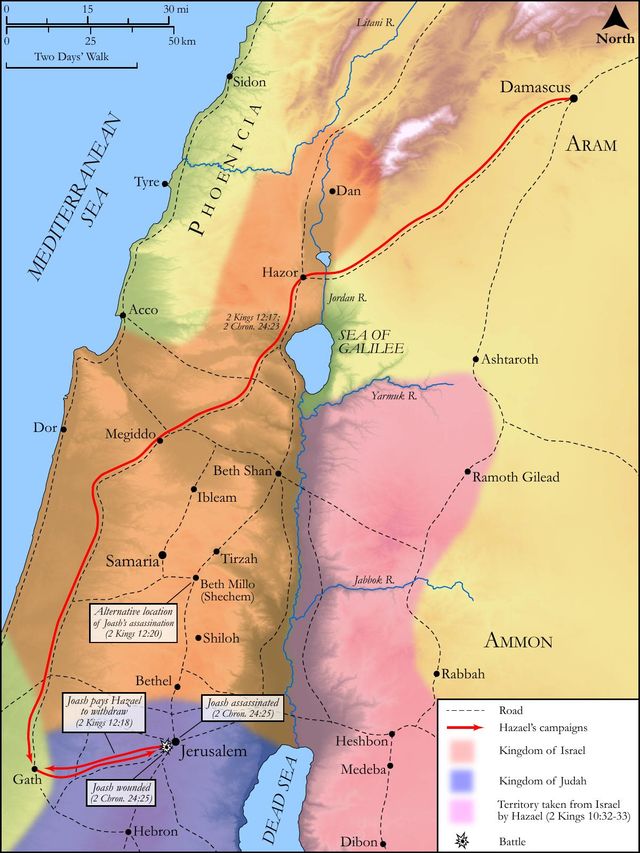
See on the biblical-era map
Study this verse
Public-domain commentary
Matthew Henry
From his Commentary on the Whole Bible. Henry comments on passages, not single verses — this entry covers 2 Chronicles 24:15–27. His three-level outline is real structure in the source text, so it is rendered as structure.
We have here a sad account of the degeneracy and apostasy of Joash. God had done great things for him; he had done something for God; but now he proved ungrateful to his God and false to the engagements he had laid himself under to him. How has the gold become dim, and the most fine gold changed! Here we find,
I.The occasions of his apostasy.
When he did that which was right it was not with a perfect heart. He never was sincere, never acted from principle, but in compliance to Jehoiada, who had helped him to the crown, and because he had been protected in the temple and rose upon the ruins of idolatry; and therefore, when the wind turned, he turned with it.
1.His good counsellor left him, and was by death removed from him. It was a mercy to him and his kingdom that Jehoiada lived so long-130 years (Ch2 24:15), by which it appears that he was born in Solomon's time, and had lived six entire reigns before this. It was an encouragement to him to go on in that good way which Jehoiada had trained him up in to see what honour was done to Jehoiada at his death: They buried him among the kings, with this honourable encomium (perhaps it was part of the inscription on his grave-stone), that he had done good in Israel. Judah is called Israel, because, the other tribes having revolted from God, they only were Israelites indeed. Note, It is the greatest honour to do good in our generations, and those who do that which is good shall have praise of the same. He had done good towards God; not that any man's goodness can extend unto him, but he had done good towards his house, in reviving the temple service, Ch2 23:8. Note, Those do the greatest good to their country that lay out themselves in their places to promote religion. Well, Jehoiada finished his course with honour; but the little religion that Joash had was all buried in his grave, and, after his death, both king and kingdom miserably degenerated. See how much one head may sustain, and what a great judgment to any prince or people the death of godly, zealous, useful men is. See how necessary it is that, as our Saviour speaks, we have salt in ourselves, that we act in religion from an inward principle, which will carry us on through all changes. Then the loss of a parent, a minister, a friend, will not involve the loss of our religion.
2.Bad counsellors got about him, insinuated themselves into his affections, wheedled him, flattered him, made obeisance to him, and, instead of condoling, congratulated him upon the death of his old tutor, as his release from the discipline he had been so long under, unworthy a man, a king. They tell him he must be priest-ridden no longer, he is now discharged from grave lessons and restraints, he may do as he pleases: and (would you think it?) the princes of Judah were the men that were so industrious to debauch him, Ch2 24:17. His father and grandfather were corrupted by the house of Ahab, from whom no better could be expected. But that the princes of Judah should be seducers to their king was very sad. But those that incline to the counsels of the ungodly will never want ungodly counsellors. They made obeisance to the king, flattered him into an opinion of his absolute power, promised to stand by him in making his royal will and pleasure pass for a law, any divine precept or institution to the contrary in any wise notwithstanding. And he hearkened to them: their discourse pleased him, and was more agreeable than Jehoiada's dictates used to be. Princes and inferior people have been many a time thus flattered into their ruin by those who have promised them liberty and dignity, but who have really brought them into the greatest servitude and disgrace.
II.The apostasy itself:
They left the house of God, and served groves and idols, Ch2 24:18. The princes, it is likely, had a request to the king, which they tell him they durst not offer while Jehoiada lived; but now they hope it will give no offence: it is that they may set up the groves and idols again which were thrown down in the beginning of his reign, for they hate to be always confined to the dull old-fashioned service of the temple. And he not only gave them leave to do it themselves, but he joined with them. The king and princes, who, a little while ago, were repairing the temple, now forsook the temple; those who had pulled down groves and idols now themselves served them. So inconstant a thing is man and so little confidence is to be put in him!
III.The aggravations of this apostasy and the additions of guilt to it.
God sent prophets to them (Ch2 24:19) to reprove them for their wickedness, and to tell them what would be in the end thereof, and so to bring them again unto the Lord. It is the work of ministers to bring people, not to themselves, but to God - to bring those again to him who have gone a whoring from him. In the most degenerate times God left not himself without witness; though they had dealt very disingenuously with God, yet he sent prophets to them to convince and instruct them, and to assure them that they should find favour with him if yet they would return; for he would rather sinners should turn and live than go on and die, and those that perish shall be left inexcusable. The prophets did their part: they testified against them; but, few or none received their testimony.
1.They slighted all the prophets; they would not give ear, were so strangely wedded to their idols that no reproofs, warnings, threatenings, nor any of the various methods which the prophets took to convince them would reclaim them. Few would hear them, fewer would heed them, but fewest of all would believe them or be governed by them.
2.They slew one of the most eminent, Zechariah the son of Jehoiada, and perhaps others. Concerning him observe,
(1.)The message which he delivered to them in the name of God, Ch2 24:20. The people were assembled in the court of the temple (for they had not quite left it), probably on occasion of some solemn feast, when this Zechariah, being filled with the spirit of prophecy, and known (it is likely) to be a prophet, stood up in some of the desks that were in the court of the priests, and very plainly, but without any provoking language, told the people of their sin and what would be the consequences of it. He did not impeach any particular persons, nor predict any particular judgments, as sometimes the prophets did, but as inoffensively as possible reminded them of what was written in the law. Let them but look into their Bibles, and there they would find, [1.] The precept they broke: "You transgress the commandments of the Lord, you know you do so, in serving groves and idols: and why will you so offend God and wrong yourselves?" [2.] The penalty they incurred: "You know, if the word of God be true, you cannot prosper in this evil way; never expect to do ill and fare well. Nay, you find already that because you have forsaken the Lord he hath forsaken you, as he told you he would," Deu 29:25; Deu 31:16, Deu 31:17. This is the work of ministers, by the word of God, as a lamp and a light, to expose the sin of men and expound the providences of God.
(2.)The barbarous treatment they gave him for his kindness and faithfulness in delivering this message to them, Ch2 24:21. By the conspiracy of the princes, or some of their party, and by the commandment of the king, who thought himself affronted by this fair warning, they stoned him to death immediately, not under colour of law, accusing him as a blasphemer, a traitor, or a false prophet, but in a popular tumult, in the court of the house of the Lord - as horrid a piece of wickedness as perhaps any we read of in all the history of the kings. The person was sacred - a priest, the place sacred - the court of the temple (the inner court, between the porch and the altar), the message yet more sacred, and we have reason to think that they knew it came from the spirit of prophecy. The reproof was just, the warning fair, both backed with scripture, and the delivery very gentle and tender; and yet so impudently and daringly do they defy God himself that nothing less than the blood of the prophet can satisfy their indignation at the prophecy. Be astonished, O heavens! at this, and tremble, O earth! that ever such villany should be committed by men, by Israelites, in contempt and violation of every thing that is just, honourable, and sacred - that a king, a king in covenant with God, should command the murder of one whom it was his office to protect and countenance! The Jews say there were seven transgressions in this; for they killed a priest, a prophet, a judge, they shed innocent blood, and polluted the court of the temple, the sabbath, and the day of expiation: for on that day, their tradition says, this happened.
(3.)The aggravation of this sin, that this Zechariah, who suffered martyrdom for his faithfulness to God and his country, was the son of Jehoiada, who had done so much good in Israel, and particularly had been as a father to Joash, Ch2 24:22. The affront done by it to God, and the contempt put on religion, are not so particularly taken notice of as the ingratitude there was in it to the memory of Jehoiada. He remembered not the kindness of the father, but slew the son for doing his duty, and what the father would have done if he had been there. Call a man ungrateful, and you can call him no worse.
(4.)The dying martyr's prophetic imprecation of vengeance upon his murderers: The Lord look upon it, and require it! This came not from a spirit of revenge, but a spirit of prophecy: He will require it. This would be the continual cry of the blood they shed, as Abel's blood cried against Cain: "Let the God to whom vengeance belongs demand blood for blood. He will do it, for he is righteous." This precious blood was quickly reckoned for in the judgments that came upon this apostate prince; it came into the account afterwards in the destruction of Jerusalem by the Chaldeans - their misusing the prophets was that which brought upon them ruin without remedy (Ch2 36:16); nay, our Saviour makes the persecutors of him and his gospel answerable for the blood of this Zechariah; so loud, so long, does the blood of the martyrs cry. See Mat 23:35. Such as this is the cry of the souls under the altar (Rev 6:10), How long ere thou avenge our blood? For it shall not always go unrevenged.
IV.The judgments of God which came upon Joash for this aggravated wickedness of his.
1.A small army of Syrians made themselves masters of Jerusalem, destroyed the princes, plundered the city, and sent the spoil of it to Damascus, Ch2 24:23, Ch2 24:24. God's people, while they kept in with God, had often been conquerors when the enemy had the advantage of the greater number; but now, on the contrary, an inconsiderable handful of Syrians routed a very great host of Israelites, because they had forsaken the Lord God of their fathers, and then they were not only put upon the level with their enemies, but opposed them with the utmost disadvantage; for their God not only departed from them, but turned to be their enemy and fought against them. The Syrians were employed as instruments in God's hand to execute judgments against Joash, though they little thought so, Isa 10:6, Isa 10:7, and see Deu 32:30.
2.God smote him with great diseases, of body, or mind, or both, either like his grandfather (Ch2 21:18), or, like Saul, an evil spirit from God troubling him. While he was plagued with the Syrians he thought that, if he could but get clear of them, he should do well enough. But, before they departed from him, God smote him with diseases. If vengeance pursue men, the end of one trouble will but be the beginning of another.
3.His own servants conspired against him. Perhaps he began to hope his disease would be cured - he was but a middle-aged man and might recover it; but he that cometh up out of the pit shall fall into the snare. When he thought he should escape death by sickness he met it by the sword. They slew him in his bed for the blood of the sons of Jehoiada, by which it should seem that he did not only slay Zechariah, but others of the sons of Jehoiada for his sake. Perhaps those that slew him intended to take vengeance for that blood; but, whether they did or not, this was what God intended in permitting them to slay him. Those that drink the blood of the saints shall have their own blood given them to drink, for they are worthy. The regicides are here named (Ch2 24:26), and it is observable that the mothers of them both were foreigners, one an Ammonitess and the other a Moabitess. The idolatrous kings, it is likely, countenanced those marriages which the law prohibited for the prevention of idolatry; and see how they resulted in their own destruction.
4.His people would not bury him in the sepulchres of the kings because he had stained his honour by his mal-administration. Let him not be written with the righteous, Psa 69:28. These judgments are called the burdens laid upon him (Ch2 24:27), for the wrath of God is a heavy burden, too heavy for any man to bear. Or it may be meant of the threatenings denounced against him by the prophets, for those are called burdens. Usually God sets some special marks of his displeasure upon apostates in this life, for warning to all to remember Lot's wife.
Continue studying 2 Chronicles 24:16 across the web’s major study libraries — every link below opens this exact verse, chapter, or book on the destination site.
Read & Compare
 BibleGatewayThis verse in more than 200 translations and 70 languages.
 Bible.comThe YouVersion reader — hundreds of translations, reading plans, and highlights.
 ESV.orgCrossway's official English Standard Version reader.
 NET BibleThe NET translation with 60,000+ translators' notes on every rendering decision.
 STEP BibleTyndale House's free study tool — original text, vocabulary, and scholarly resources.
 BibliaLogos Bible Software's free web reader.
 USCCBThe New American Bible (Revised Edition) with the U.S. bishops' study notes.
Commentaries
 BibleHub CommentariesDozens of classic commentaries on this verse, gathered on one page.
 StudyLightMore than 100 commentary sets — the largest collection on the web.
 BibleRefPlain-English commentary on what this verse means, verse by verse.
 Enduring WordDavid Guzik's free commentary on this chapter, widely used by Bible teachers.
 Bible Study ToolsVerse commentary alongside Greek and Hebrew study aids.
Original Language & Research
- BibleHub InterlinearThe verse word by word — original language, transliteration, and English.
- BibleHub LexiconEvery word's original-language definition and Strong's entry.
 Blue Letter BibleDeep-study tools — Strong's numbers, concordance, and word studies.
 SefariaThe Hebrew text with Rashi and centuries of Jewish commentary.
Sermons, Hymns & Audio


TrulyRandomVerse is not affiliated with these sites and doesn’t control their content. They’re linked because they’re genuinely useful.
Summary
Second Chronicles 24:16 records the extraordinary and unprecedented honor bestowed upon Jehoiada, the high priest, who, despite not being of royal lineage, was interred among the kings in the City of David. This singular tribute was granted because of his profound and unwavering faithfulness demonstrated throughout his life in Israel, specifically through his dedicated service to God and his steadfast loyalty to the Davidic dynasty and the spiritual and physical restoration of the temple.
Context
ShowHideLiterary Context
This verse serves as the powerful concluding statement on the life and monumental legacy of Jehoiada, immediately following the brief mention of his death at the remarkable age of 130. It stands as a profound testament to his pivotal role in Judah's history, particularly during the formative years of King Joash's reign. Jehoiada's narrative began with his courageous act of rescuing the infant Joash from the murderous purge of Athaliah and meticulously hiding him in the temple for six years. He then masterminded the coup that overthrew the usurper Athaliah, restoring the rightful Davidic king to the throne. Under Jehoiada's unwavering guidance, King Joash "did that which was right in the sight of the LORD all the days of Jehoiada the priest". This period included a significant restoration of the temple and a national spiritual revival. The verse thus marks the solemn end of an era defined by Jehoiada's righteous influence, tragically setting the stage for the subsequent decline of Joash's reign after the priest's death, as detailed in the verses immediately following.
Historical & Cultural Context
Burial within the City of David, specifically among the royal tombs, was an exclusive and highly coveted privilege reserved almost entirely for the kings of Judah who were deemed righteous and honorable in the eyes of God and the nation. It symbolized not only their elevated status but also the nation's profound recognition of their faithful rule and divine favor. For Jehoiada, a high priest and not a king by birth, to receive such an honor was truly exceptional, highlighting the immense esteem in which he was held by the people and, implicitly, by God. This honor transcended typical social and political hierarchies, underscoring the cultural value placed on integrity, courage, and faithful service to both God and the kingdom. His actions—such as preserving the sacred Davidic line, which was foundational to God's covenant promises, and zealously restoring the temple to its proper function—were seen as indispensable to the stability and spiritual well-being of the nation, earning him a place alongside the most revered monarchs.
Key Themes
ShowHideThe verse powerfully encapsulates several key themes prevalent throughout the book of Chronicles. Firstly, it emphasizes the theme of divine recognition and reward for faithfulness. Jehoiada's burial among the kings, an unprecedented honor for a non-king, underscores that true greatness and lasting legacy are not solely defined by birthright or positional authority but by one's devotion and deeds "toward God, and toward his house." This aligns with the Chronicler's consistent emphasis on immediate divine retribution and reward. Secondly, it highlights the impact of godly leadership and mentorship. Jehoiada's unwavering guidance and moral compass were instrumental in shaping King Joash's early righteous reign and in spearheading the vital temple restoration, demonstrating how one individual's integrity and spiritual influence can profoundly impact a nation's spiritual trajectory and well-being. Thirdly, the phrase "both toward God, and toward his house" articulates a holistic understanding of faithful service, encompassing both direct worship and obedience to God, and practical, diligent care for His people and institutions (the temple, the Davidic covenant). This dual commitment reflects the Chronicler's emphasis on a comprehensive covenantal relationship that impacts all spheres of life, leading to blessings and honor, as promised in passages like 1 Samuel 2:30.
Exposition and Analysis
ShowHideKey Word Analysis
ShowHideThis primitive root signifies the act of interring or placing a body in the ground. In the context of 2 Chronicles 24:16, its usage highlights the physical act of Jehoiada's interment, but the significance lies not merely in the burial itself, but in the location of the burial. The verb points to the final, solemn act of honoring a deceased individual, and here, it is elevated by the unprecedented choice of burial site, emphasizing the profound respect and honor shown to Jehoiada's earthly remains.
This word is rich in meaning, extending beyond simple moral uprightness. It describes that which is beneficial, pleasing, right, proper, excellent, advantageous, and conducive to flourishing. In Jehoiada's case, his actions were not just morally correct but profoundly salutary and restorative for Israel. He brought about a state of spiritual and national flourishing, stability, and health, making things "good" in the broadest sense for the nation, its worship, and its leadership. His deeds were wholesome and resulted in prosperity and well-being.
This term is remarkably multifaceted, referring both to the physical temple, often called "God's house," and to the royal dynasty, specifically "his house," meaning the house of David. Jehoiada's "good" was directed comprehensively toward both: he meticulously restored the dilapidated temple, ensuring proper worship and the re-establishment of the Mosaic cult, and he courageously preserved the Davidic lineage by protecting Joash, thereby safeguarding the royal house and the covenant promises associated with it. This dual meaning underscores the comprehensive and foundational nature of his faithfulness.
Verse Breakdown
ShowHide"And they buried him in the city of David among the kings"
This clause describes the extraordinary and unprecedented honor bestowed upon Jehoiada. The "city of David" refers to Jerusalem, specifically the royal burial grounds on Mount Zion, a hallowed precinct reserved for the most revered monarchs of Judah. Burial among the kings was a privilege almost exclusively reserved for righteous kings, signifying national recognition of exceptional service and divine favor. For a high priest, who was not of royal blood, to receive this honor highlights his unique and indispensable contribution to the nation's well-being and spiritual integrity, elevating him beyond his priestly office to a status akin to the most revered and faithful kings. This act was a public declaration of his exceptional merit.
"because he had done good in Israel"
This phrase provides the explicit and direct reason for the extraordinary burial. The "good" (Hebrew: ṭôwb') Jehoiada performed was not a single act but a lifetime of beneficial, righteous, and salutary deeds that had a profound positive impact on the entire nation. This encompasses his courage in preserving the Davidic line, his strategic leadership in overthrowing the usurper Athaliah, his diligent guidance of King Joash, and his zealous efforts in restoring the temple and true worship. This clause establishes a clear cause-and-effect relationship, demonstrating that the honor he received was a direct consequence of his faithful and beneficial actions for the people of God.
"both toward God, and toward his house"
This final clause specifies the two primary spheres of Jehoiada's "good" deeds, demonstrating the holistic and comprehensive nature of his faithfulness. "Toward God" refers to his zealous commitment to true worship, eradicating idolatry, re-establishing the proper temple cult, and ensuring the functioning and restoration of the sacred space. "Toward his house" refers to his unwavering loyalty and service to the Davidic dynasty (the "house" of David), ensuring its continuity and stability, which was crucial for the fulfillment of God's covenant promises regarding an everlasting kingdom. This dual focus illustrates a life fully dedicated to divine purposes and the well-being of God's people, reflecting a complete and integrated devotion.
Literary Devices
ShowHideThe verse employs several potent literary devices to underscore Jehoiada's exceptional significance and the profound impact of his life. Honorific Burial is the central device, as the unprecedented act of burying a non-king among the kings serves as a powerful symbolic gesture of national gratitude, divine approval, and lasting legacy. This exceptional burial highlights Jehoiada's unique status and the profound, positive impact of his life on the nation. The phrase "because he had done good" employs Cause and Effect, directly linking Jehoiada's righteous and beneficial actions to the extraordinary honor he received, reinforcing the biblical principle that faithfulness and diligent service are recognized and rewarded by God. Finally, the concluding phrase "both toward God, and toward his house" utilizes Parallelism (specifically, a type of complementary parallelism) to comprehensively describe the two main dimensions of Jehoiada's "good" deeds, emphasizing the breadth, completeness, and integrated nature of his service to both divine commands and human institutions.
Theological and Thematic Connections
ShowHideJehoiada's burial among the kings serves as a powerful theological statement about the nature of true greatness and divine recognition in God's economy. It transcends the typical markers of status, lineage, and earthly power, affirming that God honors those who faithfully serve Him and His purposes, regardless of their official title or position. His life demonstrates that genuine leadership, marked by integrity, courage, and a profound commitment to righteousness, leaves a lasting legacy that is valued by both God and humanity. This extraordinary honor underscores the biblical truth that a life lived in obedience to God and for the good of His people is never in vain, and that such faithfulness often receives tangible recognition, even in this life, as a foretaste of eternal reward. It reminds us that our "good deeds" are not merely moral acts but acts of worship and service that contribute to the flourishing of God's kingdom on earth and reflect the character of God Himself.
Reflection and Application
ShowHideJehoiada's life and the exceptional honor he received offer profound and enduring lessons for contemporary believers. His story challenges us to consider what truly constitutes a life well-lived and genuinely honored in God's eyes. It's not primarily about accumulating earthly power, prestige, or a grand title, but about faithful stewardship of the opportunities God gives us, whether in positions of overt leadership or behind-the-scenes influence. Jehoiada's unwavering commitment "both toward God, and toward his house" calls us to a holistic and integrated faith that impacts every sphere of our existence: our personal devotion and obedience to God, our active and sacrificial engagement with the church (God's "house" today), and our diligent contributions to the well-being of our communities and society at large. We are encouraged to be courageous in standing for truth, diligent in restoring what is broken, and committed to mentoring the next generation in righteousness and wisdom. His legacy reminds us that a life of integrity, selfless service, and unwavering faithfulness, even if seemingly unnoticed or uncelebrated by the world, is profoundly valued by God and can leave an indelible mark for good, inspiring future generations to pursue similar faithfulness and devotion.
Questions for Reflection
ShowHideFAQ
ShowHideWhy was Jehoiada buried among the kings when he was not a king?
ShowHideJehoiada's burial among the kings was an extraordinary and unprecedented honor, signaling the immense respect, gratitude, and national recognition the people of Judah held for him. Typically, this privilege was reserved exclusively for righteous kings of Judah who had served faithfully. However, Jehoiada's actions were so pivotal and beneficial to the kingdom's survival and spiritual health that he was deemed worthy of this unique distinction. He not only courageously preserved the Davidic royal line by saving the infant Joash from Athaliah's murderous purge, but he also orchestrated the restoration of the legitimate monarchy and led a significant spiritual revival, including the comprehensive repair and purification of the temple. His unwavering faithfulness, courageous leadership, and profound impact on the very existence and spiritual well-being of Judah were considered so vital that he was honored as if he were a king, underscoring that true greatness in God's eyes is measured by faithfulness, righteous impact, and selfless service, not merely by title or lineage.
Christ-Centered Fulfillment
ShowHideJehoiada's extraordinary honor, granted for his faithful service "toward God, and toward his house," powerfully foreshadows the ultimate and perfect service of Jesus Christ. While Jehoiada preserved a temporal earthly king and restored a physical temple in Jerusalem, Christ, as the eternal High Priest and King, secured an eternal kingdom and built a spiritual temple that will never decay. Jesus is the true Son of David, whose very lineage Jehoiada helped preserve, and through His perfect life, atoning death on the cross, and glorious resurrection, He established a new and everlasting covenant, making possible the full reconciliation of humanity to God. His "good" was not merely the restoration of a building but the redemption of humanity, building His "house"—the Church—not with stones, but with living stones, believers who are built into a spiritual house for God's dwelling. Unlike Jehoiada, whose profound influence waned after his death, leading to Joash's apostasy, Christ's reign is eternal, and His "good" continues to transform lives and build His kingdom until He returns in glory. The honor bestowed upon Jehoiada points to the infinitely greater honor and glory that belong to Christ, who, though he was in the form of God, did not count equality with God a thing to be grasped, but emptied himself, by taking the form of a servant, ultimately being exalted to the highest place and given the name that is above every name because of His perfect obedience and ultimate sacrifice for God and His "house," the redeemed people of God, whom He calls His own.