


1 Samuel 14:21
Bible text: King James Version (1769 Blayney text) · Public domain
Bible text: King James Version with Strong's numbers · Public domain
Bible text: Berean Standard Bible · Public domain
Bible text: American Standard Version (1901) · Public domain
Bible text: World English Bible, Messianic edition · Public domain
Bible text: Geneva Bible (1599) · Public domain
Bible text: Young's Literal Translation · Public domain
- וְהָעִבְרִיםve·ha·'iv·Rimand the HebrewsH5680Conj-w ¦ Art ¦ N-mpNoun Gentilic Plural Masculine AbsoluteוְandהָtheעִבְרִיםHebrews
- הָיוּha·Yuthey [who] were [belonging]H1961V-Qal-Perf-3cpVerb Qal Perfect 3rd Plural common gender
- לַפְּלִשְׁתִּיםla·pe·lish·Timto the PhilistinesH6430Prep-l ¦ N-mpNoun Gentilic Plural Masculine Absoluteלַto theפְּלִשְׁתִּיםPhilistines
- כְּאֶתְמוֹלke·'et·Molas yesterdayH865Prep-k ¦ N-msNoun Singular Masculine Absoluteכְּasאֶתְמוֹלyesterday
- שִׁלְשׁוֹםshil·Shomthree days agoH8032N-msNoun Singular Masculine Absolute
- אֲשֶׁר'a·SherwhoH834RelParticle Relative
- עָלוּ'a·Luthey had gone upH5927V-Qal-Perf-3cpVerb Qal Perfect 3rd Plural common gender
- עִמָּם'i·Mamwith themH5973Prep ¦ 3mpPreposition Definiteעִמָּwithםthem
- בַּמַּחֲנֶהba·ma·cha·Nehin the campH4264Prep-b ¦ N-fsNoun Singular Feminine Absoluteבַּin theמַּחֲנֶהcamp
- סָבִיבsa·Vivall aroundH5439N-csNoun Singular common gender Absolute
- וְגַםve·gamand alsoH1571Conj-w ¦ AdvAdverbוְandגַםalso
- הֵמָּהHe·mahtheyH1992Pro-3mpPronoun Personal 3rd Plural Masculine
- לִהְיוֹתlih·yOtto beH1961Prep-l ¦ V-Qal-InfVerb Qal Infinitive Constructלִtoהְיוֹתbe
- עִם'imwithH5973PrepPreposition
- יִשְׂרָאֵלYis·ra·'ElIsraelH3478N-properNoun Proper Location
- אֲשֶׁר'a·SherwhichH834RelParticle Relative
- עִם'im[was] withH5973PrepPreposition
- שָׁאוּלsha·'UlSaulH7586N-proper-mNoun Proper Masculine
- וְיוֹנָתָןve·yo·na·Tanand JonathanH3129Conj-w ¦ N-proper-mNoun Proper MasculineוְandיוֹנָתָןJonathan
English is a literal word-by-word gloss of the Hebrew, not the KJV's wording. Why?
This is the original text the KJV's translators worked from — each Hebrew word with its own literal English meaning in this verse, prepared by scholars at Tyndale House, Cambridge. The KJV translates whole sentences, not word by word, so its wording differs: one Hebrew word can become several English words, and the KJV may choose “the LORD” where the gloss reads “Yahweh”. Both are faithful — they answer different questions. For the KJV's own rendering, switch to the KJV text.
Details
See on the biblical-era map
Study this verse
Public-domain commentary
Matthew Henry
From his Commentary on the Whole Bible. Henry comments on passages, not single verses — this entry covers 1 Samuel 14:16–23. His three-level outline is real structure in the source text, so it is rendered as structure.
We have here the prosecution and improvement of the wonderful advantages which Jonathan and his armour-bearer gained against the Philistines.
I.The Philistines were, by the power of God, set against one another.
They melted away like snow before the sun, and went on beating down one another (Sa1 14:16), for (Sa1 14:20) every man's sword was against his fellow. When they fled for fear, instead of turning back upon those that chased them, they reckoned those only their enemies that stood in their way, and treated them accordingly. The Philistines were very secure, because all the swords and spears were in their hands. Israel had none except what Saul and Jonathan had. But now God showed them the folly of that confidence, by making their own swords and spears the instruments of their own destruction, and more fatal in their own hands than if they had been in the hands of Israel. See the like done, Jdg 7:22; Ch2 20:23.
II.The Israelites were hereby animated against them.
1.Notice was soon taken of it by the watchmen of Saul, those that stood sentinel at Gibeah, Sa1 14:16. They were aware that the host of the enemy was in great confusion, and that a great slaughter was made among them, and yet, upon search, they found none of their own forces absent, but only Jonathan and his servant (Sa1 14:17), which no doubt greatly animated them, and assured them that it could be no other than the Lord's doing, when there was no more of man's doing than what those two could do against a great host.
2.Saul began to enquire of God, but soon desisted. His spirit had not come down so far as to allow him to consult Samuel, though, it is probable, he was near him; for we read (Sa1 13:15) that he had come to Gibeah of Benjamin; but he called for the ark (Sa1 14:18), desiring to know whether it would be safe for him to attack the Philistines, upon the disorder they perceived them to be in. Many will consult God about their safety that would never consult him about their duty. But, perceiving by his scouts that the noise in the enemy's camp increased, he commanded the priest that officiated to break off abruptly: "Withdraw thy hand (Sa1 14:19), consult no more, wait no longer for an answer." He was very unwise indeed if (as some think) he forbade him to lift up his hands in prayer; for when Joshua was actually engaged with Amalek Moses continued still to lift up his hands. It is rather a prohibition to his enquiring of the Lord, either,
(1.)Because now he thought he did not need an answer, the case was plain enough. And yet the more evident it was that God did all the more reason he had to enquire whether he would give him leave to do any thing. Or,
(2.)Because now he would not stay for it; he was in such haste to fight a falling enemy that he would not stay to make and end of his devotions, nor hear what answer God would give him. A little thing will divert a vain and carnal mind from religious exercises. He that believeth will not make haste, such haste as this, nor reckon any business so urgent as not to allow time to take God along with him.
3.He, and all the little force he had, made a vigorous attack upon the enemy; and all the people were cried together (so the word is, Sa1 14:20), for want of the silver trumpets wherewith God appointed them to sound an alarm in the day of battle, Num 10:9. They summoned them together by shouting, and their number was not so great but that they might soon be got together. And now they seem bold and brave when the work is done to their hands. Our Lord Jesus had conquered our spiritual enemies, routed and dispersed them, so that we are cowards indeed if we will not stand to our arms when it is only to pursue the victory and to divide the spoil.
4.Every Hebrew, even those from whom one would least have expected it, now turned his hand against the Philistines.
(1.)Those that had deserted and gone over to the enemy, and were among them, now fought against them, Sa1 14:21. Some think, they were such as had been taken prisoners by them, and now they were goads in their sides. It rather seems that they went in to them voluntarily, but, now that they saw them falling, recovered the hearts of Israelites, and did valiantly for their country.
(2.)Those that had fled their colours, and hid themselves in the mountains, returned to their posts, and joined in with the pursuers (Sa1 14:22), hoping by their great zeal and officiousness, now that the danger was over and the victory sure, to atone for their former cowardice. It was not much to their praise to appear now, but it would have been more their reproach if they had not appeared. Those that are remiss and faint-hearted indeed that will not act in the cause of God when they see it victorious, as well as righteous. Thus all hands were at work against the Philistines, and every Israelite slew as many as he could, without sword or spear; yet it is said (Sa1 14:23), it was the Lord that saved Israel that day. He did it by them, for without him they could do nothing. Salvation is of the Lord.
Historical interpretation
Twelve Centuries of Reception
2 surviving comments on this verse. Each one is dated, so this reads as a timeline rather than a list.
Select a marker to jump to its quote. Markers stagger vertically where authors wrote within a few decades of each other.
And the Hebrews who had been with the Philistines yesterday and the day before, etc. Many, having been seduced by heretics and fighting against the Church with them, when they perceived the dissonance of their doctrine, and saw their dialectical subtleties surpassed by the simplicity of the Catholic faith, as if by the act of Jonathan, returned to be reconciled to the Catholic Church by the imposition of the priestly hand.
The one perfectly divine thing, the one glimpse of God's paradise given on earth, is to fight a losing battle - and not lose it.
Continue studying 1 Samuel 14:21 across the web’s major study libraries — every link below opens this exact verse, chapter, or book on the destination site.
Read & Compare
 BibleGatewayThis verse in more than 200 translations and 70 languages.
 Bible.comThe YouVersion reader — hundreds of translations, reading plans, and highlights.
 ESV.orgCrossway's official English Standard Version reader.
 NET BibleThe NET translation with 60,000+ translators' notes on every rendering decision.
 STEP BibleTyndale House's free study tool — original text, vocabulary, and scholarly resources.
 BibliaLogos Bible Software's free web reader.
 USCCBThe New American Bible (Revised Edition) with the U.S. bishops' study notes.
Commentaries
 BibleHub CommentariesDozens of classic commentaries on this verse, gathered on one page.
 StudyLightMore than 100 commentary sets — the largest collection on the web.
 BibleRefPlain-English commentary on what this verse means, verse by verse.
 Enduring WordDavid Guzik's free commentary on this chapter, widely used by Bible teachers.
 Bible Study ToolsVerse commentary alongside Greek and Hebrew study aids.
Original Language & Research
- BibleHub InterlinearThe verse word by word — original language, transliteration, and English.
- BibleHub LexiconEvery word's original-language definition and Strong's entry.
 Blue Letter BibleDeep-study tools — Strong's numbers, concordance, and word studies.
 SefariaThe Hebrew text with Rashi and centuries of Jewish commentary.
Sermons, Hymns & Audio


TrulyRandomVerse is not affiliated with these sites and doesn’t control their content. They’re linked because they’re genuinely useful.
Summary
1 Samuel 14:21 vividly describes a pivotal moment in the conflict between Israel and the Philistines, where a significant contingent of "Hebrews" who had previously been integrated into or serving the Philistine forces, decisively defected to join Saul and Jonathan. This dramatic shift, occurring amidst the divinely induced chaos and internal strife within the Philistine camp, not only swelled Israel's ranks but also underscored God's sovereign hand in turning the enemy's own resources and personnel against them, marking a crucial turning point in the battle and demonstrating a clear act of divine deliverance for His people.
Context
ShowHideLiterary Context
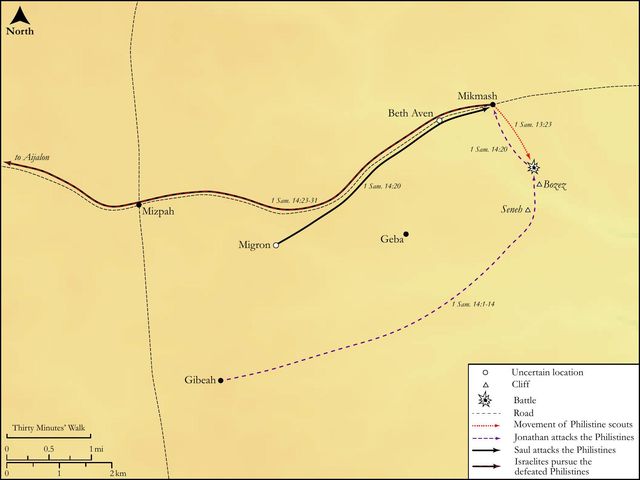
This verse is strategically placed immediately following Jonathan's audacious, faith-driven assault on a Philistine garrison, accompanied only by his armor-bearer. This daring act, empowered by divine intervention, initiated a supernatural panic and an earthquake within the Philistine camp, causing widespread confusion and leading them to turn their swords against one another, as described in 1 Samuel 14:15-20. Saul, observing the escalating chaos from Gibeah, recognized the hand of God and mobilized his own forces to pursue the disoriented enemy. Verse 21 then details a critical consequence of this divinely induced disarray: those Israelites who had been under Philistine control seized the opportune moment to switch their allegiance, further amplifying the Philistine's confusion and bolstering Israel's momentum. This event directly precedes Saul's broader pursuit of the fleeing Philistines, setting the stage for a more comprehensive Israelite victory.
Historical & Cultural Context
For an extended period leading up to this battle, the Philistines had maintained a dominant and oppressive grip over Israel. A key aspect of this subjugation was their strict monopoly over ironworking, effectively preventing the Israelites from forging their own weapons and even essential agricultural tools, thereby ensuring Philistine military superiority (1 Samuel 13:19-22). Within this context of severe oppression, many Israelites, referred to as "Hebrews" in this verse, found themselves living within Philistine territories or even serving in their auxiliary forces. This service was often a result of coercion, economic necessity, or conscription, as the Philistines commonly integrated conquered or subjugated peoples into their military or labor structures. The phrase "went up with them into the camp from the country round about" suggests these individuals were part of the Philistine logistical or support apparatus, perhaps as forced laborers, porters, or even lightly armed auxiliaries. Their presence highlights the pervasive nature of Philistine influence and the widespread, dire circumstances faced by Israelites across their ancestral lands.
Key Themes
ShowHideThe defection of these "Hebrews" in 1 Samuel 14:21 powerfully reinforces several overarching themes found in 1 Samuel 14 and the broader narrative of 1 Samuel. Firstly, it underscores Divine Intervention and Sovereignty, demonstrating how God can orchestrate seemingly chaotic events—such as the Philistine's internal strife and panic—to bring about His purposes and deliver His people. The turning of these Hebrews was not merely opportunistic but a direct consequence of the divine disarray, a clear sign of God's favor upon Jonathan and Saul's efforts (1 Samuel 14:6). Secondly, it highlights the theme of Shifting Allegiance and Loyalty. These individuals, previously aligned with or coerced by the oppressor, now decisively choose to stand with their own people, reflecting the volatile nature of ancient warfare and the deep-seated desire for liberation. This shift contributes significantly to the theme of National Unity and Reclamation, as scattered or subjugated Israelites are drawn back into the fold, strengthening the nascent Israelite kingdom and affirming their identity against foreign domination.
Exposition and Analysis
ShowHideKey Word Analysis
ShowHideThis term (H5680) is a patronymic from Eber, referring to a descendant of Eber or an Eberite. In this context, it specifically designates Israelites who were distinct from those directly under Saul's command, often used by foreigners to refer to the Israelites (e.g., Genesis 39:14). Here, it likely refers to those Israelites who, due to prolonged Philistine oppression, had been living among or serving the Philistines, perhaps as forced laborers, auxiliary troops, or simply residents of Philistine-controlled territories. Their turning signifies a powerful reassertion of their national and covenantal identity.
The Hebrew verb (H5927) is a primitive root meaning "to ascend," "to be high," or "to mount." It is used in a wide variety of senses, both literal and figurative, including "to arise," "to come up," or "to go up." In this verse, it describes the action of these Hebrews who had "gone up" with the Philistines into their camp. This implies their physical movement and integration into the Philistine military operations, highlighting their prior association and proximity to the enemy's forces.
This term (H3478), derived from "he will rule as God," is the symbolical name given to Jacob and subsequently refers to his posterity, the nation of Israel. In this verse, it identifies the people with whom Saul and Jonathan were fighting, representing the true covenant people of God. The phrase "turned to be with the Israelites" underscores the dramatic shift in loyalty, as these previously displaced or coerced "Hebrews" now align themselves with their rightful national and spiritual kin, reinforcing the concept of a unified people under God's chosen leadership.
Verse Breakdown
ShowHide"Moreover the Hebrews [that] were with the Philistines before that time"
This initial clause precisely identifies the group in question: ethnic Israelites ("Hebrews") who, prior to the immediate battle, had been associated with or serving the Philistine forces. This association could have been involuntary, such as forced labor or conscription, or a means of survival under the Philistine's oppressive dominion.
"which went up with them into the camp [from the country] round about"
This phrase further clarifies their previous role and geographical origin. They were integrated into the Philistine military apparatus, having "gone up" with them into their encampment. The "country round about" suggests they were drawn from the surrounding Israelite territories that were under Philistine control, indicating their direct involvement and proximity to the Philistine war machine.
"even they also [turned] to be with the Israelites that [were] with Saul and Jonathan."
This is the climactic statement of the verse, detailing the dramatic and decisive shift in allegiance. Amidst the Philistine's internal chaos and panic, these "Hebrews" seized the opportune moment to abandon their Philistine association. They actively and decisively "turned" to join their Israelite brethren, who were fighting under the leadership of King Saul and his son Jonathan. This act significantly bolstered Israel's strength, further demoralized the Philistines, and effectively turned the enemy's own auxiliary forces against them.
Literary Devices
ShowHideThe narrative of 1 Samuel 14:21 powerfully employs Irony and Dramatic Reversal. The Irony is profound: the Philistines, who had long oppressed Israel and even conscripted some of their people into service, now find those very "Hebrews" turning against them, directly contributing to their downfall. Their own resources and personnel, previously instruments of their dominance, become agents of their defeat. This unexpected turn of events highlights the sovereign hand of God, who orchestrates circumstances to turn the tables on the oppressor. The verse also functions as a moment of Dramatic Reversal in the battle's momentum. The sudden and decisive defection of these Hebrews signals a significant turning point, amplifying the Philistine's panic and bolstering Israel's confidence and numbers. It represents a rapid transformation, moving from a situation of Philistine dominance and Israelite subjugation to one of Israelite resurgence, largely due to an internal collapse within the enemy's ranks.
Theological and Thematic Connections
ShowHideThe defection of the "Hebrews" in 1 Samuel 14:21 profoundly illustrates God's sovereign ability to work through unexpected means and turn the tide of human events. It underscores that even in situations of deep oppression and apparent disadvantage, God can create opportune moments for liberation and unity. This moment is not merely a tactical victory but a powerful theological statement: God is actively fighting for His people, even using the very elements of their oppression to bring about their deliverance. It speaks to the divine power that can break bonds, reorient loyalties, and gather a scattered people, transforming former adversaries or coerced servants into willing participants in God's redemptive plan. This event serves as a powerful reminder that true allegiance ultimately belongs to God and His chosen people, and that His call to freedom can manifest in dramatic, opportune moments, calling individuals to choose whom they will serve.
Reflection and Application
ShowHideThe turning of the "Hebrews" in 1 Samuel 14:21 offers a compelling metaphor for the decisive choices believers are called to make in their spiritual journey. Just as these individuals broke free from their association with the Philistines to join their true brethren, we are called to renounce allegiances to the world's oppressive practices—be it sin, self-reliance, or the dictates of secular culture—and commit wholeheartedly to Christ and His kingdom. This often involves a radical reorientation of our lives, a profound "turning" from old ways to new, from spiritual bondage to true freedom in Christ. The chaos and confusion in the Philistine camp created an opportunity for these Hebrews; similarly, God can use moments of crisis, upheaval, or conviction in our lives or in the broader world to prompt a decisive commitment to Him. It reminds us that God is always working to draw people to Himself, and our response should be one of courageous and unwavering allegiance, embracing our true identity as His children and joining His ongoing work in the world.
Questions for Reflection
ShowHideFAQ
ShowHideWho were these "Hebrews" and why were they with the Philistines?
ShowHideThese "Hebrews" were ethnic Israelites who, due to the long-standing and severe Philistine oppression, found themselves living within Philistine-controlled territories or even serving in their auxiliary forces. The Philistines had a military and economic monopoly over Israel (1 Samuel 13:19-22), which meant many Israelites were subjugated, forced into labor, or conscripted into Philistine service to survive. They were likely part of the Philistine logistical support or lightly armed auxiliaries, possibly even those who had sought refuge or subsistence under Philistine rule. Their presence highlights the deep penetration of Philistine influence and the dire circumstances faced by many Israelites at that time.
What caused them to "turn" and join Saul and Jonathan?
ShowHideTheir "turning" was a direct response to the divinely orchestrated chaos and panic that erupted within the Philistine camp (1 Samuel 14:15-20). Jonathan's bold, faith-filled attack, empowered by God, caused the Philistines to turn their swords against one another, creating immense confusion and disarray. This sudden and dramatic shift in the battle's momentum presented a clear opportunity for these oppressed Hebrews. Seeing the Philistines in disarray and the Israelites gaining the upper hand, they seized the moment to break free from their forced allegiance and rejoin their own people, driven by a desire for liberation and a recognition of God's hand in the unfolding events.
Christ-Centered Fulfillment
ShowHideThe dramatic "turning" of the Hebrews from Philistine service to join Israel's ranks in 1 Samuel 14:21 finds its ultimate and most profound fulfillment in the spiritual liberation and transformation offered by Jesus Christ. Just as these Hebrews were under the oppressive dominion of the Philistines, humanity is born under the spiritual dominion of sin and death, enslaved to its dictates (Romans 6:16-17). Christ, through His decisive victory on the cross and resurrection, breaks the power of this spiritual oppression, much like Jonathan's attack shattered the Philistine's hold. He calls all who are held captive by sin to "turn"—to repent and believe—thereby shifting their allegiance from the kingdom of darkness to the glorious kingdom of light (Colossians 1:13-14). This turning is not merely an opportunistic choice but a divine invitation to new life and a new identity, transforming former enemies of God into adopted children and co-heirs with Christ (John 1:12). The "Hebrews" found their true place and purpose with Saul and Jonathan; likewise, believers find their ultimate freedom, belonging, and purpose in Christ, who sets them truly free (John 8:36) and makes them a new creation (2 Corinthians 5:17).