


1 Kings 17:4
Bible text: King James Version (1769 Blayney text) · Public domain
Bible text: Berean Standard Bible · Public domain
Bible text: American Standard Version (1901) · Public domain
Bible text: World English Bible, Messianic edition · Public domain
Bible text: Geneva Bible (1599) · Public domain
Bible text: Young's Literal Translation · Public domain
- וְהָיָהve·ha·Yahand it will beH1961Conj-w ¦ V-Qal-ConsecPerf-3msVerb Qal Consecutive Perfect 3rd Singular Masculineוְandהָיָהit will be
- מֵהַנַּחַלme·ha·Na·chalfrom the wadiH5158Prep-m ¦ Art ¦ N-msNoun Singular Masculine Absoluteמֵfromהַtheנַּחַלwadi
- תִּשְׁתֶּהtish·Tehyou will drinkH8354V-Qal-Imperf-2msVerb Qal Imperfect 2nd Singular Masculine
- וְאֶתve·'Etand <obj.>H853Conj-w ¦ DirObjMParticle Object Indicatorוְandאֶת<obj.>
- הָעֹרְבִיםha·'o·re·Vimthe ravensH6158Art ¦ N-mpNoun Plural Masculine Absoluteהָtheעֹרְבִיםravens
- צִוִּיתִיtzi·Vi·tiI have commandedH6680V-Piel-Perf-1csVerb Piel Perfect 1st Singular common gender
- לְכַלְכֶּלְךָle·khal·kel·Khato supply youH3557Prep-l ¦ V-Piel-Inf ¦ 2msVerb Piel Infinitive Constructלְtoכַלְכֶּלְsupplyךָyou
- שָׁםShamthereH8033AdvAdverb
English is a literal word-by-word gloss of the Hebrew, not the KJV's wording. Why?
This is the original text the KJV's translators worked from — each Hebrew word with its own literal English meaning in this verse, prepared by scholars at Tyndale House, Cambridge. The KJV translates whole sentences, not word by word, so its wording differs: one Hebrew word can become several English words, and the KJV may choose “the LORD” where the gloss reads “Yahweh”. Both are faithful — they answer different questions. For the KJV's own rendering, switch to the KJV text.
Details
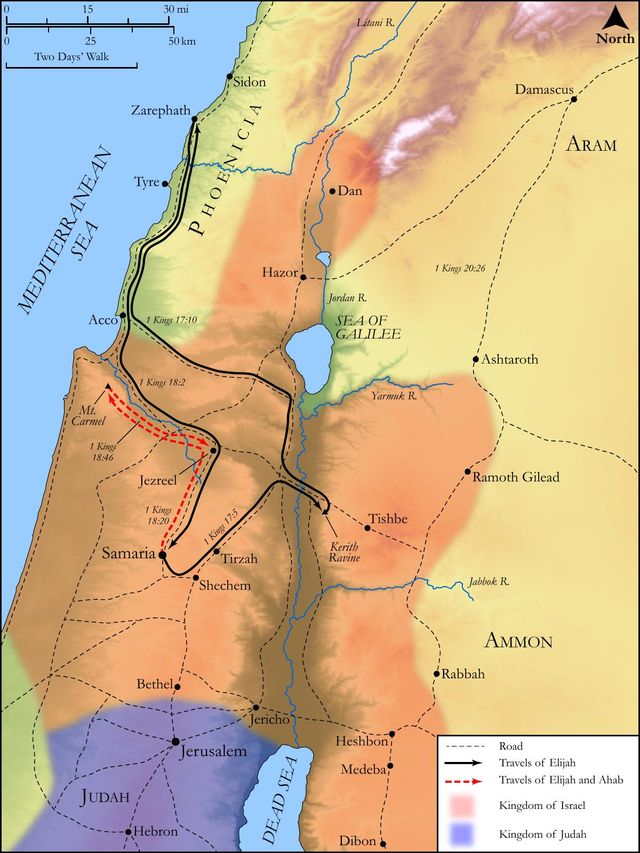
See on the biblical-era maps

Study this verse
Public-domain commentary
Matthew Henry
From his Commentary on the Whole Bible. Henry comments on passages, not single verses — this entry covers 1 Kings 17:1–7. His four-level outline is real structure in the source text, so it is rendered as structure.
The history of Elijah begins somewhat abruptly. Usually, when a prophet enters, we have some account of his parentage, are told whose son he was and of what tribe; but Elijah drops (so to speak) out of the clouds, as if, like Melchisedek, he were without father, without mother, and without descent, which made some of the Jews fancy that he was an angel sent from heaven; but the apostle has assured us that he was a man subject to like passions as we are (Jam 5:17), which perhaps intimates, not only that he was liable to the common infirmities of human nature, but that, by his natural temper, he was a man of strong passions, more hot and eager than most men, and therefore the more fit to deal with the daring sinners of the age he lived in: so wonderfully does God suit men to the work he designs them for. Rough spirits are called to rough services. The reformation needed such a man as Luther to break the ice. Observe, 1. The prophet's name: Elijahu - "My God Jehovah is he" (so it signifies), "is he who sends me and will own me and bear me out, is he to whom I would bring Israel back and who alone can effect that great work." 2. His country: He was of the inhabitants of Gilead, on the other side Jordan, either of the tribe of Gad or the half of Manasseh, for Gilead was divided between them; but whether a native of either of those tribes is uncertain. The obscurity of his parentage was no prejudice to his eminency afterwards. We need not enquire whence men are, but what they are: if it be a good thing, no matter though it come out of Nazareth. Israel was sorely wounded when God sent them this balm from Gilead and this physician thence. He is called a Tishbite from Thisbe, a town in that country. Two things we have an account of here in the beginning of his story: -
I.How he foretold a famine, a long and grievous famine, with which Israel should be punished for their sins.
That fruitful land, for want of rain, should be turned into barrenness, for the iniquity of those that dwelt therein. He went and told Ahab this; did not whisper it to the people, to make them disaffected to the government, but proclaimed it to the king, in whose power it was to reform the land, and so to prevent the judgment. It is probable that he reproved Ahab for his idolatry and other wickedness, and told him that unless he repented and reformed this judgment would be brought upon his land. There should be neither dew nor rain for some years, none but according to my word, that is, "Expect none till you hear from me again." The apostle teaches us to understand this, not only of the word of prophecy, but the word of prayer, which turned the key of the clouds, Jam 5:17, Jam 5:18. He prayed earnestly (in a holy indignation at Israel's apostasy, and a holy zeal for the glory of God, whose judgments were defied) that it might not rain; and, according to his prayers, the heavens became as brass, till he prayed again that it might rain. In allusion to this story it is said of God's witnesses (Rev 11:6), These have power to shut heaven, that it rain not in the days of their prophecy. Elijah lets Ahab know,
1.That the Lord Jehovah is the God of Israel, whom he had forsaken.
2.That he is a living God, and not like the gods he worshipped, which were dead dumb idols.
3.That he himself was God's servant in office, and a messenger sent from him: "It is he before whom I stand, to minister to him," or "whom IO now represent, in whose stead I stand, and in whose name I speak, in defiance of the prophets of Baal and the groves." 4. That, notwithstanding the present peace and prosperity of the kingdom of Israel, God was displeased with them for their idolatry and would chastise them for it by the want of rain (which, when he withheld it, it was not in the power of the gods they served to bestow; for are there any of the vanities of the heathen that can give rain? Jer 14:22), which would effectually prove their impotency, and the folly of those who left the living God, to make their court to such as could do neither good nor evil; and this he confirms with a solemn oath - As the Lord God of Israel liveth, that Ahab might stand the more in awe of the threatening, the divine life being engaged for the accomplishment of it. 5. He lets Ahab know what interest he had in heaven: It shall be according to my word. With what dignity does he speak when he speaks in God's name, as one who well understood that commission of a prophet (Jer 1:10), I have set thee over the nations and over the kingdoms. See the power of prayer and the truth of God's word; for he performeth the counsel of his messengers.
II.How he was himself taken care of in that famine.
1.How he was hidden. God bade him go and hide himself by the brook Cherith, Kg1 17:3. This was intended, not so much for his preservation, for it does not appear that Ahab immediately sought his life, but as a judgment to the people, to whom, if he had publicly appeared, he might have been a blessing both by his instructions and his intercession, and so have shortened the days of their calamity; but God had determined it should last three years and a half, and therefore, so long, appointed Elijah to abscond, that he might not be solicited to revoke the sentence, the execution of which he had said should be according to his word. When God speaks concerning a nation, to pluck up and destroy, he finds some way or other to remove those that would stand in the gap to turn away his wrath. It bodes ill to a people when good men and good ministers are ordered to hide themselves. When God intended to send rain upon the earth then he bade Elijah go and show himself to Ahab, Kg1 18:1. For the present, in obedience to the divine command, he went and dwelt all alone in some obscure unfrequented place, where he was not discovered, probably among the reeds of the brook. If Providence calls us to solitude and retirement, it becomes us to acquiesce; when we cannot be useful we must be patient, and when we cannot work for God we must sit still quietly for him.
2.How he was fed. Though he could not work there, having nothing to do but to meditate and pray (which would help to prepare him for his usefulness afterwards), yet he shall eat, for he is in the way of his duty, and verily he shall be fed, in the day of famine he shall be satisfied. When the woman, the church, is driven into the wilderness, care it taken that she be fed and nourished there, time, times, and half a time, that is, three years and a half, which was just the time of Elijah's concealment. See Rev 12:6, Rev 12:14. Elijah must drink of the brook, and the ravens were appointed to bring him meat (Kg1 17:4) and did so, Kg1 17:6. Here,
(1.)The provision was plentiful, and good, and constant, bread and flesh twice a day, daily bread and food convenient. We may suppose that he fared not so sumptuously as the prophets of the groves, who did eat at Jezebel's table (Kg1 18:19), and yet better than the rest of the Lord's prophets, whom Obadiah fed with bread and water, Kg1 18:4. It ill becomes God's servants, especially his servants the prophets, to be nice and curious about their food and to affect dainties and varieties; if nature be sustained, no matter though the palate be not pleased; instead of envying those who have daintier fare, we should think how many there are, better than we, who live comfortably upon coarser fare and would be glad of our leavings. Elijah had but one meal brought him at a time, every morning and every evening, to teach him not to take thought for the morrow. Let those who have but from hand to mouth learn to live upon Providence, and trust it for the bread of the day in the day; thank God for bread this day, and let tomorrow bring bread with it.
(2.)The caterers were very unlikely; the ravens brought it to him. Obadiah, and others in Israel that had not bowed the knee to Baal, would gladly have entertained Elijah; but he was a man by himself, and must be red in an extraordinary way. He was a figure of John the baptist, whose meat was locusts and wild honey. God could have sent angels to minister to him, as he did afterwards (Oba 1:19 :5) and as he did to our Saviour (Mat 4:11), but he chose to send by winged messengers of another nature, to show that when he pleases he can serve his own purposes by the meanest creatures as effectually as by the mightiest. If it be asked whence the ravens had this provision, how and where it was cooked, and whether they came honestly by it, we must answer, as Jacob did (Gen 27:20), The Lord our God brought it to them, whose the earth is and the fulness thereof, the world and those that dwell therein. But why ravens?
[1.]They are birds of prey, ravenous devouring creatures, more likely to have taken his meat from him, or to have picked out his eyes (Pro 30:17); but thus Samson's riddle is again unriddled, Out of the eater comes forth meat.
[2.]They are unclean creatures.Every raven after his kind was, by the law, forbidden to be eaten (Lev 11:15), yet Elijah did not think the meat they brought ever the worse for that, but ate and gave thanks, asking no question for conscience' sake. Noah's dove was to him a more faithful messenger than his raven; yet here the ravens are faithful and constant to Elijah.
[3.]Ravens feed on insects and carrion themselves, yet they brought the prophet man's meat and wholesome food. It is a pity that those who bring the bread of life to others should themselves take up with that which is not bread.
[4.]Ravens could bring but a little, and broken meat, yet Elijah was content with such things as he had, and thankful that the was fed, though not feasted.
[5.]Ravens neglect their own young ones, and do not feed them; yet when God pleases they shall feed his prophet. Young lions and young ravens may lack, and suffer hunger, but not those that fear the Lord, Psa 34:10.
[6.]Ravens are themselves fed by special providence (Job 38:41; Psa 147:9), and now they fed the prophet. Have we experienced God's special goodness to us and ours? Let us reckon ourselves obliged thereby to be kind to those that are his, for his sake. Let us learn hence, First, To acknowledge the sovereignty and power of God over all the creatures; he can make what use he pleases of them, either for judgment or mercy. Secondly, To encourage ourselves in God in the greatest straits, and never to distrust him. He that could furnish a table in the wilderness, and make ravens purveyors, cooks, and servitors to his prophet, is able to supply all our need according to his riches in glory.
Thus does Elijah, for a great while, eat his morsels alone, and his provision of water, which he has in an ordinary way from the brook, fails him before that which he has by miracle. The powers of nature are limited, but not the powers of the God of nature. Elijah's brook dried up (Kg1 17:7) because there was no rain. If the heavens fail, earth fails of course; such are all our creature-comforts; we lose them when we most need them, like the brooks in summer, Job 6:15. But there is a river which makes glad the city of God and which never runs dry (Psa 46:4), a well of water that springs up to eternal life. Lord, give us that living water!
Continue studying 1 Kings 17:4 across the web’s major study libraries — every link below opens this exact verse, chapter, or book on the destination site.
Read & Compare
 BibleGatewayThis verse in more than 200 translations and 70 languages.
 Bible.comThe YouVersion reader — hundreds of translations, reading plans, and highlights.
 ESV.orgCrossway's official English Standard Version reader.
 NET BibleThe NET translation with 60,000+ translators' notes on every rendering decision.
 STEP BibleTyndale House's free study tool — original text, vocabulary, and scholarly resources.
 BibliaLogos Bible Software's free web reader.
 USCCBThe New American Bible (Revised Edition) with the U.S. bishops' study notes.
Commentaries
 BibleHub CommentariesDozens of classic commentaries on this verse, gathered on one page.
 StudyLightMore than 100 commentary sets — the largest collection on the web.
 BibleRefPlain-English commentary on what this verse means, verse by verse.
 Enduring WordDavid Guzik's free commentary on this chapter, widely used by Bible teachers.
 Bible Study ToolsVerse commentary alongside Greek and Hebrew study aids.
Original Language & Research
- BibleHub InterlinearThe verse word by word — original language, transliteration, and English.
- BibleHub LexiconEvery word's original-language definition and Strong's entry.
 Blue Letter BibleDeep-study tools — Strong's numbers, concordance, and word studies.
 SefariaThe Hebrew text with Rashi and centuries of Jewish commentary.
Sermons, Hymns & Audio


TrulyRandomVerse is not affiliated with these sites and doesn’t control their content. They’re linked because they’re genuinely useful.
Summary
1 Kings 17:4 unveils God's extraordinary and precise provision for the prophet Elijah during a severe drought in Israel. Following Elijah's bold declaration of no rain, God directs him to the secluded brook Cherith, promising both a water source and miraculous sustenance delivered by ravens. This verse powerfully underscores God's meticulous sovereign care for His servant, His capacity to employ unconventional and even seemingly impure means, and the vital necessity of complete obedience and unwavering trust in His divine plan, even amidst the most desperate and isolating circumstances.
Context
ShowHideLiterary Context
This pivotal verse immediately follows Elijah's dramatic and audacious confrontation with King Ahab in 1 Kings 17:1, where the prophet pronounces a severe, multi-year drought as divine judgment against Israel's rampant idolatry, particularly the state-sponsored worship of Baal. The declaration sets the stage for a period of intense national crisis and famine. God's subsequent instruction to Elijah in 1 Kings 17:3 to "Go from here, and turn eastward, and hide thyself by the brook Cherith, that is before Jordan" is a divine command for strategic retreat and isolation, a stark contrast to the public prophetic act. Verse 4 then details the specific, miraculous means by which God will sustain Elijah in this hidden place, emphasizing God's immediate, intimate, and supernatural care for His servant's safety and sustenance in the very judgment Elijah himself announced. This divine provision demonstrates God's faithfulness to His prophet even as He brings judgment upon the land.
Historical & Cultural Context
The historical setting is the tumultuous reign of King Ahab and Queen Jezebel, a period characterized by unprecedented state-sponsored Baal worship and severe moral decay in Israel, as detailed in 1 Kings 16:30-33. Baal was the Canaanite storm god, revered as the bringer of rain and fertility. Elijah's prophecy of drought directly challenges Baal's supposed authority, unequivocally demonstrating Yahweh's absolute sovereignty over nature and His power to withhold rain. The ensuing drought would have been a devastating national crisis, leading to widespread famine, disease, and death. Culturally, ravens were considered unclean animals under Mosaic Law (Leviticus 11:15), typically scavengers, and certainly not associated with benevolent provision. Their use here highlights God's transcendence of human categories and His capacity to repurpose any part of His creation for His divine purposes, even those considered ritually impure or naturally predatory. The brook Cherith itself, likely a wadi (a seasonal stream), would have been a remote, desolate location, emphasizing Elijah's complete and total dependence on God for survival.
Key Themes
ShowHideThe verse powerfully contributes to several overarching themes within 1 Kings and the broader biblical narrative. Foremost is the theme of Divine Provision, showcasing God's unwavering faithfulness to sustain His chosen instruments, even in the most dire circumstances. This is not merely general provision but a highly specific and miraculous intervention, underscoring God's meticulous care for His servant's every need. Another crucial theme is God's Sovereignty over Creation, as He commands not only the elements (drought) but also the creatures (ravens) to fulfill His will, demonstrating His absolute control over all natural laws and instincts, as seen in Psalm 147:9. Finally, the narrative highlights Obedience and Trust, as Elijah's survival is entirely predicated on his immediate and complete adherence to God's seemingly illogical instructions. His willingness to retreat and rely on such unconventional means of sustenance serves as a profound example of faith in the face of uncertainty, a recurring motif throughout the lives of God's prophets, mirroring the call to trust in God's care found in Matthew 6:26.
Exposition and Analysis
ShowHideKey Word Analysis
ShowHideThe Hebrew verb שָׁתָה (shâthâh), meaning "to imbibe," signifies the act of taking in liquid. In the context of a severe drought, the simple act of drinking becomes a profound symbol of life and survival. The divine command for Elijah to "drink of the brook" underscores God's direct provision for his most basic and immediate physiological need, highlighting that even in the midst of widespread scarcity, God ensures His prophet's sustenance. This word emphasizes the directness and certainty of God's care.
The term נַחַל (nachal) refers to a wadi, a seasonal stream or torrent bed that typically flows only during the rainy season and often dries up during prolonged dry spells. This detail is crucial, as it implies a temporary and finite source of water, foreshadowing the eventual drying up of the brook mentioned in 1 Kings 17:7 and God's subsequent command for Elijah to move to Zarephath. The use of "brook" here emphasizes Elijah's complete dependence on God for daily provision, as even this initial source of sustenance was not permanent and was subject to God's timing and the severity of the drought.
The Hebrew verb צָוָה (tsâvâh), translated as "commanded," is a strong term denoting an authoritative, irresistible divine decree. It signifies that the ravens' actions were not coincidental, natural, or instinctual, but rather a direct, supernatural intervention by God. This verb emphasizes God's absolute sovereignty over all creation, including the animal kingdom, overriding the ravens' natural predatory and scavenging instincts to serve His specific purpose. It highlights the miraculous nature of Elijah's provision and God's power to orchestrate events beyond human comprehension.
The Hebrew word עֹרֵב (‘ôrêb) specifically denotes ravens. These birds were considered unclean under Mosaic Law (Leviticus 11:15) and were known for their scavenging habits, not for sharing or providing food. Their selection as providers is profoundly significant, serving as a powerful demonstration of God's ability to use any means, however unexpected, seemingly inappropriate, or ritually impure by human standards, to accomplish His divine will. This choice underscores the miraculous nature of Elijah's sustenance and God's independence from human conventions or limitations.
The Hebrew verb כּוּל (kûwl) carries a broad meaning encompassing "to contain," "to sustain," "to nourish," or "to provide sustenance." In this context, it specifically refers to the act of providing food. The use of this verb highlights the ongoing, consistent nature of the provision. It wasn't a one-time event, but a sustained, daily act of divine nourishment. This emphasizes God's faithfulness to maintain Elijah's life throughout his time by the brook, ensuring his physical well-being in a desolate environment.
Verse Breakdown
ShowHide"And it shall be, [that] thou shalt drink of the brook;"
This initial clause establishes the first, and immediate, component of God's provision for Elijah. The phrase "it shall be" (or "it will come to pass") conveys the certainty and divine decree of this arrangement, indicating a divinely ordained outcome. The "brook" (Cherith) is designated as Elijah's vital source of water, a critical necessity during the declared drought. This demonstrates God's direct involvement in securing Elijah's most basic need, showcasing His meticulous care for His prophet's survival in an otherwise desolate and parched land.
"and I have commanded the ravens to feed thee there."
This second clause reveals the extraordinary and miraculous nature of God's provision for food. The explicit declaration "I have commanded" emphasizes God's absolute sovereign control over all creation, overriding the natural instincts of ravens, which are typically scavengers and not providers, and were considered ritually unclean. This direct command ensures Elijah's sustenance in a place where human aid would be impossible, highlighting God's limitless power to use any means, even those deemed unlikely or impure by human standards, to accomplish His will. The adverb "there" reinforces the specific location by the brook Cherith as the precise site of this ongoing divine miracle.
Literary Devices
ShowHideThe passage employs several potent literary devices that amplify its theological message. Divine Command is central, as God explicitly states His direct intervention ("I have commanded"), underscoring His absolute sovereignty over nature and His unwavering intention to sustain Elijah. This command highlights the miraculous nature of the provision, as it defies the natural behavior of ravens. There is also a strong element of Irony in God choosing ravens—unclean birds known for scavenging and often associated with ill omens—to provide clean, life-sustaining food for His prophet. This choice subverts human expectations and emphasizes God's power to work through unconventional means, demonstrating that His ways are profoundly higher than human ways. Furthermore, the narrative uses Symbolism: the brook Cherith, a temporary water source in a time of drought, symbolizes the finite nature of earthly provisions and the constant, moment-by-moment need for continuous divine dependence. The ravens, often associated with judgment or desolation in other biblical contexts, here become instruments of life and sustenance, symbolizing God's ability to transform even the seemingly negative or impure into a source of blessing. The entire episode serves as a powerful Foreshadowing of God's continued, often surprising, provision for Elijah throughout the drought, culminating in the miracle at Zarephath (1 Kings 17:8-16), reinforcing the overarching theme of God's unwavering faithfulness to His obedient servants.
Theological and Thematic Connections
ShowHideThe divine provision for Elijah at the brook Cherith is a profound theological statement on God's active, personal involvement in the lives of His faithful servants. It demonstrates that God's care is not abstract but intensely practical, extending to the most basic human needs of food and water, especially in times of crisis and isolation. This episode underscores God's absolute sovereignty over all creation, as He commands both the elements (the drought that dries the brook) and the creatures (the ravens) to serve His precise purposes. It challenges human notions of what is possible or proper, revealing God's unconventional methods and His ability to work outside human limitations or expectations. Furthermore, it highlights the critical importance of radical obedience and unwavering trust; Elijah's very survival hinges entirely on his willingness to follow God's specific, and seemingly strange, instructions without question. This narrative serves as a powerful testament to God's faithfulness, assuring believers that when they walk in obedience, God will provide, often in ways that defy natural explanation, thereby strengthening their faith and dependence on Him alone.
Reflection and Application
ShowHideThe account of Elijah at the brook Cherith offers a timeless and profound lesson in divine provision and radical trust. In our own lives, we often encounter "droughts"—periods of scarcity, uncertainty, or intense challenge where conventional solutions seem to vanish, and our human resources are depleted. This passage serves as a powerful reminder that God's resources are limitless, and His methods are not bound by human logic, societal norms, or our limited expectations. When God calls us to a particular path, even one that leads to isolation, vulnerability, or what appears to be a dead end, He simultaneously commits to providing for us in ways we cannot foresee or orchestrate. Our role, like Elijah's, is one of simple, unwavering obedience and profound trust. We are called to go where He sends, to wait on His timing, and to receive His provision, no matter how unconventional or even undignified it may seem from a human perspective. This narrative encourages us to release our need for control and our reliance on visible means, instead cultivating a deeper, moment-by-moment dependence on the invisible God who "commands" even the ravens to serve His purposes. It challenges us to look beyond our immediate, often daunting, circumstances and fix our gaze on the faithful Provider, confident that He will sustain us through every wilderness experience, building our faith in the process.
Questions for Reflection
ShowHideFAQ
ShowHideWhy did God choose ravens, which were considered unclean, to feed Elijah?
ShowHideGod's choice of ravens is profoundly significant and serves multiple theological and practical purposes. First, it powerfully demonstrates His absolute sovereignty over all creation, including animals that operate by instinct. By commanding ravens—birds known for scavenging and not sharing, and often associated with death or desolation—to deliver food, God highlights His ability to override natural laws and use any means, however unlikely or contrary to their nature, to accomplish His will. Second, it underscores the undeniably miraculous nature of the provision. If the food had come from a human source, it might have been attributed to human kindness or ingenuity; but ravens make it undeniably divine. Third, the fact that ravens were considered "unclean" under Mosaic Law (Leviticus 11:15) adds a layer of theological depth. It shows God's transcendence of ritual purity laws when it comes to sustaining His prophet, emphasizing that His life-giving power and provision are not constrained by human categories, religious conventions, or even the Law He Himself established. This unconventional method also served to isolate Elijah further, forcing him into complete dependence on God alone, away from any human aid or traditional means of sustenance, thereby deepening his faith.
How long was Elijah at the brook Cherith, and what happened after the brook dried up?
ShowHideThe Bible does not specify the exact duration Elijah stayed by the brook Cherith, but it implies a significant period, likely many months, as the drought was severe and prolonged across the land. 1 Kings 17:7 states that "it came to pass after a while, that the brook dried up, because there had been no rain in the land." This drying up of the brook was not a failure of God's provision but rather a divinely orchestrated sign that the next phase of His plan for Elijah was to begin. Once the brook dried, God immediately commanded Elijah to go to Zarephath, a town in Sidon (outside the borders of Israel), where He had "commanded a widow woman there to sustain" him (1 Kings 17:9). This transition further illustrates God's continuous, adaptive, and often surprising provision, moving Elijah from one miraculous source of sustenance to another, always ensuring his needs were met according to His divine timing and purpose, demonstrating His unwavering faithfulness.
Christ-Centered Fulfillment
ShowHideThe miraculous provision for Elijah at the brook Cherith finds its ultimate and most profound fulfillment in Jesus Christ, who is the embodiment of God's perfect and inexhaustible provision for humanity's deepest needs. Just as God sustained Elijah in the wilderness through unconventional means, so too does Christ offer eternal sustenance that far surpasses the daily bread brought by ravens. Jesus declared, "I am the living bread which came down from heaven: if any man eat of this bread, he shall live for ever" (John 6:51), positioning Himself as the ultimate source of spiritual nourishment. Furthermore, the narrative of Elijah's complete dependence on the Father foreshadows Christ's own perfect dependence during His earthly ministry, particularly during His forty days in the wilderness where He was sustained by God amidst intense temptation (Matthew 4:1-11). Christ's kingdom operates on principles that often seem unconventional or even paradoxical to human wisdom, much like God's choice of ravens. He calls His followers to trust in God's provision and "seek ye first the kingdom of God, and his righteousness; and all these things shall be added unto you" (Matthew 6:33). Ultimately, the story of Cherith points to Christ as the faithful Provider who not only sustains physical life but offers spiritual life, eternal security, and reconciliation with God through His ultimate sacrifice as the Lamb of God, who takes away the sin of the world!. He is the unceasing wellspring of life, ensuring that those who come to Him will "never thirst" (John 4:14).