


1 Kings 17:5
Bible text: King James Version (1769 Blayney text) · Public domain
Bible text: Berean Standard Bible · Public domain
Bible text: American Standard Version (1901) · Public domain
Bible text: World English Bible, Messianic edition · Public domain
Bible text: Geneva Bible (1599) · Public domain
Bible text: Young's Literal Translation · Public domain
- וַיֵּלֶךְvai·Ye·lekhand he wentH1980Conj-w ¦ V-Qal-ConsecImperf-3msVerb Qal Consecutive Imperfect 3rd Singular Masculineוַandיֵּלֶךְhe went
- וַיַּעַשׂvai·Ya·'asand he didH6213Conj-w ¦ V-Qal-ConsecImperf-3msVerb Qal Consecutive Imperfect 3rd Singular Masculineוַandיַּעַשׂhe did
- כִּדְבַרkid·Varaccording to [the] word ofH1697Prep-k ¦ N-mscNoun Singular Masculine Constructכִּaccording toדְבַר[the] word of
- יְהוָהYah·wehYahwehH3068N-properNoun Proper Title
- וַיֵּלֶךְvai·Ye·lekhand he wentH1980Conj-w ¦ V-Qal-ConsecImperf-3msVerb Qal Consecutive Imperfect 3rd Singular Masculineוַandיֵּלֶךְhe went
- וַיֵּשֶׁבvai·Ye·shevand he dweltH3427Conj-w ¦ V-Qal-ConsecImperf-3msVerb Qal Consecutive Imperfect 3rd Singular Masculineוַandיֵּשֶׁבhe dwelt
- בְּנַחַלbe·Na·chalat [the] wadi ofH5158Prep-b ¦ N-mscNoun Singular Masculine Constructבְּatנַחַל[the] wadi of
- כְּרִיתke·RitKerithH3747N-properNoun Proper Location
- אֲשֶׁר'a·SherwhichH834RelParticle Relative
- עַל'al[is] onH5921PrepPreposition
- פְּנֵיpe·Nei[the] face ofH6440N-mpcNoun Plural Masculine Construct
- הַיַּרְדֵּןhai·yar·Denthe JordanH3383Art ¦ N-properNoun Proper LocationהַtheיַּרְדֵּןJordan
English is a literal word-by-word gloss of the Hebrew, not the KJV's wording. Why?
This is the original text the KJV's translators worked from — each Hebrew word with its own literal English meaning in this verse, prepared by scholars at Tyndale House, Cambridge. The KJV translates whole sentences, not word by word, so its wording differs: one Hebrew word can become several English words, and the KJV may choose “the LORD” where the gloss reads “Yahweh”. Both are faithful — they answer different questions. For the KJV's own rendering, switch to the KJV text.
Details
See on the biblical-era maps
Study this verse
Public-domain commentary
Matthew Henry
From his Commentary on the Whole Bible. Henry comments on passages, not single verses — this entry covers 1 Kings 17:1–7. His four-level outline is real structure in the source text, so it is rendered as structure.
The history of Elijah begins somewhat abruptly. Usually, when a prophet enters, we have some account of his parentage, are told whose son he was and of what tribe; but Elijah drops (so to speak) out of the clouds, as if, like Melchisedek, he were without father, without mother, and without descent, which made some of the Jews fancy that he was an angel sent from heaven; but the apostle has assured us that he was a man subject to like passions as we are (Jam 5:17), which perhaps intimates, not only that he was liable to the common infirmities of human nature, but that, by his natural temper, he was a man of strong passions, more hot and eager than most men, and therefore the more fit to deal with the daring sinners of the age he lived in: so wonderfully does God suit men to the work he designs them for. Rough spirits are called to rough services. The reformation needed such a man as Luther to break the ice. Observe, 1. The prophet's name: Elijahu - "My God Jehovah is he" (so it signifies), "is he who sends me and will own me and bear me out, is he to whom I would bring Israel back and who alone can effect that great work." 2. His country: He was of the inhabitants of Gilead, on the other side Jordan, either of the tribe of Gad or the half of Manasseh, for Gilead was divided between them; but whether a native of either of those tribes is uncertain. The obscurity of his parentage was no prejudice to his eminency afterwards. We need not enquire whence men are, but what they are: if it be a good thing, no matter though it come out of Nazareth. Israel was sorely wounded when God sent them this balm from Gilead and this physician thence. He is called a Tishbite from Thisbe, a town in that country. Two things we have an account of here in the beginning of his story: -
I.How he foretold a famine, a long and grievous famine, with which Israel should be punished for their sins.
That fruitful land, for want of rain, should be turned into barrenness, for the iniquity of those that dwelt therein. He went and told Ahab this; did not whisper it to the people, to make them disaffected to the government, but proclaimed it to the king, in whose power it was to reform the land, and so to prevent the judgment. It is probable that he reproved Ahab for his idolatry and other wickedness, and told him that unless he repented and reformed this judgment would be brought upon his land. There should be neither dew nor rain for some years, none but according to my word, that is, "Expect none till you hear from me again." The apostle teaches us to understand this, not only of the word of prophecy, but the word of prayer, which turned the key of the clouds, Jam 5:17, Jam 5:18. He prayed earnestly (in a holy indignation at Israel's apostasy, and a holy zeal for the glory of God, whose judgments were defied) that it might not rain; and, according to his prayers, the heavens became as brass, till he prayed again that it might rain. In allusion to this story it is said of God's witnesses (Rev 11:6), These have power to shut heaven, that it rain not in the days of their prophecy. Elijah lets Ahab know,
1.That the Lord Jehovah is the God of Israel, whom he had forsaken.
2.That he is a living God, and not like the gods he worshipped, which were dead dumb idols.
3.That he himself was God's servant in office, and a messenger sent from him: "It is he before whom I stand, to minister to him," or "whom IO now represent, in whose stead I stand, and in whose name I speak, in defiance of the prophets of Baal and the groves." 4. That, notwithstanding the present peace and prosperity of the kingdom of Israel, God was displeased with them for their idolatry and would chastise them for it by the want of rain (which, when he withheld it, it was not in the power of the gods they served to bestow; for are there any of the vanities of the heathen that can give rain? Jer 14:22), which would effectually prove their impotency, and the folly of those who left the living God, to make their court to such as could do neither good nor evil; and this he confirms with a solemn oath - As the Lord God of Israel liveth, that Ahab might stand the more in awe of the threatening, the divine life being engaged for the accomplishment of it. 5. He lets Ahab know what interest he had in heaven: It shall be according to my word. With what dignity does he speak when he speaks in God's name, as one who well understood that commission of a prophet (Jer 1:10), I have set thee over the nations and over the kingdoms. See the power of prayer and the truth of God's word; for he performeth the counsel of his messengers.
II.How he was himself taken care of in that famine.
1.How he was hidden. God bade him go and hide himself by the brook Cherith, Kg1 17:3. This was intended, not so much for his preservation, for it does not appear that Ahab immediately sought his life, but as a judgment to the people, to whom, if he had publicly appeared, he might have been a blessing both by his instructions and his intercession, and so have shortened the days of their calamity; but God had determined it should last three years and a half, and therefore, so long, appointed Elijah to abscond, that he might not be solicited to revoke the sentence, the execution of which he had said should be according to his word. When God speaks concerning a nation, to pluck up and destroy, he finds some way or other to remove those that would stand in the gap to turn away his wrath. It bodes ill to a people when good men and good ministers are ordered to hide themselves. When God intended to send rain upon the earth then he bade Elijah go and show himself to Ahab, Kg1 18:1. For the present, in obedience to the divine command, he went and dwelt all alone in some obscure unfrequented place, where he was not discovered, probably among the reeds of the brook. If Providence calls us to solitude and retirement, it becomes us to acquiesce; when we cannot be useful we must be patient, and when we cannot work for God we must sit still quietly for him.
2.How he was fed. Though he could not work there, having nothing to do but to meditate and pray (which would help to prepare him for his usefulness afterwards), yet he shall eat, for he is in the way of his duty, and verily he shall be fed, in the day of famine he shall be satisfied. When the woman, the church, is driven into the wilderness, care it taken that she be fed and nourished there, time, times, and half a time, that is, three years and a half, which was just the time of Elijah's concealment. See Rev 12:6, Rev 12:14. Elijah must drink of the brook, and the ravens were appointed to bring him meat (Kg1 17:4) and did so, Kg1 17:6. Here,
(1.)The provision was plentiful, and good, and constant, bread and flesh twice a day, daily bread and food convenient. We may suppose that he fared not so sumptuously as the prophets of the groves, who did eat at Jezebel's table (Kg1 18:19), and yet better than the rest of the Lord's prophets, whom Obadiah fed with bread and water, Kg1 18:4. It ill becomes God's servants, especially his servants the prophets, to be nice and curious about their food and to affect dainties and varieties; if nature be sustained, no matter though the palate be not pleased; instead of envying those who have daintier fare, we should think how many there are, better than we, who live comfortably upon coarser fare and would be glad of our leavings. Elijah had but one meal brought him at a time, every morning and every evening, to teach him not to take thought for the morrow. Let those who have but from hand to mouth learn to live upon Providence, and trust it for the bread of the day in the day; thank God for bread this day, and let tomorrow bring bread with it.
(2.)The caterers were very unlikely; the ravens brought it to him. Obadiah, and others in Israel that had not bowed the knee to Baal, would gladly have entertained Elijah; but he was a man by himself, and must be red in an extraordinary way. He was a figure of John the baptist, whose meat was locusts and wild honey. God could have sent angels to minister to him, as he did afterwards (Oba 1:19 :5) and as he did to our Saviour (Mat 4:11), but he chose to send by winged messengers of another nature, to show that when he pleases he can serve his own purposes by the meanest creatures as effectually as by the mightiest. If it be asked whence the ravens had this provision, how and where it was cooked, and whether they came honestly by it, we must answer, as Jacob did (Gen 27:20), The Lord our God brought it to them, whose the earth is and the fulness thereof, the world and those that dwell therein. But why ravens?
[1.]They are birds of prey, ravenous devouring creatures, more likely to have taken his meat from him, or to have picked out his eyes (Pro 30:17); but thus Samson's riddle is again unriddled, Out of the eater comes forth meat.
[2.]They are unclean creatures.Every raven after his kind was, by the law, forbidden to be eaten (Lev 11:15), yet Elijah did not think the meat they brought ever the worse for that, but ate and gave thanks, asking no question for conscience' sake. Noah's dove was to him a more faithful messenger than his raven; yet here the ravens are faithful and constant to Elijah.
[3.]Ravens feed on insects and carrion themselves, yet they brought the prophet man's meat and wholesome food. It is a pity that those who bring the bread of life to others should themselves take up with that which is not bread.
[4.]Ravens could bring but a little, and broken meat, yet Elijah was content with such things as he had, and thankful that the was fed, though not feasted.
[5.]Ravens neglect their own young ones, and do not feed them; yet when God pleases they shall feed his prophet. Young lions and young ravens may lack, and suffer hunger, but not those that fear the Lord, Psa 34:10.
[6.]Ravens are themselves fed by special providence (Job 38:41; Psa 147:9), and now they fed the prophet. Have we experienced God's special goodness to us and ours? Let us reckon ourselves obliged thereby to be kind to those that are his, for his sake. Let us learn hence, First, To acknowledge the sovereignty and power of God over all the creatures; he can make what use he pleases of them, either for judgment or mercy. Secondly, To encourage ourselves in God in the greatest straits, and never to distrust him. He that could furnish a table in the wilderness, and make ravens purveyors, cooks, and servitors to his prophet, is able to supply all our need according to his riches in glory.
Thus does Elijah, for a great while, eat his morsels alone, and his provision of water, which he has in an ordinary way from the brook, fails him before that which he has by miracle. The powers of nature are limited, but not the powers of the God of nature. Elijah's brook dried up (Kg1 17:7) because there was no rain. If the heavens fail, earth fails of course; such are all our creature-comforts; we lose them when we most need them, like the brooks in summer, Job 6:15. But there is a river which makes glad the city of God and which never runs dry (Psa 46:4), a well of water that springs up to eternal life. Lord, give us that living water!
Continue studying 1 Kings 17:5 across the web’s major study libraries — every link below opens this exact verse, chapter, or book on the destination site.
Read & Compare
 BibleGatewayThis verse in more than 200 translations and 70 languages.
 Bible.comThe YouVersion reader — hundreds of translations, reading plans, and highlights.
 ESV.orgCrossway's official English Standard Version reader.
 NET BibleThe NET translation with 60,000+ translators' notes on every rendering decision.
 STEP BibleTyndale House's free study tool — original text, vocabulary, and scholarly resources.
 BibliaLogos Bible Software's free web reader.
 USCCBThe New American Bible (Revised Edition) with the U.S. bishops' study notes.
Commentaries
 BibleHub CommentariesDozens of classic commentaries on this verse, gathered on one page.
 StudyLightMore than 100 commentary sets — the largest collection on the web.
 BibleRefPlain-English commentary on what this verse means, verse by verse.
 Enduring WordDavid Guzik's free commentary on this chapter, widely used by Bible teachers.
 Bible Study ToolsVerse commentary alongside Greek and Hebrew study aids.
Original Language & Research
- BibleHub InterlinearThe verse word by word — original language, transliteration, and English.
- BibleHub LexiconEvery word's original-language definition and Strong's entry.
 Blue Letter BibleDeep-study tools — Strong's numbers, concordance, and word studies.
 SefariaThe Hebrew text with Rashi and centuries of Jewish commentary.
Sermons, Hymns & Audio


TrulyRandomVerse is not affiliated with these sites and doesn’t control their content. They’re linked because they’re genuinely useful.
Summary
1 Kings 17:5 presents the prophet Elijah's immediate and unqualified obedience to the Lord's command to hide himself by the brook Cherith. This pivotal verse highlights Elijah's deep faith and sets the stage for God's miraculous and unconventional provision for His servant during a severe famine, underscoring the principle that divine blessing often follows faithful submission.
Context
ShowHideLiterary Context
This verse is the direct consequence of the dramatic confrontation between Elijah and King Ahab recorded in 1 Kings 17:1. Having boldly declared a severe drought as divine judgment, Elijah is immediately commanded by the Lord to withdraw and hide himself (1 Kings 17:2-4). Verse 5 demonstrates Elijah's swift and complete compliance, acting as a crucial bridge between God's directive and the subsequent narrative of miraculous provision by the brook Cherith (1 Kings 17:6) and later by the widow of Zarephath (1 Kings 17:7-16). His obedience here is foundational, establishing his character as a faithful servant ready to follow God's word without question, no matter how unusual or challenging the instruction.
Historical & Cultural Context
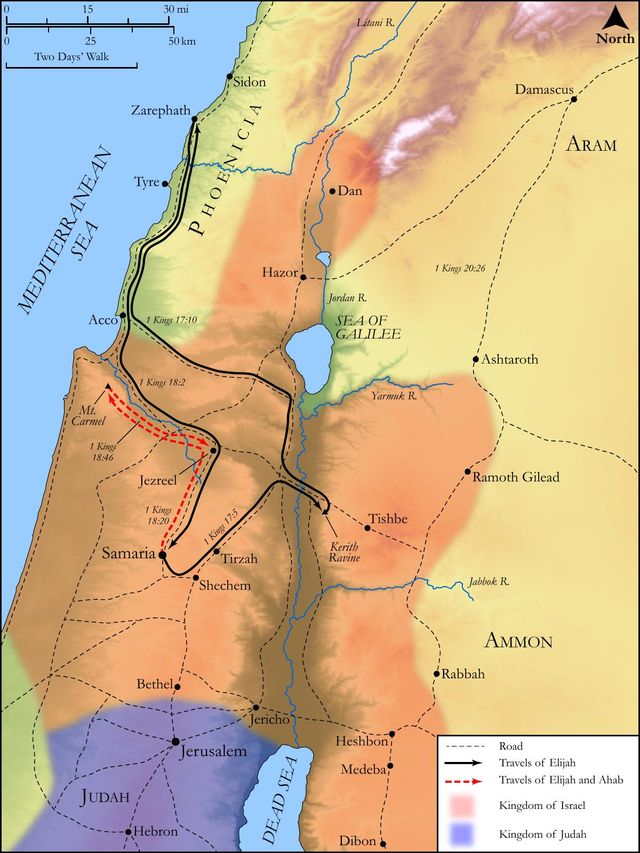
The period of Elijah's ministry was marked by intense spiritual apostasy in Israel, spearheaded by King Ahab and his Phoenician wife, Jezebel, who aggressively promoted the worship of Baal and Asherah. Drought was a form of divine judgment foretold in the law of Moses, which warned that the LORD would "shut up the heaven, that there be no rain". For the Canaanite god Baal, who was believed to control rain and fertility, a prolonged drought directly challenged his perceived authority, making Elijah's prophecy a direct assault on Baal worship. God's command for Elijah to hide by the brook Cherith was both a protective measure against Ahab's wrath and a strategic move to demonstrate Yahweh's absolute sovereignty over nature and life, even in the midst of famine. The brook Cherith, located "before Jordan" (likely east of the Jordan River), would have been a secluded, desolate location, emphasizing Elijah's isolation and complete dependence on God.
Key Themes
ShowHide1 Kings 17:5 contributes significantly to several key themes within the book of Kings and the broader biblical narrative. Firstly, it powerfully illustrates unquestioning obedience to God's word, even when the path is uncertain or uncomfortable. Elijah's immediate action, "So he went and did according unto the word of the LORD," serves as a model of faith that translates into action, a theme echoed in the New Testament's emphasis on faith without works being dead (James 2:17). Secondly, it highlights divine sovereignty and meticulous provision. God directs Elijah to a specific, secluded place, demonstrating His ability to care for His servants in extraordinary ways, even orchestrating ravens to deliver food (1 Kings 17:6). This underscores God's faithfulness to His people, a truth celebrated throughout the Psalms (e.g., Psalm 23:1). Finally, the verse introduces the theme of preparation through isolation and dependence. The brook Cherith becomes a place where Elijah is "cut off" from conventional means of sustenance, forcing him into absolute reliance on God, a period of spiritual refinement that prepares him for the greater challenges and demonstrations of power that lie ahead, such as the confrontation on Mount Carmel (1 Kings 18).
Exposition and Analysis
ShowHideKey Word Analysis
ShowHideThis phrase, literally "and he went and he did," emphasizes the immediate, active, and complete nature of Elijah's obedience. The repetition of the verb "went" (H3212, yâlak) followed by "did" (H6213, ʻâsâh) underscores that his compliance was not merely intellectual assent but a physical, decisive action. There was no hesitation, no negotiation, only prompt execution of the divine command.
The name of the brook (H3747), while its exact location remains debated, is significant. It is derived from a root meaning "to cut," "to cut off," or "to separate." This etymology subtly alludes to the nature of Elijah's experience there: a place of isolation, a "cutting off" from society and conventional means of sustenance. It was a place where God "cut off" Elijah's reliance on anything but Himself, preparing him through a period of intense dependence and discipline.
This phrase (H6440 for "before" or "face," and H3383 for "Jordan") literally means "upon the face of the Jordan" or "in front of the Jordan." It is a geographical indicator, typically understood to mean east of the Jordan River. This detail emphasizes the specific and remote nature of the location God chose for Elijah, highlighting the precision of divine guidance and the extent of Elijah's withdrawal from the public eye and the reach of Ahab.
Verse Breakdown
ShowHide"So he went and did according unto the word of the LORD:"
This opening clause immediately establishes Elijah's character and the central theme of obedience. The conjunction "So" links directly back to God's command in 1 Kings 17:2-4, indicating a direct cause-and-effect relationship. Elijah's actions were not arbitrary but were precisely "according unto the word of the LORD," signifying his submission to divine authority and his role as a faithful messenger. This highlights a fundamental principle of biblical faith: hearing God's word must lead to doing God's word.
"for he went and dwelt by the brook Cherith,"
This clause provides the specific action and location of Elijah's obedience. The repetition of "he went" reinforces the active nature of his compliance. The instruction was not just to go, but to "dwell" (H3427, yâshab), implying a sustained presence and commitment to the divinely appointed place. The brook Cherith is identified as the precise refuge, a place chosen by God for Elijah's protection and provision.
"that [is] before Jordan."
This final clause offers a geographical marker, placing the brook Cherith in relation to the Jordan River. While its exact location is unknown today, this detail emphasizes the remote and secluded nature of the spot. Being "before Jordan" (likely on its eastern side) would have placed Elijah away from the main population centers and the immediate reach of Ahab, further highlighting God's protective hand over His prophet.
Literary Devices
ShowHideThe verse employs several literary devices to enhance its impact. Repetition is evident in the phrase "he went," appearing twice within the short verse, which serves to emphasize the active, deliberate, and immediate nature of Elijah's obedience. This repetition underscores that his compliance was not passive but involved a decisive movement and commitment. Foreshadowing is also present; Elijah's dwelling by the brook Cherith, a place of isolation and dependence, subtly foreshadows the miraculous provision of food and water that God will supply there, setting the stage for the dramatic demonstrations of divine power in the subsequent verses. The very name Cherith functions as a form of symbolism, alluding to a place of "cutting off"—a period of divine discipline, purification, and absolute reliance on God, preparing Elijah for his future ministry. Finally, the verse stands in contrast to the prevalent disobedience and idolatry of King Ahab and the nation of Israel, highlighting Elijah's singular faithfulness amidst widespread apostasy.
Theological and Thematic Connections
ShowHide1 Kings 17:5 serves as a profound theological statement on the nature of faith and divine sovereignty. Elijah's immediate and unquestioning obedience exemplifies a core biblical principle: true faith is demonstrated through action. His willingness to follow God's seemingly illogical command to hide in a desolate place, especially after a public declaration of drought, underscores that God's ways are often beyond human understanding, yet always perfect. This act of obedience positions Elijah to experience God's miraculous provision, illustrating that God often calls us to step out in faith before He reveals the full extent of His plan or provision. It reinforces the truth that God is faithful to sustain those who trust and obey Him, even in the most dire circumstances, demonstrating His absolute control over creation and human affairs.
Reflection and Application
ShowHideElijah's immediate and unqualified obedience in 1 Kings 17:5 offers a powerful and enduring lesson for believers today. In a world that often values self-reliance and rational calculation, Elijah's response reminds us of the profound spiritual power found in simple, trusting submission to God's word. His journey to Cherith was not a logical career move or a comfortable retreat; it was a divinely appointed period of isolation and absolute dependence, a "cutting off" from all conventional means of support. This challenges us to consider our own "Cherith moments"—those times when God calls us to step away from the familiar, to trust Him in uncertainty, or to embrace a season of hiddenness or difficulty. It is often in these periods of radical dependence that our faith is deepened, our understanding of God's faithfulness is expanded, and we are prepared for what lies ahead. This verse encourages us to cultivate a heart that listens intently for God's voice and responds with swift, unwavering obedience, confident that His commands always lead to His provision and purpose.
Questions for Reflection
ShowHideFAQ
ShowHideWhy was Elijah commanded to go to the brook Cherith, a seemingly desolate place?
ShowHideGod commanded Elijah to go to the brook Cherith for several crucial reasons, demonstrating His divine care and strategic planning. Firstly, it was a place of protection from the wrath of King Ahab and Queen Jezebel, who would undoubtedly have sought to silence the prophet after his bold prophecy of drought (1 Kings 17:1). Secondly, it was a place of provision during the severe famine. God intended to sustain Elijah miraculously there, first through ravens bringing him bread and meat, and then through the brook itself providing water (1 Kings 17:6). This showcased Yahweh's absolute sovereignty over creation, directly challenging the false god Baal, who was supposedly the god of rain and fertility. Finally, the isolation at Cherith served as a period of spiritual training and deeper dependence for Elijah. Being "cut off" from human society and conventional means of sustenance forced him into total reliance on God alone, preparing him for the monumental tasks and confrontations that lay ahead in his ministry.
What is the significance of the "brook Cherith" beyond being a mere location?
ShowHideThe brook Cherith holds significant symbolic and theological meaning beyond its geographical designation. Its name, derived from a Hebrew root meaning "to cut" or "to cut off," suggests a place of isolation and separation. For Elijah, it was a place where he was "cut off" from the world, from the political turmoil, and from the expectations of society. This isolation was not punitive but purposeful, serving as a crucible for his faith. It became a place of divine discipline and preparation, where God stripped away Elijah's reliance on anything but Himself. In this desolate setting, Elijah learned profound lessons about God's faithfulness, His ability to provide in unconventional ways, and the power of absolute dependence. Cherith, therefore, represents any period or place in a believer's life where God calls them away from the familiar to deepen their trust, refine their character, and prepare them for future service, often through challenging circumstances that compel total reliance on Him.
Christ-Centered Fulfillment
ShowHideElijah's immediate and perfect obedience to the Father's word at the brook Cherith profoundly foreshadows the perfect obedience of Jesus Christ. Just as Elijah "went and did according unto the word of the LORD," so too did Jesus live a life of absolute submission to His Father's will, declaring, "I always do what pleases him" (John 8:29). Christ's obedience was not merely an act but the very essence of His mission, culminating in His willingness to go to the cross, even to the point of death (Philippians 2:8). Furthermore, the miraculous provision for Elijah at Cherith—water from the brook and food from ravens—points to Christ as the ultimate source of all sustenance. Jesus declares Himself to be the "bread of life" (John 6:35) and offers "living water" that satisfies eternally (John 4:10-14 and John 7:37-38). Just as Cherith was a place of refuge and provision for Elijah, Christ is our ultimate refuge and the one in whom "all our needs are met according to his riches in glory" (Philippians 4:19). He is the one who perfectly fulfilled the Father's commands, securing for us not just physical provision but eternal life and spiritual nourishment.