


1 Corinthians 8:10
Bible text: King James Version (1769 Blayney text) · Public domain
Bible text: King James Version with Strong's numbers · Public domain
Bible text: Berean Standard Bible · Public domain
Bible text: American Standard Version (1901) · Public domain
Bible text: World English Bible, Messianic edition · Public domain
Bible text: Geneva Bible (1599) · Public domain
Bible text: Young's Literal Translation · Public domain
- ἐὰνeanIfG1437CONDConjunction
- γάρgarforG1063CONJConjunction
- τιςtisanyoneG5100X-NSMIndefinite pronoun Nominative Singular Masculine
- ἴδῃidēshall seeG1492V-2AAS-3SVerb 2nd Aorist Active Subjunctive 3rd Singular
- σὲseyouG4771P-2ASPersonal pronoun Accusative 2nd Singular
- τὸνtonwhoG3588T-ASMDefinite article Accusative Singular Masculine
- ἔχονταechontais havingG2192V-PAP-ASMVerb Present Active Participle Accusative Singular Masculine
- γνῶσινgnōsinknowledgeG1108N-ASFNoun Accusative Singular Feminine
- ἐνeninG1722PREPPreposition
- εἰδωλείῳeidōleiōan idol’s templeG1493N-DSNNoun Dative Singular Neuter
- κατακείμενονkatakeimenoneatingG2621V-PNP-ASMVerb Present Middle Or Passive Deponent Participle Accusative Singular Masculine
- οὐχὶouchisurelyG3780PRT-NNegative Particle Negative
- ἡhētheG3588T-NSFDefinite article Nominative Singular Feminine
- συνείδησιςsuneidēsisconscienceG4893N-NSFNoun Nominative Singular Feminine
- αὐτοῦautouof himG846P-GSMPersonal pronoun Genitive Singular Masculine
- ἀσθενοῦςasthenousweakG772A-GSMAdjective Genitive Singular Masculine
- ὄντοςontosbeingG1510V-PAP-GSMVerb Present Active Participle Genitive Singular Masculine
- οἰκοδομηθήσεταιoikodomēthēsetaihe will be encouragedG3618V-FPI-3SVerb Future Passive Indicative 3rd Singular
- εἰςeis<to>G1519PREPPreposition
- τὸto<the>G3588T-ASNDefinite article Accusative Singular Neuter
- τὰtatheG3588T-APNDefinite article Accusative Plural Neuter
- εἰδωλόθυταeidōlothutaidol-sacrificesG1494A-APNAdjective Accusative Plural Neuter
- ἐσθίειν;esthieinto eat?G2068V-PANVerb Present Active Infinitive
English is a literal word-by-word gloss of the Greek, not the KJV's wording. Why?
This is the original text the KJV's translators worked from — each Greek word with its own literal English meaning in this verse, prepared by scholars at Tyndale House, Cambridge. The KJV translates whole sentences, not word by word, so its wording differs: one Greek word can become several English words, and the KJV may choose “charity” where the gloss reads “love”. Both are faithful — they answer different questions. For the KJV's own rendering, switch to the KJV text.
Details
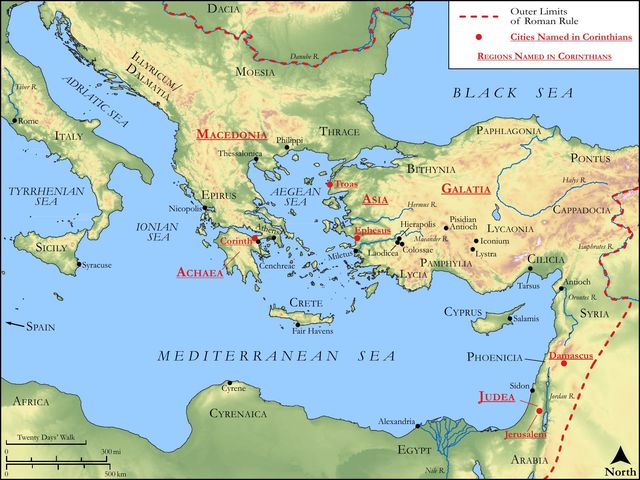
See on the biblical-era maps

Study this verse
Public-domain commentary
Matthew Henry
From his Commentary on the Whole Bible. Henry comments on passages, not single verses — this entry covers 1 Corinthians 8:7–13.
The apostle, having granted, and indeed confirmed, the opinion of some among the Corinthians, that idols were nothing, proceeds now to show them that their inference from this assumption was not just, namely, that therefore they might go into the idol-temple, and eat of the sacrifices, and feast there with their heathen neighbours. He does not indeed here so much insist upon the unlawfulness of the thing in itself as the mischief such freedom might do to weaker Christians, persons that had not the same measure of knowledge with these pretenders. And here,
I.He informs them that every Christian man, at that time, was not so fully convinced and persuaded that an idol was nothing.
Howbeit, there is not in every man this knowledge; for some, with conscience of the idol, unto this hour, eat it as a thing offered unto an idol; with conscience of the idol; that is, some confused veneration for it. Though they were converts to Christianity, and professed the true religion, they were not perfectly cured of the old leaven, but retained an unaccountable respect for the idols they had worshipped before. Note, Weak Christians may be ignorant, or have but a confused knowledge of the greatest and plainest truths. Such were those of the one God and one Mediator. And yet some of those who were turned form heathenism to Christianity among the Corinthians seem to have retained a veneration for their idols, utterly irreconcilable with those great principles; so that when an opportunity offered to eat things offered to idols they did not abstain, to testify their abhorrence of idolatry, nor eat with a professed contempt of the idol, by declaring they looked upon it to be nothing; and so their conscience, being weak, was defiled; that is, they contracted guilt; they ate out of respect to the idol, with an imagination that it had something divine in it, and so committed idolatry: whereas the design of the gospel was to turn men from dumb idols to the living God. They were weak in their understanding, not thoroughly apprized of the vanity of idols; and, while they ate what was sacrificed to them out of veneration for them, contracted the guilt of idolatry, and so greatly polluted themselves. This seems to be the sense of the place; though some understand it of weak Christians defiling themselves by eating what was offered to an idol with an apprehension that thereby it became unclean, and made those so in a moral sense who should eat it, every one not having a knowledge that the idol was nothing, and therefore that it could not render what was offered to it in this sense unclean. Note, We should be careful to do nothing that may occasion weak Christians to defile their consciences.
II.He tells them that mere eating and drinking had nothing in them virtuous nor criminal, nothing that could make them better nor worse, pleasing nor displeasing to God: Meat commendeth us not to God; for neither if we eat are we the better, nor if we eat not are we the worse, Co1 8:8. It looks as if some of the Corinthians made a merit of their eating what had been offered to idols, and that in their very temples too (Co1 8:10), because it plainly showed that they thought the idols nothing. But eating and drinking are in themselves actions indifferent. It matters little what we eat. What goes into the man of this sort neither purifies nor defiles. Flesh offered to idols may in itself be as proper for food as any other; and the bare eating, or forbearing to eat, has no virtue in it. Note, It is a gross mistake to think that distinction of food will make any distinction between men in God's account. Eating this food, and forbearing that, having nothing in them to recommend a person to God.
III.He cautions them against abusing their liberty, the liberty they thought they had in this matter.
For that they mistook this matter, and had no allowance to sit at meat in the idol's temple, seems plain from Co1 10:20, etc. But the apostle argues here that, even upon the supposition that they had such power, they must be cautious how they use it; it might be a stumbling-block to the weak (Co1 10:9), it might occasion their falling into idolatrous actions, perhaps their falling off from Christianity and revolting again to heathenism. "If a man see thee, who hast knowledge (hast superior understanding to his, and hereupon concedest that thou hast a liberty to sit at meat, or feast, in an idol's temple, because an idol, thou sayest, is nothing), shall not one who is less thoroughly informed in this matter, and thinks an idol something, be emboldened to eat what was offered to the idol, not as common food, but sacrifice, and thereby be guilty of idolatry?" Such an occasion of falling they should be careful of laying before their weak brethren, whatever liberty or power they themselves had. The apostle backs this caution with two considerations: - 1. The danger that might accrue to weak brethren, even those weak brethren for whom Christ died. We must deny ourselves even what is lawful rather than occasion their stumbling, and endanger their souls (Co1 10:11): Through thy knowledge shall thy weak brother perish, for whom Christ died? Note, Those whom Christ hath redeemed with his most precious blood should be very precious and dear to us. If he had such compassion as to die for them, that they might not perish, we should have so much compassion for them as to deny ourselves, for their sakes, in various instances, and not use our liberty to their hurt, to occasion their stumbling, or hazard their ruin. That man has very little of the spirit of the Redeemer who had rather his brother should perish than himself be abridged, in any respect, of his liberty. He who hath the Spirit of Christ in him will love those whom Christ loved, so as to die for them, and will study to promote their spiritual and eternal warfare, and shun every thing that would unnecessarily grieve them, and much more every thing that would be likely to occasion their stumbling, or falling into sin. 2. The hurt done to them Christ takes as done to himself: When you sin so against the weak brethren and wound their consciences, you sin against Christ, Co1 10:12. Note, Injuries done to Christians are injuries to Christ, especially to babes in Christ, to weak Christians; and most of all, involving them in guilt: wounding their consciences is wounding him. He has a particular care of the lambs of the flock: He gathers them in his arm and carries them in his bosom, Isa 60:11. Strong Christians should be very careful to avoid what will offend weak ones, or lay a stumbling-block in their way. Shall we be void of compassion for those to whom Christ has shown so much? Shall we sin against Christ who suffered for us? Shall we set ourselves to defeat his gracious designs, and help to ruin those whom he died to save?
IV.He enforces all with his own example (Co1 8:13):
Wherefore if meat make my brother to offend I will eat no flesh while the world standeth, lest I make my brother to offend. He does not say that he will never eat more. This were to destroy himself, and to commit a heinous sin, to prevent the sin and fall of a brother. Such evil must not be done that good may come of it. But, though it was necessary to eat, it was not necessary to eat flesh. And therefore, rather than occasion sin in a brother, he would abstain from it as long as he lived. He had such a value for the soul of his brother that he would willingly deny himself in a matter of liberty, and forbear any particular food, which he might have lawfully eaten and might like to eat, rather than lay a stumbling-block in a weak brother's way, and occasion him to sin, by following his example, without being clear in his mind whether it were lawful or no. Note, We should be very tender of doing any thing that may be an occasion of stumbling to others, though it may be innocent in itself. Liberty is valuable, but the weakness of a brother should induce, and sometimes bind, us to waive it. We must not rigorously claim nor use our own rights, to the hurt and ruin of a brother's soul, and so to the injury of our Redeemer, who died for him. When it is certainly foreseen that my doing what I may forbear will occasion a fellow-christian to do what he ought to forbear, I shall offend, scandalize, or lay a stumbling-block in his way, which to do is a sin, however lawful the thing itself be which is done. And, if we must be so careful not to occasion other men's sins, how careful should we be to avoid sin ourselves! If we must not endanger other men's souls, how much should we be concerned not to destroy our own!
Historical interpretation
Two Centuries of Reception
6 surviving comments on this verse. Each one is dated, so this reads as a timeline rather than a list.
Select a marker to jump to its quote. Markers stagger vertically where authors wrote within a few decades of each other.
What schoolmaster, without a table of the seven idols, will yet frequent the Quinquatria? The very first payment of every pupil he consecrates both to the honour and to the name of Minerva; so that, even though he be not said "to eat of that which is sacrificed to idols" nominally (not being dedicated to any particular idol), he is shunned as an idolater.
Give nothing and take nothing from an idol! If it be against the faith to recline at table in the temple of an idol, what would you call it if one wore the garb of an idol?
What sense is there in discussing the merely accidental, when that on which it rests is to be condemned? Do we believe it lawful for a human oath to be superadded to one divine, for a man to come under promise to another master after Christ, and to abjure father, mother, and all nearest kinsfolk, whom even the law has commanded us to honour and love next to God Himself, to whom the gospel, too, holding them only of less account than Christ, has in like manner rendered honour? Shall it be held lawful to make an occupation of the sword, when the Lord proclaims that he who uses the sword shall perish by the sword? And shall the son of peace take part in the battle when it does not become him even to sue at law? And shall he apply the chain, and the prison, and the torture, and the punishment, who is not the avenger even of his own wrongs? Shall he, forsooth, either keep watch-service for others more than for Christ, or shall he do it on the Lord's day, when he does not even do it for Christ Himself? And shall he keep guard before the temples which he has renounced? And shall he take a meal where the apostle has forbidden him? And shall he diligently protect by night those whom in the day-time he has put to flight by his exorcisms, leaning and resting on the spear the while with which Christ's side was pierced? Shall he carry a flag, too, hostile to Christ? And shall he ask a watchword from the emperor who has already received one from God? Shall he be disturbed in death by the trumpet of the trumpeter, who expects to be aroused by the angel's trump? And shall the Christian be burned according to camp rule, when he was not permitted to burn incense to an idol, when to him Christ remitted the punishment of fire? Then how many other offences there are involved in the performances of camp offices, which we must hold to involve a transgression of God's law, you may see by a slight survey.
Paul is afraid that the weaker brother may be tempted to eat meat sacrificed to idols, not because he also possesses the knowledge that there is no such thing as an idol but because he might think that there is some spiritual power in such food, which he will acquire if he eats it.
"For if a man see thee who hast knowledge, sitting at meat in an idol's temple, will not his conscience if he is weak, be emboldened to eat things sacrificed to idols?"
After having said, "Take heed lest this your liberty become a stumbling-block," he explains how and in what manner it becomes so: and he continually employs the term "weakness," that the mischief may not be thought to arise from the nature of the thing, nor demons appear formidable. As thus: "At present," saith he, "a man is on the point of withdrawing himself entirely from all idols; but when he sees you fond of loitering about them, he takes the circumstance for a recommendation and abides there himself also. So that not only his weakness, but also your ill-timed behavior, helps to further the plot against him; for it is you who make him weaker."
Let us expand this thought so as to say: “If someone sees you who have knowledge of piety passing the whole day in those senseless and harmful associations, will not the conscience of the weak man be emboldened to pursue such actions more earnestly?” That blessed apostle said this to keep in check those who were heedless, even after having knowledge of piety, who were exposing themselves to places of idolatry and causing scandal to the rest.
Continue studying 1 Corinthians 8:10 across the web’s major study libraries — every link below opens this exact verse, chapter, or book on the destination site.
Read & Compare
 BibleGatewayThis verse in more than 200 translations and 70 languages.
 Bible.comThe YouVersion reader — hundreds of translations, reading plans, and highlights.
 ESV.orgCrossway's official English Standard Version reader.
 NET BibleThe NET translation with 60,000+ translators' notes on every rendering decision.
 STEP BibleTyndale House's free study tool — original text, vocabulary, and scholarly resources.
 BibliaLogos Bible Software's free web reader.
 USCCBThe New American Bible (Revised Edition) with the U.S. bishops' study notes.
Commentaries
 BibleHub CommentariesDozens of classic commentaries on this verse, gathered on one page.
 StudyLightMore than 100 commentary sets — the largest collection on the web.
 BibleRefPlain-English commentary on what this verse means, verse by verse.
 Enduring WordDavid Guzik's free commentary on this chapter, widely used by Bible teachers.
 Bible Study ToolsVerse commentary alongside Greek and Hebrew study aids.
Original Language & Research
- BibleHub InterlinearThe verse word by word — original language, transliteration, and English.
- BibleHub LexiconEvery word's original-language definition and Strong's entry.
 Blue Letter BibleDeep-study tools — Strong's numbers, concordance, and word studies.
 CNTR CollationThe earliest Greek manuscripts of this verse, collated letter by letter.
Sermons, Hymns & Audio


TrulyRandomVerse is not affiliated with these sites and doesn’t control their content. They’re linked because they’re genuinely useful.
Summary
First Corinthians 8:10 addresses the delicate balance between Christian liberty and loving consideration for others, specifically concerning the practice of eating meat sacrificed to idols. Paul warns that a believer who possesses "knowledge" regarding the non-existence of idols, and thus feels free to eat in an idol's temple, risks causing a "weaker" brother or sister, whose conscience is not as robust, to stumble into sin by emboldening them to act against their own convictions regarding such food. This verse underscores the principle that personal freedom should always be subordinated to the spiritual well-being of the community.
Context
ShowHideLiterary Context
This verse is deeply embedded within Paul's broader discussion in 1 Corinthians 8, which begins with the assertion that "knowledge puffs up, but love builds up" (1 Corinthians 8:1). Paul establishes that while believers know "an idol is nothing in the world" and "there is no God but one" (1 Corinthians 8:4), not everyone possesses this same robust understanding or conviction. He then introduces the concept of the "weak" brother whose conscience is defiled by eating idol-meat, leading to a warning against causing a brother to stumble (1 Corinthians 8:9). Verse 10 provides a specific, vivid scenario illustrating how a "strong" believer's actions can directly lead to the "weak" brother's spiritual detriment, setting the stage for Paul's concluding exhortation to forgo personal rights for the sake of another's salvation (1 Corinthians 8:13).
Historical & Cultural Context
The city of Corinth was a major Roman provincial capital, a bustling port city renowned for its wealth, diverse population, and numerous pagan temples dedicated to deities such as Aphrodite, Apollo, and Poseidon. Sacrificial practices were integral to Corinthian life; animals were offered in temples, and the remaining meat was often sold in the public markets (the macellum) or consumed in communal feasts held within the temple precincts. For new converts, many of whom had recently emerged from a lifetime of idolatry, the distinction between participating in a pagan ritual and merely eating food was blurred. Their former lives deeply ingrained the idea that eating such meat, especially in a temple, was an act of worship or communion with a pagan deity. This made the issue of "idol meat" not merely a dietary one, but a profound theological and ethical challenge for the nascent Christian community, testing their understanding of freedom in Christ versus their responsibility to one another.
Key Themes
ShowHideFirst Corinthians 8 is saturated with themes critical to Christian community and ethics. The primary tension explored is that between Christian Liberty and Love. While the "strong" believer possesses the knowledge that "an idol is nothing" (1 Corinthians 8:4), their liberty to act on this knowledge must be tempered by Agape Love for their fellow believers. This leads to the theme of Protecting the Conscience of the Weak. Paul emphasizes that the actions of the "strong" can inadvertently "embolden" (or "build up" in a negative sense) the "weak" to violate their own conscience, thereby causing them to sin and potentially destroying them (1 Corinthians 8:11). Consequently, the chapter highlights the importance of Avoiding Stumbling Blocks, asserting that what is permissible for one may become a snare for another, demanding self-restraint and sacrifice for the sake of unity and spiritual well-being within the body of Christ.
Exposition and Analysis
ShowHideKey Word Analysis
ShowHideThis term refers to "knowing (the act), i.e. (by implication) knowledge." In this context, it signifies the intellectual understanding or spiritual insight that an idol is merely a piece of wood or stone and holds no divine power, and that there is only one true God. This knowledge grants the "strong" believer a sense of freedom concerning food offered to idols.
This word denotes an "image-fane," or a temple dedicated to an idol. The setting is crucial, as eating in such a place, rather than simply consuming idol-meat bought in the market, carried a stronger association with pagan worship and could be perceived as participation in the idolatrous cult, especially by those with a sensitive conscience.
This verb primarily means "to be a house-builder," or "to construct or (figuratively) confirm, edify, build up." Here, however, it is used ironically or negatively. The "strong" believer's action, intended as an exercise of freedom, "builds up" or "emboldens" the "weak" brother, not in faith, but in a way that leads them to act against their conscience, thus building them up into sin rather than spiritual maturity.
Verse Breakdown
ShowHide"For if any man see thee which hast knowledge sit at meat in the idol's temple,"
This clause sets the scene, describing the specific action of the "strong" believer. The "man" who "has knowledge" is one who understands the theological truth that idols are nothing. His action is to "sit at meat" (G2621, katákeimai), which implies reclining at a meal, a common posture for feasting, and doing so "in the idol's temple" (G1493, eidōleîon). The visual aspect ("see thee") is paramount; it's not merely the act itself, but the public perception and example set by the knowledgeable believer.
"shall not the conscience of him which is weak be emboldened to eat those things which are offered to idols;"
This is the rhetorical question, implying an affirmative answer, that highlights the negative consequence. The "conscience" (G4893, syneídēsis) of the "weak" (G772, asthenḗs) individual—one who lacks the full understanding or conviction of the "strong"—is directly impacted. This weak conscience is "emboldened" (G3618, oikodoméō), or "built up" in a detrimental way, to "eat those things which are offered to idols" (G1494, eidōlóthyton). The implication is that the weaker brother, seeing the example of the stronger, is encouraged to partake despite their inner conviction that it is wrong, thereby defiling their own conscience and sinning against God.
Literary Devices
ShowHidePaul employs a powerful Rhetorical Question in this verse ("shall not the conscience... be emboldened?"), which serves to underscore the inevitable negative outcome of the "strong" believer's action. This device compels the reader to acknowledge the direct cause-and-effect relationship between the public display of liberty and the potential spiritual harm to a weaker brother. Furthermore, there is a subtle Irony in the use of the word "emboldened" (Greek, oikodoméō), which typically means "to build up" or "edify." Here, it is used in a destructive sense, implying that the "building up" of the weak brother's confidence to eat idol meat actually leads to their spiritual downfall, rather than their growth in faith. This highlights the paradox that an action, innocent in itself, can become a stumbling block when not exercised with love and consideration.
Theological and Thematic Connections
ShowHideFirst Corinthians 8:10 profoundly illustrates the New Testament's emphasis on communal responsibility and the supremacy of love over personal rights within the Christian fellowship. It challenges the notion that individual freedom can be exercised without regard for its impact on others, especially those who are spiritually vulnerable. Paul's argument is that while knowledge of theological truth is valuable, it must always be subservient to the greater principle of agape love, which seeks the welfare and spiritual edification of others. This teaching directly connects to the broader biblical theme of self-sacrifice for the sake of others, echoing Christ's own example of laying down His rights and life for humanity. The verse serves as a foundational text for understanding how Christian liberty is not an end in itself, but a means to serve and build up the body of Christ, guarding against actions that, though permissible, might lead a brother or sister to stumble.
Reflection and Application
ShowHideThe principles of 1 Corinthians 8:10 remain acutely relevant for believers today, even though the specific issue of eating meat sacrificed to idols may not be a common dilemma. The core message challenges us to examine how we exercise our Christian liberties and whether our actions, however innocent in our own eyes, might inadvertently cause a fellow believer to stumble or violate their conscience. This calls for a profound shift from a self-centered approach to freedom to a Christ-centered one, where love for our brother or sister takes precedence. It compels us to cultivate empathy, understanding that others may have different backgrounds, sensitivities, or stages of spiritual maturity. True liberty is not merely the right to do what is permissible, but the freedom to forgo that right for the sake of another's spiritual well-being. This requires discernment, humility, and a willingness to prioritize the unity and health of the body of Christ over personal preferences or assertions of rights. Our ultimate goal should be to build up, not tear down, and to reflect the self-sacrificial love of Christ in all our interactions within the community of faith.
Questions for Reflection
ShowHideFAQ
ShowHideWhat does Paul mean by "weak" and "strong" in this context?
ShowHideIn 1 Corinthians 8, Paul uses "strong" to refer to believers who possess a robust theological understanding (knowledge) that idols are nothing and therefore eating meat offered to them is not inherently sinful. They are spiritually mature enough to distinguish between the food itself and the pagan ritual. Conversely, "weak" refers to believers, often new converts from pagan backgrounds, whose consciences are still sensitive to the association of such meat with idolatry. For them, eating idol-meat, especially in a temple, would feel like a return to their former idolatrous practices, thus defiling their conscience and leading them to sin against their conviction, even if the act itself is not inherently wrong in God's eyes. Paul is not implying a moral or spiritual inferiority, but rather a difference in the maturity of their theological understanding and the robustness of their conscience on this specific issue.
Christ-Centered Fulfillment
ShowHideThe ethical dilemma presented in 1 Corinthians 8:10 finds its ultimate resolution and fulfillment in the person and work of Jesus Christ. Christ, though possessing all power and divine prerogative, did not insist on His rights but willingly laid them aside for the sake of humanity's salvation. He "did not consider equality with God something to be used to His own advantage; rather, He emptied Himself" (Philippians 2:6-7). His entire earthly ministry was an act of self-sacrificial love, culminating in His death on the cross, where He became a "stumbling block" to some and "foolishness" to others, yet the power and wisdom of God for those who believe (1 Corinthians 1:23-24). The principle Paul advocates—that the "strong" should forgo their liberty to prevent the "weak" from stumbling—is a direct imitation of Christ's selfless example. Jesus did not use His freedom to indulge His own desires but to serve and redeem. Therefore, when believers choose to limit their own freedoms out of love for a brother or sister, they are not merely following an ethical guideline, but are actively participating in the very character and mission of Christ, who came "not to be served, but to serve, and to give His life as a ransom for many" (Mark 10:45). This Christ-centered love is the true measure of Christian maturity and the foundation of genuine community.