


Numbers 12:11
Bible text: King James Version (1769 Blayney text) · Public domain
Bible text: Berean Standard Bible · Public domain
Bible text: American Standard Version (1901) · Public domain
Bible text: World English Bible, Messianic edition · Public domain
Bible text: Geneva Bible (1599) · Public domain
Bible text: Young's Literal Translation · Public domain
- וַיֹּאמֶרvai·Yo·merand he saidH559Conj-w ¦ V-Qal-ConsecImperf-3msVerb Qal Consecutive Imperfect 3rd Singular Masculineוַandיֹּאמֶרhe said
- אַהֲרֹן'a·ha·RonAaronH175N-proper-mNoun Proper Masculine
- אֶל'eltoH413PrepPreposition
- מֹשֶׁהmo·ShehMosesH4872N-proper-mNoun Proper Masculine
- בִּיbipardon meH994PrtParticle Interjection
- אֲדֹנִי'a·do·Nimy O lordH113N-msc ¦ 1csNoun Singular Masculine ConstructאֲדֹנִO lordיmy
- אַל'aldo notH408NegParticle Negative
- נָאna'pleaseH4994PrtParticle Interjection
- תָשֵׁתta·Shetmay putH7896V-Qal-Imperf-2msVerb Qal Imperfect 2nd Singular Masculine
- עָלֵינוּ'a·Lei·nuon usH5921Prep ¦ 1cpPreposition Definiteעָלֵיonנוּus
- חַטָּאתcha·Tat[the] sinH2403N-fsNoun Singular Feminine Absolute
- אֲשֶׁר'a·SherwhichH834RelParticle Relative
- נוֹאַלְנוּno·'Al·nuwe have acted foolishlyH2973V-Niphal-Perf-1cpVerb Niphal Perfect 1st Plural common gender
- וַאֲשֶׁרva·'a·Sherand whichH834Conj-w ¦ RelParticle Relativeוַandאֲשֶׁרwhich
- חָטָאנוּcha·Ta·nuwe have sinnedH2398V-Qal-Perf-1cpVerb Qal Perfect 1st Plural common gender
English is a literal word-by-word gloss of the Hebrew, not the KJV's wording. Why?
This is the original text the KJV's translators worked from — each Hebrew word with its own literal English meaning in this verse, prepared by scholars at Tyndale House, Cambridge. The KJV translates whole sentences, not word by word, so its wording differs: one Hebrew word can become several English words, and the KJV may choose “the LORD” where the gloss reads “Yahweh”. Both are faithful — they answer different questions. For the KJV's own rendering, switch to the KJV text.
Details
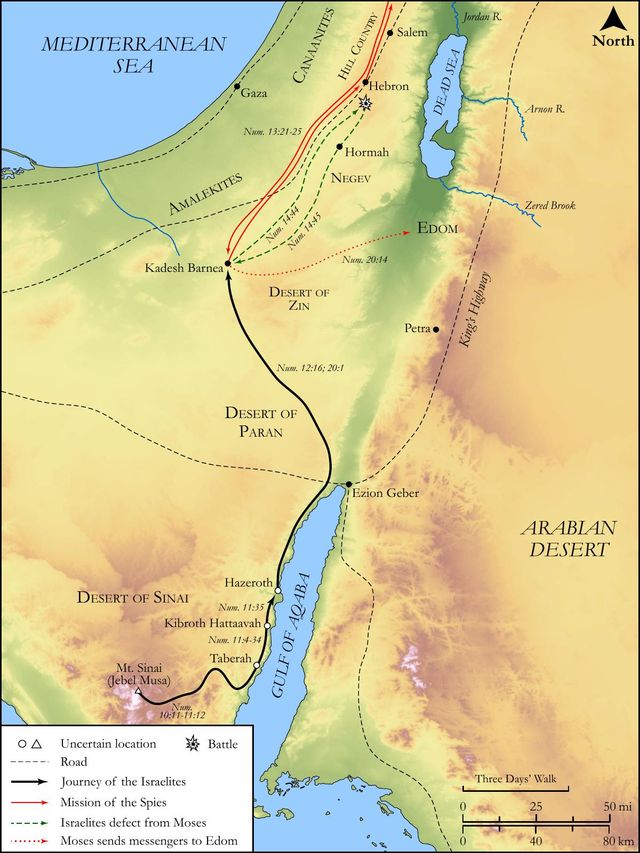
See on the biblical-era map
Study this verse
Public-domain commentary
Matthew Henry
From his Commentary on the Whole Bible. Henry comments on passages, not single verses — this entry covers Numbers 12:10–16. His two-level outline is real structure in the source text, so it is rendered as structure.
Here is, I. God's judgment upon Miriam (Num 12:10): The cloud departed from off that part of the tabernacle, in token of God's displeasure, and presently Miriam became leprous; when God goes, evil comes; expect no good when God departs. The leprosy was a disease often inflicted by the immediate hand of God as the punishment of some particular sin, as on Gehazi for lying, on Uzziah for invading the priest's office, and here on Miriam for scolding and making mischief among relations. The plague of the leprosy, it is likely, appeared in her face, so that it appeared to all that saw her that she was struck with it, with the worst of it, she was leprous as snow; not only so white, but so soft, the solid flesh losing its consistency, as that which putrefies does. Her foul tongue (says bishop Hall) is justly punished with a foul face, and her folly in pretending to be a rival with Moses is made manifest to all men, for every one sees his face to be glorious, and hers to be leprous. While Moses needs a veil to hide his glory, Miriam needs one to hide her shame. Note, Those distempers which any way deform us ought to be construed as a rebuke to our pride, and improved for the cure of it, and under such humbling providences we ought to be very humble. It is a sign that the heart is hard indeed if the flesh be mortified, and yet the lusts of the flesh remain unmortified. It should seem that this plague upon Miriam was designed for an exposition of the law concerning the leprosy (Lev. 13), for it is referred to upon the rehearsal of that law, Deu 24:8, Deu 24:9. Miriam was struck with a leprosy, but not Aaron, because she was first in the transgression, and God would put a difference between those that mislead and those that are misled. Aaron's office, though it saved him not from God's displeasure, yet helped to secure him from this token of his displeasure, which would not only have suspended him for the present from officiating, when (there being no priests but himself and his two sons) he could ill be spared, but it would have rendered him and his office mean, and would have been a lasting blot upon his family. Aaron as priest was to be the judge of the leprosy, and his performing that part of his office upon this occasion, when he looked upon Miriam, and behold she was leprous, was a sufficient mortification to him. He was struck through her side, and could not pronounce her leprous without blushing and trembling, knowing himself to be equally obnoxious. This judgment upon Miriam is improvable by us as a warning to take heed of putting any affront upon our Lord Jesus. If she was thus chastised for speaking against Moses, what will become of those that sin against Christ?
II.Aaron's submission hereupon (Num 12:11, Num 12:12); he humbles himself to Moses, confesses his fault, and begs pardon.
He that but just now joined with his sister in speaking against Moses is here forced for himself and his sister to make a penitent address to him, and in the highest degree to magnify him (as if he had the power of God to forgive and heal) whom he had so lately vilified. Note, Those that trample upon the saints and servants of God will one day be glad to make court to them; at furthest, in the other world, as the foolish virgins to the wise for a little oil, and the rich man to Lazarus for a little water; and perhaps in this world, as Job's friend to him for his prayers, and here Aaron to Moses. Rev 3:9. In his submission,
1.He confesses his own and his sister's sin, Num 12:11. He speaks respectfully to Moses, of whom he had spoken slightly, calls him his lord, and now turns the reproach upon himself, speaks as one ashamed of what he had said: We have sinned, we have done foolishly. Those sin, and do foolishly, who revile and speak evil of any, especially of good people or of those in authority. Repentance is the unsaying of that which we have said amiss, and it had better be unsaid than that we be undone by it.
2.He begs Moses's pardon: Lay not this sin upon us. Aaron was to bring his gift to the altar, but, knowing that his brother had something against him, he of all men was concerned to reconcile himself to his brother, that he might be qualified to offer his gift. Some think that this speedy submission which God saw him ready to make was that which prevented his being struck with a leprosy as his sister was.
3.He recommends the deplorable condition of his sister to Moses's compassionate consideration (Num 12:12): Let her not be as one dead, that is, "Let her not continue so separated from conversation, defiling all she touches, and even to putrefy above ground as one dead." He eloquently describes the misery of her case, to move his pity.
III.The intercession made for Miriam (Num 12:13):
He cried unto the Lord with a loud voice, because the cloud, the symbol of his presence, was removed and stood at some distance, and to express his fervency in this request, Heal her now, O Lord, I beseech thee. By this he made it to appear that he did heartily forgive her the injury she had one him, that he had not accused her to God, nor called for justice against her; so far from this that, when God in tenderness to his honour had chastised her insolence, he was the first that moved for reversing the judgment. By this example we are taught to pray for those that despitefully use us; and not to take pleasure in the most righteous punishment inflicted either by God or man on those that have been injurious to us. Jeroboam's withered hand was restored at the special instance and request of the prophet against whom it had been stretched out, Kg1 13:6. So Miriam here was healed by the prayer of Moses, whom she had abused, and Abimelech by the prayer of Abraham, Gen 20:17. Moses might have stood off, and have said, "She is served well enough, let her govern her tongue better next time;" but, not content with being able to say that he had not prayed for the inflicting of the judgment, he prays earnestly for the removal of it. This pattern of Moses, and that of our Saviour, Father, forgive them, we must study to conform to.
IV.The accommodating of this matter so as that mercy and justice might meet together.
1.Mercy takes place so far as that Miriam shall be healed; Moses forgives her, and God will. See Co2 2:10. But,
2.Justice takes place so far as that Miriam shall be humbled (Num 12:14): Let her be shut out from the camp seven days, that she herself might be made more sensible of her fault and penitent for it, and that her punishment might be the more public, and all Israel might take notice of it and take warning by it not to mutiny. If Miriam the prophetess be put under such marks of humiliation for one hasty word spoken against Moses, what may we expect for our murmurings? If this be done in a green tree, what shall be done in the dry? See how people debase and diminish themselves by sin, stain their glory, and lay their honour in the dust. When Miriam praised God, we find her at the head of the congregation and one of the brightest ornaments of it, Exo 15:20. Now that she quarrelled with God we find her expelled as the filth and off-scouring of it. A reason is given for her being put out of the camp for seven days, because thus she ought to accept of the punishment of her iniquity. If her father, her earthly father, had but spit in her face, and so signified his displeasure against her, would she not be so troubled and concerned at it, and so sorry that she had deserved it, as to shut herself up for some time in her room, and not come into his presence, or show her face in the family, being ashamed of her own folly and unhappiness? If such reverence as this be owing to the fathers of our flesh, when they correct us, much more ought we to humble ourselves under the mighty hand of the Father of spirits, Heb 12:9. Note, When we are under the tokens of God's displeasure for sin, it becomes us to take shame to ourselves, and to lie down in that shame, owning that to us belongs confusion of face. If by our own fault and folly we expose ourselves to the reproach and contempt of men, the just censures of the church, or the rebukes of the divine Providence, we must confess that our Father justly spits in our face, and be ashamed.
V.The hindrance that this gave to the people's progress:
The people journeyed not till Miriam was brought in again, Num 12:15. God did not remove the cloud, and therefore they did not remove their camp. This was intended,
1.As a rebuke to the people, who were conscious to themselves of having sinned after the similitude of Miriam's transgression, in speaking against Moses: thus far therefore they shall share in her punishment, that it shall retard their march forward towards Canaan. Many things oppose us, but nothing hinders us in the way to heaven as sin does.
2.As a mark of respect to Miriam. If the camp had removed during the days of her suspension, her trouble and shame had been the greater; therefore, in compassion to her, they shall stay till her excommunication be taken off, and she taken in again, it is probable with the usual ceremonies of the cleansing of lepers. Note, Those that are under censure and rebuke for sin ought to be treated with a great deal of tenderness, and not be over-loaded, no, not with the shame they have deserved, not counted as enemies (Th2 3:15), but forgiven and comforted, Co2 2:7. Sinners must be cast out with grief, and penitents taken in with joy. When Miriam was absolved and re-admitted, the people went forward into the wilderness of Paran, which joined up to the south border of Canaan, and thither their next remove would have been if they had not put a bar in their own way.
Continue studying Numbers 12:11 across the web’s major study libraries — every link below opens this exact verse, chapter, or book on the destination site.
Read & Compare
 BibleGatewayThis verse in more than 200 translations and 70 languages.
 Bible.comThe YouVersion reader — hundreds of translations, reading plans, and highlights.
 ESV.orgCrossway's official English Standard Version reader.
 NET BibleThe NET translation with 60,000+ translators' notes on every rendering decision.
 STEP BibleTyndale House's free study tool — original text, vocabulary, and scholarly resources.
 BibliaLogos Bible Software's free web reader.
 USCCBThe New American Bible (Revised Edition) with the U.S. bishops' study notes.
Commentaries
 BibleHub CommentariesDozens of classic commentaries on this verse, gathered on one page.
 StudyLightMore than 100 commentary sets — the largest collection on the web.
 BibleRefPlain-English commentary on what this verse means, verse by verse.
 Enduring WordDavid Guzik's free commentary on this chapter, widely used by Bible teachers.
 Bible Study ToolsVerse commentary alongside Greek and Hebrew study aids.
Original Language & Research
- BibleHub InterlinearThe verse word by word — original language, transliteration, and English.
- BibleHub LexiconEvery word's original-language definition and Strong's entry.
 Blue Letter BibleDeep-study tools — Strong's numbers, concordance, and word studies.
 SefariaThe Hebrew text with Rashi and centuries of Jewish commentary.
Sermons, Hymns & Audio


TrulyRandomVerse is not affiliated with these sites and doesn’t control their content. They’re linked because they’re genuinely useful.
Summary
Numbers 12:11 records Aaron's urgent and remorseful plea to Moses following God's immediate judgment on Miriam. Struck with leprosy as a direct consequence of their joint challenge to Moses's unique prophetic authority, Miriam's affliction serves as a stark divine rebuke. Aaron, witnessing the severe repercussions, humbly confesses their profound error and appeals to Moses for intercession, seeking to avert further divine wrath and the imputation of their grievous sin.
Context
ShowHideLiterary Context
This verse is deeply embedded within the dramatic narrative of Numbers 12. Immediately preceding it, Miriam and Aaron, Moses's own siblings, had openly questioned his leadership and prophetic preeminence, particularly in relation to his marriage to a Cushite woman, as recounted in Numbers 12:1. God swiftly intervened, summoning all three to the Tent of Meeting, where He unequivocally affirmed Moses's unparalleled relationship with Him, speaking "mouth to mouth, even apparently, and not in dark speeches," as detailed in Numbers 12:8. The divine judgment was immediate and severe: Miriam was struck with leprosy, "white as snow," as described in Numbers 12:10. Aaron's desperate plea in verse 11 is a direct response to this terrifying display of divine wrath, demonstrating his immediate recognition of their collective guilt and the gravity of their transgression against God's chosen leader.
Historical & Cultural Context
The setting is the wilderness journey of Israel, a period marked by God's direct governance through Moses and the tabernacle. Moses held a unique position as God's chosen mediator and leader, a role unparalleled even among prophets. Challenging such authority was not merely a personal affront but an act of rebellion against God Himself, who had appointed Moses. Leprosy (צָרַעַת, tsaraʿat) in ancient Israel was a severe skin condition, often seen as a divine judgment, rendering the afflicted ritually unclean and requiring isolation from the community, as outlined in Leviticus 13. Its sudden appearance on Miriam underscored the immediate and tangible consequences of their sin, a clear sign of divine displeasure that would have been understood by all Israelites as a profound curse. Aaron, as the High Priest, would have been acutely aware of the ritual implications and the theological weight of such an affliction.
Key Themes
ShowHideThe incident in Numbers 12 and Aaron's subsequent plea highlight several critical themes. Foremost is the sanctity of God-given authority and the severe consequences of challenging it, especially when God Himself has explicitly affirmed the leader's unique standing. This narrative underscores the theme of divine justice, demonstrating that God holds His chosen leaders to account, but also that He will defend their unique calling against those who seek to undermine it. Aaron's words introduce the theme of confession and repentance, as he immediately acknowledges their "foolish" and "sinful" actions, seeking mercy. Finally, the passage powerfully illustrates Moses's role as an intercessor for the people, a recurring motif throughout the Pentateuch, as Aaron instinctively turns to him to mediate with God on their behalf.
Exposition and Analysis
ShowHideKey Word Analysis
ShowHideThis is an interjection expressing distress, urgency, or a plea for attention and mercy. It conveys a sense of immediate alarm and desperation, indicating Aaron's terror and profound regret at the sight of Miriam's leprosy. It's a humble cry for help, signifying a recognition of dire circumstances and a desperate appeal for intervention.
This word means to be slack or, figuratively, to be foolish. It implies acting senselessly, stupidly, or with a profound lack of wisdom, often in a moral or spiritual context. It suggests a heedless action that demonstrates a deep misunderstanding or disregard for God's ways and His chosen servants, indicating not merely an intellectual error but a moral failing stemming from spiritual blindness.
This is a primitive root meaning "to miss" or "to go astray." It denotes a transgression against God's law, will, or standard, signifying a failure to meet a divine expectation. The combination of "foolishly" and "sinned" emphasizes both the irrational, reckless nature of their rebellion and its direct violation of God's holy character and established order.
Verse Breakdown
ShowHide"And Aaron said unto Moses,"
This identifies the speaker and the immediate recipient of the plea. Aaron, as Moses's older brother and the High Priest, now finds himself in a position of humble supplication to the very brother whose authority he had just challenged.
"Alas, my lord,"
Aaron's opening expresses deep anguish and a respectful, albeit desperate, appeal to Moses. The term "my lord" (אֲדֹנִי, ʾădōnî) signifies deference and acknowledges Moses's superior position, particularly in light of God's recent affirmation.
"I beseech thee, lay not the sin upon us,"
This is the core of Aaron's urgent request. He is pleading for Moses to intercede with God so that the full weight or continued consequence of their sin (symbolized by Miriam's leprosy) might not be imputed to them or extend to him. It's a desperate cry for mercy and a cessation of judgment.
"wherein we have done foolishly, and wherein we have sinned."
This is a direct and dual confession of guilt. Aaron acknowledges both the senseless, unwise nature of their rebellion ("done foolishly") and its direct transgression against God's will and Moses's divinely appointed authority ("sinned"). The plural "we" indicates his inclusion of himself and Miriam in the transgression, taking corporate responsibility.
Literary Devices
ShowHideNumbers 12:11 employs several powerful literary devices. The most prominent is Confession, as Aaron explicitly and immediately admits the guilt of both himself and Miriam. This confession is framed as a Plea or Supplication, an earnest and humble request for intercession directed to Moses. The phrasing "lay not the sin upon us" functions as a form of Metonymy, where "sin" stands for its devastating consequences, particularly Miriam's leprosy. There is also a subtle Contrast between the arrogance and rebellion displayed by Miriam and Aaron in the preceding verses and Aaron's sudden, humble remorse and fear in the face of divine judgment. The use of two distinct terms, "foolishly" and "sinned," creates a form of Parallelism or Emphasis, underscoring the comprehensive nature of their transgression—it was both an act of spiritual folly and a direct violation of God's command. This verse also highlights Moses's established role as an Intercessor, as Aaron instinctively turns to him as the mediator between God and the people.
Theological and Thematic Connections
ShowHideAaron's desperate plea in Numbers 12:11 serves as a profound theological statement on the nature of sin, divine judgment, and the path to restoration. It underscores the gravity of rebellion against God's appointed authority, demonstrating that such acts are not merely personal grievances but affronts to God Himself. The immediate and visible judgment on Miriam reveals God's holiness and His commitment to upholding the order He establishes. Yet, Aaron's confession, coupled with his appeal to Moses, also introduces the vital theological principle of intercession and the possibility of divine mercy in response to genuine repentance. This moment highlights that even those in positions of spiritual leadership are not immune to sin and its consequences, but that humility and confession are the necessary first steps toward reconciliation.
Reflection and Application
ShowHideNumbers 12:11 offers a timeless lesson on the immediate and profound impact of sin, particularly when it involves challenging divinely appointed authority. Aaron's swift and humble confession, born out of terror at the visible judgment on Miriam, reminds us that true repentance begins with acknowledging our wrongdoing without excuse or delay. In a world often prone to self-justification and blaming others, Aaron's cry, "lay not the sin upon us," models a posture of desperate humility before God. It compels us to consider how quickly we confess our own errors, especially those that undermine the spiritual order God has established. This passage also powerfully reinforces the critical role of intercession, urging us to pray for those who have stumbled and to seek out those who can intercede on our behalf when we are in spiritual distress. Ultimately, it calls us to cultivate a deep reverence for God's authority and a readiness to humble ourselves when we fall short of His holy standards.
Questions for Reflection
ShowHideFAQ
ShowHideWhy was Aaron not struck with leprosy like Miriam, since he was also involved?
ShowHideWhile the text does not explicitly state why Aaron was spared, several factors are implied. First, Aaron's immediate and desperate confession and plea for mercy in Numbers 12:11 likely played a significant role. His swift acknowledgement of guilt ("wherein we have done foolishly, and wherein we have sinned") demonstrates genuine remorse. Second, Aaron's unique role as the High Priest may have afforded him a measure of divine forbearance, though this does not excuse his sin. God often deals with leaders and those in different roles with varying degrees of discipline. Miriam, as the instigator and perhaps the more vocal challenger, as seen in Numbers 12:1, bore the immediate, visible judgment, serving as a stark warning to both siblings and to all Israel. Aaron's response of humility and fear, in contrast to continued rebellion, likely averted a similar fate.
Christ-Centered Fulfillment
ShowHideAaron's desperate plea to Moses, "lay not the sin upon us," profoundly foreshadows the ultimate intercession and atonement found in Jesus Christ. Moses, acting as a mediator for Israel, stands as a type of Christ, who is the perfect and ultimate Mediator between God and humanity, as affirmed in 1 Timothy 2:5. Aaron's fear of sin being "laid upon us" resonates with the biblical concept of sin's imputation and its devastating consequences, a burden that Christ willingly took upon Himself. The New Testament reveals that God "made him to be sin who knew no sin, so that in him we might become the righteousness of God," beautifully articulated in 2 Corinthians 5:21. Just as Aaron sought Moses to remove the burden of their transgression, so too do believers turn to Christ, who, as our Great High Priest, continually intercedes for us before the Father, as Hebrews 7:25 proclaims. Through His sacrifice, the "foolishness" and "sin" of humanity are not laid upon us who believe, but are instead borne by the Lamb of God, who takes away the sin of the world, as declared in John 1:29, offering true cleansing and reconciliation.