


2 Samuel 19:19
Bible text: King James Version (1769 Blayney text) · Public domain
Bible text: King James Version with Strong's numbers · Public domain
Bible text: Berean Standard Bible · Public domain
Bible text: American Standard Version (1901) · Public domain
Bible text: World English Bible, Messianic edition · Public domain
Bible text: Geneva Bible (1599) · Public domain
Bible text: Young's Literal Translation · Public domain
- וַיֹּאמֶרvai·Yo·merand he saidH559Conj-w ¦ V-Qal-ConsecImperf-3msVerb Qal Consecutive Imperfect 3rd Singular Masculineוַandיֹּאמֶרhe said
- אֶל'eltoH413PrepPreposition
- הַמֶּלֶךְha·Me·lekhthe kingH4428Art ¦ N-msNoun Singular Masculine Absoluteהַtheמֶּלֶךְking
- אַל'almay notH408NegParticle Negative
- יַחֲשָׁבya·cha·shovhe reckonH2803V-Qal-Imperf-3msVerb Qal Imperfect 3rd Singular Masculine
- לִיlito <the> mePrep-l ¦ 1csSuffix Personal 1st Singular common genderלִto <the>יme
- אֲדֹנִי'a·do·Nimy lordH113N-msc ¦ 1csNoun Singular Masculine Constructאֲדֹנִlordיmy
- עָוֹן'a·VonguiltH5771N-msNoun Singular Masculine Absolute
- וְאַלve·'aland may notH408Conj-w ¦ NegParticle Negativeוְandאַלmay not
- תִּזְכֹּרtiz·Koryou rememberH2142V-Qal-Imperf-2msVerb Qal Imperfect 2nd Singular Masculine
- אֵת'et<obj.>H853DirObjMParticle Object Indicator
- אֲשֶׁר'a·Sher[that] whichH834RelParticle Relative
- הֶעֱוָהhe·'e·Vahhe did perverselyH5753V-Hiphil-Perf-3msVerb Hiphil Perfect 3rd Singular Masculine
- עַבְדְּךָ'av·de·Khayour servantH5650N-msc ¦ 2msNoun Singular Masculine Constructעַבְדְּservantךָyour
- בַּיּוֹםbai·Yomon the dayH3117Prep-b ¦ N-msNoun Singular Masculine Absoluteבַּon theיּוֹםday
- אֲשֶׁר'a·SherwhenH834RelParticle Relative
- יָׄצָׄאׄya·Tza'he went outH3318V-Qal-Perf-3msVerb Qal Perfect 3rd Singular Masculine
- אֲדֹנִי'a·do·nimy lordH113N-msc ¦ 1csNoun Singular Masculine Constructאֲדֹנִlordיmy
- הַמֶּלֶךְha·Me·lekhthe kingH4428Art ¦ N-msNoun Singular Masculine Absoluteהַtheמֶּלֶךְking
- מִירוּשָׁלִָםmi·ru·sha·Limfrom JerusalemH3389Prep-m ¦ N-properNoun Proper LocationמִfromירוּשָׁלִָםJerusalem
- לָשׂוּםla·Sumto put [it]H7760Prep-l ¦ V-Qal-InfVerb Qal Infinitive Constructלָtoשׂוּםput [it]
- הַמֶּלֶךְha·Me·lekhthe kingH4428Art ¦ N-msNoun Singular Masculine Absoluteהַtheמֶּלֶךְking
- אֶל'eltoH413PrepPreposition
- לִבּוֹli·Bohis heartH3820N-msc ¦ 3msNoun Singular Masculine Constructלִבּheartוֹhis
English is a literal word-by-word gloss of the Hebrew, not the KJV's wording. Why?
This is the original text the KJV's translators worked from — each Hebrew word with its own literal English meaning in this verse, prepared by scholars at Tyndale House, Cambridge. The KJV translates whole sentences, not word by word, so its wording differs: one Hebrew word can become several English words, and the KJV may choose “the LORD” where the gloss reads “Yahweh”. Both are faithful — they answer different questions. For the KJV's own rendering, switch to the KJV text.
Details
See on the biblical-era maps
Study this verse
Public-domain commentary
Matthew Henry
From his Commentary on the Whole Bible. Henry comments on passages, not single verses — this entry covers 2 Samuel 19:16–23. His four-level outline is real structure in the source text, so it is rendered as structure.
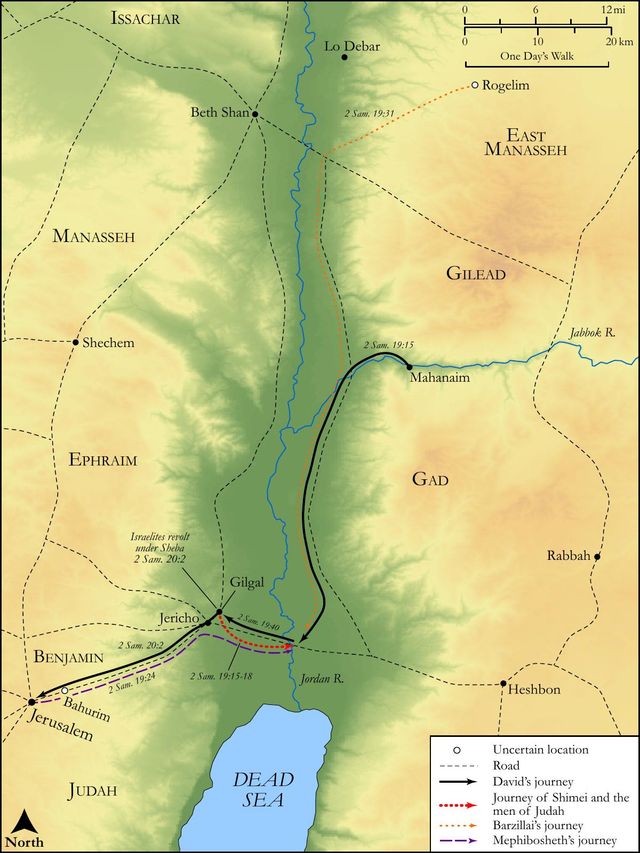
Perhaps Jordan was never passed with so much solemnity, nor with so many remarkable occurrences, as it was now, since Israel passed it under Joshua. David, in his afflictive flight, remembered God particularly from the land of Jordan (Psa 42:6), and now that land, more than any other, was graced with the glories of his return. David's soldiers furnished themselves with accommodations for their passage over this river, but, for his own family, a ferry-boat was sent on purpose, Sa2 19:18. A fleet of boats, say some; a bridge of boats was made, say others; the best convenience they had to serve him with. Two remarkable persons met him on the banks of Jordan, both of whom had abused him wretchedly when he was in his flight.
I.Ziba, who had abused him with his fair tongue, and by accusing his master, had obtained from the king a grant of his estate, Sa2 16:4.
A greater abuse he could not have done him, than, by imposing upon his credulity, to draw him in to do a thing so unkind to the son of his friend Jonathan. He comes now, with a retinue of sons and servants, to meet the king (Sa2 19:17), that he may obtain the king's favour, and so come off the better when Mephibosheth shall shortly undeceive him, and clear himself, Sa2 19:26.
II.Shimei, who had abused him with his foul tongue, railed at him, and cursed him, Sa2 16:5.
If David had been defeated, no doubt he would have continued to trample upon him, and have gloried in what he had done; but now that he sees him coming home in triumph, and returning to his throne, he thinks it his interest to make his peace with him. Those who now slight and abuse the Son of David would be glad to make their peace too when he shall come in his glory; but it will be too late. Shimei, to recommend himself to the king,
1.Came with good company, with the men of Judah, as one in their interest.
2.He brought a regiment of the men of Benjamin with him, 1000, of which perhaps he was chiliarch, or commander-in-chief, offering his own and their service to the king; or perhaps they were volunteers, whom by his interest he had got together to meet the king, which was the more obliging because of all the tribes of Israel there were none, except these and Judah, that appeared to pay him this respect.
3.What he did he hastened to do; he lost no time. Agree with thy adversary quickly, while thou art in the way. Here is,
(1.)The criminal's submission (Sa2 19:18-20): He fell down before the king, as a penitent, as a supplicant; and, that he might be thought sincere, he did it publicly before all David's servants, and his friends the men of Judah, yea, and before his own thousand. The offence was public, therefore the submission ought to be so. He owns his crime: Thy servant doth know that I have sinned. He aggravates it: I did perversely. He begs the king's pardon: Let not the king impute iniquity to thy servant, that is, deal with me as I deserve. He intimates that it was below the king's great and generous mind to take it to his heart; and pleads his early return to his allegiance, that he was the first of all the house of Joseph (that is, of Israel, who in the beginning of David's reign had distinguished themselves from Judah by their adherence to Ishbosheth, Sa2 2:10) that came to meet the king. He came first, that by his example of duty the rest might be induced, and by his experience of the king's clemency the rest might be encouraged to follow.
(2.)A motion made for judgment against him (Sa2 19:21): "Shall not Shimei be put to death as a traitor? Let him, of all men, be made an example." This motion was made by Abishai, who would have ventured his life to have been the death of Shimei when he was cursing, Sa2 16:9. David did not think fit to have it done then, because his judicial power was cut short; but, now that it was restored, why should not the law have its course? Abishai herein consulted what he supposed to be David's feelings more than his true interest. Princes have need to arm themselves against temptations to severity.
(3.)His discharge by the king's order, Sa2 19:22, Sa2 19:23. He rejected Abishai's motion with displeasure: What have I to do with you, you sons of Zeruiah? The less we have to do with those who are of an angry revengeful spirit, and who put us upon doing what is harsh and rigorous, the better. He looks upon these prosecutors as adversaries to him, though they pretended friendship and zeal for his honour. Those who advise us to what is wrong are really Satans, adversaries to us.
[1.]They were adversaries to his inclination, which was to clemency. He knew that he was this day king in Israel, restored to, and re-established in, his kingdom, and therefore his honour inclined him to forgive. It is the glory of kings to forgive those that humble and surrender themselves: Satis est prostrasse leoni - it suffices the lion that he has laid his victim prostrate. His joy inclined him to forgive. The pleasantness of his spirit on this great occasion forbade the entrance of any thing that was sour and peevish: joyful days should be forgiving days. Yet this was not all; his experience of God's mercy in restoring him to his kingdom, his exclusion from which he attributed to his sin, inclined him to show mercy to Shimei. Those that are forgiven must forgive. David had severely revenged the abuses done to his ambassadors by the Ammonites (Sa2 12:31), but easily passes by the abuse done to himself by an Israelite. That was an affront to Israel in general, and touched the honour of his crown and kingdom; this was purely personal, and therefore (according to the usual disposition of good men) he could the more easily forgive it.
[2.]They were adversaries to his interest. If he should put to death Shimei, who cursed him, those would expect the same fate who had taken up arms and actually levied war against him, which would drive them from him, while he was endeavouring to draw them to him. Acts of severity are seldom acts of policy. The throne is established by mercy. Shimei, hereupon, had his pardon signed and sealed with an oath, yet being bound, no doubt, to his good behaviour, and liable to be prosecuted if he afterwards misbehaved; and thus he was reserved to be, in due time, as much a monument of the justice of the government as he was now of its clemency, and in both of its prudence.
Continue studying 2 Samuel 19:19 across the web’s major study libraries — every link below opens this exact verse, chapter, or book on the destination site.
Read & Compare
 BibleGatewayThis verse in more than 200 translations and 70 languages.
 Bible.comThe YouVersion reader — hundreds of translations, reading plans, and highlights.
 ESV.orgCrossway's official English Standard Version reader.
 NET BibleThe NET translation with 60,000+ translators' notes on every rendering decision.
 STEP BibleTyndale House's free study tool — original text, vocabulary, and scholarly resources.
 BibliaLogos Bible Software's free web reader.
 USCCBThe New American Bible (Revised Edition) with the U.S. bishops' study notes.
Commentaries
 BibleHub CommentariesDozens of classic commentaries on this verse, gathered on one page.
 StudyLightMore than 100 commentary sets — the largest collection on the web.
 BibleRefPlain-English commentary on what this verse means, verse by verse.
 Enduring WordDavid Guzik's free commentary on this chapter, widely used by Bible teachers.
 Bible Study ToolsVerse commentary alongside Greek and Hebrew study aids.
Original Language & Research
- BibleHub InterlinearThe verse word by word — original language, transliteration, and English.
- BibleHub LexiconEvery word's original-language definition and Strong's entry.
 Blue Letter BibleDeep-study tools — Strong's numbers, concordance, and word studies.
 SefariaThe Hebrew text with Rashi and centuries of Jewish commentary.
Sermons, Hymns & Audio


TrulyRandomVerse is not affiliated with these sites and doesn’t control their content. They’re linked because they’re genuinely useful.
Summary
Second Samuel 19:19 captures the urgent and desperate plea of Shimei, a Benjamite from the house of Saul, as King David makes his triumphant return to Jerusalem following the suppression of Absalom's rebellion. Having previously cursed and reviled David during his flight from the capital, Shimei now prostrates himself before the restored monarch, begging for mercy and imploring David not to hold his past treachery against him, nor to remember his perverse actions with a vengeful heart. This verse marks a pivotal moment of reconciliation and the king's demonstration of initial clemency amidst a period of national healing and reunification.
Context
ShowHideLiterary Context
This verse is situated at a crucial juncture in David's reign, immediately following the tragic defeat of Absalom's rebellion and David's journey back to Jerusalem. As David crosses the Jordan River, he is met by various groups seeking to welcome him and re-establish their loyalty. Shimei's appearance is particularly significant, as he rushes to be among the first to greet the king, indicating his profound fear and urgent desire for pardon. His plea in this verse directly follows his prostration before David with a thousand men of Benjamin, acknowledging the king's restored authority. The immediate literary backdrop is Shimei's earlier, virulent cursing of David as the king fled Jerusalem, documented in 2 Samuel 16:5-8, where he threw stones and accused David of being a "man of blood." David's initial response to those who wished to execute Shimei for this offense was one of remarkable restraint, even considering the possibility of divine orchestration behind the curses (2 Samuel 16:10). This history sets up the high stakes of Shimei's current appeal for mercy, highlighting the dramatic shift in power dynamics.
Historical & Cultural Context
The scene unfolds as David, the anointed king, is returning to his capital after a period of exile and civil war. In Israel, a returning king held immense power, and those who had committed treason faced severe penalties, often execution. Shimei's actions during David's flight were not merely disrespectful but constituted an act of open rebellion and a challenge to David's divine right to rule. As a Benjamite, Shimei likely harbored lingering loyalty to the deposed house of Saul and resentment towards David, viewing David's misfortune as divine judgment for usurping Saul's throne. The act of prostration and urgent appeal for mercy was a common cultural practice for those seeking clemency from a king, demonstrating absolute submission. The Jordan River crossing itself symbolized a return to stability and a new beginning for David's reign, making it a fitting moment for acts of reconciliation and forgiveness, or the dispensing of justice, as the kingdom sought to heal from the wounds of civil strife.
Key Themes
ShowHideShimei's plea in 2 Samuel 19:19 contributes to several major themes within the book of 2 Samuel and the broader biblical narrative. Firstly, it highlights the theme of Seeking Forgiveness and Repentance. Shimei's desperate words, though perhaps motivated by fear for his life, represent an acknowledgment of wrongdoing and a direct request for the king's pardon, underscoring the human need to confess sin and seek reconciliation. Secondly, the verse sets up a profound tension between Mercy vs. Justice. David's advisors, particularly Abishai, immediately advocated for Shimei's execution (2 Samuel 19:21), presenting David with a choice between exacting retribution for past treachery and extending an act of clemency during a moment of national reunification. David's decision here reveals his capacity for grace, albeit a nuanced one. Lastly, Shimei's request, "neither do thou remember that which thy servant did perversely," powerfully illustrates The Weight of Past Actions. It emphasizes that one's deeds, especially those of disloyalty and rebellion, carry significant consequences and can haunt an individual until forgiveness is sought and, ideally, granted, demonstrating the lasting impact of sin.
Exposition and Analysis
ShowHideKey Word Analysis
ShowHideVerse Breakdown
ShowHide"And said unto the king,"
This opening phrase immediately establishes the direct and personal nature of Shimei's address. He is speaking directly to David, without an intermediary, underscoring the urgency, humility, and personal risk involved in his plea for mercy.
"Let not my lord impute iniquity unto me,"
This is the central request of Shimei's desperate appeal. He begs David not to reckon, account, or hold his past sin against him. It is a plea for non-punishment, for the king to set aside the legal and moral claim he has over Shimei's life due to his treasonous acts of cursing and rebellion.
"neither do thou remember that which thy servant did perversely the day that my lord the king went out of Jerusalem,"
Shimei explicitly identifies the specific offense: his perverse (twisted, malicious) actions on the day David fled Jerusalem from Absalom's rebellion. This demonstrates his full awareness of the gravity of his actions and his hope that David will choose not to recall them with a desire for vengeance or retribution. The detailed reference to the "day that my lord the king went out of Jerusalem" serves as a precise confession of the timing and context of his deep disloyalty.
"that the king should take it to his heart."
This final clause articulates the desired outcome of Shimei's plea. He asks that David not internalize the offense, not hold it as a grudge, or allow it to become a source of bitterness or a motivation for punitive action. To "take it to his heart" implies a deep-seated remembrance that would inevitably lead to judgment or a desire for retribution, which Shimei desperately seeks to avoid.
Literary Devices
ShowHideThe passage makes effective use of several literary devices to convey the drama and tension of the moment. Supplication is central, as Shimei's words are a direct, desperate plea for mercy from a position of profound vulnerability and abject submission. His language is humble and deferential, referring to himself as "thy servant" and David as "my lord," which stands in stark Contrast to his previous insolence and open defiance. There is also a strong element of Irony in the scene: the man who publicly reviled and cursed the king now abases himself, begging for the very mercy he denied David. This dramatic shift highlights Shimei's opportunistic nature and the overwhelming power dynamic now in David's favor. The narrative also employs Foreshadowing, as David's immediate clemency, while significant and publicly declared, is not absolute, hinting at future consequences for Shimei that are later revealed in 1 Kings 2:8-9.
Theological and Thematic Connections
ShowHideShimei's urgent plea for David not to "impute iniquity" to him resonates deeply with the broader biblical understanding of sin, judgment, and divine forgiveness. His desire for David not to "remember" his perverse actions reflects humanity's longing for a fresh start, a wiping clean of the slate. This human plea for non-imputation finds its ultimate and perfect fulfillment in God's character and His gracious provision for humanity's sin. Unlike human forgiveness, which can be conditional or incomplete, God's forgiveness, when truly sought through genuine repentance and faith, is absolute, leading to a complete non-reckoning of sin. It is a profound theological truth that God does not hold our iniquities against us when we turn to Him, offering a mercy that far surpasses any earthly king's clemency.
Reflection and Application
ShowHideShimei's desperate plea in 2 Samuel 19:19 offers powerful lessons for our own lives, both in seeking and extending forgiveness. It reminds us of the profound humility required to acknowledge our wrongs, especially when we have deeply offended someone. Shimei's willingness to abase himself before David, despite his previous arrogance, illustrates the courage it takes to confess and seek reconciliation. For us, this means setting aside pride, genuinely apologizing for the hurt we have caused, and making amends where possible, recognizing that true repentance often involves a willingness to humble oneself. Conversely, David's initial response challenges us to consider the grace of extending forgiveness, particularly when we hold power or have been deeply wronged. While Shimei's motives might have been mixed (fear vs. true repentance), David's act of clemency during a time of national healing set a powerful precedent for mercy over immediate retribution. This passage encourages us to cultivate a spirit of forgiveness, recognizing that holding onto bitterness or a desire for vengeance can poison our own hearts and hinder reconciliation, both with others and with God.
Questions for Reflection
ShowHideFAQ
ShowHideWhy did Shimei curse David in the first place?
ShowHideShimei, a Benjamite from Bahurim and a relative of King Saul, harbored deep loyalty to Saul's house and resentment towards David. When David fled Jerusalem during Absalom's rebellion, Shimei saw an opportunity to express his contempt and possibly to align himself with what he perceived as the rising power of Absalom. He believed David was a "man of blood" and was being justly punished by God for the perceived wrong done to Saul's family (2 Samuel 16:5-8). His actions were a public act of defiance and an opportunistic challenge to David's authority, demonstrating his animosity towards the Davidic dynasty.
Did David truly forgive Shimei, or was his mercy temporary?
ShowHideDavid's mercy towards Shimei in 2 Samuel 19 was a strategic and merciful act during a moment of national reunification and David's triumphant return. He swore an oath not to put Shimei to death on that day (2 Samuel 19:23). However, David's forgiveness was not absolute or permanent in its scope. Years later, on his deathbed, David instructed his son Solomon to deal with Shimei, reminding him of Shimei's past actions and implying that Shimei should not go unpunished (1 Kings 2:8-9). Solomon later found a pretext to execute Shimei, fulfilling David's implicit desire for justice. This illustrates the complex nature of justice and mercy in the Old Testament, where consequences for sin, even if delayed, often remained, and human forgiveness can have limits.
Christ-Centered Fulfillment
ShowHideShimei's desperate plea to David, "Let not my lord impute iniquity unto me," finds its ultimate and glorious fulfillment in the person and work of Jesus Christ. While David, an earthly king, could offer a temporary and conditional non-imputation of guilt, the Lord Jesus Christ offers a perfect, eternal, and complete non-imputation of sin for all who believe. Our "perverse" actions, far more grievous than Shimei's, are fully accounted for at the cross. On the cross, Christ, who knew no sin, became sin for us, so that in Him we might become the righteousness of God (2 Corinthians 5:21). God, through Christ, does not merely choose not to remember our sins; He removes them as far as the east is from the west (Psalm 103:12). The blessedness of the one to whom the Lord "will not impute sin" (Romans 4:7-8) is a reality made possible only by the atoning sacrifice of the Lamb of God, who takes away the sin of the world!. In Christ, the record of debt that stood against us has been canceled and nailed to the cross (Colossians 2:14), and God declares, "I will remember their sins no more" (Hebrews 8:12). This is a divine, perfect mercy that vastly transcends any human king's clemency, offering true and lasting reconciliation.