


Mark 15:5
Bible text: King James Version (1769 Blayney text) · Public domain
Bible text: Berean Standard Bible · Public domain
Bible text: American Standard Version (1901) · Public domain
Bible text: World English Bible, Messianic edition · Public domain
Bible text: Geneva Bible (1599) · Public domain
Bible text: Young's Literal Translation · Public domain
- ὉHo<the>G3588T-NSMDefinite article Nominative Singular Masculine
- δὲdeButG1161CONJConjunction
- ἸησοῦςIēsousJesusG2424N-NSM-PNoun Nominative Singular Masculine Individual
- οὐκέτιouketino longerG2089PRT-N + G2089=ADV
- οὐδὲνoudenno [thing]G3762A-ASNAdjective Accusative Singular Neuter
- ἀπεκρίθηapekrithēansweredG611V-ADI-3SVerb Aorist Middle Deponent Indicative 3rd Singular
- ὥστεhōsteso asG5620CONJConjunction
- θαυμάζεινthaumazeinto amazeG2296V-PANVerb Present Active Infinitive
- τὸνton<the>G3588T-ASMDefinite article Accusative Singular Masculine
- ΠιλᾶτονPilatonPilateG4091N-ASM-PNoun Accusative Singular Masculine Individual
English is a literal word-by-word gloss of the Greek, not the KJV's wording. Why?
This is the original text the KJV's translators worked from — each Greek word with its own literal English meaning in this verse, prepared by scholars at Tyndale House, Cambridge. The KJV translates whole sentences, not word by word, so its wording differs: one Greek word can become several English words, and the KJV may choose “charity” where the gloss reads “love”. Both are faithful — they answer different questions. For the KJV's own rendering, switch to the KJV text.
Details
See on the biblical-era maps
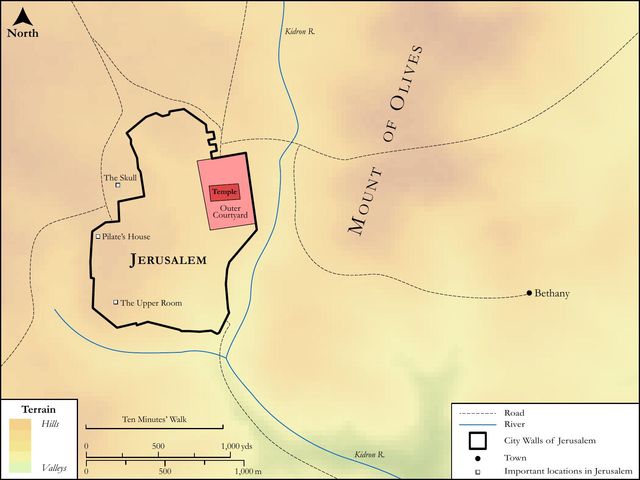
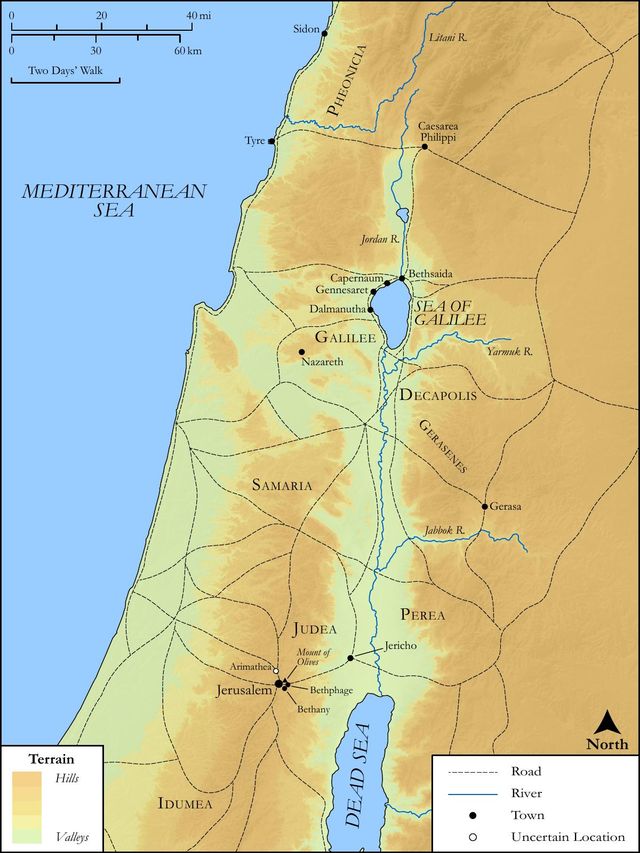
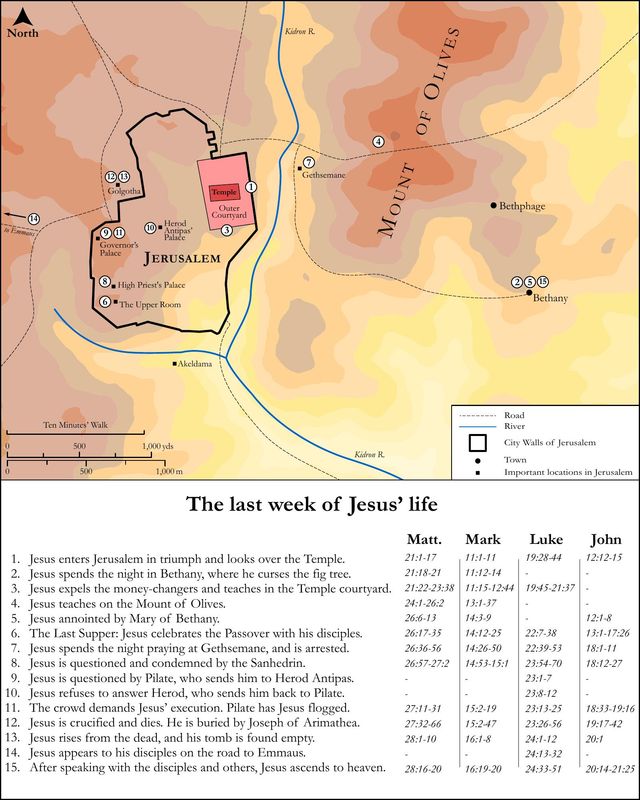
Study this verse
Public-domain commentary
Matthew Henry
From his Commentary on the Whole Bible. Henry comments on passages, not single verses — this entry covers Mark 15:1–14. His two-level outline is real structure in the source text, so it is rendered as structure.
Here we have, I. A consultation held by the great Sanhedrim for the effectual prosecution of our Lord Jesus. They met early in the morning about it, and went into a grand committee, to find out ways and means to get him put to death; they lost no time, but followed their blow in good earnest, lest there should be an uproar among the people. The unwearied industry of wicked people in doing that which is evil, should shame us for our backwardness and slothfulness in that which is good. They that war against Christ and thy soul, are up early; How long then wilt thou sleep, O sluggard?
II.The delivering of him up a prisoner to Pilate; they bound him.
He was to be the great sacrifice, and sacrifices must be bound with cords, Psa 118:27. Christ was bound, to make bonds easy to us, and enable us, as Paul and Silas, to sing in bonds. It is good for us often to remember the bonds of the Lord Jesus, as bound with him who was bound for us. They led him through the streets of Jerusalem, to expose him to contempt, who, while he taught in the temple, but a day or two before, was had in veneration; and we may well imagine how miserably he looked after such a night's usage as he had had; so buffeted, spit upon, and abused. Their delivering him to the Roman power was a type of ruin of their church, which hereby they merited, and brought upon themselves; it signified that the promise, the covenant, and the oracles, of God, and the visible state church, which were the glory of Israel, and had been so long in their possession, should now be delivered up to the Gentiles. By delivering up the king they do, in effect, deliver up the kingdom of God, which is therefore, as it were, by their own consent, taken from them, and given to another nation. If they had delivered up Christ, to gratify the desires of the Romans, or to satisfy and jealousies of theirs concerning him, it had been another matter; but they voluntarily betrayed him that was Israel's crown, to them that were Israel's yoke.
III.The examining of him by Pilate upon interrogatories (Mar 15:2); "Art thou the king of the Jews? Dost thou pretend to be so, to be that Messiah whom the Jews expect as a temporal prince?" - "Yea," saith Christ, "it is as thou sayest, I am that Messiah, but not such a one as they expect." He is the king that rules and protects his Israel according to the spirit, who are Jews inwardly by the circumcision of the spirit, and the king that will restrain and punish the carnal Jews, who continue in unbelief.
IV.The articles of impeachment exhibited against him, and his silence under the charge and accusation.
The chief priests forgot the dignity of their place, when they turned informers, and did in person accuse Christ of many things (Mar 15:3), and witness against him, Mar 15:4. Many of the Old Testament prophets charge the priests of their times with great wickedness, in which well did they prophesy of these priests; see Eze 22:26; Hos 5:1; Hos 6:9; Mic 3:11; Zep 3:4; Mal 1:6; Mal 2:8. The destruction of Jerusalem by the Chaldeans is said to be for the iniquity of the priests that shed the blood of the just, Lam 4:13. Note, Wicked priests are generally the worst of men. The better any thing is, the worse it is when it is corrupted. Lay persecutors have been generally found more compassionate than ecclesiastics. These priests were very eager and noisy in their accusation; but Christ answered nothing, Mar 15:3. When Pilate urged him to clear himself, and was desirous he should (Mar 15:4), yet still he stood mute (Mar 15:5), he answered nothing, which Pilate thought very strange. He gave Pilate a direct answer (Mar 15:2), but would not answer the prosecutors and witnesses, because the things they alleged, were notoriously false, and he knew Pilate himself was convinced they were so. Note, As Christ spoke to admiration, so he kept silence to admiration.
V.The proposal Pilate made to the people, to have Jesus released to them, since it was the custom of the feast to grace the solemnity with the release of one prisoner. The people expected and demanded that he should do as he had ever done to them (Mar 15:8); it was not an ill usage, but they would have it kept up. Now Pilate perceived that the chief priests delivered up Jesus for envy, because he had got such a reputation among the people as eclipsed theirs, Mar 15:10. It was easy to see, comparing the eagerness of the prosecutors with the slenderness of the proofs, that it was not his guilt, but his goodness, not any thing mischievous or scandalous, but something meritorious and glorious, that they were provoked at. And therefore, hearing how much he was the darling of the crowd, he thought that he might safely appeal from the priests to the people, and that they would be proud of rescuing him out of the priests' hands; and he proposed an expedient for their doing it without danger of an uproar; let them demand him to be released, and Pilate will be ready to do it, and stop the mouths of the priests with this - that the people insisted upon his release. There was indeed another prisoner, one Barabbas, that had an interest, and would have some votes; but he questioned not but Jesus would out-poll him.
VI.The unanimous outrageous clamours of the people have Christ put to death, and particularly to have him crucified.
It was a great surprise to Pilate, when he found the people so much under the influence of the priests, that they all agreed to desire that Barabbas might be released, Mar 15:11. Pilate opposed it all he could; "What will ye that I shall do to him whom ye call the King of the Jews? Would not ye then have him released too?" Mar 15:12. No, say they, Crucify him. The priests having put that in their mouths, the insist upon it; when Pilate objected, Why, what evil has he done? (a very material question in such a case), they did not pretend to answer it, but cried out more exceedingly, as they were more and more instigated and irritated by the priests, Crucify him, crucify him. Now the priests, who were very busy dispersing themselves and their creatures among the mob, to keep up the cry, promised themselves that it would influence Pilate two ways to condemn him.
1.It might incline him to believe Christ guilty, when there was so general an out-cry against him. "Surely," might Pilate think, "he must needs be a bad man, whom all the world is weary of." He would now conclude that he had been misinformed, when he was told what an interest he had in the people, and that the matter was not so. But the priest had hurried on the prosecution with so much expedition, that we may suppose that they who were Christ's friends, and would have opposed this cry, were at the other end of the town, and knew nothing of the matter. Note, It has been the common artifice of Satan, to put Christ and his religion into an ill name, and so to run them down. When once this sect, as they called it, comes to be every where spoken against, though without cause, then that is looked upon as cause enough to condemn it. But let us judge of persons and things by their merits, and the standard of God's word, and not prejudge by common fame and the cry of the country.
2.It might induce him to condemn Christ, to please the people, and indeed for fear of displeasing them. Though he was not so weak as to be governed by their opinion, to believe him guilty, yet he was so wicked as to be swayed by their outrage, to condemn him, though he believed him innocent; induced thereunto by reasons of state, and the wisdom of the world. Our Lord Jesus dying as a sacrifice for the sins of many, he fell a sacrifice to the rage of many.
Historical interpretation
Eight Centuries of Reception
5 surviving comments on this verse. Each one is dated, so this reads as a timeline rather than a list.
Select a marker to jump to its quote. Markers stagger vertically where authors wrote within a few decades of each other.
He is the One who, although he was silent in his passion, will not be silent finally in the day of reckoning. He is our God, even if unrecognized. He is already known among the faithful and all who believe. When he comes manifesting himself in his second coming, he will not be silent. For although he was formerly hidden in humility, he will come manifested in power.
The Lord became the defender of truth, and came in silence before Pilate, on behalf of truth which had been oppressed. Others gain victory through making defenses, but our Lord gained victory through his silence, because the recompense of his death through divine silence was the victory of true teaching. He spoke in order to teach, but kept silent in the tribunal. He was not silent over that which was exalting us, but he did not struggle against those who were provoking him. The words of his calumniators, like a crown on his head, were a source of redemption. He kept silent so that his silence would make them shout even louder, and so that his crown would be made more beautiful through all this clamor.
This silence of our Lord Jesus Christ took place more than once. It occurred before the chief priest, and before Herod, and before Pilate himself. So it was not in vain that the prophecy regarding him had preceded: “As the lamb before its shearer was dumb, so he opened not his mouth,” especially on those occasions when he did not answer his questioners. Usually he replied to questions addressed to him, but in this case he declined to make any reply. The metaphor of the lamb is used to indicate that his silence does not imply guilt but innocence. When he did not open his mouth as he passed through the process of judgment, it was in the character of a lamb that he did so; that is, not as one with an evil conscience who was convicted of his sins, but as one who in his meekness was sacrificed for the sins of others.
(in Marc. 4, 44) The Jews had a custom of delivering him whom they had condemned to death, bound to the judge. Wherefore after the condemnation of Christ, the Evangelist adds: And straightway in the morning the Chief Priests held a consultation with the elders and Scribes and the whole council, and bound Jesus, and carried him away, and delivered him to Pilate. But it must be observed, that they did not then first bind Him, but they bound Him on first taking Him in the garden by night, as John declares.
(ubi sup.) By Pilate's asking Him about no other accusation, except whether He was King of the Jews, they are convicted of impiety, for they could not even find a false accusation against our Saviour. It goes on: And he answering said unto him, Thou sayest. He answers in this way so as both to speak the truth, and yet not to be open to cavil.
(ubi sup.) He indeed who condemns Jesus is a heathen, but he refers it to the people of the Jew's as the cause. There follows: But Jesus yet answered nothing; so that Pilate marvelled. He was unwilling to give an answer, lest He should clear Himself of the charge, and be acquitted by the judge, and so the gain resulting from the Cross should be done away.
They then gave Jesus up to the Romans, but were themselves given up by God into the hands of the Romans, that the Scriptures might be fulfilled, which say, Recompense them after the work of their hands. (Ps. 28:5) It goes on: And Pilate asked him, Art thou the King of the Jews?
For His answer is doubtful, since it may mean, Thou sayest, but I say not so. 1And observe that He does somewhere answer Pilate, who condemned Him unwillingly, but does not choose to answer the priests and great men, and judges them unworthy of a reply. It goes on: And the Chief Priests accused him of many things.
But Pilate wondered, because, though He was a teacher of the law, and eloquent, and able by His answer to destroy their accusations, He did not answer any thing, but rather bore their accusations courageously.
Continue studying Mark 15:5 across the web’s major study libraries — every link below opens this exact verse, chapter, or book on the destination site.
Read & Compare
 BibleGatewayThis verse in more than 200 translations and 70 languages.
 Bible.comThe YouVersion reader — hundreds of translations, reading plans, and highlights.
 ESV.orgCrossway's official English Standard Version reader.
 NET BibleThe NET translation with 60,000+ translators' notes on every rendering decision.
 STEP BibleTyndale House's free study tool — original text, vocabulary, and scholarly resources.
 BibliaLogos Bible Software's free web reader.
 USCCBThe New American Bible (Revised Edition) with the U.S. bishops' study notes.
Commentaries
 BibleHub CommentariesDozens of classic commentaries on this verse, gathered on one page.
 StudyLightMore than 100 commentary sets — the largest collection on the web.
 BibleRefPlain-English commentary on what this verse means, verse by verse.
 Enduring WordDavid Guzik's free commentary on this chapter, widely used by Bible teachers.
 Bible Study ToolsVerse commentary alongside Greek and Hebrew study aids.
Original Language & Research
- BibleHub InterlinearThe verse word by word — original language, transliteration, and English.
- BibleHub LexiconEvery word's original-language definition and Strong's entry.
 Blue Letter BibleDeep-study tools — Strong's numbers, concordance, and word studies.
 CNTR CollationThe earliest Greek manuscripts of this verse, collated letter by letter.
Sermons, Hymns & Audio


TrulyRandomVerse is not affiliated with these sites and doesn’t control their content. They’re linked because they’re genuinely useful.
Summary
Mark 15:5 captures a profoundly significant moment during Jesus' trial before Pontius Pilate, where Jesus maintains a complete and deliberate silence in the face of numerous, escalating accusations from the chief priests and elders. This unexpected and unprecedented refusal to defend Himself deeply astonished Pilate, highlighting Jesus' sovereign control, fulfillment of prophecy, and unique divine composure amidst intense pressure and injustice.
Context
ShowHideLiterary Context
This verse is situated at a critical juncture in Jesus' passion narrative, immediately following Pilate's direct interrogation of Jesus regarding His kingship in Mark 15:2 and the subsequent, vehement accusations hurled by the chief priests and scribes (Mark 15:3-4). While Jesus had offered a brief, enigmatic affirmation to Pilate's initial question ("You have said so"), the escalating volume and severity of the charges from His Jewish accusers are met with an absolute and unwavering silence. This silence stands in stark contrast to the clamor of the crowd and the legal expectations of the Roman court, serving as a powerful narrative device that underscores Jesus' unique posture and the gravity of the moment. The preceding verses establish the chaotic and unjust nature of the trial, making Jesus' composed silence all the more striking.
Historical & Cultural Context
The trial of Jesus before Pilate took place in Jerusalem during the Passover festival, a time of heightened religious and political tension. Pontius Pilate, the Roman prefect of Judea (26-36 AD), was responsible for maintaining order and administering Roman law. Roman legal proceedings typically involved a defendant's vigorous self-defense, and silence was often interpreted as an admission of guilt. Pilate, as a seasoned governor, would have been accustomed to defendants pleading their cases, arguing, and attempting to sway his judgment. The Jewish leaders, driven by religious and political animosity, were determined to secure Jesus' execution, presenting a multitude of charges. Jesus' refusal to engage in the expected legal discourse was therefore culturally and historically anomalous, profoundly challenging Pilate's understanding of justice and human behavior.
Key Themes
ShowHideMark 15:5 powerfully reinforces several overarching themes found within the Gospel of Mark and the broader biblical narrative. First, it highlights the sovereignty of Christ, demonstrating that even in His apparent vulnerability and impending suffering, Jesus remains in complete control, submitting to the Father's will rather than succumbing to human pressure. His silence is not weakness but a deliberate act of divine purpose. Second, it underscores the fulfillment of Old Testament prophecy, particularly the suffering servant passages in Isaiah 53, which depict a lamb led to slaughter who "opened not his mouth" (Isaiah 53:7). This deliberate silence confirms Jesus' identity as the promised Messiah who willingly embraces suffering for redemption. Finally, the verse emphasizes Pilate's bewilderment and moral dilemma, as Jesus' unique composure forces the Roman governor to confront an innocence and authority unlike any he had encountered, ultimately leading to his internal conflict and attempt to release Jesus (Mark 15:6-10).
Exposition and Analysis
ShowHideKey Word Analysis
ShowHideFrom ἀπό and κρίνω, meaning "to conclude for oneself," and by implication, "to respond." In this context, it refers to Jesus' expected verbal reply to the accusations. The fact that He "answered nothing" emphasizes the complete absence of any verbal defense or counter-argument, a profound and deliberate choice.
From οὐδέ and εἷς, meaning "not even one (man, woman or thing)," or "none, nobody, nothing." This word intensifies the meaning of Jesus' silence, indicating an absolute lack of any response whatsoever, not just a brief or incomplete one. It highlights the stark contrast between the clamor of the accusers and Jesus' utter stillness.
From θαῦμα, meaning "to wonder" or "to admire." This term conveys Pilate's profound astonishment, bewilderment, and possibly a sense of awe or admiration. It suggests that Jesus' silence was not merely unexpected but deeply perplexing and impactful to the Roman governor, challenging his understanding of human behavior and legal proceedings.
Verse Breakdown
ShowHide"But Jesus yet answered nothing"
This clause highlights Jesus' deliberate and complete silence in the face of the mounting accusations from the chief priests and elders. The adverb "yet" (Greek, oukéti) emphasizes that He ceased to answer, even after His initial brief affirmation to Pilate. This refusal to engage in self-defense is extraordinary, defying the expectations of a defendant in a legal trial and underscoring His unique posture and divine resolve.
"so that Pilate marvelled"
This clause describes the profound effect of Jesus' silence on Pontius Pilate. The conjunction "so that" (Greek, hṓste) indicates a direct consequence. Pilate, accustomed to defendants vigorously pleading their cases, was utterly astonished by Jesus' composure and refusal to speak. His "marvelling" suggests a mixture of bewilderment, perhaps a dawning realization of Jesus' innocence, and an unsettling sense of His unusual authority, despite His bound and accused state.
Literary Devices
ShowHideMark 15:5 employs several potent literary devices. Contrast is immediately evident between the vociferous accusations of the chief priests and Jesus' absolute silence, highlighting the stark difference in their postures and purposes. This silence itself functions as a powerful rhetorical device, speaking volumes about Jesus' sovereignty and deliberate submission to God's will, rather than engaging in a futile defense. There is also an element of irony in Pilate, the powerful Roman governor, being "marvelled" or astonished by the prisoner, suggesting a reversal of expected power dynamics. Furthermore, Jesus' silence serves as a profound foreshadowing and fulfillment of prophecy, directly echoing the Suffering Servant passages in Isaiah that describe one who "opened not his mouth" (Isaiah 53:7). This literary connection enriches the theological depth of the moment, portraying Jesus as the preordained Lamb of God.
Theological and Thematic Connections
ShowHideJesus' profound silence in Mark 15:5 is a powerful theological statement, demonstrating His active submission to the Father's redemptive plan rather than a passive resignation. It underscores His divine sovereignty, revealing that His path to the cross was not a tragic accident but a deliberate, willed act of obedience and love. This silence is not born of fear or inability to defend Himself, but of a deeper, spiritual purpose—to fulfill prophecy and secure salvation. It speaks to the mystery of His suffering, where the Creator of the universe stands accused and chooses silence, embodying humility and perfect trust in God's ultimate justice.
Reflection and Application
ShowHideJesus' silence before Pilate offers a profound model for believers navigating moments of injustice, false accusation, or intense pressure. In a world that often demands immediate self-defense and vocal vindication, Jesus demonstrates the power and spiritual depth of choosing silence, not out of fear, but out of trust in God's ultimate sovereignty and justice. This does not mean silence is always the appropriate response, but it invites us to discern when surrendering our right to defend ourselves, in humble reliance on God, can be a more powerful witness than any words. It challenges us to reflect on whether our responses are driven by human instinct for self-preservation or by a deeper commitment to God's will and timing. Ultimately, Jesus' silence reminds us that our true vindication comes from God, and our ultimate purpose is to glorify Him, even in suffering.
Questions for Reflection
ShowHideFAQ
ShowHideWhy did Jesus remain silent when His life was on the line?
ShowHideJesus' silence was not an act of weakness or resignation, but a deliberate and powerful choice rooted in His divine purpose and identity. First, it was a fulfillment of Old Testament prophecy, particularly Isaiah 53:7, which describes the Suffering Servant as a lamb led to slaughter who "opened not his mouth." This demonstrated His identity as the Messiah. Second, His silence asserted His sovereignty and authority; He did not need to defend Himself against false accusations because His kingdom was "not of this world" (John 18:36). Engaging in a verbal defense would have legitimized the false charges. Third, His silence was an act of profound humility and obedience to the Father's will, essential for His atoning sacrifice. By remaining silent, He willingly submitted to the unjust process, becoming the perfect sacrifice for humanity's sins.
Christ-Centered Fulfillment
ShowHideMark 15:5, with Jesus' profound silence before Pilate, is a pivotal moment that powerfully foreshadows and embodies His Christ-centered fulfillment. His refusal to answer, which "marvelled" Pilate, is not merely a legal tactic but a divine act that perfectly aligns with His role as the Suffering Servant prophesied in Isaiah 53. Like a lamb led to slaughter, He "opened not his mouth" (Isaiah 53:7), willingly embracing the path of humiliation and injustice for the sake of humanity's redemption. This silence underscores His unique authority and divine nature; He is not a mere man on trial, but the Son of God who, though innocent, chooses to bear the world's sin. His silence before Pilate ultimately leads to His crucifixion, the very act by which He "gave his life as a ransom for many" (Mark 10:45). Thus, Jesus' silence here is a profound declaration of His mission as the Lamb of God who takes away the sin of the world, a silent yet eloquent testament to His sacrificial love and the ultimate triumph of God's redemptive plan.