


Hosea 5:1
- שִׁמְעוּshim·'uhearH8085V-Qal-Imp-2mpVerb Qal Imperative 2nd Plural Masculine
- זֹאתzotthisH2063PrtParticle Demonstrative
- הַכֹּהֲנִיםha·ko·ha·NimO priestsH3548Art ¦ N-mpNoun Plural Masculine AbsoluteהַOכֹּהֲנִיםpriests
- וְהַקְשִׁיבוּve·hak·Shi·vuand pay attentionH7181Conj-w ¦ V-Hiphil-Imp-2mpVerb Hiphil Imperative 2nd Plural Masculineוְandהַקְשִׁיבוּpay attention
- בֵּיתbeitO house ofH1004N-mscNoun Singular Masculine Construct
- יִשְׂרָאֵלYis·ra·'ElIsraelH3478N-properNoun Proper Location
- וּבֵיתu·Veitand O house ofH1004Conj-w ¦ N-mscNoun Singular Masculine ConstructוּandבֵיתO house of
- הַמֶּלֶךְha·Me·lekhthe kingH4428Art ¦ N-msNoun Singular Masculine Absoluteהַtheמֶּלֶךְking
- הַאֲזִינוּha·'a·Zi·nugive earH238V-Hiphil-Imp-2mpVerb Hiphil Imperative 2nd Plural Masculine
- כִּיkiforH3588PrtParticle Conditional
- לָכֶםla·Khem[belongs] to youPrep-l ¦ 2mpSuffix Personal 2nd Plural Masculineלָ[belongs] toכֶםyou
- הַמִּשְׁפָּטha·mish·Patthe judgmentH4941Art ¦ N-msNoun Singular Masculine Absoluteהַtheמִּשְׁפָּטjudgment
- כִּיkiforH3588PrtParticle Conditional
- פַחfacha trapH6341N-msNoun Singular Masculine Absolute
- הֱיִיתֶםhe·yi·Temyou have beenH1961V-Qal-Perf-2mpVerb Qal Perfect 2nd Plural Masculine
- לְמִצְפָּהle·mitz·Pahto MizpahH4709Prep-l ¦ N-properNoun Proper LocationלְtoמִצְפָּהMizpah
- וְרֶשֶׁתve·Re·shetand a netH7568Conj-w ¦ N-fscNoun Singular Feminine Constructוְandרֶשֶׁתa net
- פְּרוּשָׂהpe·ru·Sahspread outH6566V-Qal-PassPrtcpl-fsVerb Qal Participle Passive Singular Feminine Absolute
- עַל'aloverH5921PrepPreposition
- תָּבוֹרta·VorTaborH8396N-properNoun Proper Location
English is a literal word-by-word gloss of the Hebrew, not the KJV's wording. Why?
This is the original text the KJV's translators worked from — each Hebrew word with its own literal English meaning in this verse, prepared by scholars at Tyndale House, Cambridge. The KJV translates whole sentences, not word by word, so its wording differs: one Hebrew word can become several English words, and the KJV may choose “the LORD” where the gloss reads “Yahweh”. Both are faithful — they answer different questions. For the KJV's own rendering, switch to the KJV text.
Details
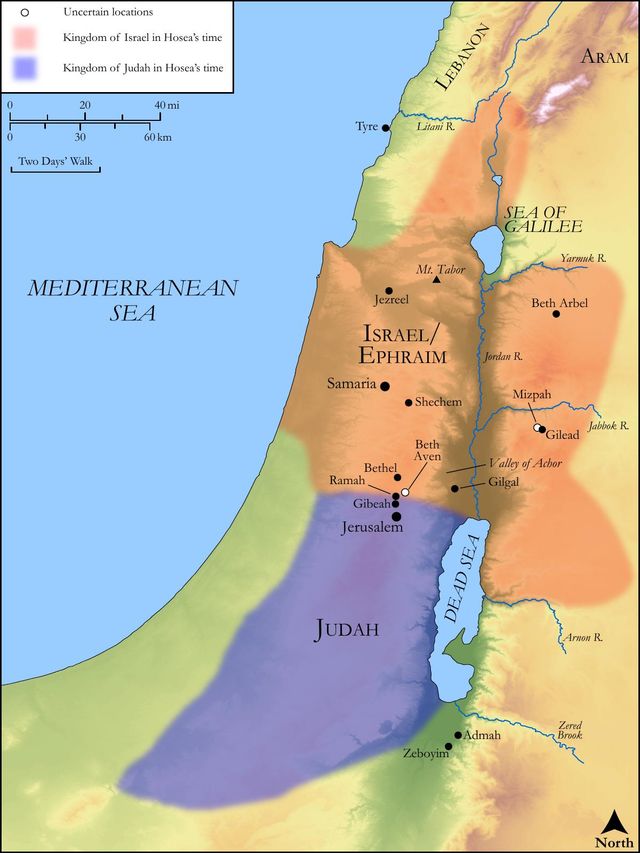
See on the biblical-era map
Study this verse
Public-domain commentary
Matthew Henry
From his Commentary on the Whole Bible. Henry comments on passages, not single verses — this entry covers Hosea 5:1–7. His three-level outline is real structure in the source text, so it is rendered as structure.
Here, I. All orders and degrees of men are cited to appear and answer to such things as shall be laid to their charge (Hos 5:1): Hear you this, O priests! whether in holy orders (as those in Judah, and perhaps many in Israel too, for in the ten tribes there were divers cities of priests and Levites, who, it is probable, staid in their own lot after the revolt of the ten tribes and did so much of their office as might be done at a distance from the temple) or pretending holy orders, as the priests of the calves, who, some think, are included here. "Hearken, you house of Israel, the common people, and give ear, O house of the king!" let them all take notice, for they have all contributed to the national guilt, and they shall all share in the national judgments. Note, If neither the sanctity of the priesthood nor the dignity of the royal family will prevail to keep out sin, it cannot be expected that they should avail to keep out wrath. If the priests, and the house of the king, though they bear such noble characters, sin like others, their noble characters will not excuse them, but they must smart like others. Nor shall it be any plea for the house of Israel that they were misled by their priests and princes, but they shall receive their doom with them, and neither their meanness nor their multitude shall be their exemption.
II.Witness is produced against them, one instead of a thousand; it is God's omniscience (Hos 5:3):
I know Ephraim, and Israel is not hidden from me. They have not known the Lord (Hos 5:4), but the Lord has known them, knows their true character however disguised, knows their secret wickedness however concealed. Note, Men's rejecting the knowledge of God will not secure them from his knowledge of them; and when he contends with them he will prove their sins upon them by his own knowledge, so that is will be in vain to plead Not guilty.
III.Very bad things are laid to their charge.
1.They had been very ingenious and very industrious to draw people either into sin or into trouble: You have been a snare on Mizpah, and a net spread upon Tabor (Hos 5:1), that is, such snares and nets as the huntsmen used to lay upon those mountains in pursuit of their game. When the worship of the calves was set up in Israel the patrons of that idolatry, and sticklers for it, contrived by all possible arts and wiles to draw men into it and reconcile those to it that at first had a dread of it. Note, Those that allure and entice men to sin, however they may pretend friendship and good-will, are to be looked upon as snares and nets to them, and their hands as bands, Ecc 7:26. But to those whom they could not seduce into sin they were as a net and a snare to bring them into trouble. Some think it was their practice to set spies in the road, and particularly upon the mountains of Mizpah and Tabor, at the times of the solemn feasts at Jerusalem, to watch if any of their people who were piously affected went thither, and to inform against them, that they might be prosecuted for it, thus doing the devil's work, who disquiets those whom he cannot debauch.
2.They had been both very crafty and very cruel in carrying on their designs (Hos 5:2): The revolters are profound to make slaughter. Note, Those who have themselves apostatized from the truths of God are often the most subtle and barbarous persecutors of those who still adhere to them. Nothing will serve them but to make slaughter (it is the blood of the saints that they thirst after): and with the serpent's sting they have his head; they are profound to do it. O the depth of the depths of Satan, of the wickedness of his agents, of those that have deeply revolted! Isa 31:6. Now that which aggravated this was the many reproofs and warnings that had been given them: Though I have been a rebuker of them all. The prophet had been so, a reprover by office. He had many a time told them of the evil of their ways and doings, had dealt plainly with them all, and had not spared either the priests or the house of the king. God himself had been a rebuker of them all by their own consciences and by his providences. Note, Sins against reproof are doubly sinful, Pro 29:1.
3.They had committed whoredom, had defiled their own bodies with fleshly lusts, had defiled their own souls with the worship of idols, Hos 5:3. This God was a witness to, though secretly committed and artfully palliated. Nay, the piercing eye of God saw the spirit of whoredom that was in the midst of them, their secret inclination and disposition to those sins, the love they had to their sins, and the dominion their sins had over them, how much they were under the power of a spirit of whoredom, that root of bitterness which bore all this gall and wormwood, that corrupt and poisoned fountain.
4.They had no disposition at all to come into acquaintance and communion with God. The spirit of whoredoms, having caused them to err from him, keeps them wandering endlessly, Hos 5:4.
(1.)They have not known the Lord, nor desire to know him, but have rather declined, nay dreaded, the knowledge of him, for that would disturb them in their sinful ways.
(2.)Therefore they will not frame their doings to turn to their God, by which it appeared that they did not know him aright. This intimates their obstinate persistence in their apostasy from God; they would not turn to God, though he was their God, theirs in covenant, by whose name they had been called, and whom they were bound to serve. They would not return to the worship of him, from which they had turned aside. Nay, they would not frame their doings to turn to God. They would not consider their ways, nor dispose themselves into a serious temper, nor apply their minds to think of those things that would bring them to God. It is true we cannot by our own power, without the special grace of God, turn to him; but we may by the due improvement of our faculties, and the common aids of his Spirit, frame our doings to turn to him. Those that will not do this, that prepare not their hearts to seek the Lord (Ch2 12:14), owe it to themselves that they are not turned; they die because they will die; and to those that will do this further grace shall not be wanting. (5.) They were guilty of notorious arrogancy, and insolence in sin (Hos 5:5): The pride of Israel doth testify to his face, doth witness against him that he is a rebel to God and his government. The spirit of whoredoms which was in the midst of them showed itself in the gaiety and gaudiness of their worship, as a harlot is known by her attire, Pro 7:10. The wantonness of her dress testifies to her face that she is not a modest woman. Or their pride in confronting the prophets God sent them and the message they brought (Jer 43:2), or a haughty scornful conduct towards their brethren and those that were under them, witnessed against them that they were not God's people and justified God in all the humbling judgments he brought upon them. His pride testifies in his face; so some read it, agreeing with Isa 3:9, The show of their countenance doth witness against them. They have that proud look which the Lord hates. (6.) They departed from God to idols, and bred up their children in idolatry (Hos 5:7): They have dealt treacherously against the Lord, as a wife, who, in contempt of the marriage covenant, forsakes her husband, and lives in adultery with another. Thus those who are guilty of spiritual idolatry, whose god is their money, whose god is their belly, deal treacherously against the Lord; they violate their engagements to him and frustrate his expectations from them. Note, Wilful sinners are treacherous dealers. They have begotten strange children, that is, their children which they have begotten are estranged from God, and trained up in a false way of worship; they are a spurious brood, as children of fornication (Joh 8:41), whom God will disown. Note, Those deal treacherously with God indeed who not only turn from following him themselves but train up their children in wicked ways.
IV.Very sad things are made to be their doom.
In general (Hos 5:1), "Judgment is towards you. God is coming forth to contend with you, and to testify his displeasure against you for your sins." It is time to hearken when judgment is towards us. In particular,
1.They shall fall in their iniquity. This follows upon their pride testifying to their face (Hos 5:5) Therefore shall Israel and Ephraim fall in their iniquity. Note, Pride will have a fall; it is the certain presage and forerunner of it. Those that exalt themselves shall be abased. The face in which pride testifies shall be filled with confusion. They shall not only fall, but fall in their iniquity, the saddest fall of any. Their pride kept them from repenting of their iniquity, and therefore they shall fall in it. Note, Those that are not humbled for their sins are likely to perish for ever in their sins. it is added, Judah also shall fall with them in her iniquity. As the ten tribes were carried captive into Assyria, for their idolatry, so the two tribes, in process of time, were carried into Babylon for following their bad example; but the former fell and were utterly cast down, the latter fell and were raised up again. Judah had the temple and priesthood, and yet these shall not secure them, but, if they sin with Israel and Ephraim, with them they shall fall.
2.They shall fall short of God's favour when they profess to seek it (Hos 5:6): They shall go with their flocks and with their herds to seek the Lord, but in vain; they shall not find him. This seems to be spoken principally of Judah, when they fell into their iniquity, and when they fell in their iniquity.
(1.)When they fell into their iniquity they sought the Lord; but they did not seek him only, and therefore he was not found of them. When they worshipped strange gods, yet they kept up the show and shadow of the worship of the true God; they went as usual, at the solemn feasts, with their flocks and herds to seek the Lord; but their hearts were not upright with him, because they were not entire for him, and therefore he would not accept them; for then only shall we find him when we seek him with our whole heart, not divided between God and Baal, Eze 14:3.
(2.)When they fell in their iniquity, or found themselves falling by it, they sought the Lord; but they did not seek him early, and therefore he will not be found of them. They shall see ruin coming upon them, and shall then, in their distress, flee to God, and think to make him their friend with burnt-offerings and sacrifices; but it will be too late then to turn away his wrath when the decree has gone forth. Even Josiah's reformation did not prevail to turn away the wrath of God, Kg2 23:25, Kg2 23:26. Those that go with their flocks and their herds only to seek the Lord, and not with their hearts and souls, cannot expect to find him, for his favour is not to be purchased with thousands of rams. Nor shall those speed who do not seek the Lord while he may be found, for there is a time when he will not be found. They shall not find him, for he has withdrawn himself; he will not be enquired of by them, but will turn a deaf ear to their sacrifices. See how much it is our concern to seek God early, now while the accepted time is, and the day of salvation.
3.They and their portions shall all be swallowed up. They have dealt treacherously against the Lord, and have thought to strengthen themselves in it by their alliances with strange children; but now shall a month devour them with their portions, that is, their estates and inheritances, all those things which they have taken, and taken up with, as their portion; or by their portions is meant their idols, whom they chose for their portion instead of God. Note, Those that make an idol of the world, by taking it for their portion, will themselves perish with it. A month shall devour them, or eat them up - a certain time prefixed, and a short time. When God's judgments begin with them they shall soon make an end; one month will do their business. How much may a body be weakened by one month's sickness, or a kingdom wasted by one month's war! Three shepherds (says God) I cut off in one month, Zac 11:8. Note, The judgments of God sometimes make quick work with a sinful people. A month devours more, and more portions, than many years can repair.
Historical interpretation
Fourteen Centuries of Reception
3 surviving comments on this verse. Each one is dated, so this reads as a timeline rather than a list.
Select a marker to jump to its quote. Markers stagger vertically where authors wrote within a few decades of each other.
"Hear these things, O priests, and attend, O house of Israel, and O house of the king, give ear; for judgment is for you. For you have become a snare at Mizpah and a net spread upon Tabor, and victims on high have been turned aside into the depths." LXX: "Listen to these things, priests, and attend, House of Israel, and House of the King, perceive with your ears, for judgment belongs to you, since you have become a snare for speculation, and like a net spread out over Italy, those who capture it have established a hunt." The priests of the ten tribes are called to judgment, and the kings, not because the priests are from the tribe of Levi, but because the priests are called by the people. So even the priests of Baal, and four hundred and fifty prophets whom Elijah slew (1 Kings 18), and later Jehu the son of Namshi (2 Kings 9:10), in the presence of Jonadab the son of Rechab, were called priests. But even Israel, that is the people, is called to judgment, and none is excused, so that both priests and people and kings, who had led the people and appointed priests, hear together what they did and why they are handed over to enemies. I have appointed you as spies," he said, "and as leaders among the people, and have placed you on the high pinnacle of dignity, so that you might guide the wandering people. But you have become a trap, and are to be called not so much spies and leaders as hunters. For you have spread your net over Mount Tabor, which the Seventy translated as Itabyrium, having the custom of using Greek speech to decline Hebrew names, just as Edom, that is, Esau, and Seir are always interpreted as Idumea. But Mount Tabor is in Galilee, located in a plain, round and lofty, and finished equally on every side. About this mountain, we also read in the Psalms: "Thabor and Hermon shall rejoice in thy name". (Psalm 88:13). This mountain was translated as "Itabyrium" by the Seventy translators [of the Septuagint], as in Jeremiah. Birds are often caught in traps set upon this mountain. "And ye have cast off my fear, and have not kept my covenant. I also will cast off you for ever." (Jeremiah 34:15-16). The kings and priests have prohibited the people from going to the Temple of Jerusalem; therefore, they are said to have turned down sacrifices into the depths. According to the trope, the people are accused not to consider themselves strangers to crime, if they are induced by kings and priests, whom we understand as leaders of heretics. The leaders themselves are also accused of having taken the people like a trap and, with spies placed in the Church, led them astray. And on the lofty and most beautiful mountain "Tabor", which is interpreted as "coming light", they set traps, so that they could draw every deceiving person into the abyss, and offer them as sacrifices to demons, and steer them into the pit, lest they ever come to their senses, or sigh for the house of God, the Church. Some think that Thabor means a lake, that is, a cistern, and is suitable for the immediate meaning, that the heretics dug a lake and fell into the pit which they made. (Ps. LVI).
For indeed the shepherds drink most pure water, when with a right understanding they imbibe the streams of truth. But to foul the same water with their feet is to corrupt the studies of holy meditation by evil living. And truly the sheep drink the water fouled by their feet, when any of those subject to them follow not the words that they hear but only imitate the bad examples that they see. Thirsting for things said but perverted by the works observed, they take in mud with their draughts, as from polluted fountains. Hence also it is written through the prophet, “A snare for the downfall of my people are evil spirits.”
O priests: What is said of priests in this prophecy is chiefly understood of the priests of the kingdom of Israel; who were not true priests of the race of Aaron; but served the calves at Bethel and Dan.
Continue studying Hosea 5:1 across the web’s major study libraries — every link below opens this exact verse, chapter, or book on the destination site.
Read & Compare
 BibleGatewayThis verse in more than 200 translations and 70 languages.
 Bible.comThe YouVersion reader — hundreds of translations, reading plans, and highlights.
 ESV.orgCrossway's official English Standard Version reader.
 NET BibleThe NET translation with 60,000+ translators' notes on every rendering decision.
 STEP BibleTyndale House's free study tool — original text, vocabulary, and scholarly resources.
 BibliaLogos Bible Software's free web reader.
 USCCBThe New American Bible (Revised Edition) with the U.S. bishops' study notes.
Commentaries
 BibleHub CommentariesDozens of classic commentaries on this verse, gathered on one page.
 StudyLightMore than 100 commentary sets — the largest collection on the web.
 BibleRefPlain-English commentary on what this verse means, verse by verse.
 Enduring WordDavid Guzik's free commentary on this chapter, widely used by Bible teachers.
 Bible Study ToolsVerse commentary alongside Greek and Hebrew study aids.
Original Language & Research
- BibleHub InterlinearThe verse word by word — original language, transliteration, and English.
- BibleHub LexiconEvery word's original-language definition and Strong's entry.
 Blue Letter BibleDeep-study tools — Strong's numbers, concordance, and word studies.
 SefariaThe Hebrew text with Rashi and centuries of Jewish commentary.
Sermons, Hymns & Audio


TrulyRandomVerse is not affiliated with these sites and doesn’t control their content. They’re linked because they’re genuinely useful.
Summary
Hosea 5:1 delivers a stark divine indictment against the Northern Kingdom of Israel, specifically addressing its spiritual, civil, and royal leadership, alongside the entire populace. The prophet declares that judgment is imminent because the nation's leaders and people have become a spiritual "snare" and "net" at significant historical and religious sites like Mizpah and Tabor, leading the people into idolatry and covenant unfaithfulness. This verse serves as a solemn warning of the impending consequences for widespread apostasy and corrupt leadership.
Context
ShowHideLiterary Context
Hosea 5:1 initiates a new section of prophetic oracle (chapters 5-7) that intensifies the declaration of divine judgment against Israel. Following the detailed accusations of spiritual prostitution and covenant violation in chapter 4, this verse directly names the recipients of God's wrath: the priests, the house of Israel, and the house of the king. It sets the stage for further elaboration on their specific transgressions and the inevitable consequences, contrasting their unfaithfulness with God's enduring love, a theme explored throughout the book of Hosea, particularly in passages like Hosea 11:1-11. The imagery of "snare" and "net" foreshadows the entrapment and exile that will befall the nation.
Historical & Cultural Context
Hosea ministered in the Northern Kingdom (Israel/Ephraim) during the turbulent reigns of Jeroboam II and his successors, leading up to the Assyrian conquest in 722 BC. This period was marked by political instability, moral decay, and rampant syncretism, where the worship of Yahweh was blended with Canaanite Baal worship. The "priests" mentioned were those serving at the cultic centers (like Bethel and Dan), often complicit in or actively promoting idolatry. The "house of the king" refers to the succession of unstable and often wicked kings who failed to lead the nation in righteousness. "Mizpah" (H4709) was a site of significant historical and religious importance, often associated with covenant gatherings and national assembly (e.g., Judges 20:1 and 1 Samuel 7:5-6). "Tabor" (H8396) was a prominent mountain, likely a high place used for illicit worship and pagan rituals, making these locations symbolic of Israel's deep-seated apostasy and the very places where they should have sought God, they instead set traps for others.
Key Themes
ShowHideThis verse powerfully contributes to several overarching themes in Hosea. Firstly, it underscores the theme of Divine Judgment, emphasizing God's righteous response to Israel's persistent spiritual infidelity. The declaration "judgment is toward you" is a direct pronouncement of impending divine retribution, a common prophetic warning found in the Old Testament, as seen in Amos 3:2. Secondly, the verse highlights the Corruption of Leadership, implicating priests, kings, and the general populace. Those in positions of spiritual and political authority, who were meant to guide the nation in covenant faithfulness, instead became instruments of its downfall, acting as a "snare" and a "net." This failure of leadership is a recurring motif in prophetic literature, with similar condemnations found in Jeremiah 2:8. Lastly, the imagery of "snare" and "net" vividly portrays Spiritual Entrapment. The actions of Israel's leaders and people led others into dangerous spiritual practices and sin, trapping them in destructive patterns of idolatry and immorality, rather than leading them to the freedom found in obedience to God's law, as warned against in Proverbs 29:25.
Exposition and Analysis
ShowHideKey Word Analysis
ShowHideThis word (H1004) is used three times in the verse ("house of Israel," "house of the king"). While literally meaning a physical dwelling, its application here is primarily metaphorical, referring to a "family" or "household" in the broadest sense. "House of Israel" denotes the entire nation, the collective descendants of Jacob. "House of the king" refers to the royal dynasty, the reigning monarchy and its administration. The repetition emphasizes the comprehensive nature of the indictment, encompassing all societal strata from the common people to the highest political authority.
The term (H4941) is rich in meaning, signifying not merely a legal verdict but also justice, a formal decree, a penalty, or even a customary law. Here, "judgment is toward you" indicates a divine pronouncement of a negative verdict or a sentence against Israel. It implies God's just and righteous assessment of their actions, leading to inevitable consequences. It's not arbitrary punishment but a just response to their unfaithfulness and violation of the covenant.
This word (H6341) refers to a trap, often a spring-net used for catching birds or small animals. It suggests a hidden, deceptive device designed to ensnare unsuspecting prey. In this context, it metaphorically describes the deceptive and destructive influence of Israel's leaders and people, whose idolatrous practices and immoral ways acted as a spiritual trap, leading others away from God and into sin.
This term (H7568) denotes a fishing net or fowler's net, typically spread out to catch prey. Used in conjunction with "snare," it reinforces the imagery of deliberate entrapment. The verb "spread" (H6566, pâras') further emphasizes the active and widespread nature of this spiritual deception. The leaders and people were not just passively sinning but actively creating an environment that led others into spiritual danger.
Verse Breakdown
ShowHide"Hear ye this, O priests; and hearken, ye house of Israel; and give ye ear, O house of the king"
This opening tripartite imperative serves as a solemn summons, demanding attention from all segments of Israelite society. The repetition of commands to "hear" and "hearken" underscores the urgency and gravity of the message. The specific addressing of the "priests" (religious leaders), the "house of Israel" (the general populace of the Northern Kingdom), and the "house of the king" (the political rulers and royal family) highlights the pervasive nature of the nation's spiritual and moral corruption, indicating that no segment of society is exempt from the divine indictment.
"for judgment [is] toward you"
This clause immediately states the reason for the urgent summons: God's judgment is imminent and directed at them. The Hebrew word mishpat (judgment) here signifies a divine verdict or sentence, indicating that God, as the ultimate judge, has found them guilty of covenant unfaithfulness and is preparing to act. This is not a mere warning but a declaration of a settled divine resolve.
"because ye have been a snare on Mizpah, and a net spread upon Tabor"
This final clause provides the specific grounds for the impending judgment, using powerful metaphorical language. The leaders and people have acted as "snares" (pach) and "nets" (resheth), trapping others in sin and idolatry. The mention of "Mizpah" and "Tabor" is highly significant. These were not random locations but historically and geographically prominent sites, likely used for illicit cultic practices or where the people had engaged in covenant violations. By setting spiritual traps at such places, they defiled sacred memory and led the people further into apostasy, making their sin particularly egregious.
Literary Devices
ShowHideHosea 5:1 employs several powerful literary devices to convey its urgent message of judgment. The most prominent is Metaphor, specifically the use of "snare" and "net." These terms are not literal hunting devices but vivid comparisons for the deceptive and destructive influence of Israel's leaders and people, who, instead of guiding the nation in righteousness, led them into spiritual danger and idolatry. This imagery creates a strong visual of entrapment and inevitable doom. The verse also utilizes Parallelism through the repeated commands to "hear," "hearken," and "give ear," emphasizing the universality of the call to attention across all societal groups. Furthermore, the addressing of the "house of Israel" and "house of the king" can be seen as a form of Synecdoche, where "house" represents the entire institution or people group. The specific naming of "Mizpah" and "Tabor" serves as powerful Symbolism, transforming these geographical locations into representations of Israel's pervasive idolatry and covenant breaking, sites where the very means of spiritual entrapment were laid. The cumulative effect of these devices is a stark, direct, and unforgettable pronouncement of divine judgment.
Theological and Thematic Connections
ShowHideHosea 5:1 profoundly illustrates the biblical principle that divine judgment is a righteous response to persistent unfaithfulness, particularly when it originates from those entrusted with leadership. The indictment against priests, kings, and the people underscores the holistic nature of covenant responsibility and the severe consequences of its breach. God's justice demands accountability, and when those meant to uphold His law become instruments of corruption, they not only invite judgment upon themselves but also lead an entire nation astray. This passage highlights the sanctity of the covenant relationship and God's unwavering commitment to His holiness, which necessitates addressing sin and apostasy. It serves as a timeless reminder that spiritual authority carries immense responsibility, and its misuse is a grave offense against God and His people.
Reflection and Application
ShowHideHosea 5:1 offers profound lessons for contemporary believers, particularly concerning leadership, accountability, and the pervasive nature of sin. It challenges us to consider the immense responsibility placed upon those in positions of spiritual, political, or social influence. When leaders, whether in the church, government, or community, deviate from God's truth and become "snares" or "nets" through their actions, doctrines, or policies, they lead others into spiritual danger and moral compromise. This verse calls for a rigorous self-examination, urging us to assess whether our own lives and spheres of influence are guiding others towards God or inadvertently creating stumbling blocks. It reminds us that spiritual apostasy, especially when it becomes pervasive, invites divine judgment. Therefore, we are called to live with integrity, uphold biblical truth, and actively work against anything that would ensnare ourselves or others, striving to be agents of truth and righteousness in a world often caught in spiritual traps.
Questions for Reflection
ShowHideFAQ
ShowHideWhy does God address the priests, the house of Israel, and the house of the king separately?
ShowHideGod addresses these three groups separately to emphasize the comprehensive nature of Israel's spiritual and moral corruption, indicating that no segment of society was exempt from guilt. The "priests" (H3548) were responsible for upholding God's law and mediating His presence, but they had become complicit in idolatry and led the people astray. The "house of the king" (H4428) represents the political leadership, which was characterized by instability, violence, and a failure to govern righteously according to God's covenant. The "house of Israel" (H3478) signifies the entire populace, who had followed their leaders into widespread apostasy. By naming each group, God underscores that the nation's failure was pervasive, involving every level of authority and the people themselves, collectively contributing to the spiritual decay that warranted divine judgment, as seen in other prophetic condemnations of corrupt leadership in Isaiah 3:12.
What is the significance of Mizpah and Tabor in this verse?
ShowHideMizpah (H4709) and Tabor (H8396) are specific geographical locations that hold symbolic weight. Mizpah was historically a significant place for national gatherings, covenants, and seeking God's will (e.g., Judges 20:1). By Hosea's time, it appears to have become a site where spiritual "snares" were laid, suggesting a perversion of its former sacred purpose. Tabor, a prominent mountain in the Jezreel Valley, was likely a "high place" (a common site for pagan worship) where idolatrous altars were erected. The mention of these specific locations highlights the pervasive nature of Israel's apostasy, indicating that even places with historical or natural prominence were defiled by their unfaithfulness. They became symbols of the nation's deliberate turning away from God and setting traps for others to fall into sin.
Christ-Centered Fulfillment
ShowHideHosea 5:1, with its pronouncement of judgment on corrupt leaders and a wayward people, finds its ultimate Christ-centered fulfillment in the person and work of Jesus Christ. The "priests" and "house of the king" in Israel failed to lead God's people in righteousness, becoming "snares" that led to spiritual death. In stark contrast, Jesus embodies the perfect Priest and King. As our Great High Priest, He offered Himself as the spotless sacrifice, not for His own sins, but for the sins of the world, thereby removing the ultimate "snare" of sin and death (compare Hebrews 9:26). As the true King, He establishes a kingdom of righteousness and peace, unlike the unstable and corrupt earthly kings of Israel (as prophesied in Isaiah 9:6-7). Furthermore, while Israel's leaders set "nets" of idolatry and unfaithfulness, Jesus came to gather His people, drawing them into a relationship with God, calling His disciples to be "fishers of men" who draw people out of the snares of the world into His saving grace (see Matthew 4:19). Thus, Hosea's lament over a trapped and judged people ultimately points to Christ, who delivers us from judgment and leads us into true freedom and life.