


Micah 7:2
Bible text: King James Version (1769 Blayney text) · Public domain
Bible text: King James Version with Strong's numbers · Public domain
Bible text: Berean Standard Bible · Public domain
Bible text: American Standard Version (1901) · Public domain
Bible text: World English Bible, Messianic edition · Public domain
Bible text: Geneva Bible (1599) · Public domain
Bible text: Young's Literal Translation · Public domain
- אָבַד'a·Vadhe has perishedH6V-Qal-Perf-3msVerb Qal Perfect 3rd Singular Masculine
- חָסִידcha·Sid[the] faithfulH2623Adj-msAdjective Singular Masculine Absolute
- מִןminfromH4480PrepPreposition
- הָאָרֶץha·'A·retzthe landH776Art ¦ N-fsNoun Singular Feminine Absoluteהָtheאָרֶץland
- וְיָשָׁרve·ya·Sharand [is] an upright [person]H3477Conj-w ¦ Adj-msAdjective Singular Masculine Absoluteוְandיָשָׁר[is] an upright [person]
- בָּאָדָםba·'a·Damamong <the> humankindH120Prep-b ¦ N-msNoun Singular Masculine Absoluteבָּamong <the>אָדָםhumankind
- אָיִן'A·yinthere notH369N-msNoun Singular Masculine Absolute
- כֻּלָּםku·Lamall of themH3605N-msc ¦ 3mpNoun Singular Masculine Constructכֻּלָּall ofםthem
- לְדָמִיםle·da·Mimfor blood<s>H1818Prep-l ¦ N-mpNoun Plural Masculine Absoluteלְforדָמִיםblood<s>
- יֶאֱרֹבוּye·'e·Routhey lie in waitH693V-Qal-Imperf-3mpVerb Qal Imperfect 3rd Plural Masculine
- אִישׁ'isheachH376N-msNoun Singular Masculine Absolute
- אֶת'et<obj.>H853DirObjMParticle Object Indicator
- אָחִיהוּ'a·Chi·huhis brotherH251N-msc ¦ 3msNoun Singular Masculine Constructאָחִיbrotherהוּhis
- יָצוּדוּya·Tzu·duthey huntH6679V-Qal-Imperf-3mpVerb Qal Imperfect 3rd Plural Masculine
- חֵרֶםChe·rema netH2764N-msNoun Singular Masculine Absolute
English is a literal word-by-word gloss of the Hebrew, not the KJV's wording. Why?
This is the original text the KJV's translators worked from — each Hebrew word with its own literal English meaning in this verse, prepared by scholars at Tyndale House, Cambridge. The KJV translates whole sentences, not word by word, so its wording differs: one Hebrew word can become several English words, and the KJV may choose “the LORD” where the gloss reads “Yahweh”. Both are faithful — they answer different questions. For the KJV's own rendering, switch to the KJV text.
Details
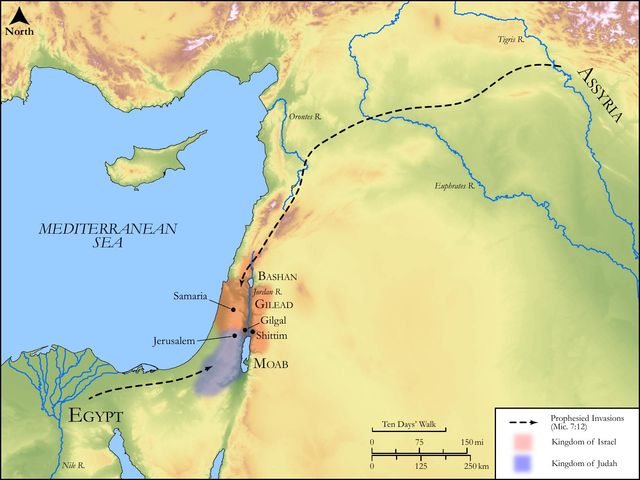
See on the biblical-era map
Study this verse
Public-domain commentary
Matthew Henry
From his Commentary on the Whole Bible. Henry comments on passages, not single verses — this entry covers Micah 7:1–6.
This is such a description of bad times as, some think, could scarcely agree to the times of Hezekiah, when this prophet prophesied; and therefore they rather take it as a prediction of what should be in the reign of Manasseh. But we may rather suppose it to be in the reign of Ahaz (and in that reign he prophesied, ch. 1:1) or in the beginning of Hezekiah's time, before the reformation he was instrumental in; nay, in the best of his days, and when he had done his best to purge out corruptions, still there was much amiss. The prophet cries out, Woe is me! He bemoans himself that his lot was cast in such a degenerate age, and thinks it his great unhappiness that he lived among a people that were ripening apace for a ruin which many a good man would unavoidably be involved in. Thus David cries out, Woe is me that I sojourn in Mesech! He laments, 1. That there were so few good people to be found, even among those that were God's people; and this was their reproach: The good man has perished out of the earth, or out of the land, the land of Canaan; it was a good land, and a land of uprightness (Isa 26:10), but there were few good men in it, none upright among them, Mic 7:2. The good man is a godly man and a merciful man; the word signifies both. Those are completely good men that are devout towards God and compassionate and beneficent towards men, that love mercy and walk with God. "These have perished; those few honest men that some time ago enriched and adorned our country are now dead and gone, and there are none risen up in their stead that tread in their steps; honesty is banished, and there is no such thing as a good man to be met with. Those that were of religious education have degenerated, and become as bad as the worst; the godly man ceases," Psa 12:1. This is illustrated by a comparison (Mic 7:1): they were as when they have gathered the summer fruits; it was as hard a thing to find a good man as to find any of the summer-fruits (which were the choicest and best, and therefore must carefully be gathered in) when the harvest is over. The prophet is ready to say, as Elijah in his time (Kg1 19:10), I, even I only, am left. Good men, who used to hang in clusters, are now as the grape-gleanings of the vintage, here and there a berry, Isa 17:6. You can find no societies of them as bunches of grapes, but those that are are single persons: There is no cluster to eat; and the best and fullest grapes are those that grow in large clusters. Some think that this intimates not only that good people were few, but that those few who remained, who went for good people, were good for little, like the small withered grapes, the refuse that were left behind, not only by the gatherer, but by the gleaner. When the prophet observed this universal degeneracy it made him desire the first-ripe fruit; he wished to see such worthy good men as were in the former ages, were the ornaments of the primitive times, and as far excelled the best of all the present age as the first and full-ripe fruits do those of the latter growth, that never come to maturity. When we read and hear of the wisdom and zeal, the strictness and conscientiousness, the devotion and charity, of the professors of religion in former ages, and see the reverse of this in those of the present age, we cannot but sit down, and wish, with a sigh, O for primitive Christianity again! Where are the plainness and integrity of those that went before us? Where are the Israelites indeed, without guile? Our souls desire them, but in vain. The golden age is gone, and past recall; we must make the best of what is, for we are not likely to see such times as have been. 2. That there were so many wicked mischievous people among them, not only none that did any good, but multitudes that did all the hurt they could: "They all lie in wait for blood, and hunt every man his brother. To get wealth to themselves, they care not what wrong, what hurt, they do to their neighbours and nearest relations. They act as if mankind were in a state of war, and force were the only right. They are as beasts of prey to their neighbours, for they all lie in wait for blood as lions for their prey; they thirst after it, make nothing of taking away any man's life or livelihood to serve a turn for themselves, and lie in wait for an opportunity to do it. Their neighbours are as beasts of prey to them, for they hunt every man his brother with a net; they persecute them as noxious creatures, fit to be taken and destroyed, though they are innocent excellent ones." We say of him that is outlawed, Caput gerit lupinum - He is to be hunted as a wolf. "Or they hunt them as men do the game, to feast upon it; they have a thousand cursed arts of ensnaring men to their ruin, so that they may but get by it. Thus they do mischief with both hands earnestly; their hearts desire it, their heads contrive it, and then both hands are ready to put it in execution." Note, The more eager and intent men are upon any sinful pursuit, and the more pains they take in it, the more provoking it is. 3. That the magistrates, who by their office ought to have been the patrons and protectors of right, were the practicers and promoters of wrong: That they may do evil with both hands earnestly, to excite and animate themselves in it, the prince asketh, and the judge asketh, for a reward, for a bribe, with which they well be hired to exert all their power for the supporting and carrying on of any wicked design with both hands. They do evil with both hands well (so some read it); they do evil with a great deal of art and dexterity; they praise themselves for doing it so well. Others read it thus: To do evil they have both hands (they catch at an opportunity of doing mischief), but to do good the prince and the judge ask for a reward; if they do any good offices they are mercenary in them, and must be paid for them. The great man, who has wealth and power to do good, is not ashamed to utter his mischievous desire in conjunction with the prince and the judge, who are ready to support him and stand by him in it. So they wrap it up; they perplex the matter, involve it, and make it intricate (so some understand it), that they may lose equity in a mist, and so make the cause turn which way they please. It is ill with a people when their princes, and judges, and great men are in a confederacy to pervert justice. And it is a sad character that is given of them (Mic 7:4), that the best of them is as a brier, and the most upright is sharper than a thorn-hedge; it is a dangerous thing to have any thing to do with them; he that touches them must be fenced with iron (Sa2 23:6, Sa2 23:7), he shall be sure to be scratched, to have his clothes torn, and his eyes almost pulled out. And, if this be the character of the best and most upright, what are the worst? And, when things have come to this pass, the day of thy watchmen comes, that is, as it follows, the day of thy visitation, when God will reckon with thee for all this wickedness, which is called the day of the watchmen, because their prophets, whom God set as watchmen over them, had often warned them of that day. When all flesh have corrupted their way, even the best and the most upright, what can be expected but a day of visitation, a deluge of judgments, as that which drowned the old world when the earth was filled with violence? 4. That there was no faith in man; people had grown so universally treacherous that one knew not whom to repose any confidence in, Mic 7:5. "Those that have any sense of honour, or spark of virtue, remaining in them, have a firm regard to the laws of friendship; they would not discover what passed in private conversation, nor divulge secrets, to the prejudice of a friend. But those things are now made a jest of; you will not meet with a friend that you dare trust, whose word you dare take, or who will have any tenderness or concern for you; so that wise men shall give it and take it for a rule, trust you not in a friend, for you will find him false, you can trust him no further than you can see him; and even him that passes for an honest man you will find to be so only with good looking to. Nay, as for him that undertakes to be your guide, to lead you into any business which he professes to understand better than you, you cannot put a confidence in him, for he will be sure to mislead you if he can get any thing by it." Some by a guide understand a husband, who is called the guide of thy youth; and that agrees well enough with what follows, "Keep the doors of thy lips from her that lieth in thy bosom, from thy own wife; take heed what thou sayest before her, lest she betray thee, as Delilah did Samson, lest she be the bird of the air that carries the voice of that which thou sayest in thy bed-chamber," Ecc 10:20. It is an evil time indeed when the prudent are obliged even thus far to keep silence. 5. That children were abusive to their parents, and men had no comfort, no satisfaction, in their own families and their nearest relations, Mic 7:6. The times are bad indeed when the son dishonours his father, gives him bad language, exposes him, threatens him, and studies to do him a mischief, when the daughter rises up in rebellion against her own mother, having no sense of duty, or natural affection; and no marvel that then the daughter-in-law quarrels with her mother-in-law, and is vexatious to her. Either they cannot agree about their property and interest, or their humours and passions clash, or from a spirit of bigotry and persecution, the brother shall deliver up the brother to death, and the father the child, Mat 10:4; Luk 21:16. It is sad when a man's betrayers and worst enemies are the men of his own house, his own children and servants, that should be his guard and his best friends. Note, The contempt and violation of the laws of domestic duties are a sad symptom of a universal corruption of manners. Those are never likely to come to good that are undutiful to their parents, and study to be provoking to them and cross them.
Historical interpretation
Historical reception
2 surviving comments on this verse. Each one is dated, so this reads as a timeline rather than a list.
Select a marker to jump to its quote. Markers stagger vertically where authors wrote within a few decades of each other.
Cain and Abel followed in the generation of humankind, and Cain was the first murderer. Afterwards a deluge engulfed the earth because of exceeding wickedness of humanity. Fire came down from heaven upon the people of Sodom because of their corruption. Subsequently God chose out Israel, but even Israel became perverse and the chosen race was wounded. For, while Moses stood on the mountain before God, the people worshiped a calf in place of God. In the days of their lawgiver Moses, who said, “You shall not commit adultery,” a man dared to enter a brothel and be wanton. After Moses, prophets were sent to heal Israel, but in their exercise of healing they deplored the fact that they could not overcome evil, so that one of them [Micah] says, “The faithful are gone from the earth, among men the upright are no more!” The psalmist says, “All alike have gone astray; they have become perverse; there is not one who does good, not even one.” And again, “Cursing, and theft, and adultery, and killing have overflowed” upon the land. “They sacrificed their sons and daughters to demons.” They engaged themselves in auguries and enchantments and divinations; and again, “They fastened their garments with cords and hung veils next to the altar.”
(Chapter 7, Verses 1 onwards) Woe is me, for I have become like one who gathers the grapes of the vineyard in autumn: there is no cluster to eat; my soul longed for the early figs. The holy one has perished from the earth, and there is no upright person among mankind. They all lie in wait for blood; each hunts his brother to death. They declare their evil deeds as good; the ruler demands, and the judge accepts bribes, and the great one speaks of the cravings of his own soul, and they trouble it. The best among them is like a thornbush, and the most upright is like a thorn from a fence. Woe is me, for I have become like one who gathers straw in the harvest, and like grape clusters in the vineyard, when there is no first-ripe fig for my hunger, which my soul craves. Woe is me, for the reverent one has perished from the earth, and there is no one who corrects among men. They are all judged in bloodshed; each one of them inflicts trouble on his neighbor, and they prepare their hands for evil. The ruler makes demands, and the judge speaks peaceable words; his desire is for the longing of his soul. And I will take away their goods, like a consuming moth, and walking over the ruler in the day of your watchfulness. In the aforementioned captivity and ten tribes and two (For the word of the Lord has come to Micah the Morestite concerning Samaria and Jerusalem), the prophet laments that no just person is found in the land who can resist the anger of God and stand as a wall in the middle. In vain, he says, I have spoken: in vain I sought the last clusters of the vine and the destroyed city; and since there is no bunch to eat, I will at least take immature figs, which the Hebrews call "Bechchora", that is, thick figs, as food: as if to say, not finding bread because of the magnitude of the famine, I have sought scraps and chaff. The saint has perished from the earth, and the righteous among men are no more. Everywhere there are traps, everywhere there is deceit. Innocent blood is shed. Due to greed and lust, kinship is disregarded. Not only do they commit evil deeds, but they also defend them. They change names and claim that what is evil is good. The rulers do not accept gifts from those offering them, but they force their subjects to give and demand. And in rendering judgment, the judge treats another as he himself is judged by another, so that they may mutually favor each other in their crimes and defend themselves in the crimes of others. Whoever is great and almost most learned in the Law, speaks not the will of God, but his own will. And they have disturbed it, either the city, or the truth, or the land, of which it is said above: The holy one has perished from the earth. For whoever is the best among them, like a sharp thorn, pierces and holds, injuring the one who approaches him, and grasping with a hooked tooth: and whoever is found to be upright, like a thorn from a fence, so that there may be found pain where help was supposed to be. According to the Hebrew text, however, according to the Septuagint, who differ in some respects, and at the end of the chapter they translated completely differently, this is the meaning that seems to me: The prophetic or apostolic discourse laments, in general, the human race, which has in vain cast the seeds of doctrines, and instead of crops and grain, the late reaper finds only empty straw and useless stalks, and he cannot even find small grapes in the vineyard, and so on until the end of the chapter. For if it is a blessing for the speaker to be heard by the listener's ears, and the desire of the wise is the ear of the listener, and the understanding of the listener is the joy of the speaker; on the contrary, the grief of the teacher is a bad disciple, with Jeremiah's words also fitting this complaint: I have not profited, nor has anyone else profited me (Jeremiah). There are those who believe that these words are spoken from the perspective of the Savior, who is the cause of not finding worthy works in such a great multitude of believers and in the whole world of human kind, and who also says in Psalm 29: What profit is there in my blood, while I descend into corruption? Although others assert that these words do not fit his person at all, as he says: Woe is me, because I have become as one who gathers straw in the harvest; he who spoke in the Gospel: Lift up your eyes and see the regions, for they are already white for harvest (John 4:35). And elsewhere: The harvest indeed is great, but the laborers are few (Matthew 9:35). Therefore, those who want to understand this from the perspective of the Savior say that it is not surprising if he says: Woe is me, who wept in Jerusalem and shed tears at the death of Lazarus (Luke 19). But also this, I have become like one who gathers straw in the harvest, they apply it to the end of the age: and the harvest is interpreted to signify this, and they say that at that time this prophecy can be fulfilled, when, with the increase of wickedness, the love of many will grow cold, and when the Son of Man comes, he will scarcely find faith on earth (Mat. XIV, 24): for then, like straw after the harvest, and like grapes after the vintage, there will be few found among them who will maintain faith amidst the devastation of all things, and they believe that this statement, spoken from the perspective of the assumed man, approves of what follows: Woe is me, my soul: of whom he was speaking: My soul is sorrowful even unto death (Mat. XXVI, 38). He will perish (or He will be destroyed) returning from the earth, either by the Antichrist killing the saints, or by everyone collapsing due to the magnitude of scandals. And there is no one to correct among men: all are judged by blood, not by slight and small sins, but by the greatest sins and those related to bloodshed. Proximity, friendship, and kinship will not delay the crime: all will raise their hands to evil, so that even one who couldn't commit evil, yet, while preparing the hand, may sin by the will. The ruler himself seeks, and the judge speaks peaceful words; for he receives gifts, the desire of his soul. And because this is evident, and I avoid the envy of rulers and judges, leaving it to the understanding of the reader, I will only add this: Gifts blind the eyes even of the wise (Deut. XVI, 19): they also give life to the soul, which they should not have given life to, and they kill her who lives by her own merit and virtues, and they do this because of the gifts they demand shamelessly, and accept them more shamefully. To those whom the Lord threatens, saying: 'And I will take away their goods, which they think are good, but which appear good to them. Moreover, the truth of the matter will never be called good, which both deprives the giver and kills the receiver: although it is not so much a threat as a blessing, to take away evil from them, and for the Lord Himself and His divine word to enter into their consciences like a moth eating away whatever is perverse, and to make a devastation of plunder and evil thoughts, and to walk above the measure and rule of truth, and to lead back those who were led by false opinions to what is straight; and to do this in the light of truth, and on that day when those who are holy and elected from the Church ascend to the watchtower, and in the height of their learning and works, they will discuss heavenly matters.'
Continue studying Micah 7:2 across the web’s major study libraries — every link below opens this exact verse, chapter, or book on the destination site.
Read & Compare
 BibleGatewayThis verse in more than 200 translations and 70 languages.
 Bible.comThe YouVersion reader — hundreds of translations, reading plans, and highlights.
 ESV.orgCrossway's official English Standard Version reader.
 NET BibleThe NET translation with 60,000+ translators' notes on every rendering decision.
 STEP BibleTyndale House's free study tool — original text, vocabulary, and scholarly resources.
 BibliaLogos Bible Software's free web reader.
 USCCBThe New American Bible (Revised Edition) with the U.S. bishops' study notes.
Commentaries
 BibleHub CommentariesDozens of classic commentaries on this verse, gathered on one page.
 StudyLightMore than 100 commentary sets — the largest collection on the web.
 BibleRefPlain-English commentary on what this verse means, verse by verse.
 Enduring WordDavid Guzik's free commentary on this chapter, widely used by Bible teachers.
 Bible Study ToolsVerse commentary alongside Greek and Hebrew study aids.
Original Language & Research
- BibleHub InterlinearThe verse word by word — original language, transliteration, and English.
- BibleHub LexiconEvery word's original-language definition and Strong's entry.
 Blue Letter BibleDeep-study tools — Strong's numbers, concordance, and word studies.
 SefariaThe Hebrew text with Rashi and centuries of Jewish commentary.
Sermons, Hymns & Audio


TrulyRandomVerse is not affiliated with these sites and doesn’t control their content. They’re linked because they’re genuinely useful.
Summary
Micah 7:2 serves as a poignant lament from the prophet, articulating the profound moral decay and pervasive corruption that had engulfed Judah during his ministry. The verse paints a stark and desolate portrait of a society where righteousness and integrity have vanished, replaced by a predatory culture of deceit, violence, and mutual exploitation, even among those who should be kin. It underscores the prophet's deep anguish over the spiritual and ethical collapse of his own people.
Context
ShowHideLiterary Context
Micah 7:2 is situated within a deeply personal and despairing lament (Micah 7:1-6) that follows Micah's scathing denunciations of Judah's sins in the preceding chapters (Micah 1-6). While earlier sections deliver God's judgment through prophetic oracles, this chapter shifts to the prophet's own voice, expressing his profound sorrow and isolation. The lament in Micah 7:1-6 describes the complete absence of integrity and the prevalence of treachery, setting the stage for the specific accusations in verse 2. This personal anguish highlights the severity of the moral collapse, as Micah feels like a solitary righteous voice in a land utterly devoid of godliness. The passage serves as a stark contrast to the hope of restoration and divine intervention that eventually surfaces in Micah 7:7-20, making the initial lament all the more powerful.
Historical & Cultural Context
Micah prophesied in Judah during the late 8th century BC, spanning the reigns of Jotham, Ahaz, and Hezekiah. This was a tumultuous period characterized by rampant oppression, political instability, and widespread spiritual apostasy. The wealthy and powerful exploited the poor, judges were bribed, and religious leaders misled the people into idolatry and false worship. The looming threat of the Assyrian Empire, which had already decimated the Northern Kingdom of Israel, cast a long shadow over Judah, yet the people largely failed to heed God's warnings or repent. Micah's lament in Micah 7:2 reflects this specific historical reality, where covenant faithfulness had eroded, and the foundational principles of justice and righteousness, central to Israel's identity, were systematically violated by all strata of society.
Key Themes
ShowHideThe verse powerfully contributes to several key themes found throughout Micah's prophecy and the broader biblical narrative. Firstly, it highlights the Pervasive Moral Collapse of a society that has abandoned God's standards. The lament that "the good [man] is perished out of the earth" and "none upright among men" signifies a complete societal breakdown where honesty, integrity, and godliness are virtually absent. This reflects humanity's fallen state and its inherent tendency towards sin when left to its own devices, a theme echoed in Psalm 14:1-3. Secondly, the vivid imagery of "they all lie in wait for blood; they hunt every man his brother with a net" emphasizes Betrayal and Predation. This portrays a society steeped in treachery and violence, where individuals, even within their own communities, actively seek to harm and exploit one another through cunning and deceit, rather than open conflict. This predatory behavior underscores the breakdown of communal trust and the perversion of human relationships. Finally, the verse encapsulates the Prophetic Despair of a faithful servant of God observing such widespread wickedness. Micah's profound sorrow over the spiritual and ethical decline of his people is palpable, reflecting the anguish of prophets like Jeremiah, who similarly lamented the absence of a righteous person in Jeremiah 5:1.
Exposition and Analysis
ShowHideKey Word Analysis
ShowHideThis word describes someone who is "pious," "godly," "holy," or "merciful." It denotes a person characterized by hesed, God's covenant loyalty and steadfast love, which is then reflected in their own faithful and ethical conduct towards God and others. Its "perishing" indicates not merely physical death, but the tragic disappearance of such character from the societal landscape, signifying a profound spiritual and moral void.
This term means "straight," "just," or "righteous." It refers to moral integrity, honesty, and adherence to what is right and equitable. The declaration that "none upright among men" emphasizes the total absence of moral rectitude and fairness in the community, indicating a pervasive corruption where ethical standards have been completely abandoned.
This word refers to a physical net used for trapping, but also carries the connotation of a "doomed object" or "utter destruction." In this context, it functions as a powerful metaphor for cunning, deceitful, and entrapping schemes. The use of a "net" implies that the predatory actions are not open conflict but involve stealth, trickery, and the deliberate ensnaring of victims, often those who are vulnerable or unsuspecting.
Verse Breakdown
ShowHide"The good [man] is perished out of the earth:"
This opening clause sets the tone of lament and despair. It signifies a complete absence of righteous, godly, and covenant-keeping individuals from the land. The word "perished" (H6, ʼâbad) suggests not just death, but a vanishing, a loss, or a destruction of the very essence of goodness. It implies that the moral fabric of society has disintegrated to such an extent that those who embody integrity and faithfulness are no longer to be found.
"and [there is] none upright among men:"
This clause reinforces the previous statement, using a synonymous parallel to emphasize the pervasive lack of moral integrity. "Upright" (H3477, yâshâr) refers to those who are just, honest, and walk in accordance with God's ways. The phrase asserts that this quality is entirely absent among the general populace ("among men," H120, ʼâdâm), indicating a universal moral failing within Judah.
"they all lie in wait for blood;"
This phrase shifts from absence of good to active malevolence. "Lie in wait" (H693, ʼârab) suggests lurking, ambushing, or plotting with malicious intent. "For blood" (H1818, dâm) signifies a murderous or violent purpose, indicating that the people are not merely morally bankrupt but actively seeking to harm, exploit, or even kill others for personal gain. This points to a society consumed by greed and violence.
"they hunt every man his brother with a net."
This climactic clause uses a vivid metaphor to illustrate the predatory nature of human relationships. "Hunt" (H6679, tsûwd) implies pursuing prey, while "every man his brother" (H376, ʼîysh... H251, ʼâch) highlights the shocking betrayal within the community – people are preying on those who should be their closest kin or fellow citizens. The "net" (H2764, chêrem) symbolizes the cunning, deceitful, and entrapping methods used, emphasizing that exploitation is not direct confrontation but insidious manipulation and betrayal.
Literary Devices
ShowHideMicah 7:2 is rich with literary devices that amplify its message of despair and moral collapse. The dominant device is Lament, which pervades the entire passage (Micah 7:1-6), expressing the prophet's profound sorrow and anguish over the state of his people. The opening declaration, "The good [man] is perished out of the earth," employs Hyperbole to emphasize the extreme and widespread nature of the moral decay; while perhaps not literally every good person was gone, the statement conveys the overwhelming sense that righteousness was virtually non-existent. The most striking device is Metaphor and Simile, particularly in the phrases "they all lie in wait for blood" and "they hunt every man his brother with a net." These vivid images liken the people to predatory animals, lurking and ambushing their victims, and using cunning traps (the "net") to ensnare even their own kin. This animalistic imagery powerfully conveys the dehumanizing effect of sin and the complete breakdown of social trust. The phrase "every man his brother" also highlights Irony and Pathos, as those who should be bound by familial or communal ties are instead engaged in betrayal and exploitation, intensifying the tragedy of the situation.
Theological and Thematic Connections
ShowHideMicah 7:2 provides a stark biblical commentary on the depth of human depravity when left to its own devices, a theme consistently woven throughout Scripture. It illustrates the devastating consequences of abandoning God's covenant and moral law, leading to a society characterized by self-interest, violence, and the systematic exploitation of others. The prophet's lament underscores the biblical truth that true righteousness and justice do not naturally flourish in fallen humanity but are gifts and requirements from a holy God. This verse serves as a powerful reminder of humanity's inherent need for divine intervention and redemption, as no amount of human effort can truly rectify such pervasive moral corruption. It points to the universal reality that "all have sinned and fall short of the glory of God," necessitating a radical transformation that only God can provide.
Reflection and Application
ShowHideMicah 7:2 serves as a timeless mirror, challenging us to honestly examine the moral landscape of our own societies and, more intimately, the inclinations of our own hearts. In a world that often prioritizes self-advancement, material gain, and personal comfort, the prophet's lament against a society where "the good [man] is perished" resonates deeply. It calls us to consider whether integrity, compassion, and justice are truly valued and practiced, or if subtle (or not-so-subtle) forms of "lying in wait for blood" and "hunting... with a net" manifest in our interactions, our business practices, or our political discourse. For believers, this verse is a sobering reminder of the call to be salt and light in a decaying world, to embody the very "goodness" (chasid) and "uprightness" (yashar) that Micah found so conspicuously absent. It compels us to actively resist the pervasive currents of self-interest and exploitation, to cultivate genuine love for our neighbor, and to stand firm in righteousness, even when surrounded by corruption. Ultimately, it drives us to humble dependence on God's grace, acknowledging our own capacity for fallenness and seeking His transformative power to live lives that reflect His character.
Questions for Reflection
ShowHideFAQ
ShowHideWhy does Micah use such strong language like "perished" and "hunt... with a net"?
ShowHideMicah employs such vivid and strong language to convey the extreme depth and pervasiveness of Judah's moral corruption. The word "perished" (H6, ʼâbad) suggests a complete disappearance or destruction of goodness, not just a decline. It underscores the prophet's despair at the utter absence of integrity. The imagery of "lying in wait for blood" and "hunting... with a net" uses powerful metaphors to depict the people as predatory animals, preying on each other with cunning and malice. This language is designed to shock and to highlight the horrific reality of betrayal and exploitation even among those who should be "brothers." It emphasizes that the sin is not just passive unrighteousness but active, insidious malevolence, reflecting the profound breakdown of covenant relationships and social trust.
Is there any hope in Micah's prophecy, given this bleak verse?
ShowHideWhile Micah 7:2 presents a profoundly bleak picture of human depravity, it is crucial to understand it within the broader context of the book of Micah. The prophet's lament in Micah 7:1-6 is immediately followed by a powerful declaration of hope and trust in God's faithfulness, beginning in Micah 7:7. Micah declares, "But as for me, I will look to the Lord; I will wait for God my Savior; my God will hear me." The book concludes with a magnificent affirmation of God's incomparable character, His steadfast love, and His willingness to pardon sin and delight in mercy (Micah 7:18-20). Thus, the lament serves to highlight the desperate need for God's intervention, making His subsequent promise of restoration and forgiveness all the more glorious.
How does this verse relate to the concept of "justice" in the Bible?
ShowHideMicah 7:2 directly contrasts with the biblical concept of justice. Throughout the Old Testament, particularly in the prophetic books, God repeatedly calls His people to practice mishpat (justice) and tsedeq (righteousness). These terms encompass fair treatment, upholding the rights of the vulnerable, and maintaining equitable relationships within society. Micah himself frequently condemns the lack of justice, such as in Micah 6:8, where he famously asks, "And what does the Lord require of you? To act justly and to love mercy and to walk humbly with your God." Micah 7:2 describes the complete antithesis of this divine expectation: a society where the "good" and "upright" are absent, and people actively "hunt" their "brother" for "blood." This vivid portrayal underscores the profound injustice and moral perversion that characterized Judah, demonstrating their utter failure to live up to God's righteous standards and the devastating consequences that follow.
Christ-Centered Fulfillment
ShowHideMicah 7:2, with its stark depiction of a world utterly devoid of goodness and integrity, where humanity preys upon itself, powerfully underscores the profound necessity of Christ. The prophet's lament, "The good [man] is perished out of the earth: and [there is] none upright among men," finds its ultimate theological echo in the New Testament's declaration of universal human sinfulness, as articulated by Paul in Romans 3:10-12. This verse highlights the desperate state of humanity, incapable of producing true righteousness on its own. It is into this fallen world, where no "good man" could be found to satisfy God's perfect standard, that Jesus Christ came. He is the perfectly "good" and "upright" man, the only one who lived a life of flawless obedience and integrity, fulfilling all righteousness where humanity had utterly failed (Philippians 2:8). Furthermore, the predatory nature described in Micah 7:2—the "lying in wait for blood" and "hunting... with a net"—foreshadows the spiritual warfare and the pervasive evil that Christ came to overcome. Jesus, the Lamb of God who takes away the sin of the world, offered Himself as the ultimate sacrifice, not only to atone for the "blood" shed by humanity's sin but also to break the power of the "net" of sin and death that entrapped mankind. Through His sacrifice and resurrection, He provides the only means for fallen humanity to be made truly "good" and "upright" in God's sight, offering a new covenant where God's Spirit enables believers to live lives of integrity, reflecting the very righteousness that Micah longed to see (2 Corinthians 5:21). Thus, Micah's lament, while bleak, ultimately points to the glorious and essential work of Christ as the sole source of true human goodness and redemption.