


Isaiah 44:11
Bible text: King James Version (1769 Blayney text) · Public domain
Bible text: King James Version with Strong's numbers · Public domain
Bible text: Berean Standard Bible · Public domain
Bible text: American Standard Version (1901) · Public domain
Bible text: World English Bible, Messianic edition · Public domain
Bible text: Geneva Bible (1599) · Public domain
Bible text: Young's Literal Translation · Public domain
- הֵןhenthere!H2005PrtParticle Interjection
- כָּלkolallH3605N-mscNoun Singular Masculine Construct
- חֲבֵרָיוcha·ve·Ravhis companionsH2270N-mpc ¦ 3msNoun Plural Masculine Constructחֲבֵרָיcompanionsוhis
- יֵבֹשׁוּye·Vo·shuthey will be ashamedH954V-Qal-Imperf-3mpVerb Qal Imperfect 3rd Plural Masculine
- וְחָרָשִׁיםve·cha·ra·Shimand craftsmenH2796Conj-w ¦ N-mpNoun Plural Masculine Absoluteוְandחָרָשִׁיםcraftsmen
- הֵמָּהHe·mahtheyH1992Pro-3mpPronoun Personal 3rd Plural Masculine
- מֵאָדָםme·'a·Dam[are] from humankindH120Prep-m ¦ N-msNoun Singular Masculine Absoluteמֵ[are] fromאָדָםhumankind
- יִתְקַבְּצוּyit·ka·be·Tzulet them gather togetherH6908V-Hithpael-Imperf-3mpVerb Hithpael Imperfect 3rd Plural Masculine
- כֻלָּםkhu·Lamall of themH3605N-msc ¦ 3mpNoun Singular Masculine Constructכֻלָּall ofםthem
- יַעֲמֹדוּya·'a·Mo·dulet them stand upH5975V-Qal-Imperf-3mpVerb Qal Imperfect 3rd Plural Masculine
- יִפְחֲדוּyif·cha·Dulet them be in dreadH6342V-Qal-Imperf-3mpVerb Qal Imperfect 3rd Plural Masculine
- יֵבֹשׁוּye·Vo·shulet them be ashamedH954V-Qal-Imperf-3mpVerb Qal Imperfect 3rd Plural Masculine
- יָחַדYa·chadaltogetherH3162N-msNoun Singular Masculine Absolute
English is a literal word-by-word gloss of the Hebrew, not the KJV's wording. Why?
This is the original text the KJV's translators worked from — each Hebrew word with its own literal English meaning in this verse, prepared by scholars at Tyndale House, Cambridge. The KJV translates whole sentences, not word by word, so its wording differs: one Hebrew word can become several English words, and the KJV may choose “the LORD” where the gloss reads “Yahweh”. Both are faithful — they answer different questions. For the KJV's own rendering, switch to the KJV text.
Details
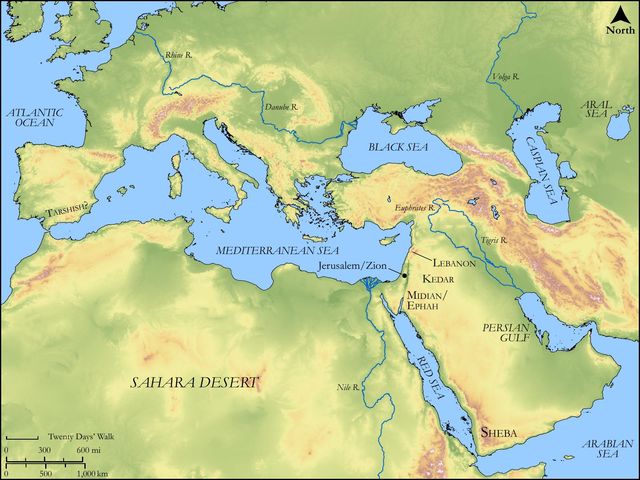
See on the biblical-era map
Study this verse
Public-domain commentary
Matthew Henry
From his Commentary on the Whole Bible. Henry comments on passages, not single verses — this entry covers Isaiah 44:9–20. His four-level outline is real structure in the source text, so it is rendered as structure.
Often before, God, by the prophet, had mentioned the folly and strange sottishness of idolaters; but here he enlarges upon that head, and very fully and particularly exposes them to contempt and ridicule. This discourse is intended, 1. To arm the people of Israel against the strong temptation they would be in to worship idols when they were captives in Babylon, in compliance with the custom of the country (they being far from the city of their own solemnities) and to humour those who were now their lords and masters. 2. To cure them of their inclination to idolatry, which was the sin that did most easily beset them and to reform them from which they were sent into Babylon. As the rod of God is of use to enforce the word, so the word of God is of use to explain the rod, that the voice of both together may be heard and answered. 3. To furnish them with something to say to their Chaldean task-masters. When they insulted over them, when they asked, Where is your God? they might hence ask them, What are your gods? 4. To take off their fear of the gods of their enemies, and to encourage their hope in their own God that he would certainly appear against those who set up such scandalous competitors as these with him for the throne.
Now here, for the conviction of idolaters, we have,
I.A challenge given to them to clear themselves, if they can, from the imputation of the most shameful folly and senselessness imaginable, Isa 44:9-11. They set their wits on work to contrive, and their hands on work to frame, graven images, and they call them their delectable things; extremely fond they are of them, and mighty things they expect from them. Note, Through the corruption of men's nature, those things that should be detestable to them are desirable and delectable; but those are far gone in a distemper to whom that which is the food and fuel of it is most agreeable. Now,
1.We tell them that those that do so are all vanity; they deceive themselves and one another, and put a great cheat upon those for whom they make these images.
2.We tell them that their delectable things shall not profit them, nor make them any return for the pleasure they take in them; they can neither supply them with good nor protect them from evil. The graven images are profitable for nothing at all, nor will they ever get any thing by the devoirs they pay to them.
3.We appeal to themselves whether it be not a silly sottish thing to expect any good from gods of their own making: They are their own witnesses, witnesses against themselves, if they would but give their own consciences leave to deal faithfully with them, that they are blind and ignorant in doing thus. They see not nor know, and let them own it, that they may be ashamed. If men would but be true to their own convictions, ordinarily we might be sure of their conversion, particularly idolaters; for who has formed a god? Who but a mad-man, or one out of his wits, would think of forming a god, of making that which, if he make it a god, he must suppose to be his maker?
4.We challenge them to plead their own cause with any confidence or assurance. If any one has the front to say that he has formed a god, when all his fellows come together to declare what each of them has done towards the making of this god, they will all be ashamed of the cheat they have put upon themselves, and laugh in their sleeves at those whom they have imposed upon; for the workmen that formed this god are of men, weak and impotent, and therefore cannot possibly make a being that shall be omnipotent, nor can they without blushing pretend to do so. Let them all be gathered together, as Demetrius and the craftsmen were, to support their sinking trade; let them stand up to plead their own cause, and make the best they can of it, with hand joined in hand; yet they shall fear to undertake it when it comes to the setting to, as conscious to themselves of the weakness and badness of their cause, and they shall be ashamed of it, not only when they appear singly, but when by appearing together they hope to keep one another in countenance. Note, Idolatry and impiety are things which men may justly both tremble and blush to appear in the defence of.
II.A particular narrative of the whole proceeding in making a god; and there needs no more to expose it than to describe it and tell the story of it.
1.The persons employed about it are handicraft tradesmen, the meanest of them, the very same that you would employ in making the common utensils of your husbandry, a cart or a plough. You must have a smith, a blacksmith, who with the tongs works in the coals; and it is hard work, for he works with the strength of his arms, till he is hungry and his strength fails, so eager is he, and so hasty are those who set him at the work to get it despatched. He cannot allow himself time to eat or drink, for he drinks no water, and therefore is faint, Isa 44:12. Perhaps it was a piece of superstition among them for the workman not to eat or drink while he was making a god. The plates with which the smith was to cover the image, or whatever iron-work was to be done about it, he fashioned with hammers, and made it all very exact, according to the model given him. Then comes the carpenter, and he takes as much care and pains about the timber-work, Isa 44:13. He brings his box of tools, for he has occasion for them all: He stretches out his rule upon the piece of wood, marks it with a line, where it must be sawed or cut of; he fits it, or polishes it, with planes, the greater first and then the less; he marks out with the compasses what must be the size and shape of it; and it is just what he pleases.
2.The form in which it is made is that of a man, a poor, weak, dying creature; but it is the noblest form and figure that he is acquainted with, and, being his own, he has a peculiar fondness for it and is willing to put all the reputation he can upon it. He makes it according to the beauty of a man, in comely proportion, with those limbs and lineaments that are the beauty of a man, but are altogether unfit to represent the beauty of the Lord. God put a great honour upon man when, in respect of the powers and faculties of his souls, he made him after the image of God; but man does a great dishonour to God when he makes him, in respect of bodily parts and members, after the image of man. Nor will it at all atone for the affront so far to compliment his god as to take the fairest of the children of men for his original whence to take his copy, and to give him all the beauty of a man that he can think of; for all the beauty of the body of a man, when pretended to be put upon him who is an infinite Spirit, is a deformity and diminution to him. And, when the goodly piece is finished, it must remain in the house, in the temple or shrine prepared for it, or perhaps in the dwelling house if it be one of the lares or penates - the household gods.
3.The matter of which it is mostly made is sorry stuff to make a god of; it is the stock of a tree.
(1.)The tree itself was fetched out of the forest, where it grew among other trees, of no more virtue or value than its neighbours. It was a cedar, it may be, or a cypress, or an oak, Isa 44:14. Perhaps he had an eye upon it some time before for this use, and strengthened it for himself, used some art or other to make it stronger and better-grown than other trees were. Or, as some read it, which hath strengthened or lifted up itself among the trees of the forest, the tallest and strongest he can pick out. Or, it may be, it pleases his fancy better to take an ash, which is of a quicker growth, and which was of his own planting for this use, and which has been nourished with rain from heaven. See what a fallacy he puts upon himself, in making that his refuge which was of his own planting, and which he not only gave the form to, but prepared the matter for; and what an affront he puts upon the God of heaven in setting up that a rival with him which was nourished by his rain, that rain which falls upon the just and unjust.
(2.)The boughs of this tree were good for nothing but for fuel; to that use were they put, and so were the chips that were cut off from it in the working of it; they are for a man to burn, Isa 44:15, Isa 44:16. To show that that tree has no innate virtue in it for its own protection, it is as capable of being burnt as any other tree; and, to show that he who chose it had no more antecedent value for it than for any other tree, he makes no difficulty of throwing part of it into the fire as common rubbish, asking no question for conscience' sake.
[1.]It serves him for his parlour-fire: He will take thereof and warm himself (Isa 44:15), and he finds the comfort of it, and is so far from having any regret in his mind for it that he saith, Aha! I am warm; I have seen the fire; and certainly that part of the tree which served him for fuel, the use for which God and nature designed it, does him a much greater kindness and yields him more satisfaction than ever that will which he makes a god of.
[2.]It serves him for his kitchen-fire: He eats flesh with it, that is, he dresses the flesh with it which he is to eat; he roasteth roast, and is satisfied that he has not done amiss to put it to this use. Nay,
[3.]It serves him to heat the oven with, in which we use that fuel which is of least value: He kindles it and bakes bread with the heat of it, and none charges him with doing wrong.
(3.)Yet, after all, the stock or body of the tree shall serve to make a god of, when it might as well have served to make a bench, as one of themselves, even a poet of their own, upbraids them, Horat. Sat. 1.8:
Olim truncus eram ficulnus, inutile lignum,
Quum faber, incertus scamnum faceretne Priapum,
Maluit esse deum; deus inde ego -
In days of yore our godship stood
A very worthless log of wood,
The joiner, doubting or to shape us
Into a stool or a Priapus,
At length resolved, for reasons wise,
Into a god to bid me rise.
- Francis
And another of them threatens the idol to whom he had committed the custody of his woods that, if he did not preserve them to be fuel for his fire, he should himself be made use of for that purpose:
Furaces moneo manus repellas,
Et silvam domini focis reserves,
Si defecerit haec, et ipse lignum es.
Drive the plunderers away, and preserve the wood
for thy master's hearth, or thou thyself shalt
be converted into fuel.
- Martial
When the besotted idolater has thus served the meanest purposes with part of his tree, and the rest has had time to season (he makes that a god in his imagination while that is in the doing, and worships it): He makes it a graven image, and falls down thereto (Isa 44:15), that is (Isa 44:17), The residue thereof he makes a god, even his graven image, according to his fancy and intention; he falls down to it, and worships it, gives divine honours to it, prostrates himself before it in the most humble reverent posture, as a servant, as a suppliant; he prays to it, as having a dependence upon it, and great expectations from it; he saith, Deliver me, for thou art my god. There where he pays his homage and allegiance he justly looks for protection and deliverance. What a strange infatuation is this, to expect help from gods that cannot help themselves! But it is this praying to them that makes them gods, not what the smith or the carpenter did to them. What we place our confidence in for deliverance that we make a god of.
Qui fingit sacros, auro vel marmore, vultus
Non facit ille deos; qui rogat, ille facit.
He who supplicates the figure, whether it be
of gold or of marble, makes it a god, and not
he who merely constructs it.
- Martial
III.Here is judgment given upon this whole matter, Isa 44:18-20.
In short, it is the effect and evidence of the greatest stupidity and sottishness that one could ever imagine rational beings to be guilty of, and shows that man has become worse than the beasts that perish; for they act according to the dictates of sense, but man acts not according to the dictates of reason (Isa 44:18): They have not known nor understood common sense; men that act rationally in other things in this act most absurdly. Though they have some knowledge and understanding, yet they are strangers to, nay, they are rebels against the great law of consideration (Isa 44:12): None considers in his heart, nor has so much application of mind as to reason thus with himself, which one would think he might easily do, though there were none to reason with him: "I have burnt part of this tree in the fire, for baking and roasting; and now shall I make the residue thereof an abomination?" (that is, an idol, for that is an abomination to God and all wise and good men); "shall I ungratefully choose to do, or presumptuously dare to do, what the Lord hates? shall I be such a fool as to fall down to the stock of a tree - a senseless, lifeless, helpless thing? shall I so far disparage myself, and make myself like that I bow down to?" A growing tree may be a beautiful stately thing, but the stock of a tree has lost its glory, and he has lost his that gives glory to it. Upon the whole, the sad character given of these idolaters is,
1.That they put a cheat upon themselves (Isa 44:20): They feed on ashes; they feed themselves with hopes of advantage by worshipping these idols, but they will be disappointed as much as a man that would expect nourishment by feeding on ashes. Feeding on ashes is an evidence of a depraved appetite and a distempered body; and it is a sign that the soul is overpowered by very bad habits when men, in their worship, go no further than the sight of their eyes will carry them. They are wretchedly deluded, and it is their own fault: A deceived heart of their own, more than the deceiving tongue of others, has turned them aside from the faith and worship of the living God to dumb idols. They are drawn away of their own lusts and enticed. The apostasy of sinners from God is owing entirely to themselves and to the evil heart of unbelief that is in their own bosom. A revolting and rebellious heart is a deceived heart.
2.That they wilfully persist in their self-delusion and will not be undeceived. There is none of them that can be persuaded so far to suspect himself as to say, Is there not a lie in my right hand? and so to think of delivering his soul. Note,
(1.)Idolaters have a lie in their right hand; for an idol is a lie, is not what it pretends, performs not what it promises, and it is a teacher of lies, Hab 2:18.
(2.)It highly concerns those that are secure in an evil way seriously to consider whether there be not a lie in their right hand. Is not that a lie which with complacency we hold fast as our chief good? Are our hearts set upon the wealth of the world and the pleasures of sense? They will certainly prove a lie in our right hand. And is not that a lie which with confidence we hold fast by, as the ground on which we build our hopes for heaven? If we trust to our external professions and performances, as if those would save us, we deceive ourselves with a lie in our right hand, with a house built on the sand.
(3.)Self-suspicion is the first step towards self-deliverance. We cannot be faithful to ourselves unless we are jealous of ourselves. He that would deliver his soul must begin with putting this question to his own conscience. Is there not a lie in my right hand?
(4.)Those that are given up to believe in a lie are under the power of strong delusions, which it is hard to get clear of, Th2 2:11.
Historical interpretation
Two Centuries of Reception
3 surviving comments on this verse. Each one is dated, so this reads as a timeline rather than a list.
Select a marker to jump to its quote. Markers stagger vertically where authors wrote within a few decades of each other.
When, however, the Scripture terms them [gods] that are not gods, it does not declare them as gods in every sense but with a certain addition and signification, by which they are shown to be no gods at all, as with David, “The gods of the heathens are idols of demons” and “You shall not follow other gods.” For in the fact that he says “the God of the heathen,” yet the heathen are ignorant of the true God, and he calls them “other gods,” he thereby bars their claim [to be looked on] as gods at all. But as to what they are in their own person, he speaks concerning them, “for they are,” he says, “the idols of demons.” And Isaiah says, “Let them be confounded, all who blaspheme God and carve useless things; even I am witness, says God.” He removes them from [the category of] gods, but he makes use of the word alone, for this [purpose] that we may know of whom he speaks.
How could he fail to pity them in this also, seeing that they worship them that cannot see. In hearing, they pray to them that cannot hear. Born with life and reason, people, as they are, call gods things that do not move at all but do not even have life. Strangest of all, do they serve as their masters beings whom they themselves keep under their own power?
(Verse 6 and following) This is what the Lord, the king of Israel and his redeemer, the Lord of hosts, says: I am the first and I am the last, and there is no God besides me. Who is like me? Let him call and declare, and lay out the order for me, since I established the ancient people: what is coming and what will happen, let them declare to them. Do not be afraid, nor be troubled: from that time I have made you hear and announced it; you are my witnesses. Is there any God besides me, and a creator whom I do not know? All the idols of the nations are worthless, and the things they love do not profit them. They themselves are witnesses to their own worthlessness, for they do not see or understand, so that they may be put to shame. Who formed a god or cast an idol that is profitable for nothing? Look, all his companions shall be put to shame; the craftsmen are mere men. Let them all assemble, let them stand forth. They shall be terrified; they shall be put to shame together. The blacksmith takes a tool and works it with the coals; he fashions it with hammers and works it with his strong arm. He will be hungry and will become weak, he will not drink water, and he will grow weary. The carpenter extends the rule (or the form), he shapes it on the plane, he forms it with angles, and rounds it off with a compass. And he makes an image of a man, like a handsome man dwelling in a house. He cuts down cedars, he takes an oak, and a tree that stood among the woods. He plants a pine, which the rain nourishes, and it becomes fuel for men. He takes from them, and warms himself; he kindles it, and bakes bread. But the rest of it he made into a god and worshipped; he made an idol and bowed down to it. He burned half of it in the fire and cooked meat on it; he roasted a stew and ate it, and then he was satisfied. He warmed himself and said, 'Ah! I am warm; I see the fire.' The rest of the wood he made into a god, his idol. He bows down to it and worships; he prays to it and says, 'Save me, for you are my god.' They do not know, nor do they understand; for their eyes are too dim to see, and their hearts too dull to perceive. They do not recognize in their mind, nor do they know, nor do they feel to say: I burnt its middle with fire, and I baked bread on its coals. I cooked meat, and I ate, and from the rest of it I will make an idol, I will prostrate before the trunk of a tree, a part of it is ashes: the foolish heart worshipped it: and it did not save its soul, nor will it say: perhaps there is a lie in my right hand. After the preaching of the Apostles, the calling of the Gentiles, the coming of the Savior, and the outpouring of the Holy Spirit, which he promised to give to all who believe, when another will say, I belong to the Lord: another will call himself in the name of Jacob: another will write with his own hand that he belongs to the Lord, and when he has arisen from the unbelieving crowd of the Gentiles, he will be likened to Israel, so that having abandoned idols, he may be a worshipper of one God: it begins another section, which we have presented in its entirety, so as not to divide the unity of its meaning. And because the Septuagint in this chapter, with the exception of a few words, does not differ from the Hebrew, we are satisfied with our edition, by understanding which, the others will be understood as well. And this is a discourse against the idolaters of that time, to whom the prophet Isaiah proclaimed the coming things for the people, and he reproves those who, despising the religion of Almighty God, incline to wooden idols and worship the works of their own hands. Let us therefore run through each point. Thus says the Lord, the king of Israel, who is to be believed in me, and his redeemer, who will receive the coming of my Son: The Lord of hosts and virtues, and Almighty. For in Hebrew, it means Sabaoth (). I am the first and the last, I am Α and Ω; and there is no God without me, for the child whom I have chosen is God in me. Of whom I said above: Behold my child, whom I have chosen: my chosen one, whom my soul has received: he will bring judgment to the nations: and in his name the nations will hope. He does not say that he alone exists, but that apart from his own virtue and wisdom there is no external God, and condemns the belief in many gods and images: Who, he says, is like me? Let him call those things which are not as though they were, and explain the order of my creation, which I have balanced with reason, since I made man upon the earth. And not only do I desire this, but I also seek knowledge of the future. Therefore, you, Israel, of whom I am both king and redeemer, do not fear the images that you have learned are nothing on Mount Sinai. Is there perhaps another Creator, whom I do not know? Or is there another world beyond this one, which reveals the power of an unknown God? And not only the things that are made, but also those who make them, will be considered worthless. And when the time of vengeance comes, they will not be able to free themselves from the works of their own hands, which blind and senseless artisans confuse. For who can believe that God is formed by an axe, file, drill, or hammer? And are there statues made of thorns; or do the plumb-line, plow, and corner-squares, and the compass suddenly rise up into gods? Especially since the poverty of the artist is shown by hunger and thirst. For a wooden statue is made, representing human form, and the more beautiful it is, the narrower is the God thought to be. It is placed in a shrine, and is enclosed in eternal prison, which grew for a long time in the woods, and depending on the variety of trees, was either a cedar or an oak or a pine. And in a wondrous manner, its segments and scratches are thrown into the hearth, so that they may warm the artisan of God and cook different dishes. But the other part is fashioned into a god, so that, with the work complete, the creator may adore it and seek assistance from his own creation. Yet he does not understand or consider, indeed, he does not even look upon it with the eyes of the flesh or the mind, that it cannot be God, whose part has been consumed by fire, nor can the divine majesty be made by the hand of man. Moreover, the prophetic language is more fully covered with ridicule, which is easily understood and does not require a verbose, rather superfluous commentary. This is what Horace also writes about in his Satire, mocking the idols of the nations (Satire VIII, Book I).
Once I was a fig tree trunk, useless wood: When a craftsman was unsure whether to make a bench or Priapus. He preferred it to be a god: I became a god, the greatest fear of thieves and birds. . . . . . . . . . . . . Whatever is said about idols can also be applied to the leaders of heresies, who create images of their doctrines and lies with cunning hearts and worship things that they know are made by themselves. And their own error is not enough for them, unless they deceive even the simplest of their followers with their worship. Those who think that gain is godliness and devour the homes of widows (I Tim. VI), taking advantage of the ignorance of the common people, in this way, with dialectic art, as if with an axe and drill, they shape their own god, and they forge with a hammer, and they gild with the elegance of rhetorical language: of whom their god is their belly, and their glory is in their shame (Philipp. III).
Continue studying Isaiah 44:11 across the web’s major study libraries — every link below opens this exact verse, chapter, or book on the destination site.
Read & Compare
 BibleGatewayThis verse in more than 200 translations and 70 languages.
 Bible.comThe YouVersion reader — hundreds of translations, reading plans, and highlights.
 ESV.orgCrossway's official English Standard Version reader.
 NET BibleThe NET translation with 60,000+ translators' notes on every rendering decision.
 STEP BibleTyndale House's free study tool — original text, vocabulary, and scholarly resources.
 BibliaLogos Bible Software's free web reader.
 USCCBThe New American Bible (Revised Edition) with the U.S. bishops' study notes.
Commentaries
 BibleHub CommentariesDozens of classic commentaries on this verse, gathered on one page.
 StudyLightMore than 100 commentary sets — the largest collection on the web.
 BibleRefPlain-English commentary on what this verse means, verse by verse.
 Enduring WordDavid Guzik's free commentary on this chapter, widely used by Bible teachers.
 Bible Study ToolsVerse commentary alongside Greek and Hebrew study aids.
Original Language & Research
- BibleHub InterlinearThe verse word by word — original language, transliteration, and English.
- BibleHub LexiconEvery word's original-language definition and Strong's entry.
 Blue Letter BibleDeep-study tools — Strong's numbers, concordance, and word studies.
 SefariaThe Hebrew text with Rashi and centuries of Jewish commentary.
Sermons, Hymns & Audio


TrulyRandomVerse is not affiliated with these sites and doesn’t control their content. They’re linked because they’re genuinely useful.
Summary
Isaiah 44:11 delivers a scathing prophetic indictment against idolatry, powerfully asserting the inherent futility and inevitable shame awaiting those who craft and place their trust in man-made gods. The verse meticulously exposes the profound weakness of idols by highlighting their human origin, emphasizing that the "workmen" who create them are themselves mere mortals. It foretells a collective gathering of these idolaters and their lifeless creations, not for a display of power or triumph, but for an unavoidable public manifestation of fear and deep humiliation, thereby underscoring the absolute sovereignty and singular power of the one true God in stark contrast to the utter impotence of false deities.
Context
ShowHideLiterary Context
Isaiah 44:11 is intricately woven into a broader, sustained prophetic discourse found in Isaiah 44:9-20, which serves as a profound critique and satirical exposé of idolatry. This section immediately follows God's majestic self-declaration as the unique, eternal, and all-knowing Creator, who alone declares the future from the past, challenging any rival to His incomparable power or knowledge, as proclaimed in Isaiah 44:6-8. The verses directly preceding Isaiah 44:11 (Isaiah 44:9-10) introduce the profound foolishness inherent in idol-making, setting the stage for the verse's direct confrontation with the idolaters and the prophesied disgrace. The passage then continues to vividly describe the laborious and absurd process of crafting an idol from wood, part of which is used for fuel and part for worship, further highlighting the deep delusion of the idolater in Isaiah 44:12-20.
Historical & Cultural Context
During Isaiah's prophetic ministry in the 8th century BCE, the kingdom of Judah faced immense political instability and, more critically, pervasive spiritual challenges. The worship of foreign deities such as Baal, Asherah, and Moloch, alongside widespread syncretistic practices that blended Yahweh worship with pagan rituals, posed a constant and grave temptation. Idols, often meticulously crafted from wood, stone, or various metals by skilled artisans, were believed to embody or represent divine power and were central to the religious, social, and political fabric of many of the nations round about. Isaiah's prophecy directly confronts this deeply ingrained cultural practice, serving as a powerful reminder to Judah of their unique covenant relationship with the one true God and exposing the utter emptiness of the gods worshipped by their powerful neighbors and, tragically, by some within their own nation.
Key Themes
ShowHideThe overarching theme is the futility and profound absurdity of idolatry, which is presented in stark and absolute contrast to the absolute supremacy, uniqueness, and incomparable power of Yahweh. The verse powerfully underscores that idols are not divine beings but are, in fact, mere products of human hands, fashioned by "workmen" who are themselves "of men," thereby stripping these objects of any inherent power, authority, or claim to divinity. This leads directly to the theme of shame and disgrace, as the idolaters and their lifeless creations will inevitably be exposed as powerless, foolish, and utterly dependent when confronted by the true, living God. The passage also subtly emphasizes God's unwavering faithfulness to His people by issuing a severe warning against false worship, thereby calling them to exclusive devotion to the One who alone can truly save, deliver, and declare the future, a foundational theme woven throughout Isaiah's profound prophecies of both judgment and ultimate salvation, as seen in Isaiah 43:10-13.
Exposition and Analysis
ShowHideKey Word Analysis
ShowHideThis word (H954) fundamentally signifies a state of being confounded, disgraced, or put to shame. It conveys a deep, internal sense of humiliation and public mortification, often arising from the failure or exposure of something one has relied upon or boasted in. In this prophetic context, it speaks to the profound public disgrace and inner mortification that will inevitably befall idolaters when their false gods prove utterly powerless and their misplaced trust is revealed as baseless.
This term (H2796) precisely refers to a fabricator, artisan, or craftsman—someone highly skilled in working with various materials such as wood, metal, or stone. By explicitly identifying the "gods" as mere products of "workmen," Isaiah masterfully emphasizes their human origin and manufactured nature, directly undermining any spurious claim to divinity or inherent power. This highlights the inherent contradiction of worshipping something made by human hands.
The word (H120) denotes a human being, an individual, or mankind in general. The profound phrase "they are of men" serves as a crucial theological statement, highlighting that the very creators of idols are themselves finite, mortal, and created beings. This starkly contrasts with the infinite, self-existent, and uncreated nature of the true God, Yahweh, thereby exposing the utter absurdity and theological blasphemy of created beings attempting to create or define their own gods.
Verse Breakdown
ShowHide"Behold, all his fellows shall be ashamed:"
This opening prophetic declaration serves as a dramatic call to attention, proclaiming the inevitable disgrace awaiting not only the idol itself, but more importantly, "his fellows"—those who associate with, worship, or place their ultimate reliance upon the idol. The shame is presented as a direct, unavoidable consequence of the idol's inherent powerlessness and the idolater's profoundly misplaced trust.
"and the workmen, they are of men:"
This parenthetical yet pivotal statement underscores the core absurdity and theological flaw of idolatry. The very "workmen" (the skilled craftsmen) who fashion these so-called "gods" are themselves mere mortals, "of men." This highlights the fundamental, unbridgeable chasm between the created and the Creator, emphasizing that anything created by finite hands cannot possess infinite, divine power.
"let them all be gathered together, let them stand up;"
This is a powerful, divine challenge, a summons for the idolaters and their idols to present themselves, perhaps in a grand, court-like setting, to demonstrate their alleged power or to justify their very existence. It implies an impending, decisive confrontation where the true God will unequivocally expose their utter impotence and lack of authority.
"yet they shall fear, and they shall be ashamed together."
Despite being "gathered together" and "standing up" as if in defiance or defense, the ultimate and inescapable outcome for the idolaters and their creations will be profound fear and collective shame. This fear arises from the sudden, terrifying realization of their utter helplessness before the omnipotent, true God, and the shame is the public, universal humiliation of their false hopes and misplaced trust being exposed for all to see.
Literary Devices
ShowHideIsaiah 44:11 masterfully employs several potent literary devices to convey its message with striking force and clarity. Satire is exceptionally prominent, as the prophet mercilessly ridicules the very notion of finite human beings attempting to create their own gods, highlighting the profound absurdity of worshipping something fashioned by one's own hands. This satirical approach is closely interwoven with Irony, where the "gods" are revealed to be utterly dependent on their human creators for their very existence and form, rather than being the source of life and power themselves. The phrase "the workmen, they are of men" is a powerful example of both Understatement and Juxtaposition, subtly yet profoundly emphasizing the vast qualitative and ontological difference between the created idol and the true, uncreated Creator. The repeated use of the word "ashamed" (Hebrew: bûwsh) and the collective "together" (Hebrew: yachad) at the conclusion of the verse creates a powerful sense of Emphasis and Climax, building towards the inevitable and universal disgrace of all who are involved in the practice of idolatry.
Theological and Thematic Connections
ShowHideIsaiah 44:11 stands as a foundational text for understanding the comprehensive biblical critique of idolatry, revealing its inherent foolishness, spiritual emptiness, and ultimate futility. It unequivocally underscores the absolute uniqueness, sovereignty, and incomparable majesty of the one true God, Yahweh, who alone is the Creator and Sustainer of all things, in stark contrast to the lifeless, powerless objects of human worship. The shame prophesied for idolaters is far more than mere personal embarrassment; it is a profound theological judgment, exposing the utter emptiness and spiritual bankruptcy of any trust placed outside of the living God. This passage serves as a timeless, urgent warning against placing ultimate allegiance, hope, security, or identity in anything other than the living God, whether in the form of literal statues or the myriad modern-day idols of wealth, power, self-achievement, human wisdom, comfort, or even political ideologies.
Reflection and Application
ShowHideWhile the literal carving of wooden or stone idols may not be a widespread practice in many contemporary societies, the spiritual principle of idolatry remains profoundly and pervasively relevant. This verse challenges every believer to critically examine what truly holds our ultimate allegiance, deepest trust, and most fervent affection. Anything that displaces God from His rightful, supreme place as the sole object of our worship and reliance—be it career success, financial security, personal relationships, reputation, comfort, technological advancements, or even our own abilities and wisdom—becomes a functional idol in our lives. Isaiah 44:11 serves as a stark and sobering warning that placing our ultimate hope and security in anything less than the living God will inevitably lead to deep disappointment, spiritual fear, and profound shame, as these false gods are inherently incapable of delivering on their implicit promises of fulfillment or security. True and lasting security, profound peace, and ultimate fulfillment are found exclusively in acknowledging God's absolute supremacy and aligning every aspect of our lives with His perfect will and character.
Questions for Reflection
ShowHideFAQ
ShowHideWhy does Isaiah dedicate so much prophetic energy to ridiculing idols?
ShowHideIsaiah dedicates significant portions of his prophecy, including the powerful discourse in Isaiah 44:9-20, to ridiculing idols because idolatry was not merely a cultural practice but a pervasive and gravely dangerous spiritual threat to ancient Israel. It represented a direct and egregious violation of the first commandment, "You shall have no other gods before me" (Exodus 20:3), and consistently led to spiritual apostasy, moral corruption, and ultimately, national judgment. By exposing the absurdity, powerlessness, and inherent emptiness of man-made gods, Isaiah aimed to call God's covenant people back to exclusive worship of Yahweh, the one true God who alone is sovereign, omnipotent, and truly able to save and deliver, as powerfully declared in Isaiah 43:10-13. This prophetic satire served as both a severe warning and a compassionate evangelistic appeal to turn from dead, false worship to the living God.
Is this verse still relevant today, given that literal idol worship is less common in many parts of the world?
ShowHideAbsolutely. While overt worship of physical statues may indeed be less common in some contemporary cultures, the underlying spiritual principle of idolatry remains profoundly and universally relevant. Idolatry, at its core, is the act of placing ultimate trust, hope, devotion, and allegiance in anything or anyone other than the one true God. Modern "idols" can manifest in countless forms, ranging from money, power, fame, career success, personal relationships, technology, comfort, self-image, or even deeply held political ideologies. Anything that promises ultimate satisfaction, security, meaning, or identity apart from God functions as a functional idol. Isaiah 44:11 serves as a timeless and urgent warning that any such misplaced trust will ultimately lead to profound disappointment, spiritual fear, and deep shame, because only God is truly sovereign, faithful, and capable of delivering on His promises and meeting our deepest, eternal needs, as Jesus Himself taught in Matthew 6:24.
Christ-Centered Fulfillment
ShowHideIsaiah 44:11, with its stark and uncompromising portrayal of the utter futility of human-made gods and the inevitable shame of those who misguidedly trust in them, finds its ultimate fulfillment and profound counterpoint in the person and work of Jesus Christ. While the Old Testament prophets meticulously exposed the emptiness of idols crafted by finite human hands, the New Testament gloriously reveals the true God who, far from being a human construct or creation, paradoxically became human in the person of Jesus. He is the very image of the invisible God, the firstborn over all creation, through whom all things were created and in whom all things hold together, as declared in Colossians 1:15-17. Unlike the "workmen" who are "of men" and fashion lifeless objects, Jesus is God incarnate, the one true God who willingly stepped into human history, not to be fashioned by human hands, but to redeem humanity from its futile worship of created things. The shame prophesied for idolaters in Isaiah is gloriously overcome by the boundless grace and unfailing hope found in Christ, who bore our shame and sin on the cross, offering true freedom, an unshakeable identity, and a secure hope that will never lead to disappointment, as affirmed in Hebrews 12:2 and Romans 5:5. In Christ, all false gods and misplaced trusts are exposed as empty, and the true, living object of worship is revealed, inviting all to turn from dead idols to the living and true God (1 Thessalonians 1:9-10) who alone offers eternal life and unfailing joy.