


Isaiah 42:17
Bible text: King James Version (1769 Blayney text) · Public domain
Bible text: Berean Standard Bible · Public domain
Bible text: American Standard Version (1901) · Public domain
Bible text: World English Bible, Messianic edition · Public domain
Bible text: Geneva Bible (1599) · Public domain
Bible text: Young's Literal Translation · Public domain
- נָסֹגוּna·So·guthey will be turned backH5472V-Niphal-Perf-3cpVerb Niphal Perfect 3rd Plural common gender
- אָחוֹר'a·chOrbackwardsH268N-msNoun Singular Masculine Absolute
- יֵבֹשׁוּye·Vo·shuthey will be ashamedH954V-Qal-Imperf-3mpVerb Qal Imperfect 3rd Plural Masculine
- בֹשֶׁתVo·shetshameH1322N-fsNoun Singular Feminine Absolute
- הַבֹּטְחִיםha·bo·te·Chimthose [who] trustH982Art ¦ V-Qal-Prtcpl-mpVerb Qal Participle Plural Masculine Absoluteהַthoseבֹּטְחִים[who] trust
- בַּפָּסֶלba·Pa·selin <the> idolH6459Prep-b ¦ N-msNoun Singular Masculine Absoluteבַּin <the>פָּסֶלidol
- הָאֹמְרִיםha·'o·me·Rimthose [who] sayH559Art ¦ V-Qal-Prtcpl-mpVerb Qal Participle Plural Masculine Absoluteהָthoseאֹמְרִים[who] say
- לְמַסֵּכָהle·ma·se·Khahto a molten imageH4541Prep-l ¦ N-fsNoun Singular Feminine Absoluteלְtoמַסֵּכָהa molten image
- אַתֶּם'a·TemyouH859Pro-2mpPronoun Personal 2nd Plural Masculine
- אֱלֹהֵינוּ'e·lo·Hei·nu[are] our godH430N-mpc ¦ 1cpNoun Plural Masculine Constructאֱלֹהֵי[are] godנוּour
English is a literal word-by-word gloss of the Hebrew, not the KJV's wording. Why?
This is the original text the KJV's translators worked from — each Hebrew word with its own literal English meaning in this verse, prepared by scholars at Tyndale House, Cambridge. The KJV translates whole sentences, not word by word, so its wording differs: one Hebrew word can become several English words, and the KJV may choose “the LORD” where the gloss reads “Yahweh”. Both are faithful — they answer different questions. For the KJV's own rendering, switch to the KJV text.
Details
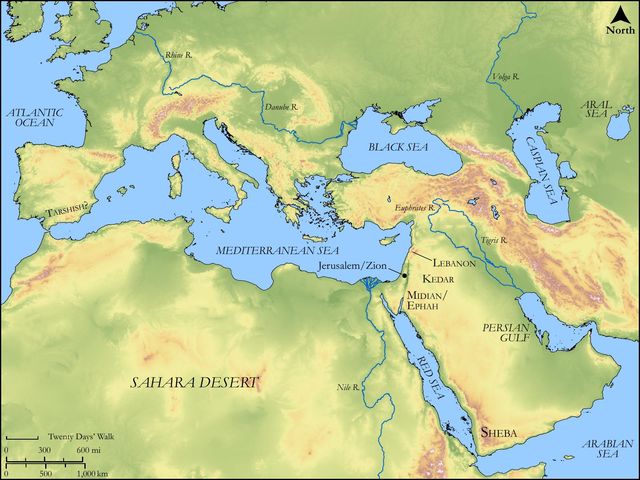
See on the biblical-era map
Study this verse
Public-domain commentary
Matthew Henry
From his Commentary on the Whole Bible. Henry comments on passages, not single verses — this entry covers Isaiah 42:13–17. His two-level outline is real structure in the source text, so it is rendered as structure.
It comes all to one whether we make these verses (as some do) the song itself that is to be sung by the Gentile world or a prophecy of what God will do to make way for the singing of that song, that evangelical new song.
I.He will appear in his power and glory more than ever.
So he did in the preaching of his gospel, in the divine power and energy which went along with it, and in the wonderful success it had in the pulling down of Satan's stronghold, Isa 42:13, Isa 42:14. He had long held his peace, and been still, and refrained himself, while he winked at the times of the ignorance of the Gentile world (Act 17:30), and suffered all nations to walk in their own ways (Act 14:16); but now he shall go forth as a mighty man, as a man of war, to attack the devil's kingdom and give it a fatal blow. The going forth of the gospel is thus represented, Rev 6:2. Christ, in it, went forth conquering and to conquer. The ministry of the apostles is called their warfare; and they were the soldiers of Jesus Christ. He shall stir up jealousy, shall appear more jealous than ever for the glory of his own name and against idolatry.
1.He shall cry, in the preaching of his word, cry like a travailing woman; for the ministers of Christ preached as men in earnest, and that travailed in birth again till they saw Christ formed in the souls of the people, Gal 4:19. He shall cry, yea, roar, in the gospel woes, which are more terrible than the roaring of a lion, and which must be preached along with gospel blessings to awaken a sleeping world.
2.He shall conquer by the power of his Spirit: He shall prevail against his enemies, shall prevail to make them friends, Col 1:21. Those that contradict and blaspheme his gospel, he shall prevail to put them to silence and shame. He will destroy and devour at once all the oppositions of the powers of darkness. Satan shall fall as lightning from heaven, and he that had the power of death shall be destroyed. As a type and figure of this, to make way for the redemption of the Jews out of Babylon, God will humble the pride, and break the power, of their oppressors, and will at once destroy and devour the Babylonian monarchy. In accomplishing this destruction of Babylon by the Persian army under the command of Cyrus, he will make waste mountains and hills, level the country, and dry up all their herbs. The army, as usual, shall either carry off the forage or destroy it, and by laying bridges of boats over rivers shall turn them into islands, and so drain the fens and low grounds, to make way for the march of their army, that the pools shall be dried up. Thus, when the gospel shall be preached, it shall have a free course, and that which hinders the progress of it shall be taken out of the way.
II.He will manifest his favour and grace towards those whose spirits he had stirred up to follow him, as Ezr 1:5.
Those who ask the way to Zion he will show the way, and lead in it, Isa 42:16. Those who by nature were blind, and those who, being under convictions of sin and wrath are quite at a loss and know not what to do with themselves, God will lead by a way that they knew not, will show them the way to life and happiness by Jesus Christ, who is the way, and will conduct and carry them on in that way, which before they were strangers to. Thus, in the conversion of Paul, he was struck blind first, and then God revealed his Son in him, and made the scales to fall from his eyes. They are weak in knowledge, and the truths of God at first seem unintelligible; but God will make darkness light before them, and knowledge shall be easy to them. They are weak in duty, the commands of God seem impracticable, and insuperable difficulties are in the way of their obedience; but God will make crooked things straight; their way shall be plain, and the yoke easy. Those whom God brings into the right way he will guide in it. As a type of this, he will lead the Jews, when they return out of captivity, in a ready road to their own land again, and nothing shall occur to perplex or embarrass them in their journey. These are great things, and kind things, very great and very kind; but lest any should say, "They are too great, too kind, to be expected from God by such an undeserving people as that of the Jews, such an undeserving world as that of the Gentiles," he adds, These things will I do unto them, take my word for it I will, and I will not forsake them; he that begins to show this great mercy will go on to do them good.
III.He will particularly put those to confusion who adhere to idols notwithstanding the attempts made by the preaching of the gospel to turn them from idols (Isa 42:17): They shall be turned back, and greatly ashamed, that trust in graven images. The Babylonians shall when they see how the Jews, who despise their images, are owned and delivered by the God they worship without images, and the Gentiles when they see how idolatry falls before the preaching of the gospel, is scattered like darkness before the light of the sun, and melts like snow before its heat. They shall be ashamed that ever they said to these molten images, You are our gods; for how can those help their worshippers who cannot help themselves, nor save themselves from falling into contempt? In times of reformation, when many turn from iniquity, and sin, being generally deserted, becomes unfashionable, it may be hoped that those who will not otherwise be reclaimed will be wrought upon by that consideration to be ashamed of it.
Historical interpretation
Historical reception
1 surviving comment on this verse from the historical church.
(Verse 10, 11 and following) Sing to God a new song: his praise from the ends of the earth: you who descend into the sea, and its fullness; islands and their inhabitants. Let the desert and its cities lift up: in the houses shall Cedar dwell, praise you inhabitants of Petra, they shall shout from the top of the mountains. They shall give glory to the Lord, and his praise in the islands they shall declare. The Lord shall go forth as a mighty man, as a warrior he shall stir up zeal: he shall shout and cry out: he shall strengthen himself against his enemies. I have always kept silent, I have been quiet, I have been patient: like a woman in labor, I will speak. I will scatter and devour together. I will make mountains and hills desolate, and I will dry up all their vegetation, and I will turn rivers into islands, and I will dry up ponds. And I will lead the blind on a path they do not know, and I will make them walk on paths they have not known. I will turn darkness into light in front of them, and I will make crooked paths straight. These are the things I will do for them, and I will not abandon them. They have turned back: let them be confounded with confusion, that trust in idols, that say to molten things: You are our gods. Sing ye to the Lord a new canticle: his praise is in the church of the saints. Let Israel rejoice in him that made him: and let the children of Sion be joyful in their king. Let them praise his name in choir: let them sing to him with the timbrel and the psaltery. For the Lord is well pleased with his people: and he will exalt the meek unto salvation. The saints shall rejoice in glory: they shall be joyful in their beds. The high praises of God shall be in their mouth: and two-edged swords in their hands. To execute vengeance upon the nations, chastisements among the people. To bind their kings with fetters, and their nobles with manacles of iron. To execute upon them the judgment that is written: this glory is to all his saints. Alleluia. They will give glory to God, his virtues will be proclaimed in the islands. The Lord God of hosts will go forth and crush the battle, he will stir up zeal, and he will cry out against his enemies with strength. Have I been silent from the beginning, will I always be silent and endure? As one in labor, I have acted with patience; I will burst forth and dry up together, I will lay waste the mountains and hills, and I will dry up all their grass. And I will turn rivers into islands, and I will dry up marshes. And I will lead the blind along a way they do not know, and I will make their paths uneven; I will turn darkness into light for them, and crooked things into straight paths. I will speak these words to them, and I will not abandon them, but they have turned backward; you will be confused with confusion, you who trust in idols, who say that they are gods. He who had said: what was first, behold, it has come; I also announce new things: before they arise, I will make them heard to you; and he had promised that he would say what they did not know: what are those new things, he states in the following discourse, commanding the Apostles and the Apostolic men to sing a new song, not in the antiquity of the letter; but in the novelty of the spirit. Not only in the old Instrument, but also in the new; and His praise reaches to the ends of the earth. For He has come forth from the highest heaven and His circuit is to the highest point of it (Psalm XIX). The sound of the Apostles has gone out into all the earth, and their words to the ends of the world. Or according to the Septuagint: Glorify His name in the ends of the earth, that the name of Christ may be announced to the nations in the whole world. But who are those who should sing a new song, the following words declare: You who go down to the sea and sail upon it, or the fullness of the sea. For seeing the apostles, Jesus by the sea of Galilee, mending their nets, called and sent them into the great sea (Luke 5); to make fishermen of fish, who preached the Gospel from Jerusalem to Illyria and Spain: taking the power of the Roman city itself in a short time. Or certainly they descended into the sea and sailed it; enduring the storms and persecutions of this age. Also the islands and their inhabitants, whether understanding the diversity of nations or the multitude of churches. Let the desert and its cities raise their voices, as we mentioned earlier. Whether the desert and its villages rejoice, and Cedar, which was once an uninhabitable region beyond Arabia of the Saracens. And the inhabitants of Petra, which is also a city of Palestine. But this signifies that the deserted people of the nations, previously bound by the ignorance of God and the errors of idolatry, should be converted to the praises of the Lord. Whether because Cedar is interpreted as darkness, and according to the Apostle (I Cor. X) Christ is the rock, it is commanded to all believers, that those who were previously in darkness, and now believe in the Lord Savior, shout from the top of the mountains, and openly proclaim Christ, to whom it is also said above (Ad cap. XL, 9): Ascend to the high mountain, you who proclaim the good news to Zion. Lift up your voice with strength, you who proclaim good news to Jerusalem. And I will set his glory among the islands, of which we have spoken before. And the prophetic discourse describes the glorious advent of the Savior, about which even the Apostle Paul speaks: According to the illumination of the glory of the great God and our Savior Jesus Christ (2 Corinthians 4; 2 Timothy 1:10); and he compares him to a mighty man who will fight against his adversaries, arousing zeal. Of whom it is also prophesied in the Song of Deuteronomy: They have made me jealous with what is not a god; they have provoked me with their idols. So I will make them jealous with those who are not a nation; I will provoke them with a foolish nation (Deuteronomy 32:21). He will also shout and cry out against his enemies, openly condemning their faithlessness, and with loud voice proclaiming: I have been silent, I have always kept silent, I have been patient, or as the Septuagint translated: I have been silent, will I always be silent? (Ecclesiastes 3:7) That which is said through Solomon may be fulfilled: A time to keep silent, and a time to speak. And the meaning is: I have often borne with you as you have transgressed for a long time; but because I remained silent before, I will by no means keep silent any longer. And just as a woman giving birth brings forth a child into the light and makes what was previously hidden in the depths of her womb open and visible, so too I will reveal my pain and the deceit that I have always harbored regarding your crimes, and I will expose your plans. And at once I will devour the entire nation and all the pride of your mountains and the swelling of your hills. And the grass, of which it was said: Truly the grass is the people, that is, both the leaders and the common people, I will reduce to a desert. What is added in the edition of Theodotion of the Septuagint, who had omitted these words (See above, Chapter IV, 7). And when I have dried you up from head to toe and wiped you out, then I will make the rivers of my teaching flow in the islands of the nations, and I will turn your lakes or marshes into dry land, so that there may be knowledge of the Scriptures among the nations and dryness of teaching among you. And I will lead the blind along a path they did not know, of whom we have also read above: I have made you a covenant of the people, a light of the nations, to open the eyes of the blind. They will be led along the way by which Christ speaks. I am the way, that is, the way of the knowledge of God, and I will make them walk on the prophetical paths. Then their darkness will be changed into light, and their faults will be turned into righteousness, so that they may understand what they read and with the eyes of their hearts may gaze upon the clear light of Christ in the Old Testament. At the same time, he adds: These words that I have spoken or will speak to them do not promise anything further in the future, but fulfill what I promised before. But when this was said, the Jewish people turned backward so as not to believe the promise, and in their errors they were confused and neglected the pledge of God, whom they had believed in before idols. Or when the fullness of the Gentiles has come in, then also the people of Israel will be converted (Rom. II), and they will repent of their error, by which they had served idols before. Or certainly after the calling of the Gentiles, they will return to the beginning: so that it may be said, all the Gentiles who did not want to believe in the Gospel will be confounded in their idols.
Continue studying Isaiah 42:17 across the web’s major study libraries — every link below opens this exact verse, chapter, or book on the destination site.
Read & Compare
 BibleGatewayThis verse in more than 200 translations and 70 languages.
 Bible.comThe YouVersion reader — hundreds of translations, reading plans, and highlights.
 ESV.orgCrossway's official English Standard Version reader.
 NET BibleThe NET translation with 60,000+ translators' notes on every rendering decision.
 STEP BibleTyndale House's free study tool — original text, vocabulary, and scholarly resources.
 BibliaLogos Bible Software's free web reader.
 USCCBThe New American Bible (Revised Edition) with the U.S. bishops' study notes.
Commentaries
 BibleHub CommentariesDozens of classic commentaries on this verse, gathered on one page.
 StudyLightMore than 100 commentary sets — the largest collection on the web.
 BibleRefPlain-English commentary on what this verse means, verse by verse.
 Enduring WordDavid Guzik's free commentary on this chapter, widely used by Bible teachers.
 Bible Study ToolsVerse commentary alongside Greek and Hebrew study aids.
Original Language & Research
- BibleHub InterlinearThe verse word by word — original language, transliteration, and English.
- BibleHub LexiconEvery word's original-language definition and Strong's entry.
 Blue Letter BibleDeep-study tools — Strong's numbers, concordance, and word studies.
 SefariaThe Hebrew text with Rashi and centuries of Jewish commentary.
Sermons, Hymns & Audio


TrulyRandomVerse is not affiliated with these sites and doesn’t control their content. They’re linked because they’re genuinely useful.
Summary
Isaiah 42:17 powerfully declares the inevitable and profound humiliation awaiting those who place their trust in idols. It prophesies a complete reversal of fortune and deep disgrace for all who worship and rely on man-made images, whether carved or cast, rather than on the one true God. This verse serves as a stark warning, emphasizing the utter futility of idolatry and implicitly exalting the unparalleled sovereignty and unique power of the Lord.
Context
ShowHideLiterary Context
Isaiah 42 initiates the first of the "Servant Songs" (Isaiah 42:1-9), introducing the Lord's chosen Servant who is commissioned to bring justice and light to the nations. This passage intentionally contrasts the active, righteous, and effective work of God's Servant with the inertness, impotence, and ultimate failure of idols. Following a celebratory hymn of praise to God for His mighty acts (Isaiah 42:10-13) and a declaration of His impending judgment and deliverance (Isaiah 42:14-17), verse 17 stands as a climactic warning. It directly underscores the decisive power of God, who acts sovereignly, in opposition to the utter powerlessness of false gods and the resulting shame of their devotees. The verse immediately precedes a lament over Israel's spiritual blindness and deafness (Isaiah 42:18-25), highlighting that the promised judgment against idolaters is a direct consequence of rejecting the true God and His covenant.
Historical & Cultural Context
The prophecies of Isaiah are set against a turbulent historical backdrop, primarily the rise of the Assyrian and Babylonian empires. During these periods, Israel faced constant political pressure and the pervasive temptation to form alliances with foreign nations, often involving the adoption of their deities. Idolatry was deeply embedded in the religious and cultural landscape of the nations round about Israel, who worshipped a pantheon of gods represented by physical images. These idols were commonly believed to embody divine presence and power, and trust in them was a widespread practice for securing prosperity, military victory, or protection. The creation of "graven images" (carved from wood or stone) and "molten images" (cast from metal) was a common craft. Isaiah's prophecy directly confronts this prevailing cultural norm, challenging the worldview of his audience by asserting the unique sovereignty of the God of Israel and exposing the inherent emptiness and deceitfulness of all other deities.
Key Themes
ShowHideIsaiah 42:17 significantly contributes to several overarching theological and narrative themes within the book of Isaiah. Foremost, it powerfully articulates the Futility of Idolatry, a recurring motif throughout Isaiah that consistently mocks the powerlessness and absurdity of man-made gods (e.g., the detailed exposition in Isaiah 44:9-20). It profoundly highlights the Divine Sovereignty of Yahweh, who alone is God, whose plans are unthwartable, and whose active power stands in stark contrast to the inertness of idols. The verse also speaks directly to the theme of Judgment and Shame, prophesying that those who reject God's covenant and embrace false worship will inevitably face disgrace and a reversal of their perceived security, a consequence frequently tied to Israel's disobedience (e.g., the curses outlined in Deuteronomy 28:15-68). Furthermore, it implicitly reinforces the Uniqueness of God, positioning Him as incomparable and the only one truly worthy of trust and worship, echoing the foundational commands of the Torah against idolatry.
Exposition and Analysis
ShowHideKey Word Analysis
ShowHideThe primary verb is H954 (bûwsh), meaning "to pale, i.e., by implication to be ashamed; also (by implication) to be disappointed or delayed." This signifies a deep personal and public humiliation that arises from the exposure of misplaced confidence. The accompanying H1322 (bôsheth), translated "greatly," is from the same root and denotes "shame (the feeling and the condition, as well as its cause)." Together, they emphasize a profound and inescapable disgrace, a public exposure of the idolaters' folly as their false gods prove utterly incapable of delivering on their promises.
H6459 (peçel) refers to "an idol; carved (graven) image." This term specifically designates idols that are sculpted, hewn, or carved, typically from materials like wood, stone, or bone. Its use here underscores the human effort and material limitations inherent in their creation, contrasting sharply with the uncreated, self-existent, and living God. These are objects of human manufacture, not divine revelation.
H430 (ʼĕlôhîym) is a plural form that can refer to "gods in the ordinary sense," but also, especially with the article, to the supreme God. In this context, it unequivocally refers to the false deities worshipped by the idolaters. The irony is profound: humans declare inanimate objects to be their "gods," attributing divine power and authority to that which has none, a claim that the prophet directly refutes by exposing their ultimate powerlessness.
Verse Breakdown
ShowHide"They shall be turned back"
This phrase, using the Hebrew root H5472 (çûwg), meaning "to flinch, i.e., to go back, literally (to retreat) or figuratively (to apostatize)," indicates a sudden and complete reversal of their expected progression, success, or position of confidence. It signifies a decisive defeat, a forced retreat from their chosen path, or a turning away from their idolatrous reliance, ultimately demonstrating the utter failure of their misplaced trust.
"they shall be greatly ashamed"
This clause emphasizes the profound and public humiliation that will inevitably accompany their reversal. The shame is not merely an internal regret but a deep-seated disgrace, intensified by the Hebrew term H1322 (bôsheth). It signifies the utter confusion and disappointment that arises when one's trust is utterly betrayed by the object of their devotion, revealing its impotence and the folly of their allegiance.
"that trust in graven images"
This identifies the specific group facing judgment: those who place their confidence (H982, bâṭach, "to hide for refuge... to trust, be confident or sure") in idols crafted by human hands. Their reliance is fundamentally misplaced, resting on objects that possess no inherent power, consciousness, or ability to deliver, protect, or fulfill.
"that say to the molten images, Ye are our gods"
This further defines the idolaters as those who verbally acknowledge and declare their allegiance to "molten images" (H4541, maççêkâh, referring to a "fusion of metal, especially a cast image"). This declaration, "Ye are our gods" (H430, ʼĕlôhîym), is a direct affront to the singular sovereignty of Yahweh. It demonstrates their complete spiritual and existential allegiance to inanimate objects, a devotion that will ultimately lead to their downfall and profound shame.
Literary Devices
ShowHideIsaiah 42:17 employs several potent literary devices to convey its message with force and clarity. Parallelism is prominently featured in the repetition of the consequences ("turned back," "greatly ashamed") and the identification of the subjects ("that trust in graven images," "that say to the molten images"). This structural repetition emphasizes the certainty, severity, and dual nature of the impending judgment. Irony is central to the verse's impact: those who proclaim lifeless, man-made images as their "gods" will themselves be "turned back" and "ashamed," thereby demonstrating the absolute powerlessness of their supposed deities. The very objects meant to bring strength, security, and blessing instead lead to weakness, confusion, and humiliation. The prophet's use of both "graven images" and "molten images" constitutes a Merism, encompassing the full spectrum of idolatrous practices, implying that no form of man-made deity, regardless of its construction, can escape this judgment. Ultimately, the entire verse functions as a powerful Prophetic Warning, a declarative statement of future judgment intended to call the audience to repentance and exclusive reliance on the one true God.
Theological and Thematic Connections
ShowHideIsaiah 42:17 profoundly articulates the theological principle that placing ultimate trust, devotion, or reliance in anything other than the living God leads to inevitable disappointment, disgrace, and a reversal of one's perceived security. It underscores God's exclusive claim to worship and His absolute sovereignty over all creation, sharply contrasting His active power, knowledge, and faithfulness with the inertness, blindness, and futility of idols. The prophet's message is a timeless indictment against any form of idolatry—whether the ancient worship of physical images or the modern devotion to wealth, power, self, human ideologies, or even technology—affirming that only God can truly deliver, sustain, and fulfill. To trust in anything else is to set oneself up for a spiritual, emotional, and existential "turning back" and "great shame," as the objects of misplaced trust are revealed to be empty and powerless.
Reflection and Application
ShowHideWhile the explicit worship of "graven images" and "molten images" may seem archaic or distant to many in contemporary society, the underlying spiritual principle of Isaiah 42:17 remains profoundly relevant and convicting. Modern idolatry often takes more subtle, yet equally destructive, forms. It manifests as an excessive reliance on career success, financial security, social status, personal achievements, technological advancements, political ideologies, or even self-sufficiency and human wisdom. When these pursuits or entities become the ultimate source of our hope, identity, security, or meaning, they effectively become "gods" in our lives, demanding our devotion and promising a fulfillment they are inherently incapable of delivering. This verse challenges us to critically examine where our ultimate trust and allegiance truly lie. Do we lean on the fleeting promises and fragile foundations of the world, or do we place our unwavering confidence in the unchanging character, unfailing power, and eternal promises of the Lord? When our "gods" fail, as all false gods inevitably will, the resulting "shame" is not merely embarrassment, but a deep spiritual emptiness, profound disappointment, and a crisis of meaning. True security, lasting fulfillment, and genuine peace are found only in turning back to the one true God, who never disappoints those who trust in Him and whose faithfulness endures forever.
Questions for Reflection
ShowHideFAQ
ShowHideWhat is the primary message of Isaiah 42:17?
ShowHideThe primary message of Isaiah 42:17 is a potent prophetic warning that those who place their trust in idols, whether carved or cast, will inevitably face profound humiliation and a complete reversal of their expectations. It underscores the utter futility of idolatry and powerfully asserts the supreme sovereignty of the Lord, who alone is worthy of worship and trust.
How does this verse relate to the broader context of Isaiah 42?
ShowHideIsaiah 42:17 serves as a climactic warning within a section that introduces the Lord's Servant and declares God's mighty acts. It sharply contrasts the active, powerful, and effective God with the inertness and impotence of idols, highlighting that God's judgment will fall upon those who reject Him in favor of man-made deities. This warning immediately precedes a lament over Israel's spiritual blindness, emphasizing the dire consequences of their misplaced trust, as seen in Isaiah 42:18-20.
Does this verse only apply to ancient idol worship?
ShowHideWhile the verse explicitly addresses the ancient practice of worshipping physical "graven images" and "molten images," its underlying spiritual principle extends to all forms of idolatry. In modern contexts, anything that takes the place of God in one's life—such as wealth, power, status, self-reliance, human wisdom, or even personal relationships—can become a "modern idol." The verse's message of inevitable shame and disappointment applies whenever ultimate trust and devotion are placed in anything other than the living God, echoing warnings found in the New Testament about covetousness being idolatry (Colossians 3:5).
Christ-Centered Fulfillment
ShowHideIsaiah 42:17, with its declaration of shame and reversal for those who trust in idols, finds its ultimate Christ-centered fulfillment in the stark contrast between humanity's futile attempts at self-salvation and the perfect, divine provision of Jesus Christ. Humanity's inherent inclination to create "gods" in its own image, or to place its trust in its own works, wisdom, or worldly systems, inevitably leads to "great shame" when these false saviors fail to deliver. However, the New Testament reveals Jesus as the true and living God, the very image of the invisible God, in whom all the fullness of deity dwells bodily (Colossians 1:15; Colossians 2:9). Unlike lifeless idols that cannot see, hear, or save, Jesus, the Servant introduced in Isaiah 42, perfectly fulfilled God's mission, offering Himself as the ultimate and final sacrifice for sin, once for all (Hebrews 9:26). Those who "trust" (as in Isaiah 42:17) in Him are not "turned back" or "ashamed," but rather receive eternal life, justification, and an unshakeable hope that will never disappoint (Romans 10:11; 1 Peter 2:6). Thus, Isaiah 42:17 serves as a powerful backdrop, highlighting the desperate human need for a true deliverer and underscoring the glorious reality that in Christ, all who believe find not shame and judgment, but salvation, eternal glory, and an everlasting relationship with the living God.