


Hosea 9:17
Bible text: King James Version (1769 Blayney text) · Public domain
Bible text: Berean Standard Bible · Public domain
Bible text: American Standard Version (1901) · Public domain
Bible text: World English Bible, Messianic edition · Public domain
Bible text: Geneva Bible (1599) · Public domain
Bible text: Young's Literal Translation · Public domain
- יִמְאָסֵםyim·'a·Semhe will reject themH3988V-Qal-Imperf-3ms ¦ 3mpVerb Qal Imperfect 3rd Singular Masculineיִמְאָסֵhe will rejectםthem
- אֱלֹהַי'e·lo·Haimy GodH430N-mpc ¦ 1csNoun Plural Masculine ConstructאֱלֹהַGodיmy
- כִּיkiforH3588PrtParticle Conditional
- לֹאlo'notH3808NegParticle Negative
- שָׁמְעוּsha·me·'Uthey have listenedH8085V-Qal-Perf-3cpVerb Qal Perfect 3rd Plural common gender
- לוֹloto himPrep-l ¦ 3msSuffix Personal 3rd Singular Masculineלtoוֹhim
- וְיִהְיוּve·yih·Yuso they may beH1961Conj-w ¦ V-Qal-ConjImperf-3mpVerb Qal Conjunction+Imperfect 3rd Plural Masculineוְsoיִהְיוּthey may be
- נֹדְדִיםno·de·DimwanderersH5074V-Qal-Prtcpl-mpVerb Qal Participle Plural Masculine Absolute
- בַּגּוֹיִםba·go·Yimamong the nationsH1471Prep-b ¦ N-mpNoun Plural Masculine Absoluteבַּamong theגּוֹיִםnations
English is a literal word-by-word gloss of the Hebrew, not the KJV's wording. Why?
This is the original text the KJV's translators worked from — each Hebrew word with its own literal English meaning in this verse, prepared by scholars at Tyndale House, Cambridge. The KJV translates whole sentences, not word by word, so its wording differs: one Hebrew word can become several English words, and the KJV may choose “the LORD” where the gloss reads “Yahweh”. Both are faithful — they answer different questions. For the KJV's own rendering, switch to the KJV text.
Details
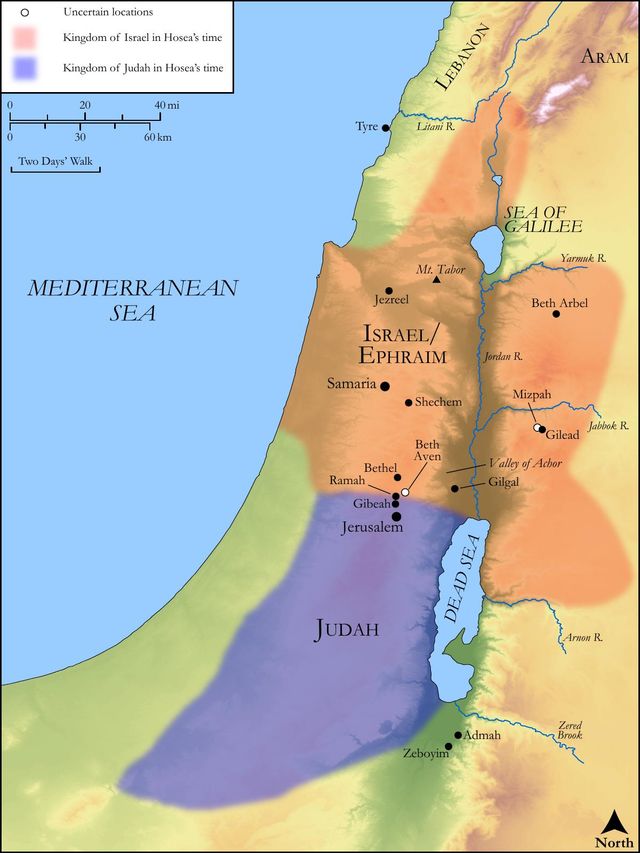
See on the biblical-era map
Study this verse
Public-domain commentary
Matthew Henry
From his Commentary on the Whole Bible. Henry comments on passages, not single verses — this entry covers Hosea 9:11–17. His four-level outline is real structure in the source text, so it is rendered as structure.
In the foregoing verses we saw the sin of Israel derived from their fathers; here we see the punishment of Israel derived to their children; for, as death entered by sin at first, so it is still entailed with it. We may observe, in these verses,
I.The sin of Ephraim. Some expressions are here which describe that.
1.They did not hearken to God (Hos 9:17); they did not give attention to the voice either of his word or of his rod; they did not believe what he said, nor would they be ruled by him. He told them their duty, their interest, their danger, but they regarded him not; all he said to them by his words and by his prophets was to them as a tale that is told; and then no wonder that we hear,
2.Of the wickedness of their doings (Hos 9:15), the downright malice that was in their sins; they were not infirmities, but daring presumptions. How can those but do wickedly who will not hearken to the word of God, that would teach and persuade them to do well? And no wonder that there were wicked doings among them when,
3.Their worship was corrupt (Hos 9:15): All their wickedness is in Gilgal, which was a place infamous for idolatry, as appears, Hos 4:15; Hos 12:11; Amo 4:4; Amo 5:5. It is probable that the idolaters chose that place for their head-quarters because it had been famous in other ages for solemn transactions between God and Israel, as Jos 5:2, Jos 5:10; Sa1 10:8; Sa1 11:15. There, where the source of idolatry was, whence it spread through the kingdom, there it might be said that all their wickedness was, for all other wickedness owed its origin to that. Corruptions in worship make way for corruptions in morals. The mother of harlots is the mother of all other abominations, Rev 17:5. The learned Grotius conjectures that there is a mystical sense here. Golgotha in Syriac is the same with Gilgal in Hebrew, and therefore he thinks this may have reference to the putting of Christ to death at Golgotha, which was the greatest sin of the Jewish nation, and of which it might truly be said, All their wickedness was summed up in that. And no wonder that the people did wickedly, both in worship and conversation, when 4. All their princes were revolters; the whole succession of the kings of the ten tribes did evil in the sight of the Lord, or all the set of judges and magistrates at this time were wicked; they turned aside to sinful ways and persisted in those ways.
II.The displeasure of God against Ephraim for sin.
This is variously expressed here, to show what a provocation sin is to the pure eyes of his glory, and how odious it makes the sinner to him.
1.He departs from them, Hos 9:12. When they revolt from him, and withdraw from their allegiance to him, how can they expect but that he should depart from them and withdraw both his protection and his bounty? And well may his threatening be enforced as it is, and made terrible: Woe also unto them when I depart from them! Note, Those are in a woeful condition indeed whom God has forsaken. Our weal or woe depends upon the gracious presence of God with us; and, if he goes, all weal goes with him and all woes come upon us. God has forsaken him; persecute and take him. Saul knew this when he laid such an emphasis upon this part of his complaint, The Philistines make war against me, and God has departed from me. Nay, he does not only depart from them, but,
2.He hates them. In Gilgal, where all their wickedness is, there I hated them. There, where the abominations of sin are committed, there God abominates the sinners. In Gilgal he had bestowed many tokens of his favour upon their ancestors, but now that is the place where he hates them for their base ingratitude. Nay, he not only hates them, but,
3.He will love them no more, will never take them into his favour again; the breach between God and Israel is wide as the sea, which cannot be healed. This agrees with what he had said, (Hos 1:6, Hos 1:7), I will no more have mercy upon the house of Israel, the ten tribes.
4.He will discard them, and have no more to do with them: For the wickedness of their doings, I will drive them out of my house. He will no longer own them as his, or as belonging to his family in the world; he will turn them out of doors as unfaithful tenants that pay him no rent, as unprofitable servants that do him neither credit nor work. Note, Those that profane God's house can expect no other than to be expelled his house, and no longer suffered to be either lodgers in it or retainers to it. Nay, he will not only drive them out of his house, but,
5.He will drive them far enough (Hos 9:17): My God will cast them away, not only out of his house, but out of his sight; he will quite abandon and reject them; they shall be cast-aways. God said that he would drive them out of his house, and here the prophet seconds it, as one that knew his Master's mind very well: My God will cast them away. See with what comfort and pleasure he calls God his God. Note, When others disown God, and are disowned by him, it is a very great satisfaction to good people that they can call God their God, can cheerfully own him and see themselves owned by him - all revolters, all ruined, yet God is my God.
III.The fruit of this displeasure, in the cutting off and abandoning of their posterity, which is the judgment here threatened again and again. Observe here,
1.How numerous Ephraim seemed likely to be. The name Ephraim is derived from fruitfulness, Gen 41:51. Joseph is a fruitful bough, Gen 49:22. And Moses's blessing foretold the ten thousands of Ephraim, Deu 33:17. This was his glory, Hos 9:11. For this he seemed designed by him that appoints the bounds of men's habitation; for Ephraim, as I saw Tyrus, is planted in a pleasant place, to encourage his increase, which one may expect as from a tree planted by the river's side. Ephraim is as strong and rich as ever Tyre was, and as proud and secure. The Chaldee paraphrase gives this sense of it, The congregation of Israel, while they observed the law, was like to Tyrus in prosperity and security.
2.How few Ephraim should be (Hos 9:11): Their glory shall fly away like a bird; their children shall be taken away and the hopes of their families cut off. All their glory shall fly as an eagle towards heaven, swiftly and irrecoverably. Note, Worldly glory is glory that will fly away; but those that have their God their glory have in him an unfading everlasting glory. Ephraim has been as a fruitful tree. But now Ephraim is smitten, is blasted; their root is dried up; they shall bear no fruit, Hos 9:16. If the root be dried, the branch must wither of course. Observe,
(1.)God's threatening this judgment of the destroying of their children.
[1.]They shall perish of themselves by the immediate hand of God (Hos 9:11): They shall fly away from the birth, and from the womb, and from the conception. Some of their children shall die as soon as they are born; the cradle shall be presently turned into a coffin. Others of them shall be still-born, or the womb shall be their grave, and their death there their mothers' death too. Of others their mothers shall miscarry almost as soon as they have conceived, and they shall be as untimely fruit. See how easily God can, and how justly we are sure he might, root out the whole race of mankind, that degenerate, guilty, obnoxious race, and blot out the name of it from under heaven; it is but doing as he does by Ephraim here, writing them all childless, making all their glory to fly away from the birth, the womb, and the conception, drying up their root, that they bear no fruit, and their business is done in a few years.
[2.]They shall perish by the hand of their enemies; they shall die violent deaths (Hos 9:12): "Though they bring up their children to some maturity, though they escape the diseases and deaths which the infant age is liable to, and are thought to be reared past danger, yet will I bereave them (Hos 9:12), by one judgment or other, so that there shall not be a man left to build up their families and bear up their name." Again (Hos 9:13), Ephraim shall bring forth his children to the murderer. The mothers shall travail with pain to bear their children, and a great deal of care, and pains, and cost shall be bestowed upon the nursing of them, and when a cruel enemy comes and puts all to the word, young and old, without mercy, then they seem but as lambs that were all this while fed for the slaughter. Note, It is a great alloy to the comfort parents have in their children that they know not what they have brought them forth and brought them up for, perhaps for the murderer, or, which is worse, to be themselves the plagues of their generation. It is threatened again (Hos 9:16), Though they bring forth, yet will I slay even the beloved fruit of their womb, those children that they are most fond of. Note, The parents' love is no security to the children's lives; nay, sometimes death is commissioned to take the darlings of the family and leave the burdens of it. When sentence was passed upon Israel in the wilderness, that they should all perish there, this mercy was mixed with the wrath, that their children should nevertheless enter into that rest which they through unbelief could not enter into. But this is a total and final rejection; even their children shall be cut off, and the land shall escheat to the crown, ob defectum sanguinis - shall be lost for want of heirs. The Chaldee-paraphrase, and many of the rabbin, by the murderers to whom the children were brought forth, understand those that sacrificed their children to Moloch, a sin which was its own punishment, which showed the parents void of bowels and justly left them void of blessings.
[3.]Those few that escape and remain shall be dispersed (Hos 9:17): They shall be wanderers among the nations; so the remains of the Jews are at this day, and there is no place in the world where they are a distinct nation.
(2.)The prophet's prayer relating to it (Hos 9:14): Give them, O Lord! what wilt thou give? What shall I ask for a people thus doomed to destruction? It is this; since the decree has gone forth, that they must either die from the womb or be brought forth for the murderer, of the two let them rather die from the womb. Rather let them have no children than have them to be made miserable; for the same reason, when a total ruin was coming on the Jewish nation, Christ said, Blessed is the womb that never bore and the paps that never gave suck, Luk 23:29. "Give therefore a miscarrying womb and dry breasts; for it is better to fall into the hands of the Lord, whose mercies are great, than into the hands of man." Note, Those that are childless may with this reconcile themselves to the will of God herein, that the time may come when, if they were not so, they would wish they had been so.
Historical interpretation
Historical reception
1 surviving comment on this verse from the historical church.
"Ephraim is struck: their root has dried up, they will bear no fruit. Even if they do, I will kill the beloved offspring of their womb. My God will reject them because they did not listen to him, and they will wander among the nations." LXX: "Ephraim grieves over his roots: they are withered, and bear no fruit, and even if they give birth, I will kill the cherished offspring of their wombs. God will reject them because they have not listened to him, and they will wander among the nations." It takes a metaphor from a tree, which if its roots are dried up, it will not be able to bear fruit, and if it does even a little, it will soon wither in its own flower. But he speaks of Ephraim, whose root is withered, because he destroyed the God in whom he was founded, or did not deserve to have his fathers Abraham, Isaac, and Jacob, in whom he had sent his roots: and therefore he does not bear the fruit of righteousness; and if he does, "I will slay," he said, "the dearest of his womb," according to what he had said above: "If they bring up their children, I will make them childless among men:" hence God rejected them and made them go into captivity. "And they shall wander among the nations." We can say this about all the Jews whose leaders have departed from God, stirring up the people to demand his death; therefore, he cast them out of his house and will not love them anymore. He struck their root and dried it up, and they will never bear fruit again, even if they study the Holy Scripture and the Law, and produce something of knowledge and doctrine from their heart as if they were beloved children; the Lord will oppose them and they will be cut off. For God has rejected them, all the prophets, because they did not listen to Him; and they will wander among the nations, not having an altar, not having a seat, not having a proper city. Therefore, David also speaks in the psalm: "Do not kill them, lest my people forget: scatter them by your power" (Psalm 59:12). And in another place: "Expel them according to the multitude of their impieties, for they have provoked You, Lord" (Psalm 5:12). We read about this tree also in the Gospel: 'Now the ax is laid at the root of the trees, and every tree therefore that does not produce good fruit will be cut down and thrown into fire' (Matthew 3:10). Let no one doubt that heretics are incapable of producing the fruits of virtues, because they have lost the Lord, on whom, according to the Apostle, they ought to have been rooted and founded (Ephesians 3). And even if they should produce some fruit and generate some offspring by the fertility of their own womb, they will die with the Lord being against them. Whether because their fruits are all those things which they imagine and generate from their own heart, they will wither and perish: and it will be clear to all that a dry root cannot produce fruits. These will be cast away, indeed they are cast away by God, because they did not listen to him saying: "Do not move the boundaries which your fathers have established" (Deut. XIX, 14). And for this reason they will wander among nations, passing from these opinions to those, since it does not please them to keep what they have once found, but always changing old things for new, and imitating the errors of the pagans.
Continue studying Hosea 9:17 across the web’s major study libraries — every link below opens this exact verse, chapter, or book on the destination site.
Read & Compare
 BibleGatewayThis verse in more than 200 translations and 70 languages.
 Bible.comThe YouVersion reader — hundreds of translations, reading plans, and highlights.
 ESV.orgCrossway's official English Standard Version reader.
 NET BibleThe NET translation with 60,000+ translators' notes on every rendering decision.
 STEP BibleTyndale House's free study tool — original text, vocabulary, and scholarly resources.
 BibliaLogos Bible Software's free web reader.
 USCCBThe New American Bible (Revised Edition) with the U.S. bishops' study notes.
Commentaries
 BibleHub CommentariesDozens of classic commentaries on this verse, gathered on one page.
 StudyLightMore than 100 commentary sets — the largest collection on the web.
 BibleRefPlain-English commentary on what this verse means, verse by verse.
 Enduring WordDavid Guzik's free commentary on this chapter, widely used by Bible teachers.
 Bible Study ToolsVerse commentary alongside Greek and Hebrew study aids.
Original Language & Research
- BibleHub InterlinearThe verse word by word — original language, transliteration, and English.
- BibleHub LexiconEvery word's original-language definition and Strong's entry.
 Blue Letter BibleDeep-study tools — Strong's numbers, concordance, and word studies.
 SefariaThe Hebrew text with Rashi and centuries of Jewish commentary.
Sermons, Hymns & Audio


TrulyRandomVerse is not affiliated with these sites and doesn’t control their content. They’re linked because they’re genuinely useful.
Summary
Hosea 9:17 delivers a stark prophetic judgment against the Northern Kingdom of Israel, declaring that God will reject them due to their persistent disobedience and refusal to heed His voice. This divine abandonment will result in their tragic dispersion and aimless wandering among foreign nations, a direct consequence of their covenant unfaithfulness and idolatry.
Context
ShowHideLiterary Context
Hosea 9:17 concludes a section (Hosea 9:10-17) that vividly portrays Israel's spiritual decline and the impending judgment. Following earlier chapters where God pleads for Israel's return and laments their unfaithfulness, this passage shifts to a definitive pronouncement of their fate. The preceding verses lament Israel's moral corruption, their adoption of pagan practices at places like Baal-peor, and the barrenness that will afflict them as a sign of divine displeasure. The verse acts as a summary and culmination of the warnings, leading into further descriptions of their desolation in Hosea 10. It underscores the finality of God's decision given Israel's hardened heart.
Historical & Cultural Context
Hosea prophesied during the tumultuous final decades of the Northern Kingdom (Israel/Ephraim), roughly 750-715 BC. This was a period marked by political instability, assassinations of kings, and a desperate reliance on foreign alliances (Egypt or Assyria) rather than on the Lord. Spiritually, the nation was deeply entrenched in idolatry, particularly the worship of Baal, fertility cults, and syncretistic practices that blended Yahwism with Canaanite religion. The covenant relationship with Yahweh, established at Sinai, had been systematically violated. The cultural norm of the day involved pagan rituals for agricultural prosperity, which Israel adopted, believing it would ensure blessings, directly contradicting God's law. The impending Assyrian invasion, which would lead to the exile of the northern tribes in 722 BC, looms large over Hosea's prophecies, making the "wanderers among the nations" a direct historical prediction.
Key Themes
ShowHideThis verse powerfully encapsulates several overarching themes found throughout Hosea and the broader prophetic literature. Firstly, it highlights Divine Judgment as an inevitable consequence of persistent sin and covenant breaking. God's act of "casting them away" is not arbitrary but a just response to Israel's deliberate rebellion, echoing the curses for disobedience outlined in Deuteronomy 28. Secondly, the theme of Disobedience and its Consequences is central, as Israel's failure to "hearken unto him" is explicitly stated as the cause of their downfall. This emphasizes the critical importance of obedience in the covenant relationship. Finally, the theme of Exile and Dispersion is a prominent motif, predicting the loss of land, national identity, and divine presence, leading to their scattering among foreign peoples. This scattering is a profound reversal of God's promise to Abraham to make his descendants a great nation in their own land, signifying a profound loss of blessing and security, as seen in the warnings of Leviticus 26:33.
Exposition and Analysis
ShowHideKey Word Analysis
ShowHideThis primitive root means "to spurn," "abhor," "reject," or "refuse." It implies a strong, decisive act of rejection, not merely a passive turning away. When God "casts them away," it signifies His righteous indignation and the termination of His protective care over them due to their persistent and willful rebellion. It conveys the idea of God finding them utterly loathsome due to their unfaithfulness.
This root means "to hear intelligently," but often with the crucial implication of "attention," "obedience," or "consent." Israel's failure was not a mere inability to perceive God's voice, but a deliberate and active refusal to listen attentively, understand, and, most critically, to obey His commands and covenant stipulations. This disobedience was the direct cause of their judgment.
This primitive root means "to wave to and fro," "to rove," or "flee." It describes a state of aimless movement, instability, and lack of a fixed home or secure dwelling. When applied to Israel, it vividly portrays their impending exile and dispersion, losing their national identity, their land, and the stability that came from being rooted in the Promised Land under God's protection.
Verse Breakdown
ShowHide"My God will cast them away"
This opening clause asserts God's sovereign authority and His decisive act of judgment. The possessive "My God" emphasizes the personal relationship that Israel had rejected, making the judgment all the more poignant. "Cast them away" signifies a complete and final rejection of Israel as His favored nation, withdrawing His protection and presence due to their unfaithfulness.
"because they did not hearken unto him"
This clause provides the explicit reason for the divine judgment. It establishes a clear cause-and-effect relationship. Israel's downfall is not arbitrary but a direct consequence of their persistent and willful disobedience to God's commands, warnings, and covenant requirements. Their refusal to "hearken" (to listen, understand, and obey) sealed their fate.
"and they shall be wanderers among the nations"
This final clause describes the specific consequence of God's rejection. It is a prophetic declaration of their impending exile and dispersion. Losing their land, their national identity, and their secure place, they would become rootless, aimless, and vulnerable, scattered among foreign peoples, fulfilling the covenant curses for disobedience.
Literary Devices
ShowHideHosea 9:17 employs several powerful literary devices to convey its message of judgment. Prophecy is the overarching device, as the verse foretells the future exile and dispersion of Israel. This prophecy serves as a solemn warning and a demonstration of God's foreknowledge and sovereign control over history. The verse also utilizes Cause and Effect with striking clarity, explicitly stating "because they did not hearken unto him" as the direct reason for God's action to "cast them away" and their subsequent state as "wanderers among the nations." This direct linkage underscores divine justice. Furthermore, the phrase "wanderers among the nations" serves as a potent Metaphor and Symbolism. It is a metaphor for a people stripped of their identity, security, and divine favor, symbolizing spiritual and physical homelessness. The imagery evokes a sense of rootlessness and vulnerability, contrasting sharply with the security and identity promised to a people dwelling in their own land under God's blessing.
Theological and Thematic Connections
ShowHideHosea 9:17 profoundly articulates the theological principle that God, while merciful and loving, is also righteous and just, holding His covenant people accountable for their actions. It underscores the gravity of disobedience and the inviolability of God's covenant warnings. The "casting away" is not an act of caprice but a judicial response to Israel's consistent rejection of His authority and love. This verse highlights God's sovereignty over nations and His commitment to His own character, even when it means bringing judgment upon those who claim His name but refuse to obey His voice. The dispersion of Israel serves as a stark historical example of the consequences of spiritual apostasy and a reminder that true blessing is contingent upon faithful adherence to God's revealed will.
Reflection and Application
ShowHideHosea 9:17 serves as a timeless and sobering warning for all who claim to be God's people. It powerfully reminds us that a genuine relationship with God is predicated not merely on profession but on active, attentive listening and faithful obedience to His Word. The "casting away" and "wandering" are vivid metaphors for the spiritual consequences of ignoring God's voice and choosing our own path. When we neglect to "hearken" to God's commands, we risk losing the blessings of His presence, protection, and guidance, leading to a sense of spiritual aimlessness and vulnerability. This passage calls us to a deep introspection: Are we truly listening to God, or are we merely hearing? Are we actively integrating His truth into our daily lives, or are we allowing spiritual apathy and the allure of worldly idols to lead us astray? Our spiritual vitality and security are directly linked to our willingness to obey God's voice, ensuring we do not become wanderers in a world that offers no true home apart from Him.
Questions for Reflection
ShowHideFAQ
ShowHideWhy does God "cast them away" in this verse, given His character of love and mercy?
ShowHideGod's act of "casting them away" (H3988, mâʼaç) is a severe but just response to Israel's persistent and willful disobedience, as explicitly stated: "because they did not hearken unto him." While God is indeed loving and merciful, His character also includes righteousness and justice. He is faithful to His covenant, which included both blessings for obedience and curses for disobedience (e.g., Deuteronomy 28). Israel had continually rejected His warnings, pursued idolatry, and broken their covenant vows, despite His relentless calls to repentance through prophets like Hosea. Therefore, God's judgment is not arbitrary but a necessary consequence of their rebellion, demonstrating His holiness and the seriousness of sin. It is a judicial act, upholding the integrity of His covenant and His divine authority.
What does "wanderers among the nations" mean for Israel, and how was it fulfilled?
ShowHide"Wanderers among the nations" (H5074, nâdad) signifies the loss of Israel's land, national identity, and secure dwelling place, leading to their dispersion and aimless existence among foreign peoples. Historically, this was fulfilled with the Assyrian conquest of the Northern Kingdom in 722 BC. The Assyrians systematically deported the Israelite population, scattering them throughout their empire (as described in 2 Kings 17:6). This act stripped them of their homeland, their unique status as God's chosen people in their own land, and left them culturally and spiritually vulnerable in foreign territories. It was a direct reversal of God's promise to establish them securely in the land of Canaan, serving as a powerful consequence for their covenant unfaithfulness.
Christ-Centered Fulfillment
ShowHideHosea 9:17, with its pronouncement of God casting away a disobedient Israel, finds its ultimate and profound Christ-centered fulfillment not in a continued state of wandering for God's people, but in the radical solution offered through Jesus Christ. The "casting away" and "wandering" of Israel highlight humanity's inherent inability to perfectly "hearken" to God's commands, leading to separation and alienation. However, Jesus, the obedient Son, perfectly fulfilled the law and "hearkened" to God in every way, even to the point of death on the cross (as seen in Philippians 2:8). His sacrifice became the means by which God could justly reconcile a disobedient humanity to Himself without compromising His holiness. Through faith in Christ, believers are no longer "wanderers" alienated from God and His promises. Instead, they are brought into a new covenant relationship, given a spiritual home in Him, and become citizens of a heavenly kingdom (as described in Ephesians 2:19). Jesus, the Good Shepherd, gathers those who were scattered, offering them rest, security, and eternal belonging, transforming the curse of wandering into the blessing of abiding in Him (as promised in John 15:4).