


Genesis 6:14
- עֲשֵׂה'a·SehmakeH6213V-Qal-Imp-2msVerb Qal Imperative 2nd Singular Masculine
- לְךָle·Khafor <the> yourselfPrep-l ¦ 2msSuffix Personal 2nd Singular Masculineלְfor <the>ךָyourself
- תֵּבַתte·Vatan ark ofH8392N-fscNoun Singular Feminine Construct
- עֲצֵי'a·tzeiwood<s> ofH6086N-mpcNoun Plural Masculine Construct
- גֹפֶרGo·fergopherH1613N-msNoun Singular Masculine Absolute
- קִנִּיםki·NimnestsH7064N-mpNoun Plural Masculine Absolute
- תַּעֲשֶׂהta·'a·Sehyou will makeH6213V-Qal-Imperf-2msVerb Qal Imperfect 2nd Singular Masculine
- אֶת'et<obj.>H853DirObjMParticle Object Indicator
- הַתֵּבָהha·te·Vahthe arkH8392Art ¦ N-fsNoun Singular Feminine Absoluteהַtheתֵּבָהark
- וְכָפַרְתָּve·kha·far·Taand you will coverH3722Conj-w ¦ V-Qal-ConsecPerf-2msVerb Qal Consecutive Perfect 2nd Singular Masculineוְandכָפַרְתָּyou will cover
- אֹתָהּ'o·Tah<obj.> itH853DirObjM ¦ 3fsParticle Object Indicatorאֹתָ<obj.>הּit
- מִבַּיִתmi·Ba·yitfrom insideH1004Prep-m ¦ N-msNoun Singular Masculine Absoluteמִfromבַּיִתinside
- וּמִחוּץu·mi·Chutzand from outsideH2351Conj-w ¦ Prep-m ¦ N-msNoun Singular Masculine Absoluteוּandמִfromחוּץoutside
- בַּכֹּפֶרba·Ko·ferwith <the> pitchH3724Prep-b ¦ N-msNoun Singular Masculine Absoluteבַּwith <the>כֹּפֶרpitch
English is a literal word-by-word gloss of the Hebrew, not the KJV's wording. Why?
This is the original text the KJV's translators worked from — each Hebrew word with its own literal English meaning in this verse, prepared by scholars at Tyndale House, Cambridge. The KJV translates whole sentences, not word by word, so its wording differs: one Hebrew word can become several English words, and the KJV may choose “the LORD” where the gloss reads “Yahweh”. Both are faithful — they answer different questions. For the KJV's own rendering, switch to the KJV text.
Details
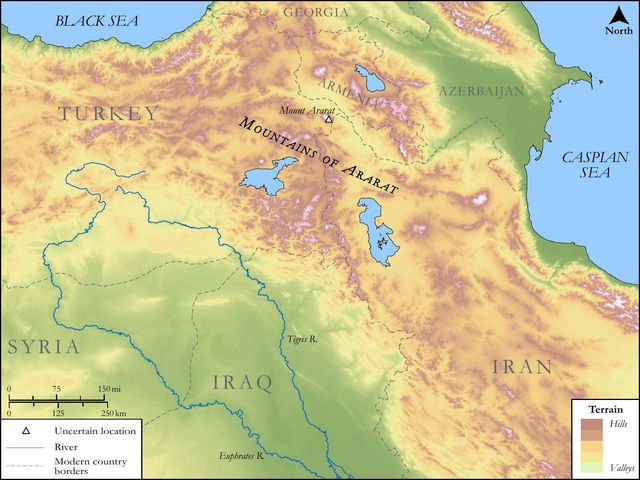
See on the biblical-era maps


Study this verse
Public-domain commentary
Matthew Henry
From his Commentary on the Whole Bible. Henry comments on passages, not single verses — this entry covers Genesis 6:13–21. His three-level outline is real structure in the source text, so it is rendered as structure.
Here it appears indeed that Noah found grace in the eyes of the Lord. God's favour to him was plainly intimated in what he said of him, Gen 6:8-10, where his name is mentioned five times in five lines, when once might have served to make the sense clear, as if the Holy Ghost took a pleasure in perpetuating his memory; but it appears much more in what he says to him in these verses - the informations and instructions here given him.
I.God here makes Noah the man of his counsel, communicating to him his purpose to destroy this wicked world by water.
As, afterwards, he told Abraham his resolution concerning Sodom (Gen 18:17, Shall I hide from Abraham?) so here "Shall I hide from Noah the thing that I do, seeing that he shall become a great nation?" Note, The secret of the Lord is with those that fear him (Psa 25:14); it was with his servants the prophets (Amo 3:7), by a spirit of revelation, informing them particularly of his purposes; it is with all believers by a spirit of wisdom and faith, enabling them to understand and apply the general declarations of the written word, and the warnings there given. Now,
1.God told Noah, in general, that he would destroy the world (Gen 6:13): The end of all flesh has come before me; I will destroy them; that is, the ruin of this wicked world is decreed and determined; it has come, that is, it will come surely, and come quickly. Noah, it is likely, in preaching to his neighbours, had warned them, in general, of the wrath of God that they would bring upon themselves by their wickedness, and now God seconds his endeavours by a particular denunciation of wrath, that Noah might try whether this would work upon them. Hence observe,
(1.)That God confirmeth the words of his messengers, Isa 44:26.
(2.)That to him that has, and uses what he has for the good of others, more shall be given, more full instructions.
2.He told him, particularly, that he would destroy the world by a flood of waters: And behold, I, even I, do bring a flood of waters upon the earth, Gen 6:17. God could have destroyed all mankind by the sword of an angel, a flaming sword turning every way, as he destroyed all the first-born of the Egyptians and the camp of the Assyrians; and then there needed no more than to set a mark upon Noah and his family for their preservation. But God chose to do it by a flood of waters, which should drown the world. The reasons, we may be sure, were wise and just, though to us unknown. God has many arrows in his quiver, and he may use which he please: as he chooses the rod with which he will correct his children, so he chooses the sword with which he will cut off his enemies. Observe the manner of expression: "I, even I, do bring a flood; I that am infinite in power, and therefore can do it, infinite in justice, and therefore will do it." (1.) It intimates the certainty of the judgment: I, even I, will do it. That cannot but be done effectually which God himself undertakes the doing of. See Job 11:10. (2.) It intimates the tendency of it to God's glory and the honour of his justice. Thus he will be magnified and exalted in the earth, and all the world shall be made to know that he is the God to whom vengeance belongs; methinks the expression here is somewhat like that, Isa 1:24, Ah, I will ease me of mine adversaries.
II.God here makes Noah the man of his covenant, another Hebrew periphrasis of a friend (Gen 6:18): But with thee will I establish my covenant.
1.The covenant of providence, that the course of nature shall be continued to the end of time, notwithstanding the interruption which the flood would give to it. This promise was immediately made to Noah and his sons, Gen 9:8, etc. They were as trustees for all this part of the creation, and a great honour was thereby put upon him and his.
2.The covenant of grace, that God would be to him a God and that out of his seed God would take to himself a people. Note,
(1.)When God makes a covenant, he establishes it, he makes it sure, he makes it good; his are everlasting covenants.
(2.)The covenant of grace has in it the recompence of singular services, and the fountain and foundation of all distinguishing favours; we need desire no more, either to make up our losses for God or to make up a happiness for us in God, than to have his covenant established with us.
III.God here makes Noah a monument of sparing mercy, by putting him in a way to secure himself in the approaching deluge, that he might not perish with the rest of the world: I will destroy them, says God, with the earth, Gen 6:13. "But make thee an ark; I will take care to preserve thee alive." Note, Singular piety shall be recompensed with distinguishing salvations, which are in a special manner obliging. This will add much to the honour and happiness of glorified saints, that they shall be saved when the greatest part of the world is left to perish. Now,
1.God directs Noah to make an ark, Gen 6:14-15. This ark was like the hulk of a ship, fitted not to sail upon the waters (there was no occasion for that, when there should be no shore to sail to), but to float upon the waters, waiting for their fall. God could have secured Noah by the ministration of angels, without putting him to any care, or pains, or trouble, himself; but he chose to employ him in making that which was to be the means of his preservation, both for the trial of his faith and obedience and to teach us that none shall be saved by Christ but those only that work out their salvation. We cannot do it without God, and he will not without us. Both the providence of God, and the grace of God, own and crown the endeavours of the obedient and diligent. God gave him very particular instructions concerning this building, which could not but be admirably well fitted for the purpose when Infinite Wisdom itself was the architect.
(1.)It must be made of gopher-wood. Noah, doubtless, knew what sort of wood that was, though we now do not, whether cedar, or cypress, or what other.
(2.)He must make it three stories high within.
(3.)He must divide it into cabins, with partitions, places fitted for the several sorts of creatures, so as to lose no room.
(4.)Exact dimensions were given him, that he might make it proportionable, and might have room enough in it to answer the intention and no more. Note, Those that work for God must take their measures from him and carefully observe them. Note, further, It is fit that he who appoints us our habitation should fix the bounds and limits of it.
(5.)He must pitch it within and without - without, to shed off the rain, and to prevent the water from soaking in - within, to take away the bad smell of the beasts when kept close. Observe, God does not bid him paint it, but pitch it. If God gives us habitations that are safe, and warm, and wholesome, we are bound to be thankful, though they are not magnificent or nice.
(6.)He must make a little window towards the top, to let in light, and (some think) that through that window he might behold the desolations to be made in the earth.
(7.)He must make a door in the side of it, by which to go in and out.
2.God promises Noah that he and his shall be preserved alive in the ark (Gen 6:18): Thou shalt come into the ark. Note, What we do in obedience to God, we ourselves are likely to have the comfort and benefit of. If thou be wise, thou shalt be wise for thyself. Nor was he himself only saved in the ark, but his wife, and his sons, and his sons' wives. Observe,
(1.)The care of good parents; they are solicitous not only for their own salvation, but for the salvation of their families, and especially their children.
(2.)The happiness of those children that have godly parents. Their parents' piety often procures them temporal salvation, as here; and it furthers them in the way to eternal salvation, if they improve the benefit of it.
IV.God here makes Noah a great blessing to the world, and herein makes him an eminent type of the Messiah, though not the Messiah himself, as his parents expected, Gen 5:29.
1.God made him a preacher to the men of that generation. As a watchman, he received the word from God's mouth, that he might give them warning, Eze 3:17. Thus, while the long-suffering of God waited, by his Spirit in Noah, he preached to the old world, who, when Peter wrote, were spirits in prison (Pe1 3:18-20), and herein he was a type of Christ, who, in a land and age wherein all flesh had corrupted their way, went about preaching repentance and warning men of a deluge of wrath coming.
2.God made him a saviour to the inferior creatures, to keep the several kinds of them from perishing and being lost in the deluge, Gen 6:19-21. This was a great honour put upon him, that not only in him the race of mankind should be kept up, and that from him should proceed a new world, the church, the soul of the world, and Messiah, the head of that church, but that he should be instrumental to preserve the inferior creatures, and so mankind should in him acquire a new title to them and their service.
(1.)He was to provide shelter for them, that they might not be drowned. Two of every sort, male and female, he must take with him into the ark; and lest he should make any difficulty of gathering them together, and getting them in, God promises (Gen 6:20) that they shall of their own accord come to him. He that makes the ox to know his owner and his crib then made him know his preserver and his ark.
(2.)He was to provide sustenance for them, that they might not be starved, Gen 6:21. He must victual his ship according to the number of his crew, that great family which he had now the charge of, and according to the time appointed for his confinement. Herein also he was a type of Christ, to whom it is owing that the world stands, by whom all things consist, and who preserves mankind from being totally cut off and ruined by sin; in him the holy seed is saved alive, and the creation rescued from the vanity under which it groans. Noah saved those whom he was to rule, so does Christ, Heb 5:9.
Historical interpretation
Three Centuries of Reception
7 surviving comments on this verse. Each one is dated, so this reads as a timeline rather than a list.
Select a marker to jump to its quote. Markers stagger vertically where authors wrote within a few decades of each other.
We read in Genesis that the ark that Noah built was three hundred cubits long, fifty cubits wide and thirty cubits high. Notice the mystical significance of the numbers. In the number fifty, penance is symbolized because the fiftieth psalm of King David is the prayer of his repentance. Three hundred contains the symbol of crucifixion. The letter T is the sign for three hundred, whence Ezekiel says, “Mark THAV on the forehead of those who moan; and do not kill any marked with THAV.” No one marked with the sign of the cross on his forehead can be struck by the devil; he is not able to efface this sign, only sin can. We have spoken of the ark, of the number fifty, of the number three hundred. Let us comment on the number thirty because the ark was thirty cubits high and finished above in one cubit. First, we repent in the number fifty; then, through penance, we arrive at the mystery of the cross; we reach the mystery of the cross through the perfect Word that is Christ. As a matter of fact, when Jesus was baptized, according to Luke, “he was thirty years of age.” These same thirty cubits were finished off one cubit above. Fifty, and three hundred, and thirty were finished above in one cubit, that is, in one faith of God.
(Verse 14) Make for yourself an ark of square wooden planks. For the square planks, we read it is coated with pitch in Hebrew.
Undoubtedly the ark is a symbol of the city of God on its pilgrimage in history. It is a figure of the church that was saved by the wood on which there hung the “Mediator between God and men, himself man, Jesus Christ.” Even the very measurements of length, height and breadth of the ark are meant to point to the reality of the human body into which he came as it was foretold that he would come. It will be recalled that the length of a normal body from head to foot is six times the breadth from one side to the other and ten times the thickness from back to front. Measure a man who is lying on the ground, either prone or supine. He is six times as long from head to foot as he is wide from left to right or right to left, and he is ten times as long as he is high from the ground up. That is why the ark was made three hundred cubits in length, fifty in breadth and thirty in height. As for the door in the side, that surely, symbolizes the open wound made by the lance in the side of the Crucified—the door by which those who come to him enter in, in the sense that believers enter the church by means of the sacraments that issued from that wound. It was ordered that the ark be made out of squared timbers—a symbol of the foursquare stability of a holy life, which, like a cube, stands firm however it is turned. So it is with every other detail of the ark’s construction. They are all symbols of something in the church.
However, for the smoothed wood, the ancient translation used the term squared wood, which equally refers to the same perfection of the elect. For wherever you turn a square, it will stand, nor can it be prone to falling in any way. Thus indeed, thus the mind of the elect remembers to maintain the inviolate state of holy intention, whatever temptations it may encounter.
You shall make little rooms in the ark. All the mansions in the ark were arranged as receptacles for various animals that were to enter it, and in the Church there are many orders of institutions according to the diversity of those who come to the faith. For the same life or manner of living ought not to be that of the married and the continent, the sinners, and the rulers; and to this one it is said: If you wish to enter into life, keep the commandments, you shall not kill, you shall not commit adultery, you shall not steal, you shall not bear false witness (Matthew 19:17), and other such things. But to another: If you wish to be perfect, go, sell all that you have, and give to the poor (Ibid., 21). Hence also, concerning the reward itself of eternal retribution, the Lord says: In my Father's house there are many mansions (John 14:2). Therefore, there are little rooms in the ark because not all have the same merit in the Church, nor the same progress in faith, although all are contained within one faith and washed in the same baptism.
Make for yourself, he says, an ark of smoothed wood. Not only the humans who were saved in the ark, but also the animals that entered it together; even the wood of which it was made mystically announces the faithful of the holy Church. Therefore, the wood of which it was made is commanded to be smoothed, because whoever is placed in the structure of the Church by coming to faith must first, being cut off from the root of his former lifestyle through the instruction or chastisement of those who have preceded in Christ, remove everything of harmful crookedness and deformity which he finds in himself, and direct his whole mind and action to the rule of the Catholic faith and truth, so that, in the order of the heavenly building, he may be fitly and opportunely placed for the creation of a new man in his proper place and time.
And you shall cover it inside and outside with bitumen, and you shall make it thus. Bitumen is the hottest and most violent adhesive, whose power is such that the woods which have been coated with it can neither be eaten by worms, nor can they be dissolved by the heat of the sun, or the blows of the winds, or the flooding of the waters; whence what else is mystically understood by bitumen than the constancy of faith? Moreover, the ark is covered inside and outside with bitumen, and thus it is completely perfected, while both the thoughts of the elect and their works, so that they may not be overcome or deceived by the incursions of vices, are fortified by the power of faith in all things.
Continue studying Genesis 6:14 across the web’s major study libraries — every link below opens this exact verse, chapter, or book on the destination site.
Read & Compare
 BibleGatewayThis verse in more than 200 translations and 70 languages.
 Bible.comThe YouVersion reader — hundreds of translations, reading plans, and highlights.
 ESV.orgCrossway's official English Standard Version reader.
 NET BibleThe NET translation with 60,000+ translators' notes on every rendering decision.
 STEP BibleTyndale House's free study tool — original text, vocabulary, and scholarly resources.
 BibliaLogos Bible Software's free web reader.
 USCCBThe New American Bible (Revised Edition) with the U.S. bishops' study notes.
Commentaries
 BibleHub CommentariesDozens of classic commentaries on this verse, gathered on one page.
 StudyLightMore than 100 commentary sets — the largest collection on the web.
 BibleRefPlain-English commentary on what this verse means, verse by verse.
 Enduring WordDavid Guzik's free commentary on this chapter, widely used by Bible teachers.
 Bible Study ToolsVerse commentary alongside Greek and Hebrew study aids.
Original Language & Research
- BibleHub InterlinearThe verse word by word — original language, transliteration, and English.
- BibleHub LexiconEvery word's original-language definition and Strong's entry.
 Blue Letter BibleDeep-study tools — Strong's numbers, concordance, and word studies.
 SefariaThe Hebrew text with Rashi and centuries of Jewish commentary.
Sermons, Hymns & Audio


TrulyRandomVerse is not affiliated with these sites and doesn’t control their content. They’re linked because they’re genuinely useful.
Summary
Genesis 6:14 records God's meticulously detailed command to Noah for the construction of the ark, a pivotal moment in divine history. This instruction serves as the foundational step in God's redemptive plan to preserve a righteous remnant of humanity and the animal kingdom from the impending global flood. The verse powerfully underscores God's righteous judgment against sin, His profound mercy in providing a way of salvation, and the essential role of human obedience in actualizing His sovereign purposes.
Context
ShowHideLiterary Context
This divine directive to Noah is situated immediately after God's profound grief and declaration of judgment over the pervasive wickedness and violence that had corrupted the entire earth. The preceding verses Genesis 6:5-7 vividly describe humanity's descent into depravity, leading God to lament His creation and resolve to "blot out mankind from the face of the earth." However, in stark contrast to this universal condemnation, Noah found grace in the eyes of the Lord, being described as a "righteous man, blameless in his generation" Genesis 6:9. Therefore, the specific instructions for the ark's construction in verse 14 are not merely a practical building project but emerge as God's sovereign act of mercy and provision for salvation, set against the backdrop of global depravity and impending judgment. It marks a decisive turn from the narrative of human corruption to God's initiative for preservation.
Historical & Cultural Context
In the ancient Near East, large-scale construction projects, especially those involving timber and waterproofing, were known, though none on the scale of the ark. The concept of a global flood, while unique in its biblical scope, finds echoes in various ancient Mesopotamian flood narratives (e.g., the Epic of Gilgamesh), suggesting a shared memory of a cataclysmic event, albeit reinterpreted through different cultural lenses. Noah's world was characterized by widespread moral decay, a society "filled with violence" Genesis 6:11. Building such a massive vessel would have been an unprecedented and seemingly absurd undertaking in a world that had never experienced a global deluge, requiring immense faith and resilience from Noah and his family. The command to "pitch" the ark reflects common ancient waterproofing techniques using bitumen or tar, a practical necessity for maritime vessels of the time, yet imbued with deeper theological significance in this context.
Key Themes
ShowHideGenesis 6:14 contributes significantly to several overarching themes within the book of Genesis and the broader biblical narrative. It highlights the theme of Divine Judgment and Mercy, showcasing God's righteous response to sin while simultaneously providing a gracious means of escape. The meticulous details of the command underscore God's Sovereignty and Meticulous Planning, revealing a God who is intimately involved in the specifics of His redemptive work. Furthermore, Noah's subsequent obedience to these precise instructions, as noted in Genesis 6:22, establishes Obedience as the Pathway to Deliverance and Blessing, a foundational principle reiterated throughout scripture. The ark itself introduces the theme of Salvation through a Chosen Vessel, a concept that foreshadows later divine provisions for salvation, culminating in Christ. Finally, the use of "pitch" introduces the subtle yet profound theme of Atonement and Covering, which will be more fully developed in the Mosaic Law and ultimately fulfilled in the New Covenant.
Exposition and Analysis
ShowHideGod's command to Noah in Genesis 6:14 is characterized by remarkable precision and divine foresight, revealing a meticulous architect who leaves nothing to chance in His plan for salvation.
Key Word Analysis
ShowHideA primitive root meaning "to do or make, in the broadest sense and widest application." This word implies not just a casual construction but a comprehensive act of accomplishment and performance. God is commissioning Noah to fully execute a specific, divine task, emphasizing the intentionality and completeness required in building the ark according to divine specifications.
An unused root, probably meaning "to house in"; a kind of tree or wood, apparently the cypress. This term, unique to this passage, denotes a specific type of wood, widely understood to be a durable, resinous, and water-resistant timber like cypress or a type of pine. God's precise material choice underscores His meticulous care in providing for the ark's structural integrity and longevity, ensuring it could withstand the cataclysmic forces of the flood.
The verb "shalt pitch" comes from H3722 (kâphar), meaning "to cover (specifically with bitumen); figuratively, to expiate or condone, to placate or cancel; appease, make (an) atonement." The noun "with pitch" comes from H3724 (kôpher), meaning "properly, a cover; (specifically) bitumen (as used for coating)." The profound significance lies in the linguistic connection between the physical act of "covering" the ark with bitumen for waterproofing and the theological concept of "atonement" – a covering for sin. This subtle wordplay hints at the greater spiritual salvation God would one day provide through a "covering" for humanity's sin.
Verse Breakdown
ShowHide"Make thee an ark of gopher wood"
This is the foundational command, specifying the primary material for the vessel. The ark (Hebrew: têbâh, H8392) is not just any boat but a unique, divinely commissioned vessel designed for preservation. The choice of "gopher wood" highlights God's specific and practical provision for the ark's durability and water resistance, essential for its function as a refuge.
"rooms shalt thou make in the ark"
This instruction details the internal structure, emphasizing the necessity of compartments. These "rooms" (Hebrew: qên, H7064, also meaning "nest" or "chamber") were crucial for organizing and housing the vast array of creatures and provisions needed for sustaining life during the long period of the flood. This detail speaks to the ark's function not merely as a vessel but as a self-contained ecosystem, a testament to God's comprehensive plan for the preservation of life.
"and shalt pitch it within and without with pitch"
This final directive concerns the waterproofing of the ark. The command to apply pitch "within" (Hebrew: bayith, H1004, meaning "house" or "inside") and "without" (Hebrew: chûwts, H2351, meaning "outside" or "outward") ensures complete impermeability. This practical measure was vital for sealing the ark from the destructive waters. Theologically, as discussed in the Key Word Analysis, the word "pitch" (Hebrew: kôpher) carries a profound resonance with the concept of "atonement" (Hebrew: kâphar), providing a symbolic layer of meaning to this crucial act of covering.
Literary Devices
ShowHideGenesis 6:14 employs several significant literary devices. The primary device is Divine Command, where God issues direct, imperative instructions to Noah, highlighting His absolute authority and sovereign initiation of the salvation plan. The meticulous detail in the command, such as specifying "gopher wood" and "rooms," functions as Precision or Specificity, emphasizing God's careful design and forethought, leaving no aspect to chance. The ark itself is a powerful Symbolism, representing refuge, salvation, and God's provision amidst judgment. Furthermore, the linguistic connection between "pitch" (kôpher) and "atonement" (kâphar) serves as a profound example of Foreshadowing or Typology, subtly hinting at a deeper theological reality of spiritual covering and redemption that would be fully revealed later in biblical history. The repeated emphasis on "make" and "ark" creates a sense of Repetition that reinforces the central task and object of God's command.
Theological and Thematic Connections
ShowHideGenesis 6:14 is rich with theological implications, serving as a foundational text for understanding God's character and His redemptive purposes. It reveals a God who is both just in His judgment of sin and merciful in His provision of salvation. The detailed nature of the command underscores His sovereignty and meticulous planning, demonstrating that His plans are precise and purposeful. Noah's faithful execution of these instructions highlights the critical role of human obedience as the necessary response to divine revelation, establishing a pattern for all who would seek deliverance through faith. The ark, therefore, becomes a powerful symbol of God's refuge, a physical manifestation of His protective care for His chosen ones amidst a world facing divine wrath.
Reflection and Application
ShowHideGenesis 6:14 challenges believers today to consider the profound implications of God's specific commands in a world that often dismisses divine authority or prioritizes human ingenuity over divine wisdom. Like Noah, we are called to trust in God's blueprint for our lives, even when His instructions seem counter-intuitive, demand significant effort, or prepare us for realities yet unseen. This verse encourages a posture of diligent and precise obedience, reminding us that God's provision and protection are found within the boundaries of His revealed will. It urges us to build our lives, our families, and our ministries according to God's design, confident that His meticulous foresight ensures our ultimate safety and purpose, even amidst spiritual floods of judgment or cultural currents of depravity. Our faithful adherence, like Noah's, becomes a testament to God's saving power and a pathway for His grace to flow through us to others.
Questions for Reflection
ShowHideFAQ
ShowHideWhat is "gopher wood" and why is it specified?
ShowHideThe exact species of "gopher wood" (Hebrew: גֹּפֶר, gôpher) is unique to this passage and its precise botanical identification remains a subject of scholarly debate. However, it is widely understood to refer to a durable, resinous, and water-resistant timber, likely a type of cypress or pine. God specified this particular wood because of its inherent properties, ensuring the ark's structural integrity and its ability to remain watertight and buoyant throughout the cataclysmic flood. This detail underscores God's meticulous provision for the ark's efficacy as a vessel of salvation.
Why did God give such detailed instructions for the ark?
ShowHideGod gave such specific and detailed instructions for the ark for several crucial reasons. Practically, these blueprints ensured the ark's structural integrity, seaworthiness, and capacity to house and sustain all its inhabitants. Theologically, the precision demonstrates God's absolute sovereignty and meticulous care in carrying out His plans, leaving no room for human improvisation on such a critical mission. It also served as a test of Noah's faith and obedience, requiring him to trust and follow divine wisdom rather than his own understanding. The detailed nature of the command also foreshadows God's later precise instructions for the Tabernacle and Temple, emphasizing that His redemptive work is always according to His divine design, not human invention.
What is the significance of "pitching it within and without"?
ShowHidePractically, pitching the ark with pitch (Hebrew: כֹּפֶר, kôpher) provided essential waterproofing, sealing the massive vessel from the destructive floodwaters. This ensured the safety and preservation of all life within. Theologically, the Hebrew word for "pitch," kôpher, is profoundly significant because it is directly related to the verb kâphar, meaning "to cover" or "to atone." This linguistic connection subtly weaves a deep theological thread into a practical command. Just as the physical pitch provided an impermeable covering that sealed the ark from judgment, it foreshadows the spiritual "covering" or atonement that God would provide for humanity's sin, protecting believers from divine wrath. This concept is central to the biblical understanding of salvation.
How does Noah's obedience in building the ark relate to our faith today?
ShowHideNoah's obedience in building the ark was an extraordinary act of faith. He built a massive vessel in a world that had never seen such a flood, trusting God's word completely despite the apparent absurdity of the task. Similarly, our faith in God involves trusting and obeying His commands, even when the outcome is not immediately visible, the task seems overwhelming, or His ways seem counter-cultural to the world around us. Noah's example in Hebrews 11:7 teaches us that true faith is demonstrated through obedient action, preparing for future realities based on God's revealed truth, confident that His way leads to true salvation and life.
Christ-Centered Fulfillment
ShowHideThe ark, built according to God's precise command in Genesis 6:14, stands as a profound and multifaceted type of Christ and the salvation He offers. Just as the ark was the sole means of salvation and refuge from God's righteous judgment upon a sinful world, Jesus Christ is the singular pathway to salvation from the ultimate judgment of sin. The "gopher wood" of the ark, chosen for its durability and resistance, points to Christ's perfect humanity and His unblemished nature, capable of bearing the full weight of divine wrath. The "rooms" within the ark, designed to house and preserve life, foreshadow the expansive and inclusive nature of Christ's salvation, which gathers all who believe into His protective embrace. Most profoundly, the "pitch" (kôpher) that covered the ark, sealing it from the destructive waters, beautifully foreshadows Christ's atoning sacrifice (kâphar) on the cross. His blood provides a spiritual covering and protection from God's wrath for all who believe, ensuring their safety and eternal life. Noah's faith-filled obedience in building the ark also points to Christ's perfect obedience to the Father's will, even unto death on the cross, which secured our salvation. As Peter states in 1 Peter 3:20-21, the ark is a figure of baptism, which now saves us, not by removing dirt from the body, but as an appeal to God for a good conscience through the resurrection of Jesus Christ. Ultimately, the ark represents God's sovereign provision of a "way" for salvation, a truth fully realized in Jesus Christ who declares, "I am the way, the truth, and the life."