


Genesis 6:21
Bible text: King James Version (1769 Blayney text) · Public domain
Bible text: Berean Standard Bible · Public domain
Bible text: American Standard Version (1901) · Public domain
Bible text: World English Bible, Messianic edition · Public domain
Bible text: Geneva Bible (1599) · Public domain
Bible text: Young's Literal Translation · Public domain
- וְאַתָּהve·'a·Tahand youH859Conj-w ¦ Pro-2msPronoun Personal 2nd Singular Masculineוְandאַתָּהyou
- קַחkachtakeH3947V-Qal-Imp-2msVerb Qal Imperative 2nd Singular Masculine
- לְךָle·Khafor <the> yourselfPrep-l ¦ 2msSuffix Personal 2nd Singular Masculineלְfor <the>ךָyourself
- מִכָּלmi·kolsome of allH3605Prep-m ¦ N-mscNoun Singular Masculine Constructמִsome ofכָּלall
- מַאֲכָלma·'a·KhalfoodH3978N-msNoun Singular Masculine Absolute
- אֲשֶׁר'a·SherwhichH834RelParticle Relative
- יֵאָכֵלye·'a·Khel<it> is eatenH398V-Niphal-Imperf-3msVerb Niphal Imperfect 3rd Singular Masculine
- וְאָסַפְתָּve·'a·saf·Taand you will gather [it]H622Conj-w ¦ V-Qal-ConsecPerf-2msVerb Qal Consecutive Perfect 2nd Singular Masculineוְandאָסַפְתָּyou will gather [it]
- אֵלֶיךָ'e·Lei·khato yourselfH413Prep ¦ 2msPreposition Definiteאֵלֶיtoךָyourself
- וְהָיָהve·ha·Yahand it will becomeH1961Conj-w ¦ V-Qal-ConsecPerf-3msVerb Qal Consecutive Perfect 3rd Singular Masculineוְandהָיָהit will become
- לְךָle·Khafor youPrep-l ¦ 2msSuffix Personal 2nd Singular Masculineלְforךָyou
- וְלָהֶםve·la·Hemand for <the> themConj-w ¦ Prep-l ¦ 3mpSuffix Personal 3rd Plural Masculineוְandלָfor <the>הֶםthem
- לְאָכְלָהle·'okh·Lah<into> foodH402Prep-l ¦ N-fsNoun Singular Feminine Absoluteלְ<into>אָכְלָהfood
English is a literal word-by-word gloss of the Hebrew, not the KJV's wording. Why?
This is the original text the KJV's translators worked from — each Hebrew word with its own literal English meaning in this verse, prepared by scholars at Tyndale House, Cambridge. The KJV translates whole sentences, not word by word, so its wording differs: one Hebrew word can become several English words, and the KJV may choose “the LORD” where the gloss reads “Yahweh”. Both are faithful — they answer different questions. For the KJV's own rendering, switch to the KJV text.
Details
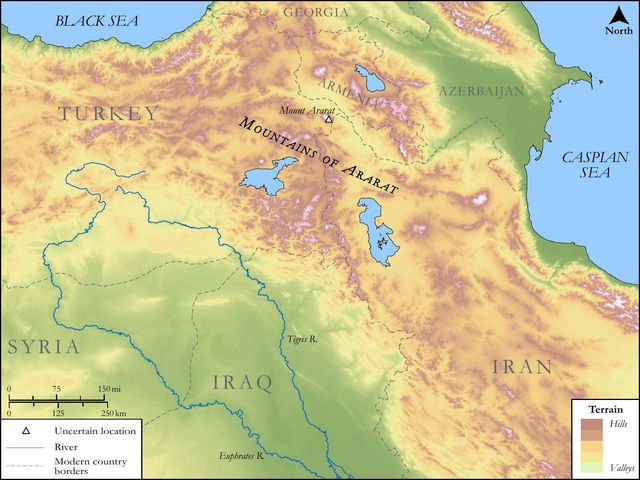
See on the biblical-era maps


Study this verse
Public-domain commentary
Matthew Henry
From his Commentary on the Whole Bible. Henry comments on passages, not single verses — this entry covers Genesis 6:13–21. His three-level outline is real structure in the source text, so it is rendered as structure.
Here it appears indeed that Noah found grace in the eyes of the Lord. God's favour to him was plainly intimated in what he said of him, Gen 6:8-10, where his name is mentioned five times in five lines, when once might have served to make the sense clear, as if the Holy Ghost took a pleasure in perpetuating his memory; but it appears much more in what he says to him in these verses - the informations and instructions here given him.
I.God here makes Noah the man of his counsel, communicating to him his purpose to destroy this wicked world by water.
As, afterwards, he told Abraham his resolution concerning Sodom (Gen 18:17, Shall I hide from Abraham?) so here "Shall I hide from Noah the thing that I do, seeing that he shall become a great nation?" Note, The secret of the Lord is with those that fear him (Psa 25:14); it was with his servants the prophets (Amo 3:7), by a spirit of revelation, informing them particularly of his purposes; it is with all believers by a spirit of wisdom and faith, enabling them to understand and apply the general declarations of the written word, and the warnings there given. Now,
1.God told Noah, in general, that he would destroy the world (Gen 6:13): The end of all flesh has come before me; I will destroy them; that is, the ruin of this wicked world is decreed and determined; it has come, that is, it will come surely, and come quickly. Noah, it is likely, in preaching to his neighbours, had warned them, in general, of the wrath of God that they would bring upon themselves by their wickedness, and now God seconds his endeavours by a particular denunciation of wrath, that Noah might try whether this would work upon them. Hence observe,
(1.)That God confirmeth the words of his messengers, Isa 44:26.
(2.)That to him that has, and uses what he has for the good of others, more shall be given, more full instructions.
2.He told him, particularly, that he would destroy the world by a flood of waters: And behold, I, even I, do bring a flood of waters upon the earth, Gen 6:17. God could have destroyed all mankind by the sword of an angel, a flaming sword turning every way, as he destroyed all the first-born of the Egyptians and the camp of the Assyrians; and then there needed no more than to set a mark upon Noah and his family for their preservation. But God chose to do it by a flood of waters, which should drown the world. The reasons, we may be sure, were wise and just, though to us unknown. God has many arrows in his quiver, and he may use which he please: as he chooses the rod with which he will correct his children, so he chooses the sword with which he will cut off his enemies. Observe the manner of expression: "I, even I, do bring a flood; I that am infinite in power, and therefore can do it, infinite in justice, and therefore will do it." (1.) It intimates the certainty of the judgment: I, even I, will do it. That cannot but be done effectually which God himself undertakes the doing of. See Job 11:10. (2.) It intimates the tendency of it to God's glory and the honour of his justice. Thus he will be magnified and exalted in the earth, and all the world shall be made to know that he is the God to whom vengeance belongs; methinks the expression here is somewhat like that, Isa 1:24, Ah, I will ease me of mine adversaries.
II.God here makes Noah the man of his covenant, another Hebrew periphrasis of a friend (Gen 6:18): But with thee will I establish my covenant.
1.The covenant of providence, that the course of nature shall be continued to the end of time, notwithstanding the interruption which the flood would give to it. This promise was immediately made to Noah and his sons, Gen 9:8, etc. They were as trustees for all this part of the creation, and a great honour was thereby put upon him and his.
2.The covenant of grace, that God would be to him a God and that out of his seed God would take to himself a people. Note,
(1.)When God makes a covenant, he establishes it, he makes it sure, he makes it good; his are everlasting covenants.
(2.)The covenant of grace has in it the recompence of singular services, and the fountain and foundation of all distinguishing favours; we need desire no more, either to make up our losses for God or to make up a happiness for us in God, than to have his covenant established with us.
III.God here makes Noah a monument of sparing mercy, by putting him in a way to secure himself in the approaching deluge, that he might not perish with the rest of the world: I will destroy them, says God, with the earth, Gen 6:13. "But make thee an ark; I will take care to preserve thee alive." Note, Singular piety shall be recompensed with distinguishing salvations, which are in a special manner obliging. This will add much to the honour and happiness of glorified saints, that they shall be saved when the greatest part of the world is left to perish. Now,
1.God directs Noah to make an ark, Gen 6:14-15. This ark was like the hulk of a ship, fitted not to sail upon the waters (there was no occasion for that, when there should be no shore to sail to), but to float upon the waters, waiting for their fall. God could have secured Noah by the ministration of angels, without putting him to any care, or pains, or trouble, himself; but he chose to employ him in making that which was to be the means of his preservation, both for the trial of his faith and obedience and to teach us that none shall be saved by Christ but those only that work out their salvation. We cannot do it without God, and he will not without us. Both the providence of God, and the grace of God, own and crown the endeavours of the obedient and diligent. God gave him very particular instructions concerning this building, which could not but be admirably well fitted for the purpose when Infinite Wisdom itself was the architect.
(1.)It must be made of gopher-wood. Noah, doubtless, knew what sort of wood that was, though we now do not, whether cedar, or cypress, or what other.
(2.)He must make it three stories high within.
(3.)He must divide it into cabins, with partitions, places fitted for the several sorts of creatures, so as to lose no room.
(4.)Exact dimensions were given him, that he might make it proportionable, and might have room enough in it to answer the intention and no more. Note, Those that work for God must take their measures from him and carefully observe them. Note, further, It is fit that he who appoints us our habitation should fix the bounds and limits of it.
(5.)He must pitch it within and without - without, to shed off the rain, and to prevent the water from soaking in - within, to take away the bad smell of the beasts when kept close. Observe, God does not bid him paint it, but pitch it. If God gives us habitations that are safe, and warm, and wholesome, we are bound to be thankful, though they are not magnificent or nice.
(6.)He must make a little window towards the top, to let in light, and (some think) that through that window he might behold the desolations to be made in the earth.
(7.)He must make a door in the side of it, by which to go in and out.
2.God promises Noah that he and his shall be preserved alive in the ark (Gen 6:18): Thou shalt come into the ark. Note, What we do in obedience to God, we ourselves are likely to have the comfort and benefit of. If thou be wise, thou shalt be wise for thyself. Nor was he himself only saved in the ark, but his wife, and his sons, and his sons' wives. Observe,
(1.)The care of good parents; they are solicitous not only for their own salvation, but for the salvation of their families, and especially their children.
(2.)The happiness of those children that have godly parents. Their parents' piety often procures them temporal salvation, as here; and it furthers them in the way to eternal salvation, if they improve the benefit of it.
IV.God here makes Noah a great blessing to the world, and herein makes him an eminent type of the Messiah, though not the Messiah himself, as his parents expected, Gen 5:29.
1.God made him a preacher to the men of that generation. As a watchman, he received the word from God's mouth, that he might give them warning, Eze 3:17. Thus, while the long-suffering of God waited, by his Spirit in Noah, he preached to the old world, who, when Peter wrote, were spirits in prison (Pe1 3:18-20), and herein he was a type of Christ, who, in a land and age wherein all flesh had corrupted their way, went about preaching repentance and warning men of a deluge of wrath coming.
2.God made him a saviour to the inferior creatures, to keep the several kinds of them from perishing and being lost in the deluge, Gen 6:19-21. This was a great honour put upon him, that not only in him the race of mankind should be kept up, and that from him should proceed a new world, the church, the soul of the world, and Messiah, the head of that church, but that he should be instrumental to preserve the inferior creatures, and so mankind should in him acquire a new title to them and their service.
(1.)He was to provide shelter for them, that they might not be drowned. Two of every sort, male and female, he must take with him into the ark; and lest he should make any difficulty of gathering them together, and getting them in, God promises (Gen 6:20) that they shall of their own accord come to him. He that makes the ox to know his owner and his crib then made him know his preserver and his ark.
(2.)He was to provide sustenance for them, that they might not be starved, Gen 6:21. He must victual his ship according to the number of his crew, that great family which he had now the charge of, and according to the time appointed for his confinement. Herein also he was a type of Christ, to whom it is owing that the world stands, by whom all things consist, and who preserves mankind from being totally cut off and ruined by sin; in him the holy seed is saved alive, and the creation rescued from the vanity under which it groans. Noah saved those whom he was to rule, so does Christ, Heb 5:9.
Historical interpretation
Four Centuries of Reception
2 surviving comments on this verse. Each one is dated, so this reads as a timeline rather than a list.
Select a marker to jump to its quote. Markers stagger vertically where authors wrote within a few decades of each other.
On that same day elephants came from the east, apes and peacocks approached from the south, other animals gathered from the west, and still others hastened to come from the north. Lions came from the jungles, and wild beasts arrived from their lairs. Deer and wild asses came from their lands, and the mountain beasts gathered from their mountains.When those of that generation gathered [to see] this novel sight, it was not to repent but rather to amuse themselves. Then in their very presence the lions began to enter the ark, and the bulls, with no fear, hurried in right on their heels to seek shelter with the lions. The wolves and the lambs entered together, and the hawks and the sparrows together with the doves and the eagles.
Therefore, you shall take with you of all food that can be eaten, and gather it to yourself, and it shall be food both for you and for them. And the Lord has abundantly filled His Church with the nourishment of spiritual life in many ways, so that He might invite the multitudes of the faithful to the reception of heavenly rewards by the general precepts of His commandments, and call whomever is more perfect to the higher gifts of the same everlasting kingdom through the disciplines of stricter observance. But it is usually asked whether the ark, with the capacity described, could have carried all the animals said to have entered it along with their food? Origen tries to solve this question with the geometric cubit, asserting that it was not for nothing that Scripture mentioned that Moses was learned in all the wisdom of the Egyptians, who loved geometry. He states that the geometric cubit is equivalent to the value of six of our cubits. If, therefore, we understand such large cubits, there is no question that the ark had such a capacity as to contain all these things. But it should be noted that although Moses had learned geometric cubits, the people for whom he wrote the book were ignorant of such arts, nor did he wish to deceive them by writing things that they would not understand in truth but that he alone, with the most skilled Egyptians, could comprehend. It must also be considered that Moses, when writing about the construction of the tabernacle, noted cubits of the same kind as those he used for the ark, not of a different mode. For neither could he place something different in the same work for the same readers or listeners. If, however, he was also following geometric cubits there, then the tabernacle was not made thirty cubits long, ten cubits high, and wide, as read, but by multiplying this number by one and a half, it had one hundred and eighty cubits in length and sixty in both height and width, thus being much longer and wider than Solomon's temple, which was only forty cubits in length and twenty cubits in width. And the boards of the tabernacle itself, which are said to be ten cubits long and a cubit and a half wide, would have been sixty cubits long and nine cubits wide, larger than would generally be produced by wood or suited for such a building or easily carried by human hands. The coverings, which are said to have been thirty cubits long each and four cubits wide, would have been one hundred and eighty cubits long and twenty-four wide. But Josephus, writing about the construction of the same tabernacle, also prohibits understanding it in this way. He says, "The ark was made, five palms in length, three in width," while Moses in Exodus wrote that the length of the ark was two and a half cubits and the width a cubit and a half, which, according to Josephus's testimony, are understood not as geometric but as ordinary cubits. Thus, regarding Noah's ark, it should be observed that all that happened within it or in relation to it was full of divine miracles. For if everything were done in the usual manner of men, how could eight people daily provide food and drink and other necessities to such a multitude of birds, beasts, and reptiles? Especially when Scripture does not recount any command from God regarding bringing drink into the ark? How could the waste and urine of so many creatures not render the place intolerable with stench for the animals themselves or corrode the floor of the ark, no matter how well it was pitch-sealed? How could they, remaining in one place for a whole year, neither the birds lose their ability to fly, nor the quadrupeds their ability to walk? The Lord Himself, who preserved the ark with all it contained, keeping it incorrupt, and who guided it so that it did not sink into the sea, but placed it in a location in the mountains where there was an easy and prompt exit to the land for all the animals within it from the door it had, also provided how they might be fed and kept safe within the ark. Nor is it unreasonable to believe, as some assert, that Noah prepared for the animals about to enter the ark food that would suffice for their daily use, and, having refreshed each one, they, to signify a mystery—that in the Church all are fed with the food of life according to the capacity of their nature—remained quiet or even in slumber by divine command until the day of their exit.
Continue studying Genesis 6:21 across the web’s major study libraries — every link below opens this exact verse, chapter, or book on the destination site.
Read & Compare
 BibleGatewayThis verse in more than 200 translations and 70 languages.
 Bible.comThe YouVersion reader — hundreds of translations, reading plans, and highlights.
 ESV.orgCrossway's official English Standard Version reader.
 NET BibleThe NET translation with 60,000+ translators' notes on every rendering decision.
 STEP BibleTyndale House's free study tool — original text, vocabulary, and scholarly resources.
 BibliaLogos Bible Software's free web reader.
 USCCBThe New American Bible (Revised Edition) with the U.S. bishops' study notes.
Commentaries
 BibleHub CommentariesDozens of classic commentaries on this verse, gathered on one page.
 StudyLightMore than 100 commentary sets — the largest collection on the web.
 BibleRefPlain-English commentary on what this verse means, verse by verse.
 Enduring WordDavid Guzik's free commentary on this chapter, widely used by Bible teachers.
 Bible Study ToolsVerse commentary alongside Greek and Hebrew study aids.
Original Language & Research
- BibleHub InterlinearThe verse word by word — original language, transliteration, and English.
- BibleHub LexiconEvery word's original-language definition and Strong's entry.
 Blue Letter BibleDeep-study tools — Strong's numbers, concordance, and word studies.
 SefariaThe Hebrew text with Rashi and centuries of Jewish commentary.
Sermons, Hymns & Audio


TrulyRandomVerse is not affiliated with these sites and doesn’t control their content. They’re linked because they’re genuinely useful.
Summary
Genesis 6:21 records God's meticulous and comprehensive command to Noah, instructing him to gather and store a vast array of provisions for all life aboard the Ark. This divine directive underscores God's foresight in preserving humanity and the animal kingdom from the impending global flood, while simultaneously highlighting Noah's unwavering obedience and diligent stewardship in fulfilling every detail of God's redemptive plan.
Context
ShowHideLiterary Context
This specific command for provisioning is strategically placed within God's detailed instructions to Noah for the construction of the Ark and the preservation of life. Preceding this verse, God has already outlined the Ark's design and dimensions in Genesis 6:14-16 and commanded Noah to bring two of every kind of living creature, male and female, into the Ark in Genesis 6:19-20. Genesis 6:21 then addresses the crucial logistical challenge of sustaining this diverse population for an extended period, demonstrating the thoroughness of God's plan. It signifies that divine preservation is not merely about shelter and companionship, but also about the practical sustenance of life. Noah's immediate and complete obedience to all these commands is emphasized in Genesis 6:22, setting the stage for the unfolding narrative of the flood.
Historical & Cultural Context
In a pre-industrial agrarian society, the task of gathering "all food that is eaten" for potentially thousands of animals and eight humans for over a year (as implied by the flood's duration in Genesis 7:11 and Genesis 8:14) was monumental. There were no large-scale storage facilities, advanced preservation techniques, or global supply chains. Noah would have relied on local flora and fauna, requiring immense labor, foresight, and knowledge of diverse dietary needs. This command highlights the unprecedented nature of the impending judgment and the extraordinary preparation required. Unlike typical agricultural cycles, this was a one-time, massive collection for an unknown, extended period, demanding an unparalleled act of faith and diligence from Noah and his family. The sheer scale of the undertaking underscores the severity of God's judgment and the depth of His commitment to preserving a remnant.
Key Themes
ShowHideGenesis 6:21 contributes significantly to several overarching themes in the book of Genesis and the broader biblical narrative. It powerfully illustrates Divine Provision, showcasing God's meticulous care not only for humanity but for all His creation, even amidst judgment, as seen in His provision for Israel in the wilderness in Exodus 16. It also highlights Human Responsibility and Stewardship, as Noah is actively commanded to gather and manage resources, rather than passively awaiting miraculous provision, a theme echoed in humanity's initial mandate to tend the garden in Genesis 2:15. Furthermore, the verse emphasizes Obedience and Trust, as Noah's willingness to undertake such a daunting task demonstrates his profound faith in God's word, a hallmark of his character throughout the flood narrative, culminating in his faithful sacrifice in Genesis 8:20. Finally, it underscores the theme of Preservation and New Creation, as the sustenance gathered ensures the continuity of life, paving the way for a renewed world after the flood, a concept later fulfilled in Christ's work of new creation in 2 Corinthians 5:17.
Exposition and Analysis
ShowHideGenesis 6:21 presents a critical logistical and theological component of God's plan for preservation through Noah.
Key Word Analysis
ShowHideThis primitive root (H3947) signifies to "take" in a very broad sense, encompassing actions like accepting, bringing, fetching, seizing, and receiving. In this context, it implies an active, intentional acquisition on Noah's part. It's not a passive reception but a deliberate act of collecting and securing. The breadth of this verb suggests the comprehensive nature of the task: Noah was to acquire all necessary provisions by whatever means appropriate.
Derived from the root for "to eat," this noun (H3978) refers to anything eatable, including provender, flesh, and fruit. Its use here emphasizes the diverse dietary needs of the Ark's inhabitants. It's a general term, indicating that Noah was not to be selective based on human preferences but was to consider the sustenance requirements of all creatures, from the smallest to the largest, ensuring a balanced and sufficient diet for each.
This primitive root (H622) means "to gather for any purpose," also implying to receive, take away, or put up. It speaks to the act of collecting, assembling, and storing. This word highlights the active, laborious nature of Noah's task. He was to systematically bring together and consolidate the vast quantities of food, implying organization, foresight, and sustained effort in preparation for the long period of confinement.
Verse Breakdown
ShowHide"And take thou unto thee of all food that is eaten"
This initial clause is a direct divine command, emphasizing the comprehensive scope of Noah's responsibility. "All food that is eaten" (כָּל־מַאֲכָל אֲשֶׁר יֵאָכֵל, kol-ma'ăkal 'ăsher ye'akhel) signifies every conceivable type of edible substance suitable for the diverse array of creatures and humans on the Ark. This was not a partial or selective gathering but a thorough collection, requiring immense planning, knowledge of various diets, and a monumental effort to procure. It reflects God's meticulous attention to detail and His expectation of Noah's complete compliance.
"and thou shalt gather [it] to thee"
This phrase reinforces Noah's active and personal involvement in the process. The repetition of the idea of "taking" and "gathering" underscores the diligence and labor required. Noah was not merely to identify the food but to physically collect, transport, and store it within the Ark. This highlights Noah's role as God's chosen agent, demonstrating his unwavering obedience and trust in the divine directive, even when faced with an unprecedented and arduous task. It speaks to the practical, hands-on nature of his faith.
"and it shall be for food for thee, and for them"
This final clause clarifies the dual purpose of the gathered provisions. The food was intended for the sustenance of Noah and his family ("thee") and equally for "them"—all the animals within the Ark. This demonstrates God's holistic care, extending His provision to every living creature He purposed to preserve. The repetition of "food" (אֹכְלָה, 'okhlah, a feminine form of 'food') further emphasizes the critical importance of this life-sustaining resource for all on board, ensuring the continuity of life for both humanity and the animal kingdom through the flood.
Literary Devices
ShowHideThe verse primarily employs Divine Command as a central literary device, structuring the narrative around God's direct, imperative instructions to Noah. This highlights God's sovereignty and active involvement in the unfolding events, emphasizing His control over creation and judgment. The comprehensive nature of the command, "all food that is eaten," utilizes Hyperbole or Totalization to convey the absolute and exhaustive extent of the provisioning task, underscoring the thoroughness required. Furthermore, the Repetition of the concept of "food" (using different Hebrew terms: maʼăkâl and 'okhlah) serves to emphasize the critical importance of sustenance for the survival of all life on the Ark, reinforcing the meticulousness of God's plan and Noah's task.
Theological and Thematic Connections
ShowHideGenesis 6:21 stands as a profound testament to God's comprehensive sovereignty and His meticulous care for all creation, even in the midst of judgment. It reveals a God who not only commands but also provides for the means of survival, demonstrating His faithfulness to His covenant purposes. Noah's obedience in this monumental task exemplifies the human responsibility to partner with God in stewardship and preparation, trusting implicitly in His divine wisdom. This divine-human partnership ensures the preservation of life and the continuity of God's redemptive plan.
Reflection and Application
ShowHideGenesis 6:21 offers profound lessons for believers today, reminding us of God's unfailing provision and meticulous care, even amidst the most daunting circumstances. Just as God meticulously planned for the sustenance of Noah and all life on the Ark, we are called to trust in His comprehensive provision for our lives, both physically and spiritually. Noah's diligent obedience in gathering provisions encourages us to be wise and responsible stewards of the resources God entrusts to us, to plan with foresight, and to actively prepare for the future, both practically and spiritually. This verse challenges us to embrace proactive faith, to obey God's instructions implicitly, even when the path seems arduous or unconventional, knowing that His commands are always for our ultimate good and the fulfillment of His divine purposes. It invites us to consider how our daily diligence and preparation reflect our trust in God's overarching plan for our lives and the world.
Questions for Reflection
ShowHideFAQ
ShowHideWhy did God command Noah to gather food, rather than providing it miraculously on the Ark?
ShowHideWhile God certainly possesses the omnipotent power to provide miraculously, as seen in other biblical accounts like the manna in the wilderness (Exodus 16), His command to Noah in Genesis 6:21 emphasizes crucial principles of human responsibility, diligent stewardship, and active partnership in His divine plan. This approach teaches us about foresight, the value of labor, and the cultivation of faith through obedience. God often chooses to work through human effort and preparation, even when His ultimate provision is sovereign. This not only ensures the practical outcome but also develops character, fosters diligence, and deepens reliance on God's specific instructions. It demonstrates that faith is not passive but an active response to divine command, preparing for what God has promised.
Christ-Centered Fulfillment
ShowHideThe comprehensive provision and meticulous preservation seen in Genesis 6:21 powerfully foreshadow the ultimate provision found in Jesus Christ. Just as the Ark provided physical sustenance and salvation from the judgment of the flood, Christ is the ultimate "bread of life" (John 6:35) who provides spiritual sustenance and eternal salvation from the judgment of sin. Noah's diligent obedience in gathering food for the preservation of life points to Christ's perfect obedience in fulfilling the Father's will, even to the point of death on the cross (Philippians 2:8), thereby securing eternal life for all who trust in Him. Through Christ, God provides not just for temporary physical needs, but for the eternal spiritual nourishment and preservation of His people, sustaining them by His very presence and word (John 6:63). He is the one who "upholds the universe by the word of his power" (Hebrews 1:3), demonstrating a far greater and more enduring provision than any physical food.