


Genesis 29:22
Bible text: King James Version (1769 Blayney text) · Public domain
Bible text: Berean Standard Bible · Public domain
Bible text: American Standard Version (1901) · Public domain
Bible text: World English Bible, Messianic edition · Public domain
Bible text: Geneva Bible (1599) · Public domain
Bible text: Young's Literal Translation · Public domain
- וַיֶּאֱסֹףvai·ye·'e·Sofand he gatheredH622Conj-w ¦ V-Qal-ConsecImperf-3msVerb Qal Consecutive Imperfect 3rd Singular Masculineוַandיֶּאֱסֹףhe gathered
- לָבָןla·VanLabanH3837N-proper-mNoun Proper Masculine
- אֶת'et<obj.>H853DirObjMParticle Object Indicator
- כָּלkolallH3605N-mscNoun Singular Masculine Construct
- אַנְשֵׁי'an·Shei[the] people ofH582N-mpcNoun Plural Masculine Construct
- הַמָּקוֹםha·ma·Komthe placeH4725Art ¦ N-msNoun Singular Masculine Absoluteהַtheמָּקוֹםplace
- וַיַּעַשׂvai·Ya·'asand he preparedH6213Conj-w ¦ V-Qal-ConsecImperf-3msVerb Qal Consecutive Imperfect 3rd Singular Masculineוַandיַּעַשׂhe prepared
- מִשְׁתֶּהmish·Teha feastH4960N-msNoun Singular Masculine Absolute
English is a literal word-by-word gloss of the Hebrew, not the KJV's wording. Why?
This is the original text the KJV's translators worked from — each Hebrew word with its own literal English meaning in this verse, prepared by scholars at Tyndale House, Cambridge. The KJV translates whole sentences, not word by word, so its wording differs: one Hebrew word can become several English words, and the KJV may choose “the LORD” where the gloss reads “Yahweh”. Both are faithful — they answer different questions. For the KJV's own rendering, switch to the KJV text.
Details
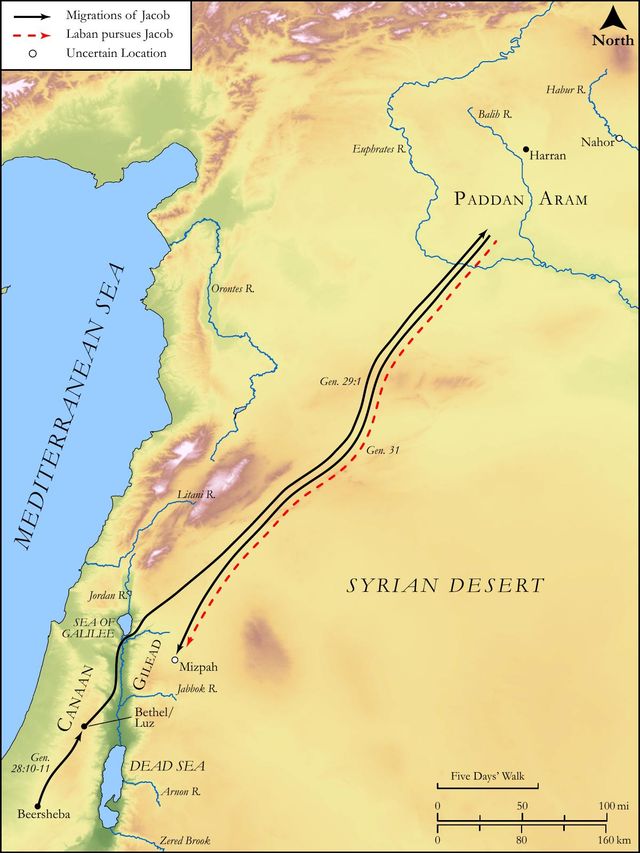
See on the biblical-era maps


Study this verse
Public-domain commentary
Matthew Henry
From his Commentary on the Whole Bible. Henry comments on passages, not single verses — this entry covers Genesis 29:15–30.
Here is, I. The fair contract made between Laban and Jacob, during the month that Jacob spent there as a guest, Gen 29:14. It seems he was not idle, nor did he spend his time in sport and pastime; but like a man of business, though he had no stock of his own, he applied himself to serve his uncle, as he had begun (Gen 29:10) when he watered his flock. Note, Wherever we are, it is good to be employing ourselves in some useful business, which will turn to a good account to ourselves or others. Laban, it seems, was so taken with Jacob's ingenuity and industry about his flocks that he was desirous he should continue with him, and very fairly reasons thus: "Because thou art my brother, shouldst thou therefore serve me for nought? Gen 29:15. No, what reason for that?" If Jacob be so respectful to his uncle as to give him his service without demanding any consideration for it, yet Laban will not be so unjust to his nephew as to take advantage either of his necessity or of his good-nature. Note, Inferior relations must not be imposed upon; if it be their duty to serve us, it is our duty to reward them. Now Jacob had a fair opportunity to make known to Laban the affection he had for his daughter Rachel; and, having no worldly goods in his hand with which to endow her, he promises him seven years' service, upon condition that, at the end of the seven years, he would bestow her upon him for his wife. It appears by computation that Jacob was now seventy-seven years old when he bound himself apprentice for a wife, and for a wife he kept sheep, Hos 12:12. His posterity are there reminded of it long afterwards, as an instance of the meanness of their origin: probably Rachel was young, and scarcely marriageable, when Jacob first came, which made him the more willing to stay for her till his seven years' service had expired.
II.Jacob's honest performance of his part of the bargain, Gen 29:20.
He served seven years for Rachel. If Rachel still continued to keep her father's sheep (as she did, Gen 29:9), his innocent and religious conversation with her, while they kept the flocks, could not but increase their mutual acquaintance and affection (Solomon's song of love is a pastoral); if she now left it off, his easing her of that care was very obliging. Jacob honestly served out his seven years, and did not forfeit his indentures, though he was old; nay, he served them cheerfully: They seemed to him but a few days, for the love he had to her, as if it were more his desire to earn her than to have her. Note, Love makes long and hard services short and easy; hence we read of the labour of love, Heb 6:10. If we know how to value the happiness of heaven, the sufferings of this present time will be as nothing to us in comparison of it. An age of work will be but as a few days to those that love God and long for Christ's appearing.
III.The base cheat which Laban put upon him when he was out of his time:
he put Leah into his arms instead of Rachel, Gen 29:23. This was Laban's sin; he wronged both Jacob and Rachel, whose affections, doubtless, were engaged to each other, and, if (as some say) Leah was herein no better than an adulteress, it was no small wrong to her too. But it was Jacob's affliction, a damp to the mirth of the marriage-feast, when in the morning behold it was Leah, Gen 29:25. It is easy to observe here how Jacob was paid in his own coin. He had cheated his own father when he pretended to be Esau, and now his father-in-law cheated him. Herein, how unrighteous soever Laban was, the Lord was righteous; as Jdg 1:7. Even the righteous, if they take a false step, are sometimes thus recompensed on the earth. Many that are not, like Jacob, disappointed in the person, soon find themselves, as much to their grief, disappointed in the character. The choice of that relation therefore, on both sides, ought to be made with good advice and consideration, that, if there should be a disappointment, it may not be aggravated by a consciousness of mismanagement.
IV.The excuse and atonement Laban made for the cheat.
1. The excuse was frivolous: It must not be so done in our country, Gen 29:26. We have reason to think there was no such custom of his country as he pretends; only he banters Jacob with it, and laughs at his mistake. Note, Those that can do wickedly and then think to turn it off with a jest, though they may deceive themselves and others, will find at last that God is not mocked. But if there had been such a custom, and he had resolved to observe it, he should have told Jacob so when he undertook to serve him for his younger daughter. Note, As saith the proverb of the ancients, Wickedness proceeds from the wicked, Sa1 24:13. Those that deal with treacherous men must expect to be dealt treacherously with 2. His compounding the matter did but make bad worse: We will give thee this also, Gen 29:27. Hereby he drew Jacob into the sin, and snare, and disquiet, of multiplying wives, which remains a blot in his escutcheon, and will be so to the end of the world. Honest Jacob did not design it, but to have kept as true to Rachel as his father had done to Rebekah. He that had lived without a wife to the eighty-fourth year of his age could then have been very well content with one; but Laban, to dispose of his two daughters without portions, and to get seven years' service more out of Jacob, thus imposes upon him, and draws him into such a strait by his fraud, that (the matter not being yet settled, as it was afterwards by the divine law, Lev 18:18, and more fully since by our Saviour, Mat 19:5) he had some colourable reasons for marrying them both. He could not refuse Rachel, for he had espoused her; still less could he refuse Leah, for he had married her; and therefore Jacob must be content, and take two talents, Kg2 5:23. Note, One sin is commonly the inlet of another. Those that go in by one door of wickedness seldom find their way out but by another. The polygamy of the patriarchs was, in some measure, excusable in them, because, though there was a reason against it as ancient as Adam's marriage (Mal 2:15), yet there was no express command against it; it was in them a sin of ignorance. It was not he product of any sinful lust, but for the building up of the church, which was the good that Providence brought out of it; but it will by no means justify the like practice now, when God's will is plainly made known, that one man and one woman only must be joined together, Co1 7:2. The having of many wives suits well enough with the carnal sensual spirit of the Mahomedan imposture, which allows it; but we have not so learned Christ. Dr. Lightfoot makes Leah and Rachel to be figures of the two churches, the Jews under the law and the Gentiles under the gospel: the younger the more beautiful, and more in the thoughts of Christ when he came in the form of a servant; but he other, like Leah, first embraced: yet in this the allegory does not hold, that the Gentiles, the younger, were more fruitful, Gal 4:27.
Continue studying Genesis 29:22 across the web’s major study libraries — every link below opens this exact verse, chapter, or book on the destination site.
Read & Compare
 BibleGatewayThis verse in more than 200 translations and 70 languages.
 Bible.comThe YouVersion reader — hundreds of translations, reading plans, and highlights.
 ESV.orgCrossway's official English Standard Version reader.
 NET BibleThe NET translation with 60,000+ translators' notes on every rendering decision.
 STEP BibleTyndale House's free study tool — original text, vocabulary, and scholarly resources.
 BibliaLogos Bible Software's free web reader.
 USCCBThe New American Bible (Revised Edition) with the U.S. bishops' study notes.
Commentaries
 BibleHub CommentariesDozens of classic commentaries on this verse, gathered on one page.
 StudyLightMore than 100 commentary sets — the largest collection on the web.
 BibleRefPlain-English commentary on what this verse means, verse by verse.
 Enduring WordDavid Guzik's free commentary on this chapter, widely used by Bible teachers.
 Bible Study ToolsVerse commentary alongside Greek and Hebrew study aids.
Original Language & Research
- BibleHub InterlinearThe verse word by word — original language, transliteration, and English.
- BibleHub LexiconEvery word's original-language definition and Strong's entry.
 Blue Letter BibleDeep-study tools — Strong's numbers, concordance, and word studies.
 SefariaThe Hebrew text with Rashi and centuries of Jewish commentary.
Sermons, Hymns & Audio


TrulyRandomVerse is not affiliated with these sites and doesn’t control their content. They’re linked because they’re genuinely useful.
Summary
Genesis 29:22 marks a pivotal moment in Jacob's narrative, describing Laban's assembly of "all the men of the place" to host a grand feast. This celebration, seemingly in honor of Jacob's long-awaited marriage to Rachel after seven years of faithful service, serves as a deceptive prelude to Laban's cunning substitution of Leah for Rachel, thereby initiating a complex web of familial strife and highlighting Laban's manipulative character.
Context
ShowHideLiterary Context
This verse immediately follows Jacob's completion of seven years of arduous labor for Rachel, as stipulated in his agreement with Laban in Genesis 29:18. Jacob has just reminded Laban, "Give me my wife, for my days are fulfilled, that I may go in unto her" (Genesis 29:21). Genesis 29:22 thus sets the stage for the anticipated wedding, but its festive atmosphere quickly turns to deception in Genesis 29:23-25, where Laban substitutes Leah for Rachel under the cover of darkness. This act of betrayal then precipitates Jacob's subsequent seven years of labor for Rachel and the intense rivalry between his two wives, shaping the entire family dynamic for generations.
Historical & Cultural Context
Marriage customs among the patriarchs involved elaborate public celebrations, often lasting several days, to solemnize the union and ensure communal recognition. The gathering of "all the men of the place" for a "feast" (Hebrew: mishteh) was a standard practice, serving as a public witness to the covenant being established. Brides were typically heavily veiled, especially during the procession and initial parts of the ceremony, which, combined with the celebratory consumption of wine and the darkness of the wedding tent, created an environment where deception could be plausible. Laban's actions, while culturally embedded, twisted these customs for his own manipulative ends, exploiting the very traditions designed to ensure integrity.
Key Themes
ShowHideGenesis 29 is rich with themes of deception and manipulation, primarily exemplified by Laban's character, which ironically mirrors Jacob's own earlier deceit of his brother Esau and father Isaac (e.g., Genesis 27:18-29). The chapter also highlights the consequences of sin, as Laban's trickery leads to years of familial strife, jealousy, and competition between Leah and Rachel. Furthermore, it underscores God's sovereignty even amidst human imperfection and brokenness, as He continues to work His purposes through flawed individuals and challenging circumstances, ultimately ensuring the continuation of the covenant line. The theme of love and labor is also prominent, with Jacob's devoted service for Rachel (described in Genesis 29:20) setting a stark contrast to Laban's subsequent betrayal.
Exposition and Analysis
ShowHideGenesis 29:22 succinctly states, "And Laban gathered together all the men of the place, and made a feast." This verse, while brief, is pivotal, marking the transition from Jacob's fulfilled labor to the dramatic deception that defines the subsequent narrative. The act of gathering "all the men of the place" underscores the public and communal nature of wedding customs in Jacob's day, where such events were not private affairs but significant social occasions involving the wider community.
Key Word Analysis
ShowHideFrom the primitive root H622, meaning "to gather for any purpose; hence, to receive, take away, i.e. remove (destroy, leave behind, put up, restore, etc.)." In this context, it signifies a deliberate assembly of people, underscoring the communal and public nature of the event Laban orchestrated. It implies a purposeful collection of individuals for a specific occasion.
Properly "a mortal (and thus differing from the more dignified אָדָם [ʼâdâm]); hence, a man in general (singly or collectively)." This term refers to the local male inhabitants, emphasizing that the entire community was invited to witness and participate in the celebration, adding weight to the public nature of the impending marriage.
Derived from H8354 (שָׁתָה, "to drink"), meaning "drink, by implication, drinking (the act); also (by implication) a banquet or (generally) feast." This word denotes a celebratory meal, often involving significant consumption of beverages, particularly wine. The term suggests a festive atmosphere that could contribute to a dulled perception, making Laban's subsequent deception more plausible.
Verse Breakdown
ShowHide"And Laban gathered together all the men of the place,"
This clause details Laban's deliberate action of assembling the local community. The gathering of "all the men" highlights the public and communal nature of the event, indicating that the upcoming marriage was to be a recognized social occasion, not a private affair. This public assembly also serves to lend an air of legitimacy to the proceedings, which Laban would later exploit for his deceit.
"and made a feast."
This clause specifies the purpose of the gathering: a celebratory banquet. The term "feast" (mishteh) implies a festive atmosphere, likely involving food, drink, and revelry. This celebratory context is crucial, as it provides the cover and conditions (such as potential intoxication and the cover of night) under which Laban's cunning substitution of Leah for Rachel could successfully take place without immediate detection by Jacob.
Literary Devices
ShowHideThe verse employs Foreshadowing and Irony. While outwardly describing a joyous occasion, the very act of "making a feast" foreshadows the deception to come. The celebratory atmosphere, intended to mark a new union, becomes the perfect cover for Laban's betrayal, highlighting the Irony of the situation. The feast, a symbol of communal blessing and new beginnings, is perverted by Laban into an instrument of manipulation, setting the stage for years of strife rather than unadulterated joy. This use of a traditional, positive social event for a nefarious purpose underscores Laban's cunning and self-serving character.
Theological and Thematic Connections
ShowHideGenesis 29:22, though seemingly simple, encapsulates the deceptive nature that permeates this part of Jacob's story, setting the stage for a narrative that profoundly illustrates the far-reaching consequences of human sin and manipulation. Despite Laban's cunning, the unfolding events demonstrate God's unwavering sovereignty, as He orchestrates His divine plan even through the flawed choices of individuals, ultimately ensuring the continuation of the covenant line and the formation of the twelve tribes of Israel. This narrative serves as a powerful reminder of the destructive power of dishonesty and the enduring faithfulness of God.
Reflection and Application
ShowHideThis seemingly straightforward verse serves as a crucial turning point, immediately preceding the dramatic twist of Laban's substitution of Leah for Rachel. It underscores the profound consequences of deception, reminding us that dishonesty, even when seemingly advantageous in the short term, often leads to long-lasting pain, conflict, and broken relationships. The narrative implicitly calls believers to uphold integrity in all their dealings, especially in covenants and agreements, recognizing that trust is a fragile yet essential foundation for healthy relationships. It also offers comfort, demonstrating that even amidst human manipulation and moral failings, God remains sovereign, capable of weaving His divine purpose through the complex tapestry of human choices. This passage challenges us to consider our own integrity in promises and agreements, and to trust that God can redeem even the most challenging circumstances born of human sin.
Questions for Reflection
ShowHideFAQ
ShowHideWhy did Laban make a feast if he intended to deceive Jacob?
ShowHideLaban's feast was a strategic and calculated part of his deception. By adhering to the customary public celebration, he maintained an appearance of integrity and fulfilled the traditional expectations of a wedding. This public display provided the perfect cover for his private, nighttime substitution of Leah for Rachel (Genesis 29:23), exploiting the festive atmosphere, the darkness, and potentially Jacob's dulled senses from the celebration, to ensure his cunning plan went undetected until it was too late for Jacob to undo.
How could Jacob not tell the difference between Leah and Rachel in the wedding tent?
ShowHideSeveral factors likely contributed to Jacob's inability to discern the switch. Wedding customs of the patriarchs' day often involved the bride being heavily veiled, as when Rebekah took a veil and covered herself before Isaac, making identification difficult, especially in the dark. Furthermore, the "feast" (Hebrew: mishteh) likely included significant consumption of wine or other intoxicants, which could have dulled Jacob's senses. The combination of the veil, the darkness of the wedding tent, and potential intoxication created an environment ripe for Laban's deception to succeed (Genesis 29:25).
What was the significance of "all the men of the place" being gathered for the feast?
ShowHideThe gathering of "all the men of the place" signified that the wedding was a public, communal event, not a private affair. It served as a public witness to the marriage covenant, lending it legitimacy and communal recognition within the society. Laban's subsequent deception, carried out under the cover of darkness, was therefore a profound betrayal not only of Jacob but also of the community's expectations and the integrity of their shared customs, making the community unwitting participants in his elaborate scheme.
Christ-Centered Fulfillment
ShowHideWhile Genesis 29:22 details a moment of human deceit and the beginning of familial strife, it paradoxically sets the stage for God's redemptive plan. Despite Laban's manipulation and Jacob's unwitting participation in a flawed union, the lineage of the Messiah would ultimately pass through Leah, the very woman deceptively given to Jacob (Genesis 35:23). Indeed, King David and, by extension, Jesus Christ, would trace their ancestry through Judah, Leah's son (Matthew 1:2-3; Luke 3:31-34). This event, steeped in human sin and brokenness, powerfully illustrates God's sovereign ability to work through imperfect circumstances and flawed individuals to accomplish His perfect will, ensuring the continuation of the covenant line that would eventually lead to the birth of Jesus Christ, the ultimate fulfillment of God's promises for redemption and salvation for all humanity (Galatians 4:4-5).