


Genesis 29:21
Bible text: King James Version (1769 Blayney text) · Public domain
Bible text: Berean Standard Bible · Public domain
Bible text: American Standard Version (1901) · Public domain
Bible text: World English Bible, Messianic edition · Public domain
Bible text: Geneva Bible (1599) · Public domain
Bible text: Young's Literal Translation · Public domain
- וַיֹּאמֶרvai·Yo·merand he saidH559Conj-w ¦ V-Qal-ConsecImperf-3msVerb Qal Consecutive Imperfect 3rd Singular Masculineוַandיֹּאמֶרhe said
- יַעֲקֹבya·'a·KoJacobH3290N-proper-mNoun Proper Masculine
- אֶל'eltoH413PrepPreposition
- לָבָןla·VanLabanH3837N-proper-mNoun Proper Masculine
- הָבָהha·Vahgive !H3051V-Qal-Imp-2ms ¦ SfxVerb Qal Imperative 2nd Singular Masculineהָבָgiveה!
- אֶת'et<obj.>H853DirObjMParticle Object Indicator
- אִשְׁתִּי'ish·Timy wifeH802N-fsc ¦ 1csNoun Singular Feminine Constructאִשְׁתִּwifeיmy
- כִּיkiforH3588PrtParticle Conditional
- מָלְאוּmal·'Uthey have been completedH4390V-Qal-Perf-3cpVerb Qal Perfect 3rd Plural common gender
- יָמָיya·Maimy daysH3117N-mpc ¦ 1csNoun Plural Masculine Constructיָמָdaysיmy
- וְאָבוֹאָהve·'a·Vo·'ahso I may goH935Conj-w ¦ V-Qal-Imperf-1csVerb Qal Imperfect 1st Singular common genderוְsoאָבוֹאָהI may go
- אֵלֶיהָ'e·Lei·hainto herH413Prep ¦ 3fsPreposition Definiteאֵלֶיintoהָher
English is a literal word-by-word gloss of the Hebrew, not the KJV's wording. Why?
This is the original text the KJV's translators worked from — each Hebrew word with its own literal English meaning in this verse, prepared by scholars at Tyndale House, Cambridge. The KJV translates whole sentences, not word by word, so its wording differs: one Hebrew word can become several English words, and the KJV may choose “the LORD” where the gloss reads “Yahweh”. Both are faithful — they answer different questions. For the KJV's own rendering, switch to the KJV text.
Details
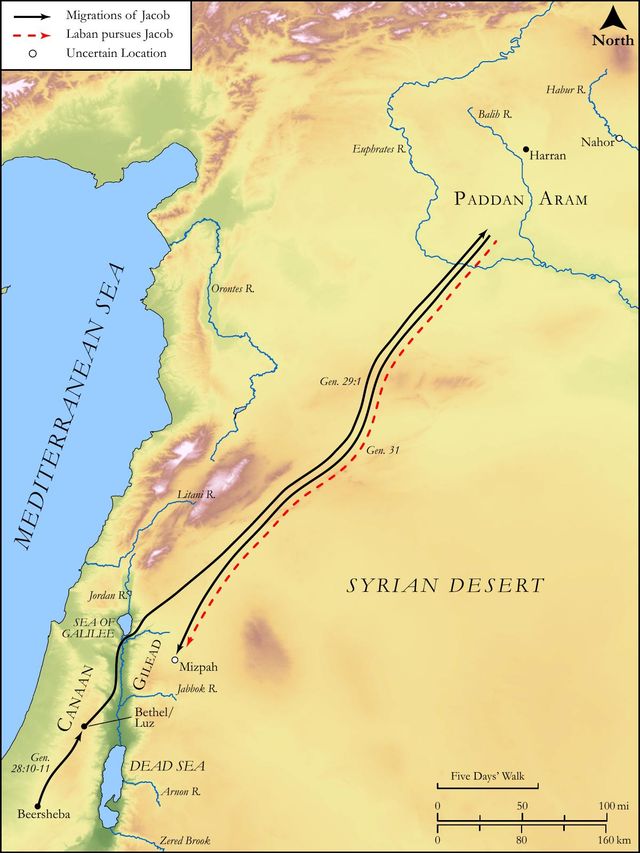
See on the biblical-era maps


Study this verse
Public-domain commentary
Matthew Henry
From his Commentary on the Whole Bible. Henry comments on passages, not single verses — this entry covers Genesis 29:15–30.
Here is, I. The fair contract made between Laban and Jacob, during the month that Jacob spent there as a guest, Gen 29:14. It seems he was not idle, nor did he spend his time in sport and pastime; but like a man of business, though he had no stock of his own, he applied himself to serve his uncle, as he had begun (Gen 29:10) when he watered his flock. Note, Wherever we are, it is good to be employing ourselves in some useful business, which will turn to a good account to ourselves or others. Laban, it seems, was so taken with Jacob's ingenuity and industry about his flocks that he was desirous he should continue with him, and very fairly reasons thus: "Because thou art my brother, shouldst thou therefore serve me for nought? Gen 29:15. No, what reason for that?" If Jacob be so respectful to his uncle as to give him his service without demanding any consideration for it, yet Laban will not be so unjust to his nephew as to take advantage either of his necessity or of his good-nature. Note, Inferior relations must not be imposed upon; if it be their duty to serve us, it is our duty to reward them. Now Jacob had a fair opportunity to make known to Laban the affection he had for his daughter Rachel; and, having no worldly goods in his hand with which to endow her, he promises him seven years' service, upon condition that, at the end of the seven years, he would bestow her upon him for his wife. It appears by computation that Jacob was now seventy-seven years old when he bound himself apprentice for a wife, and for a wife he kept sheep, Hos 12:12. His posterity are there reminded of it long afterwards, as an instance of the meanness of their origin: probably Rachel was young, and scarcely marriageable, when Jacob first came, which made him the more willing to stay for her till his seven years' service had expired.
II.Jacob's honest performance of his part of the bargain, Gen 29:20.
He served seven years for Rachel. If Rachel still continued to keep her father's sheep (as she did, Gen 29:9), his innocent and religious conversation with her, while they kept the flocks, could not but increase their mutual acquaintance and affection (Solomon's song of love is a pastoral); if she now left it off, his easing her of that care was very obliging. Jacob honestly served out his seven years, and did not forfeit his indentures, though he was old; nay, he served them cheerfully: They seemed to him but a few days, for the love he had to her, as if it were more his desire to earn her than to have her. Note, Love makes long and hard services short and easy; hence we read of the labour of love, Heb 6:10. If we know how to value the happiness of heaven, the sufferings of this present time will be as nothing to us in comparison of it. An age of work will be but as a few days to those that love God and long for Christ's appearing.
III.The base cheat which Laban put upon him when he was out of his time:
he put Leah into his arms instead of Rachel, Gen 29:23. This was Laban's sin; he wronged both Jacob and Rachel, whose affections, doubtless, were engaged to each other, and, if (as some say) Leah was herein no better than an adulteress, it was no small wrong to her too. But it was Jacob's affliction, a damp to the mirth of the marriage-feast, when in the morning behold it was Leah, Gen 29:25. It is easy to observe here how Jacob was paid in his own coin. He had cheated his own father when he pretended to be Esau, and now his father-in-law cheated him. Herein, how unrighteous soever Laban was, the Lord was righteous; as Jdg 1:7. Even the righteous, if they take a false step, are sometimes thus recompensed on the earth. Many that are not, like Jacob, disappointed in the person, soon find themselves, as much to their grief, disappointed in the character. The choice of that relation therefore, on both sides, ought to be made with good advice and consideration, that, if there should be a disappointment, it may not be aggravated by a consciousness of mismanagement.
IV.The excuse and atonement Laban made for the cheat.
1. The excuse was frivolous: It must not be so done in our country, Gen 29:26. We have reason to think there was no such custom of his country as he pretends; only he banters Jacob with it, and laughs at his mistake. Note, Those that can do wickedly and then think to turn it off with a jest, though they may deceive themselves and others, will find at last that God is not mocked. But if there had been such a custom, and he had resolved to observe it, he should have told Jacob so when he undertook to serve him for his younger daughter. Note, As saith the proverb of the ancients, Wickedness proceeds from the wicked, Sa1 24:13. Those that deal with treacherous men must expect to be dealt treacherously with 2. His compounding the matter did but make bad worse: We will give thee this also, Gen 29:27. Hereby he drew Jacob into the sin, and snare, and disquiet, of multiplying wives, which remains a blot in his escutcheon, and will be so to the end of the world. Honest Jacob did not design it, but to have kept as true to Rachel as his father had done to Rebekah. He that had lived without a wife to the eighty-fourth year of his age could then have been very well content with one; but Laban, to dispose of his two daughters without portions, and to get seven years' service more out of Jacob, thus imposes upon him, and draws him into such a strait by his fraud, that (the matter not being yet settled, as it was afterwards by the divine law, Lev 18:18, and more fully since by our Saviour, Mat 19:5) he had some colourable reasons for marrying them both. He could not refuse Rachel, for he had espoused her; still less could he refuse Leah, for he had married her; and therefore Jacob must be content, and take two talents, Kg2 5:23. Note, One sin is commonly the inlet of another. Those that go in by one door of wickedness seldom find their way out but by another. The polygamy of the patriarchs was, in some measure, excusable in them, because, though there was a reason against it as ancient as Adam's marriage (Mal 2:15), yet there was no express command against it; it was in them a sin of ignorance. It was not he product of any sinful lust, but for the building up of the church, which was the good that Providence brought out of it; but it will by no means justify the like practice now, when God's will is plainly made known, that one man and one woman only must be joined together, Co1 7:2. The having of many wives suits well enough with the carnal sensual spirit of the Mahomedan imposture, which allows it; but we have not so learned Christ. Dr. Lightfoot makes Leah and Rachel to be figures of the two churches, the Jews under the law and the Gentiles under the gospel: the younger the more beautiful, and more in the thoughts of Christ when he came in the form of a servant; but he other, like Leah, first embraced: yet in this the allegory does not hold, that the Gentiles, the younger, were more fruitful, Gal 4:27.
Continue studying Genesis 29:21 across the web’s major study libraries — every link below opens this exact verse, chapter, or book on the destination site.
Read & Compare
 BibleGatewayThis verse in more than 200 translations and 70 languages.
 Bible.comThe YouVersion reader — hundreds of translations, reading plans, and highlights.
 ESV.orgCrossway's official English Standard Version reader.
 NET BibleThe NET translation with 60,000+ translators' notes on every rendering decision.
 STEP BibleTyndale House's free study tool — original text, vocabulary, and scholarly resources.
 BibliaLogos Bible Software's free web reader.
 USCCBThe New American Bible (Revised Edition) with the U.S. bishops' study notes.
Commentaries
 BibleHub CommentariesDozens of classic commentaries on this verse, gathered on one page.
 StudyLightMore than 100 commentary sets — the largest collection on the web.
 BibleRefPlain-English commentary on what this verse means, verse by verse.
 Enduring WordDavid Guzik's free commentary on this chapter, widely used by Bible teachers.
 Bible Study ToolsVerse commentary alongside Greek and Hebrew study aids.
Original Language & Research
- BibleHub InterlinearThe verse word by word — original language, transliteration, and English.
- BibleHub LexiconEvery word's original-language definition and Strong's entry.
 Blue Letter BibleDeep-study tools — Strong's numbers, concordance, and word studies.
 SefariaThe Hebrew text with Rashi and centuries of Jewish commentary.
Sermons, Hymns & Audio


TrulyRandomVerse is not affiliated with these sites and doesn’t control their content. They’re linked because they’re genuinely useful.
Summary
Genesis 29:21 captures Jacob's forthright demand to Laban for his promised wife, Rachel, after diligently completing the agreed-upon seven years of labor. This pivotal moment underscores Jacob's expectation that the marital covenant be honored, highlighting his directness and setting the immediate stage for the unexpected deceptions and complex family dynamics that would profoundly shape the patriarchal narrative.
Context
ShowHideLiterary Context
This verse serves as the climax of Jacob's initial seven-year commitment to Laban, which was agreed upon in Genesis 29:18. Following Jacob's flight from Esau and his transformative encounter with God at Bethel (Genesis 28:10-22), he arrived in Haran, where he met Rachel at the well. His immediate affection for her led to the unique arrangement with Laban. Jacob's declaration here marks the fulfillment of his side of the bargain, creating a moment of high anticipation for the marriage. However, this expectation is immediately subverted by Laban's cunning deception in the very next verses, introducing Leah into the narrative and complicating Jacob's family life for decades (Genesis 29:23-25).
Historical & Cultural Context
In Jacob's day, marriage agreements often involved a period of service or a bride-price paid by the prospective groom to the bride's family. Jacob's seven years of labor for Rachel exemplify this practice, serving as a form of "bride service." The consummation of marriage, expressed euphemistically as "going in unto her," was a crucial step, signifying the full establishment of the marital bond and the expectation of procreation, which was vital for family lineage and tribal continuity. The patriarchal culture also placed a high value on offspring, particularly sons, for the continuation of the family name and inheritance. This cultural backdrop illuminates Jacob's earnest desire to formalize his union with Rachel and begin building his family.
Key Themes
ShowHideGenesis 29:21 contributes significantly to several overarching themes within the book of Genesis. It highlights the theme of covenant fidelity and human obligation, as Jacob honors his commitment, contrasting sharply with Laban's subsequent deceit. The verse also underscores the divine design for marriage and family, echoing God's command to "be fruitful and multiply" found in Genesis 1:28 and the importance of establishing a household within the patriarchal narrative. Furthermore, it subtly introduces the theme of deception and its consequences, a recurring motif throughout the Jacob narrative, beginning with his own deception of Esau (Genesis 27:1-40) and now experienced by him at the hands of Laban. Ultimately, despite human failings, the verse remains part of God's unfolding sovereign plan for the descendants of Abraham, Isaac, and Jacob (Genesis 28:15), through whom the covenant promises would be realized.
Exposition and Analysis
ShowHideKey Word Analysis
ShowHideJacob's direct imperative, "Give me my wife," uses the Hebrew verb yâhab, a primitive root meaning "to give," "to put," or "to grant." This highlights the contractual nature of their agreement, where Jacob is now demanding the promised exchange for his seven years of labor. It's a formal request for Laban to fulfill his obligation, emphasizing the expectation of a just and timely reciprocation.
The word mâlêʼ signifies "to fill," "to be full of," or "to be at an end." In this context, "my days are fulfilled" indicates the precise and complete expiration of the agreed-upon seven-year period of service. It underscores Jacob's meticulous adherence to his part of the bargain and the completion of the stipulated time, making his demand for Rachel legitimate and overdue from his perspective.
The Hebrew verb bôwʼ, meaning "to go or come," is used here as a common biblical euphemism for the consummation of marriage, specifically sexual union. This phrase respectfully conveys Jacob's desire to fully formalize the marital bond, including its physical intimacy, which was crucial for procreation and the continuation of the family line in ancient Israelite culture. It signifies the complete establishment of the marriage.
Verse Breakdown
ShowHide"And Jacob said unto Laban,"
This opening phrase sets the scene, identifying the speaker and the recipient of the demand. It immediately establishes a direct, face-to-face confrontation or request, indicating Jacob's initiative in asserting his rights.
"Give [me] my wife,"
This is the core of Jacob's demand, a direct and assertive statement. The possessive "my wife" indicates Jacob's claim to Rachel based on their prior agreement and his completed service. It reflects his expectation that Laban will honor the terms of their contract.
"for my days are fulfilled,"
This clause provides the justification for Jacob's demand. The phrase "my days are fulfilled" signifies the precise and complete expiration of the seven-year period of labor Jacob had agreed to serve Laban for Rachel's hand. It underscores that Jacob has upheld his end of the bargain and the time for Laban to fulfill his promise has arrived.
"that I may go in unto her."
This concluding clause expresses Jacob's ultimate desire for the marriage. "To go in unto her" is a common biblical euphemism for the consummation of marriage, the act of sexual union. It respectfully conveys Jacob's longing to fully establish the marital bond, which was essential for procreation and the continuation of the family lineage in ancient Israelite society.
Literary Devices
ShowHideThe verse employs several literary devices to convey its meaning and emotional weight. Direct Speech is prominently featured, allowing Jacob's assertive demand to be heard clearly and without ambiguity, emphasizing his expectation of immediate fulfillment. The phrase "my days are fulfilled" functions as a form of Legal Language or Contractual Language, highlighting the binding nature of the agreement between Jacob and Laban and Jacob's meticulous adherence to its terms. Furthermore, "that I may go in unto her" is a classic example of Euphemism, a polite or indirect expression used to refer to something considered too blunt or embarrassing to mention directly. This euphemism respectfully alludes to the physical consummation of marriage, which was a vital component of establishing a legitimate union and ensuring progeny among the patriarchs.
Theological and Thematic Connections
ShowHideGenesis 29:21 stands as a powerful testament to the biblical emphasis on integrity and the fulfillment of promises. Jacob's forthright demand, grounded in his completed service, underscores the divine expectation that agreements, whether formal covenants or personal commitments, should be honored. This principle of faithfulness, though immediately challenged by Laban's deception, remains a cornerstone of righteous living. The verse also implicitly affirms the sanctity and purpose of marriage within God's created order, highlighting both the physical and relational aspects essential for the establishment of family and the continuation of God's covenant people. Even amidst the unfolding human drama of expectation and betrayal, God's overarching plan for Jacob's lineage, through whom the twelve tribes would emerge, continues to advance, demonstrating His sovereignty over human actions and imperfections.
Reflection and Application
ShowHideJacob's patient endurance of seven years of labor for Rachel, culminating in his confident demand in Genesis 29:21, offers profound lessons for contemporary believers. His steadfastness in fulfilling his commitment, even when the reward was delayed, challenges us to cultivate perseverance and integrity in our own relationships and responsibilities. We are called to be people of our word, honoring our commitments, whether to God or to others, recognizing that our faithfulness reflects the character of God Himself. Furthermore, this verse reminds us that while we may fulfill our obligations and expect just outcomes, life often presents unexpected challenges and deceptions, much like Laban's trickery. In such moments, like Jacob, we are called to trust in God's overarching sovereignty, knowing that He can work His purposes even through human imperfection and adversity. Our ultimate hope and fulfillment are found not in perfect circumstances, but in the unwavering faithfulness of God to His covenant promises.
Questions for Reflection
ShowHideFAQ
ShowHideWhat does "my days are fulfilled" signify in this context?
ShowHideThe phrase "my days are fulfilled" (Hebrew: mal'u) signifies the precise completion of the seven-year period of labor that Jacob agreed to serve Laban in exchange for Rachel's hand in marriage, as detailed in Genesis 29:18. It indicates that Jacob had fully discharged his contractual obligation, making his demand for Rachel legitimate according to their agreement and the cultural norms of the time.
What is the meaning of "that I may go in unto her"?
ShowHide"That I may go in unto her" is a common biblical euphemism for the consummation of marriage, referring to the sexual union between husband and wife. It respectfully acknowledges the physical aspect of marriage, which was essential for procreation and the continuation of the family line in ancient Israelite culture, fulfilling the divine command to "be fruitful and multiply" found in Genesis 1:28.
How does this verse foreshadow future events in Jacob's life?
ShowHideWhile Jacob's demand is based on a fulfilled agreement and an expectation of integrity, this verse immediately precedes Laban's significant act of deception. Instead of Rachel, Laban gives Leah to Jacob (Genesis 29:23-25), setting in motion decades of family strife, polygamy, and complex relationships. This deception profoundly shapes the early history of the Israelite patriarchs and the formation of the twelve tribes, highlighting the theme of human imperfection and God's sovereign work amidst it.
Christ-Centered Fulfillment
ShowHideGenesis 29:21, with Jacob's earnest demand for his promised bride after a period of faithful service, subtly foreshadows the ultimate Bridegroom, Jesus Christ. Just as Jacob diligently served for Rachel, Christ served God perfectly, fulfilling all righteousness and completing His redemptive work on the cross, a "service" that procured His bride, the Church. His "days were fulfilled" not in a temporal sense of labor, but in the complete accomplishment of His mission, culminating in His death, resurrection, and ascension, thereby making His Church ready for the eternal union. The longing of Jacob for his bride mirrors Christ's own profound desire for His Church, for whom He gave Himself up (Ephesians 5:25-27). Furthermore, the lineage that would eventually lead to the Messiah passes directly through Jacob's family, highlighting how God's covenant promises, though often unfolding amidst human imperfection and struggle, are ultimately fulfilled in the person and work of Jesus Christ, the ultimate Bridegroom who perfectly keeps His promises and will one day fully claim His redeemed people in glory (Revelation 19:7-9).