


Genesis 29:9
Bible text: King James Version (1769 Blayney text) · Public domain
Bible text: Berean Standard Bible · Public domain
Bible text: American Standard Version (1901) · Public domain
Bible text: World English Bible, Messianic edition · Public domain
Bible text: Geneva Bible (1599) · Public domain
Bible text: Young's Literal Translation · Public domain
- עוֹדֶנּוּo·De·nustill [was] heH5750Adj-msc ¦ 3msAdjective Numerical Singular Masculine Constructעוֹדֶstill [was]נּוּhe
- מְדַבֵּרme·da·BerspeakingH1696V-Piel-Prtcpl-msVerb Piel Participle Singular Masculine Absolute
- עִמָּם'i·Mamwith themH5973Prep ¦ 3mpPreposition Definiteעִמָּwithםthem
- וְרָחֵלve·ra·Cheland RachelH7354Conj-w ¦ N-proper-fNoun Proper FeminineוְandרָחֵלRachel
- בָּאָהBa·'ahshe cameH935V-Qal-Perf-3fsVerb Qal Perfect 3rd Singular Feminine
- עִם'imwithH5973PrepPreposition
- הַצֹּאןha·tzoNthe sheepH6629Art ¦ N-csNoun Singular common gender Absoluteהַtheצֹּאןsheep
- אֲשֶׁר'a·SherwhichH834RelParticle Relative
- לְאָבִיהָle·'a·Vi·ha[belonged] to her fatherH1Prep-l ¦ N-msc ¦ 3fsNoun Singular Masculine Constructלְ[belonged] toאָבִיfatherהָher
- כִּיkiforH3588PrtParticle Conditional
- רֹעָהro·'Ah[was] a shepherdessH7462V-Qal-Prtcpl-fsVerb Qal Participle Singular Feminine Absolute
- הִואhi'sheH1931Pro-3fsPronoun Personal 3rd Singular Feminine
English is a literal word-by-word gloss of the Hebrew, not the KJV's wording. Why?
This is the original text the KJV's translators worked from — each Hebrew word with its own literal English meaning in this verse, prepared by scholars at Tyndale House, Cambridge. The KJV translates whole sentences, not word by word, so its wording differs: one Hebrew word can become several English words, and the KJV may choose “the LORD” where the gloss reads “Yahweh”. Both are faithful — they answer different questions. For the KJV's own rendering, switch to the KJV text.
Details
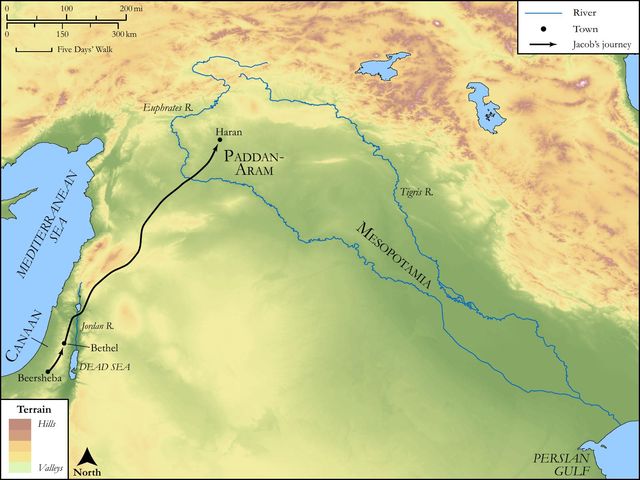
See on the biblical-era maps


Study this verse
Public-domain commentary
Matthew Henry
From his Commentary on the Whole Bible. Henry comments on passages, not single verses — this entry covers Genesis 29:9–14.
Here we see, 1. Rachel's humility and industry: She kept her father's sheep (Gen 29:9), that is, she took the care of them, having servants under her that were employed about them. Rachel's name signifies a sheep. Note, Honest useful labour is that which nobody needs be ashamed of, nor ought it to be a hindrance to any one's preferment. 2. Jacob's tenderness and affection. When he understood that this was his kinswoman (probably he had heard of her name before), knowing what his errand was into that country, we may suppose it struck his mind immediately that his must be his wife. Being already smitten with her ingenuous comely face (though it was probably sun-burnt, and she was in the homely dress of a shepherdess), he is wonderfully officious, and anxious to serve her (Gen 29:10), and addresses himself to her with tears of joy and kisses of love, Gen 29:11. She runs with all haste to tell her father; for she will by no means entertain her kinsman's address without her father's knowledge and approbation, Gen 29:12. These mutual respects, at their first interview, were good presages of their being a happy couple. 3. Providence made that which seemed contingent and fortuitous to give speedy satisfaction to Jacob's mind, as soon as ever he came to the place which he was bound for. Abraham's servant, when he came upon a similar errand, met with similar encouragement. Thus God guides his people with his eye, Psa 32:8. It is a groundless conceit which some of the Jewish writers have, that Jacob, when he kissed Rachel, wept because he had been set upon in his journey by Eliphaz the eldest son of Esau, at the command of his father, and robbed of all his money and jewels, which his mother had given him when she sent him away. It was plain that it was his passion for Rachel, and the surprise of this happy meeting, that drew these tears from his eyes. 4. Laban, though none of the best-humoured men, bade him welcome, was satisfied in the account he gave of himself, and of the reason of his coming in such poor circumstances. While we avoid the extreme, on the one hand, of being foolishly credulous, we must take heed of falling into the other extreme, of being uncharitably jealous and suspicious. Laban owned him for his kinsman: Thou art my bone and my flesh, Gen 29:14. Note, Those are hard-hearted indeed that are unkind to their relations, and that hide themselves from their own flesh, Isa 58:7.
Continue studying Genesis 29:9 across the web’s major study libraries — every link below opens this exact verse, chapter, or book on the destination site.
Read & Compare
 BibleGatewayThis verse in more than 200 translations and 70 languages.
 Bible.comThe YouVersion reader — hundreds of translations, reading plans, and highlights.
 ESV.orgCrossway's official English Standard Version reader.
 NET BibleThe NET translation with 60,000+ translators' notes on every rendering decision.
 STEP BibleTyndale House's free study tool — original text, vocabulary, and scholarly resources.
 BibliaLogos Bible Software's free web reader.
 USCCBThe New American Bible (Revised Edition) with the U.S. bishops' study notes.
Commentaries
 BibleHub CommentariesDozens of classic commentaries on this verse, gathered on one page.
 StudyLightMore than 100 commentary sets — the largest collection on the web.
 BibleRefPlain-English commentary on what this verse means, verse by verse.
 Enduring WordDavid Guzik's free commentary on this chapter, widely used by Bible teachers.
 Bible Study ToolsVerse commentary alongside Greek and Hebrew study aids.
Original Language & Research
- BibleHub InterlinearThe verse word by word — original language, transliteration, and English.
- BibleHub LexiconEvery word's original-language definition and Strong's entry.
 Blue Letter BibleDeep-study tools — Strong's numbers, concordance, and word studies.
 SefariaThe Hebrew text with Rashi and centuries of Jewish commentary.
Sermons, Hymns & Audio


TrulyRandomVerse is not affiliated with these sites and doesn’t control their content. They’re linked because they’re genuinely useful.
Summary
Genesis 29:9 marks a pivotal moment in Jacob's journey, providentially orchestrating the arrival of Rachel, Laban's daughter, with her father's sheep at the well where Jacob is conversing with local shepherds. This precisely timed encounter introduces Jacob to his future beloved wife, setting the stage for the dramatic and formative years of his life, family formation, and the continuation of the covenant lineage in Haran.
Context
ShowHideLiterary Context
This verse is situated immediately after Jacob's arrival in the land of the people of the East, specifically near a well in the field, which serves as a central gathering point. Having fled Esau and received the vision at Bethel, Jacob is now actively seeking his mother Rebekah's family. The preceding verses (Genesis 29:1-8) describe Jacob's initial interaction with shepherds at the well, his inquiry about Laban, and the custom of rolling the stone from the well's mouth. The narrative builds anticipation for a significant encounter, and Rachel's sudden appearance fulfills this expectation, directly leading to Jacob's emotional response and his subsequent stay with Laban, as detailed in the remainder of Genesis 29.
Historical & Cultural Context
In the patriarchal narratives, wells were far more than just sources of water; they were vital economic, social, and communal hubs. They were places where shepherds gathered their flocks, where news was exchanged, and where significant encounters, including betrothals, frequently occurred. The custom of "keeping" or tending sheep, as Rachel does, was a common and respected occupation, even for daughters of prominent families, highlighting diligence and responsibility. The scene at the well also echoes earlier biblical narratives, such as the meeting of Abraham's servant with Rebekah at the well and Moses' encounter with Zipporah, establishing a recurring motif of divine orchestration in the formation of covenant families.
Key Themes
ShowHideGenesis 29:9 contributes significantly to several overarching themes within the book of Genesis and the broader biblical narrative. Foremost among these is Divine Providence, as Rachel's arrival is precisely timed, demonstrating God's active hand in guiding Jacob's steps and orchestrating events to fulfill His covenant promises. The verse also highlights the Significance of Wells as sites of crucial encounters and new beginnings, often linked to the formation of covenant families. Furthermore, Rachel's role as a shepherdess subtly introduces the theme of the Dignity of Labor and the value placed on diligence and responsibility in pastoral life, a theme echoed throughout the patriarchal narratives.
Exposition and Analysis
ShowHideKey Word Analysis
ShowHideA primitive root meaning "to arrange," but figuratively "to speak." It denotes communication, declaration, or even command. In this context, "while he yet spake" emphasizes the ongoing nature of Jacob's conversation with the shepherds, highlighting the precise and immediate timing of Rachel's arrival, underscoring the providential nature of the encounter.
A collective name for a flock of sheep or goats, derived from a root meaning "to migrate." This term refers to the primary livelihood and wealth of pastoral societies. Rachel's arrival with her "father's sheep" immediately identifies her role within her family's economy and establishes her as a working member of the household, rather than a passive figure.
A primitive root meaning "to tend a flock," "to pasture," or generally "to rule." It signifies the act of shepherding, which involves leading, feeding, and protecting the flock. The phrase "for she kept them" explicitly states Rachel's active and responsible role as a shepherdess, demonstrating her diligence and capability, which were highly valued traits in her cultural context.
Verse Breakdown
ShowHide"And while he yet spake with them"
This opening clause establishes the precise timing of Rachel's arrival. Jacob is in mid-conversation with the local shepherds, inquiring about Laban and the customs of the well. The adverb "yet" (H5750, ʻôwd) emphasizes the ongoing nature of his speech, making Rachel's appearance seem almost immediate and divinely orchestrated, rather than a mere coincidence. It sets a scene of anticipation and readiness for the dramatic introduction.
"Rachel came with her father's sheep"
This introduces the pivotal figure of Rachel, the daughter of Laban, Jacob's uncle. Her arrival is not solitary but accompanied by her family's flock, immediately identifying her social standing and her active role in the household's livelihood. The mention of "her father's sheep" connects her directly to Laban, whom Jacob is seeking, creating an immediate and direct link to his purpose in Haran.
"for she kept them"
This concluding phrase clarifies Rachel's specific role and responsibility. She is not merely accompanying the sheep but is actively "keeping" or tending to them, functioning as a shepherdess. This detail underscores her diligence, capability, and participation in the daily labor of her family, presenting her as a responsible and hardworking individual, a trait that would have been highly regarded in the ancient pastoral society.
Literary Devices
ShowHideThe verse masterfully employs Providential Timing, as Rachel's arrival occurs precisely "while he yet spake with them," highlighting God's unseen hand orchestrating the seemingly coincidental meeting. This precise timing underscores the divine guidance in Jacob's journey, leading him directly to his destined family. Furthermore, the narrative utilizes the Motif of the Well, a recurring biblical setting for significant encounters, particularly those involving betrothals and the formation of covenant families (e.g., Rebekah and Moses). This motif imbues the scene with deeper theological significance, suggesting a divinely appointed meeting. Finally, Rachel's active role as a shepherdess, "keeping" her father's sheep, serves as subtle Foreshadowing of her character as diligent and responsible, traits that will be evident in her later life as a matriarch of Israel.
Theological and Thematic Connections
ShowHideGenesis 29:9 is a profound illustration of God's meticulous providence and sovereign timing in the lives of His people. Rachel's arrival at the well precisely as Jacob is speaking with the shepherds is not accidental but divinely orchestrated, demonstrating God's faithfulness to the covenant promises made to Abraham and Isaac, now extending to Jacob. This encounter is a crucial step in the formation of the nation of Israel, as Rachel will become a matriarch through whom key tribal lineages will emerge. The scene at the well, a place of life and gathering, symbolizes new beginnings and the unfolding of God's plan for Jacob's family and the future of the covenant people.
Reflection and Application
ShowHideGenesis 29:9 serves as a powerful testament to the reality of God's active involvement in our lives, often working through seemingly ordinary circumstances and perfect timing. Just as Jacob's long and uncertain journey culminated in this precisely timed meeting, we are called to cultivate a deep trust in God's sovereign plan, even when our path appears unclear or events unfold in unexpected ways. The verse also subtly highlights the dignity and value of daily labor, as Rachel, a significant figure, is found faithfully tending her father's sheep. This encourages us to approach our own responsibilities, no matter how mundane, with diligence, faithfulness, and a recognition that God can use our ordinary tasks and moments to bring about extraordinary connections and fulfill His ultimate will. Our faithfulness in the small things can open doors to God's grander purposes.
Questions for Reflection
ShowHideFAQ
ShowHideWhy is Rachel introduced specifically at the well?
ShowHideWells in the lands of the patriarchs were not merely sources of water but served as vital social, economic, and communal hubs. Their significance made them common biblical settings for important encounters, especially those involving betrothals or divine appointments, symbolizing new beginnings and the provision of life. The well provided a natural, culturally appropriate, and divinely orchestrated meeting place for Jacob and Rachel, echoing earlier narratives like Abraham's servant meeting Rebekah and Moses meeting Zipporah.
What does "she kept them" tell us about Rachel's character and role?
ShowHideThe phrase "she kept them" (Hebrew: râʻâh) indicates Rachel's active and responsible role as a shepherdess. This highlights her diligence, capability, and participation in her family's livelihood. It portrays her as a hardworking and competent individual, a highly valued trait in that cultural context, and sets a precedent for her character within the broader narrative of Genesis.
Does Rachel's arrival at this exact moment imply divine intervention?
ShowHideYes, the precise timing of Rachel's arrival "while he yet spake with them" is widely interpreted as a clear sign of divine providence. It suggests God's active orchestration of events to lead Jacob to his destined family and continue the lineage of the covenant. This aligns with the overarching theme in Genesis of God guiding the patriarchs to fulfill His promises, often through seemingly coincidental or perfectly timed encounters.
Christ-Centered Fulfillment
ShowHideWhile Genesis 29:9 primarily details a providential human encounter, it stands as a significant moment within the grand narrative of God's covenant faithfulness to Abraham, Isaac, and Jacob, through whom the lineage of the Messiah would ultimately come. Rachel's introduction, orchestrated by divine timing at the well, foreshadows God's meticulous plan to bring forth the promised Seed. Just as Jacob, a wanderer, found his beloved bride at the well, so too does Christ, the ultimate Shepherd, seek and find His bride, the Church. He offers living water to all who thirst, drawing His people to Himself through His perfect timing and redemptive work on the cross. The well, a source of physical life, serves as a faint echo of Christ Himself, who is the true source of eternal life and the one who perfectly fulfills all of God's promises to His people, establishing a new covenant and a spiritual family that transcends earthly lineage, as seen in Ephesians 5:25-27.