


Esther 4:8
Bible text: King James Version (1769 Blayney text) · Public domain
Bible text: King James Version with Strong's numbers · Public domain
Bible text: Berean Standard Bible · Public domain
Bible text: American Standard Version (1901) · Public domain
Bible text: World English Bible, Messianic edition · Public domain
Bible text: Geneva Bible (1599) · Public domain
Bible text: Young's Literal Translation · Public domain
- וְאֶתve·'Etand <obj.>H853Conj-w ¦ DirObjMParticle Object Indicatorוְandאֶת<obj.>
- פַּתְשֶׁגֶןpat·She·gen<the> copy ofH6572N-mscNoun Singular Masculine Construct
- כְּתָבke·tav[the] writing ofH3791N-mscNoun Singular Masculine Construct
- הַדָּתHa·dotthe lawH1881Art ¦ N-fsNoun Singular Feminine Absoluteהַtheדָּתlaw
- אֲשֶׁר'a·SherwhichH834RelParticle Relative
- נִתַּןni·Tanit had been givenH5414V-Niphal-Perf-3msVerb Niphal Perfect 3rd Singular Masculine
- בְּשׁוּשָׁןbe·shu·Shanin SusaH7800Prep-b ¦ N-properNoun Proper LocationבְּinשׁוּשָׁןSusa
- לְהַשְׁמִידָםle·hash·mi·Damto annihilate themH8045Prep-l ¦ V-Hiphil-Inf ¦ 3mpVerb Hiphil Infinitive Constructלְtoהַשְׁמִידָannihilateםthem
- נָתַןNa·tanhe gaveH5414V-Qal-Perf-3msVerb Qal Perfect 3rd Singular Masculine
- לוֹloto himPrep-l ¦ 3msSuffix Personal 3rd Singular Masculineלtoוֹhim
- לְהַרְאוֹתle·har·'otto showH7200Prep-l ¦ V-Hiphil-InfVerb Hiphil Infinitive Constructלְtoהַרְאוֹתshow
- אֶת'et<obj.>H853DirObjMParticle Object Indicator
- אֶסְתֵּר'es·TerEstherH635N-proper-fNoun Proper Feminine
- וּלְהַגִּידu·le·ha·Gidand to tellH5046Conj-w ¦ Prep-l ¦ V-Hiphil-InfVerb Hiphil Infinitive Constructוּandלְtoהַגִּידtell
- לָהּLahto herPrep-l ¦ 3fsSuffix Personal 3rd Singular Feminineלָtoהּher
- וּלְצַוּוֹתu·le·tza·Votand to commandH6680Conj-w ¦ Prep-l ¦ V-Piel-InfVerb Piel Infinitive Constructוּandלְtoצַוּוֹתcommand
- עָלֶיהָ'a·Lei·hato herH5921Prep ¦ 3fsPrepositionעָלֶיtoהָher
- לָבוֹאla·Vo'to goH935Prep-l ¦ V-Qal-InfVerb Qal Infinitive Constructלָtoבוֹאgo
- אֶל'eltoH413PrepPreposition
- הַמֶּלֶךְha·Me·lekhthe kingH4428Art ¦ N-msNoun Singular Masculine Absoluteהַtheמֶּלֶךְking
- לְהִתְחַנֶּןle·hit·cha·nento seek favorH2603Prep-l ¦ V-Hithpael-InfVerb Hithpael Infinitive Constructלְtoהִתְחַנֶּןseek favor
- לוֹloto himPrep-l ¦ 3msSuffix Personal 3rd Singular Masculineלtoוֹhim
- וּלְבַקֵּשׁu·le·va·Keshand to requestH1245Conj-w ¦ Prep-l ¦ V-Piel-InfVerb Piel Infinitive Constructוּandלְtoבַקֵּשׁrequest
- מִלְּפָנָיוmi·le·fa·Navfrom to before himH6440Prep-m ¦ Prep-l ¦ N-mpc ¦ 3msNoun Plural Masculine Constructמִfromלְּtoפָנָיbeforeוhim
- עַל'alonH5921PrepPreposition
- עַמָּהּ'a·Mahher peopleH5971N-msc ¦ 3fsNoun Singular Masculine Constructעַמָּpeopleהּher
English is a literal word-by-word gloss of the Hebrew, not the KJV's wording. Why?
This is the original text the KJV's translators worked from — each Hebrew word with its own literal English meaning in this verse, prepared by scholars at Tyndale House, Cambridge. The KJV translates whole sentences, not word by word, so its wording differs: one Hebrew word can become several English words, and the KJV may choose “the LORD” where the gloss reads “Yahweh”. Both are faithful — they answer different questions. For the KJV's own rendering, switch to the KJV text.
Details
See on the biblical-era maps
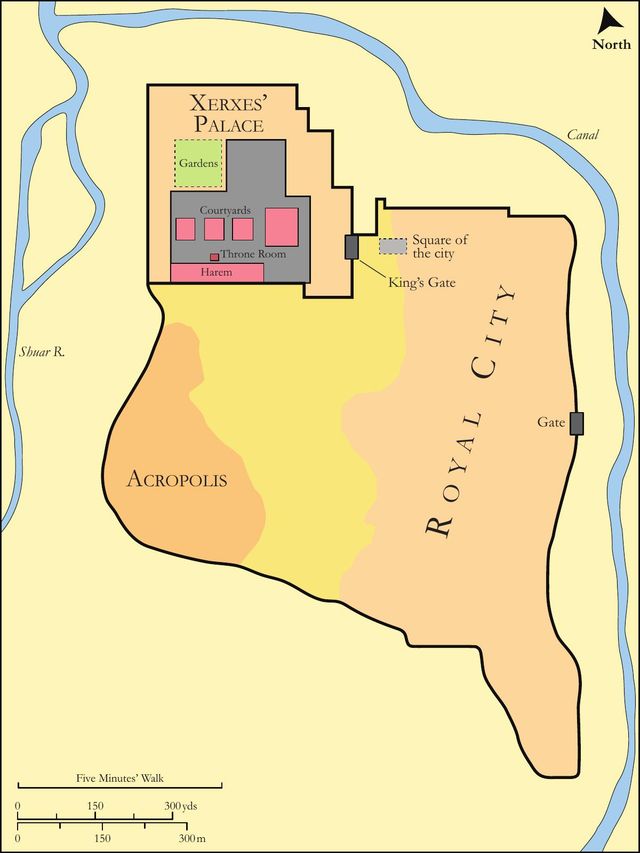
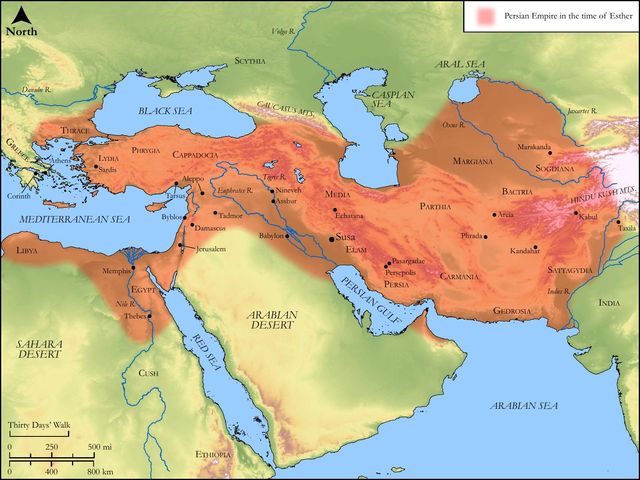
Study this verse
Public-domain commentary
Matthew Henry
From his Commentary on the Whole Bible. Henry comments on passages, not single verses — this entry covers Esther 4:5–17. His three-level outline is real structure in the source text, so it is rendered as structure.
So strictly did the laws of Persia confine the wives, especially the king's wives, that it was not possible for Mordecai to have a conference with Esther about this important affair, but divers messages are here carried between them by Hatach, whom the king had appointed to attend her, and it seems he was one she could confide in.
I.She sent to Mordecai to know more particularly and fully what the trouble was which he was now lamenting (Est 4:5) and why it was that he would not put off his sackcloth. To enquire thus after news, that we may know the better how to direct our griefs and joys, our prayers and praises, well becomes all that love Sion. If we must weep with those that weep, we must know why they weep.
II.Mordecai sent her an authentic account of the whole matter, with a charge to her to intercede with the king in this matter:
Mordecai told him all that had happened unto him (Est 4:7), what a pique Haman had against him for now bowing to him, and by what arts he had procured this edict; he sent her also a true copy of the edict, that she might see what imminent danger she and her people were in, and charged her, if she had any respect for him or any kindness for the Jewish nation, that she should appear now on their behalf, rectify the misinformations with which the king was imposed upon, and set the matter in a true light, not doubting but that then he would vacate the decree.
III.She sent her case to Mordecai, that she could not, without peril of her life, address the king, and that therefore he put a great hardship upon her in urging her to it. Gladly would she wait, gladly would she stoop, to do the Jews a kindness; but, if she must run the hazard of being put to death as a malefactor, she might well say, I pray thee have me excused, and find out some other intercessor.
1.The law was express, and all knew it, that whosoever came to the king uncalled should be put to death, unless he was pleased to hold out the golden sceptre to them, and it was extremely doubtful whether she should find him in so good a humour, Est 4:11. This law was made, not so much in prudence, for the greater safety of the king's person, as in pride, that being seldom seen, and not without great difficulty, he might be adored as a little god. A foolish law it was; for,
(1.)It made the kings themselves unhappy, confining them to their retirements for fear they should be seen. This made the royal palace little better than a royal prison, and the kings themselves could not but become morose, and perhaps melancholy, and so a terror to others and a burden to themselves. Many have their lives made miserable by their own haughtiness and ill nature.
(2.)It was bad for the subjects; for what good had they of a king that they might never have liberty to apply to for the redress of grievances and appeal to from the inferior judges? It is not thus in the court of the King of kings; to the footstool of his throne of grace we may at any time come boldly, and may be sure of an answer of peace to the prayer of faith. We are welcome, not only into the inner court, but even into the holiest, through the blood of Jesus.
(3.)It was particularly very uncomfortable for their wives (for there was not a proviso in the law to except them), who were bone of their bone and flesh of their flesh. But perhaps it was wickedly intended as much against them as any other, that the kings might the more freely enjoy their concubines, and Esther knew it. Miserable was the kingdom when the princes framed their laws to serve their lusts.
2.Her case was at present very discouraging. Providence so ordered it that, just at this juncture, she was under a cloud, and the king's affections cooled towards her, for she had been kept from his presence thirty days, that her faith and courage might be the more tried, and that God's goodness in the favour she now found with the king notwithstanding might shine the brighter. It is probable that Haman endeavoured by women, as well as wine, to divert the king from thinking of what he had done, and then Esther was neglected, from whom no doubt he did what he could to alienate the king, knowing her to be averse to him.
IV.Mordecai still insisted upon it that, whatever hazard she might run, she must apply to the king in this great affair, Est 4:13, Est 4:14.
No excuse will serve, but she must appear an advocate in this cause; he suggested to her,
1.That it was her own cause, for that the decree to destroy all the Jews did not except here: "Think not therefore that thou shalt escape in the king's house, that the palace will be thy protection, and the crown save thy head: no, thou art a Jewess, and, if the rest be cut off, thou wilt be cut off too." It was certainly her wisdom rather to expose herself to a conditional death from her husband than to a certain death from her enemy.
2.That it was a cause which, one way or other, would certainly be carried, and which therefore she might safely venture in. "If thou shouldst decline the service, enlargement and deliverance will arise to the Jews from another place." This was the language of a strong faith, which staggered not at the promise when the danger was most threatening, but against hope believed in hope. Instruments may fail, but God's covenant will not.
3.That if she deserted her friends now, through cowardice and unbelief, she would have reason to fear that some judgment from heaven would be the ruin of her and her family: "Thou and thy father's house shall be destroyed, when the rest of the families of the Jews shall be preserved." He that by sinful shifts will save his life, and cannot find in his heart to trust God with it in the way of duty, shall lose it in the way of sin.
4.That divine Providence had an eye to this in bringing her to be queen: "Who knows whether thou hast come to the kingdom for such a time as this?" and therefore, (1.) "Thou art bound in gratitude to do this service for God and his church, else thou dost not answer the end of thy elevation." (2.) "Thou needest not fear miscarrying in the enterprise; if God designed thee for it, he will bear thee out and give thee success." Now, [1.] It appeared, by the event, that she did come to the kingdom that she might be an instrument of the Jews' deliverance, so that Mordecai was right in the conjecture. Because the Lord loved his people, therefore he made Esther queen. There is a wise counsel and design in all the providences of God, which is unknown to us till it is accomplished, but it will prove, in the issue, that they are all intended for, and centre in, the good of the church. [2.] The probability of this was a good reason why she should now bestir herself, and do her utmost for her people. We should every one of us consider for what end God has put us in the place where we are, and study to answer that end; and, when any particular opportunity of serving God and our generation offers itself, we must take care that we do not let it slip; for we were entrusted with it that we might improve it. These things Mordecai urges to Esther; and some of the Jewish writers, who are fruitful in invention, add another thing which had happened to him (v. 7) which he desired she might be told, "that going home, the night before, in great heaviness, upon the notice of Haman's plot, he met three Jewish children coming from school, of whom he enquired what they had learned that day; one of them told him his lesson was, Pro 3:25, Pro 3:26, Be not afraid of sudden fear; the second told him his was, Isa 8:10, Take counsel together, and it shall come to nought; the third told him his was Isa 46:4, I have made, and I will bear, even I will carry and will deliver you. 'O the goodness of God,' says Mordecai, 'who out of the mouth of babes and sucklings ordains strength!"'
V.Esther hereupon resolved, whatever it might cost her, to apply to the king, but not till she and her friends had first applied to God.
Let them first by fasting and prayer obtain God's favour, and then she should hope to find favour with the king, Est 4:15, Est 4:16. She speaks here,
1.With the piety and devotion that became an Israelite. She had here eye up unto God, in whose hands the hearts of kings are, and on whom she depended to incline this king's heart towards her. She went in peril of her life, but would think herself safe, and would be easy, when she had committed the keeping of her soul to God and had put herself under his protection. She believed that God's favour was to be obtained by prayer, that his people are a praying people, and he a prayer-hearing God. She knew it was the practice of good people, in extraordinary cases, to join fasting with prayer, and many of them to join together in both. She therefore,
(1.)Desired that Mordecai would direct the Jews that were in Shushan to sanctify a fast and call a solemn assembly, to meet in the respective synagogues to which they belonged, and to pray for her, and to keep a solemn fast, abstaining from all set meals and all pleasant food for three days, and as much as possible from all food, in token of their humiliation for sin and in a sense of their unworthiness of God's mercy. Those know not how to value the divine favours who grudge thus much labour and self-denial in the pursuit of it.
(2.)She promised that she and her family would sanctify this fast in her apartment of the palace, for she might not come to their assemblies; her maids were either Jewesses or so far proselytes that they joined with her in her fasting and praying. Here is a good example of a mistress praying with her maids, and it is worthy to be imitated. Observe also, Those who are confined to privacy may join their prayers with those of the solemn assemblies of God's people; those that are absent in body may be present in spirit. Those who desire, and have, the prayers of others for them, must not think that this will excuse them from praying for themselves.
2.With the courage and resolution that became a queen. "When we have sought God in this matter, I will go unto the king to intercede for my people. I know it is not according to the king's law, but it is according to God's law; and therefore, whatever comes of it, I will venture, and not count my life dear to me, so that I may serve God and his church, and, if I perish, I perish. I cannot lose my life in a better cause. Better do my duty and die for my people than shrink from my duty and die with them." She reasons as the lepers (Kg2 7:4): "If I sit still, I die; if I venture, I may live, and be the life of my people: if the worst come to the worst," as we say, "I shall but die." Nothing venture, nothing win. She said not this in despair or passion, but in a holy resolution to do her duty and trust God with the issue; welcome his holy will. In the apocryphal part of this book (ch. 13 and 14) we have Mordecai's prayer and Esther's upon this occasion, and both of them very particular and pertinent. In the sequel of the story we shall find that God said not to this seed of Jacob, Seek you me in vain.
Historical interpretation
Three Centuries of Reception
2 surviving comments on this verse. Each one is dated, so this reads as a timeline rather than a list.
Select a marker to jump to its quote. Markers stagger vertically where authors wrote within a few decades of each other.
Many women, fortified by the grace of God, have accomplished many heroic actions. The blessed Judith, when the city was besieged, asked permission of the elders to be allowed to go into the foreigners’ camp. By exposing herself to danger she went out for love of her country and of the people who were besieged, and the Lord delivered Holophernes into the hand of a woman. To no less danger did Esther, who was perfect in faith, expose herself, in order to save the twelve tribes of Israel that were to be destroyed. For by fasting and humiliation she begged the all-seeing Master of the ages, and he, seeing the meekness of her soul, rescued the people for whose sake she had faced danger.
Why did Queen Esther expose herself to death and not fear the wrath of a fierce king? Was it not to save her people from death, an act both seemly and virtuous? The king of Persia himself also, though fierce and proud, yet thought it seemly to show honor to the man who had given information about a plot that had been laid against himself, to save a free people from slavery, to snatch them from death and not to spare him who had pressed on such unseemly plans. So finally he handed over to the gallows the man who stood second to himself and whom he counted chief among all his friends, because he considered that he had dishonored him with his false counsels. For that commendable friendship that maintains virtue is to be preferred most certainly to wealth, or honors or power. It is not accustomed to be preferred to virtue indeed, but to follow after it. So it was with Jonathan, who for his affection’s sake avoided not his father’s displeasure or the danger to his own safety. So, too, it was with Ahimelech, who, to preserve the duties of hospitality, though he must endure death rather than betray his friends when fleeing.
Continue studying Esther 4:8 across the web’s major study libraries — every link below opens this exact verse, chapter, or book on the destination site.
Read & Compare
 BibleGatewayThis verse in more than 200 translations and 70 languages.
 Bible.comThe YouVersion reader — hundreds of translations, reading plans, and highlights.
 ESV.orgCrossway's official English Standard Version reader.
 NET BibleThe NET translation with 60,000+ translators' notes on every rendering decision.
 STEP BibleTyndale House's free study tool — original text, vocabulary, and scholarly resources.
 BibliaLogos Bible Software's free web reader.
 USCCBThe New American Bible (Revised Edition) with the U.S. bishops' study notes.
Commentaries
 BibleHub CommentariesDozens of classic commentaries on this verse, gathered on one page.
 StudyLightMore than 100 commentary sets — the largest collection on the web.
 BibleRefPlain-English commentary on what this verse means, verse by verse.
 Enduring WordDavid Guzik's free commentary on this chapter, widely used by Bible teachers.
 Bible Study ToolsVerse commentary alongside Greek and Hebrew study aids.
Original Language & Research
- BibleHub InterlinearThe verse word by word — original language, transliteration, and English.
- BibleHub LexiconEvery word's original-language definition and Strong's entry.
 Blue Letter BibleDeep-study tools — Strong's numbers, concordance, and word studies.
 SefariaThe Hebrew text with Rashi and centuries of Jewish commentary.
Sermons, Hymns & Audio


TrulyRandomVerse is not affiliated with these sites and doesn’t control their content. They’re linked because they’re genuinely useful.
Summary
Esther 4:8 serves as the pivotal moment where Mordecai, having learned of Haman's genocidal decree against the Jews, dispatches Hathach to Queen Esther. This verse conveys the dire urgency of the situation by explicitly charging Esther with the perilous task of approaching King Ahasuerus unbidden. Her mission is to make earnest supplication and fervent request on behalf of her people, underscoring the immense burden of responsibility placed upon her as the sole hope for the Jewish nation's survival and setting the stage for her courageous intercession.
Context
ShowHideLiterary Context
This verse immediately follows Mordecai's profound and public lamentation upon discovering Haman's decree to annihilate all Jews throughout the Persian Empire, as detailed in Esther 4:1-3. Having torn his clothes and donned sackcloth, Mordecai sends Hathach, one of Esther's eunuchs, to inform her of the dire situation. The preceding chapters meticulously establish Haman's meteoric rise to power, his deep-seated malice towards Mordecai and the Jews, and the king's unwitting authorization of the genocidal plot, sealed by the royal signet ring in Esther 3:10 and disseminated throughout the provinces in Esther 3:13. Esther 4:8 thus acts as the direct catalyst for Esther's active involvement, shifting the narrative focus from Mordecai's distress to Esther's critical role as an intercessor. It directly precedes her initial apprehension in Esther 4:11 and Mordecai's iconic challenge in Esther 4:14.
Historical & Cultural Context
The events of Esther 4:8 are set within the sprawling Persian Empire, with the capital city of Shushan (Susa) as the immediate backdrop. The "writing of the decree" would have been an official royal edict, likely penned in Imperial Aramaic, the lingua franca of the empire, and then translated and dispatched to all 127 provinces, demonstrating the highly centralized and bureaucratic nature of Achaemenid Persian governance. A critical cultural nuance is the immutability of Persian law; once a decree was issued and sealed by the king, it was considered irreversible, as emphasized in Esther 1:19 and later reiterated in Esther 8:8. Furthermore, the protocol for approaching the king was extraordinarily rigid: an uninvited audience was a capital offense, punishable by death unless the king extended his golden scepter as a sign of favor. This custom underscores the absolute power of the monarch and the extreme, life-threatening danger Esther faced, making her "charge" an act of profound courage and desperation. The Jewish people, living in diaspora, were vulnerable minorities, making Haman's genocidal plot a terrifyingly real and imminent threat to their very existence.
Key Themes
ShowHideThis verse powerfully contributes to several overarching themes within the Book of Esther. Foremost is Intercession and Advocacy, as Esther is explicitly commanded to "make supplication" and "make request" for her people, embodying the role of a courageous advocate who risks her life for others. It also subtly highlights the theme of Divine Providence, even though God is conspicuously absent by name from the entire book. Esther's strategic placement and Mordecai's challenge, "who knows whether you have come to the kingdom for such a time as this?" (Esther 4:14), strongly imply a guiding, unseen hand orchestrating events for the deliverance of His people. The Burden of Responsibility is palpable, as Mordecai places the weight of the entire nation's survival squarely on Esther's shoulders, compelling her to leverage her unique position for the greater good. Finally, the Urgency of Crisis is paramount, driven by the immediate and existential threat of annihilation outlined in the decree, demanding swift, decisive, and perilous action.
Exposition and Analysis
ShowHideKey Word Analysis
ShowHideThis word (H1881) refers to a "royal edict or statute." In the context of Esther 4:8, it signifies a legally binding, authoritative command issued by the king, carrying the full weight of Persian law. The immutability of such decrees made Haman's edict particularly terrifying, as it was not merely a suggestion but an unchangeable law for the destruction of the Jews.
The Hebrew verb (H6680) translated as "charge" signifies an intensive command, an imperative that constitutes or enjoins. It is not a mere suggestion or request but a binding directive, emphasizing the gravity, authority, and non-negotiable nature of Mordecai's instruction to Esther. It conveys a strong sense of duty and obligation.
This term (H2603) denotes a humble, earnest plea for favor, mercy, or grace, often made from a position of vulnerability or distress. It implies an act of bending or stooping in kindness to an inferior, and causatively, to implore or move to favor by petition. Esther's mission is not a casual request but a fervent, desperate appeal for the lives of her people, acknowledging the king's supreme power and their dire need.
Verse Breakdown
ShowHide"Also he gave him the copy of the writing of the decree that was given at Shushan to destroy them"
Mordecai ensures that Esther receives tangible, irrefutable evidence of the existential threat. The "copy of the writing of the decree" underscores the official, legal, and binding nature of Haman's edict, which originated from the highest authority in the capital city, Shushan. The chilling phrase "to destroy them" leaves no ambiguity about the genocidal intent against the Jewish people, making the threat undeniably clear and immediate.
"to shew [it] unto Esther, and to declare [it] unto her"
This clause emphasizes Mordecai's deliberate intention for Esther to be fully informed and to grasp the profound gravity of the situation. "Shew" implies the physical presentation of the document, allowing Esther to see the official seal and wording, while "declare" suggests Hathach's verbal explanation of its contents and dire implications. Mordecai leaves no room for misunderstanding regarding the imminent danger facing Esther herself and her entire ethnic group.
"and to charge her that she should go in unto the king, to make supplication unto him, and to make request before him for her people"
This is the core imperative of the verse, conveying Mordecai's direct command and Esther's prescribed, perilous action. The "charge" is a forceful directive, demanding immediate and courageous intervention. Her mission involves an uninvited approach to the king, an act fraught with mortal danger, for the specific purpose of "making supplication" and "making request"—two terms that together denote a desperate, humble, and urgent plea for the lives of "her people," the Jewish nation, highlighting her unique position as their advocate.
Literary Devices
ShowHideEsther 4:8 is rich in literary devices that amplify its dramatic impact and underscore its significance. The explicit "charge" from Mordecai to Esther employs Imperative language, highlighting the absolute necessity and urgency of her mission. There is profound Dramatic Irony at play, as the reader is acutely aware of Esther's Jewish identity, a fact meticulously concealed from the king and the Persian court, which makes her potential intercession both uniquely qualified and incredibly dangerous. The verse also functions as powerful Foreshadowing, directly setting the stage for Esther's courageous, life-risking approach to the king in Esther 5 and the subsequent, miraculous reversal of the decree. The phrase "her people" functions as Synecdoche, where a part (Esther's immediate family and ethnic heritage) stands for the whole (the entire Jewish nation), emphasizing the collective threat and Esther's representative burden as their sole hope.
Theological and Thematic Connections
ShowHideEsther 4:8 marks a pivotal theological moment, underscoring the intersection of human courage and divine providence, even in a book where God's name is conspicuously absent. It reveals a profound truth: God often works through the obedience, bravery, and strategic positioning of individuals to accomplish His sovereign purposes. Esther's call to intercede for her people is a powerful testament to the necessity of advocacy and the moral responsibility of those in positions of influence to rebuke the powerful, especially on behalf of the vulnerable and oppressed. Her willingness to risk her life for others echoes a consistent pattern throughout biblical history, where individuals are called to step into dangerous situations for the sake of God's people and the advancement of His redemptive plan. This verse demonstrates that even in seemingly secular or politically charged contexts, God's unseen hand guides events, positioning His servants for critical moments of deliverance and demonstrating His faithfulness to His covenant people.
Reflection and Application
ShowHideEsther 4:8 serves as a profound and challenging call to action for believers today, compelling us to critically examine our own unique positions, talents, and resources as potential instruments for God's redemptive purposes in the world. Just as Esther was strategically placed "for such a time as this" in the Persian palace, we too are positioned in our families, workplaces, communities, and various spheres of influence for a divine reason. This verse urges us to move beyond passive observation of injustice, suffering, or spiritual need and to actively engage in intercession and advocacy. It powerfully reminds us that true courage is not the absence of fear, but the willingness to act decisively and faithfully despite it, especially when the stakes are high and the cost is personal. Our "charge" may not involve approaching an earthly king, but it might entail speaking up for the lowly, challenging pervasive injustices, offering compassionate care to the hurting, or simply praying fervently and consistently for those in need. The fundamental question for us, echoing Mordecai's challenge to Esther, is whether we are willing to steward our influence and courageously step into our God-given roles to bring about His kingdom and righteousness in our contemporary world.
Questions for Reflection
ShowHideFAQ
ShowHideWhat was the specific "decree" mentioned in Esther 4:8, and why was it so dangerous?
ShowHideThe "decree" was Haman's official edict, issued with the full authority of King Ahasuerus, commanding the systematic annihilation of all Jewish people throughout the 127 provinces of the Persian Empire on a specific day. Esther 3:13 explicitly details its genocidal purpose: "to destroy, to kill, and to cause to perish, all Jews, both young and old, little children and women, in one day." This made it an existential threat to the entire Jewish nation, leaving no one exempt and no possibility of escape within the empire's vast reach. The danger was profoundly compounded by the fact that Persian laws, once written and sealed with the king's ring, were considered irrevocable and unchangeable, as highlighted in Esther 8:8.
Why did Mordecai specifically "charge" Esther to go to the king, rather than attempting to intervene himself or through other means?
ShowHideMordecai understood that Esther's unique position as queen made her the only person with direct, intimate access to the king who could potentially influence him. While Mordecai was a high-ranking official, he did not possess the personal relationship or the privileged access to the inner court that Esther did. Furthermore, strict Persian court protocol dictated that approaching the king uninvited was a capital offense, punishable by immediate death unless the king extended his golden scepter as a sign of mercy and favor (Esther 4:11). Only Esther, as the queen, had any remote chance of surviving such an audacious approach, making her the last and only hope for her people's survival. Mordecai's "charge" was thus an act of desperate necessity, recognizing her singular, strategic placement by divine providence.
Christ-Centered Fulfillment
ShowHideEsther's perilous call to "make supplication" and "make request" for her people, at the profound risk of her own life, serves as a powerful and poignant foreshadowing of the ultimate intercession of Jesus Christ. Esther, an earthly queen, courageously steps into the breach for her earthly people, risking physical death to save them from a genocidal decree. Christ, the eternal King of kings and Lord of lords, willingly laid down His divine life not merely for a single nation, but for all humanity, to save us from eternal spiritual death and the decree of sin. He is our ultimate and perfect intercessor, who "always lives to intercede" for us (Hebrews 7:25), standing before the throne of God not with a plea for His own mercy, but as our perfect advocate and propitiation. Just as Esther was uniquely positioned to approach the Persian king, Jesus is the one and only mediator between God and humanity (1 Timothy 2:5), the spotless Lamb of God who takes away the sin of the world (John 1:29). Her courageous act, born of deep love and solidarity with her people, points to the infinitely greater, self-sacrificial love of the Good Shepherd who lays down His life for His sheep (John 10:11).