


2 Kings 7:4
Bible text: King James Version (1769 Blayney text) · Public domain
Bible text: King James Version with Strong's numbers · Public domain
Bible text: Berean Standard Bible · Public domain
Bible text: American Standard Version (1901) · Public domain
Bible text: World English Bible, Messianic edition · Public domain
Bible text: Geneva Bible (1599) · Public domain
Bible text: Young's Literal Translation · Public domain
- אִם'imifH518PrtParticle Conditional
- אָמַרְנוּ'a·mar·Nuwe saidH559V-Qal-Perf-1cpVerb Qal Perfect 1st Plural common gender
- נָבוֹאna·Vo'we will enterH935V-Qal-Imperf-1cpVerb Qal Imperfect 1st Plural common gender
- הָעִירha·'Irthe cityH5892Art ¦ N-fsNoun Singular Feminine Absoluteהָtheעִירcity
- וְהָרָעָבve·ha·ra·'Avand the famineH7458Conj-w ¦ Art ¦ N-msNoun Singular Masculine Absoluteוְandהָtheרָעָבfamine
- בָּעִירba·'Ir[is] in the cityH5892Prep-b ¦ N-fsNoun Singular Feminine Absoluteבָּ[is] in theעִירcity
- וָמַתְנוּva·Mat·nuand we will dieH4191Conj-w ¦ V-Qal-ConsecPerf-1cpVerb Qal Consecutive Perfect 1st Plural common genderוָandמַתְנוּwe will die
- שָׁםShamthereH8033AdvAdverb
- וְאִםve·'imand ifH518Conj-w ¦ PrtParticle Conditionalוְandאִםif
- יָשַׁבְנוּya·Shav·nuwe satH3427V-Qal-Perf-1cpVerb Qal Perfect 1st Plural common gender
- פֹהfohhereH6311AdvAdverb
- וָמָתְנוּva·Ma·te·nuand we will dieH4191Conj-w ¦ V-Qal-ConsecPerf-1cpVerb Qal Consecutive Perfect 1st Plural common genderוָandמָתְנוּwe will die
- וְעַתָּהve·'a·Tahand thereforeH6258Conj-w ¦ AdvAdverbוְandעַתָּהtherefore
- לְכוּle·KhucomeH1980V-Qal-Imp-2mpVerb Qal Imperative 2nd Plural Masculine
- וְנִפְּלָהve·ni·pe·Lahso let us fallH5307Conj-w ¦ V-Qal-Imperf-1cpVerb Qal Imperfect 1st Plural common genderוְsoנִפְּלָהlet us fall
- אֶל'eltoH413PrepPreposition
- מַחֲנֵהma·cha·Neh[the] camp ofH4264N-fscNoun Singular Feminine Construct
- אֲרָם'a·RamAramH758N-properNoun Proper Location
- אִם'imifH518PrtParticle Conditional
- יְחַיֻּנוּye·chai·Yu·nuthey will let live usH2421V-Piel-Imperf-3mp ¦ 1cpVerb Piel Imperfect 3rd Plural Masculineיְחַיֻּthey will let liveנוּus
- נִחְיֶהnich·Yehwe will liveH2421V-Qal-Imperf-1cpVerb Qal Imperfect 1st Plural common gender
- וְאִםve·'imand ifH518Conj-w ¦ PrtParticle Conditionalוְandאִםif
- יְמִיתֻנוּye·mi·Tu·nuthey will put to death usH4191V-Hiphil-Imperf-3mp ¦ 1cpVerb Hiphil Imperfect 3rd Plural Masculineיְמִיתֻthey will put to deathנוּus
- וָמָתְנוּva·Ma·te·nuand we will dieH4191Conj-w ¦ V-Qal-ConsecPerf-1cpVerb Qal Consecutive Perfect 1st Plural common genderוָandמָתְנוּwe will die
English is a literal word-by-word gloss of the Hebrew, not the KJV's wording. Why?
This is the original text the KJV's translators worked from — each Hebrew word with its own literal English meaning in this verse, prepared by scholars at Tyndale House, Cambridge. The KJV translates whole sentences, not word by word, so its wording differs: one Hebrew word can become several English words, and the KJV may choose “the LORD” where the gloss reads “Yahweh”. Both are faithful — they answer different questions. For the KJV's own rendering, switch to the KJV text.
Details
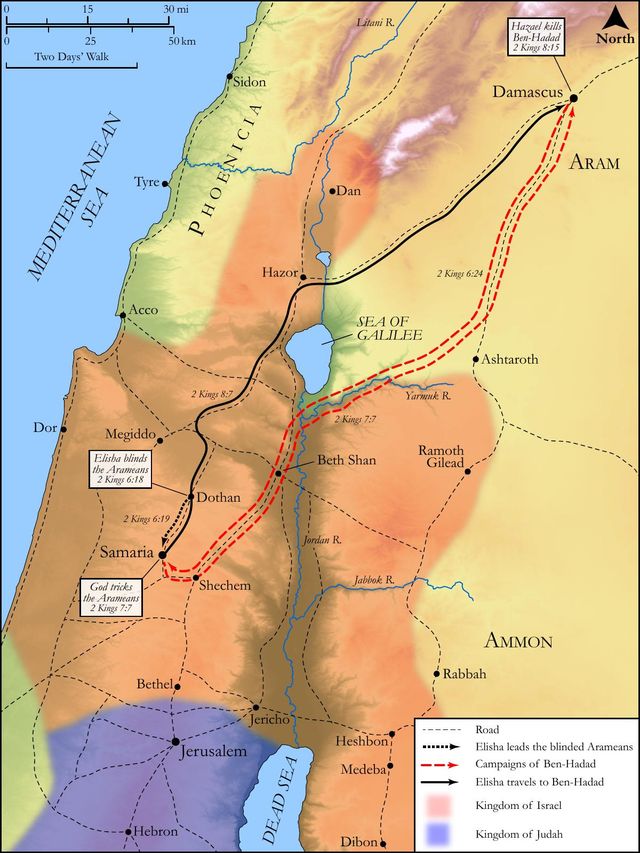
See on the biblical-era map
Study this verse
Public-domain commentary
Matthew Henry
From his Commentary on the Whole Bible. Henry comments on passages, not single verses — this entry covers 2 Kings 7:3–11. His two-level outline is real structure in the source text, so it is rendered as structure.
We are here told,
I.How the siege of Samaria was raised in the evening, at the edge of night (Kg2 7:6, Kg2 7:7), not by might or power, but by the Spirit of the Lord of hosts, striking terror upon the spirits of the besiegers. Here was not a sword drawn against them, not a drop of blood shed, it was not by thunder or hailstones that they were discomfited, nor were they slain, as Sennacherib's army before Jerusalem, by a destroying angel; but,
1.The Lord made them to hear a noise of chariots and horses. The Syrians that besieged Dothan had their sight imposed upon, Kg2 6:18. These had their hearing imposed upon. For God knows how to work upon every sense, pursuant to his own counsels as he makes the hearing ear and the seeing eye, so he makes the deaf and the blind, Exo 4:11. Whether the noise was really made in the air by the ministry of angels, or whether it was only a sound in their ears, is not certain; which soever it was, it was from God, who both brings the wind out of his treasures, and forms the spirit of man within him. The sight of horses and chariots had encouraged the prophet's servant, Kg2 6:17. The noise of horses and chariots terrified the hosts of Syria. For notices from the invisible world are either very comfortable or very dreadful, according as men are at peace with God or at war with him.
2.Hearing this noise, they concluded the king of Israel had certainly procured assistance from some foreign power: He has hired against us the kings of the Hittites and the kings of the Egyptians. There was, for aught we know but one king of Egypt, and what kings there were of the Hittites nobody can imagine; but, as they were imposed upon by that dreadful sound in their ears, so they imposed upon themselves by the interpretation they made of it. Had they supposed the king of Judah to have come with his forces, there would have been more of probability in their apprehensions than to dream of the kings of the Hittites and the Egyptians. If the fancies of any of them raised this spectre, yet their reasons might soon have laid it: how could the king of Israel, who was closely besieged, hold intelligence with those distant princes? What had he to hire them with? It was impossible but some notice would come, before, of the motions of so great a host; but there were they in great fear where no fear was.
3.Hereupon they all fled with incredible precipitation, as for their lives, left their camp as it was: even their horses, that might have hastened their flight, they could not stay to take with them, Kg2 7:7. None of them had so much sense as to send out scouts to discover the supposed enemy, much less courage enough to face the enemy, though fatigued with a long march. The wicked flee when none pursues. God can, when he pleases, dispirit the boldest and most brave, and make the stoutest heart to tremble. Those that will not fear God he can make to fear at the shaking of a leaf.
II.How the Syrians' flight was discovered by four leprous men.
Samaria was delivered, and did not know it. The watchmen on the walls were not aware of the retreat of the enemy, so silently did they steal away. But Providence employed four lepers to be the intelligencers, who had their lodging without the gate, being excluded from the city, as ceremonially unclean: the Jews say they were Gehazi and his three sons; perhaps Gehazi might be one of them, which might cause him to be taken notice of afterwards by the king, Kg2 8:4. See here,
1.How these lepers reasoned themselves into a resolution to make a visit in the night to the camp of the Syrians, Kg2 7:3, Kg2 7:4. They were ready to perish for hunger; none passed through the gate to relieve them. Should they go into the city, there was nothing to be had there, they mist die in the streets; should they sit still, they must pine to death in their cottage. They therefore determine to go over to the enemy, and throw themselves upon their mercy: if they killed them, better die by the sword than by famine, one death than a thousand; but perhaps they would save them alive, as objects of compassion. Common prudence will put us upon that method which may better our condition, but cannot make it worse. The prodigal son resolves to return to his father, whose displeasure he had reason to fear, rather than perish with hunger in the far country. These lepers conclude, "If they kill us, we shall but die;" and happy they who, in another sense, can thus speak of dying. "We shall but die, that is the worst of it, not die and be damned, not be hurt of the second death." According to this resolution, they went, in the beginning of the night, to the camp of the Syrians, and, to their great surprise, found it wholly deserted, not a man to be seen or heard in it, Kg2 7:5. Providence ordered it, that these lepers came as soon as ever the Syrians had fled, for they fled in the twilight, the evening twilight (Kg2 7:7), and in the twilight the lepers came (Kg2 7:5), and so no time was lost.
2.How they reasoned themselves into a resolution to bring tidings of this to the city. They feasted in the first tent they came to (Kg2 7:8) and then began to think of enriching themselves with the plunder; but they corrected themselves (Kg2 7:9): "We do not well to conceal these good tidings from the community we are members of, under colour of being avenged upon them for excluding us from their society; it was the law that did it, not they, and therefore let us bring them the news. Though it awake them from sleep, it will be life from the dead to them." Their own consciences told them that some mischief would befal them if they acted separately, and sought themselves only. Selfish narrow-spirited people cannot expect to prosper; the most comfortable advantage is that which our brethren share with us in. According to this resolution, they returned to the gate, and acquainted the sentinel with what they had discovered (Kg2 7:10), who straightway brought the intelligence to court (Kg2 7:11), and it was not the less acceptable for being first brought by lepers.
Historical interpretation
Historical reception
1 surviving comment on this verse from the historical church.
Even though the four lepers are loathsome, if we symbolically recognize in them the fact that they announced goods for the inhabitants of their city, they do no wrong to the symbol but correctly represent the four holy Evangelists. Indeed, we must bear in mind that through their books the grace of our Savior and source of life Jesus Christ was known, and freedom was given to all people according to his divine plan. And so those whose flesh was leprous shone in their interior look with the splendor of their righteousness. In addition, they symbolically represent the first attitude of the apostles in the fact that leprosy had corrupted their skin. But they also represent them in the fact that their interior was adorned with righteous behavior because the old man has been transformed by the coming of the Holy Spirit and renewed. Therefore they have clothed themselves with the garment shining with the colors of heaven and have been sent to show the work of the hands of God.
Continue studying 2 Kings 7:4 across the web’s major study libraries — every link below opens this exact verse, chapter, or book on the destination site.
Read & Compare
 BibleGatewayThis verse in more than 200 translations and 70 languages.
 Bible.comThe YouVersion reader — hundreds of translations, reading plans, and highlights.
 ESV.orgCrossway's official English Standard Version reader.
 NET BibleThe NET translation with 60,000+ translators' notes on every rendering decision.
 STEP BibleTyndale House's free study tool — original text, vocabulary, and scholarly resources.
 BibliaLogos Bible Software's free web reader.
 USCCBThe New American Bible (Revised Edition) with the U.S. bishops' study notes.
Commentaries
 BibleHub CommentariesDozens of classic commentaries on this verse, gathered on one page.
 StudyLightMore than 100 commentary sets — the largest collection on the web.
 BibleRefPlain-English commentary on what this verse means, verse by verse.
 Enduring WordDavid Guzik's free commentary on this chapter, widely used by Bible teachers.
 Bible Study ToolsVerse commentary alongside Greek and Hebrew study aids.
Original Language & Research
- BibleHub InterlinearThe verse word by word — original language, transliteration, and English.
- BibleHub LexiconEvery word's original-language definition and Strong's entry.
 Blue Letter BibleDeep-study tools — Strong's numbers, concordance, and word studies.
 SefariaThe Hebrew text with Rashi and centuries of Jewish commentary.
Sermons, Hymns & Audio


TrulyRandomVerse is not affiliated with these sites and doesn’t control their content. They’re linked because they’re genuinely useful.
Summary
Second Kings 7:4 vividly portrays the desperate deliberation of four lepers during the severe Aramean siege of Samaria. Faced with the certainty of death by famine, whether they remain outside the city walls or attempt to enter the starving city, they pragmatically conclude that their only remote chance of survival lies in surrendering to the besieging Syrian army. Their stark reasoning—that death is inevitable regardless of their immediate choice, so taking a risk offers a potential, albeit uncertain, path to life—sets the stage for an extraordinary divine intervention that will ultimately deliver the entire city from its dire predicament.
Context
ShowHideLiterary Context
This pivotal verse is situated at a moment of extreme crisis in the narrative of the siege of Samaria by King Ben-Hadad of Aram (Syria), as meticulously detailed in 2 Kings 6:24-25. The preceding verses paint a grim and harrowing picture of intense famine within the city, escalating to horrific acts of cannibalism, as vividly recounted in 2 Kings 6:26-29. King Joram of Israel, overwhelmed by the suffering, holds the prophet Elisha responsible for the crisis and even threatens his life. Elisha, however, boldly prophesies a miraculous end to the famine within twenty-four hours, a promise met with profound skepticism by a royal officer in 2 Kings 7:1-2. It is against this backdrop of utter despair and a seemingly impossible divine promise that the four lepers, overlooked and outcast from society, find themselves in a unique, isolated position outside the city gates. Their desperate decision articulated in this verse directly leads to the astonishing fulfillment of Elisha's prophecy, as described in 2 Kings 7:5-8.
Historical & Cultural Context
The period of the Divided Monarchy, in which this event occurs, was characterized by frequent and often brutal conflicts between Israel and its powerful neighbors, particularly Aram (Syria). Sieges were a common and devastating tactic of ancient warfare, designed to starve a city into submission, frequently leading to immense suffering, widespread disease, and high mortality rates, as tragically evidenced by the severity of Samaria's famine. Culturally, leprosy rendered individuals ritually unclean and profoundly socially ostracized, compelling them to live apart from the community, typically outside city walls, as explicitly prescribed in Leviticus 13:45-46. This societal exclusion meant the lepers had no access to the already meager and rapidly dwindling resources within Samaria, placing them in an even more dire predicament than those trapped inside. Their desperate gamble to approach the enemy camp was a radical departure from typical behavior, born not of courage but of absolute necessity and the complete absence of any other viable option for survival.
Key Themes
ShowHideThis verse powerfully contributes to several profound themes within the book of 2 Kings and the broader biblical narrative. It highlights the theme of human desperation, showcasing the extreme lengths to which individuals will go when faced with the certainty of death and the complete absence of hope. Crucially, it underscores the concept of divine sovereignty and unexpected deliverance, as God chooses to use the most lowly, despised, and unlikely individuals—four lepers—as the instruments of salvation for an entire city. This demonstrates that God's power is not limited by human status, social standing, or perceived circumstances. The lepers' pragmatic decision, born not of explicit faith but of a logical, albeit grim, assessment of a "no-win" situation, also introduces the theme of action over passive resignation, suggesting that even a desperate, humanly reasoned step can open the door for extraordinary divine intervention. This narrative sets up a stark contrast between human despair and God's abundant provision, revealing how God can sovereignly turn seemingly hopeless situations into powerful demonstrations of His miraculous power, echoing themes found in other narratives of miraculous provision like the manna in Exodus 16.
Exposition and Analysis
ShowHideKey Word Analysis
ShowHideDerived from H3427, this verb signifies "to sit down, dwell, or remain." In this desperate context, it emphatically conveys a state of passive resignation and inaction. The lepers recognize that to "sit still" is to passively accept certain death by starvation, highlighting the futility of remaining idle when faced with an unavoidable and dire fate. It underscores a choice to do nothing, leading to a predetermined end.
This root primarily means "to fall," but in this construction, it carries the profound sense of surrendering, casting oneself upon the mercy of an adversary, or defecting. It denotes a decisive, albeit highly desperate, act of moving towards the Syrian encampment with the express intention of submission. This active, perilous choice stands in stark contrast to the passive "sitting still," underscoring their willingness to gamble on an uncertain outcome rather than passively succumb to certain death.
Derived from H4264, this noun refers to an encampment, specifically a military one, and by extension, an army or company. The lepers are not merely contemplating approaching a small group but the entire organized military "host" of the Arameans. This emphasizes the immense, life-threatening risk involved, as approaching an enemy army during a siege would typically lead to immediate capture or execution. Their desperate reasoning fully accounts for the extreme danger of their chosen path.
Verse Breakdown
ShowHide"If we say, We will enter into the city, then the famine [is] in the city, and we shall die there:"
The lepers begin their grim deliberation by assessing the option of returning to Samaria. They immediately recognize that this path offers no salvation, as the city itself is in the throes of an extreme famine, leading to certain death for anyone, including themselves, who might seek refuge within its walls. This establishes the first "no-win" scenario, eliminating any hope of sustenance from their own people.
"and if we sit still here, we die also."
Their second assessment considers their current situation outside the city gates. They acknowledge that remaining where they are, inactive and without any source of sustenance, will also inevitably lead to death by starvation. This confirms their predicament as a true dilemma, with both immediate, seemingly logical options leading to the same fatal outcome.
"Now therefore come, and let us fall unto the host of the Syrians:"
Having systematically eliminated the first two options as paths to certain death, the lepers propose a third, radical, and counter-intuitive course of action: to surrender to the besieging Syrian army. The phrase "Now therefore come" indicates a decisive shift from passive deliberation to active, albeit desperate, resolve, a pragmatic decision born of sheer necessity rather than a pre-existing plan or strategy.
"if they save us alive, we shall live; and if they kill us, we shall but die."
This final clause articulates their cold, logical, and utterly grim risk-reward calculation. They fully understand that approaching the enemy carries the significant risk of immediate execution. However, they reason that even if killed, the outcome is no worse than the certain death they already face by famine. Conversely, there is a slim, desperate possibility that the Syrians might spare them, offering a chance at life that no other option provides. This pragmatic assessment underscores their profound human will to survive even in the most dire circumstances.
Literary Devices
ShowHideThe verse employs several powerful literary devices to convey the lepers' desperate situation and their momentous decision. Dilemma is central to the lepers' internal monologue, as they articulate a "no-win" scenario with two initial options (entering the city or sitting still) both leading to certain death. This stark presentation heightens the narrative tension and underscores the extreme severity of the famine. The lepers' subsequent decision to approach the Syrian army introduces a profound irony: those considered the lowest and most ritually unclean in Israelite society become the unlikely, indeed unwitting, instruments of the city's salvation. Their desperate, pragmatic act inadvertently foreshadows the miraculous deliverance that God is about to orchestrate, turning a seemingly hopeless gamble into the catalyst for widespread provision. Furthermore, the verse utilizes powerful contrast by juxtaposing the passive acceptance of death ("sit still here") with the active, albeit risky, pursuit of a slim chance at life ("fall unto the host of the Syrians"), highlighting the inherent human drive to survive even in the direst circumstances.
Theological and Thematic Connections
ShowHideThis verse profoundly illustrates the intersection of human desperation and divine intervention. The lepers' situation is a microcosm of humanity's predicament when faced with forces beyond its control—a "no-win" scenario where every human effort, left to its own devices, leads to death. Their pragmatic decision, born of necessity rather than explicit faith, becomes the unlikely trigger for God's miraculous provision, demonstrating His absolute sovereignty and His profound ability to use the most lowly and overlooked individuals to accomplish His grand purposes. It highlights that God's deliverance often comes through unexpected channels and in response to seemingly desperate human choices, revealing His power to bring life out of death and abundance out of scarcity. This narrative serves as a powerful reminder that even when all human options appear exhausted, God's redemptive plan for deliverance can unfold through the most improbable means, showcasing His glory through the weak and the unexpected.
Reflection and Application
ShowHideThe account of the four lepers in 2 Kings 7:4 offers profound and enduring lessons for contemporary life. We often find ourselves in situations that feel like "no-win" scenarios, where every apparent path seems to lead to undesirable or even catastrophic outcomes—be it in personal crises, professional challenges, relational struggles, or spiritual dilemmas. This verse challenges us to critically assess our circumstances and, like the lepers, consider whether passive resignation is truly the only option. It compels us to ask if there might be a "third option," a desperate but calculated step of action, however risky, that offers a slim possibility of a different outcome. This narrative powerfully reminds us that God often works through the unexpected, using the lowly, the overlooked, or even our own desperate, pragmatic steps to bring about His miraculous purposes. It encourages us to move beyond paralysis and to take that "desperate step" when faced with overwhelming odds, trusting that even a seemingly hopeless action can be the catalyst for divine intervention, transforming seemingly impossible situations into opportunities for God to display His power and provision in ways we could never anticipate.
Questions for Reflection
ShowHideFAQ
ShowHideWhy were the lepers outside the city gates and not allowed inside?
ShowHideAccording to the Mosaic Law, individuals afflicted with leprosy were considered ritually unclean and were strictly required to live outside the community, separated from healthy people. Leviticus 13:45-46 explicitly states that a leper "shall dwell alone; outside the camp shall be his dwelling." This was a crucial measure not only to prevent the spread of disease but also to maintain ceremonial purity within the Israelite camp or city. Thus, during the siege, even with the city starving, the lepers were not permitted to enter and share in the city's dwindling resources, leaving them in an even more precarious and isolated position.
How severe was the famine in Samaria at this time?
ShowHideThe famine in Samaria was extraordinarily severe, reaching a point of horrific and unimaginable desperation. The preceding chapter, 2 Kings 6:29, records a shocking incident where two women resorted to cannibalism, agreeing to boil and eat their own children due to the extreme hunger. This gruesome detail underscores the dire and catastrophic conditions within Samaria, where basic sustenance was non-existent and human life had lost its value in the face of starvation. The lepers' assessment that they would "die there" if they entered the city was an accurate and chilling reflection of this truly desperate situation.
Did the lepers make their decision out of faith in God or simply desperation?
ShowHideThe biblical text presents the lepers' decision as a pragmatic, logical assessment born purely out of extreme desperation rather than an explicit act of faith in God. Their reasoning is based on a clear-eyed calculation of risk: "if they save us alive, we shall live; and if they kill us, we shall but die." They faced certain death by staying put or entering the city, so taking a chance with the Syrians, even if it meant death, was no worse than their current fate and offered the only slim hope of survival. However, it is precisely through this desperate, humanly logical decision that God chose to work His miraculous deliverance, demonstrating that His sovereignty can utilize even pragmatic human actions and the most unlikely individuals to fulfill His divine purposes.
Christ-Centered Fulfillment
ShowHideThe desperate plight of the four lepers in 2 Kings 7:4, facing certain death with no viable human option, powerfully foreshadows humanity's own spiritual predicament apart from Christ. Just as the lepers were trapped between the famine within the city and the famine outside, so too is humanity trapped by sin, with every path leading to spiritual death and separation from God (Romans 6:23). We are spiritually outcast, unable to enter God's holy presence or secure our own salvation, much like the lepers were excluded from the city. Yet, in our utter helplessness and the absence of any self-salvation, God provided a "third option," a seemingly desperate and counter-intuitive act that turned out to be the ultimate salvation: the sending of His Son, Jesus Christ. Christ's crucifixion was, in a profound sense, God's "falling unto the host" of humanity's sin and death, a radical act that appeared to be weakness and defeat but was in fact the power of God for salvation to all who believe (1 Corinthians 1:18). Just as the lepers' risky venture led to the discovery of abundant provision for all Samaria (2 Kings 7:5-8), Christ's death and resurrection opened the way to eternal life and spiritual abundance for all who believe in Him (John 10:10). The lepers, the lowly and despised, became the unexpected instruments of deliverance, mirroring how God consistently chooses the "foolish things of the world to shame the wise" and the "weak things of the world to shame the strong" through Christ (1 Corinthians 1:27). In Christ, our "if they save us alive, we shall live" becomes a glorious certainty, for He has conquered death, secured life, and offers true, eternal life to all who surrender to Him as the Way, the Truth, and the Life (John 14:6).