


2 Kings 7:5
- וַיָּקוּמוּvai·ya·Ku·muand they aroseH6965Conj-w ¦ V-Qal-ConsecImperf-3mpVerb Qal Consecutive Imperfect 3rd Plural Masculineוַandיָּקוּמוּthey arose
- בַנֶּשֶׁףva·Ne·shefat <the> twilightH5399Prep-b ¦ N-msNoun Singular Masculine Absoluteבַat <the>נֶּשֶׁףtwilight
- לָבוֹאla·Vo'to goH935Prep-l ¦ V-Qal-InfVerb Qal Infinitive Constructלָtoבוֹאgo
- אֶל'eltoH413PrepPreposition
- מַחֲנֵהma·cha·Neh[the] camp ofH4264N-fscNoun Singular Feminine Construct
- אֲרָם'a·RamAramH758N-properNoun Proper Location
- וַיָּבֹאוּvai·ya·Vo·'uand they cameH935Conj-w ¦ V-Qal-ConsecImperf-3mpVerb Qal Consecutive Imperfect 3rd Plural Masculineוַandיָּבֹאוּthey came
- עַד'adtoH5704PrepPreposition
- קְצֵהke·Tzeh[the] edge ofH7097N-mscNoun Singular Masculine Construct
- מַחֲנֵהma·cha·Neh[the] camp ofH4264N-fscNoun Singular Feminine Construct
- אֲרָם'a·RamAramH758N-properNoun Proper Location
- וְהִנֵּהve·hi·Nehand there!H2009Conj-w ¦ PrtParticle Interjectionוְandהִנֵּהthere!
- אֵין'einthere notH369N-mscNoun Singular Masculine Construct
- שָׁםshamthereH8033AdvAdverb
- אִישׁ'Ish[was] anyoneH376N-msNoun Singular Masculine Absolute
English is a literal word-by-word gloss of the Hebrew, not the KJV's wording. Why?
This is the original text the KJV's translators worked from — each Hebrew word with its own literal English meaning in this verse, prepared by scholars at Tyndale House, Cambridge. The KJV translates whole sentences, not word by word, so its wording differs: one Hebrew word can become several English words, and the KJV may choose “the LORD” where the gloss reads “Yahweh”. Both are faithful — they answer different questions. For the KJV's own rendering, switch to the KJV text.
Details
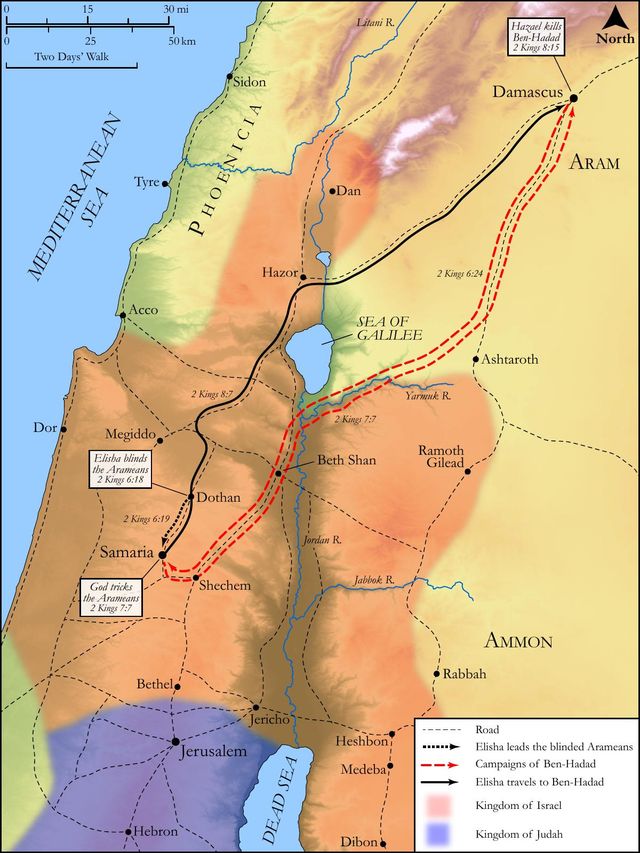
See on the biblical-era map
Study this verse
Public-domain commentary
Matthew Henry
From his Commentary on the Whole Bible. Henry comments on passages, not single verses — this entry covers 2 Kings 7:3–11. His two-level outline is real structure in the source text, so it is rendered as structure.
We are here told,
I.How the siege of Samaria was raised in the evening, at the edge of night (Kg2 7:6, Kg2 7:7), not by might or power, but by the Spirit of the Lord of hosts, striking terror upon the spirits of the besiegers. Here was not a sword drawn against them, not a drop of blood shed, it was not by thunder or hailstones that they were discomfited, nor were they slain, as Sennacherib's army before Jerusalem, by a destroying angel; but,
1.The Lord made them to hear a noise of chariots and horses. The Syrians that besieged Dothan had their sight imposed upon, Kg2 6:18. These had their hearing imposed upon. For God knows how to work upon every sense, pursuant to his own counsels as he makes the hearing ear and the seeing eye, so he makes the deaf and the blind, Exo 4:11. Whether the noise was really made in the air by the ministry of angels, or whether it was only a sound in their ears, is not certain; which soever it was, it was from God, who both brings the wind out of his treasures, and forms the spirit of man within him. The sight of horses and chariots had encouraged the prophet's servant, Kg2 6:17. The noise of horses and chariots terrified the hosts of Syria. For notices from the invisible world are either very comfortable or very dreadful, according as men are at peace with God or at war with him.
2.Hearing this noise, they concluded the king of Israel had certainly procured assistance from some foreign power: He has hired against us the kings of the Hittites and the kings of the Egyptians. There was, for aught we know but one king of Egypt, and what kings there were of the Hittites nobody can imagine; but, as they were imposed upon by that dreadful sound in their ears, so they imposed upon themselves by the interpretation they made of it. Had they supposed the king of Judah to have come with his forces, there would have been more of probability in their apprehensions than to dream of the kings of the Hittites and the Egyptians. If the fancies of any of them raised this spectre, yet their reasons might soon have laid it: how could the king of Israel, who was closely besieged, hold intelligence with those distant princes? What had he to hire them with? It was impossible but some notice would come, before, of the motions of so great a host; but there were they in great fear where no fear was.
3.Hereupon they all fled with incredible precipitation, as for their lives, left their camp as it was: even their horses, that might have hastened their flight, they could not stay to take with them, Kg2 7:7. None of them had so much sense as to send out scouts to discover the supposed enemy, much less courage enough to face the enemy, though fatigued with a long march. The wicked flee when none pursues. God can, when he pleases, dispirit the boldest and most brave, and make the stoutest heart to tremble. Those that will not fear God he can make to fear at the shaking of a leaf.
II.How the Syrians' flight was discovered by four leprous men.
Samaria was delivered, and did not know it. The watchmen on the walls were not aware of the retreat of the enemy, so silently did they steal away. But Providence employed four lepers to be the intelligencers, who had their lodging without the gate, being excluded from the city, as ceremonially unclean: the Jews say they were Gehazi and his three sons; perhaps Gehazi might be one of them, which might cause him to be taken notice of afterwards by the king, Kg2 8:4. See here,
1.How these lepers reasoned themselves into a resolution to make a visit in the night to the camp of the Syrians, Kg2 7:3, Kg2 7:4. They were ready to perish for hunger; none passed through the gate to relieve them. Should they go into the city, there was nothing to be had there, they mist die in the streets; should they sit still, they must pine to death in their cottage. They therefore determine to go over to the enemy, and throw themselves upon their mercy: if they killed them, better die by the sword than by famine, one death than a thousand; but perhaps they would save them alive, as objects of compassion. Common prudence will put us upon that method which may better our condition, but cannot make it worse. The prodigal son resolves to return to his father, whose displeasure he had reason to fear, rather than perish with hunger in the far country. These lepers conclude, "If they kill us, we shall but die;" and happy they who, in another sense, can thus speak of dying. "We shall but die, that is the worst of it, not die and be damned, not be hurt of the second death." According to this resolution, they went, in the beginning of the night, to the camp of the Syrians, and, to their great surprise, found it wholly deserted, not a man to be seen or heard in it, Kg2 7:5. Providence ordered it, that these lepers came as soon as ever the Syrians had fled, for they fled in the twilight, the evening twilight (Kg2 7:7), and in the twilight the lepers came (Kg2 7:5), and so no time was lost.
2.How they reasoned themselves into a resolution to bring tidings of this to the city. They feasted in the first tent they came to (Kg2 7:8) and then began to think of enriching themselves with the plunder; but they corrected themselves (Kg2 7:9): "We do not well to conceal these good tidings from the community we are members of, under colour of being avenged upon them for excluding us from their society; it was the law that did it, not they, and therefore let us bring them the news. Though it awake them from sleep, it will be life from the dead to them." Their own consciences told them that some mischief would befal them if they acted separately, and sought themselves only. Selfish narrow-spirited people cannot expect to prosper; the most comfortable advantage is that which our brethren share with us in. According to this resolution, they returned to the gate, and acquainted the sentinel with what they had discovered (Kg2 7:10), who straightway brought the intelligence to court (Kg2 7:11), and it was not the less acceptable for being first brought by lepers.
Historical interpretation
Historical reception
1 surviving comment on this verse from the historical church.
Even though the four lepers are loathsome, if we symbolically recognize in them the fact that they announced goods for the inhabitants of their city, they do no wrong to the symbol but correctly represent the four holy Evangelists. Indeed, we must bear in mind that through their books the grace of our Savior and source of life Jesus Christ was known, and freedom was given to all people according to his divine plan. And so those whose flesh was leprous shone in their interior look with the splendor of their righteousness. In addition, they symbolically represent the first attitude of the apostles in the fact that leprosy had corrupted their skin. But they also represent them in the fact that their interior was adorned with righteous behavior because the old man has been transformed by the coming of the Holy Spirit and renewed. Therefore they have clothed themselves with the garment shining with the colors of heaven and have been sent to show the work of the hands of God.
Continue studying 2 Kings 7:5 across the web’s major study libraries — every link below opens this exact verse, chapter, or book on the destination site.
Read & Compare
 BibleGatewayThis verse in more than 200 translations and 70 languages.
 Bible.comThe YouVersion reader — hundreds of translations, reading plans, and highlights.
 ESV.orgCrossway's official English Standard Version reader.
 NET BibleThe NET translation with 60,000+ translators' notes on every rendering decision.
 STEP BibleTyndale House's free study tool — original text, vocabulary, and scholarly resources.
 BibliaLogos Bible Software's free web reader.
 USCCBThe New American Bible (Revised Edition) with the U.S. bishops' study notes.
Commentaries
 BibleHub CommentariesDozens of classic commentaries on this verse, gathered on one page.
 StudyLightMore than 100 commentary sets — the largest collection on the web.
 BibleRefPlain-English commentary on what this verse means, verse by verse.
 Enduring WordDavid Guzik's free commentary on this chapter, widely used by Bible teachers.
 Bible Study ToolsVerse commentary alongside Greek and Hebrew study aids.
Original Language & Research
- BibleHub InterlinearThe verse word by word — original language, transliteration, and English.
- BibleHub LexiconEvery word's original-language definition and Strong's entry.
 Blue Letter BibleDeep-study tools — Strong's numbers, concordance, and word studies.
 SefariaThe Hebrew text with Rashi and centuries of Jewish commentary.
Sermons, Hymns & Audio


TrulyRandomVerse is not affiliated with these sites and doesn’t control their content. They’re linked because they’re genuinely useful.
Summary
2 Kings 7:5 chronicles the pivotal moment when four desperate lepers, facing certain death by starvation within the besieged city of Samaria, embark on a perilous journey at dusk towards the Aramean (Syrian) encampment with the intention of surrendering. This verse captures their audacious first step of faith and the astonishing discovery they make upon reaching the enemy's perimeter: the formidable camp is utterly deserted, setting the stage for God's miraculous deliverance and the dramatic fulfillment of Elisha's prophecy.
Context
ShowHideLiterary Context
This verse serves as the dramatic turning point following the harrowing descriptions of Samaria's severe siege and famine in 2 Kings 6, which had escalated to horrific acts of cannibalism. The narrative immediately preceding 2 Kings 7:5 includes Elisha's audacious prophecy of abundant food within 24 hours, a declaration met with cynical disbelief by a royal officer (2 Kings 7:1-2). The four lepers, introduced in 2 Kings 7:3-4, are depicted as outcasts at the city gate, contemplating their inevitable demise. Their decision to venture into the enemy camp, rather than succumb to starvation, is an act born of sheer desperation, which miraculously aligns with God's already unfolding plan, as revealed in the subsequent verses explaining the divine panic that caused the Syrian flight (2 Kings 7:6-7). The lepers' discovery is the crucial link between prophecy and fulfillment, transforming a seemingly hopeless situation into one of divine triumph.
Historical & Cultural Context
The historical backdrop is the brutal siege of Samaria, the capital of the northern kingdom of Israel, by the Aramean (Syrian) army under Ben-Hadad II. Sieges in ancient Near Eastern warfare were designed to inflict maximum suffering and starvation to force surrender, often leading to horrific conditions as detailed in 2 Kings 6:25-29. Lepers, according to the Mosaic Law (Leviticus 13-14 and Leviticus 14), were ritually unclean and forced to live outside the city's walls, isolated from society. Their precarious position at the city gate, caught between a starving city and a hostile army, epitomizes utter human helplessness. Their decision to "fall unto the host of the Syrians" was not an act of bravery but a last, desperate gamble on the slim chance of mercy from an enemy, preferable to certain death by famine. This highlights the extreme desperation of the times and the neglect of the lepers.
Key Themes
ShowHideThis verse profoundly contributes to several overarching themes within 2 Kings. Foremost is the theme of Divine Providence and Intervention, as the lepers' discovery is not accidental but the direct result of God's unseen, prior action, causing the Syrian army to flee in panic (2 Kings 7:6). It powerfully illustrates God's Use of the Despised and Outcast, demonstrating that He frequently chooses the most unlikely and overlooked individuals – in this case, four ritually unclean outcasts – to accomplish His mighty purposes, thereby magnifying His own power and grace. Furthermore, it highlights the theme of Faith in Desperation, where a human act, born of extreme need and a "nothing to lose" mentality, becomes the very pathway through which divine deliverance is revealed, fulfilling the prophetic word of God spoken through Elisha in 2 Kings 7:1. This narrative underscores God's sovereignty over human affairs and His faithfulness to His promises.
Exposition and Analysis
ShowHideKey Word Analysis
ShowHideThis term properly refers to a breeze, by implication, dusk (when the evening breeze prevails). In this context, it denotes the period of dim light either at dusk (after sunset) or dawn (before sunrise). Here, it refers to dusk or early evening. The choice of this time is highly significant; it is a liminal space, neither full light nor full darkness, offering a measure of concealment for the lepers' perilous journey while simultaneously heightening the sense of uncertainty and vulnerability. It sets a mood of quiet desperation and daring, where movements might be less observed, yet dangers can be more hidden.
This word signifies an extremity, end, border, or brim. Here, it describes the very perimeter or outermost boundary of the Syrian camp. The lepers did not have to penetrate deep into enemy territory to make their discovery; the miraculous absence of the enemy was evident from the very first point of contact. This emphasizes the completeness and suddenness of the Syrian flight, as well as the immediate nature of the lepers' revelation, underscoring the divine precision of the intervention.
This word refers to a man as an individual or a male person. In the phrase "no man there," it emphatically states a complete absence of human presence. It is not merely "few men" or "some had left," but an absolute void, indicating that the entire formidable army had vanished. This unexpected emptiness is the lynchpin of the entire narrative, revealing God's prior, invisible work and directly setting the stage for the city's deliverance and the fulfillment of Elisha's prophecy.
Verse Breakdown
ShowHide"And they rose up in the twilight,"
This clause describes the lepers' decisive action, a desperate but determined movement. "They" refers to the four lepers introduced in 2 Kings 7:3. The timing, "in the twilight," adds to the dramatic tension, suggesting a clandestine, perilous venture under cover of dim light, indicative of their vulnerable position and the gravity of their decision to leave the perceived safety of the city gate. Their rising up signifies a proactive step, however small, out of passive despair.
"to go unto the camp of the Syrians:"
This specifies the destination and purpose of their movement. Their intention was not to fight or spy, but to surrender, hoping for mercy or at least a quicker death than starvation. This act, born of utter hopelessness within Samaria, paradoxically becomes the vehicle for their salvation and, ultimately, the city's deliverance, as God had already prepared the way. It highlights their desperate gamble for survival.
"and when they were come to the uttermost part of the camp of Syria,"
This marks the moment of arrival at the threshold of the enemy's domain. The phrase "uttermost part" emphasizes that their discovery was immediate upon reaching the camp's edge, not after a deep penetration. This proximity to the enemy's former position heightens the surprise of what they find, underscoring the sudden and complete nature of the Syrian departure, implying an overwhelming divine intervention.
"behold, [there was] no man there."
This is the astonishing revelation that changes everything. The interjection "behold" (Hebrew: hinneh) draws the reader's attention to the unexpected and miraculous nature of the discovery. The complete and utter absence of the formidable Syrian army signifies that God had already intervened, fulfilling Elisha's prophecy before the lepers even arrived, demonstrating His sovereign control over nations and circumstances. This climatic statement reveals the divine miracle at the heart of the narrative.
Literary Devices
ShowHideThe narrative in 2 Kings 7:5 masterfully employs several literary devices to heighten its impact and convey its theological message. Suspense is meticulously built through the description of the lepers' desperate journey "in the twilight," creating an atmosphere of uncertainty and danger surrounding their perilous undertaking. This tension culminates in the dramatic discovery of the empty camp, a moment of profound surprise and relief for both the characters and the reader. The entire scene is imbued with powerful irony: those who are the most lowly and desperate, venturing out of sheer hopelessness and a desire to surrender, become the unlikely instruments through whom the city's salvation is revealed. Their act of "surrender" to the enemy paradoxically leads to the discovery of the enemy's complete and miraculous retreat. Furthermore, the verse functions as a powerful moment of foreshadowing, hinting at the miraculous divine intervention that will be fully explained in the subsequent verses (2 Kings 7:6-7), where God is revealed as the true, unseen agent behind the empty camp, orchestrating events for His people's deliverance.
Theological and Thematic Connections
ShowHide2 Kings 7:5 stands as a profound testament to God's sovereign providence and His often unexpected methods of deliverance. It beautifully illustrates that divine intervention frequently occurs in ways unseen by human eyes, often before we even perceive the need or take our first steps of faith. The lepers' desperate gamble, born of a "nothing to lose" mentality, became the very conduit through which God's pre-ordained plan for Samaria's salvation unfolded. This narrative affirms that God is not limited by human weakness, social standing, or the direst of circumstances; rather, He delights in using the humble and the outcast to display His magnificent power, turning human despair into divine triumph and demonstrating that His ways are higher than our ways. It underscores God's active involvement in human history, even when His hand is not immediately visible, and His faithfulness to His prophetic word.
Reflection and Application
ShowHideThe account of the lepers in 2 Kings 7:5 offers a powerful and enduring message for believers facing seemingly insurmountable challenges. It reminds us that even when all human avenues are exhausted, and our circumstances appear utterly hopeless, a desperate step of faith towards the unknown can be the very path God uses to reveal His miraculous provision. The lepers, having nothing left to lose, chose action over passive despair, and in doing so, stumbled upon God's already-accomplished deliverance. This narrative challenges us to consider where we might be paralyzed by fear or hopelessness, and to ask if God might be calling us to take a similar "desperate step" – perhaps to trust Him with a difficult situation, to step out in obedience when the outcome is uncertain, or to seek Him when all other options have failed. Our perceived weakness or neglect is never a barrier to God's work; often, it is precisely through such instruments that He chooses to display His glory, reminding us that His power is made perfect in our weakness and that He is always working, even when we cannot see it. It encourages us to embrace a posture of courageous dependence, knowing that God often works most powerfully when human strength has completely failed.
Questions for Reflection
ShowHideFAQ
ShowHideWhy did the lepers go to the Syrian camp in the first place, given the inherent danger?
ShowHideThe lepers were driven by extreme desperation and the certainty of death if they remained in Samaria. 2 Kings 7:4 explicitly states their grim reasoning: "If we say, We will enter into the city, then the famine is in the city, and we shall die there: and if we sit still here, we die also. Now therefore come, and let us fall unto the host of the Syrians: if they save us alive, we shall live; and if they kill us, we shall but die." They faced a stark choice between certain death by starvation within the city or outside its walls, and the slim possibility of survival (or at least a quicker end) by surrendering to the enemy. Their decision was a calculated risk born of utter necessity, demonstrating the profound depths of the famine's impact and their "nothing to lose" mindset. It highlights that sometimes, the only way forward in dire circumstances is to move towards what seems dangerous, in the hope of escaping certain doom.
Christ-Centered Fulfillment
ShowHideThe narrative of 2 Kings 7:5, with its theme of desperate outcasts discovering an unexpected deliverance and abundant provision, finds profound Christ-centered fulfillment. Just as the lepers, overlooked and facing certain death, ventured out to find an empty camp and a feast of abandoned supplies, so too does humanity, spiritually diseased by sin and facing eternal death, find salvation through the "empty tomb" of Jesus Christ. He is the ultimate provision, the Bread of Life who satisfies our deepest spiritual hunger. Christ Himself identified deeply with the outcasts and overlooked, not only ministering to actual lepers during His earthly ministry (Matthew 8:2-3) but also becoming "unclean" for us, bearing our sin and shame outside the city gate (Hebrews 13:12). His death on the cross was the ultimate act of "going out" from the safety of heaven, becoming a curse for us (Galatians 3:13), and His resurrection left the tomb "empty," signifying the complete defeat of sin, death, and the devil. Through faith in Him, we, like the lepers, discover an abundance of spiritual life, forgiveness, and an inheritance that was prepared for us before we even knew to seek it (Ephesians 1:3-14). He is the true Lamb of God who takes away the sin of the world, providing a feast of grace and eternal life where there was only famine and desolation, turning our spiritual desperation into glorious, unmerited salvation.